

 |
市場調查報告書
商品編碼
2125558
輔助水泥基材(SCM):市場佔有率分析、產業趨勢與統計、成長預測(2026-2031)Supplementary Cementitious Materials - Market Share Analysis, Industry Trends & Statistics, Growth Forecasts (2026 - 2031) |
||||||

※ 本網頁內容可能與最新版本有所差異。詳細情況請與我們聯繫。
根據 Mordor Intelligence 預測,輔助水泥材料 (SCM) 市場規模將從 2025 年的 297.2 億美元和 2026 年的 315.7 億美元成長到 2031 年的 427.1 億美元,2026 年至 2031 年的複合年成長率為 6.23%。
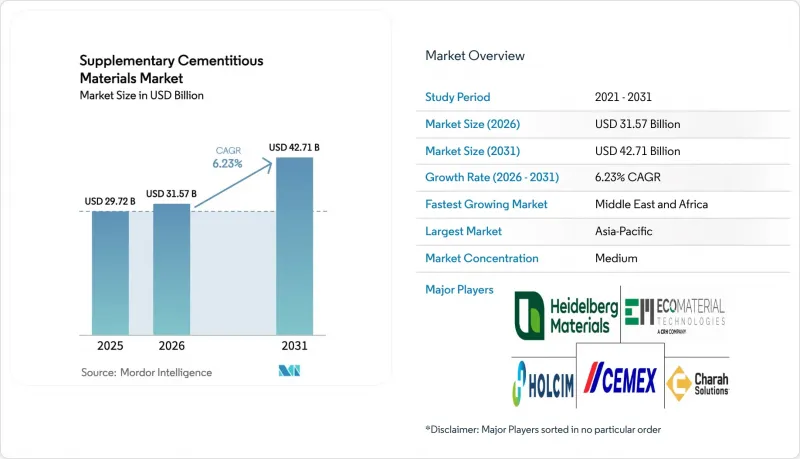
本報告按材料形態(粉末、漿料/懸浮液、顆粒狀)、輔助膠凝材料類型(飛灰、礦渣水泥等)、最終用戶(住宅建築、商業和公共設施、工業設施、交通基礎設施等)以及地區(亞太地區、北美地區、歐洲地區等)進行細分。市場預測以美元計價。
全球供應鏈管理市場趨勢與洞察
更嚴格的二氧化碳排放法規與碳定價體系
根據歐盟排放交易體系(EU ETS),到2026年,每單位排放權的成本將超過80歐元,這將使水泥熟料成本每噸上漲約60歐元,即使沒有補貼,替代50%水泥熟料的混合料也具有價格競爭力。加州的總量管制與交易體系和中國的全國市場也實施了類似的懲罰措施,加速了低碳三元混合料(LC3)的商業化進程。與標準波特蘭水泥混合料相比,LC3混合料的二氧化碳排放強度降低了40%。歐盟的碳邊境調節機制(CBAM)將這些成本擴展到進口產品,迫使土耳其、埃及和摩洛哥的出口商轉向使用富含礦渣和黏土的混合料。諸如ISO 14067和ISO 19694系列(草案)等平行標準正在推動碳排放資訊在整個生命週期內的揭露,迫使供應商審核與供應鏈材料(SCM)採購和運輸相關的碳足跡。
混合水泥/環保水泥的快速普及
自2018年獲批以來,波特蘭石灰水泥(IL型)已佔據北美市場30%以上的佔有率,在最大限度減少強度衰減的同時,降低了10-15%的水泥熟料需求。印度已承諾2027年資助興建12座LC3示範廠,總合年產能將達500萬噸。 CEMEX等全球製造商目前已在30個國家銷售「Vertua」混凝土,可減少高達70%的二氧化碳排放。由於增加混合料中輔助膠凝材料(SCM)的比例會減緩初始強度的發展,外加劑製造商已推出新型速凝劑,可在7天後使混凝土性能恢復到普通矽酸鹽水泥(OPC)基準值,從而促進SCM在大型基礎設施項目中的應用。
供應鏈管理的品質和規格存在高度變異性
飛灰的氧化鈣含量變化範圍很大,從1%到35%不等,導致凝結時間和水化熱的波動遠遠超過ASTM C618標準範圍。預拌混凝土生產商每車需額外花費150至250美元進行逐批次反應性測試。電弧爐渣目前佔全球鋼鐵產量的30%,儘管其性能不如傳統高爐渣,但仍以ASTM C989標準銷售,造成了隱性差異。印度2024版IS 16714標準引入了雷射衍射和粉末細度的相關規定,但主要城市以外地區的實施不力,導致不合格材料流入農村計畫。偏高嶺土的顏色差異給建築應用帶來了挑戰,儘管其機械性能優異,但仍難以廣泛應用。
細分市場分析
2025年,粉狀材料在短鏈膠凝材料(SCM)市場銷售額中佔72.25%。這反映了數十年來筒倉基礎設施的完善和操作人員的熟練。然而,漿狀/懸浮狀材料的市場正以6.56%的複合年成長率快速成長。這是因為在孟買和聖保羅等人口稠密的城市,罐車運輸的混合物可以繞過筒倉的瓶頸。對於橋面和筏板基礎等需要連續澆築500立方米以上材料的應用,能夠確保不間斷流動和均勻反應的漿狀材料供應鏈如今更受青睞。此外,預混顆粒狀材料在預製構件廠的市場佔有率也在不斷擴大,因為其粉塵控制和更高的計量精度使其能夠獲得更高的價格。這種應用範圍的擴大導致標準有缺口。 ASTM C1709漿狀短鏈膠凝材料標準仍在委員會審查中,缺乏明確的黏度和保存期限標準使得公共工程客戶在批准合約時更加謹慎。在熱帶東南亞地區,高濕度容易導致粉末凝固或失去流動性,因此漿料在可加工性和品質穩定性方面更勝一籌。隨著都市化進程的推進,預計這一趨勢將進一步蔓延。
粉狀產品在低層住宅和農村項目中仍將佔據主導地位,因為這些項目擁有充足的筒倉來儲存攪拌站中水泥和飛灰的雙組分混合物,而且卡車負載容量通常較小。同時,漿狀產品在基礎設施項目中越來越受歡迎,例如印度的加蒂沙克蒂走廊和沙烏地阿拉伯的「2030願景」鐵路擴建項目,在這些項目中,連續澆築1000立方公尺的漿料已成為常態。顆粒狀產品在建築預製外牆領域也越來越受歡迎,透過減少90%的空氣顆粒物,滿足了更嚴格的職業健康標準。在整個預測期內,漿狀產品的供應鏈佔有率預計將主要在具有高處理能力的大都會圈擴大,而粉狀產品將繼續成為更廣泛的供應鏈管理行業的主流形式。
區域分析
到2025年,亞太地區將佔全球輔助膠凝材料(SCM)市場規模的48.89%,主要得益於中國24億噸的水泥產能和印度1,300億美元的國家基礎建設規劃。北京的「十四五」計畫旨在將二氧化碳排放強度降低40%,但非石化燃料發電的日益普及限制了飛灰的供應,迫使生產商轉向石灰石填充材並從印尼進口粉煤灰。印度的「總理綠色力量」(PM Gati Shakti)總體規劃協調了16個部會在鐵路、公路和港口方面的投資,確保了對飛灰混凝土的穩定需求。光是2024年,印度公路部就使用了1,200萬噸飛灰。東南亞國協的成長品質仍參差不齊。部分原因是由於越南的 TCVN 10302 標準執行不嚴格,導致農村建築工地使用不合格的飛灰。
在北美,美國聯邦政府的「清潔採購」計畫將合約授予與EPD(支出處理)指標掛鉤,實際上強制要求聯邦混凝土中摻入30-40%的輔助膠凝材料(SCM)。加拿大CSA A3000-2025標準引入了一種「低碳」水泥等級,其中SCM含量為40-50%,旨在促進其在渥太華政府「投資加拿大計畫」資助的基礎設施項目中得到應用。儘管墨西哥的水泥市場正在擴張,但由於飛灰產量有限,該國不得不從東亞進口超過40萬噸礦渣用於沿海建設項目。
根據歐盟的分類標準,只有當水泥的二氧化碳排放強度低於每噸接合材料0.498噸時,才能被認證為“綠色水泥”,這使得混合料中的輔助膠凝材料(SCM)含量高達50%甚至更高。在德國,允許使用由礦渣、石灰石和二氧化矽組成的三組分覆蓋層,前提是其百年耐久性模型通過審核。而在法國,綠色債券的收益正被用於資助優先考慮生命週期(LC3)的低碳公共住宅。
中東和非洲是成長最快的地區,年複合成長率達6.48%。沙烏地阿拉伯的「2030願景」計畫以及阿拉伯聯合大公國對結構混合料二氧化碳當量350公斤/立方公尺的排放上限,正在推動對結構水泥的需求。南非耗資1000億美元的計畫導致國內礦渣供應緊張,迫使南非從印度高成本進口礦渣。在埃及,由於石灰石資源豐富且缺乏碳排放稅,輔助膠凝材料(SCM)的普及速度緩慢,滲透率仍低於15%。
在南美洲,巴西扮演著主導角色,礦渣和火山灰混合物的需求已經推動了市場成長。阿根廷和智利由於鋼鐵工業規模較小,當地礦渣供應有限,因此發展落後。但兩國正在進行利用安地斯山脈天然火山灰礦床的先導計畫,預計在本十年末實現原料多元化。
其他好處:
- Excel格式的市場預測(ME)表
- 3個月的分析師支持
目錄
第1章:引言
- 研究假設和市場定義
- 調查範圍
第2章:調查方法
第3章執行摘要
第4章 市場狀況
- 市場概覽
- 市場促進因素
- 加強二氧化碳排放法規與碳定價機制
- 混合水泥/環保水泥(例如PLC)的快速普及
- 政府對綠色採購的獎勵
- 將鍛燒黏土和天然火山灰的加工擴大到商業規模。
- 以性能為導向的規範將加速替代供應鏈管理方案的採用。
- 市場限制因素
- 供應鏈管理產品的品質和規格差異很大。
- 進口爐渣和火山灰的價格波動
- 預拌混凝土廠的物流和筒倉容量瓶頸
- 價值鏈分析
- 監理情勢
- 波特五力模型
第5章 市場規模與成長預測
- 按物質形式
- 粉末
- 漿液/懸浮液
- 顆粒狀藥丸
- 按供應鏈管理類型
- 飛灰
- 礦渣水泥(高爐礦渣細粉)
- 矽灰
- 燒製黏土/偏高嶺土
- 石灰石填料
- 其他類型的供應鏈管理
- 最終用戶
- 住宅
- 商業和機構企業
- 工業設施
- 交通基礎建設(公路、鐵路、港口、機場)
- 能源和公用事業基礎設施
- 按地區
- 亞太地區
- 中國
- 印度
- 日本
- 韓國
- 東南亞國協
- 其他亞太國家
- 北美洲
- 美國
- 加拿大
- 墨西哥
- 歐洲
- 德國
- 英國
- 義大利
- 法國
- 北歐國家
- 其他歐洲國家
- 南美洲
- 巴西
- 阿根廷
- 其他南美國家
- 中東和非洲
- 沙烏地阿拉伯
- 南非
- 其他中東和非洲國家
- 亞太地區
第6章 競爭情勢
- 市場集中度
- 策略趨勢
- 市佔率和排名分析
- 公司簡介
- Advanced Cement Technologies LLC
- ArcelorMittal SA
- BASF
- Bharathi Cement Corporation Private Limited
- Boral Limited
- CEMEX SAB de CV
- CemGreen ApS
- Charah Solutions, Inc.
- CR Minerals Company LLC
- Dangote Cement Plc.
- ECO MATERIAL TECHNOLOGIES
- Ecocem
- Ferroglobe PLC
- Heidelberg Materials
- Hoffmann Green Cement Technologies
- HOLCIM
- JSW Cement Ltd.
- Tata Steel Ltd.
- TITAN
- UltraTech Cement Ltd.
- Votorantim Cimentos
第7章 市場機會與未來展望
According to Mordor Intelligence, the supplementary cementitious materials market size is projected to expand from USD 29.72 billion in 2025 and USD 31.57 billion in 2026 to USD 42.71 billion by 2031, registering a CAGR of 6.23% between 2026 to 2031.
This report is Segmented by Material Form (Powder, Slurry/Suspension, and Granulated Pellets), SCM Type (Fly Ash, Slag Cement, and More), End-User (Residential Construction, Commercial and Institutional, Industrial Facilities, Transport Infrastructure, and More), and Geography (Asia-Pacific, North America, Europe, and More). The Market Forecasts are Provided in Terms of Value (USD).
Global Supplementary Cementitious Materials Market Trends and Insights
Stricter CO2-Emissions Regulations And Carbon-Pricing Schemes
The EU ETS cleared EUR 80 per allowance in 2026, inflating clinker costs by nearly EUR 60 per tonne and making 50% clinker-replacement blends price-competitive even without subsidies. California's cap-and-trade and China's national market impose similar penalties, prompting rapid commercialization of LC3 mixes that cut CO2 intensity 40% relative to ordinary Portland formulations. The EU Carbon Border Adjustment Mechanism extends those costs to imports, compelling exporters in Turkey, Egypt, and Morocco to pivot to slag- and clay-rich blends. Parallel standards such as ISO 14067 and the draft ISO 19694 series institutionalize life-cycle carbon disclosures, forcing suppliers to audit SCM sourcing and transport footprints.
Rapid Adoption of Blended/Green Cements
Portland Limestone Cement (Type IL) has climbed above a 30% shipment share in North America since its 2018 approval, lowering clinker demand 10-15% with minimal strength trade-offs. India funded 12 LC3 demonstration plants totaling 5 million t of annual capacity by 2027, and global producers such as CEMEX now market Vertua concrete with up to 70% CO2 reduction across 30 countries. Elevated SCM ratios slow early strength gain, so admixture suppliers have launched new accelerator chemistries that restore seven-day performance to OPC benchmarks, smoothing adoption in high-throughput infrastructure pours.
High Variability In SCM Quality/Specifications
Calcium-oxide content in fly ash ranges from 1% to 35%, swinging setting times and heat of hydration far beyond what ASTM C618 covers, so ready-mix firms spend an extra USD 150-250 per truckload on batch-specific reactivity tests. Electric-arc-furnace slag, now 30% of global steel output, underperforms traditional blast-furnace slag yet sells under the same ASTM C989 grade, creating hidden variability. India's 2024 IS 16714 introduced laser-diffraction and Blaine fineness rules, but enforcement outside Tier-1 cities is patchy, letting sub-spec material permeate rural projects. Color variability in metakaolin complicates architectural applications, throttling broader uptake despite strong mechanical benefits.
Other drivers and restraints analyzed in the detailed report include:
- Government Green-Procurement Incentives
- Commercial Scale-Up of Calcined-Clay and Natural-Pozzolan Processing
- Price Volatility of Imported Slag and Pozzolans
For complete list of drivers and restraints, kindly check the Table Of Contents.
Segment Analysis
Powder accounted for 72.25% of 2025 revenue within the supplementary cementitious materials market, reflecting decades-old silo infrastructure and operator familiarity. Yet slurry/suspension is scaling at a 6.56% CAGR because tanker-delivered mixes bypass silo bottlenecks in dense metros such as Mumbai and Sao Paulo. Continuous pours exceeding 500 m3 per batch for bridge decks or mat foundations now favor slurry supply chains that ensure uninterrupted flow and uniform reactivity. Pre-blended granulated materials are winning share in precast factories where dust abatement and dosing precision justify premiums. Adoption has triggered a standards gap; ASTM C1709 for slurry SCMs remains under committee review, leaving public owners hesitant to approve contracts without definitive viscosity and shelf-life limits. In tropical Southeast Asia, humidity drives caking and flow losses in powders, giving slurries an edge in workability and quality consistency, a trend likely to broaden as urbanization intensifies.
Powders will remain deeply entrenched in low-rise residential builds and rural projects where batching plants have enough silos for binary cement-fly-ash blends and truck volumes remain modest. Slurries are penetrating infrastructure programmes such as India's Gati Shakti corridor and Saudi Arabia's Vision 2030 rail expansions, where 1,000 m3 continuous placements are routine. Granulated pellets are carving out a foothold in architectural precast facades by slashing airborne particulates 90%, aligning with stricter occupational-health limits. Over the forecast horizon, slurry supply chains are projected to capture incremental share chiefly in high-throughput megacities, whereas powders will persist as the staple format across the broader supplementary cementitious materials industry.
Complete Report Scope:
- By Material Form
- Powder
- Slurry/Suspension
- Granulated Pellets
- By SCM Type
- Fly Ash
- Slag Cement (Ground-granulated Blast-Furnace Slag)
- Silica Fume
- Calcined Clay/Metakaolin
- Limestone Filler
- Other SCM Types
- By End-user
- Residential Construction
- Commercial and Institutional
- Industrial Facilities
- Transport Infrastructure (roads, rail, ports, airports)
- Energy and Utilities Infrastructure
- By Geography
- Asia-Pacific
- China
- India
- Japan
- South Korea
- ASEAN Countries
- Rest of Asia-Pacific
- North America
- United States
- Canada
- Mexico
- Europe
- Germany
- United Kingdom
- Italy
- France
- NORDIC Countries
- Rest of Europe
- South America
- Brazil
- Argentina
- Rest of South America
- Middle-East and Africa
- Saudi Arabia
- South Africa
- Rest of Middle-East and Africa
- Asia-Pacific
Geography Analysis
Asia-Pacific generated 48.89% of 2025 value for the supplementary cementitious materials market, anchored by China's 2.4 billion t cement capacity and India's USD 130 billion National Infrastructure Pipeline. Beijing's 14th Five-Year Plan targets a 40% CO2-intensity cut, but rising non-fossil power constrains fly-ash supply, nudging producers toward limestone fillers and imported Indonesian ash. India's PM Gati Shakti master plan synchronizes rail, road, and port investments across 16 ministries, locking in steady demand for fly-ash-rich concrete; the highway ministry alone used 12 million t in 2024. ASEAN growth quality variance remains severe because Vietnam's TCVN 10302 lacks strict enforcement, allowing sub-grade ash into rural jobsites.
In North America, the U.S. Federal Buy Clean program now ties contract awards to EPD metrics, effectively mandating 30-40% SCM content in federal concrete. Canada's CSA A3000-2025 ushers in a "Low Carbon" cement class with 40-50% SCM, priming uptake in infrastructure funded by Ottawa's Investing in Canada Plan. Mexico's cement market is rising, yet limited fly-ash production forces 400,000 t-plus slag imports from East Asia for coastal builds.
The EU Taxonomy only labels cement green when CO2 intensity dips below 0.498 t per tonne of binder, nudging mixes toward >=50% SCM. Germany permits slag-limestone-silica ternary overlays provided 100-year durability models pass audit, and France channels green-bond proceeds into low-carbon public housing that favors LC3.
The Middle-East and Africa is the fastest-growing region at 6.48% CAGR. Saudi Arabia's Vision 2030 pipeline and the UAE's 350 kg CO2e / m3 cap in structural mixes create structural pull. South Africa's USD 100 billion plan strains local slag supply, forcing higher-cost imports from India. In Egypt, abundant limestone and the absence of carbon charges dampen SCM adoption, keeping penetration below 15%.
South America is led by Brazil, with slag and pozzolan blends already driving demand. Argentina and Chile lag because smaller steel sectors limit local slag, but natural-pozzolan deposits in the Andes are spurring pilot projects that could diversify feedstocks by decade's end.
- Advanced Cement Technologies LLC
- ArcelorMittal SA
- BASF
- Bharathi Cement Corporation Private Limited
- Boral Limited
- CEMEX S.A.B. de C.V.
- CemGreen ApS
- Charah Solutions, Inc.
- CR Minerals Company LLC
- Dangote Cement Plc.
- ECO MATERIAL TECHNOLOGIES
- Ecocem
- Ferroglobe PLC
- Heidelberg Materials
- Hoffmann Green Cement Technologies
- HOLCIM
- JSW Cement Ltd.
- Tata Steel Ltd.
- TITAN
- UltraTech Cement Ltd.
- Votorantim Cimentos
Additional Benefits:
- The market estimate (ME) sheet in Excel format
- 3 months of analyst support
TABLE OF CONTENTS
1 Introduction
- 1.1 Study Assumptions and Market Definition
- 1.2 Scope of the Study
2 Research Methodology
3 Executive Summary
4 Market Landscape
- 4.1 Market Overview
- 4.2 Market Drivers
- 4.2.1 Stricter CO2-emissions regulations and carbon-pricing schemes
- 4.2.2 Rapid adoption of blended/green cements (e.g., PLC)
- 4.2.3 Government green-procurement incentives
- 4.2.4 Commercial scale-up of calcined-clay and natural-pozzolan processing
- 4.2.5 Performance-based specs accelerating alternative SCM acceptance
- 4.3 Market Restraints
- 4.3.1 High variability in SCM quality/specifications
- 4.3.2 Price volatility of imported slag and pozzolans
- 4.3.3 Logistics and silo-capacity bottlenecks at ready-mix plants
- 4.4 Value Chain Analysis
- 4.5 Regulatory Landscape
- 4.6 Porter's Five Forces
- 4.6.1 Bargaining Power of Suppliers
- 4.6.2 Bargaining Power of Buyers
- 4.6.3 Threat of New Entrants
- 4.6.4 Threat of Substitutes
- 4.6.5 Degree of Competition
5 Market Size and Growth Forecasts (Value)
- 5.1 By Material Form
- 5.1.1 Powder
- 5.1.2 Slurry/Suspension
- 5.1.3 Granulated Pellets
- 5.2 By SCM Type
- 5.2.1 Fly Ash
- 5.2.2 Slag Cement (Ground-granulated Blast-Furnace Slag)
- 5.2.3 Silica Fume
- 5.2.4 Calcined Clay/Metakaolin
- 5.2.5 Limestone Filler
- 5.2.6 Other SCM Types
- 5.3 By End-user
- 5.3.1 Residential Construction
- 5.3.2 Commercial and Institutional
- 5.3.3 Industrial Facilities
- 5.3.4 Transport Infrastructure (roads, rail, ports, airports)
- 5.3.5 Energy and Utilities Infrastructure
- 5.4 By Geography
- 5.4.1 Asia-Pacific
- 5.4.1.1 China
- 5.4.1.2 India
- 5.4.1.3 Japan
- 5.4.1.4 South Korea
- 5.4.1.5 ASEAN Countries
- 5.4.1.6 Rest of Asia-Pacific
- 5.4.2 North America
- 5.4.2.1 United States
- 5.4.2.2 Canada
- 5.4.2.3 Mexico
- 5.4.3 Europe
- 5.4.3.1 Germany
- 5.4.3.2 United Kingdom
- 5.4.3.3 Italy
- 5.4.3.4 France
- 5.4.3.5 NORDIC Countries
- 5.4.3.6 Rest of Europe
- 5.4.4 South America
- 5.4.4.1 Brazil
- 5.4.4.2 Argentina
- 5.4.4.3 Rest of South America
- 5.4.5 Middle-East and Africa
- 5.4.5.1 Saudi Arabia
- 5.4.5.2 South Africa
- 5.4.5.3 Rest of Middle-East and Africa
- 5.4.1 Asia-Pacific
6 Competitive Landscape
- 6.1 Market Concentration
- 6.2 Strategic Moves
- 6.3 Market Share(%)/Ranking Analysis
- 6.4 Company Profiles (includes Global level Overview, Market level overview, Core Segments, Financials as available, Strategic Information, Products and Services, and Recent Developments)
- 6.4.1 Advanced Cement Technologies LLC
- 6.4.2 ArcelorMittal SA
- 6.4.3 BASF
- 6.4.4 Bharathi Cement Corporation Private Limited
- 6.4.5 Boral Limited
- 6.4.6 CEMEX S.A.B. de C.V.
- 6.4.7 CemGreen ApS
- 6.4.8 Charah Solutions, Inc.
- 6.4.9 CR Minerals Company LLC
- 6.4.10 Dangote Cement Plc.
- 6.4.11 ECO MATERIAL TECHNOLOGIES
- 6.4.12 Ecocem
- 6.4.13 Ferroglobe PLC
- 6.4.14 Heidelberg Materials
- 6.4.15 Hoffmann Green Cement Technologies
- 6.4.16 HOLCIM
- 6.4.17 JSW Cement Ltd.
- 6.4.18 Tata Steel Ltd.
- 6.4.19 TITAN
- 6.4.20 UltraTech Cement Ltd.
- 6.4.21 Votorantim Cimentos
7 Market Opportunities and Future Outlook
- 7.1 White-space and Unmet-need Assessment


