


 |
市場調查報告書
商品編碼
2125546
歐洲機械狀態監測:市場佔有率分析、產業趨勢與統計、成長預測(2026-2031)Europe Machine Condition Monitoring - Market Share Analysis, Industry Trends & Statistics, Growth Forecasts (2026 - 2031) |
||||||

※ 本網頁內容可能與最新版本有所差異。詳細情況請與我們聯繫。
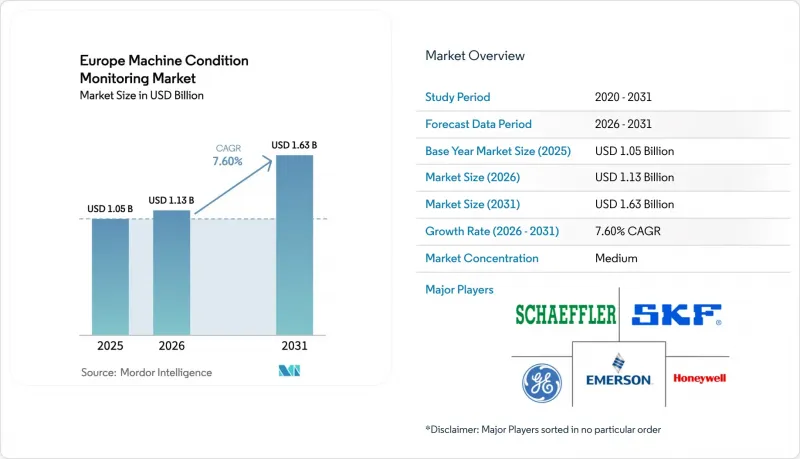
據 Mordor Intelligence 稱,歐洲機器狀態監測市場預計到 2026 年價值 11.3 億美元,高於 2025 年的 10.5 億美元,預計到 2031 年將達到 16.3 億美元。
預計從 2026 年到 2031 年,其複合年成長率將達到 7.60%。
本報告按類型(硬體、軟體、服務)、監控方法(線上狀態監測等)、部署模式(本地部署、雲端部署)、最終用戶產業(石油天然氣、發電、流程製造、離散製造等)和國家細分。市場預測以美元計價。
歐洲機器狀態監測市場的趨勢與洞察
透過預測性維護提高設備性能
德國、法國和荷蘭的製造商目前普遍認為被動維護是一種利潤浪費,研究表明,被動維護會導致設備潛在壽命的70%被白白浪費。德國「Manufacturing-X」聯盟獲得了1.33億歐元(1.505億美元)的資金支持,透過整合機器健康數據和生產指標,成功地將意外停機時間減少了25-30%,並將設備壽命延長了15-20%。在舍弗勒歐洲物流中心的58個驅動裝置上實施的線上系統,已實現了數十萬歐元的成本節約,證明了其投資回報率(ROI)為正的預期。透過整合振動數據和電氣特徵訊息,可以更早識別故障的根本原因,從而使維護人員能夠重新投入持續改進工作。因此,工廠的運轉率得到了提高,預測性維護方法正在成為中型工廠的標準做法。
在製造業和加工產業實施工業4.0
歐洲向以數據為中心的生產模式轉型,正將工廠車間感測器與企業資源計劃 (ERP) 和製造執行系統 (MES) 應用相結合。德國、義大利和西班牙強大的 5G 網路實現了機器與數位孿生體之間安全高速的資料流,從而促進了持續改進。西門子「數位傳動系統」(將於 2024 年發布)就是一個絕佳的例子,它展示了這家自動化領域的老字型大小企業如何將嵌入式分析功能直接整合到馬達驅動組件中。透過將溫度、壓力和振動資料流整合到單一儀錶板中,流程操作員能夠發現先前難以察覺的設備狀態與產品產量之間的關聯。基於「Manufacturing-X」的標準化工作正在降低整合門檻,加速跨多個工廠的部署,並重振歐洲機器狀態監測市場。
改裝和整合帶來的成本影響
傳統的泵浦、渦輪機和擠出機通常缺乏安裝現代多軸加速計所需的安裝點和數位介面。將無線網路整合到 20 世紀 90 年代的可程式邏輯控制器 (PLC) 中,僅感測器一項就可能使專案成本增加 30% 至 40%。石化廠危險區域的認證進一步使防爆硬體的支出翻倍,這一趨勢在義大利、西班牙和東歐的老舊設施中尤為明顯。各國不同的電氣標準、CE 標誌的細微差別以及 ATEX 法規,都減緩了歐洲機器狀態監測市場這一價格敏感型細分市場的採用速度,因為專案週期不斷延長,投資回報率的計算也變得越來越困難。
細分市場分析
到2025年,硬體仍將佔銷售額的61.10%,繼續保持領先地位,主要得益於加速計、超音波探頭和紅外線攝影機等監測程序的核心設備。由於旋轉機械的持續廣泛應用,振動測量設備仍佔據主導地位,而熱成像設備在高壓開關設備的審計中也日益受到關注。 2025年,歐洲機器狀態監測市場的硬體市場規模將達到6.4155億美元。同時,受訂閱模式激增的推動,服務業的複合年成長率(CAGR)達到8.65%。供應商目前提供的服務包涵蓋感測器租賃、資料託管和每月健康報告,這贏得了尋求成本確定性的財務長的青睞。軟體產業雖然市佔率較小,但其提供的分析引擎可以將訊號流轉化為可執行的工作指令。機器學習模組透過自動化故障分類,正在彌合振動專家技能短缺的現狀。
由於硬體是後續業務收益的立足點,供應商正採取「剃刀+刀片」策略,提供低成本的無線套件,為日後簽訂多站點服務合約奠定基礎。整合潤滑油分析和電訊號監控的混合解決方案豐富了根本原因故障排除的背景信息,並增強了交叉銷售機會。熱成像和超音波測量設備分別用於保護電氣設備和壓縮空氣系統,從而擴大了成熟高價值客戶的消費佔有率。
隨著關鍵資產所有者不再依賴定期檢查,到2025年,線上安裝將佔收入的56.20%。高速渦輪機、壓縮機和鐵路道岔現在可以持續傳輸數據,從而能夠在故障發生前數小時(而非數週)檢測到劣化。歐洲機械狀態監測市場中線上解決方案的佔有率成長得益於成熟的無線網狀網路協定和長壽命電池,這些技術減少了佈線工作。對於非關鍵輸送機,行動裝置因其柔軟性和較低的前期成本而繼續應用。
邊緣人工智慧感測器正吸引人們的關注,預計年複合成長率將達到 8.72%。這些節點透過在設備端進行模式匹配,僅傳輸匯總的故障指標,從而顯著降低頻寬成本,並支援在煉油廠深處部署專用 LTE 網路。德國鐵路公司的 KONUX 部署案例表明,對鐵路道岔的持續監控能夠提前通知現場工作人員,從而將網路中斷時間縮短至數分鐘。混合方法也正在興起,技術人員使用支援藍牙的手持終端機快速採集測量數據,並將其上傳到車隊儀表板進行趨勢相關性分析,從而在降低成本的同時最大限度地擴大監控覆蓋範圍。
其他好處:
- Excel格式的市場預測(ME)表
- 3個月的分析師支持
目錄
第1章:引言
- 研究假設和市場定義
- 調查範圍
第2章:調查方法
第3章執行摘要
第4章 市場狀況
- 市場概覽
- 市場促進因素
- 透過預測性維護提高設備性能和生產效率
- 在製造業和加工產業實施工業4.0
- 新冠疫情後向遠距辦公過渡及員工安全
- 關鍵基礎設施資產運轉率面臨日益成長的監管壓力
- 借助配備邊緣人工智慧的智慧感測器實現即時分析。
- 訂閱式健康監測平台的出現
- 市場限制因素
- 維修和系統整合的成本影響
- 歐洲宏觀經濟和地緣政治的不確定性
- 互聯資產中的網路安全和資料所有權問題
- 振動分析負責人和可靠性工程師短缺
- 產業價值鏈分析
- 監理情勢
- 技術展望
- 波特五力分析
- 宏觀經濟因素的影響
- 投資分析
第5章 市場規模與成長預測
- 按類型
- 硬體
- 振動狀態監測裝置
- 熱成像設備
- 超音波檢測系統
- 潤滑油分析
- 當前簽名分析
- 聲發射監測
- 軟體
- 服務
- 硬體
- 透過監測方法
- 線上狀態監控
- 可攜式狀態監測
- 邊緣人工智慧感測器
- 部署模式
- 現場
- 基於雲端的解決方案
- 按最終用戶行業分類
- 石油和天然氣
- 發電
- 工藝製造
- 離散製造
- 航太/國防
- 汽車和運輸業
- 海洋、採礦、金屬
- 其他終端用戶產業
- 國家
- 英國
- 德國
- 法國
- 義大利
- 西班牙
- 荷蘭
- 其他歐洲國家
第6章 競爭情勢
- 市場集中度
- 策略趨勢
- 市佔率分析
- 公司簡介
- SKF AB
- Schaeffler Technologies AG and Co. KG
- Emerson Electric Co.
- Honeywell International Inc.
- General Electric Company
- Siemens AG
- Bruel and Kjaer Vibro A/S
- Baker Hughes Company
- Meggitt PLC
- Pruftechnik Dieter Busch GmbH
- I-care NV
- SPM Instrument AB
- Spectris PLC
- PCE Instruments(PCE Holding GmbH)
- PCB Piezotronics Inc.
- Rockwell Automation Inc.
- Parker Hannifin Corporation
- Fluke Corporation
- Ametek Inc.(Spectro Scientific)
- ALS Limited
- National Instruments Corporation
- FLIR Systems Inc.
- ABB Ltd.
第7章 市場機會與未來展望
According to Mordor Intelligence, Europe machine condition monitoring market size in 2026 is estimated at USD 1.13 billion, growing from 2025 value of USD 1.05 billion with 2031 projections showing USD 1.63 billion, growing at 7.60% CAGR over 2026-2031.
This report is Segmented by Type (Hardware, Software, and Services), Monitoring Technique (Online Condition Monitoring, and More), Deployment Mode (On-Premises and Cloud-Based), End-User Vertical (Oil and Gas, Power Generation, Process Manufacturing, Discrete Manufacturing, and More), and Country. The Market Forecasts are Provided in Terms of Value (USD).
Europe Machine Condition Monitoring Market Trends and Insights
Increasing Equipment Performance via Predictive Maintenance
German, French, and Dutch manufacturers now view reactive maintenance as a profit drain, with studies showing it can squander 70% of potential asset life. Germany's Manufacturing-X consortium, backed by EUR 133 million (USD 150.5 million), blends machine-health data and production metrics to cut unplanned downtime 25-30% and stretch asset life 15-20%. Schaeffler's online system across 58 drives at its European logistics hub delivered six-figure cost savings, validating ROI expectations. Integrating vibration and electrical-signature insights uncovers root-cause faults sooner, reallocating maintenance labor toward continuous-improvement tasks. The resulting gains elevate plant availability and make predictive approaches standard practice across mid-sized factories.
Industry 4.0 Adoption Across Manufacturing and Process Industries
Europe's transition toward data-centric production unifies plant-floor sensors with enterprise resource planning and manufacturing-execution applications. Strong 5G coverage in Germany, Italy, and Spain allows secure, high-speed data flow between machines and digital twins, unlocking continuous improvement loops. Siemens' Digital Drivetrain (released in 2024) exemplifies how an automation incumbent embeds embedded analytics directly into motor drive packages. Process operators integrate temperature, pressure, and vibration streams into a single pane of glass, exposing correlations between asset health and product yield that once remained invisible. Standardization efforts under Manufacturing-X lower integration barriers, accelerating multi-plant rollouts, and fueling the European machine condition monitoring market.
Cost Implications of Retrofits and Integration
Legacy pumps, turbines, and extruders often lack mounting points or digital interfaces for today's multi-axis accelerometers. Integrating wireless networks with 1990-era programmable-logic controllers can inflate project expense by 30-40% over sensor costs alone. Hazard-area certifications in petrochemical plants further double the spending on explosion-proof hardware, particularly across mature facilities in Italy, Spain, and Eastern Europe. Diverse national electrical codes, CE-marking nuances, and ATEX rules extend project timelines and dilute ROI calculations, slowing adoption in price-sensitive segments within the European machine condition monitoring market.
Other drivers and restraints analyzed in the detailed report include:
- Edge-AI Smart Sensors Enabling Real-Time Analytics
- Rising Regulatory Pressure on Asset Uptime in Critical Infrastructure
- Cybersecurity and Data-Ownership Concerns in Connected Assets
For complete list of drivers and restraints, kindly check the Table Of Contents.
Segment Analysis
Hardware retained a 61.10% revenue lead in 2025, supported by indispensable accelerometers, ultrasonic probes, and infrared cameras forming any monitoring program's front line. Vibration instruments dominate because rotating machinery remains pervasive, while thermography devices gain traction for high-voltage switchgear audits. The European machine condition monitoring market size for hardware reached USD 641.55 million in 2025. Services, however, exhibit an 8.65% CAGR as subscription models surge. Vendors now bundle sensor leasing, data hosting, and monthly health reports, accepted by CFOs eager for cost certainty. Software, although a smaller slice, supplies the analytics engine that converts signal streams to actionable work orders. Machine-learning modules automate fault classification, closing a skill gap for scarce vibration experts.
Because hardware acts as the beachhead for follow-on service revenues, vendors pursue razor-and-blade strategies, offering low-cost wireless kits that later anchor multi-site service contracts. Hybrid solutions integrating lubrication analysis and electrical-signature monitoring enrich context for root-cause troubleshooting, strengthening cross-sell opportunities. Thermography and ultrasonic skids safeguard electrical assets and compressed-air systems, respectively, broadening wallet share within mature blue-chip accounts.
Online installations accounted for 56.20% of 2025 revenue as critical-asset owners refuse to rely on periodic checks. High-speed turbines, compressors, and rail switches now stream data nonstop, enabling degradations to be caught hours, not weeks, before failure. The European machine condition monitoring market share for online solutions rests on maturing wireless mesh protocols and long-life batteries that cut cabling labor. Portable devices still appear across non-critical conveyors, chosen for their flexibility and low upfront cost.
Edge-AI sensors capture headlines with a 8.72% CAGR forecast. By shifting pattern matching into the device, these nodes forward only condensed fault indicators, slashing bandwidth fees and enabling private-LTE deployments deep inside refineries. Deutsche Bahn's KONUX rollout demonstrates how continuous rail-switch monitoring triggers preemptive field crews, shrinking network disruption minutes. Hybrid approaches emerge: technicians collect quick-route readings via Bluetooth handhelds, then upload to fleet dashboards for trend correlation, maximizing coverage while controlling spend.
Complete Report Scope:
- By Type
- Hardware
- Vibration Condition Monitoring Equipment
- Thermography Equipment
- Ultrasonic Detection Systems
- Lubricating Oil Analysis
- Current Signature Analysis
- Acoustic Emission Monitoring
- Software
- Services
- Hardware
- By Monitoring Technique
- Online Condition Monitoring
- Portable Condition Monitoring
- Edge AI-enabled Sensors
- By Deployment Mode
- On-Premises
- Cloud-Based Solutions
- By End-user Vertical
- Oil and Gas
- Power Generation
- Process Manufacturing
- Discrete Manufacturing
- Aerospace and Defense
- Automotive and Transportation
- Marine, Mining, and Metals
- Other End-user Verticals
- By Country
- United Kingdom
- Germany
- France
- Italy
- Spain
- Netherlands
- Rest of Europe
List of Companies Covered in this Report:
- SKF AB
- Schaeffler Technologies AG and Co. KG
- Emerson Electric Co.
- Honeywell International Inc.
- General Electric Company
- Siemens AG
- Bruel and Kjaer Vibro A/S
- Baker Hughes Company
- Meggitt PLC
- Pruftechnik Dieter Busch GmbH
- I-care NV
- SPM Instrument AB
- Spectris PLC
- PCE Instruments (PCE Holding GmbH)
- PCB Piezotronics Inc.
- Rockwell Automation Inc.
- Parker Hannifin Corporation
- Fluke Corporation
- Ametek Inc. (Spectro Scientific)
- ALS Limited
- National Instruments Corporation
- FLIR Systems Inc.
- ABB Ltd.
Additional Benefits:
- The market estimate (ME) sheet in Excel format
- 3 months of analyst support
TABLE OF CONTENTS
1 INTRODUCTION
- 1.1 Study Assumptions and Market Definition
- 1.2 Scope of the Study
2 RESEARCH METHODOLOGY
3 EXECUTIVE SUMMARY
4 MARKET LANDSCAPE
- 4.1 Market Overview
- 4.2 Market Drivers
- 4.2.1 Increasing equipment performance and productivity through predictive maintenance
- 4.2.2 Industry 4.0 adoption across manufacturing and process industries
- 4.2.3 Shift toward remote operations and worker safety post-COVID-19
- 4.2.4 Rising regulatory pressure on asset uptime in critical infrastructure
- 4.2.5 Edge AI-powered smart sensors enabling real-time analytics
- 4.2.6 Emergence of subscription-based condition monitoring platforms
- 4.3 Market Restraints
- 4.3.1 Cost implications associated with retrofits and system integration
- 4.3.2 European macroeconomic and geopolitical uncertainties
- 4.3.3 Cybersecurity and data ownership concerns in connected assets
- 4.3.4 Shortage of vibration analysts and reliability engineers
- 4.4 Industry Value Chain Analysis
- 4.5 Regulatory Landscape
- 4.6 Technological Outlook
- 4.7 Porter's Five Forces Analysis
- 4.7.1 Bargaining Power of Suppliers
- 4.7.2 Bargaining Power of Buyers
- 4.7.3 Threat of New Entrants
- 4.7.4 Threat of Substitutes
- 4.7.5 Intensity of Competitive Rivalry
- 4.8 Impact of Macroeconomic Factors
- 4.9 Investment Analysis
5 MARKET SIZE AND GROWTH FORECASTS (VALUES)
- 5.1 By Type
- 5.1.1 Hardware
- 5.1.1.1 Vibration Condition Monitoring Equipment
- 5.1.1.2 Thermography Equipment
- 5.1.1.3 Ultrasonic Detection Systems
- 5.1.1.4 Lubricating Oil Analysis
- 5.1.1.5 Current Signature Analysis
- 5.1.1.6 Acoustic Emission Monitoring
- 5.1.2 Software
- 5.1.3 Services
- 5.1.1 Hardware
- 5.2 By Monitoring Technique
- 5.2.1 Online Condition Monitoring
- 5.2.2 Portable Condition Monitoring
- 5.2.3 Edge AI-enabled Sensors
- 5.3 By Deployment Mode
- 5.3.1 On-Premises
- 5.3.2 Cloud-Based Solutions
- 5.4 By End-user Vertical
- 5.4.1 Oil and Gas
- 5.4.2 Power Generation
- 5.4.3 Process Manufacturing
- 5.4.4 Discrete Manufacturing
- 5.4.5 Aerospace and Defense
- 5.4.6 Automotive and Transportation
- 5.4.7 Marine, Mining, and Metals
- 5.4.8 Other End-user Verticals
- 5.5 By Country
- 5.5.1 United Kingdom
- 5.5.2 Germany
- 5.5.3 France
- 5.5.4 Italy
- 5.5.5 Spain
- 5.5.6 Netherlands
- 5.5.7 Rest of Europe
6 COMPETITIVE LANDSCAPE
- 6.1 Market Concentration
- 6.2 Strategic Moves
- 6.3 Market Share Analysis
- 6.4 Company Profiles (includes Global level Overview, Market level overview, Core Segments, Financials as available, Strategic Information, Market Rank/Share for key companies, Products and Services, and Recent Developments)
- 6.4.1 SKF AB
- 6.4.2 Schaeffler Technologies AG and Co. KG
- 6.4.3 Emerson Electric Co.
- 6.4.4 Honeywell International Inc.
- 6.4.5 General Electric Company
- 6.4.6 Siemens AG
- 6.4.7 Bruel and Kjaer Vibro A/S
- 6.4.8 Baker Hughes Company
- 6.4.9 Meggitt PLC
- 6.4.10 Pruftechnik Dieter Busch GmbH
- 6.4.11 I-care NV
- 6.4.12 SPM Instrument AB
- 6.4.13 Spectris PLC
- 6.4.14 PCE Instruments (PCE Holding GmbH)
- 6.4.15 PCB Piezotronics Inc.
- 6.4.16 Rockwell Automation Inc.
- 6.4.17 Parker Hannifin Corporation
- 6.4.18 Fluke Corporation
- 6.4.19 Ametek Inc. (Spectro Scientific)
- 6.4.20 ALS Limited
- 6.4.21 National Instruments Corporation
- 6.4.22 FLIR Systems Inc.
- 6.4.23 ABB Ltd.
7 MARKET OPPORTUNITIES AND FUTURE OUTLOOK
- 7.1 White-space and Unmet-Need Assessment

 機器狀態監測市場:2026-2032年全球市場預測(依服務類型、監控技術、機器類型、最終用戶和部署模式分類)
 機器狀態監測:市場佔有率分析、產業趨勢與統計、成長預測(2026-2031)
 機械狀態監測市場報告:按監測技術、交付方式、部署方式、最終用戶產業和地區分類(2026-2034 年)
 機器狀態監控市場分析及預測(至2035年):依類型、產品類型、服務、技術、組件、應用、部署模式、最終用戶、設備及解決方案分類
 機器狀態監控市場:按產品、部署方式、最終用戶產業和地區分類
 設施監控市場規模、佔有率和成長分析(按監控類型、部署類型、垂直產業和地區分類)-2026-2033年產業預測
 全球機器狀態監測市場規模、佔有率、趨勢和成長分析報告(2026-2034年)
 2026年全球機器狀態監測市場報告
 設施監控市場 - 全球產業規模、佔有率、趨勢、機會及預測(按監控類型、監控流程、最終用戶、地區和競爭格局分類,2021-2031年)
 機器狀態監測市場規模、佔有率和趨勢分析報告:按監測技術、組件、產品、應用、架構、工廠、監控過程、最終用途、地區和細分市場預測(2026-2033 年)