


 |
市場調查報告書
商品編碼
2125542
中東和北非穿孔性癌症:市場佔有率分析、行業趨勢和統計數據以及成長預測(2026-2031 年)Middle East And North Africa Perforating Gun - Market Share Analysis, Industry Trends & Statistics, Growth Forecasts (2026 - 2031) |
||||||

※ 本網頁內容可能與最新版本有所差異。詳細情況請與我們聯繫。
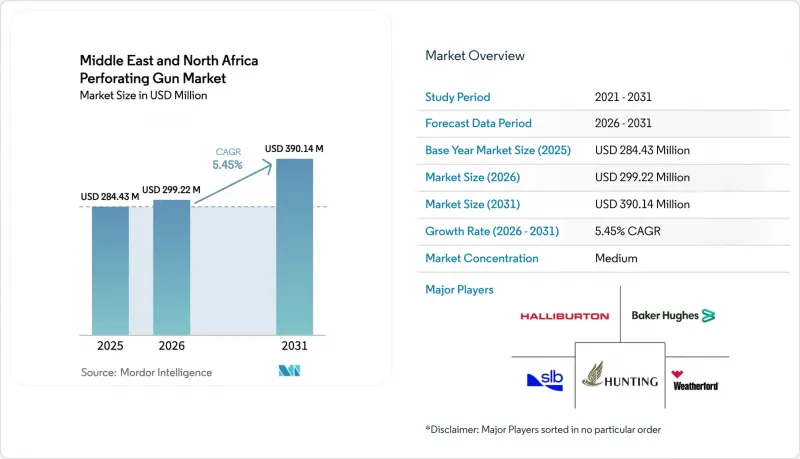
根據 Mordor Intelligence 預測,中東和北非地區穿孔性癌症的市場規模預計將從 2025 年的 2.8443 億美元和 2026 年的 2.9922 億美元成長到 2031 年的 3.9014 億美元,2026 年至 2031 年的複合年成長率為 5.45%。
本報告依載體類型(中空載體、壓裂/膠囊型等)、井類型(水平井、偏轉井、垂直井)、輸送方法(纜線套管槍、油管鑽孔、連續油管和滑線部署)、應用(陸上和海上)以及地區(沙烏地阿拉伯、阿拉伯聯合大公國、卡達、阿爾及利亞、埃及等)進行分類。
中東和北非癌症市場滲透趨勢與洞察
傳統型水平鑽井工程激增。
沙烏地阿拉伯傑夫拉頁岩氣田於2025年12月開始商業化生產,這標誌著該地區傳統天然氣發展的里程碑事件。計畫到2031年每年鑽探200口水平井,每口井需要8-12個鑽段。阿拉伯聯合大公國迪亞布和巴布地層的類似緻密氣測試項目,以及阿曼的馬布魯克東北部項目,也推動了對高密度鑽井槍的需求。隨著向長距離水平井的轉變,可回收且壓裂性能優異的鑽井槍更受青睞,因為它們可以最大限度地減少破碎並縮短清理時間。同時,在地採購法規迫使全球供應商在沿岸地區共同生產聚能裝藥,減少了海關延誤。這些趨勢共同推動了單井硬體使用量的增加,支撐了中東和北非(MENA)鑽井槍市場的長期需求。
加速中東和北非地區成熟油田的重新鑽探宣傳活動
在沙烏地阿拉伯的加瓦爾油田、科威特的布爾甘油田以及阿布達比國家石油公司(ADNOC)的陸上區塊,選擇性地進行重鑽作業,以新鑽井成本的十分之一,將產量提高了15%至25%。連續油管運輸技術使得在運作中的油井上進行作業成為可能,避免了代價高昂的維修。在阿爾及利亞和埃及,一些產油層較薄的地區也採用了類似的策略,將油田的壽命延長了多達10年。投資回報迅速,通常不到六個月即可收回成本,這促使各國國家石油公司(NOC)將越來越多的油井服務預算用於重鑽作業,從而推動了中東和北非(MENA)地區鑽井槍售後市場的蓬勃發展。
海灣國家主權財富基金對可再生能源領域的資本投資重新配置
沙烏地阿拉伯公共投資基金(PIF)目前每年向可再生能源領域投資100億美元,而阿拉伯聯合大公國則透過其子公司馬茲達爾(Mazdar)計劃在2030年投資540億美元。這些投資可能會對上游預算造成壓力,並可能在未來十年內使穿刺槍的年銷量下降8%至12%。然而,那些未受預算削減影響的項目通常需要更高級的後續加工,這將在一定程度上抵消中東和北非穿刺槍市場銷售的任何下滑。
細分市場分析
可回收式射孔槍因其可在多個區域重複部署的優勢,預計到2025年將佔據中東和北非穿孔槍市場30.2%的佔有率,到2031年年複合成長率(CAGR)將達到8.1%。中空載體系統仍佔據主導地位,市場佔有率為40.6%,在高壓碳酸鹽岩地層中仍然至關重要,因為完全回收碎片對於確保井筒完整性至關重要。破碎式射孔槍雖然市佔率較小,但在海上停產和移除(P&A)作業中正日益受到重視,因為無需進行回收作業可以顯著縮短鑽機的運作。半消耗式射孔槍滿足了在狹窄間隙套管中進行射孔的特殊需求。在整個預測期內,由於總擁有成本(TCO)較低,可回收式射孔槍預計將成為需要多次干預的成熟油田的首選;而能夠縮短完井時間的消耗式設計預計將繼續在一次性傳統型油井中佔據主導地位。因此,服務提供者正在拓展產品系列。 2025年10月,哈里伯頓公司在達姆開設了一家價值4,500萬美元的工廠,用於生產中空和可回收載體。該工廠的在地採購率達到了72%,鞏固了其作為沙烏地阿美首選供應商的地位。
到2025年,水平井和傾斜井將佔中東和北非地區井下槍市場需求的64.9%,預計到2031年將以每年6.5%的速度成長。賈夫拉油田的每口側井需要8到12段壓裂,導致其井下槍消耗量是傳統垂直井的四倍。卡達能源公司的遠海井深度超過5000英尺,依靠定向點火來最佳化壓裂叢集。在阿爾及利亞和埃及,由於現有基礎設施支援低成本完井作業,垂直井仍然佔據主導地位。阿拉伯聯合大公國最高石油委員會等監管機構目前鼓勵水平鑽井,以最大限度地增加與儲存的接觸面積,從而確保對高密度點火系統的持續需求。因此,在長水平井中,管線和盤管輸送的性能優於纜線,進一步鞏固了水平鑽井技術在中東和北非井下槍市場的主導地位。
其他好處:
- Excel格式的市場預測(ME)表
- 3個月的分析師支持
目錄
第1章:引言
- 研究假設和市場定義
- 調查範圍
第2章:調查方法
第3章執行摘要
第4章 市場狀況
- 市場概覽
- 市場促進因素
- 傳統型水平鑽井工程激增
- 加速中東和北非(MENA)地區成熟油田的重新鑽探宣傳活動
- 國營石油公司促進國內鑽井設備製造
- 引入緊湊型破碎槍以降低 Regress P&A 成本
- 從 2024 年開始,隨著原油價格回升,無鑽機油井干預的預算將會增加。
- 市場限制因素
- 海灣國家主權基金對可再生能源領域資本投資的重新配置
- 紅海海域的混亂導致鋼鐵和RDX/HMX供應鏈中斷
- 基於環境、社會和治理(ESG)的陸上油田爆炸物處理法規
- 供應鏈分析
- 監理情勢
- 技術展望
- 波特五力模型
第5章 市場規模與成長預測
- 按載體類型
- 中空載體
- 碎片化/膠囊化(一次性使用)
- 半消耗性試紙
- 可回收管槍
- 按井類型
- 水平井和斜井
- 垂直的
- 透過交通工具
- 纜線式套管槍
- 管式穿孔(TCP)
- 盤管和滑線作業現狀
- 透過使用
- 陸上
- 離岸
- 按地區
- 沙烏地阿拉伯
- 阿拉伯聯合大公國
- 卡達
- 阿爾及利亞
- 埃及
- 摩洛哥
- 其他中東和非洲地區
第6章 競爭情勢
- 市場集中度
- 策略趨勢(併購、聯盟、購電協議)
- 市場佔有率分析(主要公司的市場排名和佔有率)
- 公司簡介
- Schlumberger Ltd
- Halliburton Company
- Baker Hughes Co.
- Weatherford International plc
- Hunting plc
- NOV Inc.
- DynaEnergetics GmbH & Co. KG
- DMC Global Inc.
- Core Laboratories(Nov Completion/Owen)
- Nine Energy Service Inc.
- ADNOC Drilling
- Arabian Drilling Co.
- TAQA Well Services
- Saudi Aramco(Perforating Services)
- Sinopec Oilfield Service Corp.
- CNPC Greatwall Drilling Co.
- Promperforator LLC
- Tassaroli SA
- Geodynamics Inc.
- Titan Division-Yellow Jacket Oil Tools
- FHE USA LLC
- Shaanxi FYPE Rigid Machinery Co.
- Vigor Oil Tools Co.
第7章 市場機會與未來展望
According to Mordor Intelligence, the Middle East and North Africa perforating gun market size is projected to expand from USD 284.43 million in 2025 and USD 299.22 million in 2026 to USD 390.14 million by 2031, registering a CAGR of 5.45% between 2026 to 2031.
This report is Segmented by Carrier Type (Hollow Carrier, Fragmenting/Capsule, and More), Well Type (Horizontal and Deviated and Vertical), Conveyance Method (Wireline-Conveyed Casing Guns, Tubing-Conveyed Perforation, and Coiled-Tubing and Slickline Deployed), Application (Onshore and Offshore), and Geography (Saudi Arabia, United Arab Emirates, Qatar, Algeria, Egypt, and More).
Middle East And North Africa Perforating Gun Market Trends and Insights
Surge in Unconventional Horizontal Drilling Programs
Commercial production from Saudi Arabia's Jafurah shale in December 2025 marked a watershed for unconventional gas in the region, with 200 horizontal wells slated annually through 2031 and each well demanding 8-12 perforating stages. Similar tight-gas pilots in the UAE's Diyab and Bab formations and Oman's Mabrouk North East project reinforce the pull for high-shot-density gun strings. The switch to long laterals favors retrievable and fragmenting carriers that leave minimal debris and cut clean-out time. In parallel, local-content rules compel global vendors to co-manufacture shaped charges in the Gulf, reducing customs delays. Collectively, these trends lift per-well hardware intensity and anchor long-term demand across the Middle East & North Africa perforating gun market.
Accelerating Re-Perforation Campaigns in Mature MENA Fields
Selective re-perforation in Saudi Arabia's Ghawar, Kuwait's Burgan, and ADNOC's onshore blocks is delivering 15%-25% production uplifts at one-tenth the cost of drilling new wells. Coiled-tubing conveyance enables live-well interventions, avoiding costly workovers. Algeria and Egypt apply similar tactics in thin pay zones, extending field life by up to 10 years. Rapid payback, often under six months, encourages NOCs to earmark rising portions of well-services budgets for re-perforation, reinforcing a resilient aftermarket for the Middle East & North Africa perforating gun market.
Renewable-Energy CAPEX Diversion by Gulf Sovereign Funds
Saudi Arabia's Public Investment Fund now commits USD 10 billion annually to renewables, while the UAE targets USD 54 billion by 2030 through Masdar. Such commitments can cap upstream budgets, potentially trimming annual perforating-gun volumes by 8%-12% over a decade. Still, the projects that survive budget cuts often require higher-complexity completions, partly offsetting volume declines for the Middle East & North Africa perforating gun market.
Other drivers and restraints analyzed in the detailed report include:
- National Oil-Company Push for In-Country Perforating Manufacturing
- Adoption of Compact Fragmenting Guns to Cut Rig-less P&A Cost
- Steel and RDX/HMX Supply-Chain Volatility After Red Sea Disruptions
For complete list of drivers and restraints, kindly check the Table Of Contents.
Segment Analysis
Retrievable tubing guns claimed 30.2% of the Middle East & North Africa perforating gun market size in 2025, thanks to their ability to be redeployed across multiple zones, driving an 8.1% CAGR outlook through 2031. Hollow-carrier systems, still dominant at 40.6%, remain indispensable in high-pressure carbonates where full debris retrieval safeguards well integrity. Fragmenting guns, though smaller in share, are gaining ground in offshore P&A campaigns where eliminating retrieval trips slashes rig days. Semi-expendable strip guns fill a niche for through-tubing work in tight-clearance casings. Over the forecast horizon, mature fields that require several interventions favor retrievable carriers for total-cost-of-ownership advantages, while single-shot unconventional wells continue to lean on expendable designs that compress completion time. Service firms are accordingly broadening portfolios: Halliburton opened a USD 45 million plant in Dammam in October 2025 to manufacture both hollow and retrievable carriers, achieving 72% local content and cementing preferred-vendor status with Aramco.
Horizontal and deviated wells accounted for 64.9% of the Middle East & North Africa perforating gun market demand in 2025 and are forecast to expand at 6.5% through 2031. Each Jafurah lateral needs 8-12 stages, quadrupling gun consumption over a conventional vertical well. QatarEnergy's extended-reach offshore wells exceed 5,000 feet and rely on oriented shots to optimize fracture clusters. Vertical wells persist in Algeria and Egypt, where legacy infrastructure supports low-cost completions. Regulatory bodies such as the UAE Supreme Petroleum Council now encourage horizontal drilling to maximize reservoir contact, ensuring a sustained pull for high-shot-density systems. Consequently, tubing-conveyed and coiled-tubing conveyances outpace wireline in long laterals, reinforcing the lead of horizontal architecture within the Middle East & North Africa perforating gun market.
Complete Report Scope:
- By Carrier Type
- Hollow Carrier
- Fragmenting/Capsule (Expendable)
- Semi-Expendable Strip
- Retrievable Tubing Guns
- By Well Type
- Horizontal and Deviated
- Vertical
- By Conveyance Method
- Wireline-Conveyed Casing Guns
- Tubing-Conveyed Perforation (TCP)
- Coiled-Tubing and Slickline Deployed
- By Application
- Onshore
- Offshore
- By Geography
- Saudi Arabia
- United Arab Emirates
- Qatar
- Algeria
- Egypt
- Morocco
- Rest of Middle East and North Africa
List of Companies Covered in this Report:
- Schlumberger Ltd
- Halliburton Company
- Baker Hughes Co.
- Weatherford International plc
- Hunting plc
- NOV Inc.
- DynaEnergetics GmbH & Co. KG
- DMC Global Inc.
- Core Laboratories (Nov Completion/Owen)
- Nine Energy Service Inc.
- ADNOC Drilling
- Arabian Drilling Co.
- TAQA Well Services
- Saudi Aramco (Perforating Services)
- Sinopec Oilfield Service Corp.
- CNPC Greatwall Drilling Co.
- Promperforator LLC
- Tassaroli SA
- Geodynamics Inc.
- Titan Division - Yellow Jacket Oil Tools
- FHE USA LLC
- Shaanxi FYPE Rigid Machinery Co.
- Vigor Oil Tools Co.
Additional Benefits:
- The market estimate (ME) sheet in Excel format
- 3 months of analyst support
TABLE OF CONTENTS
1 Introduction
- 1.1 Study Assumptions & Market Definition
- 1.2 Scope of the Study
2 Research Methodology
3 Executive Summary
4 Market Landscape
- 4.1 Market Overview
- 4.2 Market Drivers
- 4.2.1 Surge in unconventional horizontal drilling programs
- 4.2.2 Accelerating re-perforation campaigns in mature MENA fields
- 4.2.3 National oil-company push for in-country perforating manufacturing
- 4.2.4 Adoption of compact fragmenting guns to cut rigless P&A cost
- 4.2.5 Rising rig-less well-intervention budgets post-2024 oil-price rebound
- 4.3 Market Restraints
- 4.3.1 Renewable-energy CAPEX diversion by Gulf sovereign funds
- 4.3.2 Steel & RDX/HMX supply-chain volatility after Red Sea disruptions
- 4.3.3 ESG-driven explosives-handling restrictions at onshore fields
- 4.4 Supply-Chain Analysis
- 4.5 Regulatory Landscape
- 4.6 Technological Outlook
- 4.7 Porter's Five Forces
- 4.7.1 Bargaining Power of Suppliers
- 4.7.2 Bargaining Power of Consumers
- 4.7.3 Threat of New Entrants
- 4.7.4 Threat of Substitute Products & Services
- 4.7.5 Intensity of Competitive Rivalry
5 Market Size & Growth Forecasts
- 5.1 By Carrier Type
- 5.1.1 Hollow Carrier
- 5.1.2 Fragmenting/Capsule (Expendable)
- 5.1.3 Semi-Expendable Strip
- 5.1.4 Retrievable Tubing Guns
- 5.2 By Well Type
- 5.2.1 Horizontal and Deviated
- 5.2.2 Vertical
- 5.3 By Conveyance Method
- 5.3.1 Wireline-Conveyed Casing Guns
- 5.3.2 Tubing-Conveyed Perforation (TCP)
- 5.3.3 Coiled-Tubing and Slickline Deployed
- 5.4 By Application
- 5.4.1 Onshore
- 5.4.2 Offshore
- 5.5 By Geography
- 5.5.1 Saudi Arabia
- 5.5.2 United Arab Emirates
- 5.5.3 Qatar
- 5.5.4 Algeria
- 5.5.5 Egypt
- 5.5.6 Morocco
- 5.5.7 Rest of Middle East and North Africa
6 Competitive Landscape
- 6.1 Market Concentration
- 6.2 Strategic Moves (M&A, Partnerships, PPAs)
- 6.3 Market Share Analysis (Market Rank/Share for key companies)
- 6.4 Company Profiles (includes Global level Overview, Market level overview, Core Segments, Financials as available, Strategic Information, Products & Services, and Recent Developments)
- 6.4.1 Schlumberger Ltd
- 6.4.2 Halliburton Company
- 6.4.3 Baker Hughes Co.
- 6.4.4 Weatherford International plc
- 6.4.5 Hunting plc
- 6.4.6 NOV Inc.
- 6.4.7 DynaEnergetics GmbH & Co. KG
- 6.4.8 DMC Global Inc.
- 6.4.9 Core Laboratories (Nov Completion/Owen)
- 6.4.10 Nine Energy Service Inc.
- 6.4.11 ADNOC Drilling
- 6.4.12 Arabian Drilling Co.
- 6.4.13 TAQA Well Services
- 6.4.14 Saudi Aramco (Perforating Services)
- 6.4.15 Sinopec Oilfield Service Corp.
- 6.4.16 CNPC Greatwall Drilling Co.
- 6.4.17 Promperforator LLC
- 6.4.18 Tassaroli SA
- 6.4.19 Geodynamics Inc.
- 6.4.20 Titan Division - Yellow Jacket Oil Tools
- 6.4.21 FHE USA LLC
- 6.4.22 Shaanxi FYPE Rigid Machinery Co.
- 6.4.23 Vigor Oil Tools Co.
7 Market Opportunities & Future Outlook
- 7.1 White-space & Unmet-Need Assessment


