


 |
市場調查報告書
商品編碼
2125519
可膨脹石墨(EG):市場佔有率分析、行業趨勢和統計數據、成長預測(2026-2031 年)Expandable Graphite - Market Share Analysis, Industry Trends & Statistics, Growth Forecasts (2026 - 2031) |
||||||

※ 本網頁內容可能與最新版本有所差異。詳細情況請與我們聯繫。
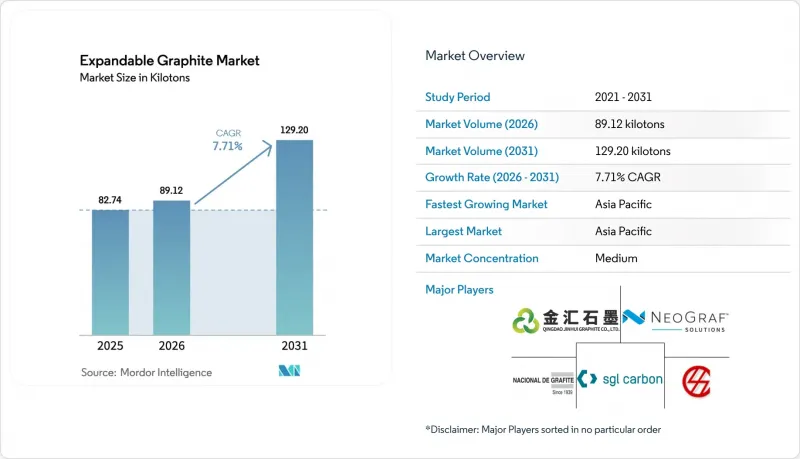
根據 Mordor Intelligence 預測,可膨脹石墨 (EG) 的市場規模預計將從 2025 年的 82.74 千噸成長到 2026 年的 89.12 千噸,並將從 2026 年到 2031 年以 7.71% 的複合年成長率成長,達到 2031 年至 2031 年。
本報告按應用領域(阻燃劑、軟性薄膜、導電添加劑等)、終端用戶產業(建築、電子及儲能、汽車及交通運輸等)和地區(亞太、北美、歐洲、南美、中東和非洲)進行細分。市場預測以噸為單位。
全球可膨脹石墨(EG)市場趨勢與洞察
無鹵阻燃劑的應用正在迅速增加。
大西洋兩岸的監管機構都在逐步淘汰溴化和氯化添加劑。 2024年,歐洲化學品管理局 (ECHA) 最終確定了 REACH 法規附件 XVII 中關於六溴環十二烷 (HBCDD) 的規定,敦促化合物生產商在聚苯乙烯發泡體和聚氨酯塗料中改用可膨脹系統。加州 65 號提案清單上的類似舉措以及美國環保署 (EPA) 的持續審查,正迫使北美電子產品原始設備製造商 (OEM) 轉向使用膨脹率超過 250 mL/g 的可膨脹石墨 (EG) 產品。隨著 REACH 法規的大部分條款將於 2024 年年中生效,目前市場對可膨脹石墨 (EG) 和聚磷酸銨具有協同效應的混合物的需求正在迅速成長,尤其是在電線電纜絕緣和印刷電路基板層壓板領域。雖然德國和荷蘭已經禁止在公共基礎設施中使用鹵代阻燃劑,但在對成本敏感的南歐市場,人們仍然更傾向於使用傳統添加劑,因此預計這一轉變需要數年時間。
電動車電池和溫度控管的蓬勃發展
電動車電池組會產生局部熱流,而使用鋁或銅散熱器散熱會顯著增加電池重量,難以有效散熱。將可膨脹石墨壓縮成軟性箔片,其導熱係數可超過 300 W/m*K,密度低於 1.9 g/cm³,從而實現圓柱形或棱柱形電池之間更薄的界面。國際能源總署 (IEA) 預測,在淨零排放情境下,到 2040 年,電池級石墨的需求量將增加四倍,其中溫度控管應用預計將擴大其市場佔有率。汽車製造商正在對 800 伏特系統中的電池-電池組一體化架構中的可膨脹石墨箔片合格。同時,歐美汽車製造商正在投資建立國內精煉產能,以滿足美國的採購獎勵,Graphite One 位於俄亥俄州的工廠就是一個典型的例子。因此,電池和溫度控管供應鏈的融合正推動可膨脹石墨市場走上持續成長的道路。
巨型片狀石墨的供應限制
可膨脹石墨 (EG) 依賴 80 目以上的超大片狀石墨,其產量僅佔天然石墨總產量的不到 15%,價格卻比細粒級石墨高出 30-50%。中國在黑龍江省和內蒙古擁有豐富的蘊藏量,但環境監管和生產配額限制了其產量成長,預計 2024 年後的增幅將低於 5%。美國仍完全依賴進口,到 2024 年,其 43% 的供應將來自中國。莫三比克巴拉馬和坦尚尼亞埃潘科計畫的新增產能提供了一種替代方案,但物流挑戰、港口擁擠和鐵路運輸不穩定等問題導致成本上升高達 15%,從而限制了阻燃劑和箔材製造商的供應。
細分市場分析
2025年,阻燃化合物佔總出貨量的45.97%,預計到2031年將以每年8.05%的速度成長。其主導地位主要歸功於法規禁止使用溴化添加劑,以及可膨脹石墨(EG)在15%至25%的混合比例下即可展現出良好的膨脹性能,輕鬆達到UL 94 V-0標準。雖然軟性箔材應用在可膨脹石墨(EG)市場中所佔佔有率較小,但其高純度和壓延性能要求使其價格高出3至5倍。箔材市場成長速度已放緩至約6.5%,但受益於電動車溫度控管和半導體封裝領域日益成長的應用需求。
鋰離子電池電極和聚合物複合複合材料的導電添加劑是成長最快的細分市場之一,其成長動力主要來自儲能技術的擴張以及電動車零件對輕質導電填料的需求。冶金應用曾是天然石墨的主要用途,但隨著鋼鐵製造商轉向粒徑分佈較窄的合成碳,其市場佔有率如今已所佔比例很小。由於產率低於10%且溶劑成本高昂,利用膨脹石墨(EG)製備石墨烯的實驗方法仍未達到商業性化成熟階段。
區域分析
預計到2025年,亞太地區可膨脹石墨(EG)產量將佔全球總產量的57.51%,並以每年8.19%的速度成長至2031年,鞏固主導地位。青島「黑龍、金輝、延鑫、明河大」叢集憑藉接近性巨型片狀石墨礦和成熟的硫酸供應鏈的優勢,生產了全球70%的可膨脹石墨。中國於2023年12月推出的出口許可證制度促使國內減少可膨脹石墨的進口,收緊了海外供應,並促使歐美買家實現採購多元化。日本和韓國正專注於高純度石墨箔的生產,隨著智慧型手機和半導體產量的成長,預計到 2030 年,日本石墨片市場規模將加倍,達到 4 億美元。印度的「生產連結獎勵計畫(PLI)」計畫正在推動蒂魯帕蒂石墨公司的薩加爾項目,該項目旨在到 2026 年底實現年產 1 萬噸。
隨著原始設備製造商 (OEM) 遵守《通膨控制法案》的採購規定,預計北美市場佔有率將顯著擴大。 Graphite One 公司位於俄亥俄州、投資 4.35 億美元的加工廠計劃於 2026 年底竣工,該廠佔地 85 英畝,將利用其多模態物流,力爭年產 2.5 萬噸合成陽極材料和可膨脹石墨 (EG)。雖然加拿大魁北克省和安大略省的礦床正在探勘中,但商業性開採仍需數年時間,因此預計在一段時間內仍將依賴進口。墨西哥的汽車線束市場清楚表明,該地區供應鏈對無鹵化阻燃劑的需求日益成長。
在歐洲,德國、法國和英國主導。歐盟建築產品法規強制要求使用符合EN 13501認證標準的膨脹塗料,這為缺乏認證測試資料的新參與企業設定了很高的進入門檻。在斯堪地那維亞,節能建築維修補貼正在推動無鹵隔熱材料的普及,儘管南歐地區對價格仍然較為敏感。在東歐,由於歐盟團結基金資助的可再生能源電纜鋪設工程,市場需求正在成長。
其他好處:
- Excel格式的市場預測(ME)表
- 3個月的分析師支持
目錄
第1章:引言
- 研究假設和市場定義
- 調查範圍
第2章:調查方法
第3章執行摘要
第4章 市場狀況
- 市場概覽
- 市場促進因素
- 作為一種無鹵阻燃添加劑,其應用範圍正在不斷擴大。
- 電動車電池和溫度控管。
- 全球建築規範中的消防安全要求正變得越來越嚴格。
- 家用電子電器對高導電性箔的需求
- 促進再生石墨原料的循環經濟
- 市場限制因素
- 天然巨型片狀石墨供應有限
- 片狀石墨和插層試劑的價格波動
- 加強對插層工廠污水和酸排放的監管。
- 價值鏈分析
- 波特五力模型
第5章 市場規模及成長預測(數量)
- 透過使用
- 阻燃劑
- 軟性箔
- 導電添加劑
- 冶金
- 石墨烯
- 按最終用途行業分類
- 建築/施工
- 電子和儲能
- 汽車和運輸業
- 化學/石油化學加工
- 其他(航太、生醫)
- 按地區
- 亞太地區
- 中國
- 日本
- 韓國
- 印度
- 其他亞太國家
- 北美洲
- 美國
- 加拿大
- 墨西哥
- 歐洲
- 德國
- 英國
- 法國
- 義大利
- 其他歐洲國家
- 南美洲
- 巴西
- 阿根廷
- 其他南美國家
- 中東和非洲
- 沙烏地阿拉伯
- 南非
- 其他中東和非洲國家
- 亞太地區
第6章 競爭情勢
- 市場集中度
- 策略趨勢
- 市佔率和排名分析
- 公司簡介
- BariteWorld
- KAIYU INDUSTRIAL(HK)LIMITED(Nanjing GRF Carbon Material Co. Ltd)
- Metachem Manufacturing Company Pvt. Ltd
- Nacional de Grafite
- NeoGraf
- Qingdao Heilong Graphite Group Co., Ltd.
- Qingdao Jinhui Graphite Co. Ltd
- QINGDAO MINGHEDA GRAPHITE NEW MATERIAL CO. LTD
- QINGDAO YANXIN GRAPHITE PRODUCTS CO. LTD
- SGL Carbon
- Shijiazhuang ADT Carbonic Material Factory
- TIRUPATI GRAPHITE PLC
- Yichang Xincheng Graphite Co. Ltd
第7章 市場機會與未來展望
According to Mordor Intelligence, the expandable graphite market size is expected to grow from 82.74 kilotons in 2025 to 89.12 kilotons in 2026 and is forecast to reach 129.20 kilotons by 2031 at a 7.71% CAGR over 2026-2031.
This report is Segmented by Application (Flame Retardant, Flexible Foils, Conductive Additives, and More), End-Use Industry (Building and Construction, Electronics and Energy Storage, Automotive and Transportation, and More), and Geography (Asia-Pacific, North America, Europe, South America, and the Middle East and Africa). Market Forecasts are Provided in Terms of Volume (tons).
Global Expandable Graphite Market Trends and Insights
Halogen-free Flame-retardant Adoption Surge
Regulators on both sides of the Atlantic are phasing out brominated and chlorinated additives. The European Chemicals Agency finalized REACH Annex XVII restrictions on HBCDD in 2024, compelling formulators to pivot toward intumescent systems in polystyrene foams and polyurethane coatings. Similar momentum in California's Proposition 65 list and ongoing US EPA reviews drives North American electronics OEMs toward expandable graphite grades that deliver expansion ratios above 250 mL/g. Because most REACH provisions entered force in mid-2024, demand for synergistic blends of expandable graphite and ammonium polyphosphate is now ramping quickly, particularly in wire-and-cable insulation and printed-circuit-board laminates. Germany and the Netherlands have already banned halogenated flame retardants in public infrastructure, yet cost-sensitive Southern European markets still favor legacy additives, suggesting a multi-year conversion window.
EV Battery and Thermal-management Boom
EV battery packs produce localized heat fluxes that aluminum or copper spreaders cannot dissipate without unacceptable mass penalties. Compressing expandable graphite into flexible foils achieves thermal conductivities above 300 W/m*K at densities below 1.9 g/cm3, supporting thinner interfaces between cylindrical or prismatic cells. The International Energy Agency projects that battery-grade graphite demand will quadruple by 2040 under net-zero scenarios, with thermal-management applications capturing an increasing slice. Automakers are qualifying expandable-graphite foils for cell-to-pack architectures in 800-volt systems, while Western OEMs finance domestic purification capacity, Graphite One's Ohio facility is a prime example, to align with US sourcing incentives. This convergence of battery and thermal-management supply chains positions the expandable graphite market for durable expansion.
Supply Constraints in Jumbo-flake Graphite
Expandable graphite relies on +80 mesh jumbo flake, which represents less than 15% of natural-graphite output and commands premiums of 30%-50% over finer grades. China dominates reserves in Heilongjiang and Inner Mongolia, yet environmental inspections and output quotas capped production growth below 5% after 2024. The United States remains fully import-reliant, sourcing 43% of its supply from China in 2024. New capacity in Mozambique's Balama and Tanzania's Epanko projects offers alternatives, but logistics challenges, port congestion, and irregular rail services inflate costs by up to 15%, constraining supply for flame-retardant and foil producers.
Other drivers and restraints analyzed in the detailed report include:
- Tightening Global Fire-safety Codes
- Demand for High-conductivity Foils in Electronics
- Price Volatility of Flake and Intercalation Reagents
For complete list of drivers and restraints, kindly check the Table Of Contents.
Segment Analysis
Flame-retardant compounds accounted for 45.97% of the 2025 volume and are projected to expand at 8.05% to 2031. This dominant position stems from regulatory bans on brominated additives and the ability of expandable graphite to deliver intumescence at 15%-25% loading levels, easily achieving UL 94 V-0 ratings. Flexible foil applications, while representing a smaller slice of the expandable graphite market size, command 3-5 times higher pricing because of demanding purity and calendaring specifications. Foil growth lags at roughly 6.5% but benefits from rising EV thermal-management and semiconductor packaging deployments.
Conductive additives for lithium-ion electrodes and polymer composites are the fastest-growing niche, driven by energy-storage expansion and a need for lightweight conductive fillers in electric-vehicle components. Metallurgy applications, once the primary outlet for natural graphite, now contribute a modest share as steelmakers shift to synthetic carbons with tighter particle-size distributions. Experimental graphene production from expandable graphite remains commercially immature because yields are below 10% and solvent costs are high.
Complete Report Scope:
- By Application
- Flame Retardant
- Flexible Foils
- Conductive Additives
- Metallurgy
- Graphene
- By End-use Industry
- Building and Construction
- Electronics and Energy Storage
- Automotive and Transportation
- Chemical and Petrochemical Processing
- Others (Aerospace, Biomedical)
- By Geography
- Asia-Pacific
- China
- Japan
- South Korea
- India
- Rest of Asia-Pacific
- North America
- United States
- Canada
- Mexico
- Europe
- Germany
- United Kingdom
- France
- Italy
- Rest of Europe
- South America
- Brazil
- Argentina
- Rest of South America
- Middle East and Africa
- Saudi Arabia
- South Africa
- Rest of Middle East and Africa
- Asia-Pacific
Geography Analysis
Asia-Pacific commanded 57.51% of 2025 volume and is forecast to grow at 8.19% to 2031, cementing its leadership in the expandable graphite market. Qingdao's cluster of Heilong, Jinhui, Yanxin, and Mingheda leverages proximity to jumbo-flake mines and mature sulfuric-acid supply chains, producing as much as 70% of global expandable-graphite output. China's December 2023 export license regime incentivized local offtake, tightened external supply, and nudged Western buyers to diversify. Japan and South Korea focus on high-purity foils; Japan's graphite-sheet market will double to USD 400 million by 2030 as smartphone and semiconductor output climbs. India's Production-Linked Incentive scheme spurs Tirupati Graphite's Sagar project, aimed at 10,000 tonnes per year by late 2026.
North America's market share should grow substantially as OEMs align with the Inflation Reduction Act sourcing rules. Graphite One's USD 435 million Ohio processing plant, set for late 2026 completion, targets 25,000 tonnes of synthetic anode and expandable graphite, leveraging an 85-acre site with multimodal logistics. Although Canada investigates Quebec and Ontario deposits, commercial extraction remains years away, preserving near-term import reliance. Mexico's automotive wire-harness market illustrates demand growth for halogen-free flame retardants in the regional supply chain.
Europe's market share volume is led by Germany, France, and the United Kingdom. The EU Construction Products Regulation mandates EN 13501-certified intumescent coatings, elevating barriers for entrants lacking accredited test data. Scandinavian retrofit subsidies for energy-efficient buildings drive halogen-free insulation uptake, whereas Southern Europe remains price sensitive. Eastern European demand rises in renewable-energy cable installations financed by EU cohesion funds.
- BariteWorld
- KAIYU INDUSTRIAL (HK) LIMITED (Nanjing GRF Carbon Material Co. Ltd)
- Metachem Manufacturing Company Pvt. Ltd
- Nacional de Grafite
- NeoGraf
- Qingdao Heilong Graphite Group Co., Ltd.
- Qingdao Jinhui Graphite Co. Ltd
- QINGDAO MINGHEDA GRAPHITE NEW MATERIAL CO. LTD
- QINGDAO YANXIN GRAPHITE PRODUCTS CO. LTD
- SGL Carbon
- Shijiazhuang ADT Carbonic Material Factory
- TIRUPATI GRAPHITE PLC
- Yichang Xincheng Graphite Co. Ltd
Additional Benefits:
- The market estimate (ME) sheet in Excel format
- 3 months of analyst support
TABLE OF CONTENTS
1 Introduction
- 1.1 Study Assumptions and Market Definition
- 1.2 Scope of the Study
2 Research Methodology
3 Executive Summary
4 Market Landscape
- 4.1 Market Overview
- 4.2 Market Drivers
- 4.2.1 Increasing adoption as halogen-free flame-retardant additive
- 4.2.2 Rapid growth of EV battery and thermal-management supply chain
- 4.2.3 Construction codes tightening fire-safety requirements globally
- 4.2.4 Demand for high-conductivity foils in consumer electronics
- 4.2.5 Circular-economy push for recycled graphite feedstocks
- 4.3 Market Restraints
- 4.3.1 Supply-constrained natural jumbo flake graphite
- 4.3.2 Price volatility of flake graphite and intercalation reagents
- 4.3.3 Stricter wastewater/acid-emission regulations on intercalation plants
- 4.4 Value Chain Analysis
- 4.5 Porter's Five Forces
- 4.5.1 Bargaining Power of Suppliers
- 4.5.2 Bargaining Power of Buyers
- 4.5.3 Threat of New Entrants
- 4.5.4 Threat of Substitutes
- 4.5.5 Degree of Competition
5 Market Size and Growth Forecasts ( Volume)
- 5.1 By Application
- 5.1.1 Flame Retardant
- 5.1.2 Flexible Foils
- 5.1.3 Conductive Additives
- 5.1.4 Metallurgy
- 5.1.5 Graphene
- 5.2 By End-use Industry
- 5.2.1 Building and Construction
- 5.2.2 Electronics and Energy Storage
- 5.2.3 Automotive and Transportation
- 5.2.4 Chemical and Petrochemical Processing
- 5.2.5 Others (Aerospace, Biomedical)
- 5.3 By Geography
- 5.3.1 Asia-Pacific
- 5.3.1.1 China
- 5.3.1.2 Japan
- 5.3.1.3 South Korea
- 5.3.1.4 India
- 5.3.1.5 Rest of Asia-Pacific
- 5.3.2 North America
- 5.3.2.1 United States
- 5.3.2.2 Canada
- 5.3.2.3 Mexico
- 5.3.3 Europe
- 5.3.3.1 Germany
- 5.3.3.2 United Kingdom
- 5.3.3.3 France
- 5.3.3.4 Italy
- 5.3.3.5 Rest of Europe
- 5.3.4 South America
- 5.3.4.1 Brazil
- 5.3.4.2 Argentina
- 5.3.4.3 Rest of South America
- 5.3.5 Middle East and Africa
- 5.3.5.1 Saudi Arabia
- 5.3.5.2 South Africa
- 5.3.5.3 Rest of Middle East and Africa
- 5.3.1 Asia-Pacific
6 Competitive Landscape
- 6.1 Market Concentration
- 6.2 Strategic Moves
- 6.3 Market Share (%)/Ranking Analysis
- 6.4 Company Profiles (includes Global level Overview, Market level overview, Core Segments, Financials as available, Strategic Information, Market Rank/Share for key companies, Products and Services, and Recent Developments)
- 6.4.1 BariteWorld
- 6.4.2 KAIYU INDUSTRIAL (HK) LIMITED (Nanjing GRF Carbon Material Co. Ltd)
- 6.4.3 Metachem Manufacturing Company Pvt. Ltd
- 6.4.4 Nacional de Grafite
- 6.4.5 NeoGraf
- 6.4.6 Qingdao Heilong Graphite Group Co., Ltd.
- 6.4.7 Qingdao Jinhui Graphite Co. Ltd
- 6.4.8 QINGDAO MINGHEDA GRAPHITE NEW MATERIAL CO. LTD
- 6.4.9 QINGDAO YANXIN GRAPHITE PRODUCTS CO. LTD
- 6.4.10 SGL Carbon
- 6.4.11 Shijiazhuang ADT Carbonic Material Factory
- 6.4.12 TIRUPATI GRAPHITE PLC
- 6.4.13 Yichang Xincheng Graphite Co. Ltd
7 Market Opportunities and Future Outlook
- 7.1 White-space and Unmet-need Assessment

 可膨脹石墨市場報告:趨勢、預測與競爭分析(至2035年)
 膨脹石墨市場:依石墨類型、形態、純度等級及最終用途產業分類-2026-2032年全球市場預測可膨脹石墨市場:依形狀、純度、應用、終端用戶產業及通路分類,全球預測,2026-2032年
 2026-2034年全球膨脹石墨市場規模、佔有率、趨勢及成長分析報告可膨脹石墨片及粉末市場:按產品類型、銷售管道、應用及最終用途產業分類的全球預測(2026-2032年)
 可膨脹石墨市場-全球產業規模、佔有率、趨勢、機會和預測,依產品形式、片狀尺寸、最終用戶產業、地區和競爭格局分類,2020-2030年預測
 可膨脹石墨片:全球市佔率及排名、總收入及需求預測(2025-2031年)
 全球膨脹石墨市場(至 2030 年)按鱗片尺寸、應用(阻燃劑、導電添加劑、軟性石墨)、最終用戶產業(電子和能源儲存、汽車、建築和施工)和地區分類