


 |
市場調查報告書
商品編碼
2125449
空調機組(AHU):市場佔有率分析、產業趨勢與統計、成長預測(2026-2031)Air Handling Units (AHU) - Market Share Analysis, Industry Trends & Statistics, Growth Forecasts (2026 - 2031) |
||||||

※ 本網頁內容可能與最新版本有所差異。詳細情況請與我們聯繫。
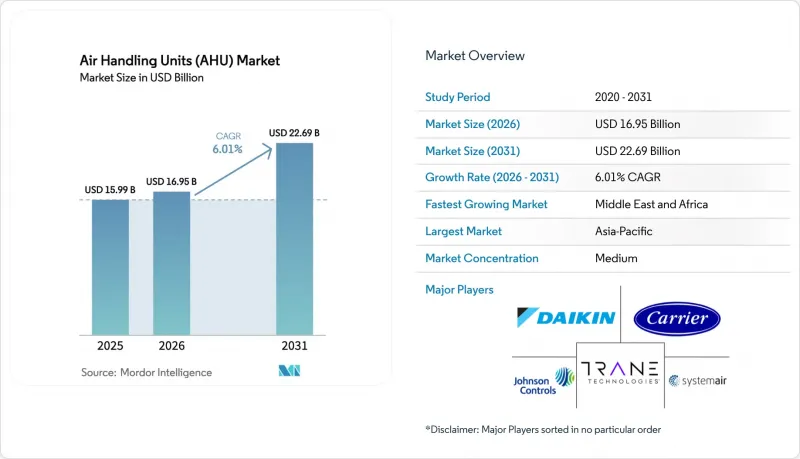
據 Mordor Intelligence 稱,2026 年空調機組市場規模估計為 169.5 億美元,高於 2025 年的 159.9 億美元,預計到 2031 年將達到 226.9 億美元。
預計 2026 年至 2031 年的複合年成長率為 6.01%。
本報告按類型(客製化、包裝、模組化等)、容量(小於5,000、5,001-15,000及其他)、安裝位置(室內、室外/屋頂)、技術(熱管、遞回式盤管、板式熱交換器及其他)、應用(舒適性空調、製程通風)、最終用戶(住宅、商業、工業)和地區進行細分。市場預測以美元計價。
全球空調機組(AHU)市場趨勢與洞察
亞洲醫療和製藥業對無塵室過濾系統的需求不斷成長。
隨著亞洲製藥設施的擴張,對能夠維持符合 ISO 14644-1 5-8 級潔淨環境並兼顧能耗的空氣處理機組 (AHU) 的需求日益成長。製造商正在客製化機組,以滿足美國 FDA 和歐盟 GMP 附錄 1 中不同的氣流速度標準,從而滿足跨境生產的要求。在中國和印度,生物技術和半導體製造廠現在必須配備高效能空氣微粒過濾器 (HEPA) 過濾系統,並整合即時顆粒物監測和建築管理系統,以確保合規性和效率。
歐盟生態設計指令 2023/813:強制減少 SFP 並提高熱回收效率。
2024/1781號法規強制要求空調機組(AHU)降低風機能耗,並將熱回收效率提高到73%或更高,使節能裝置從選用配置變為標配。功率範圍從125瓦到500千瓦的工業風機也必須符合更嚴格的能源效率標準,預計到2030年,這項變更將帶來31太瓦時的節能效益。引入生命週期數位護照將合規範圍擴展到初始銷售之後,從而提升售後服務的差異化優勢。
鋁和銅價格的波動推高了線圈和風扇的成本。
受關稅影響,鋁和鋼的成本飆升了25%,這將對2025年的空氣處理機組(AHU)利潤率構成壓力,並可能導致專案延期。銅價波動也對熱交換器的預算構成風險,熱交換器材料成本可佔單位材料成本的30%。製造商正在採取對沖採購、修改設計以減少材料用量以及重新談判供應合約等措施,同時,工程週期也在延長。
細分市場分析
預計到2025年,成套設備將佔銷售額的41.35%,因為標準辦公室更傾向於選擇可預測的產品。同時,模組化系統預計將以8.52%的複合年成長率成長,因為資料中心開發人員需要能夠快速安裝且無需停機即可擴展的容量模組。定製配置在製藥和電子製造行業中蓬勃發展,因為目錄產品無法滿足這些行業設定的特定過濾和濕度目標。暖通空調設備市場正轉向可配置框架,這使得供應商能夠在保持客製化的同時縮短前置作業時間。此外,模組化結構允許大部分組裝工作在內部完成,從而減少了對熟練勞動力的依賴,這在面臨嚴重勞動力短缺的市場中是一項顯著優勢。
推動成長的主要動力來自超大規模資料處理領域,該領域主要採用間接隔熱模組和液冷盤管。靈活的面積允許分階段進行資本投資,以配合機架部署計畫。因此,空調機組市場提供即插即用的整合式組件,包括撬裝式風扇、盤管和控制設備,這些組件在出貨前均經過內部檢驗。
到2025年,處理量在5,001至15,000立方米/小時之間的空氣處理機組將佔總銷售額的47.40%,主要服務於醫院、高等教育機構和綜合用途開發項目。同時,處理量超過15,000立方公尺/小時的機組正以9.25%的複合年成長率快速成長,主要得益於電氣化製程熱和區域供熱網路的普及。歐洲工業熱泵專案總潛在裝置容量達23吉瓦,總價值達46億至115億歐元,為處理量超過15,000立方公尺/小時的空氣處理機組市場規模提供了有力支撐。 MAN公司20至33兆瓦的二氧化碳熱泵清楚展現了大型空氣處理機組與熱迴路整合的發展趨勢。
小型空調機組(處理量小於5000立方公尺/小時)在高檔住宅大樓中仍然發揮著至關重要的作用,集中式處理能夠有效改善室內空氣品質。變速EC風扇和緊湊型熱回收輪有助於解決嚴格的噪音和空間限制,但其市場成長速度落後於大型系統。
區域分析
預計到2025年,亞太地區將引領空調市場,佔全球銷售額的31.55%。中國1.85億台的空調生產基地為區域供應鏈提供了有力支撐,而印度的暖通空調支出預計到2030年將達到300億美元,年複合成長率達15.8%,這將推動國內對空調的需求。在日本和韓國,由於室內空氣品質(IAQ)標準的嚴格修訂以及地下設施示範計畫的成功(這些計畫已將氡濃度降低了98%),維修工程正在穩步推進。當地企業正與全球原始設備製造商(OEM)合作,提供能夠滿足不同專案進度要求的模組化系統。
歐洲成熟的法規環境正在加速技術進步。 「生態設計」框架推動了熱回收效率的提升和數位化產品護照的普及,從而擴大了高效能空調機組(AHU)的市場佔有率。從斯堪地那維亞到德國,工業熱泵的部署正在推動對15,000立方公尺/小時以上機組的需求。供應商正在應對A2L冷媒的長期合格評定,但最終批准可望加快老舊設備的更換週期。
在中東,沙烏地阿拉伯、卡達和阿拉伯聯合大公國的大型企劃正以9.02%的複合年成長率推動最高的成長速度。區域供冷網路正在指定使用適用於沙漠環境的屋頂空調機組(AHU),即使在高達50°C的高溫環境下也能正常運作。永續性是政府願景中的優先事項,能夠降低尖峰時段電力負荷的設備備受青睞。同時,在北美,儘管原料價格上漲且熟練技術人員短缺,超大規模資料中心仍以前所未有的規模訂購模組化溫度控管系統。受資料中心建設擴張的推動,空調機組市場規模預計將在2031年之前保持兩位數的成長速度。
其他好處:
- Excel格式的市場預測(ME)表
- 3個月的分析師支持
目錄
第1章:引言
- 研究假設和市場定義
- 調查範圍
第2章:調查方法
第3章執行摘要
第4章 市場狀況
- 市場概覽
- 市場促進因素
- 亞洲醫療和製藥業對無塵室過濾系統的需求不斷成長。
- 歐盟生態設計 2023/813:強制減少 SFP 並提高熱回收效率。
- 超大規模資料中心擴建需要模組化、間接隔熱的空氣處理機組(北美)
- 日本和韓國對改造型能源回收通風系統的需求
- 海灣合作理事會(GCC)地區的區域供冷工程正在推動對能夠承受高溫的屋頂式空調機組(AHU)的需求。
- 工業熱負荷的電氣化推動了對處理能力超過 15,000 立方公尺/小時的熱泵空氣處理機組的需求(歐洲)。
- 市場限制因素
- 鋁和銅價格的波動推高了線圈/風扇的成本。
- 技術純熟勞工短缺導致大型客製化空氣處理機組的現場組裝出現延誤(美國)。
- 引入去中心化DOAS作為小規模商業空間的替代方案
- 歐盟對低全球暖化潛勢冷媒設備的核准流程耗時更長。
- 價值供應鏈分析
- 監理展望
- 技術展望
- 波特五力分析
- 宏觀經濟趨勢對市場的影響
- 投資分析
第5章 市場規模與成長預測
- 按類型
- 風俗
- 包裝產品
- 模組化的
- DX Integrated
- 熱回收裝置
- 按產能
- 不足5000
- 5,001~15,000
- 超過15000
- 按安裝類型
- 室內的
- 戶外/屋頂
- 透過技術
- 熱管
- 遞回式盤管
- 板式熱交換器
- 乾燥劑法
- 熱泵(空氣處理機組)
- 透過使用
- 舒適通風
- 製程通風和除濕
- 最終用戶
- 住宅
- 商業的
- 辦公室
- 飯店及休閒
- 醫療機構
- 教育機構
- 零售商店和購物中心
- 產業
- 食品/飲料
- 製藥和生物技術
- 石油天然氣/石油化工
- 汽車和機械
- 其他行業
- 按地區
- 北美洲
- 美國
- 加拿大
- 墨西哥
- 歐洲
- 英國
- 德國
- 法國
- 義大利
- 其他歐洲國家
- 亞太地區
- 中國
- 日本
- 印度
- 韓國
- 其他亞太國家
- 中東
- 以色列
- 沙烏地阿拉伯
- 阿拉伯聯合大公國
- 土耳其
- 其他中東國家
- 非洲
- 南非
- 埃及
- 其他非洲國家
- 南美洲
- 巴西
- 阿根廷
- 其他南美國家
- 北美洲
第6章 競爭情勢
- 市場集中度
- 策略趨勢
- 市佔率分析
- 公司簡介
- Daikin Industries Ltd.
- Carrier Global Corp.
- Trane Technologies plc
- Lennox International Inc.
- Johnson Controls International plc
- Systemair AB
- TROX GmbH
- Swegon Group AB
- Hitachi Ltd.
- Blue Star Ltd.
- FlaktGroup
- Greenheck Fan Corp.
- Nortek Air Solutions
- GEA Group AG
- Mitsubishi Electric Hydronics(Climaveneta)
- Dantherm A/S
- VTS Group
- Munters AB
- Howden Group
- Modine Manufacturing Co.
- CIAT Group(Carrier)
- TICA Industries
- Trosten Industries Co. LLC
- Johnson Controls-Hitachi Air Conditioning
第7章 市場機會與未來展望
According to Mordor Intelligence, the air handling units market size in 2026 is estimated at USD 16.95 billion, growing from 2025 value of USD 15.99 billion with 2031 projections showing USD 22.69 billion, growing at 6.01% CAGR over 2026-2031.
This report is Segmented by Type (Custom, Packaged, Modular, and More), Capacity (Less Than 5, 000, 5, 001-15, 000, and More), Installation (Indoor, Outdoor/Rooftop), Technology (Heat-Pipe, Run-Around Coil, Plate Heat Exchanger, and More), Application (Comfort, Process Ventilation), End-User (Residential, Commercial, Industrial), and Geography. The Market Forecasts are Provided in Terms of Value (USD).
Global Air Handling Units (AHU) Market Trends and Insights
Healthcare & Pharma Clean-room Filtration Uptick in Asia
Asia's pharmaceutical build-out is boosting demand for AHUs that maintain ISO 14644-1 Class 5-to-8 spaces while balancing energy use. Manufacturers tailor units to divergent FDA and EU GMP Annex 1 velocity criteria to serve cross-border production requirements. China and India now specify HEPA-filtered air systems for biotech and semiconductor fabs, integrating real-time particle monitoring with building controls for compliance and efficiency.
EU Ecodesign 2023/813 Mandating Lower SFP & Higher Heat-Recovery
Regulation 2024/1781 requires AHUs to curb fan power and exceed 73% heat-recovery effectiveness, pushing energy wheels from option to baseline. Industrial fans from 125 W to 500 kW must also meet tighter efficiency rules, a change forecast to save 31 TWh by 2030. Lifecycle digital passports extend compliance beyond first sale and create after-sales differentiation.
Volatile Aluminium & Copper Prices Inflating Coil/Fan Costs
Tariffs drove 25% spikes in aluminum and steel costs, compressing AHU margins and deferring projects in 2025. Copper volatility adds risk to heat-exchanger budgets that can represent 30% of unit material value. Manufacturers hedge purchases, redesign for reduced material intensity and renegotiate supply contracts, but engineering cycles lengthen.
Other drivers and restraints analyzed in the detailed report include:
- Hyperscale Data-Centre Build-outs Requiring Modular Indirect Adiabatic AHUs
- Retrofit Demand for Energy-Recovery Ventilation in Japan & South Korea
- Skilled-Labour Shortages Delaying On-site Assembly of Large Custom AHUs
For complete list of drivers and restraints, kindly check the Table Of Contents.
Segment Analysis
Packaged units held 41.35% 2025 revenue as standard offices favored predictable selection. Modular systems, however, show 8.52% CAGR as data-center developers demand capacity blocks that install quickly and expand without downtime. Custom configurations thrive in pharmaceuticals and electronics manufacturing where bespoke filtration and humidity targets preclude catalog solutions. The air handling units market sees suppliers shifting to configurable frames that shorten lead times while preserving customization. Modular construction also limits skilled-labor exposure by transferring more assembly to the factory, a key advantage in tight labor markets.
Growth momentum stems from hyperscale data processing, where indirect adiabatic modules and liquid-cooling ready coils dominate. Flexible footprints permit phasing that aligns capital spending with rack deployment. As a result, the air handling units market integrates skid-mounted fans, coils and controls into plug-and-play packages validated in-house before shipment.
The 5,001-15,000 m3/h tier accounts for 47.40% 2025 revenues, serving hospitals, higher-education and mixed-use developments. Yet units exceeding 15,000 m3/h expand at 9.25% CAGR driven by electrified process heat and district networks. The air handling units market size for >15,000 m3/h installations is supported by European industrial heat-pump projects totaling 23 GW potential, worth EUR 4.6-11.5 billion. MAN's 20-33 MW CO2 heat-pump illustrates momentum toward mega-scale AHUs integrated with thermal loops.
Smaller capacity units (<5,000 m3/h) stay relevant in premium residential towers where central treatment improves indoor air quality. Variable-speed EC fans and compact heat-recovery wheels help meet tight acoustical and spatial constraints, though market growth lags larger systems.
Complete Report Scope:
- By Type
- Custom
- Packaged
- Modular
- DX Integrated
- Heat-Recovery Units
- By Capacity
- Less than 5,000
- 5,001 - 15,000
- Greater than 15,000
- By Installation Type
- Indoor
- Outdoor / Rooftop
- By Technology
- Heat-Pipe
- Run-Around Coil
- Plate Heat Exchanger
- Desiccant-Based
- Thermodynamic Heat Pump AHU
- By Application
- Comfort Ventilation
- Process Ventilation and Dehumidification
- By End-user
- Residential
- Commercial
- Offices
- Hospitality and Leisure
- Healthcare Facilities
- Educational Institutions
- Retail and Shopping Malls
- Industrial
- Food and Beverage
- Pharmaceuticals and Biotech
- Oil and Gas / Petrochemicals
- Automotive and Machinery
- Other Industrial
- By Geography
- North America
- United States
- Canada
- Mexico
- Europe
- United Kingdom
- Germany
- France
- Italy
- Rest of Europe
- Asia-Pacific
- China
- Japan
- India
- South Korea
- Rest of Asia-Pacific
- Middle East
- Israel
- Saudi Arabia
- United Arab Emirates
- Turkey
- Rest of Middle East
- Africa
- South Africa
- Egypt
- Rest of Africa
- South America
- Brazil
- Argentina
- Rest of South America
- North America
Geography Analysis
Asia-Pacific leads the air handling units market with 31.55% 2025 revenue. China's 185 million-unit air-conditioner production base anchors the regional supply chain, while India's HVAC spending trajectory toward USD 30 billion by 2030 at 15.8% CAGR boosts domestic AHU demand. Japan and South Korea advance retrofit activity through stringent IAQ revisions and successful underground-facility demonstrations that cut radon 98%. Local players collaborate with global OEMs to supply modular systems that satisfy diverse project timelines.
Europe's mature regulatory environment accelerates technology turnover. The Ecodesign framework pushes heat-recovery effectiveness and digital product passports, enlarging the air handling units market share of high-efficiency models. Industrial heat-pump deployment from Scandinavia to Germany drives >15,000 m3/h unit demand. Suppliers navigate extended conformity assessments for A2L refrigerants, but eventual approvals unlock a replacement cycle across aging installations.
The Middle East records the fastest 9.02% CAGR thanks to mega-projects in Saudi Arabia, Qatar and the UAE. District-cooling networks specify desert-ready rooftop AHUs that thrive at 50 °C. Government visions prioritize sustainability, rewarding equipment that reduces peak electricity loads. Meanwhile North America faces raw-material surcharges and technician shortages, yet hyperscale data centers are ordering modular thermal-management systems in volumes unprecedented for the region. The air handling units market size linked to data-center build-outs is projected to expand at double-digit rates through 2031.
- Daikin Industries Ltd.
- Carrier Global Corp.
- Trane Technologies plc
- Lennox International Inc.
- Johnson Controls International plc
- Systemair AB
- TROX GmbH
- Swegon Group AB
- Hitachi Ltd.
- Blue Star Ltd.
- FlaktGroup
- Greenheck Fan Corp.
- Nortek Air Solutions
- GEA Group AG
- Mitsubishi Electric Hydronics (Climaveneta)
- Dantherm A/S
- VTS Group
- Munters AB
- Howden Group
- Modine Manufacturing Co.
- CIAT Group (Carrier)
- TICA Industries
- Trosten Industries Co. LLC
- Johnson Controls-Hitachi Air Conditioning
Additional Benefits:
- The market estimate (ME) sheet in Excel format
- 3 months of analyst support
TABLE OF CONTENTS
1 INTRODUCTION
- 1.1 Study Assumptions and Market Definition
- 1.2 Scope of the Study
2 RESEARCH METHODOLOGY
3 EXECUTIVE SUMMARY
4 MARKET LANDSCAPE
- 4.1 Market Overview
- 4.2 Market Drivers
- 4.2.1 Healthcare and Pharma Clean-room Filtration Uptick in Asia
- 4.2.2 EU Ecodesign 2023/813 Mandating Lower SFP and Higher Heat-Recovery
- 4.2.3 Hyperscale Data-Centre Build-outs Requiring Modular Indirect Adiabatic AHUs (N. America)
- 4.2.4 Retrofit Demand for Energy-Recovery Ventilation in Japan and South Korea
- 4.2.5 GCC District-Cooling Projects Spurring Custom High-Ambient Rooftop AHUs
- 4.2.6 Electrification of Industrial Heat Loads Driving Heat-Pump AHUs Greater than15 000 m3/h (Europe)
- 4.3 Market Restraints
- 4.3.1 Volatile Aluminium and Copper Prices Inflating Coil/Fan Costs
- 4.3.2 Skilled-Labour Shortages Delaying On-site Assembly of Large Custom AHUs (US)
- 4.3.3 Decentralised DOAS Adoption as Substitute in Small Commercial Spaces
- 4.3.4 Lengthy EU Approvals for Low-GWP Refrigerant Equipment
- 4.4 Value / Supply-Chain Analysis
- 4.5 Regulatory Outlook
- 4.6 Technological Outlook
- 4.7 Porter's Five Forces Analysis
- 4.7.1 Bargaining Power of Suppliers
- 4.7.2 Bargaining Power of Buyers
- 4.7.3 Threat of New Entrants
- 4.7.4 Threat of Substitutes
- 4.7.5 Intensity of Competitive Rivalry
- 4.8 Impact of Macro Trends on the Market
- 4.9 Investment Analysis
5 MARKET SIZE AND GROWTH FORECASTS (VALUE)
- 5.1 By Type
- 5.1.1 Custom
- 5.1.2 Packaged
- 5.1.3 Modular
- 5.1.4 DX Integrated
- 5.1.5 Heat-Recovery Units
- 5.2 By Capacity
- 5.2.1 Less than 5,000
- 5.2.2 5,001 - 15,000
- 5.2.3 Greater than 15,000
- 5.3 By Installation Type
- 5.3.1 Indoor
- 5.3.2 Outdoor / Rooftop
- 5.4 By Technology
- 5.4.1 Heat-Pipe
- 5.4.2 Run-Around Coil
- 5.4.3 Plate Heat Exchanger
- 5.4.4 Desiccant-Based
- 5.4.5 Thermodynamic Heat Pump AHU
- 5.5 By Application
- 5.5.1 Comfort Ventilation
- 5.5.2 Process Ventilation and Dehumidification
- 5.6 By End-user
- 5.6.1 Residential
- 5.6.2 Commercial
- 5.6.2.1 Offices
- 5.6.2.2 Hospitality and Leisure
- 5.6.2.3 Healthcare Facilities
- 5.6.2.4 Educational Institutions
- 5.6.2.5 Retail and Shopping Malls
- 5.6.3 Industrial
- 5.6.3.1 Food and Beverage
- 5.6.3.2 Pharmaceuticals and Biotech
- 5.6.3.3 Oil and Gas / Petrochemicals
- 5.6.3.4 Automotive and Machinery
- 5.6.3.5 Other Industrial
- 5.7 By Geography
- 5.7.1 North America
- 5.7.1.1 United States
- 5.7.1.2 Canada
- 5.7.1.3 Mexico
- 5.7.2 Europe
- 5.7.2.1 United Kingdom
- 5.7.2.2 Germany
- 5.7.2.3 France
- 5.7.2.4 Italy
- 5.7.2.5 Rest of Europe
- 5.7.3 Asia-Pacific
- 5.7.3.1 China
- 5.7.3.2 Japan
- 5.7.3.3 India
- 5.7.3.4 South Korea
- 5.7.3.5 Rest of Asia-Pacific
- 5.7.4 Middle East
- 5.7.4.1 Israel
- 5.7.4.2 Saudi Arabia
- 5.7.4.3 United Arab Emirates
- 5.7.4.4 Turkey
- 5.7.4.5 Rest of Middle East
- 5.7.5 Africa
- 5.7.5.1 South Africa
- 5.7.5.2 Egypt
- 5.7.5.3 Rest of Africa
- 5.7.6 South America
- 5.7.6.1 Brazil
- 5.7.6.2 Argentina
- 5.7.6.3 Rest of South America
- 5.7.1 North America
6 COMPETITIVE LANDSCAPE
- 6.1 Market Concentration
- 6.2 Strategic Moves
- 6.3 Market Share Analysis
- 6.4 Company Profiles (includes Global-level Overview, Market-level Overview, Core Segments, Financials as available, Strategic Information, Market Rank/Share for key companies, Products and Services, and Recent Developments)
- 6.4.1 Daikin Industries Ltd.
- 6.4.2 Carrier Global Corp.
- 6.4.3 Trane Technologies plc
- 6.4.4 Lennox International Inc.
- 6.4.5 Johnson Controls International plc
- 6.4.6 Systemair AB
- 6.4.7 TROX GmbH
- 6.4.8 Swegon Group AB
- 6.4.9 Hitachi Ltd.
- 6.4.10 Blue Star Ltd.
- 6.4.11 FlaktGroup
- 6.4.12 Greenheck Fan Corp.
- 6.4.13 Nortek Air Solutions
- 6.4.14 GEA Group AG
- 6.4.15 Mitsubishi Electric Hydronics (Climaveneta)
- 6.4.16 Dantherm A/S
- 6.4.17 VTS Group
- 6.4.18 Munters AB
- 6.4.19 Howden Group
- 6.4.20 Modine Manufacturing Co.
- 6.4.21 CIAT Group (Carrier)
- 6.4.22 TICA Industries
- 6.4.23 Trosten Industries Co. LLC
- 6.4.24 Johnson Controls-Hitachi Air Conditioning
7 MARKET OPPORTUNITIES AND FUTURE OUTLOOK
- 7.1 White-space and Unmet-Need Assessment

 全球資料中心空調市場:按類型、容量、資料中心類型和地區分類-預測至2032年
 空氣調節機市場-2026-2032年全球市場預測
 2026年全球預處理空氣(PCAir)能源回收市場報告2026年全球無塵室終端擴散器市場報告
 空調市場報告:按類型、容量、最終用戶和地區分類(2026-2034 年)
 全球空氣調節機市場規模、佔有率、趨勢和成長分析報告(2026-2034年)橫流式牆體組件市場:依產品類型、溫度等級、應用、最終用戶、通路分類,全球預測(2026-2032年)空調機組市場規模、佔有率、成長及全球產業分析:依類型、應用和地區劃分的洞察與預測(2026-2034)
 HVAC空氣處理機組市場機會、成長促進因素、產業趨勢分析及預測(2026-2035年)空氣處理機組市場機會、成長促進因素、產業趨勢分析及預測(2025-2034年)