


 |
市場調查報告書
商品編碼
2125339
北美工業緊固件:市佔率分析、產業趨勢與統計及成長預測(2026-2031 年)North America Industrial Fasteners - Market Share Analysis, Industry Trends & Statistics, Growth Forecasts (2026 - 2031) |
||||||

※ 本網頁內容可能與最新版本有所差異。詳細情況請與我們聯繫。
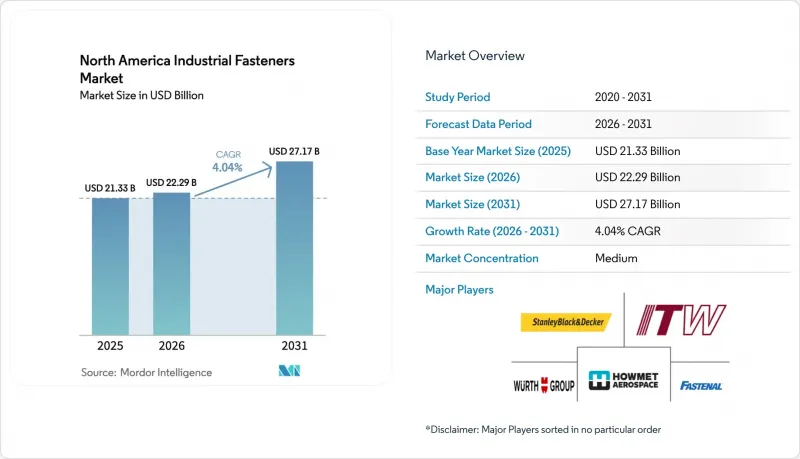
根據 Mordor Intelligence 預測,北美工業緊固件市場規模預計將在 2025 年達到 213.3 億美元,2026 年達到 222.9 億美元,2031 年達到 271.7 億美元,2026 年至 2031 年的複合年成長率為 4.04%。
本報告材質(金屬、塑膠、複合材料和特殊材料)、等級(標準級和高性能級)、產品類型(外螺紋、內螺紋等)、最終用戶應用(OEM、MRO、建築)、塗層/表面處理(未處理、鍍鋅等)以及國家/地區(美國、加拿大、墨西哥)進行細分。市場預測以美元(USD)為單位。
北美工業緊固件市場趨勢與洞察
汽車和航太製造業的擴張
通用汽車 (GM) 和 Stellantis 公司持續推進數十億美元的工廠擴建項目,由此產生了對鋁製螺栓和自鎖螺母的長期訂單,這些螺栓和螺母用於防止電池組內部發生電流腐蝕。現代汽車正在美國建造史上規模最大的單體汽車製造廠。該投資項目計劃於 2027 年運作,預計每年將消耗約 1.5 億個緊固件。航太領域的生產也在不斷成長,通用電氣航空航太公司 (GE Aerospace) 正在擴大其位於俄亥俄州的渦輪機產能,這推動了對 Inconel 718 螺絲的需求。 Inconel 718 是一種鎳基合金,能夠承受 650 度C以上的高溫。擁有可追溯熱處理批次並符合 NADCAP 審核要求的認證供應商具有競爭優勢,迫使那些實力較弱的競爭對手轉向通用零件的細分市場。所有這些發展趨勢共同縮短了特殊零件的前置作業時間,並提高了北美工業緊固件市場的在地採購要求。
北美電動車供應鏈的快速成長
2025年,特斯拉電池超級工廠將新增58吉瓦時的額定產能,將催生對符合ISO 16047扭力標準的不鏽鋼和鋁製緊固件的需求。光是特斯拉位於德克薩斯的工廠去年就使用了約8,000萬個緊固件,其中以M6和M8鋁製螺栓的使用最為普遍。雖然電動車動力傳動系統中內燃機正在淘汰數千顆螺絲,但電池機殼、逆變器外殼和馬達支架仍需要能夠承受劇烈熱循環的抗振設計。據阿貢國家實驗室稱,鍛造產能的成長速度跟不上電動車產量的成長,導致客製化零件的前置作業時間週期延長。因此,能夠提供即插即用設計並擁有區域倉庫的供應商正在獲得長期、大量的訂單。
結構性黏著劑的廣泛應用
漢高汽車黏合劑業務部門預計到2025年將成長12%,用於取代車身本體組裝中的螺栓,預計將每輛車減重高達12公斤。黏合劑能夠分散負荷、減少腐蝕並改善NVH性能,促使原始設備製造商(OEM)重新設計其連接結構。 3M的丙烯酸泡棉膠帶和西卡的聚氨酯系統目前正被用於固定外部裝飾件和電池托盤,從而縮短生產週期並降低模具複雜性。然而,可維護性問題依然存在,這促使人們開發出將緊固件與黏合劑結合的混合解決方案。緊固件製造商正透過現場固化螺絲和黏合劑的組合來應對這項挑戰,但北美工業緊固件產業整體而言,對基礎硬體的淨需求壓力仍然為負。
細分市場分析
金屬緊固件預計到2025年將佔總銷售額的84.23%,凸顯其在汽車碰撞安全結構、機械機殼和鋼結構領域的穩固地位。碳鋼憑藉其優異的強度成本比,能夠滿足大多數生產規模的需求;而合金鋼和不銹鋼則用於對抗張強度和耐腐蝕性要求更高的應用領域,例如底盤懸吊安裝點和鋼骨設備。塑膠扣環和推銷廣泛應用於儀表板、家用電器和電子產品中,在這些領域,介電絕緣性和耐刮擦性比高拉拔強度更為重要。儘管複合材料和特殊材料產品目前仍屬於小眾市場,但由於原始設備製造商(OEM)在尋求減輕重量的同時,還需要防止金屬和碳纖維基基板之間發生電偶電流腐蝕,因此該市場正以4.62%的複合年成長率快速成長。
產品設計的快速變化也促使人們重新評估材料清單(BOM) 的選擇標準。空中巴士和波音公司正在增加複合材料機身的使用,這推動了碳纖維增強複合材料 (CFRP) 螺絲的採用,以適應熱膨脹並避免電偶腐蝕。鈦合金 5 級螺栓每公斤售價超過 50 美元,已在噴射引擎和整形外科植入佔據穩固地位,其生物相容性和優於不銹鋼 3:1 的強度重量比仍然是決定性因素。在北美工業緊固件市場,Penn Engineering 公司用於薄壁鋁製機殼的自鎖螺柱將螺絲鬆動失效減少了 30%,這表明製程創新如何加速產品在特殊應用領域的滲透。同時,由於 PEEK 螺絲在術後影像中具有滲透性,因此被用於脊椎固定,這一臨床優勢使其價格比 316L 不銹鋼螺絲高出 10 倍。
符合 ASTM A307 和 SAE 2 級標準的螺栓預計在 2025 年佔總銷售量的 67.13%,作為建築和 MRO(維護、維修和營運)行業的主力產品,其需求仍然強勁。在這些產業中,成本和即時供貨比高深的技術指標更為重要。這些緊固件以托盤為單位,透過配送中心進行分銷,分店經理更關注的是最佳化單件產品的交貨速度,而不是掌握拉伸曲線等技術細節。由於價格持續下跌仍是一大挑戰,大規模物流和自動化揀選成為北美工業緊固件市場這一細分領域維持利潤率的唯一永續途徑。
預計到2031年,高性能合金的複合年成長率將達到4.49%,主要得益於電氣化、液化天然氣項目和先進民航機的發展。經熱處理抗張強度達150,000 psi的8級碳合金螺栓廣泛應用於承受極端扭轉應力的農業噴霧器和重型運輸車輛。公制10.9級螺柱目前正用於電動車馬達支架,因為與汽油引擎相比,電動車的再生煞車會對連接處施加更高的反向應力循環。 Haumet公司投資2,800萬美元建造的Inconel 718生產線進一步鞏固了鎳基緊固件在高溫(超過650 度C)環境下連接渦輪機零件方面的競爭優勢。 KAMAX公司專有的淬火回火處理技術可將疲勞壽命提高25%,進而為原始設備製造商(OEM)提供更長的保固期,並帶來40%的價格溢價。這提升了北美工業緊固件市場的整體價值。
其他好處:
- Excel格式的市場預測(ME)表
- 3個月的分析師支持
目錄
第1章:引言
- 研究假設和市場定義
- 調查範圍
第2章:調查方法
第3章執行摘要
第4章 市場狀況
- 市場概覽
- 市場促進因素
- 建築業的成長
- 汽車和航太製造業的擴張
- 耐腐蝕塗層技術的進步
- 北美電動車供應鏈的快速成長
- 《購買美國貨法案》鼓勵本地採購。
- 數位追溯和智慧緊固件計劃
- 市場限制因素
- 結構性黏著劑的廣泛應用
- 鋼鐵和非鐵金屬價格波動
- 電鍍方面的嚴格環境法規
- 生產回流導致專業產品的產能出現瓶頸。
- 產業價值鏈分析
- 監理情勢
- 技術展望
- 波特五力分析
- 宏觀經濟趨勢對市場的影響
第5章 市場規模與成長預測
- 材料
- 金屬
- 塑膠
- 複合材料和特殊材料
- 按年級
- 標準
- 高效能
- 依產品類型
- 公螺絲
- 內螺紋類型
- 沒有螺絲
- 特定應用/特殊應用
- 透過最終用戶應用程式
- OEM
- 汽車/汽車產業
- 配備內燃機(ICE)的輕型車輛
- 配備內燃機(ICE)的中型和重型卡車/巴士
- 電動車
- 航太
- 機械/資本財
- 電氣和電子設備
- 金屬製品
- 醫療設備
- 其他OEM應用
- 汽車/汽車產業
- 維護、修理和營運 (MRO)
- 建造
- OEM
- 塗層/表面處理
- 普通(未塗層)
- 鍍鋅
- 熱鍍鋅
- 聚四氟乙烯和特殊塗層
- 國家
- 美國
- 加拿大
- 墨西哥
第6章 競爭情勢
- 市場集中度
- 策略趨勢
- 市佔率分析
- 公司簡介
- Illinois Tool Works Inc.
- Howmet Aerospace Inc.
- Stanley Black and Decker, Inc.
- Wurth Group
- Fastenal Company
- Fontana Gruppo(Acument Global Technologies, Inc.)
- LISI Group
- Nifco Inc.
- Bulten AB
- ARaymond Group
- Marmon Holdings, Inc.(Berkshire Hathaway)
- Hilti Corporation
- KAMAX Holding GmbH and Co. KG
- Bossard Holding AG
- PennEngineering and Manufacturing Corp.
- Simpson Manufacturing Co., Inc.
- Precision Castparts Corp.(SPS Technologies)
- TriMas Corporation
- Agrati Group
- SFS Group AG
- Optimas Solutions
第7章 市場機會與未來展望
According to Mordor Intelligence, the North America industrial fasteners market size is projected to be USD 21.33 billion in 2025, USD 22.29 billion in 2026, and reach USD 27.17 billion by 2031, growing at a CAGR of 4.04% from 2026 to 2031.
This report is Segmented by Material (Metal, Plastic, and Composite and Specialty), Grade (Standard, and High-Performance), Product Type (Externally Threaded, Internally Threaded, and More), End-User Application (OEM, MRO, and Construction), Coating/Finish (Plain, Zinc-Plated, and More), and Country (United States, Canada, and Mexico). The Market Forecasts are Provided in Terms of Value (USD).
North America Industrial Fasteners Market Trends and Insights
Expansion Of Automotive and Aerospace Manufacturing
Ongoing multi-billion-dollar plant expansions by General Motors and Stellantis are translating into long-run orders for aluminum-compatible bolts and self-locking nuts that prevent galvanic corrosion inside battery packs. Hyundai is building the largest single automotive complex in U.S. history, an investment scheduled to come online in 2027 and consume roughly 150 million fasteners each year. Aerospace output is also climbing, with GE Aerospace adding turbine capacity in Ohio, which is boosting demand for nickel-based Inconel 718 screws capable of withstanding temperatures above 650 °C. Certified suppliers who can trace heat lots and meet NADCAP audit requirements have a competitive edge, pushing less-equipped rivals toward commodity niches. Collectively, these moves compress lead times for specialty parts and intensify local content requirements across the North America industrial fasteners market.
Rapid Growth Of North American EV Supply Chain
Battery gigafactories added 58 GWh of nameplate capacity in 2025, introducing demand for stainless-steel and aluminum fasteners engineered to ISO 16047 torque standards. Tesla's Texas plant alone used about 80 million fasteners during the year, with M6 and M8 aluminum bolts topping the volume list. EV powertrains eliminate thousands of combustion-engine screws, yet battery enclosures, inverter housings, and motor mounts require vibration-resistant designs that survive intense thermal cycling. Argonne National Laboratory notes that forging capacity is struggling to keep pace with EV ramp-ups, stretching lead times for custom parts. Suppliers capable of drop-in design support and regional warehousing are therefore securing long-term volume commitments.
Rising Adoption Of Structural Adhesives
Henkel's automotive adhesives unit grew 12% in 2025, displacing bolts in body-in-white assemblies where weight savings reach 12 kilograms per vehicle. Adhesives distribute load, reduce corrosion, and enhance NVH, motivating OEMs to redesign joint architectures. 3M acrylic foam tapes and Sika polyurethane systems now secure exterior trims and battery trays, trimming cycle times and tooling complexity. Serviceability concerns persist, so hybrid solutions pairing low-count fasteners with bonding agents are emerging. Fastener makers respond with screw-and-adhesive combos that cure in situ, but net demand pressure remains negative for basic hardware across the North America industrial fasteners industry.
Other drivers and restraints analyzed in the detailed report include:
- Growth Of The Construction Sector
- Advances In Corrosion-Resistant Coatings
- Volatility In Steel And Non-Ferrous Metal Prices
For complete list of drivers and restraints, kindly check the Table Of Contents.
Segment Analysis
Metal fasteners accounted for 84.23% of 2025 revenue, underscoring their entrenched role in automotive crash structures, machinery housings, and steel-frame construction. Carbon steel meets most volume requirements thanks to favorable strength-to-cost ratios, while alloy and stainless grades serve higher-tensile or corrosive applications, such as underbody suspension points and chemical-processing equipment. Plastic clips and push-pins thrive in dashboards, white goods, and electronics where dielectric insulation or scratch avoidance matters more than high pull-out strength. Composite and specialty options, although niche, are expanding at a 4.62% CAGR as OEMs fight weight while guarding against galvanic corrosion between metals and carbon-fiber substrates.
Rapid shifts in product design are recasting bill-of-material choices. Airbus and Boeing have increased their composite fuselage share, driving the adoption of CFRP screws that match the thermal expansion of airframes and avoid galvanic couples. Titanium Grade 5 bolts, priced at more than USD 50 per kilogram, hold a secure position in jet engines and orthopedic implants where biocompatibility and 3:1 strength-to-weight superiority over stainless steel remain decisive. In the North America industrial fasteners market, PennEngineering's self-clinching studs for thin aluminum casings reduced strip-out failures by 30%, demonstrating how process innovation can boost specialty penetration. PEEK screws, meanwhile, win spinal fixation work because they are radiolucent on post-op imaging, a clinical benefit that justifies a tenfold premium over 316L stainless alternatives.
Standard-grade bolts conforming to ASTM A307 and SAE Grade 2 delivered 67.13% of 2025 turnover, riding construction and MRO staples where cost and immediate availability outweigh deeper engineering metrics. These fasteners move through distribution hubs in pallet quantities, with branch managers optimized for line-item fill rate rather than tensile curve education. Price erosion remains an issue, so scale logistics and automated picking stand out as the only sustainable levers for margin defense in this layer of the North America industrial fasteners market.
High-performance grades are charting a 4.49% CAGR into 2031 by shadowing electrification, LNG projects, and advanced civil aircraft. Grade 8 carbon-alloy bolts, heat-treated to 150,000 psi tensile, populate agricultural sprayers and heavy haulers that encounter extreme torsion. Metric Grade 10.9 studs now anchor EV motor mounts because regenerative braking subjects joints to higher reversed-stress cycles than gasoline engines. Howmet's USD 28 million Inconel 718 line widens the moat around nickel-based fasteners that hold turbine sections together above 650 °C. KAMAX's proprietary post-quench temper raised fatigue life 25%, granting OEMs more warranty cushion and fetching 40% price premiums that buoy overall value captured within the North America industrial fasteners market.
Complete Report Scope:
- By Material
- Metal
- Plastic
- Composite and Specialty
- By Grade
- Standard
- High-Performance
- By Product Type
- Externally Threaded
- Internally Threaded
- Non-Threaded
- Application-Specific/Specialty
- By End-User Application
- OEM
- Motor Vehicles/Automotive
- ICE Light Vehicles
- ICE Medium and Heavy Trucks/Buses
- Electric Vehicles
- Aerospace
- Machinery and Capital Goods
- Electrical and Electronics
- Fabricated Metals
- Medical Equipment
- Other OEM Applications
- Motor Vehicles/Automotive
- Maintenance, Repair and Operations (MRO)
- Construction
- OEM
- By Coating/Finish
- Plain (Uncoated)
- Zinc-Plated
- Hot-Dip Galvanized
- PTFE and Specialty Coatings
- By Country
- United States
- Canada
- Mexico
List of Companies Covered in this Report:
- Illinois Tool Works Inc.
- Howmet Aerospace Inc.
- Stanley Black and Decker, Inc.
- Wurth Group
- Fastenal Company
- Fontana Gruppo (Acument Global Technologies, Inc.)
- LISI Group
- Nifco Inc.
- Bulten AB
- ARaymond Group
- Marmon Holdings, Inc. (Berkshire Hathaway)
- Hilti Corporation
- KAMAX Holding GmbH and Co. KG
- Bossard Holding AG
- PennEngineering and Manufacturing Corp.
- Simpson Manufacturing Co., Inc.
- Precision Castparts Corp. (SPS Technologies)
- TriMas Corporation
- Agrati Group
- SFS Group AG
- Optimas Solutions
Additional Benefits:
- The market estimate (ME) sheet in Excel format
- 3 months of analyst support
TABLE OF CONTENTS
1 INTRODUCTION
- 1.1 Study Assumptions and Market Definition
- 1.2 Scope of the Study
2 RESEARCH METHODOLOGY
3 EXECUTIVE SUMMARY
4 MARKET LANDSCAPE
- 4.1 Market Overview
- 4.2 Market Drivers
- 4.2.1 Growth of the Construction Sector
- 4.2.2 Expansion of Automotive and Aerospace Manufacturing
- 4.2.3 Advances in Corrosion-Resistant Coatings
- 4.2.4 Rapid Growth of North American EV Supply Chain
- 4.2.5 Buy-American Acts Driving Local Sourcing
- 4.2.6 Digital Traceability and Smart-Fastener Initiatives
- 4.3 Market Restraints
- 4.3.1 Rising Adoption of Structural Adhesives
- 4.3.2 Volatility in Steel and Non-Ferrous Metal Prices
- 4.3.3 Stringent Environmental Regulations on Plating
- 4.3.4 Reshoring-Led Capacity Bottlenecks for Specials
- 4.4 Industry Value Chain Analysis
- 4.5 Regulatory Landscape
- 4.6 Technological Outlook
- 4.7 Porter's Five Forces Analysis
- 4.7.1 Bargaining Power of Suppliers
- 4.7.2 Bargaining Power of Consumers
- 4.7.3 Threat of New Entrants
- 4.7.4 Threat of Substitutes
- 4.7.5 Intensity of Competitive Rivalry
- 4.8 Impact of Macroeconomic Trends on the Market
5 MARKET SIZE AND GROWTH FORECASTS
- 5.1 By Material
- 5.1.1 Metal
- 5.1.2 Plastic
- 5.1.3 Composite and Specialty
- 5.2 By Grade
- 5.2.1 Standard
- 5.2.2 High-Performance
- 5.3 By Product Type
- 5.3.1 Externally Threaded
- 5.3.2 Internally Threaded
- 5.3.3 Non-Threaded
- 5.3.4 Application-Specific/Specialty
- 5.4 By End-User Application
- 5.4.1 OEM
- 5.4.1.1 Motor Vehicles/Automotive
- 5.4.1.1.1 ICE Light Vehicles
- 5.4.1.1.2 ICE Medium and Heavy Trucks/Buses
- 5.4.1.1.3 Electric Vehicles
- 5.4.1.2 Aerospace
- 5.4.1.3 Machinery and Capital Goods
- 5.4.1.4 Electrical and Electronics
- 5.4.1.5 Fabricated Metals
- 5.4.1.6 Medical Equipment
- 5.4.1.7 Other OEM Applications
- 5.4.1.1 Motor Vehicles/Automotive
- 5.4.2 Maintenance, Repair and Operations (MRO)
- 5.4.3 Construction
- 5.4.1 OEM
- 5.5 By Coating/Finish
- 5.5.1 Plain (Uncoated)
- 5.5.2 Zinc-Plated
- 5.5.3 Hot-Dip Galvanized
- 5.5.4 PTFE and Specialty Coatings
- 5.6 By Country
- 5.6.1 United States
- 5.6.2 Canada
- 5.6.3 Mexico
6 COMPETITIVE LANDSCAPE
- 6.1 Market Concentration
- 6.2 Strategic Moves
- 6.3 Market Share Analysis
- 6.4 Company Profiles (includes Global Level Overview, Market Level Overview, Core Segments, Financials as available, Strategic Information, Market Rank/Share, Products and Services, Recent Developments)
- 6.4.1 Illinois Tool Works Inc.
- 6.4.2 Howmet Aerospace Inc.
- 6.4.3 Stanley Black and Decker, Inc.
- 6.4.4 Wurth Group
- 6.4.5 Fastenal Company
- 6.4.6 Fontana Gruppo (Acument Global Technologies, Inc.)
- 6.4.7 LISI Group
- 6.4.8 Nifco Inc.
- 6.4.9 Bulten AB
- 6.4.10 ARaymond Group
- 6.4.11 Marmon Holdings, Inc. (Berkshire Hathaway)
- 6.4.12 Hilti Corporation
- 6.4.13 KAMAX Holding GmbH and Co. KG
- 6.4.14 Bossard Holding AG
- 6.4.15 PennEngineering and Manufacturing Corp.
- 6.4.16 Simpson Manufacturing Co., Inc.
- 6.4.17 Precision Castparts Corp. (SPS Technologies)
- 6.4.18 TriMas Corporation
- 6.4.19 Agrati Group
- 6.4.20 SFS Group AG
- 6.4.21 Optimas Solutions
7 MARKET OPPORTUNITIES AND FUTURE OUTLOOK
- 7.1 White-Space and Unmet Need Assessment

 全球微型緊固件市場:機會與策略展望(至2035年)
 工業緊固件密封件市場-2026-2032年全球市場預測工業緊固件市場-2026-2032年全球市場預測
 工業緊固件市場規模、佔有率、趨勢和預測:按原料、產品、類型、應用和地區分類,2026-2034年
 工業緊固件市場規模、佔有率、成長及全球產業分析:按類型、應用和地區分類,並預測至2026-2034年
 工業緊固件市場:依原料、產品、應用和地區分類。
 美國工業緊固件市場規模、佔有率和趨勢分析報告:按原料、產品、應用和細分市場分類(2026-2033 年)液壓螺母市場:按類型、材料、尺寸、應用和分銷管道分類,全球預測,2026-2032年金屬鎖緊螺帽市場:依產品類型、材料類型、塗層與表面處理、通路、終端用戶產業分類,全球預測(2026-2032年)重型緊固件市場:按類型、材料、製造流程、最終用途和銷售管道,全球預測,2026-2032年