


 |
市場調查報告書
商品編碼
2125315
機械軸封:市場佔有率分析、產業趨勢與統計、成長預測(2026-2031)Mechanical Seals - Market Share Analysis, Industry Trends & Statistics, Growth Forecasts (2026 - 2031) |
||||||

※ 本網頁內容可能與最新版本有所差異。詳細情況請與我們聯繫。
根據 Mordor Intelligence 預測,機械軸封市場規模將從 2025 年的 76.2 億美元成長到 2026 年的 79.7 億美元,到 2031 年將達到 99.7 億美元,2026 年至 2031 年的複合年成長率為 4.58%。
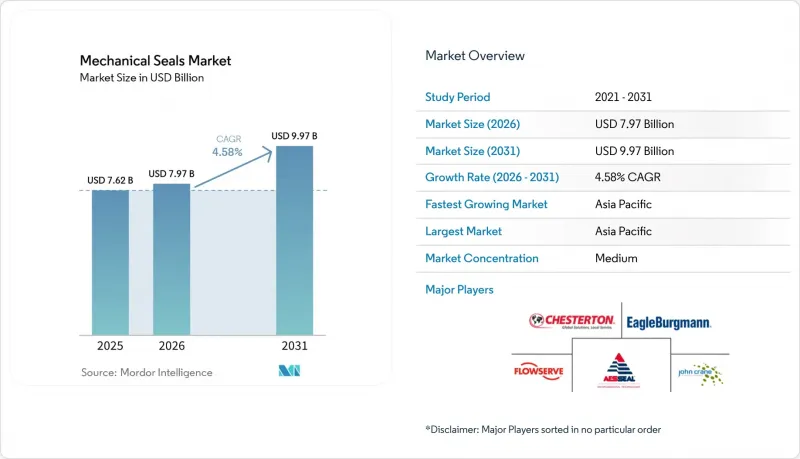
本報告按密封件類型(泵浦密封件、壓縮機密封件、混合器密封件)、設計類型(組件/推桿式、盒式、分離式)、終端用戶產業(石油天然氣、發電、化學、用水和污水及其他終端用戶產業)和地區(亞太地區、北美、歐洲、南美、中東和非洲)進行細分。市場預測以美元計價。
全球機械軸封市場趨勢與洞察
由於石油和天然氣行業的大型企劃,需求正在擴大。
沙烏地阿拉伯向下游業務的擴張凸顯了原油與化學產品融合所帶來的密封需求變化。沙烏地阿美公司的阿米拉爾綜合設施計畫於2027年投產,其混合原料裂解裝置和高壓烴幫浦需要高品質的密封件。供應商現在必須提供能夠耐受極端溫度和高腐蝕性石化物料的材料。約翰·克萊恩公司的8628VL型非接觸式螺旋槽密封件具有更長的維修間隔時間(MTBF),同時顯著降低了沖洗需求。這類大型專案往往優先考慮對先進技術進行前期投資,以降低生命週期成本,這給仍依賴傳統濕式密封件產品的供應商帶來了壓力。
新增發電能力快速成長
在全球範圍內,燃氣渦輪機、核子反應爐以及可再生石化燃料混合發電系統的部署正在增加。然而,密封件的主要需求集中在輔助給水泵、冷卻迴路和蒸氣渦輪。在英國一家煉油廠,將AESSEAL的STS蒸氣渦輪密封件進行改造後,顯著降低了每台機組每年的蒸氣消耗量。此次升級延長了汽輪機的使用壽命,並為整個工廠帶來了全年顯著的成本節約。隨著可再生能源間歇性地併入電網,聯合循環汽輪機的運作頻率預計將進一步提高。運作頻率的提高將加速密封件的磨損,從而導致售後市場需求激增。未來,模組化核能發電概念和封閉回路型冷卻技術的引入可能會減少動態密封件的安裝位置,並減緩長期成長,但預計在不久的將來,市場需求仍將保持強勁。
磨料漿料應用中的高生命週期成本
礦業和紙漿生產商通常選擇填料式密封或排屑器系統,以避免高昂的漿料密封成本。這種選擇表明他們更注重簡化庫存管理而非耐用性。另一方面,約翰·克萊恩的SB2雙筒式密封技術無需外部沖洗,延長了使用壽命,但其在實際應用中的普及很大程度上取決於是否提供技術支援和性能保證。這些保證旨在抵消初始投資的負擔。在磨料加工領域,那些只銷售產品而不提供額外服務的供應商將被市場淘汰。
細分市場分析
預計到2025年,泵浦密封件的銷售額將佔總銷售額的64.35%,並將以4.56%的複合年成長率持續成長至2031年。現有離心式幫浦幫浦的維修穩定的售後市場銷售提供了支撐,但由於清潔化學品處理領域正轉向無密封解決方案,現有設備的市場較為脆弱。非接觸式螺旋槽設計和上游泵浦表面是目前的主要創新點,使供應商能夠提案以提高能源效率和符合排放法規為重點的升級方案。雖然壓縮機密封件的銷售量較低,但其技術複雜性和更嚴格的監管要求導致其平均售價較高。混合器密封件仍然是一個小眾市場,但它們在衛生控制至關重要的反應器中必不可少,從而保持了較高的利潤率。
泵用機械軸封市場預計將穩定成長,但隨著亞洲製造商供應低成本的接觸面密封件,競爭日益激烈。老牌廠商正透過數位化診斷、效能保證和快速的本地服務來凸顯自身優勢。
區域分析
預計到2025年,亞太地區將佔機械軸封市場銷售額的36.35%,並將在2031年之前保持最高的複合年成長率(CAGR),達到4.68%。中國煉油、石化和電力產業的擴張正在推動顯著的需求成長。此外,中國在電解槽製造領域的主導地位也促進了氫兼容密封件的早期應用。緊隨其後的是印度正在擴大其煉油和水利基礎設施項目。然而,由於價格敏感性,國內製造商在標準泵業務領域更受青睞。同時,日本和韓國儘管市場規模較小,但正在投資液化天然氣和半導體應用領域的高性能密封件,從而開闢了高利潤的細分市場。
預計到2025年,北美將佔據顯著的市場佔有率。美國環保署(EPA)的甲烷排放法規正在推動墨西哥灣沿岸地區中游管網幹氣密封件的維修。液化天然氣出口終端和石化廠瓶頸消除帶來的投資正在提振訂單,而老化的基礎設施則確保了售後市場的穩定性。在加拿大,油砂關稅推動了對耐磨雙密封件的需求,但管道專案的延誤導致投資波動。
歐洲佔據了相當大的市場。專注於能源轉型的項目,例如碳捕獲、氫電解和離岸風力發電,正在推動市場成長,但授權的延誤常常阻礙了進展。德國和英國在氫氣管道領域扮演著主導角色,但預計2026年至2028年的大部分收入將來自工業氣體和特種化學品的升級改造。中東和非洲的市場佔有率較小,但卻參與了一些業內規模最大的項目。值得關注的項目包括沙烏地阿拉伯從原油生產轉向化學生產、阿布達比國家石油公司(ADNOC)的二氧化碳捕集與儲存(CCS)計畫以及南非的採礦業,所有這些計畫都需要數百個密封件。然而,供應商面臨物流路線漫長和應收帳款回收期延長等挑戰。
其他好處:
- Excel格式的市場預測(ME)表
- 3個月的分析師支持
目錄
第1章:引言
- 研究假設和市場定義
- 調查範圍
第2章:調查方法
第3章執行摘要
第4章 市場狀況
- 市場概覽
- 市場促進因素
- 由於石油和天然氣行業的大型企劃,需求正在擴大。
- 新建發電設施的數量正在迅速增加。
- 加強全球溫室氣體排放法規
- 擴大化工和石化聯合企業的產能
- 開發用於氫氣和綠色氨的低溫基礎設施
- 市場限制因素
- 拋光漿料應用中的高生命週期成本
- 無密封磁力驅動幫浦和加套馬達的目標市場正在縮小。
- SiC表面材料的價格波動與供應鏈風險
- 價值鏈分析
- 波特五力模型
第5章 市場規模與成長預測
- 依貼紙類型
- 幫浦密封件
- 壓縮機密封
- 攪拌機密封件
- 依設計類型
- 組件/推桿
- 墨水匣
- 分配
- 按最終用戶行業分類
- 石油和天然氣
- 發電
- 化學品
- 供水/污水處理
- 其他終端用戶產業(採礦和礦物加工、食品、製藥等)
- 按地區
- 亞太地區
- 中國
- 印度
- 日本
- 韓國
- ASEAN
- 其他亞太國家
- 北美洲
- 美國
- 加拿大
- 墨西哥
- 歐洲
- 德國
- 英國
- 法國
- 義大利
- 俄羅斯
- 其他歐洲國家
- 南美洲
- 巴西
- 阿根廷
- 其他南美國家
- 中東和非洲
- 沙烏地阿拉伯
- 南非
- 其他中東和非洲國家
- 亞太地區
第6章 競爭情勢
- 市場集中度
- 策略趨勢
- 市佔率和排名分析
- 公司簡介
- AW Chesterton Company
- AESSEAL
- Dana Limited
- Eagle Industry Co., Ltd.
- EagleBurgmann
- Flexaseal Engineered Seals and Systems, LLC
- Flowserve Corporation
- Gallagher Seals
- Garlock
- Hutchinson Industries Inc.
- John Crane
- Parker Hannifin Corp
- SKF
- Technetics Group
第7章 市場機會與未來展望
According to Mordor Intelligence, the mechanical seals market size is expected to grow from USD 7.62 billion in 2025 to USD 7.97 billion in 2026 and is forecast to reach USD 9.97 billion by 2031 at a 4.58% CAGR over 2026-2031.
This report is Segmented by Seal Type (Pump Seals, Compressor Seals, and Mixer Seals), Design Type (Component/Pusher, Cartridge, and Split), End-User Industry (Oil and Gas, Power Generation, Chemical, Water and Waste-Water, and Other End-User Industries), and Geography (Asia-Pacific, North America, Europe, South America, and Middle-East and Africa). Market Forecasts are Provided in Terms of Value (USD).
Global Mechanical Seals Market Trends and Insights
Growing Demand from Oil and Gas Megaprojects
Saudi Arabia's push into downstream operations highlights a shift in seal requirements driven by crude-to-chemicals integration. Aramco's Amiral complex, set to commence operations in 2027, will demand premium seals for its mixed-feed crackers and high-pressure hydrocarbon pumps. Suppliers are now tasked with providing materials resilient to extreme temperatures and corrosive petrochemical streams. John Crane's Type 8628VL non-contacting spiral-groove seal boasts an extended mean time between repairs while significantly reducing flush demand. Such large-scale projects lean towards upfront investments in advanced technology, promising lifecycle savings, and putting pressure on vendors still dependent on traditional wet-seal lines.
Surge in New Power-Generation Capacity Additions
Worldwide installations of gas turbines, nuclear reactors, and hybrid renewables are on the rise. Yet, the primary demand for seals is concentrated in auxiliary feed-water pumps, cooling circuits, and steam turbines. A retrofit of AESSEAL's STS steam turbine seal at a refinery in the UK resulted in significant steam savings annually per unit. This upgrade extended the turbine's lifespan, translating to impressive annual fleet savings. As grids increasingly incorporate intermittent renewables, combined-cycle turbines are set to cycle more frequently. This heightened activity accelerates seal wear, leading to a surge in aftermarket volumes. On the horizon, while modular nuclear concepts and closed-loop cooling might reduce the number of dynamic sealing points, tempering growth in the very long term, the immediate future looks robust.
High Life-Cycle Cost in Abrasive Slurry Services
Mining and pulp operators frequently opt for packed glands or expeller devices, shunning the premium on slurry seals. Their choice underscores a preference for inventory simplicity over longevity. Meanwhile, John Crane's SB2 dual-cartridge technology, which eliminates the need for an external flush and extends service life, sees its field adoption largely dependent on bundled technical support and performance guarantees. These assurances aim to counterbalance the initial investment. Vendors who solely push products without added services find themselves sidelined in abrasive tasks.
Other drivers and restraints analyzed in the detailed report include:
- Tightening Fugitive-Emission Regulations Worldwide
- Capacity Expansion in Chemical and Petrochemical Complexes
- Seal-Less Mag-Drive and Canned-Motor Pumps Eroding Addressable Market
For complete list of drivers and restraints, kindly check the Table Of Contents.
Segment Analysis
Pump seals generated 64.35% revenue in 2025 and will track a 4.56% CAGR to 2031. Retrofits into existing centrifugal pumps underpin stable aftermarket sales, but the installed base is vulnerable to seal-less migration in clean chemical services. Non-contacting spiral-groove designs and upstream-pumping faces now headline innovation, allowing suppliers to frame upgrades around energy savings and emissions compliance. Compressor seals, though lower in volume, achieve higher average selling prices via technical complexity and rising regulatory enforcement. Mixer seals remain niche yet mission-critical in hygiene-sensitive reactors, sustaining premium margins.
While the mechanical seals market size for pump applications will expand steadily, competitive intensity is sharpening as Asian manufacturers offer low-cost contact-face cartridges. Established brands differentiate through digital diagnostics, performance warranties, and rapid local service.
Complete Report Scope:
- By Seal Type
- Pump Seals
- Compressor Seals
- Mixer Seals
- By Design Type
- Component/Pusher
- Cartridge
- Split
- By End-user Industry
- Oil and Gas
- Power Generation
- Chemical
- Water and Waste-water
- Other End-user Industries (Mining and Mineral Processing, Food, Pharma, etc.)
- By Geography
- Asia-Pacific
- China
- India
- Japan
- South Korea
- ASEAN
- Rest of Asia-Pacific
- North America
- United States
- Canada
- Mexico
- Europe
- Germany
- United Kingdom
- France
- Italy
- Russia
- Rest of Europe
- South America
- Brazil
- Argentina
- Rest of South America
- Middle-East and Africa
- Saudi Arabia
- South Africa
- Rest of Middle-East and Africa
- Asia-Pacific
Geography Analysis
Asia-Pacific captured 36.35% of the mechanical seals market revenue in 2025 and is projected to post the fastest 4.68% CAGR through 2031. China's expansions in refining, petrochemicals, and power sectors drive a significant demand. Additionally, China's leadership in electrolyser manufacturing has spurred an early adoption of hydrogen-ready seals. Following closely, India is ramping up its refinery and water infrastructure projects. However, due to price sensitivities, the standard pump business is leaning towards domestic producers. Meanwhile, Japan and South Korea, despite their smaller size, are investing in high-performance seals for LNG and semiconductor applications, carving out premium-margin niches.
North America commanded a notable market share in 2025. The EPA's methane regulations are driving retrofits of dry-gas seals throughout the Gulf Coast's midstream network. Capital orders are bolstered by LNG export terminals and petrochemical debottlenecks, while an aging installed base ensures stability in the aftermarket. In Canada, duties on oil sands are pushing the demand for abrasion-resistant dual seals, yet delays in pipeline projects introduce volatility in capital expenditures.
Europe represented a considerable portion of the market value. Projects focused on energy transition-like carbon capture, hydrogen electrolysers, and offshore wind-are fostering growth, though progress is often slowed by permitting delays. Germany and the UK are taking the lead in hydrogen pipelines, yet the bulk of revenues from 2026 to 2028 are anticipated to stem from upgrades in industrial gas and specialty chemicals. While the Middle East and Africa hold a smaller market share, they are involved in some of the industry's largest projects. Notable undertakings include Saudi Arabia's push from crude to chemicals, ADNOC's venture in carbon capture and storage, and South Africa's mining sector-all of which demand hundreds of seals per project. However, suppliers face challenges with longer logistics routes and extended receivables.
- A.W. Chesterton Company
- AESSEAL
- Dana Limited
- Eagle Industry Co., Ltd.
- EagleBurgmann
- Flexaseal Engineered Seals and Systems, LLC
- Flowserve Corporation
- Gallagher Seals
- Garlock
- Hutchinson Industries Inc.
- John Crane
- Parker Hannifin Corp
- SKF
- Technetics Group
Additional Benefits:
- The market estimate (ME) sheet in Excel format
- 3 months of analyst support
TABLE OF CONTENTS
1 Introduction
- 1.1 Study Assumptions and Market Definition
- 1.2 Scope of the Study
2 Research Methodology
3 Executive Summary
4 Market Landscape
- 4.1 Market Overview
- 4.2 Market Drivers
- 4.2.1 Growing demand from oil and gas megaprojects
- 4.2.2 Surge in new power-generation capacity additions
- 4.2.3 Tightening fugitive-emission regulations worldwide
- 4.2.4 Capacity expansion in chemical and petrochemical complexes
- 4.2.5 Hydrogen and green-ammonia cryogenic infrastructure build-out
- 4.3 Market Restraints
- 4.3.1 High life-cycle cost in abrasive slurry services
- 4.3.2 Seal-less mag-drive and canned-motor pumps eroding addressable market
- 4.3.3 SiC face-material price volatility and supply-chain risk
- 4.4 Value Chain Analysis
- 4.5 Porter's Five Forces
- 4.5.1 Bargaining Power of Suppliers
- 4.5.2 Bargaining Power of Buyers
- 4.5.3 Threat of New Entrants
- 4.5.4 Threat of Substitutes
- 4.5.5 Competitive Rivalry
5 Market Size and Growth Forecasts (Value)
- 5.1 By Seal Type
- 5.1.1 Pump Seals
- 5.1.2 Compressor Seals
- 5.1.3 Mixer Seals
- 5.2 By Design Type
- 5.2.1 Component/Pusher
- 5.2.2 Cartridge
- 5.2.3 Split
- 5.3 By End-user Industry
- 5.3.1 Oil and Gas
- 5.3.2 Power Generation
- 5.3.3 Chemical
- 5.3.4 Water and Waste-water
- 5.3.5 Other End-user Industries (Mining and Mineral Processing, Food, Pharma, etc.)
- 5.4 By Geography
- 5.4.1 Asia-Pacific
- 5.4.1.1 China
- 5.4.1.2 India
- 5.4.1.3 Japan
- 5.4.1.4 South Korea
- 5.4.1.5 ASEAN
- 5.4.1.6 Rest of Asia-Pacific
- 5.4.2 North America
- 5.4.2.1 United States
- 5.4.2.2 Canada
- 5.4.2.3 Mexico
- 5.4.3 Europe
- 5.4.3.1 Germany
- 5.4.3.2 United Kingdom
- 5.4.3.3 France
- 5.4.3.4 Italy
- 5.4.3.5 Russia
- 5.4.3.6 Rest of Europe
- 5.4.4 South America
- 5.4.4.1 Brazil
- 5.4.4.2 Argentina
- 5.4.4.3 Rest of South America
- 5.4.5 Middle-East and Africa
- 5.4.5.1 Saudi Arabia
- 5.4.5.2 South Africa
- 5.4.5.3 Rest of Middle-East and Africa
- 5.4.1 Asia-Pacific
6 Competitive Landscape
- 6.1 Market Concentration
- 6.2 Strategic Moves
- 6.3 Market Share(%)/Ranking Analysis
- 6.4 Company Profiles (includes Global Overview, Market Overview, Core Segments, Financials, Strategic Information, Products and Services, Recent Developments)
- 6.4.1 A.W. Chesterton Company
- 6.4.2 AESSEAL
- 6.4.3 Dana Limited
- 6.4.4 Eagle Industry Co., Ltd.
- 6.4.5 EagleBurgmann
- 6.4.6 Flexaseal Engineered Seals and Systems, LLC
- 6.4.7 Flowserve Corporation
- 6.4.8 Gallagher Seals
- 6.4.9 Garlock
- 6.4.10 Hutchinson Industries Inc.
- 6.4.11 John Crane
- 6.4.12 Parker Hannifin Corp
- 6.4.13 SKF
- 6.4.14 Technetics Group
7 Market Opportunities and Future Outlook
- 7.1 White-space and Unmet-Need Assessment

 全球機械軸封市場規模、佔有率、趨勢和成長分析報告(2026-2034年)
 2026-2030年全球機械密封市場
 筒式密封件市場:按類型、材質、設計、應用和分銷管道分類-2026-2032年全球市場預測攪拌器機械軸封市場:按類型、材料、設計、產業、安裝位置、潤滑方式、壓力、溫度、應用、終端用戶分類,全球預測,2026-2032年雙機械密封市場:依密封配置、材料、安裝類型、壓力等級、溫度範圍、終端用戶產業、應用、通路分類,全球預測,2026-2032年食品飲料產業旋轉密封件市場:按產品類型、材料、溫度範圍、壓力範圍、最終用途和應用分類-全球預測,2026-2032年分離式機械密封市場:按密封結構、材料、設計、應用、最終用途行業和銷售管道- 全球預測,2026-2032年氣動動態密封市場:全球預測(2026-2032 年),依產品類型、材料、運作類型、安裝方式和最終用途產業分類氣體潤滑密封件市場按產品類型、氣體類型、壓力、運行速度、溫度、最終用途產業和應用分類-全球預測,2026-2032年鍋爐機械軸封市場按產品類型、材料、安裝方式、最終用途產業、應用類型和銷售管道,全球預測(2026-2032年)