


 |
市場調查報告書
商品編碼
2125307
計量幫浦:市場佔有率分析、產業趨勢與統計、成長預測(2026-2031)Metering Pumps - Market Share Analysis, Industry Trends & Statistics, Growth Forecasts (2026 - 2031) |
||||||

※ 本網頁內容可能與最新版本有所差異。詳細情況請與我們聯繫。
據 Mordor Intelligence 稱,2025 年計量幫浦市值為 75 億美元,預計到 2031 年將達到 94.4 億美元,而 2026 年為 77.9 億美元,預測期(2026-2031 年)的複合年成長率為 3.92%。
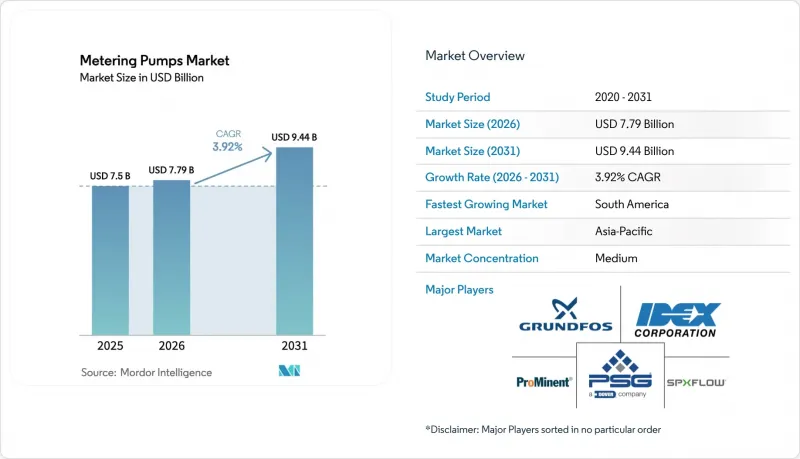
本報告按類型(隔膜式、齒輪式、旋轉葉片式等)、驅動方式(馬達驅動、電磁驅動等)、排放壓力(低於50巴、51-100巴等)、最終用戶(水處理、石油天然氣、化學、製藥等)和地區分類。市場預測以美元(USD)計價。
全球計量幫浦市場趨勢與洞察
亞洲嚴格的工業污水法規正在加速化學品的注入。
中國《水污染防治法》的重大修訂將於2024年實施,該修訂將廢水排放限值降低了40%,迫使約6.5萬家工廠安裝多個化學藥劑注入點並實施數位資料記錄。電鍍、紡織和製藥業的設備升級目前佔亞洲所有新增安裝量的35%,而支援工業物聯網(IIoT)的泵浦更受青睞,以滿足記錄保存要求(mee.gov.cn)。預計這些標準將在未來三年內推廣至東南亞和印度,推動計量幫浦市場需求的穩定成長。
供水事業的快速數字化轉型對供水精度提出了更高的要求。
已整合SCADA和物聯網平台的供水事業已證明,透過即時調節水泵劑量,可將化學品用量減少15%至22%。這項改變將更換週期從12年縮短至近8年,並將平均售價提高了四分之一。在面臨缺水問題的地區,例如美國西南部和西班牙部分地區,早期採用這些技術正逐步推進,以平衡水質保障和化學品成本控制。一種以預測性維護為中心的基於服務的收入模式正在興起,為供應商拓展了商機。
需要經常維護
機械隔膜泵通常每運作4000至6000小時就需要維護,而停機造成的連續生產中斷每小時可能造成5000至15000美元的損失。這種影響在新興市場尤其嚴重,因為這些市場普遍缺乏熟練的技術人員,一些企業開始考慮精度較低但維護需求較少的替代方案。
細分市場分析
到2025年,隔膜泵將佔全球銷售量的63.35%。其無洩漏設計使其適用於腐蝕性水處理化學品,從而在合規性要求極高的市場中佔據領先地位。隨著上游工程業者將注入壓力提高到100巴以上,柱塞/活塞幫浦市場正以每年7.02%的速度成長。這種差異表明,市場正向高壓細分領域轉移,在該領域,嚴苛條件下的流動穩定性比更高的生命週期成本更為重要。齒輪泵、旋轉葉片泵和蠕動泵則滿足更具體的需求,例如無脈動聚合物混合和衛生級藥品填充。
彈性體技術的最新進展使蠕動管的使用壽命延長了40%,從而提升了其在無菌計量管線中的應用價值。齒輪泵和LOBE泵在聚合物混煉領域持續廣泛應用,因為在該領域,連續、剪切控制的進料速率至關重要。這些趨勢共同促成了計量幫浦市場技術的多元化發展。
由於其結構堅固且易於整合到現有控制迴路中,馬達驅動裝置預計在2025年佔總銷售額的54.45%。電磁驅動幫浦雖然絕對值較小,但憑藉其能源效率和數位化原生設計,正以每年5.88%的速度成長。新型磁路結構將流量和壓力極限提高了約三分之一,同時降低了約30%的功耗。氣動和液壓驅動裝置在危險和電力匱乏的環境中仍然發揮作用,但其市場佔有率成長較為穩定。
電磁閥技術的演進,加上智慧水處理和化工廠的快速發展,使得這種架構成為計量泵市場到 2031 年的成長引擎。
區域分析
預計亞太地區將成為計量幫浦市場的主要驅動力,到2025年將佔全球銷售額的39.55%。中國最新的五年規劃包括對工業污水處理設施進行大規模維修,而印度的「飲用水生命線計畫」(Jal Jeevan Mission)則正在推動對農村地區水質改善的投資。新加坡和韓國高純度藥品產業的成長刺激了對撬裝式、數位化認證的計量模組的需求。雖然本土製造商在通用產品領域提供的價格低於進口產品,但歐美品牌在高壓和特殊材料產品領域仍佔據高階市場。
南美洲是成長最快的地區,預計到2031年複合年成長率將達到5.27%。巴西新的衛生法規正在推動氯處理和pH值控制技術的應用,而隨著製造業的擴張,其他南美國家也增加了溶劑回收和污水和設施的安裝。供應商正致力於開發電壓敏感型驅動器和簡化的維修套件,以適應當地的基礎設施。
北美和歐洲市場雖然成熟,但創新活動仍然活躍。這些地區的公共產業正主導水泵與雲端儀錶板的整合,並傾向於採用透過MQTT和OPC UA協議傳輸狀態資訊的解決方案。美國環保署(EPA)修訂了鉛和銅的相關法規,歐洲也收緊了PFAS排放標準,這些都提高了計量精度的基準值。同時,海灣國家和非洲乾旱地區的生產商正集中投資海水淡化和水資源再利用,從而帶來了耐腐蝕PVDF和超級雙相鋼泵的穩定訂單。
其他好處:
- Excel格式的市場預測(ME)表
- 3個月的分析師支持
目錄
第1章:引言
- 研究假設和市場定義
- 調查範圍
第2章:調查方法
第3章執行摘要
第4章 市場狀況
- 市場概覽
- 市場促進因素
- 亞洲嚴格的工業污水標準正在加速化學品的注入。
- 供水事業的快速數位化催生了對更智慧、更精準的配水方式的需求。
- 中東地區高價值園藝產業的施肥和灌溉蓬勃發展。
- 海洋中提高石油採收率(EOR)對化學注入的需求不斷增加。
- 在連續流製藥廠中擴大高純度原料藥撬裝設備的使用
- 化工廠的廣泛需求
- 市場限制因素
- 需要經常維護
- 對客製化(基於流體特性對設計進行微調)的需求日益成長
- 高黏度蠕動管路的空化風險阻礙了其廣泛應用。
- 低價中國假冒商品的流通給全球利潤率帶來了壓力。
- 價值供應鏈分析
- 監理展望
- 技術趨勢(利用工業物聯網和預測感測器的智慧藥物管理)
- 投資分析
- 波特五力模型
第5章 市場規模與成長預測
- 按類型
- 隔膜
- 活塞/柱塞
- 蠕動
- 齒輪
- 旋轉葉片
- 透過驅動機構
- 馬達驅動
- 螺線管驅動
- 液壓驅動
- 氣壓驅動
- 排氣壓力
- 50巴或更低
- 51~100 bar
- 101~150 bar
- 150巴或以上
- 泵材料類型
- 金屬(不鏽鋼、合金20、雙相鋼)
- 非金屬(PVC、PVDF、PP)
- 按最終用戶行業分類
- 水處理
- 石油和天然氣
- 化學處理
- 製藥
- 食品/飲料
- 紙漿和造紙
- 農業、施肥及灌溉
- 採礦和礦產
- 紡織品
- 發電及其他
- 按地區
- 北美洲
- 美國
- 加拿大
- 墨西哥
- 歐洲
- 英國
- 德國
- 法國
- 義大利
- 其他歐洲國家
- 亞太地區
- 中國
- 日本
- 印度
- 韓國
- 其他亞太國家
- 中東
- 以色列
- 沙烏地阿拉伯
- 阿拉伯聯合大公國
- 土耳其
- 其他中東國家
- 非洲
- 南非
- 埃及
- 其他非洲國家
- 南美洲
- 巴西
- 阿根廷
- 其他南美國家
- 北美洲
第6章 競爭情勢
- 市場集中度
- 策略趨勢
- 市佔率分析
- 公司簡介
- Grundfos Holding A/S
- IDEX Corporation
- PSG-Dover Corp.
- SPX Flow, Inc.
- LEWA GmbH(Nikkiso)
- ProMinent GmbH
- Milton Roy(Ingersoll Rand)
- Seko SpA
- Watson-Marlow Fluid Tech Grp.(Spirax-Sarco)
- Seepex GmbH
- Verder Group
- Blue-White Industries
- Xylem Inc.
- Flowserve Corporation
- Iwaki Co., Ltd.
- Netzsch Pumpen GmbH
- Atlas Copco(Lewa-Triplex)
- Roto Pumps Ltd.
- Haosh Pump Co.
- Swelore Engineering
- Tacmina Corp.
- Ingersoll Rand(Haskel)
- Idemitsu Kosan(Eagle Industry)
第7章 市場機會與未來展望
According to Mordor Intelligence, the metering pumps market size was valued at USD 7.5 billion in 2025 and estimated to grow from USD 7.79 billion in 2026 to reach USD 9.44 billion by 2031, at a CAGR of 3.92% during the forecast period (2026-2031).
This report is Segmented by Type (Diaphragm, Gear, Rotary Lobe, and More), Drive Mechanism (Motor-Driven, Solenoid-Driven, and More), Discharge Pressure (Up To 50 Bar, 51-100 Bar, and More), End-User (Water Treatment, Oil & Gas, Chemical Processing, Pharmaceuticals, and More), and Geography. The Market Forecasts are Provided in Terms of Value (USD).
Global Metering Pumps Market Trends and Insights
Strict Industrial Waste-water Norms Accelerating Chemical Dosing in Asia
Sweeping 2024 amendments to China's Water Pollution Prevention and Control Law cut allowable effluent loads by 40%, forcing roughly 65,000 factories to add multiple chemical dosing points and digital data logging. Upgrades across electroplating, textile, and pharma corridors now account for 35% of all new installs in Asia, with IIoT-ready pumps preferred to satisfy record-keeping mandates mee.gov.cn. These standards are expected to ripple through Southeast Asia and India over the next three years, underpinning consistent demand growth within the metering pumps market.
Rapid Digitalization of Water Utilities Demanding Smart Dosing Accuracy
Utilities integrating SCADA and IoT platforms have uncovered 15-22% chemical savings when pumps adjust doses in real time. The shift is shortening replacement cycles from 12 years to near 8 years and raising average selling prices by one-quarter. Regions facing water scarcity, such as the US Southwest and parts of Spain, are early adopters as they balance quality assurance with chemical cost control. Service-based revenue models around predictive maintenance are emerging, enlarging the opportunity set for vendors.
Requirement of Frequent Maintenance
Mechanical diaphragm pumps often need service after 4,000-6,000 hours, interrupting continuous processes that can lose USD 5,000-15,000 per hour during downtime. Emerging markets suffer most because skilled technicians are scarce, prompting some operators to consider less precise but lower-maintenance alternatives.
Other drivers and restraints analyzed in the detailed report include:
- Fertigation Boom in High-Value Horticulture across the Middle East
- Increasing Offshore Enhanced-Oil-Recovery Chemical Injection Needs
- Growing Customization Demands (Fluid-Property-Driven Design Tweaks)
For complete list of drivers and restraints, kindly check the Table Of Contents.
Segment Analysis
Diaphragm pumps controlled 63.35% of global revenue in 2025. Their leak-free architecture fits corrosive water-treatment chemistries, cementing leadership across compliance-driven markets. Plunger/piston models are expanding at 7.02% annually as upstream operators push injection pressures above 100 bar. This differential signals a migration toward high-pressure niches where flow stability under extreme conditions outweighs higher lifecycle costs. Gear, rotary lobe, and peristaltic designs address narrower needs such as pulse-free polymer blending or hygienic pharma fills.
Recent elastomer advances have extended peristaltic tube life by 40%, elevating their appeal in sterile dosing lines. Gear and lobe pumps maintain steady uptake in polymer compounding where continuous, shear-controlled feed rates matter. Collectively, these trends support a diverse technology mix inside the metering pumps market.
Motor-driven units captured 54.45% of 2025 sales thanks to rugged construction and simple integration with legacy control loops. Solenoid-driven pumps, though smaller in absolute value, are climbing 5.88% per year on the back of energy efficiency and digital-native design. New magnetic circuit geometries raise their flow and pressure ceiling by almost one-third while trimming power draw roughly 30%. Pneumatic and hydraulic drives retain roles in hazardous or power-poor sites, yet their share is stable rather than rising.
Solenoid evolution dovetails with the surge in smart water and chemical plants, positioning this architecture as a growth engine for the metering pumps market through 2031
Complete Report Scope:
- By Type
- Diaphragm
- Piston / Plunger
- Peristaltic
- Gear
- Rotary Lobe
- By Drive Mechanism
- Motor-Driven
- Solenoid-Driven
- Hydraulic-Driven
- Pneumatic-Driven
- By Discharge Pressure
- Up to 50 bar
- 51 - 100 bar
- 101 - 150 bar
- Above 150 bar
- By Pump Material
- Metallic (Stainless-steel, Alloy-20, Duplex)
- Non-Metallic (PVC, PVDF, PP)
- By End-User Industry
- Water Treatment
- Oil and Gas
- Chemical Processing
- Pharmaceuticals
- Food and Beverage
- Pulp and Paper
- Agriculture and Fertigation
- Mining and Minerals
- Textiles
- Power Generation and Others
- By Geography
- North America
- United States
- Canada
- Mexico
- Europe
- United Kingdom
- Germany
- France
- Italy
- Rest of Europe
- Asia-Pacific
- China
- Japan
- India
- South Korea
- Rest of Asia-Pacific
- Middle East
- Israel
- Saudi Arabia
- United Arab Emirates
- Turkey
- Rest of Middle East
- Africa
- South Africa
- Egypt
- Rest of Africa
- South America
- Brazil
- Argentina
- Rest of South America
- North America
Geography Analysis
Asia-Pacific dominated the metering pumps market with 39.55% of 2025 revenue. China's latest five-year plan earmarks widespread industrial effluent upgrades, while India's Jal Jeevan Mission drives rural water quality investments. High-purity pharma growth in Singapore and South Korea stimulates demand for skid-mounted, digitally certified dosing modules. Local manufacturers undercut imported models in commodity ranges, yet Western brands keep premium share in high-pressure or exotic-material builds.
South America is the fastest-growing geography at a 5.27% CAGR to 2031. Brazil's new sanitation law triggers chlorination and pH control rollouts, and other countries in South America export manufacturing sector increases solvent recycling and wastewater neutralization installations. Vendors emphasize voltage-tolerant drives and simplified service kits to suit local infrastructure.
North America and Europe are mature but innovation-intensive. Utility operators here spearhead integration of pumps with cloud-hosted dashboards, favoring solutions that broadcast status over MQTT or OPC UA. The US EPA's lead and copper rule revisions and Europe's tightening of PFAS discharge limits both raise dosing accuracy thresholds. Meanwhile, Gulf producers and arid African nations channel spending toward desalination and reuse, preserving a steady pipeline of orders for corrosion-resistant PVDF and super-duplex pumps.
- Grundfos Holding A/S
- IDEX Corporation
- PSG - Dover Corp.
- SPX Flow, Inc.
- LEWA GmbH (Nikkiso)
- ProMinent GmbH
- Milton Roy (Ingersoll Rand)
- Seko S.p.A
- Watson-Marlow Fluid Tech Grp. (Spirax-Sarco)
- Seepex GmbH
- Verder Group
- Blue-White Industries
- Xylem Inc.
- Flowserve Corporation
- Iwaki Co., Ltd.
- Netzsch Pumpen GmbH
- Atlas Copco (Lewa-Triplex)
- Roto Pumps Ltd.
- Haosh Pump Co.
- Swelore Engineering
- Tacmina Corp.
- Ingersoll Rand (Haskel)
- Idemitsu Kosan (Eagle Industry)
Additional Benefits:
- The market estimate (ME) sheet in Excel format
- 3 months of analyst support
TABLE OF CONTENTS
1 INTRODUCTION
- 1.1 Study Assumptions and Market Definition
- 1.2 Scope of the Study
2 RESEARCH METHODOLOGY
3 EXECUTIVE SUMMARY
4 MARKET LANDSCAPE
- 4.1 Market Overview
- 4.2 Market Drivers
- 4.2.1 Strict Industrial Waste-water Norms Accelerating Chemical Dosing in Asia
- 4.2.2 Rapid Digitalization of Water Utilities Demanding Smart Dosing Accuracy
- 4.2.3 Fertigation Boom in High-Value Horticulture across the Middle East
- 4.2.4 Increasing Offshore Enhanced-Oil-Recovery (EOR) Chemical Injection Needs
- 4.2.5 Growing Use of High-Purity API Skids in Continuous-Flow Pharma Plants
- 4.2.6 Extensive Demand from Chemical Plants
- 4.3 Market Restraints
- 4.3.1 Requirement of Frequent Maintenance
- 4.3.2 Growing Customization Demands (Fluid-Property-Driven Design Tweaks)
- 4.3.3 Cavitation Risk in High-Viscosity Peristaltic Lines Limiting Adoption
- 4.3.4 Availability of Low-cost Chinese Knock-offs Eroding Margins Globally
- 4.4 Value / Supply-Chain Analysis
- 4.5 Regulatory Outlook
- 4.6 Technological Outlook (IIoT-enabled Smart Dosing, Predictive Sensors)
- 4.7 Investment Analysis
- 4.8 Porter's Five Forces
- 4.8.1 Bargaining Power of Suppliers
- 4.8.2 Bargaining Power of Buyers
- 4.8.3 Threat of New Entrants
- 4.8.4 Threat of Substitutes
- 4.8.5 Intensity of Competitive Rivalry
5 MARKET SIZE AND GROWTH FORECASTS (VALUE)
- 5.1 By Type
- 5.1.1 Diaphragm
- 5.1.2 Piston / Plunger
- 5.1.3 Peristaltic
- 5.1.4 Gear
- 5.1.5 Rotary Lobe
- 5.2 By Drive Mechanism
- 5.2.1 Motor-Driven
- 5.2.2 Solenoid-Driven
- 5.2.3 Hydraulic-Driven
- 5.2.4 Pneumatic-Driven
- 5.3 By Discharge Pressure
- 5.3.1 Up to 50 bar
- 5.3.2 51 - 100 bar
- 5.3.3 101 - 150 bar
- 5.3.4 Above 150 bar
- 5.4 By Pump Material
- 5.4.1 Metallic (Stainless-steel, Alloy-20, Duplex)
- 5.4.2 Non-Metallic (PVC, PVDF, PP)
- 5.5 By End-User Industry
- 5.5.1 Water Treatment
- 5.5.2 Oil and Gas
- 5.5.3 Chemical Processing
- 5.5.4 Pharmaceuticals
- 5.5.5 Food and Beverage
- 5.5.6 Pulp and Paper
- 5.5.7 Agriculture and Fertigation
- 5.5.8 Mining and Minerals
- 5.5.9 Textiles
- 5.5.10 Power Generation and Others
- 5.6 By Geography
- 5.6.1 North America
- 5.6.1.1 United States
- 5.6.1.2 Canada
- 5.6.1.3 Mexico
- 5.6.2 Europe
- 5.6.2.1 United Kingdom
- 5.6.2.2 Germany
- 5.6.2.3 France
- 5.6.2.4 Italy
- 5.6.2.5 Rest of Europe
- 5.6.3 Asia-Pacific
- 5.6.3.1 China
- 5.6.3.2 Japan
- 5.6.3.3 India
- 5.6.3.4 South Korea
- 5.6.3.5 Rest of Asia-Pacific
- 5.6.4 Middle East
- 5.6.4.1 Israel
- 5.6.4.2 Saudi Arabia
- 5.6.4.3 United Arab Emirates
- 5.6.4.4 Turkey
- 5.6.4.5 Rest of Middle East
- 5.6.5 Africa
- 5.6.5.1 South Africa
- 5.6.5.2 Egypt
- 5.6.5.3 Rest of Africa
- 5.6.6 South America
- 5.6.6.1 Brazil
- 5.6.6.2 Argentina
- 5.6.6.3 Rest of South America
- 5.6.1 North America
6 COMPETITIVE LANDSCAPE
- 6.1 Market Concentration
- 6.2 Strategic Moves
- 6.3 Market Share Analysis
- 6.4 Company Profiles {(includes Global level Overview, Market level overview, Core Segments, Financials as available, Strategic Information, Market Rank/Share for key companies, Products and Services, and Recent Developments)}
- 6.4.1 Grundfos Holding A/S
- 6.4.2 IDEX Corporation
- 6.4.3 PSG - Dover Corp.
- 6.4.4 SPX Flow, Inc.
- 6.4.5 LEWA GmbH (Nikkiso)
- 6.4.6 ProMinent GmbH
- 6.4.7 Milton Roy (Ingersoll Rand)
- 6.4.8 Seko S.p.A
- 6.4.9 Watson-Marlow Fluid Tech Grp. (Spirax-Sarco)
- 6.4.10 Seepex GmbH
- 6.4.11 Verder Group
- 6.4.12 Blue-White Industries
- 6.4.13 Xylem Inc.
- 6.4.14 Flowserve Corporation
- 6.4.15 Iwaki Co., Ltd.
- 6.4.16 Netzsch Pumpen GmbH
- 6.4.17 Atlas Copco (Lewa-Triplex)
- 6.4.18 Roto Pumps Ltd.
- 6.4.19 Haosh Pump Co.
- 6.4.20 Swelore Engineering
- 6.4.21 Tacmina Corp.
- 6.4.22 Ingersoll Rand (Haskel)
- 6.4.23 Idemitsu Kosan (Eagle Industry)
7 MARKET OPPORTUNITIES AND FUTURE OUTLOOK
- 7.1 White-space and Unmet-Need Assessment

 2026年全球化肥注入幫浦市場報告
 計量幫浦市場分析及預測(至2035年):類型、產品類型、技術、應用、材質、最終用戶、功能、安裝配置、解決方案全球計量幫浦市場:機會與策略展望(至2035年)
 計量幫浦市場-2026-2032年全球市場預測
 2026-2030年全球計量幫浦市場
 計量幫浦市場規模、佔有率和趨勢分析報告:按類型、最終用途、地區和細分市場分類(2026-2033 年)
 計量幫浦市場報告:按類型、應用和地區分類(2026-2034 年)高純度波紋管幫浦市場:依驅動系統、流量範圍、材料、應用和終端用戶產業分類,全球預測,2026-2032年
 全球計量幫浦市場規模、佔有率、趨勢和成長分析報告(2026-2034)2026年全球計量幫浦市場報告