


 |
市場調查報告書
商品編碼
2124901
特種紙:市場佔有率分析、產業趨勢與統計、成長預測(2026-2031)Specialty Paper - Market Share Analysis, Industry Trends & Statistics, Growth Forecasts (2026 - 2031) |
||||||

※ 本網頁內容可能與最新版本有所差異。詳細情況請與我們聯繫。
據 Mordor Intelligence 稱,2025 年特種紙市值為 329.8 億美元,預計到 2031 年將達到 423.8 億美元,而 2026 年為 343.9 億美元,預測期(2026-2031 年)複合年成長率為 4.27%。
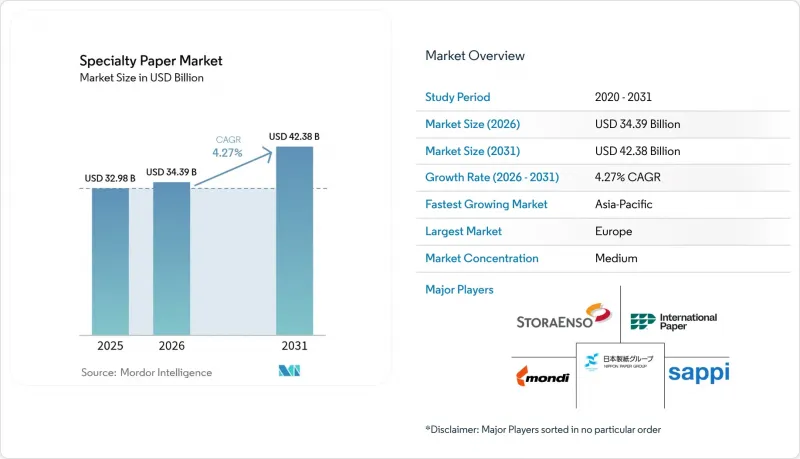
本報告按產品類型(牛皮紙、離型紙、其他)、原料(原生纖維、再生纖維、合成纖維、混合複合材料)、功能/塗層(阻隔性/耐油、抗菌、其他)、終端用戶行業(包裝和標籤、餐飲服務業、其他)、形態(捲材、片材、其他)和地區進行細分。市場預測以美元(USD)為單位。
全球特種紙市場趨勢與洞察
電子商務促進永續包裝
隨著品牌逐步淘汰塑膠包裝以滿足生產者延伸責任制 (EPR) 的要求,線上零售的快速成長正在加速二級和三級包裝的「紙質化」。零售商現在指定使用經認證的纖維、可回收材料和低紙張重量牛皮紙,以降低運輸成本,同時不影響貨物的完整性。持續的訂單處理推動了對可印刷牛皮紙信封和模塑纖維緩衝材料的需求,從而支撐了所有運輸類別的銷售穩步成長。製造商透過整合其牛皮紙生產設施,降低了原物料價格波動帶來的風險,並能靈活地將紙漿供應轉向快速成長的電商產品,從而提高了利潤率。
餐飲服務業向紡織品一次性產品的過渡
歐洲、北美和亞洲各大城市對一次性塑膠製品的法律禁令,正推動人們迅速轉向使用紡織餐具、杯子和翻蓋式容器。耐油阻隔技術的進步使紙質容器能夠承受高溫油脂和醬汁,幫助快餐店實現其堆肥目標。連鎖店層級的合約優先考慮使用再生材料,從而支持了回收和再製漿基礎設施的擴展。餐飲服務業通路需求的日益明朗,促使專門生產杯紙和輕量MG紙的造紙廠改造多台機器,提高產能運轉率。
紙漿價格波動與供應衝擊
芬蘭的勞資糾紛和造紙廠事故限制了供應,擠壓了特種紙的利潤空間,導致2024年4月基準北方漂白軟木牛皮紙的價格達到每噸1380歐元。現貨價格的飆升迫使非一體化加工商按季度調整價格,並面臨客戶流失的風險。氣候變遷導致的纖維供應中斷和新增產能有限預示著價格波動將持續,這提升了自有紙漿和長期木片合約的戰略價值。
細分市場分析
到2025年,牛皮紙將成為最大的銷售貢獻者,佔特種紙市佔率的31.60%。這主要得益於工業用袋、手提袋以及快速成長的電商信封的需求。僅瑞典卡爾斯堡工廠每年就生產33.5萬噸用於製袋的牛皮紙,凸顯了支撐其市場地位的規模經濟效益。目前,成長動能正轉向離型紙,預計到2031年,其年複合成長率(CAGR)將達到6.18%,主要得益於RFID標籤和數位印刷機的日益普及。智慧標籤需要極其光滑的表面和精確的密度控制,促使加工商從通用產品轉向客製化離型紙基材。裝飾紙和覆膜紙仍然佔據較大的市場佔有率,但正面臨數位裝飾膜的市場佔有率壓力。同時,由於嚴格的性能標準和內建的防偽功能,濾紙和安全紙在細分市場中仍然保持重要地位。
對高純度纖維和更嚴格的水分控制的結構性需求支撐著牛皮紙的長期產能,即便襯紙技術的創新創造了附加價值。儘管生產商正在透過產品系列多元化來對沖經濟波動風險,但他們目前仍優先考慮在資本配置中提高塗佈技術的柔軟性,以掌握襯紙市場的機會。特種紙市場的這種兩極化正在促成一種新的產品組合結構:傳統牛皮紙的產量為升級到下一代襯紙技術提供了資金支持。
截至2025年,原生纖維佔特種紙市場佔有率的48.40%,滿足高檔標籤、安全紙和醫療包裝材料所需的抗張強度和孔隙率標準。然而,隨著循環經濟要求推動再生材料含量標準化,以及棕色再生紙漿等級現已符合阻隔塗層包裝的規格,預計到2031年,再生纖維的複合年成長率將達到5.15%。雖然與合成和混合成分相關的特種紙市場規模仍然小規模,但這些材料能夠賦予產品獨特的性能,例如汽車墊片所需的耐溶劑性。
由竹子和農業廢棄物製成的非木漿,正透過新的酵素處理過程不斷改進,以減少二氧化矽污染。雖然其成本尚未與硬木片持平,限制了生產規模的擴大,但品牌所有者披露碳排放量的做法正在鼓勵更多企業進行試驗性生產。配備雙纖維系統的造紙廠可以透過調整原料配方來應對紙漿價格飆升,從而增強在價格劇烈波動時期的抗風險能力。
區域分析
2025年,歐洲仍將是特種紙市場最大的貢獻者,佔32.70%的市佔率。這得歸功於嚴格的環境法規加速了從塑膠到纖維的轉變。隨著造紙廠最佳化其熱電聯產(CHP)配置並簽署再生能源契約,紙張和紙板的月產量已從2023年的能源衝擊中恢復過來。德國和法國在環保油墨的採用和礦物油的逐步淘汰方面處於主導,這導致低誤用標籤紙的訂單激增。然而,不斷上漲的能源成本正在推動部分產能關閉,其中包括UPM位於埃特林根的工廠,該工廠計劃於2025年7月停止運作。諸如海因策爾集團收購斯太爾·阿瑪爾等產業重組表明,企業正在收緊資產基礎,專注於高利潤率等級的產品。
亞太地區是成長最快的地區,預計到2031年複合年成長率將達到6.05%。中國對瓦楞紙板原紙的需求復甦以及九龍紙業在馬來西亞的擴張表明,產能正在向南轉移,以充分利用鄰近的東協市場,預計瓦楞紙板市場將以每年4%的速度成長。日本和韓國的電子產品供應鏈正在推動對導電紙和防靜電紙的需求,而印度可支配收入水準的提高則促進了餐飲服務業對特種紙的需求。各地區政府都在實施獎勵策略,改善廢紙回收基礎設施,從而擴大再生纖維的供應,並促進區域特種紙的生產。
在北美,近岸外包和包裝自動化抵消了成熟出版業的下滑,從而實現了穩定的中位數個位數成長。金佰利公司20億美元的擴張計畫等投資項目,凸顯了人們對衛生紙和特種紙產能長期經濟可行性的信心。同時,像斯莫菲特·韋斯特羅克公司這樣的大型併購案正在整合瓦楞紙板行業,實現成本協同效應效應並擴大基本客群。美國南部地區接近性森林地區,且能源價格具有競爭力,因此吸引了待開發區紙漿項目,從而支持了能夠抵禦紙漿價格波動的一體化經營模式。
其他好處
- Excel格式的市場預測(ME)表
- 3個月的分析師支持
目錄
第1章:引言
- 研究假設和市場定義
- 調查範圍
第2章:調查方法
第3章執行摘要
第4章 市場狀況
- 市場概覽
- 市場促進因素
- 電子商務促進永續包裝
- 餐飲服務業向紡織品一次性產品的過渡
- 智慧標籤用離型紙的需求激增。
- 用於軟性印刷電子的基板
- 製藥業的安全與防偽紙張
- 不含 PFAS、藻類塗層、耐油等級
- 市場限制因素
- 紙漿價格波動與供應衝擊
- 加強對化學添加劑的監管
- 高透明度單材料塑膠薄膜
- 新興市場噴墨印表機普及延遲
- 重要法規結構的評估
- 工業生態系分析
- 波特五力分析
- 主要用例和案例研究
第5章 市場區隔
- 依產品類型
- 牛皮紙
- 發布文件
- 標籤和熱敏紙
- 裝飾紙和層壓紙
- 過濾器和安全紙
- 其他
- 按原料
- 原生光纖
- 再生纖維
- 合成纖維
- 混合複合材料
- 按功能和塗層
- 阻隔性和耐油性
- 防水
- 抗菌
- 導電性和抗靜電性能
- 阻燃劑
- 其他功能/塗層
- 按最終用戶行業分類
- 包裝和標籤
- 餐飲服務業
- 印刷/出版
- 建築/施工
- 工業和汽車
- 醫療保健
- 其他
- 按形式
- 卷
- 座位
- 加工產品(袋子、膠帶、杯子等)
- 按地區
- 北美洲
- 美國
- 加拿大
- 墨西哥
- 歐洲
- 英國
- 德國
- 法國
- 義大利
- 西班牙
- 北歐的
- 其他歐洲國家
- 亞太地區
- 中國
- 印度
- 日本
- 韓國
- ASEAN
- 澳洲
- 紐西蘭
- 亞太其他地區
- 南美洲
- 巴西
- 阿根廷
- 南美洲其他地區
- 中東和非洲
- 中東
- 沙烏地阿拉伯
- 阿拉伯聯合大公國
- 其他中東國家
- 非洲
- 南非
- 埃及
- 奈及利亞
- 其他非洲地區
- 中東
- 北美洲
第6章 競爭情勢
- 市場集中度
- 策略趨勢
- 市佔率分析
- 公司簡介
- Ahlstrom Corporation
- Asia Pulp and Paper(APP)Sinarmas
- BillerudKorsnas AB
- Domtar Corporation
- Fedrigoni SpA
- Georgia-Pacific LLC
- International Paper Company
- ITC Limited(Paperboards and Specialty Papers Division)
- JK Paper Ltd.
- Koehler Paper SE
- LINTEC Corporation
- Mondi plc
- Nippon Paper Industries Co., Ltd.
- Nordic Paper Holding AB
- Oji Holdings Corporation
- SAPPI Limited
- Smurfit WestRock Corporation
- Stora Enso Oyj
- Twin Rivers Paper Company LLC
- UPM-Kymmene Corporation
第7章 市場機會與未來展望
According to Mordor Intelligence, the specialty paper market size was valued at USD 32.98 billion in 2025 and estimated to grow from USD 34.39 billion in 2026 to reach USD 42.38 billion by 2031, at a CAGR of 4.27% during the forecast period (2026-2031).
This report is Segmented by Product Type (Kraft Paper, Release-Liner Paper, and More), Raw Material (Virgin Fiber, Recycled Fiber, Synthetic Fiber, and Hybrid Composites), Functionality (Barrier and Grease-Proof, Anti-Microbial, and More), End-User Industry (Packaging and Labeling, Food Service, and More), Form (Rolls, Sheets, and More), and Geography. The Market Forecasts are Provided in Terms of Value (USD).
Global Specialty Paper Market Trends and Insights
E-commerce Push for Sustainable Packaging
Rapid online retail growth is accelerating the "paperization" of secondary and tertiary packaging as brands phase out plastics to meet Extended Producer Responsibility mandates. Retailers now specify certified fiber, recyclable formats, and lower basis-weight kraft grades that reduce freight costs without compromising load integrity. Continuous order fulfillment drives demand for printable kraft mailers and molded-fiber cushioning, anchoring stable volume gains across shipping categories. Producers with integrated kraft assets capture margin upside because they can flex pulp streams toward high-growth e-commerce variants while mitigating raw-material shocks.
Food-Service Shift to Fiber-Based Disposables
Legislated single-use plastic bans in Europe, North America, and key Asian cities have triggered a swift migration to fiber utensils, cups, and clamshells. Advances in grease-proof barrier chemistries now enable paper containers to tolerate hot oils and sauces, allowing quick-service restaurants to meet compostability targets. Chain-level contracts prioritize post-consumer recycled content, supporting wider collection and re-pulping infrastructure. Volume visibility in food-service channels encourages multi-machine retrofits at mills specializing in cupstock and lightweight MG papers, boosting asset utilization.
Pulp-Price Volatility and Supply Shocks
Benchmark Northern Bleached Softwood Kraft touched EUR 1,380 per metric ton in April 2024 after labor actions in Finland and mill incidents curtailed supply, squeezing specialty margins. Spot price spikes force non-integrated converters to adjust pricing quarterly, risking customer churn. Climate-related fiber disruptions and limited greenfield capacity suggest enduring volatility, reinforcing the strategic value of captive pulp or long-term chip contracts.
Other drivers and restraints analyzed in the detailed report include:
- Smart-Label Release-Liner Demand Surge
- Flexible Printed-Electronics Substrates
- Chemical-Additive Regulatory Tightening
For complete list of drivers and restraints, kindly check the Table Of Contents.
Segment Analysis
Kraft grades generated the largest revenue contribution at 31.60% Specialty Paper market share in 2025, buoyed by industrial sacks, carrier bags, and burgeoning e-commerce mailers. The Karlsborg mill in Sweden alone produces 335,000 tons of sack kraft per year, underscoring the scale economics backing this position. Growth now tilts toward release-liner paper, which is forecast at a 6.18% CAGR through 2031 on the strength of RFID-enabled labels and rising digital press adoption. Smart labels require ultra-smooth calipers and calibrated density, steering converters toward engineered liner substrates and away from commodity options. Decor and laminating papers remain sizeable yet see share pressure from digital decor films, while filter and security papers preserve niche relevance through exacting performance criteria and embedded anti-counterfeit features.
Structural demand for high-purity fiber and tighter moisture control anchors long-term kraft capacity commitments even as liner innovations capture incremental value. Producers diversify grade slates to hedge against cyclical swings, but capital allocations now prioritize coating flexibility to address the liner opportunity. This bifurcation within the Specialty Paper Market fosters a portfolio mix where heritage kraft volumes finance next-wave liner technology upgrades.
Virgin fiber held 48.40% of the Specialty Paper market size in 2025 owing to tensile and porosity thresholds demanded by premium labels, security stock, and medical wraps. Yet recycled fiber is charting a 5.15% CAGR to 2031 as circular-economy mandates normalize recovered-content ratios and as brown recycled pulp grades reach specifications suitable for barrier-coated packaging. The Specialty Paper market size attached to synthetic and hybrid compositions remains modest, but these materials enable unique properties such as solvent resistance for automotive gaskets.
Non-wood pulps drawn from bamboo and agricultural residue are advancing through new enzymatic processes that mitigate silica contamination. Cost parity with hardwood chips remains elusive, constraining scale, yet brand-owner carbon disclosures are incentivizing trial volumes. Mills armed with dual-fiber systems can toggle furnish recipes to offset pulp pricing spikes, enhancing resilience during volatile cycles.
Complete Report Scope:
- By Product Type
- Kraft Paper
- Release-Liner Paper
- Label and Thermal Paper
- Decor and Laminating Paper
- Filter and Security Paper
- Others
- By Raw Material
- Virgin Fiber
- Recycled Fiber
- Synthetic Fiber
- Hybrid Composites
- By Functionality/Coating
- Barrier and Grease-Proof
- Water-Resistant
- Anti-microbial
- Conductive and Antistatic
- Fire-Retardant
- Other functionality/Coating
- By End-user Industry
- Packaging and Labeling
- Food Service
- Printing and Publication
- Building and Construction
- Industrial and Automotive
- Medical and Healthcare
- Other End-user Industries
- By Form
- Rolls
- Sheets
- Converted Products (Bags, Tapes, Cups, and More)
- By Geography
- North America
- United States
- Canada
- Mexico
- Europe
- United Kingdom
- Germany
- France
- Italy
- Spain
- Nordics
- Rest of Europe
- Asia-Pacific
- China
- India
- Japan
- South Korea
- ASEAN
- Australia
- New Zealand
- Rest of Asia-Pacific
- South America
- Brazil
- Argentina
- Rest of South America
- Middle East and Africa
- Middle East
- Saudi Arabia
- United Arab Emirates
- Rest of Middle East
- Africa
- South Africa
- Egypt
- Nigeria
- Rest of Africa
- Middle East
- North America
Geography Analysis
Europe remained the largest regional contributor at 32.70% Specialty Paper market share in 2025, underpinned by strict environmental statutes that accelerate conversion from plastics to fiber. Monthly paper and board output rebounded from the 2023 energy shock as mills optimized CHP configurations and locked in renewable electricity contracts. Germany and France lead eco-ink adoption and mineral-oil phase-outs, directing order flow toward low-migration label stock. Yet energy cost inflation has precipitated selective capacity closures, including UPM's Ettringen site slated to cease operations in July 2025. Consolidation, such as Heinzel Group's acquisition of Steyrermuhl, signals a tightening asset base geared toward higher-margin grades.
Asia-Pacific is the fastest-growing territory at a 6.05% CAGR to 2031. China's rebound in containerboard demand and Nine Dragons Paper's Malaysian expansion illustrate a southward capacity realignment that taps proximate ASEAN markets, predicting 4% cardboard growth per year. Electronics supply chains in Japan and South Korea spur demand for conductive and antistatic papers, while India's rising disposable-income levels lift specialty food-service grades. Regional governments channel stimulus into waste-paper collection infrastructure, broadening recycled-fiber availability that fuels local specialty conversions.
North America records steady mid-single-digit growth as nearshoring and packaging automation offset mature publishing segments. Investment programs such as Kimberly-Clark's USD 2 billion expansion underscore confidence in long-run tissue and specialty capacity economics. Simultaneously, mega-mergers like Smurfit WestRock consolidate corrugated integration, enabling cost synergies and wider customer reach. The US South attracts greenfield pulp projects due to forest proximity and competitive energy tariffs, supporting integrated models better positioned to weather pulp price gyrations.
- Ahlstrom Corporation
- Asia Pulp and Paper (APP) Sinarmas
- BillerudKorsnas AB
- Domtar Corporation
- Fedrigoni S.p.A.
- Georgia-Pacific LLC
- International Paper Company
- ITC Limited (Paperboards and Specialty Papers Division)
- JK Paper Ltd.
- Koehler Paper SE
- LINTEC Corporation
- Mondi plc
- Nippon Paper Industries Co., Ltd.
- Nordic Paper Holding AB
- Oji Holdings Corporation
- SAPPI Limited
- Smurfit WestRock Corporation
- Stora Enso Oyj
- Twin Rivers Paper Company LLC
- UPM-Kymmene Corporation
Additional Benefits:
- The market estimate (ME) sheet in Excel format
- 3 months of analyst support
TABLE OF CONTENTS
1 INTRODUCTION
- 1.1 Study Assumptions and Market Definition
- 1.2 Scope of the Study
2 RESEARCH METHODOLOGY
3 EXECUTIVE SUMMARY
4 MARKET LANDSCAPE
- 4.1 Market Overview
- 4.2 Market Drivers
- 4.2.1 E-commerce push for sustainable packaging
- 4.2.2 Food-service shift to fiber-based disposables
- 4.2.3 Smart-label release-liner demand surge
- 4.2.4 Flexible printed-electronics substrates
- 4.2.5 Security/anti-counterfeit papers in pharma
- 4.2.6 PFAS-free algae-coated grease-proof grades
- 4.3 Market Restraints
- 4.3.1 Pulp-price volatility and supply shocks
- 4.3.2 Chemical-additive regulatory tightening
- 4.3.3 High-clarity mono-material plastic films
- 4.3.4 Slow ink-jet press adoption in EMs
- 4.4 Evaluation of Critical Regulatory Framework
- 4.5 Industry Ecosystem Analysis
- 4.6 Porter's Five Forces Analysis
- 4.6.1 Bargaining Power of Suppliers
- 4.6.2 Bargaining Power of Buyers
- 4.6.3 Threat of New Entrants
- 4.6.4 Threat of Substitutes
- 4.6.5 Competitive Rivalry
- 4.7 Key Use Cases and Case Studies
5 MARKET SEGMENTATION
- 5.1 By Product Type
- 5.1.1 Kraft Paper
- 5.1.2 Release-Liner Paper
- 5.1.3 Label and Thermal Paper
- 5.1.4 Decor and Laminating Paper
- 5.1.5 Filter and Security Paper
- 5.1.6 Others
- 5.2 By Raw Material
- 5.2.1 Virgin Fiber
- 5.2.2 Recycled Fiber
- 5.2.3 Synthetic Fiber
- 5.2.4 Hybrid Composites
- 5.3 By Functionality/Coating
- 5.3.1 Barrier and Grease-Proof
- 5.3.2 Water-Resistant
- 5.3.3 Anti-microbial
- 5.3.4 Conductive and Antistatic
- 5.3.5 Fire-Retardant
- 5.3.6 Other functionality/Coating
- 5.4 By End-user Industry
- 5.4.1 Packaging and Labeling
- 5.4.2 Food Service
- 5.4.3 Printing and Publication
- 5.4.4 Building and Construction
- 5.4.5 Industrial and Automotive
- 5.4.6 Medical and Healthcare
- 5.4.7 Other End-user Industries
- 5.5 By Form
- 5.5.1 Rolls
- 5.5.2 Sheets
- 5.5.3 Converted Products (Bags, Tapes, Cups, and More)
- 5.6 By Geography
- 5.6.1 North America
- 5.6.1.1 United States
- 5.6.1.2 Canada
- 5.6.1.3 Mexico
- 5.6.2 Europe
- 5.6.2.1 United Kingdom
- 5.6.2.2 Germany
- 5.6.2.3 France
- 5.6.2.4 Italy
- 5.6.2.5 Spain
- 5.6.2.6 Nordics
- 5.6.2.7 Rest of Europe
- 5.6.3 Asia-Pacific
- 5.6.3.1 China
- 5.6.3.2 India
- 5.6.3.3 Japan
- 5.6.3.4 South Korea
- 5.6.3.5 ASEAN
- 5.6.3.6 Australia
- 5.6.3.7 New Zealand
- 5.6.3.8 Rest of Asia-Pacific
- 5.6.4 South America
- 5.6.4.1 Brazil
- 5.6.4.2 Argentina
- 5.6.4.3 Rest of South America
- 5.6.5 Middle East and Africa
- 5.6.5.1 Middle East
- 5.6.5.1.1 Saudi Arabia
- 5.6.5.1.2 United Arab Emirates
- 5.6.5.1.3 Rest of Middle East
- 5.6.5.2 Africa
- 5.6.5.2.1 South Africa
- 5.6.5.2.2 Egypt
- 5.6.5.2.3 Nigeria
- 5.6.5.2.4 Rest of Africa
- 5.6.5.1 Middle East
- 5.6.1 North America
6 COMPETITIVE LANDSCAPE
- 6.1 Market Concentration
- 6.2 Strategic Moves
- 6.3 Market Share Analysis
- 6.4 Company Profiles (includes Global level Overview, Market level overview, Core Segments, Financials as available, Strategic Information, Market Rank/Share for key companies, Products and Services, and Recent Developments)
- 6.4.1 Ahlstrom Corporation
- 6.4.2 Asia Pulp and Paper (APP) Sinarmas
- 6.4.3 BillerudKorsnas AB
- 6.4.4 Domtar Corporation
- 6.4.5 Fedrigoni S.p.A.
- 6.4.6 Georgia-Pacific LLC
- 6.4.7 International Paper Company
- 6.4.8 ITC Limited (Paperboards and Specialty Papers Division)
- 6.4.9 JK Paper Ltd.
- 6.4.10 Koehler Paper SE
- 6.4.11 LINTEC Corporation
- 6.4.12 Mondi plc
- 6.4.13 Nippon Paper Industries Co., Ltd.
- 6.4.14 Nordic Paper Holding AB
- 6.4.15 Oji Holdings Corporation
- 6.4.16 SAPPI Limited
- 6.4.17 Smurfit WestRock Corporation
- 6.4.18 Stora Enso Oyj
- 6.4.19 Twin Rivers Paper Company LLC
- 6.4.20 UPM-Kymmene Corporation
7 MARKET OPPORTUNITIES AND FUTURE OUTLOOK
- 7.1 White-space and Unmet-need Assessment

 特種紙市場規模、佔有率、成長、全球產業分析、區域趨勢及2026年至2034年預測。
 特種紙市場:2026-2032年全球市場預測(依產品類型、材料類型、紙張重量、原料、應用及產業分類)
 商業票據市場規模、佔有率和成長分析:按發行人、期限、幣種、發行類型、信用評級、投資者類型、最終用途、銷售管道和地區分類-2026-2033年產業預測
 特種紙市場:依產品類型、應用、終端用戶產業及地區分類
 特種紙市場規模、佔有率、趨勢和預測:按類型、原料、應用和地區分類,2026-2034年
 藍曬紙市場規模、佔有率和趨勢分析報告:按產品、應用、地區和細分市場分類(2026-2033 年)全球苔蘚瑪瑙市場:市場規模、佔有率和趨勢分析(按等級、應用和地區分類),細分市場預測(2026-2033 年)全球特種紙市場規模、佔有率、趨勢和成長分析報告(2026-2034年)全球矽基紙市場規模、佔有率、趨勢和成長分析報告(2026-2034)
 2026-2030年全球農業地膜市場