


 |
市場調查報告書
商品編碼
2124838
商用車遠端資訊處理:市場佔有率分析、產業趨勢與統計及成長預測(2026-2031 年)Commercial Vehicle Telematics - Market Share Analysis, Industry Trends & Statistics, Growth Forecasts (2026 - 2031) |
||||||

※ 本網頁內容可能與最新版本有所差異。詳細情況請與我們聯繫。
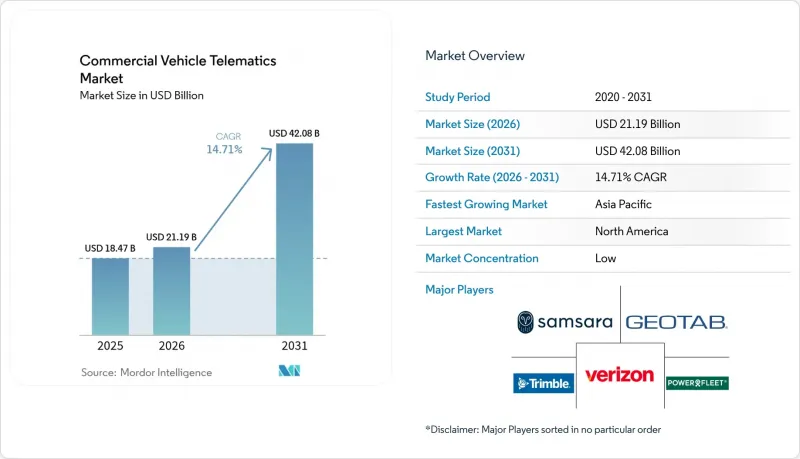
根據 Mordor Intelligence 預測,商用車遠端資訊處理市場規模將從 2025 年的 184.7 億美元成長到 2026 年的 211.9 億美元,到 2031 年達到 420.8 億美元,2026 年至 2031 年的複合年成長率為 14.71%。
本報告按產品/服務(解決方案、服務)、供應商類型(OEM、售後市場)、車輛類別(重型和中型商用車、其他)、通訊技術(蜂窩、衛星、混合)、終端用戶行業(公共產業、保險和租賃、其他)以及地區進行細分。市場預測以美元計價。
全球商用車遠端資訊處理市場趨勢與洞察
重型卡車中工廠出貨時裝載OEM車載資訊系統的應用日益普及
卡車製造商如今正在組裝上標準化部署遠端資訊處理單元,使車隊營運商能夠即時存取車輛數據,無需像後期改裝那樣耗費停機時間。例如,戴姆勒卡車將其「TruckCharge」軟體與工廠預裝設備整合,使營運商能夠微調電動牽引車的充電點。沃爾沃卡車已擁有超過一百萬輛連網重型車輛,透過傳輸診斷數據,減少了意外故障和燃油浪費。 TRATON 報告稱,旗下斯堪尼亞、曼恩和納威司達三大品牌共有 115 萬輛連網卡車,並透過數據訂閱來提高獲利能力。雖然工廠整合降低了每輛卡車的終身硬體成本,但當車隊運營多個品牌的卡車時,這也提高了品牌轉換的門檻,迫使軟體供應商將來自多個原始設備製造商 (OEM) 的數據整合到一個統一的控制面板中。
強制性電子駕駛記錄器(ELD)和安全法規
世界各國政府都在強制要求安裝電子記錄設備來監控駕駛人的工作時間,這使得遠端資訊處理成為一項強制性要求,而非可選項。美國聯邦汽車運輸安全管理局 (FMCSA) 在路邊審核期間直接從駕駛室設備提取工作時間記錄文件。歐洲智慧行車記錄器的升級符合《工作時間指令》,車隊必須在 2026 年前更換第一代記錄設備。印度運輸部強制要求在卡車和巴士上安裝位置追蹤裝置和緊急按鈕,這加速了價格敏感型市場對該技術的普及。雖然遵守地區不同的標準會增加工程成本,但法規的存在保證了供應商的設備最低需求。
連網商用車的網路安全漏洞
車輪上的電腦系統使煞車、轉向和載貨系統面臨駭客攻擊的風險。儘管歐盟WP.29法規要求卡車製造商認證其安全開發實踐並在整個生命週期內進行修補更新,但數百萬輛老舊車輛仍缺乏加密的引導程式。歐盟網路安全局發布的一份2025年報告警告稱,如果加密金鑰管理不善,空中下載更新可能會提供新的攻擊管道。備受矚目的安全漏洞可能會危及車輛運行和貨物安全,而規避風險的小規模企業可能會推遲投資,直到供應商開始提供捆綁式入侵偵測和網路保險。隨著安全升級增加終端成本,買家正在權衡價格上漲與潛在的法律責任。
細分市場分析
2025年,解決方案將佔商用車遠端資訊處理市場收入的63.42%,涵蓋車輛追蹤、駕駛管理、保險遠端資訊處理、合規性、車聯網(V2X)、預測性維護和資產監控等領域。由於營運商更傾向於可預測的營運預算而非資本支出,預計到2031年,服務領域的複合年成長率將達到15.11%,高於整體市場水準。商用車遠端資訊處理市場的託管服務領域正在蓬勃發展,供應商已採用一種新模式,將硬體、通訊費用、分析和支援服務打包到一張發票中,並根據車輛數量採用不同的定價方式。
車輛追蹤仍然是最大的解決方案領域,但隨著停機造成的損失不斷增加,預測性維護的重要性也日益凸顯。對於需要將傳統調度系統與現代雲端控制面板整合的大型、多樣化車隊而言,系統整合和客製化分析等專業服務至關重要。對於缺乏專職IT人員的小規模營運商來說,託管服務正日益受到青睞,他們與提供運作保證、遠程故障排除和合規性報告的供應商簽訂契約,同時最大限度地減少操作員的干預。
預計到2025年,OEM通路將佔總收入的58.71%,因為所有新型重型卡車平台都將在出廠時預先安裝相關設備。同時,售後市場供應商預計將以15.14%的複合年成長率成長,這主要得益於用於維修老舊車輛的改裝套件,這些套件在許多區域性和專業應用領域仍然佔據主導地位。商用車遠端資訊處理市場仍存在分歧,營運商面臨兩難:一方面是與OEM設備進行深度車聯網整合,另一方面是採用廠商中立且創新週期快速的售後市場插件。
對於擁有多個品牌的車隊而言,能夠將不同廠商的資料饋送整合到單一使用者介面中的中間件,無疑會減輕調度員的工作負擔。為此,廠商紛紛開放API介面,並聯合銷售可與主流售後市場儀錶板整合的混合軟體包。這種「競合」模式既能讓卡車製造商保持其在硬體標準化方面的優勢,又能滿足車隊對跨品牌、跨年份車型的一致分析結果的需求。
區域分析
受嚴格的駕駛時間法規和廣泛覆蓋的高密度行動電話網路的推動,北美預計將在2025年佔據商用車遠端資訊處理市場34.66%的收入佔有率。隨著主要營運商的市場佔有率基本飽和,未來的成長將主要由市政當局、郵政服務機構和小規模車隊推動,他們將選擇託管服務合約而非自行部署軟體。電池電動送貨卡車的日益普及,尤其是在加州的監管區域,推動了對整合式能源管理儀錶板的需求,這些儀表板能夠預測續航里程並引導駕駛員前往充電站。儘管加拿大北部和墨西哥南部農村地區的通訊網路不足,跨境業者仍在透過統一的合規入口網站協調其在美國、加拿大和墨西哥的業務運作。
亞太地區預計將成為成長最快的地區,到2031年複合年成長率將達到15.78%。在中國,聯網汽車目標正在強制執行,要求汽車製造商(OEM)整合相關設備;同時,國內主要物流公司正在將遠端資訊處理技術與倉庫自動化和共享貨運平台結合。在印度,強制性緊急按鈕和位置追蹤功能的實施消除了成本障礙,促使數百萬輛卡車和巴士部署了基本單元。日本正在利用路線最佳化演算法解決司機短缺問題,而韓國則在投資建造基於5G的智慧物流走廊。儘管農村地區網路覆蓋不足和低成本本地供應商的湧現限制了每輛車的平均收入,但銷量的成長正在抵消價格不利因素的影響,並推動全部區域整體支出的成長。
在歐洲,車載資訊系統的成熟應用與嚴格的資料隱私和網路安全法規並存。第二階段數位式行車記錄器的升級、低排放氣體區獎勵以及零排放卡車的推廣,都推動了系統的更新迭代。營運商正在增加對軟體定義服務的採購,以便在不更換硬體的情況下利用高級分析功能,這與沃爾沃和戴姆勒的空中升級策略相契合。隨著大規模車隊的廣泛應用接近尾聲,成長速度有所放緩,促使供應商開始提升銷售針對商用車車載資訊系統市場客製化的管理分析和電池最佳化模組。東歐的公路貨運量不斷成長,為運輸路線提供了尚未開發的機遇,但其互聯互通的普及率仍低於西歐的平均水準。
南美洲和中東/非洲雖然規模較小,但綜合成長率也達到了15%左右。巴西人口稠密的農產品綜合企業走廊需要對偏遠人工林的資產進行追蹤,但宏觀經濟波動正在減緩資本預算的擴張。海灣合作理事會(GCC)成員國正在投資智慧城市貨運舉措,這些項目結合了遠端資訊處理、自動收費和綠色區域管理規定。非洲的網路覆蓋範圍仍然是一個挑戰,但南非和波札那的礦業公司正在部署衛星連接終端來管理高價值設備。埃及和沙烏地阿拉伯的政府車輛數位化計畫正在加速公共部門的採用,為國際供應商創造了龐大的基本客群。
其他好處
- Excel格式的市場預測(ME)表
- 3個月的分析師支持
目錄
第1章:引言
- 研究假設和市場定義
- 調查範圍
第2章:調查方法
第3章執行摘要
第4章 市場狀況
- 市場概覽
- 市場促進因素
- 擴大重型卡車工廠工廠出貨時裝載的OEM 車載資訊系統的應用。
- 強制性電子駕駛記錄器(ELD)和安全法規
- 市場對人工智慧驅動的車輛營運最佳化的需求日益成長,以降低整體擁有成本(TCO)。
- 電子商務最後一公里配送車輛的快速擴張
- 訂閱式遠端資訊處理資料市場的興起
- 零排放卡車的遠端資訊處理和能源充電管理整合
- 市場限制因素
- 連網商用車的網路安全漏洞
- 發展中地區通訊基礎設施分散
- 小規模車輛所有者對成本和投資回報率的擔憂
- 與資料所有權和隱私合規相關的障礙
- 產業價值鏈分析
- 監理情勢
- 技術展望
- 宏觀經濟因素對市場的影響
- 波特五力分析
第5章 市場規模與成長預測
- 透過提供
- 解決方案
- 車輛追蹤和監控
- 駕駛員管理
- 保險遠端資訊處理
- 安全與合規
- V2X解決方案
- 預測性維護和診斷
- 資產和拖車追蹤
- 服務
- 專業服務
- 託管服務
- 解決方案
- 按提供者類型
- OEM
- 售後市場
- 按車輛類別
- 輕型商用車
- 大型/中型商用車輛
- 透過通訊技術
- 細胞
- 衛星
- 混合
- 按最終用戶行業分類
- 運輸/物流
- 建築和採礦
- 公共部門及緊急服務
- 公共產業
- 保險和租賃
- 零售與電子商務
- 其他終端用戶產業
- 按地區
- 北美洲
- 美國
- 加拿大
- 墨西哥
- 南美洲
- 巴西
- 阿根廷
- 南美洲其他地區
- 歐洲
- 英國
- 德國
- 法國
- 義大利
- 其他歐洲國家
- 亞太地區
- 中國
- 日本
- 印度
- 韓國
- 亞太其他地區
- 中東和非洲
- 中東
- 阿拉伯聯合大公國
- 沙烏地阿拉伯
- 其他中東國家
- 非洲
- 南非
- 埃及
- 其他非洲地區
- 中東
- 北美洲
第6章 競爭情勢
- 市場集中度
- 策略趨勢
- 市佔率分析
- 公司簡介
- Verizon Communications Inc.
- Geotab Inc.
- Samsara Inc.
- Trimble Inc.
- Vontier Corporation
- Powerfleet Inc.
- Omnitracs LLC
- Lytx Inc.
- CalAmp Corp.
- Webfleet Solutions
- PTC Inc.
- Octo Telematics SpA
- Zonar Systems, Inc.
- Gurtam Inc.
- Motive Technologies Inc.
- GPS Insight
- Semtech Corporation
- Cartrack Holdings Limited
- Vehicle Tracking Solutions, LLC
- Azuga Inc.
- Platform Science, Inc.
第7章 市場機會與未來展望
According to Mordor Intelligence, the commercial vehicle telematics market size is expected to increase from USD 18.47 billion in 2025 to USD 21.19 billion in 2026 and reach USD 42.08 billion by 2031, growing at a CAGR of 14.71% over 2026-2031.
This report is Segmented by Offering (Solutions and Services), Provider Type (Original Equipment Manufacturer, and Aftermarket), Vehicle Class (Heavy and Medium Commercial Vehicles, and More), Communication Technology (Cellular, Satellite, Hybrid), End-User Vertical (Utilities, Insurance and Leasing, and More), and Geography. The Market Forecasts are Provided in Terms of Value (USD).
Global Commercial Vehicle Telematics Market Trends and Insights
Increasing Adoption of Factory-Installed OEM Telematics in Heavy Trucks
Truck makers now pre-install telematics units on the assembly line, giving fleets instant access to vehicle data without downtime for retrofits. Daimler Truck, for instance, links its TruckCharge software to factory devices so operators fine-tune charging stops for electric tractors. Volvo Trucks surpassed one million connected heavy units, streaming diagnostics that cut surprise breakdowns and fuel waste. TRATON reported 1.15 million connected trucks across its Scania, MAN, and Navistar brands, turning data subscriptions into a margin lever. Factory integration lowers lifetime hardware cost per truck, yet raises switching barriers when fleets run mixed brands, pushing software vendors to aggregate multiple OEM feeds in one dashboard.
Mandatory Electronic Logging-Device and Safety Regulations
Governments require electronic logging devices to police driver hours, making telematics compulsory rather than optional. The Federal Motor Carrier Safety Administration conducts roadside audits that pull hours-of-service files directly from cab units. Europe's smart tachograph upgrade aligns with working-time directives, forcing fleets to replace first-generation recorders by 2026. India's transport ministry mandates location tracking and an emergency button on trucks and buses, accelerating adoption across a price-sensitive market. Complying with different regional standards inflates engineering costs, but the rulebook still guarantees baseline device demand for vendors.
Cyber-Security Vulnerabilities in Connected Commercial Vehicles
Rolling computers on wheels expose braking, steering, and payload systems to hackers. The European Union's WP.29 regulation now obliges truck makers to certify secure development practices and ensure life-cycle patching, but millions of legacy units lack encrypted boot loaders. A 2025 report from the EU Agency for Cybersecurity warns that over-the-air updates introduce new attack vectors if cryptographic keys are poorly managed. High-profile breaches could immobilize fleets or compromise cargo, delaying investment among risk-averse small operators until vendors add intrusion detection and bundled cyber insurance. As security hardening raises device cost, buyers weigh the price premium against potential liability.
Other drivers and restraints analyzed in the detailed report include:
- Demand for AI-Driven Fleet Optimisation to Cut Total Cost of Ownership
- Rapid Expansion of Last-Mile E-Commerce Delivery Fleets
- Fragmented Connectivity Infrastructure in Developing Regions
For complete list of drivers and restraints, kindly check the Table Of Contents.
Segment Analysis
Solutions held 63.42% of commercial vehicle telematics market revenue in 2025, covering tracking, driver management, insurance telematics, compliance, V2X, predictive maintenance, and asset monitoring. Services are projected to outpace the overall market, with a 15.11% CAGR to 2031, as operators prefer predictable operating budgets to capital outlays. The commercial vehicle telematics market for managed services is growing as vendors now bundle hardware, airtime, analytics, and support into a single invoice that scales with fleet count.
Fleet tracking remains the largest solution subset, yet predictive maintenance gains ground as downtime penalties escalate. Professional services such as system integration and custom analytics are critical for large, mixed-asset fleets that link legacy dispatch systems with modern cloud dashboards. Managed offerings resonate with small carriers lacking full-time IT staff, tipping contract awards toward providers that guarantee uptime, remote troubleshooting, and compliance reporting with minimal operator intervention.
OEM channels accounted for 58.71% of revenue in 2025 because factory-installed units are shipped with every new heavy truck platform. Meanwhile, aftermarket vendors post a 15.14% CAGR as retrofit kits modernize older vehicles that still dominate many regional haul and vocational operations. The commercial vehicle telematics market share remains split as operators weigh deep vehicle-network integration from OEM devices against the vendor neutrality and faster innovation cadence of aftermarket plugs.
Mixed-brand fleets welcome middleware that consolidates proprietary OEM data feeds under a single user interface, reducing dispatcher workload. OEMs respond by opening APIs and co-marketing hybrid packages with leading aftermarket dashboards. This coopetition model preserves hardware standardization leverage for truck builders while satisfying fleets that demand analytics uniformity across diverse brands and model years.
Complete Report Scope:
- By Offering
- Solutions
- Fleet Tracking and Monitoring
- Driver Management
- Insurance Telematics
- Safety and Compliance
- V2X Solutions
- Predictive Maintenance and Diagnostics
- Asset and Trailer Tracking
- Services
- Professional Services
- Managed Services
- Solutions
- By Provider Type
- Original Equipment Manufacturer
- Aftermarket
- By Vehicle Class
- Light Commercial Vehicles
- Heavy and Medium Commercial Vehicles
- By Communication Technology
- Cellular
- Satellite
- Hybrid
- By End-User Vertical
- Transportation and Logistics
- Construction and Mining
- Public Sector and Emergency Services
- Utilities
- Insurance and Leasing
- Retail and E-Commerce
- Other End-User Verticals
- By Geography
- North America
- United States
- Canada
- Mexico
- South America
- Brazil
- Argentina
- Rest of South America
- Europe
- United Kingdom
- Germany
- France
- Italy
- Rest of Europe
- Asia Pacific
- China
- Japan
- India
- South Korea
- Rest of Asia Pacific
- Middle East and Africa
- Middle East
- United Arab Emirates
- Saudi Arabia
- Rest of Middle East
- Africa
- South Africa
- Egypt
- Rest of Africa
- Middle East
- North America
Geography Analysis
North America retained 34.66% of the commercial vehicle telematics market revenue in 2025, owing to strict hours-of-service enforcement and dense cellular coverage. Large enterprise haulers have largely completed rollouts, so incremental growth stems from municipal, postal, and small-fleet segments that sign managed-service deals rather than self-hosting software. The rising adoption of battery-electric delivery trucks, particularly in California compliance zones, is boosting demand for integrated energy-management dashboards that forecast range and direct drivers to charging stations. Cross-border carriers link United States, Canadian, and Mexican operations under unified compliance portals despite patchy rural coverage in northern Canada and southern Mexico.
Asia-Pacific carries the fastest 15.78% CAGR through 2031. China enforces connected-vehicle targets that compel OEMs to embed devices, while domestic logistics giants integrate telematics with warehouse automation and ride-hailing style freight platforms. India's emergency-button and location-tracking mandate removes cost-sensitive barriers, pushing basic units into millions of trucks and buses. Japan combats driver shortages with route-optimization algorithms, and South Korea funds 5G-based smart logistics corridors. Rural coverage gaps and the prevalence of low-cost local suppliers temper average revenue per unit, but volume outweighs pricing headwinds, expanding total regional spend.
Europe combines mature adoption with stringent data privacy and cybersecurity rules. Digital tachograph stage-II upgrades, low-emission zones, and zero-emission truck incentives keep replacement cycles brisk. Operators increasingly purchase software-defined services that unlock enhanced analytics without swapping hardware, aligning with over-the-air update strategies from Volvo and Daimler. Growth moderates as large fleets complete full penetration, pushing vendors to upsell managed analytics and battery optimization modules tied to the commercial vehicle telematics market. Eastern European corridors offer white-space opportunities where road freight is rising, but connectivity penetration still trails Western averages.
South America, the Middle East, and Africa collectively post mid-teens growth from smaller bases. Brazil's dense agribusiness corridors demand asset tracking across remote plantations, yet macro-economic volatility slows capital budgets. Gulf Cooperation Council states invest in smart-city freight initiatives that bundle telematics with automated tolling and green-zone enforcement. Africa's challenge remains network coverage, although mining companies in South Africa and Botswana adopt satellite-linked units to manage high-value equipment. Government fleet-digitization programs across Egypt and Saudi Arabia spur public-sector uptake, providing anchor accounts for international vendors.
- Verizon Communications Inc.
- Geotab Inc.
- Samsara Inc.
- Trimble Inc.
- Vontier Corporation
- Powerfleet Inc.
- Omnitracs LLC
- Lytx Inc.
- CalAmp Corp.
- Webfleet Solutions
- PTC Inc.
- Octo Telematics SpA
- Zonar Systems, Inc.
- Gurtam Inc.
- Motive Technologies Inc.
- GPS Insight
- Semtech Corporation
- Cartrack Holdings Limited
- Vehicle Tracking Solutions, LLC
- Azuga Inc.
- Platform Science, Inc.
Additional Benefits:
- The market estimate (ME) sheet in Excel format
- 3 months of analyst support
TABLE OF CONTENTS
1 INTRODUCTION
- 1.1 Study Assumptions and Market Definition
- 1.2 Scope of the Study
2 RESEARCH METHODOLOGY
3 EXECUTIVE SUMMARY
4 MARKET LANDSCAPE
- 4.1 Market Overview
- 4.2 Market Drivers
- 4.2.1 Increasing Adoption of Factory-Installed OEM Telematics in Heavy Trucks
- 4.2.2 Mandatory Electronic Logging-Device and Safety Regulations
- 4.2.3 Demand for AI-Driven Fleet Optimisation to Cut Total Cost of Ownership
- 4.2.4 Rapid Expansion of Last-Mile E-Commerce Delivery Fleets
- 4.2.5 Emergence of Subscription-Based Telematics Data Marketplaces
- 4.2.6 Integration of Telematics with Zero-Emission Truck Energy and Charge Management
- 4.3 Market Restraints
- 4.3.1 Cyber-Security Vulnerabilities in Connected Commercial Vehicles
- 4.3.2 Fragmented Connectivity Infrastructure in Developing Regions
- 4.3.3 Cost and ROI Concerns for Small Fleet Operators
- 4.3.4 Data-Ownership and Privacy-Compliance Hurdles
- 4.4 Industry Value Chain Analysis
- 4.5 Regulatory Landscape
- 4.6 Technological Outlook
- 4.7 Impact of Macroeconomic Factors on the Market
- 4.8 Porter's Five Forces Analysis
- 4.8.1 Threat of New Entrants
- 4.8.2 Bargaining Power of Buyers/Consumers
- 4.8.3 Bargaining Power of Suppliers
- 4.8.4 Threat of Substitute Products
- 4.8.5 Intensity of Competitive Rivalry
5 MARKET SIZE AND GROWTH FORECASTS (VALUE)
- 5.1 By Offering
- 5.1.1 Solutions
- 5.1.1.1 Fleet Tracking and Monitoring
- 5.1.1.2 Driver Management
- 5.1.1.3 Insurance Telematics
- 5.1.1.4 Safety and Compliance
- 5.1.1.5 V2X Solutions
- 5.1.1.6 Predictive Maintenance and Diagnostics
- 5.1.1.7 Asset and Trailer Tracking
- 5.1.2 Services
- 5.1.2.1 Professional Services
- 5.1.2.2 Managed Services
- 5.1.1 Solutions
- 5.2 By Provider Type
- 5.2.1 Original Equipment Manufacturer
- 5.2.2 Aftermarket
- 5.3 By Vehicle Class
- 5.3.1 Light Commercial Vehicles
- 5.3.2 Heavy and Medium Commercial Vehicles
- 5.4 By Communication Technology
- 5.4.1 Cellular
- 5.4.2 Satellite
- 5.4.3 Hybrid
- 5.5 By End-User Vertical
- 5.5.1 Transportation and Logistics
- 5.5.2 Construction and Mining
- 5.5.3 Public Sector and Emergency Services
- 5.5.4 Utilities
- 5.5.5 Insurance and Leasing
- 5.5.6 Retail and E-Commerce
- 5.5.7 Other End-User Verticals
- 5.6 By Geography
- 5.6.1 North America
- 5.6.1.1 United States
- 5.6.1.2 Canada
- 5.6.1.3 Mexico
- 5.6.2 South America
- 5.6.2.1 Brazil
- 5.6.2.2 Argentina
- 5.6.2.3 Rest of South America
- 5.6.3 Europe
- 5.6.3.1 United Kingdom
- 5.6.3.2 Germany
- 5.6.3.3 France
- 5.6.3.4 Italy
- 5.6.3.5 Rest of Europe
- 5.6.4 Asia Pacific
- 5.6.4.1 China
- 5.6.4.2 Japan
- 5.6.4.3 India
- 5.6.4.4 South Korea
- 5.6.4.5 Rest of Asia Pacific
- 5.6.5 Middle East and Africa
- 5.6.5.1 Middle East
- 5.6.5.1.1 United Arab Emirates
- 5.6.5.1.2 Saudi Arabia
- 5.6.5.1.3 Rest of Middle East
- 5.6.5.2 Africa
- 5.6.5.2.1 South Africa
- 5.6.5.2.2 Egypt
- 5.6.5.2.3 Rest of Africa
- 5.6.5.1 Middle East
- 5.6.1 North America
6 COMPETITIVE LANDSCAPE
- 6.1 Market Concentration
- 6.2 Strategic Moves
- 6.3 Market Share Analysis
- 6.4 Company Profiles (includes Global Level Overview, Market Level Overview, Core Segments, Financials as available, Strategic Information, Market Rank/Share, Products and Services, Recent Developments)
- 6.4.1 Verizon Communications Inc.
- 6.4.2 Geotab Inc.
- 6.4.3 Samsara Inc.
- 6.4.4 Trimble Inc.
- 6.4.5 Vontier Corporation
- 6.4.6 Powerfleet Inc.
- 6.4.7 Omnitracs LLC
- 6.4.8 Lytx Inc.
- 6.4.9 CalAmp Corp.
- 6.4.10 Webfleet Solutions
- 6.4.11 PTC Inc.
- 6.4.12 Octo Telematics SpA
- 6.4.13 Zonar Systems, Inc.
- 6.4.14 Gurtam Inc.
- 6.4.15 Motive Technologies Inc.
- 6.4.16 GPS Insight
- 6.4.17 Semtech Corporation
- 6.4.18 Cartrack Holdings Limited
- 6.4.19 Vehicle Tracking Solutions, LLC
- 6.4.20 Azuga Inc.
- 6.4.21 Platform Science, Inc.
7 MARKET OPPORTUNITIES AND FUTURE OUTLOOK
- 7.1 White-Space and Unmet-Need Assessment

 2035年前商業遠端資訊處理市場分析和預測:按類型、產品、服務、技術、組件、應用、部署、最終用戶、功能和解決方案進行分析。
 商用車遠端資訊處理市場預測至2034年-全球分析(按服務類型、連接方式、車輛類型、車輛所有權、應用、最終用戶、提供者類型和地區分類)
 2026-2030年全球商用車載資訊服務市場
 商用車載資訊服務市場:依服務類型、最終用戶、銷售管道及地區分類
 全球商用遠端資訊處理市場規模、佔有率、趨勢和成長分析報告(2026-2034年)
 商用車遠端資訊處理市場:按組件、部署模式、通訊技術、車輛數量、應用和車輛類型分類-2026-2032年全球市場預測
 2026年全球商用遠端資訊處理市場報告商用車載資訊服務市場規模、佔有率、成長及全球產業分析:按類型、應用與地區分類-2026-2034 年洞察與預測
 商用車載資訊服務市場規模、佔有率、趨勢及預測(按類型、系統類型、提供者類型、最終用戶產業及地區分類),2026-2034年日本商用車載資訊服務市場規模、佔有率、趨勢及預測(按類型、系統類型、供應商類型、最終用戶產業及地區分類),2026-2034年