

 |
市場調查報告書
商品編碼
2124690
美國多租戶(託管)資料中心:市場佔有率分析、行業趨勢和統計數據以及成長預測(2026-2031 年)United States Multi-Tenant (Colocation) Data Center - Market Share Analysis, Industry Trends & Statistics, Growth Forecasts (2026 - 2031) |
||||||

※ 本網頁內容可能與最新版本有所差異。詳細情況請與我們聯繫。
根據 Mordor Intelligence 估計,2026 年美國多租戶(託管)資料中心市場規模為 138.5 億美元,預計從 2026 年到 2031 年將以 10.76% 的複合年成長率成長,到 2031 年達到 230.9 億美元。
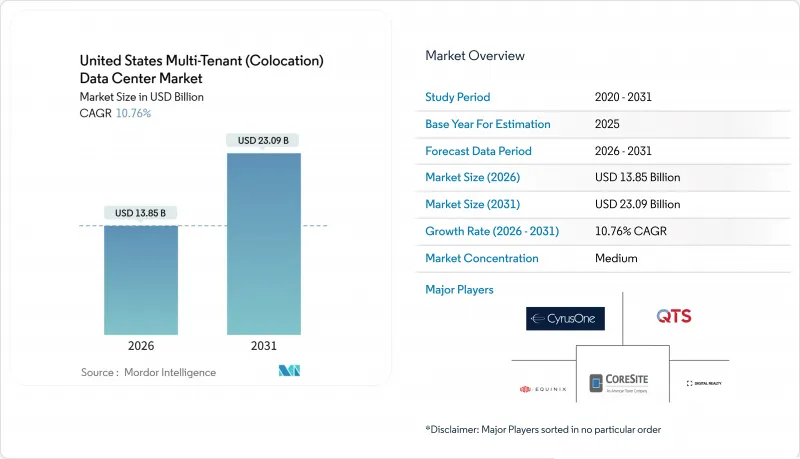
本報告按解決方案類型(批發多租戶和零售多租戶)、層級(Tier 1 和 Tier 2、Tier 3 和 Tier 4)以及資料中心規模(小規模資料中心、中型資料中心、大型資料中心和超大規模資料中心)進行分類。市場預測以美元計價。
美國多租戶(託管)資料中心市場的趨勢與洞察
人工智慧和機器學習工作負載的快速成長需要高密度託管。
用於大規模語言模型訓練的英偉達H100叢集,其密度通常超過每機櫃100千瓦,但截至2025年12月,美國僅有18%的託管資料中心能夠容納如此高的密度。因此,超大規模資料中心業者正在下一輪GPU分配週期之前預訂5-10兆瓦的批發機房,為液冷做好準備。 CyrusOne透露,在2025年前三個季度,人工智慧相關客戶佔所有訂單的42%。投資後門式熱交換器的營運商,其價格比傳統安裝方式高出30-40%,投資回收期縮短至不到四年。美國國家消防協會(NFPA)正在修訂NFPA 75標準,以明確此類高密度叢集的鋰離子電池滅火規程。
加速採用混合雲端和邊緣運算架構
根據 Flexential 的研究,2024 年至 2025 年間,採用混合部署的企業客戶比例從 51% 飆升至 63%。為了滿足延遲和資料主權要求,企業正在將工作負載分佈在本地機架、公共雲端區域和託管機房。 EdgeConneX 已將其邊緣部署擴展至 42 個地點,重點關注歐馬哈、博伊西和羅利等被全國性平台忽略的城市。分析師預測,到 2028 年,邊緣託管需求將新增 800-1000 兆瓦。諸如 HIPAA 等監管限制仍然有利於與中立運營商建立混合雲端合作夥伴關係。
電力系統面臨的日益嚴峻的限制以及電力公司的前置作業時間
在維吉尼亞北部,待處理的併網申請積壓超過4.2吉瓦,相當於大約三年的工作量。 Dominion Energy公司凍結了勞登縣部分地區2025年新增大容量負載的併網申請,迫使開發商要么自籌資金建設變電站,要么推遲電力開通。亞利桑那州公共服務公司在鳳凰城也面臨類似的危機,該地區2025年的資料中心申請量超過1.8吉瓦。聯邦能源監管委員會(FERC)可能會優先考慮選址已確定且環境評估已完成的項目,以盡快清理積壓的申請。開發商開始選擇在發電廠附近進行資料中心共址建設,或在現場安裝天然氣調峰電站,每個50兆瓦的資料中心將額外增加5,000萬至8,000萬美元的成本。
細分市場分析
至2025年,零售型託管將占美國多租戶(託管)資料中心市場的62.53%。這反映了承包式機架租賃模式對中小企業的吸引力,這種模式無需資本投資。營運商提供電力、冷卻和實體安全等服務,客戶可以逐一機架地擴展工作負載。隨著超大規模資料中心業者確保連續容量以避免電力供應排隊的不確定性,5MW及以上的批發租賃業務正以11.32%的複合年成長率快速成長。批發業務受益於人工智慧和混合雲端工作負載,這些工作負載需要客製化的電力拓撲結構、液冷迴路和專用連網機房。
CyrusOne 的「大規模模組化」架構將允許租戶在 2025 年前指定每個機架最高 30 千瓦的功率,從而使他們能夠以更高的價格獲取批發需求。 Digital Realty 在其 240 兆瓦的在建項目中,計劃於 2025 年完工,在首次發電之前,已預租了其中 85% 的容量,這表明供應仍然無法滿足需求。隨著企業優先考慮跨多個大都會圈進行地理分散部署以及災害復原方案,零售託管市場將保持強勁勢頭。然而,批發領域的快速擴張意味著,在預測期內運作的兆瓦容量中,批發將佔據絕大部分。因此,美國多租戶(託管)資料中心市場將逐步向批發領域重新平衡,而不會削弱現有的零售用戶基礎。
其他好處:
- Excel格式的市場預測(ME)表
- 3個月的分析師支持
目錄
第1章:引言
- 研究的先決條件
- 市場定義和研究範圍
第2章:調查方法
第3章執行摘要
第4章 市場狀況
- 市場概覽
- 市場促進因素
- 混合雲端和邊緣運算架構的採用正在加速。
- 人工智慧/機器學習工作負載的快速成長需要高密度託管。
- 美國電力市場對可再生能源購買協議的採用率不斷提高。
- 內容提供者和OTT提供者對互聯樞紐的需求激增。
- 美國二線大都會地區的超大規模資料中心業者營運商更傾向於客製化的批發託管服務。
- 聯邦和州政府為資料中心的建設和現代化改造提供稅收優惠
- 市場限制因素
- 高需求市場對電網的限制日益加劇,電力公司的供電時間也隨之延長。
- 美國主要資料中心所在地土地購置和建設成本不斷上漲。
- 更嚴格的永續發展報告要求增加了合規負擔。
- 超大規模資料中心業者在特定區域利用自身建設設施競爭
- 產業供應鏈分析
- 宏觀經濟因素對市場的影響
- 監理情勢
- 技術展望
- 波特五力分析
第5章 市場規模與成長預測
- 按解決方案類型
- 批發多租戶
- 零售多租戶
- 層級特定
- 一級和二級
- 三級
- 第四級
- 按資料中心規模
- 小規模資料中心
- 中型資料中心
- 大型資料中心
- 超大規模資料中心
第6章 競爭情勢
- 市場集中度
- 策略趨勢
- 市佔率分析
- 公司簡介
- Equinix Inc.
- Digital Realty Trust Inc.
- CyrusOne LLC
- Quality Technology Services(QTS Realty Trust)
- CoreSite Realty Corporation(American Tower)
- Switch Inc.
- Iron Mountain Data Centers
- Aligned Data Centers
- Flexential Corp.
- Sabey Data Centers
- EdgeConneX Inc.
- STACK Infrastructure
- Compass Datacenters
- DataBank Ltd.
- NTT Communications Corporation
- KDDI Corporation(Telehouse America)
- DataGryd
- Rackspace Technology Inc.
- IBM Corporation
- Vantage Data Centers
第7章 市場機會與未來展望
According to Mordor Intelligence, the United States multi-tenant (colocation) data center market size is estimated at USD 13.85 billion in 2026, and is expected to reach USD 23.09 billion by 2031, at a CAGR of 10.76% during the forecast period 2026-2031.
This report is Segmented by Solution Type (Wholesale Multi-Tenant and Retail Multi-Tenant), Tier Type (Tier 1 and 2, Tier 3, and Tier 4), and Data Center Size (Small Data Center, Medium Data Center, Large Data Center, and Hyperscale Data Center). The Market Forecasts are Provided in Terms of Value (USD).
United States Multi-Tenant (Colocation) Data Center Market Trends and Insights
Rapid Proliferation of AI and ML Workloads Requiring High-Density Colocation
Nvidia H100 clusters that underpin large-language-model training routinely exceed 100 kW per cabinet, a density that only 18% of US colocation halls could support in December 2025. Hyperscalers therefore reserve wholesale suites of 5-10 MW to secure liquid-cooling readiness before the next GPU allocation cycle. CyrusOne disclosed that AI customers represented 42% of all bookings during the first three quarters of 2025. Operators that invest in rear-door heat exchangers report 30-40% pricing premiums relative to legacy deployments, compressing payback periods to under four years. National Fire Protection Association is revising NFPA 75 to clarify lithium-ion battery suppression protocols for such high-density clusters.
Accelerating Adoption of Hybrid Cloud and Edge Computing Architectures
Flexential recorded a jump from 51% to 63% of enterprise customers running hybrid deployments between 2024 and 2025. Enterprises distribute workloads across on-premises racks, public-cloud regions, and colocation cages to satisfy latency and data-sovereignty mandates. EdgeConneX expanded to 42 edge locations by focusing on Omaha, Boise, and Raleigh, cities overlooked by national platforms. Analysts expect 800-1,000 MW of new edge colocation demand by 2028. Regulatory strictures such as HIPAA continue to favor hybrid cloud alliances with carrier-neutral operators.
Escalating Power Grid Constraints and Utility Lead Times
Pending interconnection requests in Northern Virginia exceed 4.2 GW, representing nearly three years of backlog. Dominion Energy froze new large-load hookups in portions of Loudoun County during 2025, compelling builders to self-fund substations or postpone energization. Arizona Public Service faces a similar strain in Phoenix, where data-center applications surpassed 1.8 GW in 2025. The Federal Energy Regulatory Commission may prioritize projects with firm site control and completed environmental reviews to clear queues faster. Operators have begun colocating adjacent to generation assets or installing on-site natural-gas peakers at an added USD 50-80 million per 50-MW hall.
Other drivers and restraints analyzed in the detailed report include:
- Hyperscaler Preference for Build-to-Suit Wholesale Colocation in Tier-2 US Metros
- Growing Availability of Renewable Energy Purchase Agreements in US Power Markets
- Rising Land Acquisition and Construction Costs in Core Hubs
For complete list of drivers and restraints, kindly check the Table Of Contents.
Segment Analysis
Retail colocation held 62.53% share of the United States multi-tenant (colocation) data center market in 2025, reflecting the appeal of turnkey rack-level leasing to small and midsized enterprises that avoid capital expenditure. Operators bundle power, cooling, and physical security so customers can scale workloads a single rack at a time. Wholesale leases of 5 MW or more are growing faster, at an 11.32% CAGR, as hyperscalers reserve contiguous capacity to bypass uncertainty in utility queues. The wholesale segment benefits from AI and hybrid-cloud workloads that demand bespoke electrical topologies, liquid-cooling loops, and dedicated meet-me rooms.
CyrusOne's Massively Modular builds allowed tenants to specify up to 30 kW per rack in 2025, capturing wholesale demand at premium rates. Digital Realty pre-leased 85% of its 240-MW 2025 pipeline before first power, signaling that supply still trails demand. Retail colocation will remain resilient because enterprises value geographic diversity and disaster-recovery options across multiple metros, yet wholesale's faster expansion ensures it will capture the majority of incremental megawatts commissioned during the forecast window. As a result, the United States multi-tenant (colocation) data center market will see a gradual rebalancing toward wholesale without eroding the entrenched retail installed base.
Complete Report Scope:
- By Solution Type
- Wholesale Multi-tenant
- Retail Multi-tenant
- By Tier Type
- Tier 1 and 2
- Tier 3
- Tier 4
- By Data Center Size
- Small Data Center
- Medium Data Center
- Large Data Center
- Hyperscale Data Center
List of Companies Covered in this Report:
- Equinix Inc.
- Digital Realty Trust Inc.
- CyrusOne LLC
- Quality Technology Services (QTS Realty Trust)
- CoreSite Realty Corporation (American Tower)
- Switch Inc.
- Iron Mountain Data Centers
- Aligned Data Centers
- Flexential Corp.
- Sabey Data Centers
- EdgeConneX Inc.
- STACK Infrastructure
- Compass Datacenters
- DataBank Ltd.
- NTT Communications Corporation
- KDDI Corporation (Telehouse America)
- DataGryd
- Rackspace Technology Inc.
- IBM Corporation
- Vantage Data Centers
Additional Benefits:
- The market estimate (ME) sheet in Excel format
- 3 months of analyst support
TABLE OF CONTENTS
1 INTRODUCTION
- 1.1 Study Assumptions
- 1.2 Market Definition and Scope of the Study
2 RESEARCH METHODOLOGY
3 EXECUTIVE SUMMARY
4 MARKET LANDSCAPE
- 4.1 Market Overview
- 4.2 Market Drivers
- 4.2.1 Accelerating Adoption of Hybrid Cloud and Edge Computing Architectures
- 4.2.2 Rapid Proliferation of AI/ML Workloads Requiring High-Density Colocation
- 4.2.3 Growing Availability of Renewable Energy Purchase Agreements in US Power Markets
- 4.2.4 Surging Demand for Interconnection Hubs from Content and OTT Providers
- 4.2.5 Hyperscaler Preference for Build-to-Suit Wholesale Colocation in Tier-2 US Metros
- 4.2.6 Federal and State Tax Incentives for Data Center Construction and Modernization
- 4.3 Market Restraints
- 4.3.1 Escalating Power Grid Constraints and Utility Lead Times in High-Demand Markets
- 4.3.2 Rising Land Acquisition and Construction Costs in Core US Data Center Hubs
- 4.3.3 Intensifying Sustainability Reporting Requirements Increasing Compliance Burden
- 4.3.4 Competition from Hyperscalers' Self-Built Facilities in Select Regions
- 4.4 Industry Supply-Chain Analysis
- 4.5 Impact of Macroeconomic Factors on the Market
- 4.6 Regulatory Landscape
- 4.7 Technological Outlook
- 4.8 Porter's Five Forces Analysis
- 4.8.1 Bargaining Power of Suppliers
- 4.8.2 Bargaining Power of Consumers
- 4.8.3 Threat of New Entrants
- 4.8.4 Threat of Substitutes
- 4.8.5 Intensity of Competitive Rivalry
5 MARKET SIZE AND GROWTH FORECASTS (VALUE)
- 5.1 By Solution Type
- 5.1.1 Wholesale Multi-tenant
- 5.1.2 Retail Multi-tenant
- 5.2 By Tier Type
- 5.2.1 Tier 1 and 2
- 5.2.2 Tier 3
- 5.2.3 Tier 4
- 5.3 By Data Center Size
- 5.3.1 Small Data Center
- 5.3.2 Medium Data Center
- 5.3.3 Large Data Center
- 5.3.4 Hyperscale Data Center
6 COMPETITIVE LANDSCAPE
- 6.1 Market Concentration
- 6.2 Strategic Moves
- 6.3 Market Share Analysis
- 6.4 Company Profiles (includes Global Level Overview, Market Level Overview, Core Segments, Financials as available, Strategic Information, Market Rank/Share, Products and Services, Recent Developments)
- 6.4.1 Equinix Inc.
- 6.4.2 Digital Realty Trust Inc.
- 6.4.3 CyrusOne LLC
- 6.4.4 Quality Technology Services (QTS Realty Trust)
- 6.4.5 CoreSite Realty Corporation (American Tower)
- 6.4.6 Switch Inc.
- 6.4.7 Iron Mountain Data Centers
- 6.4.8 Aligned Data Centers
- 6.4.9 Flexential Corp.
- 6.4.10 Sabey Data Centers
- 6.4.11 EdgeConneX Inc.
- 6.4.12 STACK Infrastructure
- 6.4.13 Compass Datacenters
- 6.4.14 DataBank Ltd.
- 6.4.15 NTT Communications Corporation
- 6.4.16 KDDI Corporation (Telehouse America)
- 6.4.17 DataGryd
- 6.4.18 Rackspace Technology Inc.
- 6.4.19 IBM Corporation
- 6.4.20 Vantage Data Centers
7 MARKET OPPORTUNITIES AND FUTURE OUTLOOK
- 7.1 White-Space and Unmet-Need Assessment

 資料中心託管市場:依解決方案類型、層級類型、資料中心規模、服務類型、國家及地區分類-全球產業分析、市場規模、市場佔有率及2026年至2033年預測
 資料中心託管市場-2026-2032年全球市場預測
 多租戶資料中心市場報告:按解決方案類型、應用、組織規模、最終用戶產業和地區分類(2026-2034 年)資料中心託管市場規模、佔有率和趨勢:按類型、組織規模、最終用戶行業和地區分類,並預測至 2026-2034 年託管資料中心託管資料中心市場概覽:2026 年第二季度
 2026年全球多租戶資料中心市場報告
 資料中心託管市場:按託管服務、組織規模、行業和地區分類
 資料中心託管市場分析及預測(至2035年):類型、產品類型、服務、技術、組件、應用、部署模式、最終用戶、解決方案
 2026-2030年全球資料中心託管與管理式主機服務市場