


 |
市場調查報告書
商品編碼
2124654
北美協作機器人:市佔率分析、產業趨勢與統計及成長預測(2026-2031 年)North America Collaborative Robots - Market Share Analysis, Industry Trends & Statistics, Growth Forecasts (2026 - 2031) |
||||||

※ 本網頁內容可能與最新版本有所差異。詳細情況請與我們聯繫。
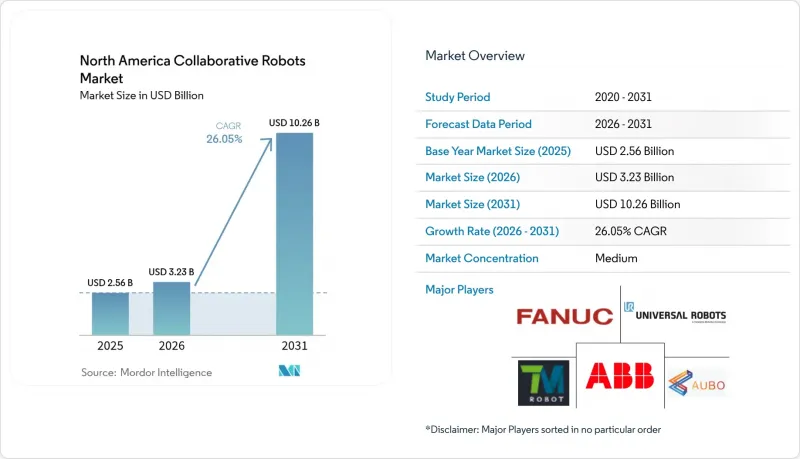
根據 Mordor Intelligence 預測,北美協作機器人市場將從 2025 年的 25.6 億美元成長到 2026 年的 32.3 億美元,然後在 2031 年達到 102.6 億美元,2026 年至 2031 年的複合年成長率為 26.05%。
本報告承重能力(小於5公斤、5-9公斤、10公斤及以上)、終端用戶行業(電子/半導體和FPD、汽車、其他)、應用(物料輸送、取放、組裝、其他)、組件(硬體、軟體、服務)和地區(美國、加拿大、墨西哥)進行細分。市場預測以美元計價。
北美協作機器人市場趨勢與洞察
製造過程中對自動化的需求日益成長
將生產線從亞洲遷回北美的製造商需要在產量和柔軟性之間取得平衡。協作機器人無需籠架即可快速更換模具,滿足了這兩個要求。眾議院人工智慧工作小組呼籲在2024年為人類-機器人協作試點計畫提供5億美元的年度預算,以加速早期部署。安川電機將其美國工廠擴建18.5萬平方英尺,凸顯了該公司對持續訂單的信心。因此,北美協作機器人市場正在從一級供應商擴展到先前缺乏機器人技術專長的本地契約製造。
由於易於實施,因此投資回報率高。
拖放式設計工具和預先設計的機械手臂將協作機器人單元的部署時間從 6-12 週縮短至 48 小時以內,即使在訂單的工廠中也是如此。 ABB 的 GoFa-Vention 套件使早期用戶能夠將安裝人事費用降低 60-70%。整合成本的降低使得批量小於 100 台的應用場景成為可能,北美協作機器人市場正在滲透到以前被認為規模太小而無法實現自動化的細分市場。
與傳統機器人相比,承重能力和速度方面有其限制。
由於ISO/TS 15066標準的力限制,大多數協作機器人的承重能力被限制在35公斤以內,速度被限制在1.5米/秒以內,車身本體焊接和沖壓等應用領域除外。傳統機械臂仍佔汽車產業88.4%的應用。將封閉式大型機器人與協作機器人結合的混合單元,由於增加了所需的占地面積,降低了協作機器人的部分柔軟性優勢,從而減緩了協作機器人在北美傳統沖壓工廠的市場滲透速度。
細分市場分析
到2025年,重量低於5公斤的協作機器人將佔據北美協作機器人市場45.38%的佔有率,這主要得益於無塵室電子組裝對緊湊型面積和輕柔作用力的要求。 Standard Bots公司計劃於2025年推出30千噸的協作機器人,這表明供應商有意進軍重量更大的碼垛機器人領域,也預示著細分市場界限的模糊化。展望未來,供應商可能會提供模組化機械手臂,讓終端用戶更換關節並擴展工作範圍,從而進一步強化推動北美協作機器人市場發展的「擴充性」理念。
預計有效載荷10公斤及以上的機型需求將以17.65%的複合年成長率成長,這主要得益於食品碼垛和機械搬運行業領域,在這些領域,人體工學風險是自動化預算的關鍵因素。庫卡(KUKA)的「mosaixx」遠端監控系統透過減少服務訪問次數和降低總體擁有成本(TCO),吸引了眾多擁有多個生產站點的加工商。隨著高承重能力設計的日趨成熟,到2031年,北美協作機器人市場中高負載機型的市場規模預計將超過11.2億美元。
到2025年,電子產業將佔銷售額的36.95%,這主要得益於晶圓處理和晶片鍵合等作業對無塵環境的要求。然而,食品飲料產業預計到2031年將以14.88%的複合年成長率成長,這將重塑北美協作機器人市場格局,因為加工商面臨著滿足衛生標準的挑戰,並且包裝生產線的員工年流動率高達50%。
物流、製藥和航太等產業構成了新興領域,隨著履約中心採用協作機器人進行訂單揀選,這些產業整體都在成長。符合 ISO 22,000 食品安全標準和 FSMA(食品安全現代化法案)預防性控制措施正在加速協作機器人的普及,並確保北美協作機器人市場在各行業的多元化發展。
其他好處:
- Excel格式的市場預測(ME)表
- 3個月的分析師支持
目錄
第1章:引言
- 研究假設和市場定義
- 調查範圍
第2章:調查方法
第3章執行摘要
第4章 市場狀況
- 市場概覽
- 市場促進因素
- 製造過程中對自動化的需求日益成長
- 透過易於實施實現高投資報酬率
- 邊緣運算和人工智慧整合技術的快速發展
- 各行各業都面臨著人事費用上升和勞動力短缺的大問題。
- 協作機器人在精密農業的應用
- 鼓勵電子設備組裝線遷回日本的激勵措施
- 市場限制因素
- 與傳統機器人相比,其負載能力和速度有其局限性
- 中小企業初始系統實施與培訓成本較高
- OSHA標準的模糊性導致認證工作出現瓶頸。
- 開放原始碼機器人作業系統中的網路安全漏洞
- 產業價值鏈分析
- 監理情勢
- 技術展望
- 宏觀經濟因素對市場的影響
- 波特五力分析
第5章 市場規模與成長預測
- 有效載荷
- 小於5公斤
- 5~9 kg
- 10公斤或以上
- 按最終用戶行業分類
- 電子/半導體和FPD
- 車
- 食品/飲料
- 其他終端用戶產業
- 透過使用
- 物料輸送
- 挑選和放置
- 組裝
- 其他應用(堆疊/拆垛、焊接、噴漆、分類、定位等)
- 按組件
- 硬體
- 軟體
- 服務
- 國家
- 美國
- 加拿大
- 墨西哥
第6章 競爭情勢
- 市場集中度
- 策略趨勢
- 供應商排名分析
- 市佔率分析
- 公司簡介
- ABB Ltd.
- Universal Robots A/S
- FANUC Corporation
- Techman Robot Inc.
- AUBO(Beijing)Robotics Technology Co., Ltd.
- Kawasaki Heavy Industries, Ltd.
- Precise Automation, Inc.
- SIASUN Robot and Automation Co., Ltd.
- Staubli International AG
- OMRON Corporation
- Seiko Epson Corporation(Epson Robots)
- Festo SE and Co. KG
- KUKA Aktiengesellschaft
- Doosan Robotics Inc.
- Hanwha Precision Machinery Co., Ltd.
- Yaskawa America, Inc.
- DENSO WAVE INCORPORATED
- Robotiq Inc.
- Neura Robotics GmbH
第7章 市場機會與未來展望
According to Mordor Intelligence, the North America collaborative robots market size is expected to grow from USD 2.56 billion in 2025 to USD 3.23 billion in 2026 and is forecast to reach USD 10.26 billion by 2031 at 26.05% CAGR over 2026-2031.
This report is Segmented by Payload (Less Than 5 Kg, 5-9 Kg, and 10 Kg and Above), End-User Industry (Electronics/Semiconductor and FPD, Automotive, and More), Application (Material Handling, Pick and Place, Assembly, and More), Component (Hardware, Software, and Services), and Geography (United States, Canada, and Mexico). The Market Forecasts are Provided in Terms of Value (USD).
North America Collaborative Robots Market Trends and Insights
Increasing Demand for Automation in Manufacturing Processes
Manufacturers that repatriate lines from Asia must balance throughput and flexibility. Cobots allow quick re-tooling without cages, satisfying this dual mandate. The 2024 House AI Task Force urged USD 500 million per year for human-robot collaboration pilots, accelerating early-stage deployments. Yaskawa's 185,000 square-foot U.S. expansion underscores vendor confidence in sustained orders. As a result, the North America collaborative robots market is expanding beyond tier-one plants toward rural contract manufacturers that previously lacked access to robotics expertise.
High Return on Investment Enabled by Easy Deployment
Drag-and-drop design suites and pre-engineered grippers now let job shops integrate a cobot cell in under 48 hours, down from 6-12 weeks. ABB's GoFa-Vention bundle cut installation labor costs by 60-70% for first-wave adopters. Lower integration overhead unlocks use cases with batch sizes below 100 units, allowing the North America collaborative robots market to penetrate segments once deemed too small for automation.
Limited Payload and Speed Capabilities Versus Traditional Robots
ISO/TS 15066 force limits cap most cobots at 35 kg payload and 1.5 m/s speed, excluding applications such as body-in-white welding or press tending. Traditional arms still handle 88.4% of automotive installations. Hybrid cells that pair fenced heavy-duty robots with cobots increase floor-space needs, diluting some flexibility benefits and slowing penetration of the North America collaborative robots market into legacy press shops.
Other drivers and restraints analyzed in the detailed report include:
- Rapid Advances in Edge Computing and AI Integration
- Rising Labor Costs and Labor Shortages Across Industries
- High Initial Integration and Training Costs for SMEs
For complete list of drivers and restraints, kindly check the Table Of Contents.
Segment Analysis
Less-than-5 kg cobots captured 45.38% of the North America collaborative robots market share in 2025, propelled by cleanroom electronics assembly that values compact footprints and gentle force limits. Standard Bots' 30 kg model, released in 2025, signals supplier intent to penetrate heavier-duty palletizing, pointing to segment blurring. Over time, vendors will package modular arms allowing end users to swap joints and extend reach, reinforcing the scalability narrative that fuels the North America collaborative robots market.
Demand for 10 kg-plus units, forecast to grow at an 17.65% CAGR, stems from food palletizing and machine tending where ergonomic risk drives automation budgets. KUKA's mosaixx remote-monitoring stack lowers service visits, cutting total cost of ownership and attracting multi-site processors. As high-payload designs mature, the North America collaborative robots market size for heavy-duty units could exceed USD 1.12 billion by 2031.
Electronics retained 36.95% revenue in 2025 owing to wafer handling and die bonding tasks that demand particle-free operation. Nonetheless, food and beverage posts a 14.88% CAGR to 2031, reshaping the North America collaborative robots market as processors confront hygiene mandates and 50% annual turnover on packaging lines.
Logistics, pharmaceuticals, and aerospace form an emerging cohort, collectively advancing as fulfillment centers deploy cobots for order picking. Compliance with ISO 22000 food-safety rules and FSMA preventive controls accelerates uptake, ensuring the North America collaborative robots market diversifies across verticals.
Complete Report Scope:
- By Payload
- Less than 5 kg
- 5-9 kg
- 10 kg and Above
- By End-user Industry
- Electronics/Semiconductor and FPD
- Automotive
- Food and Beverage
- Other End-user Industries
- By Application
- Material Handling
- Pick and Place
- Assembly
- Other Applications (Palletizing/De-palletizing, Welding, Painting, Sorting, Positioning, etc.)
- By Component
- Hardware
- Software
- Services
- By Country
- United States
- Canada
- Mexico
List of Companies Covered in this Report:
- ABB Ltd.
- Universal Robots A/S
- FANUC Corporation
- Techman Robot Inc.
- AUBO (Beijing) Robotics Technology Co., Ltd.
- Kawasaki Heavy Industries, Ltd.
- Precise Automation, Inc.
- SIASUN Robot and Automation Co., Ltd.
- Staubli International AG
- OMRON Corporation
- Seiko Epson Corporation (Epson Robots)
- Festo SE and Co. KG
- KUKA Aktiengesellschaft
- Doosan Robotics Inc.
- Hanwha Precision Machinery Co., Ltd.
- Yaskawa America, Inc.
- DENSO WAVE INCORPORATED
- Robotiq Inc.
- Neura Robotics GmbH
Additional Benefits:
- The market estimate (ME) sheet in Excel format
- 3 months of analyst support
TABLE OF CONTENTS
1 INTRODUCTION
- 1.1 Study Assumptions and Market Definition
- 1.2 Scope of the Study
2 RESEARCH METHODOLOGY
3 EXECUTIVE SUMMARY
4 MARKET LANDSCAPE
- 4.1 Market Overview
- 4.2 Market Drivers
- 4.2.1 Increasing Demand for Automation in Manufacturing Processes
- 4.2.2 High Return on Investment Enabled by Easy Deployment
- 4.2.3 Rapid Advances in Edge Computing and AI Integration
- 4.2.4 Rising Labor Costs and Labor Shortages Across Industries
- 4.2.5 Adoption of Collaborative Robots in Precision Agriculture Operations
- 4.2.6 Incentive Grants for Reshoring Electronics Assembly Lines
- 4.3 Market Restraints
- 4.3.1 Limited Payload and Speed Capabilities Versus Traditional Robots
- 4.3.2 High Initial Integration and Training Costs for SMEs
- 4.3.3 OSHA Standard Ambiguity Creating Certification Bottlenecks
- 4.3.4 Cybersecurity Vulnerabilities in Open-Source Robot Operating Systems
- 4.4 Industry Value Chain Analysis
- 4.5 Regulatory Landscape
- 4.6 Technological Outlook
- 4.7 Impact of Macroeconomic Factors on the Market
- 4.8 Porter's Five Forces Analysis
- 4.8.1 Bargaining Power of Suppliers
- 4.8.2 Bargaining Power of Consumers
- 4.8.3 Threat of New Entrants
- 4.8.4 Intensity of Competitive Rivalry
- 4.8.5 Threat of Substitute Products
5 MARKET SIZE AND GROWTH FORECASTS (VALUE)
- 5.1 By Payload
- 5.1.1 Less than 5 kg
- 5.1.2 5-9 kg
- 5.1.3 10 kg and Above
- 5.2 By End-user Industry
- 5.2.1 Electronics/Semiconductor and FPD
- 5.2.2 Automotive
- 5.2.3 Food and Beverage
- 5.2.4 Other End-user Industries
- 5.3 By Application
- 5.3.1 Material Handling
- 5.3.2 Pick and Place
- 5.3.3 Assembly
- 5.3.4 Other Applications (Palletizing/De-palletizing, Welding, Painting, Sorting, Positioning, etc.)
- 5.4 By Component
- 5.4.1 Hardware
- 5.4.2 Software
- 5.4.3 Services
- 5.5 By Country
- 5.5.1 United States
- 5.5.2 Canada
- 5.5.3 Mexico
6 COMPETITIVE LANDSCAPE
- 6.1 Market Concentration
- 6.2 Strategic Moves
- 6.3 Vendor Ranking Analysis
- 6.4 Market Share Analysis
- 6.5 Company Profiles (includes Global level Overview, Market level overview, Core Segments, Financials as available, Strategic Information, Market Rank/Share for key companies, Products and Services, and Recent Developments)
- 6.5.1 ABB Ltd.
- 6.5.2 Universal Robots A/S
- 6.5.3 FANUC Corporation
- 6.5.4 Techman Robot Inc.
- 6.5.5 AUBO (Beijing) Robotics Technology Co., Ltd.
- 6.5.6 Kawasaki Heavy Industries, Ltd.
- 6.5.7 Precise Automation, Inc.
- 6.5.8 SIASUN Robot and Automation Co., Ltd.
- 6.5.9 Staubli International AG
- 6.5.10 OMRON Corporation
- 6.5.11 Seiko Epson Corporation (Epson Robots)
- 6.5.12 Festo SE and Co. KG
- 6.5.13 KUKA Aktiengesellschaft
- 6.5.14 Doosan Robotics Inc.
- 6.5.15 Hanwha Precision Machinery Co., Ltd.
- 6.5.16 Yaskawa America, Inc.
- 6.5.17 DENSO WAVE INCORPORATED
- 6.5.18 Robotiq Inc.
- 6.5.19 Neura Robotics GmbH
7 MARKET OPPORTUNITIES AND FUTURE OUTLOOK
- 7.1 White-space and Unmet-Need Assessment

 全球協作機器人市場規模、佔有率、趨勢和成長分析報告(2026-2034)
 機器人關節模組市場規模、佔有率和成長分析:按模組類型、機器人類型、應用、最終用戶、自由度和地區分類-2026-2033年產業預測
 工業協作機器人市場規模、佔有率和成長分析:按承重能力、應用、最終用戶產業、組件、部署模式、銷售管道和地區分類-2026-2033年產業預測
 協作機器人市場:按類型、承重能力、安裝配置、應用、終端用戶產業和銷售管道分類-2026-2032年全球市場預測行動協作機器人市場:2026-2032年全球市場預測(按組件類型、有效載荷能力、企業規模、導航技術、自主等級和應用分類)
 2026年全球混合協作機器人(Cobot)市場報告
 協作機器人市場預測至2034年:按組件、安裝類型、技術、應用、最終用戶和地區分類的全球分析
 協作機器人市場規模、佔有率和趨勢分析報告:按承重能力、應用、行業、地區和細分市場預測(2026-2033 年)
 協作機器人2026年全球工業協作機器人市場報告