


 |
市場調查報告書
商品編碼
2124653
中東和非洲智慧型手機市場:市場佔有率分析、行業趨勢和統計數據以及成長預測(2026-2031 年)Middle East And Africa Smartphones - Market Share Analysis, Industry Trends & Statistics, Growth Forecasts (2026 - 2031) |
||||||

※ 本網頁內容可能與最新版本有所差異。詳細情況請與我們聯繫。
根據 Mordor Intelligence 預測,中東和非洲的智慧型手機市場規模將從 2025 年的 314 億美元成長到 2026 年的 339.5 億美元,然後在 2031 年達到 501.4 億美元,2026 年至 2031 年的複合年成長率為 8.12%。
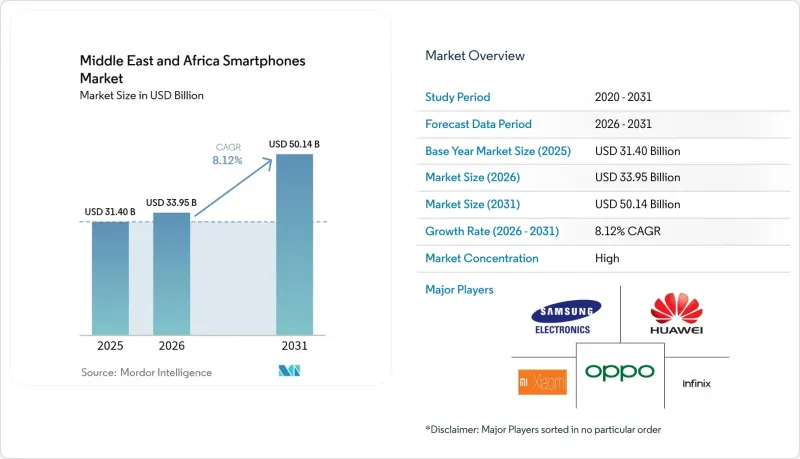
本報告按作業系統(Android、iOS 及其他)、價格區間(超高階,超過800 美元;高階,600-799 美元;中端,300-599 美元;及其他)、銷售管道(線上零售、營運商門市;及其他)、技術(5G、4G/LTE;及其他)和地區進行細分。市場預測以美元計價。
中東和非洲智慧型手機市場的趨勢和洞察
海灣合作理事會地區電信業者快速部署 5G。
海灣合作理事會(GCC)的電信業者將5G視為刺激經濟發展的催化劑,而不僅僅是例行的網路升級,它將智慧型手機與智慧城市服務、固定無線接入和企業物聯網(IoT)應用相結合。光是在沙烏地阿拉伯,預計到2030年,5G就能為該國經濟帶來180億美元的收益。 stc、Zain和e&等營運商的投資已覆蓋54.70%的人口,這推動了對高性能設備的需求成長,並推高了平均售價。
撒哈拉以南非洲地區首次智慧型手機部署,由年輕人推動。
非洲的平均年齡為19.7歲,這推動了首次使用行動網路的用戶數量激增,他們跳過功能手機,直接選擇價格實惠的設備使用行動網路服務。傳音憑藉其多語言支援和針對深色膚色用戶最佳化的拍照設備,佔據了47%的市場領先地位。在肯亞,資產融資模式已將行動網際網路滲透率提升至68.3%,這清晰地顯示了這項需求的結構性特徵。
外匯波動和進口關稅推高了平均售價(ASP)。
貨幣貶值和進口關稅推高了設備價格,抑制了自由裁量權支出。在埃及,智慧型手機進口關稅最初高達38.5%,導致出貨量下降,但原始設備製造商(OEM)轉向本地組裝以規避關稅。那些在本地擁有雙重零件採購管道的製造商最能抵禦價格衝擊。
細分市場分析
預計到2025年,Android將以87.78%的市佔率引領市場,複合年成長率(CAGR)達11.06%。這反映了該平台與當地價格敏感度和服務生態系統的高度契合。這一主導地位正在鞏固中東和非洲智慧型手機市場以Android為中心的格局,而開放原始碼的柔軟性則降低了行動銀行、叫車和遠端醫療等應用的開發成本。中國OEM廠商正利用Android的客製化層,整合針對特定地區的語言套件和針對深色膚色人群的相機演算法,進而提升使用者體驗和使用者忠誠度。此外,該平台與近距離場通訊(NFC)標準的協同作用正在加速沙烏地阿拉伯數位錢包的普及,Nafath的1,720萬用戶每天都在使用生物識別進行交易。
這種策略優勢不僅限於硬體,它透過服務捆綁,將使用者更深入地整合到雲端儲存、支付和身分生態系統中。開發者青睞安卓龐大的裝置量,便於快速擴展業務,而各國政府也正採用「安卓優先」策略來開發國家識別、稅務和醫療記錄應用程式。 iOS 在超高階市場仍佔有重要地位,但其市佔率並未削弱安卓的網路影響力。在預測期內,隨著沿岸地區5G 網路覆蓋接近全面,以及撒哈拉以南非洲地區的電信營運商逐步淘汰 2G 網路,預計中東和非洲地區安卓智慧型手機市場規模將進一步擴大。
到2025年,售價在151美元至299美元之間的低價設備將佔據37.02%的市場佔有率,凸顯了大眾市場消費者的收入水平;而售價在600美元至799美元之間的高階智慧型手機預計將以9.58%的複合年成長率成長。這種兩極化源自於消費者群體的平行分類:農村地區的首次智慧型手機購買者和都市區積極使用數位服務的重度使用者。低價設備利用補貼計畫和「先買後付」(BNPL)方案,將還款分攤到非常小的金額。相較之下,沿岸地區的富裕消費者正在更換到高階機型,以充分利用5G、擴增實境(AR)功能和內建人工智慧加速器。
由於創新的資金籌措,例如肯亞和奈及利亞的電信業者透過計量型合約銷售高階設備,這些類別之間的界線正變得模糊不清。透明的分期付款計劃使中等收入人群無需預付即可擁有高階機型,從而推動了中東和非洲高階智慧型手機市場的擴張。對於原始設備製造商 (OEM) 而言,挑戰在於如何在功能增強和成本控制之間取得平衡,以防止蠶食中階機型的銷售量。
其他好處:
- Excel格式的市場預測(ME)表
- 3個月的分析師支持
目錄
第1章:引言
- 研究假設和市場定義
- 調查範圍
第2章:調查方法
第3章執行摘要
第4章 市場狀況
- 市場概覽
- 市場促進因素
- 海灣合作理事會地區電信業者快速部署 5G。
- 撒哈拉以南非洲地區首次由青年主導的智慧型手機部署計畫。
- 超低價中國製造的OEM設備的激增
- 電子商務和社交電商通路正在加速設備銷售。
- 國家電子身分證/超級應用程式計畫(例如,沙烏地阿拉伯2030願景)
- 採用「先買後付 (BNPL)」模式的金融應用程式讓購物變得更加便捷。
- 市場限制因素
- 匯率波動和進口關稅推高了平均售價(ASP)。
- 灰色市場和假行動電話的湧入
- 新推出的資料本地化和OTT法規增加了合規成本。
- 不穩定的電力供應限制了其在農村地區的使用。
- 產業價值鏈分析
- 監理情勢
- 技術展望
- 波特五力分析
- 價格分析
- 宏觀經濟因素對市場的影響
第5章 市場規模與成長預測
- 透過作業系統
- Android
- iOS
- 其他作業系統
- 按價格範圍
- 超高階(800 美元或以上)
- 高級版(600-799 美元)
- 中價位(300-599美元)
- 價格區間較低(151-299 美元)
- 超低價位(低於150美元)
- 透過分銷管道
- 線上零售
- 電信業者/電信業者直營店
- 線下零售
- 透過科技(連接)
- 5G
- 4G/LTE
- 3G及更早版本
- 國家
- 沙烏地阿拉伯
- 阿拉伯聯合大公國
- 南非
- 埃及
- 奈及利亞
- 土耳其
- 其他中東和非洲國家
第6章 競爭情勢
- 市場集中度
- 策略趨勢
- 市佔率分析
- 公司簡介
- Samsung Electronics Co., Ltd.
- Transsion Holdings Limited
- Xiaomi Corporation
- Oppo Guangdong Mobile Communications Co., Ltd.
- Apple Inc.
- Vivo Communication Technology Co., Ltd.
- Huawei Technologies Co., Ltd.
- HMD Global Oy(Nokia)
- Google LLC
- ZTE Corporation
- Lenovo Group Limited
- Realme Chongqing Mobile Telecommunications Corp., Ltd.
- OnePlus Technology(Shenzhen)Co., Ltd.
- Honor Device Co., Ltd.
- Tecno Mobile Limited
- itel Mobile Limited
- Infinix Mobility Limited
- Motorola Mobility LLC
- TCL Technology Group Corporation(Alcatel brand)
- Sony Corporation
- Asustek Computer Inc.
- Lava International Limited
- Gionee Communication Equipment Co., Ltd.
第7章 市場機會與未來展望
According to Mordor Intelligence, the Middle East and Africa smartphones market size is expected to grow from USD 31.40 billion in 2025 to USD 33.95 billion in 2026 and is forecast to reach USD 50.14 billion by 2031 at 8.12% CAGR over 2026-2031.
This report is Segmented by Operating System (Android, IOS, and More), Price Range (Ultra-Premium Above USD 800, Premium USD 600-799, Mid-Range USD 300-599, and More), Distribution Channel (Online Retail, Carrier/Operator Stores, and More), Technology (5G, 4G/LTE, and More), and Geography. The Market Forecasts are Provided in Terms of Value (USD).
Middle East And Africa Smartphones Market Trends and Insights
Rapid 5G roll-outs across GCC operators
GCC carriers view 5G as an economic catalyst rather than a routine network refresh, linking smartphones to smart-city services, fixed-wireless access, and enterprise Internet of Things (IoT) applications. Saudi Arabia alone expects 5G to inject USD 18 billion into its economy by 2030. Operator investments by stc, Zain, and e& already support 54.70% population coverage, prompting demand for premium-capable devices and driving higher average selling prices.
Youth-driven first-time smartphone adoption in Sub-Saharan Africa
Africa's median age of 19.7 fuels a surge of first-time owners who leapfrog feature phones and access mobile internet services straight through affordable handsets. TRANSSION's market-leading 47% share results from devices optimized for multi-language support and darker skin-tone photography. Asset-financing models in Kenya lifted penetration to 68.3%, illustrating the structural nature of this demand.
FX volatility and import tariffs inflating ASPs
Currency depreciation and import duties raise device prices, constraining discretionary spending. Egypt's 38.5% smartphone import tax initially lowered shipments, pushing OEMs toward local assembly to sidestep tariffs. Manufacturers that dual-source components locally are best positioned to absorb price shocks.
Other drivers and restraints analyzed in the detailed report include:
- E-commerce and social-commerce channels accelerating device sales
- National e-ID / super-app programs (e.g., Saudi Vision 2030)
- Grey-market and counterfeit handset inflows
For complete list of drivers and restraints, kindly check the Table Of Contents.
Segment Analysis
Android led the market with an 87.78% share in 2025 and is projected to register an 11.06% CAGR, reflecting the platform's alignment with local price sensitivities and service ecosystems. This leadership reinforces the Middle East and Africa smartphones market as an Android-centric environment where open-source flexibility lowers development cost for apps in mobile banking, ride-hailing, and telemedicine. Chinese OEMs leverage Android's customization layers to embed regional language packs and camera algorithms tailored to darker skin tones, which enhance consumer experience and loyalty. The platform's synergy with near-field communication (NFC) standards propels digital-wallet adoption in Saudi Arabia, where Nafath's 17.2 million users log daily transactions via biometric authentication.
The strategic edge expands beyond hardware as service bundling locks users deeper into cloud storage, payment, and identity ecosystems. Developers favor Android's broader install base to reach scale quickly, while governments adopt Android-first approaches for national ID, tax, and health-record apps. Although iOS retains cachet in ultra-premium brackets, its niche presence does little to erode Android's network effects. Over the forecast horizon, the Middle East and Africa smartphones market size tied to Android devices is expected to widen further as 5G coverage becomes near-ubiquitous in the Gulf and as Sub-Saharan operators sunset 2G networks.
Budget devices between USD 151 and USD 299 held 37.02% share in 2025, underscoring the income realities of mass-market buyers, yet premium smartphones priced USD 600-799 are on track for 9.58% CAGR growth. The bifurcation arises from parallel consumer bases: first-time rural owners and urban digital-service power users. Budget units capitalize on subsidy programs and BNPL schemes that spread repayments across micro-instalments. In contrast, affluent Gulf consumers upgrade to premium SKUs to harness 5G, augmented-reality (AR) features, and onboard AI accelerators.
Financing innovations blur these categories as operators in Kenya and Nigeria market premium devices through pay-as-you-go contracts. Transparent installment models enable mid-income earners to aspire to higher tiers without upfront cash, thereby enlarging the Middle East and Africa smartphones market size for premium devices. The challenge for OEMs lies in balancing feature proliferation with cost control to prevent cannibalization of mid-range models.
Complete Report Scope:
- By Operating System
- Android
- iOS
- Other Operating Systems
- By Price Range
- Ultra-Premium (Above USD 800)
- Premium (USD 600-799)
- Mid-range (USD 300-599)
- Budget (USD 151-299)
- Ultra-Budget (Less Than or Equal USD 150)
- By Distribution Channel
- Online Retail
- Carrier / Operator Stores
- Offline Retail
- By Technology (Connectivity)
- 5G
- 4G / LTE
- 3G and Below
- By Country
- Saudi Arabia
- United Arab Emirates
- South Africa
- Egypt
- Nigeria
- Turkey
- Rest of Middle East and Africa
List of Companies Covered in this Report:
- Samsung Electronics Co., Ltd.
- Transsion Holdings Limited
- Xiaomi Corporation
- Oppo Guangdong Mobile Communications Co., Ltd.
- Apple Inc.
- Vivo Communication Technology Co., Ltd.
- Huawei Technologies Co., Ltd.
- HMD Global Oy (Nokia)
- Google LLC
- ZTE Corporation
- Lenovo Group Limited
- Realme Chongqing Mobile Telecommunications Corp., Ltd.
- OnePlus Technology (Shenzhen) Co., Ltd.
- Honor Device Co., Ltd.
- Tecno Mobile Limited
- itel Mobile Limited
- Infinix Mobility Limited
- Motorola Mobility LLC
- TCL Technology Group Corporation (Alcatel brand)
- Sony Corporation
- Asustek Computer Inc.
- Lava International Limited
- Gionee Communication Equipment Co., Ltd.
Additional Benefits:
- The market estimate (ME) sheet in Excel format
- 3 months of analyst support
TABLE OF CONTENTS
1 INTRODUCTION
- 1.1 Study Assumptions and Market Definition
- 1.2 Scope of the Study
2 RESEARCH METHODOLOGY
3 EXECUTIVE SUMMARY
4 MARKET LANDSCAPE
- 4.1 Market Overview
- 4.2 Market Drivers
- 4.2.1 Rapid 5G roll-outs across GCC telecom operators
- 4.2.2 Youth-driven first-time smartphone adoption in Sub-Saharan Africa
- 4.2.3 Proliferation of ultra-low-cost Chinese OEM devices
- 4.2.4 E-commerce and social-commerce channels accelerating device sales
- 4.2.5 National e-ID / super-app programs (e.g., Saudi Vision 2030)
- 4.2.6 Buy-Now-Pay-Later (BNPL) financing apps widening affordability
- 4.3 Market Restraints
- 4.3.1 FX volatility and import tariffs inflating ASPs
- 4.3.2 Grey-market and counterfeit handset inflows
- 4.3.3 Emerging data-localization and OTT regulations raising compliance cost
- 4.3.4 Power-supply unreliability limiting rural usage
- 4.4 Industry Value Chain Analysis
- 4.5 Regulatory Landscape
- 4.6 Technological Outlook
- 4.7 Porter's Five Forces Analysis
- 4.7.1 Bargaining Power of Suppliers
- 4.7.2 Bargaining Power of Consumers
- 4.7.3 Threat of New Entrants
- 4.7.4 Intensity of Competitive Rivalry
- 4.7.5 Threat of Substitute Products
- 4.8 Pricing Analysis
- 4.9 Impact of Macroeconomics Factors on the Market
5 MARKET SIZE AND GROWTH FORECASTS (VALUE)
- 5.1 By Operating System
- 5.1.1 Android
- 5.1.2 iOS
- 5.1.3 Other Operating Systems
- 5.2 By Price Range
- 5.2.1 Ultra-Premium (Above USD 800)
- 5.2.2 Premium (USD 600-799)
- 5.2.3 Mid-range (USD 300-599)
- 5.2.4 Budget (USD 151-299)
- 5.2.5 Ultra-Budget (Less Than or Equal USD 150)
- 5.3 By Distribution Channel
- 5.3.1 Online Retail
- 5.3.2 Carrier / Operator Stores
- 5.3.3 Offline Retail
- 5.4 By Technology (Connectivity)
- 5.4.1 5G
- 5.4.2 4G / LTE
- 5.4.3 3G and Below
- 5.5 By Country
- 5.5.1 Saudi Arabia
- 5.5.2 United Arab Emirates
- 5.5.3 South Africa
- 5.5.4 Egypt
- 5.5.5 Nigeria
- 5.5.6 Turkey
- 5.5.7 Rest of Middle East and Africa
6 COMPETITIVE LANDSCAPE
- 6.1 Market Concentration
- 6.2 Strategic Moves
- 6.3 Market Share Analysis
- 6.4 Company Profiles (includes global overview, market overview, core segments, financials as available, strategic information, market rank/share, products and services, recent developments)
- 6.4.1 Samsung Electronics Co., Ltd.
- 6.4.2 Transsion Holdings Limited
- 6.4.3 Xiaomi Corporation
- 6.4.4 Oppo Guangdong Mobile Communications Co., Ltd.
- 6.4.5 Apple Inc.
- 6.4.6 Vivo Communication Technology Co., Ltd.
- 6.4.7 Huawei Technologies Co., Ltd.
- 6.4.8 HMD Global Oy (Nokia)
- 6.4.9 Google LLC
- 6.4.10 ZTE Corporation
- 6.4.11 Lenovo Group Limited
- 6.4.12 Realme Chongqing Mobile Telecommunications Corp., Ltd.
- 6.4.13 OnePlus Technology (Shenzhen) Co., Ltd.
- 6.4.14 Honor Device Co., Ltd.
- 6.4.15 Tecno Mobile Limited
- 6.4.16 itel Mobile Limited
- 6.4.17 Infinix Mobility Limited
- 6.4.18 Motorola Mobility LLC
- 6.4.19 TCL Technology Group Corporation (Alcatel brand)
- 6.4.20 Sony Corporation
- 6.4.21 Asustek Computer Inc.
- 6.4.22 Lava International Limited
- 6.4.23 Gionee Communication Equipment Co., Ltd.
7 MARKET OPPORTUNITIES AND FUTURE OUTLOOK
- 7.1 White-space and Unmet-need Assessment

 ODM智慧型手機市場規模、佔有率和成長分析:按智慧型手機類型、作業系統、連接方式、最終用戶、產量和地區分類-2026-2033年產業預測
 旗艦智慧型手機市場:按銷售管道、作業系統、記憶體/儲存類型和地區分類
 平板電腦枕形支架市場規模、佔有率和成長分析:按產品類型、應用、相容設備、分銷管道、最終用戶和地區分類 - 產業預測,2026-2033 年
 智慧型手機市場:2026-2032年全球市場預測(依組件、作業系統、儲存容量、顯示器類型、顯示器尺寸、記憶體容量和銷售管道)平板手機與超級手機市場:2026-2032年全球市場預測(依作業系統、螢幕大小、顯示技術、電池容量、最終用戶和銷售管道)
 全球智慧型手機市場:市場規模、佔有率、趨勢和成長分析(2026-2034)平板手機和超級手機市場規模:按平台、螢幕尺寸、銷售管道、地區和未來預測分類
 2026年全球功能手機市場報告
 智慧型手機:市場佔有率分析、產業趨勢與統計、成長預測(2026-2031)
 智慧型手機市場:市場規模、佔有率和趨勢分析(按作業系統、分銷管道、價格範圍和地區分類),細分市場預測(2026-2033 年)