

 |
市場調查報告書
商品編碼
2124589
通訊收費收入管理:市場佔有率分析、產業趨勢與統計、成長預測(2026-2031)Telecom Billing Revenue Management - Market Share Analysis, Industry Trends & Statistics, Growth Forecasts (2026 - 2031) |
||||||

※ 本網頁內容可能與最新版本有所差異。詳細情況請與我們聯繫。
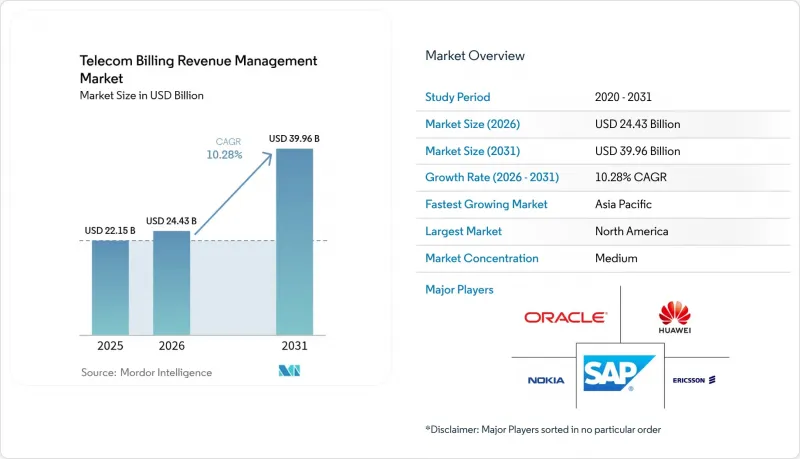
據 Mordor Intelligence 稱,電信收費和收入管理市場規模預計在 2026 年達到 244.3 億美元,高於 2025 年的 221.5 億美元,預計到 2031 年將達到 399.6 億美元。
預計 2026 年至 2031 年的複合年成長率為 10.28%。
本報告按部署模式(本地部署和雲端/SaaS)、類型(軟體和服務)、營運商(行動電信商、網際服務供應商、MVNO/MVNE)和地區進行分類。
電信收費收入管理市場的全球趨勢與洞察
行動電話用戶增加
行動用戶的快速成長,尤其是在新興市場,正在從根本上改變收費系統的需求,使其超越傳統的語音和簡訊模式。預計到2024年,亞太地區的行動用戶數量將達到18億,到2030年,5G連線將顯著成長。這將為同時管理2G和5G用戶群的營運商帶來前所未有的複雜收費流程。用戶的激增推動了對能夠每秒處理數百萬筆微交易的即時收費系統的需求,尤其是在營運商推出需要精細化、基於使用量的收費的物聯網服務時。例如,印度實施反詐騙措施後,欺騙性呼叫減少了90%,這表明隨著用戶數量的成長,對先進的收入保障機制的需求變得至關重要。挑戰不僅限於處理量,還體現在服務的多樣性上;單一用戶可能同時使用行動寬頻、邊緣運算和網路API服務,每種服務都需要不同的收費邏輯。為支持這種成長而進行的收費基礎設施投資,標誌著從週期性批量處理到連續即時收入管理的根本性轉變。
整個通訊生態系中收益分配的複雜性日益增加。
收益分成模式的複雜性已從簡單的互聯協議演變為涉及雲端服務供應商、內容合作夥伴和API開發商的複雜多方生態系統。透過Aduna等平台實現網路API貨幣化的興起(AT&T、T-Mobile和Verizon等公司合作,致力於5G功能的標準化),正在催生傳統收費系統無法應對的新型收益分成模式。這些夥伴關係要求在多個相關人員之間進行即時收益分成,結算週期以分鐘而非月來計算。 5G網路切片進一步加劇了這種複雜性。企業客戶購買專用網路資源時,需要根據跨多個網路域的效能保證和使用模式進行收費。例如,愛立信與主要電信業者合作建構全球網路API平台,清楚地展示了收益分成模式如何從傳統的通訊業擴展到軟體即服務(SaaS)模式。收費系統現在需要支援動態收益分成演算法,這些演算法能夠根據服務性能、使用模式以及多方之間的合約條款進行即時調整。
嚴格的溝通限制的存在
監管合規成本是收費系統投資的一大阻力,尤其當電信業者必須遵守多個司法管轄區相互衝突的要求時更是如此。歐盟人工智慧法案將於2027年實施,這將為部署人工智慧收費系統的營運商帶來沉重的合規負擔,違規者將面臨相當於其全球年收入4%的罰款。此外,歐洲營運商還面臨《電子通訊法典》引入統一終止費用的進一步複雜性,該法典要求營運商在2024年前修改其收費系統,以適應每分鐘0.20歐元的行動電話通話費用。例如,印度的《個人資料法》產生的合規成本直接影響收費系統架構和資料處理能力,迫使營運商實施額外的安全層和稽核追蹤。這些法規往往與營運效率目標相衝突,迫使營運商在合規和創新之間做出選擇。因此,營運商不得不將資源用於監管合規,而不是提高產生收入能力,這給他們的收費系統現代化預算帶來了壓力。
細分市場分析
即使到了2025年,本地部署仍將維持62.10%的市場佔有率,這反映出電信業者仍傾向直接管理關鍵收費基礎設施。然而,在營運商尋求降低資本支出並縮短新服務上市時間的推動下,預計到2031年,雲端部署的複合年成長率將達到13.12%。這種部署類型的差異反映了營運商優先事項的根本不同:老牌業者優先考慮安全性和合規性,而新興營運商則更注重營運靈活性和成本效益。例如,M1新加坡採用Amdocs的雲端原生收費平台就表明,營運商可以透過精心設計的雲端解決方案同時實現可擴展性和安全性。
隨著供應商推出混合部署模型,雲端遷移正在加速推進。這些模型既能解決安全問題,又能提供雲端的優勢。資料中心設備成本的不斷上漲使得雲端採用越來越具吸引力,因為它使電信業者能夠利用最新一代的基礎設施,同時避免資本支出週期。部署模型的選擇越來越受到監管要求的影響;出於數據主權方面的考慮,歐洲運營商更傾向於本地部署解決方案,而亞洲運營商則由於市場快速擴張而積極採用雲端。隨著雲端安全功能的成熟和法律規範對雲端原生架構的適應,預計這些差異將逐漸趨向於混合模式。
區域分析
北美在2025年仍維持34.95%的市場佔有率,這得益於成熟的基礎設施投資和穩定的監管環境,後者鼓勵收費系統的現代化。該地區的市場領先地位反映了營運商對先進收費能力的投資意願,而Verizon斥資200億美元收購Frontier Communications則清晰地展現了推動收費系統需求的基礎設施整合規模。例如,AT&T正在實施全面的數位轉型,透過採用Oracle雲端ERP和EPM系統,實現更先進的收入管理能力。美國正透過5G網路API舉措和專用網路的部署來推動區域成長,而加拿大和墨西哥則透過擴展光纖基礎設施和推進監管現代化做出貢獻。然而,隨著市場飽和限制了用戶,營運商將重心放在最佳化現有基礎設施而非擴展容量上,成長速度正在放緩。
亞太地區正崛起為成長最快的地區,預計到2031年將以12.51%的複合年成長率成長,這主要得益於積極的數位轉型和監管改革加速了計費系統的現代化。中國三大電信業者——中國移動、中國聯通和中國電信——總合營收將超過1.6兆元人民幣(約2400億美元),並大力投資雲端原生收費平台和人工智慧驅動的營收最佳化解決方案,例如搜狐。以中國移動的智慧營運管理系統為例,展現了該地區在人工智慧主導的收費最佳化領域的領先地位。印度的電信業也展現了該地區的轉型潛力,營運商在提高資金籌措以資助5G基礎設施建設的同時,也正在部署先進的防詐欺系統。日本則透過部署企業級5G網路做出貢獻,這需要先進的收費功能和網路切片的創新。
在南美洲,光纖基礎設施的擴張和監管的現代化推動了新的機會湧現。巴西透過電信營運商的整合和技術升級引領區域成長。例如,Millicom預計到2024年營收將達到58億美元,後付費用戶的強勁成長正在推動多個拉丁美洲市場對收費系統的需求。在歐洲,成長前景喜憂參半,歐盟人工智慧和電子通訊法規下的監管合規成本限制了收費系統的投資預算。然而,該地區正受益於先進的5G部署和網路API計劃,這些措施正在創造新的商機。在中東和非洲地區,隨著阿曼電信等電信營運商完成全面的數位轉型以實現收費基礎設施的現代化,新的機會也正在湧現。
其他好處:
- Excel格式的市場預測(ME)表
- 3個月的分析師支持
目錄
第1章:引言
- 研究假設和市場定義
- 調查範圍
第2章:調查方法
第3章執行摘要
第4章 市場狀況
- 市場概覽
- 市場促進因素
- 行動電話用戶增加
- 整個通訊生態系中收益分配的複雜性日益增加。
- 透過一級雲端服務供應商 (CSP) 向雲端原生 BSS 轉型
- 擴展專用 5G 和校園網路
- 由生成式人工智慧驅動的高度個人化費率方案的興起
- 電信業者對金融科技型「超級應用」的商業化
- 市場限制因素
- 嚴格的溝通限制的存在
- 整合傳統OSS/BSS系統的複雜性
- 即時收費領域人員短缺
- 與資料主權相關的新合規成本
- 價值供應鏈分析
- 監理情勢
- 技術展望
- 波特五力分析
- COVID-19(多重危機影響評估)
- 投資分析(資本支出與創業投資)
第5章 市場規模與成長預測
- 部署模式
- 現場
- 雲/SaaS
- 按類型
- 軟體
- 服務
- 其他
- 行動電信商
- 網際服務供應商
- MVNO/MVNE
- 按地區
- 北美洲
- 美國
- 加拿大
- 墨西哥
- 南美洲
- 巴西
- 阿根廷
- 其他南美國家
- 歐洲
- 德國
- 英國
- 法國
- 俄羅斯
- 其他歐洲國家
- 亞太地區
- 中國
- 印度
- 日本
- 其他亞太國家
- 中東和非洲
- 中東
- 沙烏地阿拉伯
- 土耳其
- 阿拉伯聯合大公國
- 其他中東國家
- 非洲
- 南非
- 奈及利亞
- 其他非洲國家
- 中東
- 北美洲
第6章 競爭情勢
- 市場集中度
- 策略趨勢
- 市佔率分析
- 公司簡介
- Amdocs
- Netcracker Technology
- CSG Systems International
- Oracle
- Ericsson
- Huawei
- Nokia
- SAP SE
- Comarch
- Optiva
- Enghouse Networks
- Sterlite Technologies
- Intracom Telecom
- Subex
- MIND CTI
- Openet(Amdocs Digital)
- Hansen Technologies
- Zuora
- BillingPlatform
- Rev.io
第7章 市場機會與未來展望
According to Mordor Intelligence, telecom billing revenue management market size in 2026 is estimated at USD 24.43 billion, growing from 2025 value of USD 22.15 billion with 2031 projections showing USD 39.96 billion, growing at 10.28% CAGR over 2026-2031.
This report is Segmented by Deployment (On-Premise and Cloud/SaaS), Type (Software and Service), Operator (Mobile Operator, Internet Service Provider, and MVNO/MVNE), and Geography.
Global Telecom Billing Revenue Management Market Trends and Insights
Growing Number of Cellular or Mobile Subscribers
The exponential growth in mobile subscribers, particularly in emerging markets, is fundamentally reshaping billing system requirements beyond traditional voice and SMS models. Asia Pacific's mobile subscriber base reached 1.8 billion in 2024, with 5G connections projected to grow significantly by 2030, creating unprecedented billing complexity for operators managing hybrid 2G-5G customer portfolios. This subscriber surge drives demand for real-time charging systems capable of processing millions of micro-transactions per second, particularly as operators launch IoT services requiring granular usage-based billing. For instance, India's implementation of anti-fraud measures that reduced spoofed calls by 90% demonstrates how subscriber growth necessitates sophisticated revenue assurance capabilities. The challenge extends beyond volume to service diversity, where a single subscriber might simultaneously consume mobile broadband, edge computing, and network API services, each requiring distinct billing logic. The billing infrastructure investment required to support this growth represents a fundamental shift from periodic batch processing to continuous real-time revenue management.
Growing Complexities in Revenue Sharing Across the Telecom Ecosystem
Revenue sharing complexity has evolved from simple interconnect agreements to intricate multi-party ecosystems involving cloud providers, content partners, and API developers. The emergence of network API monetization through platforms like Aduna, where AT&T, T-Mobile, and Verizon collaborate to standardize 5G capabilities, creates new revenue-sharing models that traditional billing systems cannot accommodate. These partnerships require real-time revenue allocation across multiple stakeholders, with settlement periods measured in minutes rather than months. The complexity deepens with 5G network slicing, where enterprise customers purchase dedicated network resources that must be billed based on performance guarantees and usage patterns across multiple network domains. For example, Ericsson's collaboration with major operators to create a global network API platform highlights how revenue sharing now extends beyond traditional telecom boundaries into software-as-a-service models. The billing systems must now support dynamic revenue allocation algorithms that adjust in real-time based on service performance, usage patterns, and contractual terms across multiple parties.
Presence of Stringent Telecom Regulations
Regulatory compliance costs are creating significant headwinds for billing system investments, particularly as operators navigate conflicting requirements across multiple jurisdictions. The EU AI Act's implementation through 2027 imposes substantial compliance burdens on telecom operators deploying AI-powered billing systems, with penalties reaching 4% of global annual revenue for non-compliance. European operators face additional complexity from the Electronic Communications Code's harmonized termination rates, requiring billing system modifications to accommodate EUR 0.2 per minute mobile call rates by 2024. For instance, India's Personal Data Law creates compliance costs that directly impact billing system architecture and data processing capabilities, forcing operators to implement additional security layers and audit trails. These regulations often conflict with operational efficiency goals, forcing operators to choose between compliance and innovation. The cumulative effect constrains billing system modernization budgets as operators allocate resources to regulatory compliance rather than revenue-generating capabilities.
Other drivers and restraints analyzed in the detailed report include:
- Cloud-native BSS transformations by Tier-1 CSPs
- Expansion of private 5G and campus networks
- Legacy OSS/BSS integration complexity
For complete list of drivers and restraints, kindly check the Table Of Contents.
Segment Analysis
On-premises deployments maintained 62.10% market share in 2025, reflecting operators' continued preference for direct control over mission-critical billing infrastructure. However, cloud deployments are experiencing 13.12% CAGR through 2031, driven by operators seeking to reduce capital expenditure and accelerate time-to-market for new services. The deployment divide reflects fundamental differences in operator priorities, where established carriers prioritize security and regulatory compliance while emerging operators focus on operational agility and cost efficiency. For instance, M1 Singapore's implementation of Amdocs' cloud-native charging platform demonstrates how operators can achieve both scalability and security through carefully architected cloud solutions.
The cloud migration trend is accelerating as vendors introduce hybrid deployment models that address security concerns while delivering cloud benefits. Material cost inflation in data center equipment has made cloud deployments increasingly attractive, as operators can avoid capital expenditure cycles while accessing the latest-generation infrastructure. The deployment choice increasingly depends on regulatory requirements, with European operators favoring on-premises solutions due to data sovereignty concerns, while Asian operators embrace cloud deployments for rapid market expansion. This segmentation will likely converge toward hybrid models as cloud security capabilities mature and regulatory frameworks adapt to cloud-native architectures.
Complete Report Scope:
- By Deployment
- On-premise
- Cloud/SaaS
- By Type
- Software
- Services
- By Operator
- Mobile Operator
- Internet Service Provider
- MVNO/MVNE
- By Geography
- North America
- United States
- Canada
- Mexico
- South America
- Brazil
- Argentina
- Rest of South America
- Europe
- Germany
- United Kingdom
- France
- Russia
- Rest of Europe
- Asia-Pacific
- China
- India
- Japan
- Rest of Asia-Pacific
- Middle East and Africa
- Middle East
- Saudi Arabia
- Turkey
- United Arab Emirates
- Rest of Middle East
- Africa
- South Africa
- Nigeria
- Rest of Africa
- Middle East
- North America
Geography Analysis
North America maintained 34.95% market share in 2025, driven by mature infrastructure investments and regulatory stability that encourage billing system modernization. The region's market leadership reflects operators' willingness to invest in advanced billing capabilities, with Verizon's USD 20 billion acquisition of Frontier Communications demonstrating the scale of infrastructure consolidation driving billing system requirements. For instance, AT&T has implemented comprehensive digital transformations, with Oracle Cloud ERP and EPM deployments enabling more sophisticated revenue management capabilities. The United States dominates regional growth through 5G network API initiatives and private network deployments, while Canada and Mexico contribute through fiber infrastructure expansion and regulatory modernization efforts. However, growth is moderating as market saturation limits subscriber expansion and operators focus on optimizing existing infrastructure rather than expanding capacity.
Asia Pacific emerges as the fastest-growing region with 12.51% CAGR through 2031, fueled by aggressive digitalization initiatives and regulatory reforms that accelerate billing system modernization. China's three major operators, China Mobile, China Unicom, and China Telecom, collectively generated over CNY 1.6 trillion (USD 240 billion) in revenue during 2024, with significant investments in cloud-native billing platforms and AI-powered revenue optimization Sohu. For instance, China Mobile's intelligent operations management system demonstrates the region's leadership in AI-driven billing optimization. India's telecom sector demonstrates the region's transformation potential, with operators implementing tariff increases to fund 5G infrastructure while deploying advanced fraud prevention systems. Japan contributes through enterprise 5G deployments and network slicing innovations that require sophisticated billing capabilities.
South America presents emerging opportunities driven by fiber infrastructure expansion and regulatory modernization, with Brazil leading regional growth through operator consolidation and technology upgrades. For example, Millicom's 2024 revenue reached USD 5.80 billion, with strong growth in postpaid subscribers driving billing system requirements across multiple Latin American markets. Europe faces mixed growth prospects due to regulatory compliance costs under the EU AI Act and Electronic Communications Code, constraining billing system investment budgets. However, the region benefits from advanced 5G deployments and network API initiatives that create new revenue opportunities. The Middle East and Africa present emerging opportunities, with operators like Omantel completing comprehensive digital transformations that modernize billing infrastructure.
- Amdocs
- Netcracker Technology
- CSG Systems International
- Oracle
- Ericsson
- Huawei
- Nokia
- SAP SE
- Comarch
- Optiva
- Enghouse Networks
- Sterlite Technologies
- Intracom Telecom
- Subex
- MIND CTI
- Openet (Amdocs Digital)
- Hansen Technologies
- Zuora
- BillingPlatform
- Rev.io
Additional Benefits:
- The market estimate (ME) sheet in Excel format
- 3 months of analyst support
TABLE OF CONTENTS
1 INTRODUCTION
- 1.1 Study Assumptions and Market Definition
- 1.2 Scope of the Study
2 RESEARCH METHODOLOGY
3 EXECUTIVE SUMMARY
4 MARKET LANDSCAPE
- 4.1 Market Overview
- 4.2 Market Drivers
- 4.2.1 Growing Number of Cellular or Mobile Subscribers
- 4.2.2 Growing Complexities in Revenue Sharing Across the Telecom Ecosystem
- 4.2.3 Cloud-native BSS transformations by Tier-1 CSPs
- 4.2.4 Expansion of private 5G and campus networks
- 4.2.5 Rise of Gen-AI-based hyper-personalised tariffs
- 4.2.6 Telco fintech-style "super-app" monetisation
- 4.3 Market Restraints
- 4.3.1 Presence of Stringent Telecom Regulations
- 4.3.2 Legacy OSS/BSS integration complexity
- 4.3.3 Scarcity of real-time billing talent
- 4.3.4 Emerging data-sovereignty compliance costs
- 4.4 Value/Supply-Chain Analysis
- 4.5 Regulatory Landscape
- 4.6 Technological Outlook
- 4.7 Porters Five Forces Analysis
- 4.7.1 Bargaining Power of Buyers/Consumers
- 4.7.2 Bargaining Power of Suppliers
- 4.7.3 Threat of New Entrants
- 4.7.4 Threat of Substitutes
- 4.7.5 Intensity of Competitive Rivalry
- 4.8 COVID-19 and Poly-Crisis Impact Assessment
- 4.9 Investment Analysis (CAPEX and VC Funding)
5 MARKET SIZE AND GROWTH FORECASTS (VALUE)
- 5.1 By Deployment
- 5.1.1 On-premise
- 5.1.2 Cloud/SaaS
- 5.2 By Type
- 5.2.1 Software
- 5.2.2 Services
- 5.3 By Operator
- 5.3.1 Mobile Operator
- 5.3.2 Internet Service Provider
- 5.3.3 MVNO/MVNE
- 5.4 By Geography
- 5.4.1 North America
- 5.4.1.1 United States
- 5.4.1.2 Canada
- 5.4.1.3 Mexico
- 5.4.2 South America
- 5.4.2.1 Brazil
- 5.4.2.2 Argentina
- 5.4.2.3 Rest of South America
- 5.4.3 Europe
- 5.4.3.1 Germany
- 5.4.3.2 United Kingdom
- 5.4.3.3 France
- 5.4.3.4 Russia
- 5.4.3.5 Rest of Europe
- 5.4.4 Asia-Pacific
- 5.4.4.1 China
- 5.4.4.2 India
- 5.4.4.3 Japan
- 5.4.4.4 Rest of Asia-Pacific
- 5.4.5 Middle East and Africa
- 5.4.5.1 Middle East
- 5.4.5.1.1 Saudi Arabia
- 5.4.5.1.2 Turkey
- 5.4.5.1.3 United Arab Emirates
- 5.4.5.1.4 Rest of Middle East
- 5.4.5.2 Africa
- 5.4.5.2.1 South Africa
- 5.4.5.2.2 Nigeria
- 5.4.5.2.3 Rest of Africa
- 5.4.5.1 Middle East
- 5.4.1 North America
6 COMPETITIVE LANDSCAPE
- 6.1 Market Concentration
- 6.2 Strategic Moves
- 6.3 Market Share Analysis
- 6.4 Company Profiles (includes Global level Overview, Market level overview, Core Segments, Financials as available, Strategic Information, Market Rank/Share for key companies, Products and Services, and Recent Developments)
- 6.4.1 Amdocs
- 6.4.2 Netcracker Technology
- 6.4.3 CSG Systems International
- 6.4.4 Oracle
- 6.4.5 Ericsson
- 6.4.6 Huawei
- 6.4.7 Nokia
- 6.4.8 SAP SE
- 6.4.9 Comarch
- 6.4.10 Optiva
- 6.4.11 Enghouse Networks
- 6.4.12 Sterlite Technologies
- 6.4.13 Intracom Telecom
- 6.4.14 Subex
- 6.4.15 MIND CTI
- 6.4.16 Openet (Amdocs Digital)
- 6.4.17 Hansen Technologies
- 6.4.18 Zuora
- 6.4.19 BillingPlatform
- 6.4.20 Rev.io
7 MARKET OPPORTUNITIES AND FUTURE OUTLOOK
- 7.1 White-space and Unmet-Need Assessment

 通訊計費和收入管理市場:全球預測,2026-2032年
 通訊收費和收入管理市場預測至2034年-按組件、部署模式、營運商類型、收費類型、解決方案類型、應用和地區分類的全球分析
 2026年全球通訊計費和收入管理市場報告
 全球電信計費收入管理市場(2026-2030 年)
 電信收費和收入管理市場分析及預測(至2035年):按類型、產品類型、服務、技術、組件、應用、部署類型、最終用戶和模組分類
 電信計費收入管理市場 - 全球產業規模、佔有率、趨勢、機會及預測(按解決方案類型、組件、最終用戶、地區和競爭格局分類,2021-2031 年)
 電信計費和收益管理市場規模(按組件、營運商、部署類型、區域範圍和預測):2020 年至 2026 年