


 |
市場調查報告書
商品編碼
2124575
先進配電管理系統:市場佔有率分析、產業趨勢與統計、成長預測(2026-2031)Advanced Distribution Management System - Market Share Analysis, Industry Trends & Statistics, Growth Forecasts (2026 - 2031) |
||||||

※ 本網頁內容可能與最新版本有所差異。詳細情況請與我們聯繫。
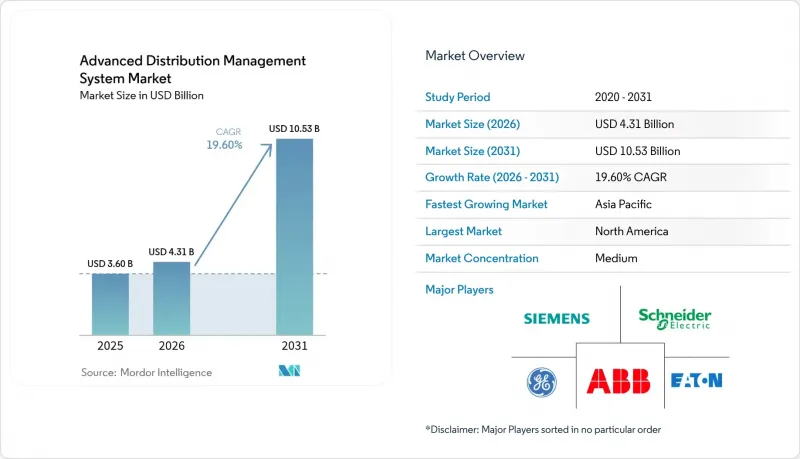
據 Mordor Intelligence 稱,到 2026 年,先進分銷管理系統 (DMS) 的市場規模估計為 43.1 億美元,高於 2025 年的 36 億美元,預計到 2031 年將達到 105.3 億美元。
預計 2026 年至 2031 年的複合年成長率為 19.60%。
本報告按交付方式(軟體和服務)、部署方式(本地部署、雲端部署、混合部署)、系統類型(配電管理系統 (DMS)、自動抄表/高級計量基礎設施 (AMR/AMI) 等)、最終用戶產業(能源和公共產業、IT 和電信、製造業等)以及地區進行細分。市場預測以美元 (USD) 計價。
全球先進配電管理系統市場趨勢及洞察
智慧電網數位化正在迅速普及。
電力公司正在快速升級其數位控制系統,以取代缺乏即時態勢感知能力的舊有系統。中國國家電網公司已撥款887億美元,用於在2025年前部署自動化配電和高級計量系統,鞏固了其在區域大規模智慧電網部署的主導地位。歐洲輸配電業者被要求將其年度配電投資增加到670億歐元(757億美元),以實現電氣化目標,這項要求促使他們即時部署自適應配電管理系統(ADMS)。據早期採用者稱,自ADMS全面運作以來,停電時間減少了21%,恢復供電時間縮短了17%,每年節省成本約1.5億美元。
分散式能源資源的整合正在推進。
來自屋頂太陽能、固定式電池和V2G(車輛到電網)資產的雙向電力流動正使傳統的配電管理工作流程不堪重負。在印度,先進的ADMS演算法能夠聯合最佳化太陽能、水力發電和電池儲能系統的運行,使基礎設施能夠充分滿足2024年創紀錄的241吉瓦尖峰負載。在美國,聯邦能源監管委員會(FERC)第2222號指令強制要求聚合分散式能源(DER)參與市場,迫使公用事業公司實施ADMS平台,以同步DER的可見性和運作。
初始資本投入高,整合過程複雜。
一套完整的ADMS系統(不包括硬體)部署成本可能在500萬美元到5000萬美元之間。變壓器的生產前置作業時間長達18到24個月,增加了資金配置風險。與現有SCADA和收費平台的介面通常會使專案工期翻倍,這對考慮採用SaaS(軟體即服務)方案的中小型公用事業公司來說是一個重大挑戰。
細分市場分析
預計到2025年,高階配電管理系統(ADMS)市場中,軟體將佔80.30%的佔有率,這進一步印證了電力公司青睞整合控制套件的趨勢。服務板塊預計將以21.40%的複合年成長率成長,這主要得益於長期整合、增強安全性和持續最佳化對專家支援的迫切需求。Schneider Electric2024年營收累計382億歐元(約432億美元),其中很大一部分將來自電網軟體生命週期服務。諮詢合約通常為期12至18個月,內容涵蓋計量系統、地理資訊系統(GIS)和停電管理系統之間的互通性測試。這些綜合項目構成了定期服務合約的基礎,從而有效緩解了收入的周期性波動。
雲端運算的快速普及正在擴大潛在客戶群,使其涵蓋那些無法升級大規模資料中心的中型電力公司。託管服務合約現在將主機託管、修補程式更新和即時網路監控打包在一起,預計這將推動高級配電管理系統 (ADMS) 服務市場到 2031 年達到 22.5 億美元。
配電管理系統 (ADMS) 保持領先地位,預計到 2025 年將佔據先進配電管理系統 (ADMS) 市場佔有率的 35.20%。能源管理系統 (EMS) 預計將以 21.05% 的複合年成長率成長,因為電力公司將輸電、配電和發電的全面最佳化視為單一的經濟方程式。分散式能源 (DER) 管理模組與 EMS 框架自然整合,形成一個整合控制平台。透過引入可再生能源的機率預測,電力公司可以將傳統發電單元的輸出調整頻率降低 12%,從而降低燃料和營運成本。該平台還能改善區域邊際價格預測,提高前台市場競標的準確性。
電錶資料管理和進階計量基礎設施 (AMI) 能夠實現對用電模式的精細化洞察,這些資料用於能源管理系統 (EMS) 演算法中。印度的國家智慧電網計畫已批准在 2024 年新增 2,200 萬個智慧電錶,從而擴展人工智慧模型的資料湖。電錶資料與 EMS 決策支援的整合將為未來的能源即服務 (EaaS)提案奠定基礎。
區域分析
亞太地區預計到2031年將以21.70%的複合年成長率成長,這主要得益於中國國家電網公司到2025年已撥出887億美元的預算,以及印度大力獎勵智慧電錶和饋線自動化。該地區各國政府正優先提高配電效率,以促進屋頂太陽能發電和快速成長的電動摩托車市場的發展。在歐洲,為符合「Fit-for-55」脫碳法規,每年必須投入757億美元用於電網升級。隨著電網營運商在更換重型導線和變壓器之前加快部署數位化系統,歐洲先進配電管理系統(ADMS)市場預計將穩定成長。
北美地區預計到2025年將佔全球銷售額的39.30%,目前正根據聯邦能源監管委員會(FERC)第2222號指令和各州韌性建設資金進行現代化改造。由於極端天氣事件頻傳,即時停電預測和分析的需求日益成長,電力公司正在試行利用人工智慧技術進行網路重構,以減少易發野火地區的停電次數,保障民眾安全。拉丁美洲尚處於應用初期,但受益於旨在減少損失的多邊資金籌措。非洲電力公司在部署完整的自動調度管理系統(ADMS)套件之前,正專注於收入保障和饋線自動化,但行動原生雲端解決方案有望加速這一進程。
供應鏈中斷是全球性的通用。 Copperweld預測,到2034年,銅的年缺口將達到800萬噸,可能會增加開關設備和導線的成本。半導體短缺也導致饋線自動化硬體的交付延遲。供應商目前正透過複製客製化ASIC晶片和採用可相容其他晶片的靈活微控制器設計來規避風險。
其他好處:
- Excel格式的市場預測(ME)表
- 3個月的分析師支持
目錄
第1章:引言
- 研究假設和市場定義
- 調查範圍
第2章:調查方法
第3章執行摘要
第4章 市場狀況
- 市場概覽
- 市場促進因素
- 智慧電網數位化快速普及
- 分散式能源(DER)的整合正在推進。
- 增加能源需求和減少停電是首要任務。
- 電動車充電的負載平衡要求
- 強制性脫碳措施(例如 FERC 2222)正在加速 ADMS 的採用。
- 雲端原生 ADMS 降低了中型公共產業的進入門檻。
- 市場限制因素
- 初始資本投入高,整合過程複雜。
- 網路安全和資料隱私問題
- ADMS領域熟練人員短缺
- 限制互通性的專有協議
- 產業價值鏈分析
- 監理情勢
- 技術展望
- 波特五力分析
第5章 市場規模與成長預測
- 報價
- 軟體
- 配送管理系統(核心引擎)
- 分散式能源管理模組
- 故障管理模組
- 服務
- 諮詢
- 系統整合
- 支援與維護
- 軟體
- 部署模式
- 現場
- 雲
- 混合
- 依系統類型
- 配送管理系統(DMS)
- AMR/AMI
- 分散式能源資源管理系統(DERMS)
- 能源管理系統(EMS)
- 客戶資訊系統(CIS)
- 計量資料管理系統(MDMS)
- 按最終用戶行業分類
- 能源公用事業
- IT/通訊
- 製造業
- 國防/政府
- 基礎設施
- 運輸/物流
- 按地區
- 北美洲
- 美國
- 加拿大
- 墨西哥
- 南美洲
- 巴西
- 阿根廷
- 其他南美國家
- 歐洲
- 德國
- 英國
- 法國
- 義大利
- 西班牙
- 其他歐洲國家
- 亞太地區
- 中國
- 印度
- 日本
- 韓國
- 其他亞太國家
- 中東和非洲
- 中東
- 沙烏地阿拉伯
- 阿拉伯聯合大公國
- 土耳其
- 其他中東國家
- 非洲
- 南非
- 奈及利亞
- 埃及
- 其他非洲國家
- 中東
- 北美洲
第6章 競爭情勢
- 市場集中度
- 策略趨勢
- 市佔率分析
- 公司簡介
- ABB Ltd.
- General Electric Co.
- Siemens AG
- Schneider Electric SE
- Eaton Corp.
- Open Systems International(Emerson)
- Survalent Technology
- ETAP/Operation Technology
- Oracle Utilities
- Capgemini
- Landis+Gyr
- ETAP/Operation Technology
- Itron
- Honeywell(Elster)
- Hexagon
- Hitachi Energy
- Survalent Technology
- SandC Electric
- Trimble
- Alstom SA
第7章 市場機會與未來展望
According to Mordor Intelligence, the advanced distribution management system market size in 2026 is estimated at USD 4.31 billion, growing from 2025 value of USD 3.60 billion with 2031 projections showing USD 10.53 billion, growing at 19.60% CAGR over 2026-2031.
This report is Segmented by Offering (Software and Services), Deployment Mode (On-Premise, Cloud, and Hybrid), System Type (Distribution Management System (DMS), AMR / AMI, and More), End-User Vertical (Energy and Utilities, IT and Telecom, Manufacturing, and More), and Geography. The Market Forecasts are Provided in Terms of Value (USD).
Global Advanced Distribution Management System Market Trends and Insights
Rapid adoption of smart-grid digitalization
Utilities are fast-tracking digital control upgrades to replace legacy systems that lack real-time situational awareness. State Grid China earmarked USD 88.7 billion for 2025 distribution automation and advanced metering deployments, cementing the region's leadership in large-scale smart-grid roll-outs. European network operators must lift annual distribution spending to EUR 67 billion (USD 75.7 billion) to cope with electrification targets, a mandate that is forcing immediate ADMS procurement. Early adopters report a 21% fall in network outage minutes and a 17% cut in restoration time after fully integrated ADMS launches, yielding annual savings near USD 150 million.
Growing integration of distributed energy resources
Bidirectional power flows from rooftop solar, stationary batteries, and vehicle-to-grid assets overwhelm legacy distribution management workflows. India met a record 241 GW peak load in 2024 without deficit by leveraging advanced ADMS algorithms that co-optimize solar, hydro, and battery dispatch. In the United States, FERC Order 2222 forces market participation by aggregated distributed resources, compelling utilities to seek ADMS platforms that deliver synchronized DER visibility and dispatch.
High initial capex and integration complexity
Full-scale ADMS deployments can cost USD 5-50 million, excluding hardware. Long production lead times on transformers have stretched to 18-24 months, magnifying capital-allocation risk. Interfaces to legacy SCADA and billing platforms often double project timelines, challenging smaller utilities that look for Software-as-a-Service options.
Other drivers and restraints analyzed in the detailed report include:
- Rising energy demand and outage-reduction priorities
- EV-charging load balancing requirements
- Cyber-security and data-privacy concerns
For complete list of drivers and restraints, kindly check the Table Of Contents.
Segment Analysis
Software accounted for 80.30% of the Advanced Distribution Management System market in 2025, affirming utilities' preference for unified control suites. The services segment is tracking a 21.40% CAGR because long-tail integration, security hardening, and continuous optimization dictate specialist support. Schneider Electric booked EUR 38.2 billion (USD 43.2 billion) in 2024 revenue, with a sizable share tied to grid-software lifecycle services. Consulting engagements typically span 12-18 months and involve interoperability testing across metering, GIS, and outage systems. These immersive projects anchor recurring service contracts that smooth revenue cyclicality.
Rapid cloud adoption widens the addressable pool of mid-tier utilities that cannot fund large data-center refreshes. Managed service agreements now bundle hosting, patching, and real-time cyber monitoring, pushing the Advanced Distribution Management System market size for services toward USD 2.25 billion by 2031.
Distribution management systems held the top position, accounting for 35.20% of the Advanced Distribution Management System market share in 2025. Energy management systems exhibit a 21.05% CAGR because utilities view holistic optimization across transmission, distribution, and generation as a single economic equation. DER management modules naturally integrate with EMS frameworks, creating an integrated control plane. When utilities incorporate probabilistic renewables forecasting, they can reduce the frequency of ramping conventional generation units by 12%, resulting in lower fuel and operational costs. Front-office market bids also improve because the platform refines locational marginal price forecasts.
Meter data management and advanced metering infrastructure provide granular visibility into consumption, which feeds EMS algorithms. India's National Smart Grid Mission cleared 22 million additional smart meters in 2024, enlarging the data lake from which AI models learn. This linkage between meter data and EMS decision support underpins future energy-as-a-service propositions.
Complete Report Scope:
- By Offering
- Software
- Distribution Management System (core engine)
- DER Management Module
- Outage Management Module
- Services
- Consulting
- System Integration
- Support and Maintenance
- Software
- By Deployment Mode
- On-premise
- Cloud
- Hybrid
- By System Type
- Distribution Management System (DMS)
- AMR / AMI
- DER Management System (DERMS)
- Energy Management System (EMS)
- Customer Information System (CIS)
- Meter Data Management System (MDMS)
- By End-user Vertical
- Energy and Utilities
- IT and Telecom
- Manufacturing
- Defense and Government
- Infrastructure
- Transportation and Logistics
- By Geography
- North America
- United States
- Canada
- Mexico
- South America
- Brazil
- Argentina
- Rest of South America
- Europe
- Germany
- United Kingdom
- France
- Italy
- Spain
- Rest of Europe
- Asia Pacific
- China
- India
- Japan
- South Korea
- Rest of Asia Pacific
- Middle East and Africa
- Middle East
- Saudi Arabia
- United Arab Emirates
- Turkey
- Rest of Middle East
- Africa
- South Africa
- Nigeria
- Egypt
- Rest of Africa
- Middle East
- North America
Geography Analysis
Asia-Pacific is on track for a 21.70% CAGR through 2031, propelled by State Grid China's USD 88.7 billion 2025 allocation and strong Indian incentives for smart meters and feeder automation. Governments in the region prioritize distribution efficiency to integrate rooftop solar and a surging electric two-wheeler fleet. Europe faces mandatory annual distribution upgrades of USD 75.7 billion to honor fit-for-55 decarbonization rules. Advanced Distribution Management System market size in Europe will expand steadily as network operators front-load digital overlays before heavier conductor and transformer replacements.
North America, which controlled 39.30% of global revenue in 2025, continues to modernize under FERC Order 2222 and state resilience funding. Severe weather incidents justify real-time outage prediction analytics, and utilities are piloting AI-based network reconfiguration to trim public safety power shutoff events in wildfire-prone regions. Latin America is at an earlier stage, yet benefits from multilateral financing directed at loss reduction. African utilities focus first on revenue protection and feeder automation before rolling out full ADMS suites, but mobile-native cloud solutions could accelerate adoption.
Supply-chain friction is a universal constraint. Copperweld forecasts an 8 million-ton annual copper shortfall by 2034, which could inflate switchgear and conductor costs. Semiconductor shortages add delay to feeder automation hardware. Vendors now hedge by dual-sourcing custom ASICs and deploying flexible microcontroller designs that can accept alternative silicon.
- ABB Ltd.
- General Electric Co.
- Siemens AG
- Schneider Electric SE
- Eaton Corp.
- Open Systems International (Emerson)
- Survalent Technology
- ETAP / Operation Technology
- Oracle Utilities
- Capgemini
- Landis+Gyr
- ETAP/Operation Technology
- Itron
- Honeywell (Elster)
- Hexagon
- Hitachi Energy
- Survalent Technology
- SandC Electric
- Trimble
- Alstom SA
Additional Benefits:
- The market estimate (ME) sheet in Excel format
- 3 months of analyst support
TABLE OF CONTENTS
1 INTRODUCTION
- 1.1 Study Assumptions and Market Definition
- 1.2 Scope of the Study
2 RESEARCH METHODOLOGY
3 EXECUTIVE SUMMARY
4 MARKET LANDSCAPE
- 4.1 Market Overview
- 4.2 Market Drivers
- 4.2.1 Rapid adoption of smart-grid digitalisation
- 4.2.2 Growing integration of distributed energy resources (DER)
- 4.2.3 Rising energy demand and outage-reduction priorities
- 4.2.4 EV-charging load balancing requirements
- 4.2.5 Decarbonisation mandates (e.g., FERC 2222) accelerating ADMS roll-outs
- 4.2.6 Cloud-native ADMS lowering entry barriers for mid-size utilities
- 4.3 Market Restraints
- 4.3.1 High initial capex and integration complexity
- 4.3.2 Cyber-security and data-privacy concerns
- 4.3.3 Shortage of ADMS-skilled workforce
- 4.3.4 Proprietary protocols limiting interoperability
- 4.4 Industry Value Chain Analysis
- 4.5 Regulatory Landscape
- 4.6 Technological Outlook
- 4.7 Porter's Five Forces Analysis
- 4.7.1 Bargaining Power of Suppliers
- 4.7.2 Bargaining Power of Buyers
- 4.7.3 Threat of New Entrants
- 4.7.4 Threat of Substitutes
- 4.7.5 Competitive Rivalry
5 MARKET SIZE AND GROWTH FORECASTS (VALUE)
- 5.1 By Offering
- 5.1.1 Software
- 5.1.1.1 Distribution Management System (core engine)
- 5.1.1.2 DER Management Module
- 5.1.1.3 Outage Management Module
- 5.1.2 Services
- 5.1.2.1 Consulting
- 5.1.2.2 System Integration
- 5.1.2.3 Support and Maintenance
- 5.1.1 Software
- 5.2 By Deployment Mode
- 5.2.1 On-premise
- 5.2.2 Cloud
- 5.2.3 Hybrid
- 5.3 By System Type
- 5.3.1 Distribution Management System (DMS)
- 5.3.2 AMR / AMI
- 5.3.3 DER Management System (DERMS)
- 5.3.4 Energy Management System (EMS)
- 5.3.5 Customer Information System (CIS)
- 5.3.6 Meter Data Management System (MDMS)
- 5.4 By End-user Vertical
- 5.4.1 Energy and Utilities
- 5.4.2 IT and Telecom
- 5.4.3 Manufacturing
- 5.4.4 Defense and Government
- 5.4.5 Infrastructure
- 5.4.6 Transportation and Logistics
- 5.5 By Geography
- 5.5.1 North America
- 5.5.1.1 United States
- 5.5.1.2 Canada
- 5.5.1.3 Mexico
- 5.5.2 South America
- 5.5.2.1 Brazil
- 5.5.2.2 Argentina
- 5.5.2.3 Rest of South America
- 5.5.3 Europe
- 5.5.3.1 Germany
- 5.5.3.2 United Kingdom
- 5.5.3.3 France
- 5.5.3.4 Italy
- 5.5.3.5 Spain
- 5.5.3.6 Rest of Europe
- 5.5.4 Asia Pacific
- 5.5.4.1 China
- 5.5.4.2 India
- 5.5.4.3 Japan
- 5.5.4.4 South Korea
- 5.5.4.5 Rest of Asia Pacific
- 5.5.5 Middle East and Africa
- 5.5.5.1 Middle East
- 5.5.5.1.1 Saudi Arabia
- 5.5.5.1.2 United Arab Emirates
- 5.5.5.1.3 Turkey
- 5.5.5.1.4 Rest of Middle East
- 5.5.5.2 Africa
- 5.5.5.2.1 South Africa
- 5.5.5.2.2 Nigeria
- 5.5.5.2.3 Egypt
- 5.5.5.2.4 Rest of Africa
- 5.5.5.1 Middle East
- 5.5.1 North America
6 COMPETITIVE LANDSCAPE
- 6.1 Market Concentration
- 6.2 Strategic Moves
- 6.3 Market Share Analysis
- 6.4 Company Profiles {(includes Global level Overview, Market level overview, Core Segments, Financials as available, Strategic Information, Market Rank/Share for key companies, Products and Services, Recent Developments)}
- 6.4.1 ABB Ltd.
- 6.4.2 General Electric Co.
- 6.4.3 Siemens AG
- 6.4.4 Schneider Electric SE
- 6.4.5 Eaton Corp.
- 6.4.6 Open Systems International (Emerson)
- 6.4.7 Survalent Technology
- 6.4.8 ETAP / Operation Technology
- 6.4.9 Oracle Utilities
- 6.4.10 Capgemini
- 6.4.11 Landis+Gyr
- 6.4.12 ETAP/Operation Technology
- 6.4.13 Itron
- 6.4.14 Honeywell (Elster)
- 6.4.15 Hexagon
- 6.4.16 Hitachi Energy
- 6.4.17 Survalent Technology
- 6.4.18 SandC Electric
- 6.4.19 Trimble
- 6.4.20 Alstom SA
7 MARKET OPPORTUNITIES AND FUTURE OUTLOOK
- 7.1 White-space and Unmet-need Assessment

 2026-2034年全球先進配電管理系統市場規模、佔有率、趨勢和成長分析報告
 先進配電管理系統市場-2026-2032年全球市場預測
 2026年全球桿式安裝自動分段切換裝置市場報告
 先進配電管理系統市場報告:按產品、系統類型、最終用戶產業和地區分類(2026-2034 年)2026年全球先進配電管理系統市場報告
 先進分銷管理系統市場分析及預測(至2035年):按類型、產品、服務、技術、組件、應用、部署類型、最終用戶、模組和功能分類
 高階分銷管理系統市場規模、佔有率和成長分析(按產品、部署、功能、最終用途和地區分類)—產業預測(2026-2033 年)
 先進分銷管理系統市場機會、成長促進因素、產業趨勢分析及預測(2025-2034年)
 全球先進分銷管理系統市場:2032 年預測 - 按產品、部署方法、功能、組織規模、最終用戶和地區進行分析
 2025-2029年全球先進物流管理系統市場