


 |
市場調查報告書
商品編碼
2124567
智慧窗戶:市場佔有率分析、產業趨勢與統計、成長預測(2026-2031)Smart Window - Market Share Analysis, Industry Trends & Statistics, Growth Forecasts (2026 - 2031) |
||||||

※ 本網頁內容可能與最新版本有所差異。詳細情況請與我們聯繫。
根據 Mordor Intelligence 預測,智慧窗戶市場規模將從 2025 年的 61.2 億美元成長到 2026 年的 66.8 億美元,然後在 2031 年達到 103.3 億美元,2026 年至 2031 年的複合年成長率為 9.12%。
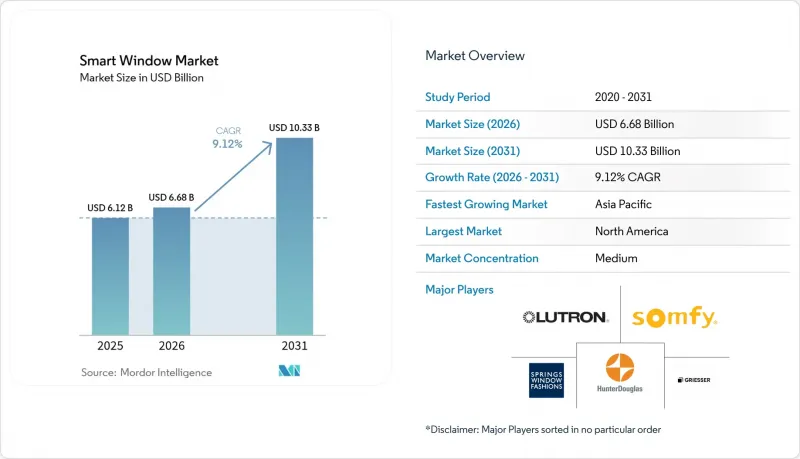
本報告按產品類型(電動捲簾、電動斑馬簾子、電動窗簾系統、電動百葉窗及其他產品類型)、電源(有線、電池供電、太陽能供電)、安裝類型(新建、維修)、應用領域(住宅、商業、工業)和地區進行細分。市場預測以美元(USD)計價。
全球智慧窗戶市場趨勢及洞察
智慧家庭的興起
到了2024年,智慧家庭將佔家庭總數的15.2%,消費者對遮陽的需求也從單純的電動化轉向預測性自動化。 Matter和Thread協議實現了多廠商互通性,與語音助理的整合使窗戶能夠自動回應入住時間表和收費系統的變化。遮陽馬達內部的邊緣處理器降低了雲端延遲,並支援本地決策邏輯。據北美通路合作夥伴稱,當智慧窗戶與安防和暖通空調系統捆綁銷售時,其普及率超過45%。提供開放API的供應商正在贏得整合商的信任,從而降低了他們對專有平台的依賴。
能源效率法規與綠建築標準
加州第24號法規強制規定,面積超過10,000平方英尺的商業空間必須安裝動態嵌裝玻璃或電動遮陽系統。 2024年國際節能規範(IECC)引入了側光區域的自動日光控制,歐盟修訂後的能源性能指令(EPBD)也要求成員國提高建築自動化標準。由於合規成本不可避免,供應商預計符合法規要求的項目比純粹出於美觀目的的住宅升級項目利潤更高。 LEED v4.1和BREEAM等認證系統會根據自動眩光抑制和太陽熱增益降低情況給予加分,而智慧窗戶被視為滿足這些評估標準的經濟有效途徑。
缺乏互通性標準
儘管Matter將於2024年推出,但傳統設備仍基於Zigbee、Z-Wave或專有射頻標準運行,迫使整合商使用網橋,增加了成本和複雜性。研究表明,相容性問題導致商業環境中35%的安裝延誤。企業負責人不願意被封閉的生態系統束縛,擔心產品過時。仍然將API保密的製造商正面臨來自銷售管道的強烈反對,導致行業趨勢轉向能夠即時在多種協議之間轉換的軟體定義閘道器。
細分市場分析
電動捲簾憑藉其久經考驗的可靠性和安裝人員熟悉的易用性,在2025年佔據了智慧窗戶市場34.02%的佔有率。其布料的多樣性使其既適用於住宅室內裝修,也適用於商業設施的防眩光需求。此細分市場智慧窗戶市場的成長主要得益於成本最佳化的管狀電機,這種電機能夠在不到0.5安培的功耗下提升更大的跨度。相較之下,電致變色智慧玻璃面板雖然吸引了媒體的關注,並維持著10.88%的複合年成長率,但仍是資本密集產品。控制器現在配備了四核心處理器,並支援設備端場景控制和無線安全修補程式應用。
機械遮陽與動態嵌裝玻璃的融合預示著未來專案中混合幕牆的實現。製造商正將捲簾、百葉窗和玻璃整合到一個中心,並透過單一的BACnet物件進行統一管理,使設施管理人員能夠精確調節太陽輻射熱量的吸收。像SageGlass這樣的供應商已在入住後審計中證明,其產品能夠降低20-30%的暖通空調成本,這印證了智慧窗戶市場關於營運投資回報的說法。例如,電動百葉窗等小眾產品正被應用於實驗室,醫生可以透過調節燈光角度來避免顯示器反射造成的眩光。電動窗簾系統在迎賓套房中持續應用,但由於布料成本和安裝時間較長,其成長速度正在放緩。
到2025年,有線解決方案將佔據智慧窗戶市場40.65%的佔有率,這主要得益於不間斷電源和與建築管理系統的直接整合。由於有線解決方案從低壓直流母線取電,因此簡化了電氣作業標準的合規性,避免了非電氣技術人員進行高壓佈線的限制。同時,太陽能智慧窗正以12.05%的複合年成長率快速成長,其面板效率超過22%,磷酸鋰鐵鋰電池組即使經過3000多次循環後仍能維持80%的容量。
嵌入玻璃的透明太陽能條具有雙重優點:既能調節太陽輻射,又能收集可再生能源。電池供電的太陽能套件在維修項目中佔據了一席之地,因為在這些項目中鑽孔和鋪設管道並不現實。製造商正在將超級電容整合到太陽能套件中,以彌補陰天地區陽光照射的不確定性。能源採集馬達可以回收利用遮陽簾運動產生的動能,雖然目前仍處於試驗階段,但它表明智慧窗戶市場正努力擺脫對電網的依賴。
區域分析
由於嚴格的建築規範和46%的智慧家庭普及率,北美在2025年仍維持32.12%的市場佔有率。美國聯邦租賃政策強制要求建築採用節能型外圍護結構,即使在預算緊張的情況下也能確保一定的需求水準。加拿大寒冷的氣候降低了暖氣成本,縮短了投資回收期;而墨西哥在美墨加協定(USMCA)下工廠建設的蓬勃發展,也促進了商業領域的應用,即便預算緊張。
亞太地區是成長最快的地區,年複合成長率達12.31%。在中國深圳和上海,智慧城市試點計畫正在高層建築中引入智慧遮陽系統;在日本,老年住宅正在安裝自動百葉窗,以幫助行動不便的居住者。在韓國首爾,兼容Matter材料的外牆正在引入豪華公寓。在印度的「智慧城市計畫」中,自動日光控制已被列為能源管理系統(EMS)投資的目標,但其應用主要集中在甲級辦公室。在「翻新浪潮」計畫的推動下,歐洲保持中等個位數的成長,德國也提供用於建築自動化的低利率貸款。在阿拉伯聯合大公國和沙烏地阿拉伯,大型企劃中正在引入電致變色玻璃,以應對尖峰時段的冷卻成本。
其他好處:
- Excel格式的市場預測(ME)表
- 3個月的分析師支持
目錄
第1章:引言
- 研究假設和市場定義
- 調查範圍
第2章:調查方法
第3章執行摘要
第4章 市場狀況
- 市場概覽
- 市場促進因素
- 智慧家庭的興起
- 能源效率法規與綠建築標準
- 與語音助理和更廣泛的物聯網生態系統整合
- 對自然採光和晝夜節律照明解決方案的需求
- 居家養老與無障礙維修
- 智慧建築認證正在推動自動化發展。
- 市場限制因素
- 缺乏互通性標準
- 維修工程的初期成本較高
- 網路安全和資料隱私問題
- 電子設備和半導體供應鏈的波動性
- 價值鏈分析
- 監理情勢
- 技術展望
- 波特五力分析
- 評估宏觀經濟對市場的影響
第5章 市場規模與成長預測
- 依產品類型
- 電動捲簾
- 電動斑馬簾子
- 電動窗簾系統
- 電動百葉窗
- 其他產品類型(智慧型玻璃面板、控制器、整合式集線器等)
- 透過電源
- 有線型
- 電池供電
- 太陽能
- 按安裝類型
- 新建工程
- 改裝
- 透過使用
- 住宅
- 商業的
- 辦公室
- 飯店業
- 衛生保健
- 教育
- 零售
- 產業
- 按地區
- 北美洲
- 美國
- 加拿大
- 墨西哥
- 南美洲
- 巴西
- 阿根廷
- 其他南美國家
- 歐洲
- 德國
- 英國
- 法國
- 義大利
- 西班牙
- 俄羅斯
- 其他歐洲國家
- 亞太地區
- 中國
- 日本
- 韓國
- 印度
- 澳洲和紐西蘭
- 其他亞太國家
- 中東
- 沙烏地阿拉伯
- 阿拉伯聯合大公國
- 土耳其
- 其他中東國家
- 非洲
- 南非
- 奈及利亞
- 其他非洲國家
- 北美洲
第6章 競爭情勢
- 市場集中度
- 策略趨勢
- 市佔率分析
- 公司簡介
- Lutron Electronics Co. Inc.
- Somfy Systems Inc.
- Hunter Douglas NV
- Inter IKEA Systems BV
- The Shade Store LLC
- Springs Window Fashions LLC
- Griesser AG
- Smartwings Home(Springblinds)
- Alta Window Fashions(Custom Brands Group LLC)
- Coulisse BV(MotionBlinds)
- Pella Corporation
- View Inc.
- Saint-Gobain(SageGlass)
- AGC Inc.(Halio)
- Velux Group
第7章 市場機會與未來展望
According to Mordor Intelligence, the smart window market size is expected to grow from USD 6.12 billion in 2025 to USD 6.68 billion in 2026 and is forecast to reach USD 10.33 billion by 2031 at 9.12% CAGR over 2026-2031.
This report is Segmented by Product Type (Motorized Roller Shades, Motorized Zebra Shades, Motorized Drapery Systems, Motorized Venetian Blinds, Other Product Types), Power Source (Hard-Wired, Battery-Powered, Solar-Powered), Installation Type (New Construction, Retrofit), Application (Residential, Commercial, Industrial), and Geography. The Market Forecasts are Provided in Terms of Value (USD).
Global Smart Window Market Trends and Insights
Growing prominence of smart homes
Smart-home penetration reached 15.2% of households in 2024, transforming consumer expectations for shading from simple motorization to predictive automation. Matter and Thread protocols now enable multi-vendor interoperability, while voice assistant links allow windows to respond automatically to occupancy schedules and tariff changes. Edge processors inside shade motors cut cloud latency and support localized decision logic. Channel partners in North America report attachment rates above 45% when smart windows are bundled with security and HVAC packages. Suppliers that expose open APIs are gaining integrator loyalty, reducing reliance on proprietary hubs.
Energy-efficiency regulations and green-building codes
California's Title 24 mandates dynamic glazing or motorized shading for commercial spaces above 10,000 square feet. The 2024 IECC introduced automated daylight controls for sidelighting zones, while the EU's EPBD recast compels member states to elevate building automation standards. Because compliance spend is non-discretionary, vendors see higher margins in code-driven projects than in purely aesthetic residential upgrades. Certifications such as LEED v4.1 and BREEAM award points for automated glare and solar-heat-gain mitigation, positioning smart windows as a cost-effective route to rating thresholds.
Lack of interoperability standards
Despite Matter's 2024 launch, legacy devices run on Zigbee, Z-Wave, or proprietary RF, forcing integrators to juggle bridges that raise cost and complexity . Surveys show compatibility headaches trigger 35% of commercial installation delays. Enterprise buyers hesitate to lock into closed ecosystems that risk obsolescence. Manufacturers that still guard APIs face channel pushback, prompting an industry shift toward software-defined gateways capable of translating multiple protocols in real time.
Other drivers and restraints analyzed in the detailed report include:
- Integration with voice assistants and wider IoT ecosystems
- Demand for daylighting and circadian-lighting solutions
- High upfront costs for retrofit installations
For complete list of drivers and restraints, kindly check the Table Of Contents.
Segment Analysis
Motorized roller shades accounted for 34.02% of the smart window market share in 2025 on the strength of proven reliability and installer familiarity. Their fabric versatility suits both residential decor changes and commercial glare-control requirements. Smart window market growth within this segment is reinforced by cost-optimized tubular motors that can lift wider spans while drawing less than 0.5 amps. In contrast, electrochromic smart glass panels capture media attention and post an 10.88% CAGR yet remain capital-intensive. Controllers now ship with quad-core processors, supporting on-device scene orchestration and over-the-air security patches.
The convergence of mechanical shading and dynamic glazing suggests hybrid facades in future projects. Manufacturers bundle integration hubs that stitch roller shades, blinds, and glass together under a single BACnet object, letting facility managers tune solar-heat gain precisely. Vendors like SageGlass showcase 20-30% HVAC savings in post-occupancy audits, bolstering the smart window market narrative around operational payback. Niche categories such as motorized venetian blinds serve laboratories where doctors calibrate light angles to avoid reflective glare on monitors. Motorized drapery systems continue in hospitality suites, though growth lags due to fabric cost and longer installation times.
Hard-wired solutions contributed 40.65% to the smart window market size in 2025, owing to uninterrupted power and direct integration to building management systems. They draw from low-voltage DC buses, simplifying compliance with electrical codes that restrict line-voltage wiring by non-electricians. However, solar-powered units are expanding at a 12.05% CAGR as panel efficiency breaches 22% and lithium-iron-phosphate packs retain 80% capacity beyond 3,000 cycles.
Transparent photovoltaic strips embedded in glazing promise a dual benefit: daylight modulation and renewable energy harvesting. Battery-powered kits occupy retrofit niches where drill paths or conduit runs are impractical. Manufacturers embed super-capacitors to buffer intermittent sunlight in cloudy regions. Energy-harvesting motors that recycle kinetic energy from shade motion remain experimental but illustrate how the smart window market pursues autonomy from grid power.
Complete Report Scope:
- By Product Type
- Motorized Roller Shades
- Motorized Zebra Shades
- Motorized Drapery Systems
- Motorized Venetian Blinds
- Other Product Types (Smart Glass Panels, Controllers and Integration Hubs, etc.)
- By Power Source
- Hard-wired
- Battery-powered
- Solar-powered
- By Installation Type
- New Construction
- Retrofit
- By Application
- Residential
- Commercial
- Offices
- Hospitality
- Healthcare
- Education
- Retail
- Industrial
- By Geography
- North America
- United States
- Canada
- Mexico
- South America
- Brazil
- Argentina
- Rest of South America
- Europe
- Germany
- United Kingdom
- France
- Italy
- Spain
- Russia
- Rest of Europe
- Asia Pacific
- China
- Japan
- South Korea
- India
- Australia and New Zealand
- Rest of Asia Pacific
- Middle East
- Saudi Arabia
- United Arab Emirates
- Turkey
- Rest of Middle East
- Africa
- South Africa
- Nigeria
- Rest of Africa
- North America
Geography Analysis
North America maintained a 32.12% revenue share in 2025 due to stringent codes and a 46% smart-home penetration rate. The US federal leasing policies stipulate energy-efficient envelopes, ensuring baseline demand even when discretionary budgets tighten. Canada's cold climate sharpens heating-savings payback, and Mexico's factory boom under the USMCA trade pact pushes commercial adoption despite tighter budgets.
Asia Pacific is the fastest-growing region at 12.31% CAGR. China's smart-city pilots in Shenzhen and Shanghai embed intelligent shading in high-rise clusters, while Japan equips senior housing blocks with automated blinds to aid occupants with limited mobility. South Korea integrates Matter-compatible facades in Seoul's premium apartments. India's Smart Cities Mission names automated daylight control as an eligible EMS investment, though uptake concentrates in Grade-A offices. Europe sustains mid-single-digit growth on the back of its Renovation Wave program, with Germany funding low-interest loans for building automation. UAE and Saudi Arabia install electrochromic glass in megaprojects to battle peak-time cooling costs.
- Lutron Electronics Co. Inc.
- Somfy Systems Inc.
- Hunter Douglas N.V.
- Inter IKEA Systems B.V.
- The Shade Store LLC
- Springs Window Fashions LLC
- Griesser AG
- Smartwings Home (Springblinds)
- Alta Window Fashions (Custom Brands Group LLC)
- Coulisse B.V. (MotionBlinds)
- Pella Corporation
- View Inc.
- Saint-Gobain (SageGlass)
- AGC Inc. (Halio)
- Velux Group
Additional Benefits:
- The market estimate (ME) sheet in Excel format
- 3 months of analyst support
TABLE OF CONTENTS
1 INTRODUCTION
- 1.1 Study Assumptions and Market Definition
- 1.2 Scope of the Study
2 RESEARCH METHODOLOGY
3 EXECUTIVE SUMMARY
4 MARKET LANDSCAPE
- 4.1 Market Overview
- 4.2 Market Drivers
- 4.2.1 Growing prominence of smart homes
- 4.2.2 Energy-efficiency regulations and green-building codes
- 4.2.3 Integration with voice assistants and wider IoT ecosystems
- 4.2.4 Demand for daylighting and circadian-lighting solutions
- 4.2.5 Aging-in-place and accessibility retrofits
- 4.2.6 Smart-building certifications pushing automation
- 4.3 Market Restraints
- 4.3.1 Lack of interoperability standards
- 4.3.2 High upfront costs for retrofit installations
- 4.3.3 Cyber-security and data-privacy concerns
- 4.3.4 Supply-chain volatility for electronics and semiconductors
- 4.4 Value Chain Analysis
- 4.5 Regulatory Landscape
- 4.6 Technological Outlook
- 4.7 Porter's Five Forces Analysis
- 4.7.1 Bargaining Power of Suppliers
- 4.7.2 Bargaining Power of Buyers
- 4.7.3 Threat of New Entrants
- 4.7.4 Intensity of Competitive Rivalry
- 4.7.5 Threat of Substitutes
- 4.8 An Assessment of Macroeconomic Impact on the Market
5 MARKET SIZE AND GROWTH FORECASTS (VALUE)
- 5.1 By Product Type
- 5.1.1 Motorized Roller Shades
- 5.1.2 Motorized Zebra Shades
- 5.1.3 Motorized Drapery Systems
- 5.1.4 Motorized Venetian Blinds
- 5.1.5 Other Product Types (Smart Glass Panels, Controllers and Integration Hubs, etc.)
- 5.2 By Power Source
- 5.2.1 Hard-wired
- 5.2.2 Battery-powered
- 5.2.3 Solar-powered
- 5.3 By Installation Type
- 5.3.1 New Construction
- 5.3.2 Retrofit
- 5.4 By Application
- 5.4.1 Residential
- 5.4.2 Commercial
- 5.4.2.1 Offices
- 5.4.2.2 Hospitality
- 5.4.2.3 Healthcare
- 5.4.2.4 Education
- 5.4.2.5 Retail
- 5.4.3 Industrial
- 5.5 By Geography
- 5.5.1 North America
- 5.5.1.1 United States
- 5.5.1.2 Canada
- 5.5.1.3 Mexico
- 5.5.2 South America
- 5.5.2.1 Brazil
- 5.5.2.2 Argentina
- 5.5.2.3 Rest of South America
- 5.5.3 Europe
- 5.5.3.1 Germany
- 5.5.3.2 United Kingdom
- 5.5.3.3 France
- 5.5.3.4 Italy
- 5.5.3.5 Spain
- 5.5.3.6 Russia
- 5.5.3.7 Rest of Europe
- 5.5.4 Asia Pacific
- 5.5.4.1 China
- 5.5.4.2 Japan
- 5.5.4.3 South Korea
- 5.5.4.4 India
- 5.5.4.5 Australia and New Zealand
- 5.5.4.6 Rest of Asia Pacific
- 5.5.5 Middle East
- 5.5.5.1 Saudi Arabia
- 5.5.5.2 United Arab Emirates
- 5.5.5.3 Turkey
- 5.5.5.4 Rest of Middle East
- 5.5.6 Africa
- 5.5.6.1 South Africa
- 5.5.6.2 Nigeria
- 5.5.6.3 Rest of Africa
- 5.5.1 North America
6 COMPETITIVE LANDSCAPE
- 6.1 Market Concentration
- 6.2 Strategic Moves
- 6.3 Market Share Analysis
- 6.4 Company Profiles (includes Global level Overview, Market level overview, Core Segments, Financials as available, Strategic Information, Market Rank/Share for key companies, Products and Services, and Recent Developments)
- 6.4.1 Lutron Electronics Co. Inc.
- 6.4.2 Somfy Systems Inc.
- 6.4.3 Hunter Douglas N.V.
- 6.4.4 Inter IKEA Systems B.V.
- 6.4.5 The Shade Store LLC
- 6.4.6 Springs Window Fashions LLC
- 6.4.7 Griesser AG
- 6.4.8 Smartwings Home (Springblinds)
- 6.4.9 Alta Window Fashions (Custom Brands Group LLC)
- 6.4.10 Coulisse B.V. (MotionBlinds)
- 6.4.11 Pella Corporation
- 6.4.12 View Inc.
- 6.4.13 Saint-Gobain (SageGlass)
- 6.4.14 AGC Inc. (Halio)
- 6.4.15 Velux Group
7 MARKET OPPORTUNITIES AND FUTURE OUTLOOK
- 7.1 White-space and Unmet-Need Assessment

 智慧窗戶市場預測(2034 年)—按產品類型、連接技術、控制方式、材料、分銷管道、最終用戶和地區分類的全球分析
 智慧窗戶市場-2026-2032年全球市場預測
 智慧窗戶市場規模、佔有率和成長分析:按技術、產品、應用、控制方式和地區分類-2026-2033年產業預測
 智慧窗戶市場報告:按技術、類型、應用和地區分類,2026-2034年
 2026年全球智慧窗戶市場報告2026年全球汽車智慧窗戶市場報告2026年全球智慧自適應窗紗市場報告2026年全球智慧自適應空氣幕市場報告
 智慧窗戶市場-全球產業規模、佔有率、趨勢、機會及預測(依技術類型、玻璃類型、終端用戶產業、地區及競爭格局分類,2021-2031年)
 2025-2029年全球智慧窗戶市場