


 |
市場調查報告書
商品編碼
2124563
汽車智慧玻璃:市場佔有率分析、產業趨勢與統計及成長預測(2026-2031)Automotive Smart Glass - Market Share Analysis, Industry Trends & Statistics, Growth Forecasts (2026 - 2031) |
||||||

※ 本網頁內容可能與最新版本有所差異。詳細情況請與我們聯繫。
據 Mordor Intelligence 稱,汽車智慧玻璃市場預計到 2026 年價值 35.5 億美元,高於 2025 年的 31.2 億美元,預計到 2031 年將達到 67.4 億美元。
預計從 2026 年到 2031 年,其複合年成長率將達到 13.69%。
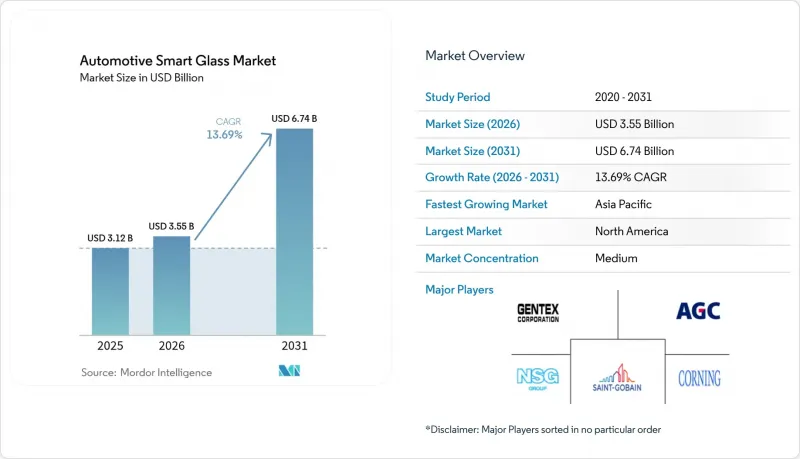
本報告按技術類型(例如,電致變色技術)、應用類型(例如,天窗玻璃)、車輛類型(例如,乘用車)、動力類型(內燃機和電動車)、銷售管道(OEM 和售後市場)以及地區進行細分。市場預測以美元計價。
全球汽車智慧玻璃市場趨勢與洞察
相容於ADAS系統的擋風玻璃正在推動可調光HUD玻璃的需求。
高級駕駛輔助系統 (ADAS) 依賴抬頭顯示器(HUD),HUD 必須在陽光直射、晨光眩光以及隧道出口光線變化等條件下保持清晰可見。聖戈班和 AGC 聯合完成了對一種夾層擋風玻璃的檢驗,該玻璃包含一層薄薄的電致變色中階,僅使 HUD 顯示區域變暗,同時保持擋風玻璃其他部分的清晰度。安裝在保護玻璃背面的 Lumineq 透明 TFEL 堆疊可顯示高對比度的擴增實境(AR) 箭頭,即使在環境光峰值達到 10,000 cd/m² 時仍清晰可讀。隨著汽車製造商追求更高水準的 SAE 自動化,他們正在為 HUD 顯示區域採用亮度調節功能,以減輕駕駛員疲勞並減少儀錶板操作。隨著 HUD 顯示密度不斷提高,並向增強導航和 ADAS 警報方向發展,智慧擋風玻璃不僅成為提升舒適性的手段,更成為一項功能性安全組件。
為了抵消電池組產生的熱量,汽車製造商正在推廣電動車採用大型全景天窗。
被動式溫度控管在電動車平台中變得日益重要,因為它們在快速充電和高負載工況下會產生過多的熱量。採用懸浮顆粒裝置 (SPD) 製造的全景天窗可在幾毫秒內從透明切換到不透明,從而在空調壓縮機啟動前顯著減少太陽熱量的侵入。雷諾的「Solarbay」原型車表明,動態不透明度控制可在夏季駕駛循環中將實際續航里程提高幾個百分點。由於電池冷卻仍然是一個成本高昂的子系統,OEM 工程師將智慧嵌裝玻璃視為一種「即用型」解決方案,可與新型熱泵架構完美配合。由此帶來的設計自由度允許採用更流暢的車頂線條,無需機械簾子,從而進一步突出電動車特有的造型元素,而這些元素是固定式有色玻璃無法實現的。
高昂的初始零件成本和整合成本
電致變色和SPD車頂模組會使每輛車的成本增加200至800美元,對於B級車和對成本敏感的市場而言,這筆費用難以負擔。除了原料成本外,OEM廠商還需要重新認證車頂的撞擊性能,增加線路,並檢驗與車身控制模組相容的軟體。生產線上陡峭的學習曲線和模具成本阻礙了中小型汽車製造商的早期採用。因此,一級供應商優先考慮高利潤豪華車的契約,這延緩了大規模生產帶來的規模經濟效益的實現,而規模經濟本可以加速價格下降。雖然持續的研發有望實現線上塗覆和捲膜(FONR)工藝,但短期成本壁壘仍限制著智慧玻璃在汽車智慧玻璃市場低價位領域的應用。
細分市場分析
到2025年,電致變色玻璃將佔據汽車智慧玻璃市場46.05%的佔有率,其市場佔有率的成長得益於均衡的切換速度、更長的使用壽命和更低的單位成本。預計到2031年,粒狀物光譜(SPD)裝置的複合年成長率將達到14.63%。 SPD裝置透過提供亞秒的顏色變化和更豐富的中間色調漸變,正在縮小與電致變色玻璃的差距。這些特性非常適合注重性能的內裝和用戶可控的遮陽預設。 Gentex的薄膜電致變色結構透過實現與汽車生產線速度相當的捲對捲層壓,進一步降低了一級車頂供應商的學習曲線。
在預測期內,結合了響應速度快的SPD和高不透明度電致變色層的混合堆疊結構有望滿足市場需求,尤其是在需要防眩光和保護隱私的全景天窗。這些技術之間的競爭正在推動對下一代透明導電材料的聯合投資,因為每種通用都力求克服ITO的共同限制。在這種競爭環境下,汽車智慧玻璃市場持續受益於相互促進的突破性創新,這些創新提高了整體性能標準。
同時,聚合物分散液晶(PDLC)和感溫變色薄膜在成本受限的車型配置中扮演著獨特的角色,尤其適用於被動調光應用。儘管它們的普及速度相對緩慢,但含有紅外線吸收奈米粒子的PDLC變體有望應用於運營於炎熱氣候旅遊線路的客製化豪華穿梭巴士。無需電力輸入即可在35 度C以上自動變色的熱致變色車頂面板,對於尋求節能車內製冷的末端配送貨車來說極具吸引力。這些小規模技術領域共同拓展了智慧玻璃的應用範圍,使汽車智慧玻璃市場能夠容納那些原本因成本壁壘而無法整合此功能的車款。隨著二級供應商從領先那裡獲得關鍵專利許可,價格競爭預計將會加劇,最終擠壓利潤空間,但預計部署數量將會增加。
至2025年,天窗安裝量將佔汽車智慧玻璃市場的73.42%。這主要得益於天窗模組更換簡便,無需對擋風玻璃進行結構性重新認證。在消費者對視野開闊的需求以及社群媒體影響者的影響下,全景天窗已成為高階車型的標配提升銷售選項。智慧玻璃具有許多實質的優勢,例如在不阻礙視線的情況下減少眩光,從而強化了以先進舒適性為核心的品牌故事。同時,隨著產業重心轉向擴增實境(AR)導航和駕駛員監控疊加技術,智慧抬頭顯示器(HUD)和顯示面板預計將以16.44%的複合年成長率成長至2031年。汽車製造商意識到,即使在極端光照條件下,擋風玻璃上顯示的內容也必須清晰可見,因此可調光面板已成為一項功能性必需品,而非奢侈品。
側窗和後窗的二次應用,尤其注重隱私保護和均勻的車內溫度,深受共乘汽車業者的青睞。雖然前擋風玻璃由於夾層厚度和安全標準方面的技術挑戰,但與ADAS(高級駕駛輔助系統)的兼容性正在為每輛車帶來額外收益。KURARAY CO. LTD.的「SkyViera」夾層最近被馬恆達的「XUV 9e」採用,它整合了與車頂調光狀態同步的環境燈槽,從而提供統一的視覺體驗。其應用範圍正從單一面板的創新發展到涵蓋多種表面的生態系統,這種轉變透過支持每輛車內容的深度化,推動了汽車智慧玻璃市場的發展。
區域分析
預計到2025年,北美將佔據汽車智慧玻璃市場41.92%的佔有率,這主要得益於豪華車的高滲透率、快速發展的ADAS(高級駕駛輔助系統)法規以及密西根州和安大略省周邊眾多一級供應商的集中分佈。美國消費者越來越願意為提升駕乘舒適性的技術買單,特斯拉Model Y提供的可調光車頂選配包便是最好的例證。在冬季嚴寒的加拿大,汽車車隊正面臨嚴峻的挑戰,聖戈班公司正在測試一種透過調節紅外線吸收率來輔助除冰的電致變色車頂,並積極檢驗這項技術。跨境監管協調,特別是關於前擋風玻璃抬頭顯示(HUD)參數的協調,正在簡化型式認證流程,並維持OEM廠商對多功能智慧玻璃的需求。
歐洲汽車總銷量位居第二,但其技術標準卻持續引領全球。德國豪華汽車品牌在新型層壓化學技術領域處於領先地位,而法國和瑞典的監管機構則積極推廣循環經濟指標,以解決報廢階段的分層問題。該地區對低眩光、低紫外線內裝環境的重視,正推動B級掀背車採用此類技術。例如,拉皮的大眾ID.3車型,根據客戶舒適度調查結果,在部分車頂區域引入了可調光功能。歐盟的「地平線」研究津貼正在資助碳中和熔爐的研發,這將透過支持未來的規模化生產,對全球汽車智慧玻璃市場產生連鎖反應。
亞太地區是成長最快的市場,預計到2031年複合年成長率將達到16.02%。作為全球電動車生產中心,中國正藉助福耀等國內玻璃巨頭的力量,確保其供應鏈的韌性。政府對新能源汽車天窗的補貼政策,正加速智慧玻璃在各大城市的普及應用,尤其是在夏季城市熱浪導致空調過度使用的情況下。在日本的輕型車領域,用於後行李箱蓋的緊湊型SPD(開關型)玻璃面板的試點測試正在進行中,凸顯了動態遮光功能在空間有限的車內環境中的重要性。在韓國,領先的記憶體晶片製造商與一級車頂供應商之間的策略合作,透過將駕駛員狀態偵測與車頂顏色調節相結合,正在該地區培育一種系統級的創新文化。
儘管規模仍然較小,但拉丁美洲和中東地區正在湧現一些細分市場機會。在墨西哥,旅遊車輛正在改裝電致變色側窗,以適應風景優美的路線;而在海灣國家,豪華SUV則採用三區隔熱玻璃來應對高達攝氏50度C的高溫。這些例子表明,智慧玻璃最終將成為全球汽車消費者的“標配”,而不同地區在普及程度上的差異也必將縮小。
其他好處:
- Excel格式的市場預測(ME)表
- 3個月的分析師支持
目錄
第1章:引言
- 研究假設和市場定義
- 調查範圍
第2章:調查方法
第3章執行摘要
第4章 市場狀況
- 市場概覽
- 市場促進因素
- 電致變色天窗在豪華車和高階車中越來越常見。
- 為了抵消電池組產生的熱量,電動車製造商正在推廣在其電動車中採用大型全景天窗。
- 相容於ADAS系統的擋風玻璃推動了對具有防眩光功能的HUD玻璃的需求。
- 歐盟收緊眩光和紫外線標準,推動了智慧嵌裝玻璃的普及。
- 為了縮短組裝時間,一級供應商正在提供整合式智慧屋頂模組。
- 一種新型碳中和玻璃熔爐,可降低生產成本。
- 市場限制因素
- 高昂的初始組件成本和整合成本
- 極端氣候條件下PDLC薄膜溫度工作範圍的限制
- 汽車用氧化銦錫(ITO)供不應求加劇了原料風險。
- ADAS相容擋風玻璃的售後校準的複雜性。
- 價值供應鏈分析
- 監理情勢
- 技術展望
- 波特五力模型
第5章 市場規模與成長預測
- 依技術類型
- 電致變色
- 懸浮顆粒探測器(SPD)
- 聚合物分散液晶(PDLC)
- 熱致變色/光致變色
- 混合/多棧
- 按應用程式類型
- 天窗玻璃
- 後窗和側窗
- 前擋風玻璃和後擋風玻璃
- 智慧HUD/顯示面板
- 車輛類型
- 搭乘用車
- 輕型商用車
- 中型和重型商用車輛
- 巴士和長途汽車
- 依推進類型
- 內燃機
- 電動車
- 按銷售管道
- 目的地設備製造商 (OEM)
- 售後市場
- 按地區
- 北美洲
- 美國
- 加拿大
- 其他北美國家
- 南美洲
- 巴西
- 阿根廷
- 其他南美國家
- 歐洲
- 德國
- 英國
- 法國
- 義大利
- 西班牙
- 俄羅斯
- 其他歐洲國家
- 亞太地區
- 中國
- 日本
- 韓國
- 印度
- 印尼
- 越南
- 菲律賓
- 澳洲
- 其他亞太國家
- 中東和非洲
- 阿拉伯聯合大公國
- 沙烏地阿拉伯
- 土耳其
- 埃及
- 南非
- 其他中東和非洲國家
- 北美洲
第6章 競爭情勢
- 市場集中度
- 策略趨勢
- 市佔率分析
- 公司簡介
- Saint-Gobain SA
- AGC Inc.
- Nippon Sheet Glass Co. Ltd.
- Corning Inc.
- Guardian Industries
- Research Frontiers Inc.
- Gentex Corporation
- Gauzy Ltd.
- View Inc.
- Fuyao Glass Industry Group
- Xinyi Glass Holdings Limited
- AGP Group
- SYP Glass Group Co.,Ltd.
- SCHOTT AG
第7章 市場機會與未來展望
According to Mordor Intelligence, the automotive smart glass market size in 2026 is estimated at USD 3.55 billion, growing from 2025 value of USD 3.12 billion with 2031 projections showing USD 6.74 billion, growing at 13.69% CAGR over 2026-2031.
This report is Segmented by Technology Type (Electrochromic and More), Application Type (Sunroof Glass and More), Vehicle Type (Passenger Cars and More), Propulsion Type (Internal Combustion Engine and Electric Vehicles), Sales Channel (OEM and Aftermarket), and Geography. The Market Forecasts are Provided in Terms of Value (USD).
Global Automotive Smart Glass Market Trends and Insights
ADAS-Ready Windshields Driving Demand for Dimmable HUD Glass
Advanced driver assistance suites depend on heads-up displays that must stay visible under direct sunlight, dawn glare, and tunnel exit transitions. Saint-Gobain and AGC have jointly validated laminated windshields incorporating a thin electrochromic interlayer that darkens only the HUD patch, preserving windshield clarity everywhere else . Lumineq's transparent TFEL stack, mounted behind the protective glass, delivers high-contrast augmented-reality arrows that remain legible at 10,000 cd/m2 peak exterior luminance. Automakers pursuing higher SAE automation levels embrace dimmable HUD zones to reduce driver workload and to keep dashboard operations minimal. As HUD content density rises toward augmented navigation and ADAS alerts, windshield smart glass emerges as a functional safety component rather than a mere comfort upgrade.
OEM Push for Larger Panoramic Roofs in EVs To Offset Battery-Pack Heat
Electric platforms generate surplus heat under fast-charge and high-load conditions, putting fresh emphasis on passive thermal management. Panoramic roofs fabricated with suspended particle devices can switch from clear to opaque in milliseconds, slashing solar heat gain before HVAC compressors engage . Renault's Solarbay prototype demonstrates that dynamic opacity scheduling can lift real-world EV range by several percentage points during summer cycles. Because battery cooling remains a cost-intensive subsystem, OEM engineers view smart glazing as a low-hanging lever that complements new heat-pump architectures. The resulting design freedom supports sleeker rooflines without mechanical shades, reinforcing distinctive EV styling cues that are impossible to replicate with fixed-tint glass.
High Initial Component and Integration Cost
Electrochromic and SPD roof modules add USD 200-800 per vehicle, a premium that remains difficult to absorb in B-segment or cost-sensitive markets . Beyond raw materials, OEMs must requalify roof crash performance, add wire routing, and validate software that interfaces with body-control modules. The steep learning curve and line-side tooling charges deter smaller automakers from early adoption. Tier-1 suppliers therefore pursue high-margin luxury contracts first, which postpones volume scale economies that would otherwise accelerate price declines. Although ongoing R&D promises inline coating and film-on-roll processes, the near-term cost hurdle continues to cap penetration in lower segments of the automotive smart glass market.
Other drivers and restraints analyzed in the detailed report include:
- Stricter EU Glare and UV Norms Encouraging Smart Glazing
- Tier-1 Suppliers Offering Integrated Smart-Roof Modules to Reduce Assembly Time
- Aftermarket Calibration Complexity for ADAS Windscreens
For complete list of drivers and restraints, kindly check the Table Of Contents.
Segment Analysis
Electrochromic glazing accounted for 46.05% of the automotive smart glass market size in 2025, a share supported by its balanced switching speed, lifecycle durability, and falling unit cost. Suspended particle devices are projected to grow at a CAGR of 14.63% through 2031. Suspended particle devices are closing the gap by offering sub-second tint changes and richer mid-tone gradients, attributes that resonate with performance-oriented interiors and user-controlled shading presets. Gentex's film-based electrochromic architecture further flattens the learning curve for tier-1 roof suppliers by enabling roll-to-roll lamination at automotive line speeds.
Over the forecast period, hybrid stacks that merge SPD for fast response with electrochromic layers for deep opacity could capture crossover demand, especially in panoramic roofs that must address glare and privacy. Competition among these technologies catalyzes co-investment in next-generation transparent conductors, as each architecture seeks to mitigate shared ITO constraints. Amid this race, the automotive smart glass market continuously benefits from cross-pollinated breakthroughs that raise overall performance benchmarks.
In parallel, polymer-dispersed liquid crystal and thermo-chromic films hold niche roles where passive modulation suits cost-constrained trim lines. Although their uptake is comparatively slower, PDLC variants with infrared-absorbing nanoparticles show promise for coach-built luxury shuttles serving hot-climate tourism routes. Thermo-chromic roof panels darken above 35 °C without electrical input and appeal to last-mile delivery vans seeking energy-neutral cabin cooling. These smaller technology slices collectively broaden the addressable spectrum for smart glass, allowing the automotive smart glass market to serve mainstream models that might otherwise miss the feature due to cost barriers. As tier-2 suppliers license key patents from early movers, pricing pressures are expected to sharpen, eventually compressing margins but expanding installed base.
Sunroof installations represented 73.42% of the automotive smart glass market size in 2025, benefiting from straightforward roof-module swaps that avoid structural windshield requalification. Consumer demand for open-air ambience, amplified by social-media influencer content, makes panoramic roofs a near-default upsell on premium trims. Smart glass delivers tangible benefits such as glare mitigation without blocking scenery, reinforcing brand storytelling around advanced comfort. Meanwhile, smart HUD and display panels are tracking a 16.44% CAGR through 2031, as the industry pivots toward augmented-reality guidance and driver monitoring overlays. Automakers recognize that windshield-level content must remain visible across lighting extremes, making dimmable patches a functional necessity rather than a luxury flourish.
Secondary applications on side and rear windows focus on privacy and uniform cabin temperature, prized by ride-sharing fleet operators. Front windshields, though technically more challenging due to lamination thickness and safety codes, unlock incremental revenue per vehicle thanks to ADAS compatibility. Kuraray's SkyViera interlayer, recently adopted by Mahindra's XUV 9e, integrates ambient lighting grooves synchronizing with the roof's dimming state, providing a cohesive visual experience. The application landscape is evolving from single-panel novelty to multi-surface ecosystems, a transformation that underpins deeper per-vehicle content and propels the automotive smart glass market.
Complete Report Scope:
- By Technology Type
- Electrochromic
- Suspended Particle Device (SPD)
- Polymer Dispersed Liquid Crystal (PDLC)
- Thermo/Photo-chromic
- Hybrid / Multi-stack
- By Application Type
- Sunroof Glass
- Rear & Side Windows
- Front & Rear Windshields
- Smart HUD / Display Panels
- By Vehicle Type
- Passenger Cars
- Light Commercial Vehicles
- Medium and Heavy Commercial Vehicles
- Bus and Coaches
- By Propulsion Type
- Internal Combustion Engine
- Electric Vehicles
- By Sales Channel
- Original Equipment Manufacturer (OEM)
- Aftermarket
- By Geography
- North America
- United States
- Canada
- Rest of North America
- South America
- Brazil
- Argentina
- Rest of South America
- Europe
- Germany
- United Kingdom
- France
- Italy
- Spain
- Russia
- Rest of Europe
- Asia-Pacific
- China
- Japan
- South Korea
- India
- Indonesia
- Vietnam
- Philippines
- Australia
- Rest of Asia-Pacific
- Middle East and Africa
- United Arab Emirates
- Saudi Arabia
- Turkey
- Egypt
- South Africa
- Rest of Middle East and Africa
- North America
Geography Analysis
North America retained 41.92% of the automotive smart glass market size in 2025, buoyed by luxury-vehicle density, fast-moving ADAS regulations, and extensive tier-1 supply footprints clustered around Michigan and Ontario. United States buyers are willing to pay for tech-enhanced comfort, as evidenced by Tesla's Model Y optional dimmable roof package. Canadian fleets, facing harsher winters, test electrochromic roofs for de-icing aid by modulating infrared absorption, a feature under active validation by Saint-Gobain. Cross-border regulatory alignment on windshield HUD parameters simplifies homologation, sustaining OEM appetite for multi-surface smart glass.
Europe ranks second in overall revenue but continues to shape global technical standards. German premium marques pioneer new stack chemistries, while French and Swedish regulators push circular-economy metrics that address end-of-life delamination. The region's laser focus on low-glare, low-UV cabins has propelled adoption across B-segment hatchbacks. Volkswagen's ID.3 facelift introduces a partial-roof dimming zone to meet customer comfort surveys. EU Horizon research grants fund carbon-neutral furnaces, underwriting future scale gains that will ripple across the automotive smart glass market worldwide.
Asia-Pacific represents the fastest-growing theater, charting a 16.02% CAGR through 2031. China, the epicenter of global EV production, leverages domestic glass giants like Fuyao to secure supply chain resilience. The government's sun-roof incentive for NEVs accelerates rooftop smart glass penetration in Tier-1 cities, where summer urban heat islands drive HVAC overuse. Japan's kei-car segment is pilot-testing compact SPD panes for rear liftgates, underscoring how space-constrained interiors value dynamic shading. South Korea fosters strategic alliances among memory-chip leaders and tier-1 roof suppliers to integrate driver-state sensing with roof tint adjustments, reinforcing the region's system-level innovation culture.
Although smaller today, Latin America and the Middle East illustrate niche opportunities. Tourism fleets in Mexico retrofit electrochromic side windows for scenic routes, while Gulf-state luxury SUVs adopt tri-zone tint control to cope with 50 °C ambient peaks. These examples signal an eventual Baseline of smart glass expectations among global car buyers, ensuring that regional adoption gaps narrow.
- Saint-Gobain S.A.
- AGC Inc.
- Nippon Sheet Glass Co. Ltd.
- Corning Inc.
- Guardian Industries
- Research Frontiers Inc.
- Gentex Corporation
- Gauzy Ltd.
- View Inc.
- Fuyao Glass Industry Group
- Xinyi Glass Holdings Limited
- AGP Group
- SYP Glass Group Co.,Ltd.
- SCHOTT AG
Additional Benefits:
- The market estimate (ME) sheet in Excel format
- 3 months of analyst support
TABLE OF CONTENTS
1 Introduction
- 1.1 Study Assumptions & Market Definition
- 1.2 Scope of the Study
2 Research Methodology
3 Executive Summary
4 Market Landscape
- 4.1 Market Overview
- 4.2 Market Drivers
- 4.2.1 Rising Adoption of Luxury and Premium Vehicles With Electro-Chromic Sunroofs
- 4.2.2 OEM Push for Larger Panoramic Roofs in EVs To Offset Battery-Pack Heat
- 4.2.3 ADAS-Ready Windshields Driving Demand for Dimmable HUD Glass
- 4.2.4 Stricter EU Glare & UV Norms Encouraging Smart Glazing
- 4.2.5 Tier-1 Suppliers Offering Integrated Smart-Roof Modules to Reduce Assembly Time
- 4.2.6 Emerging Carbon-Neutral Glass Furnaces Lowering Production Cost
- 4.3 Market Restraints
- 4.3.1 High Initial Component and Integration Cost
- 4.3.2 Limited Temperature Operability of PDLC Films in Extreme Climates
- 4.3.3 Scarcity of Auto-Grade Indium Tin Oxide Elevates Raw-Material Risk
- 4.3.4 Aftermarket Calibration Complexity for ADAS Windscreens
- 4.4 Value / Supply-Chain Analysis
- 4.5 Regulatory Landscape
- 4.6 Technological Outlook
- 4.7 Porter's Five Forces
- 4.7.1 Threat of New Entrants
- 4.7.2 Bargaining Power of Buyers/Consumers
- 4.7.3 Bargaining Power of Suppliers
- 4.7.4 Threat of Substitute Products
- 4.7.5 Intensity of Competitive Rivalry
5 Market Size and Growth Forecasts (Value (USD))
- 5.1 By Technology Type
- 5.1.1 Electrochromic
- 5.1.2 Suspended Particle Device (SPD)
- 5.1.3 Polymer Dispersed Liquid Crystal (PDLC)
- 5.1.4 Thermo/Photo-chromic
- 5.1.5 Hybrid / Multi-stack
- 5.2 By Application Type
- 5.2.1 Sunroof Glass
- 5.2.2 Rear & Side Windows
- 5.2.3 Front & Rear Windshields
- 5.2.4 Smart HUD / Display Panels
- 5.3 By Vehicle Type
- 5.3.1 Passenger Cars
- 5.3.2 Light Commercial Vehicles
- 5.3.3 Medium and Heavy Commercial Vehicles
- 5.3.4 Bus and Coaches
- 5.4 By Propulsion Type
- 5.4.1 Internal Combustion Engine
- 5.4.2 Electric Vehicles
- 5.5 By Sales Channel
- 5.5.1 Original Equipment Manufacturer (OEM)
- 5.5.2 Aftermarket
- 5.6 By Geography
- 5.6.1 North America
- 5.6.1.1 United States
- 5.6.1.2 Canada
- 5.6.1.3 Rest of North America
- 5.6.2 South America
- 5.6.2.1 Brazil
- 5.6.2.2 Argentina
- 5.6.2.3 Rest of South America
- 5.6.3 Europe
- 5.6.3.1 Germany
- 5.6.3.2 United Kingdom
- 5.6.3.3 France
- 5.6.3.4 Italy
- 5.6.3.5 Spain
- 5.6.3.6 Russia
- 5.6.3.7 Rest of Europe
- 5.6.4 Asia-Pacific
- 5.6.4.1 China
- 5.6.4.2 Japan
- 5.6.4.3 South Korea
- 5.6.4.4 India
- 5.6.4.5 Indonesia
- 5.6.4.6 Vietnam
- 5.6.4.7 Philippines
- 5.6.4.8 Australia
- 5.6.4.9 Rest of Asia-Pacific
- 5.6.5 Middle East and Africa
- 5.6.5.1 United Arab Emirates
- 5.6.5.2 Saudi Arabia
- 5.6.5.3 Turkey
- 5.6.5.4 Egypt
- 5.6.5.5 South Africa
- 5.6.5.6 Rest of Middle East and Africa
- 5.6.1 North America
6 Competitive Landscape
- 6.1 Market Concentration
- 6.2 Strategic Moves
- 6.3 Market Share Analysis
- 6.4 Company Profiles (Includes Global level Overview, Market level overview, Core Segments, Financials as available, Strategic Information, Market Rank/Share for key companies, Products & Services, and Recent Developments)
- 6.4.1 Saint-Gobain S.A.
- 6.4.2 AGC Inc.
- 6.4.3 Nippon Sheet Glass Co. Ltd.
- 6.4.4 Corning Inc.
- 6.4.5 Guardian Industries
- 6.4.6 Research Frontiers Inc.
- 6.4.7 Gentex Corporation
- 6.4.8 Gauzy Ltd.
- 6.4.9 View Inc.
- 6.4.10 Fuyao Glass Industry Group
- 6.4.11 Xinyi Glass Holdings Limited
- 6.4.12 AGP Group
- 6.4.13 SYP Glass Group Co.,Ltd.
- 6.4.14 SCHOTT AG
7 Market Opportunities & Future Outlook

 汽車智慧玻璃市場:按技術、應用、功能、控制機制、玻璃結構、車輛類型和地區分類-全球市場預測至2036年
 汽車用智慧玻璃的全球市場,各技術,各用途,控制機構,各車輛,各地區,機會,預測,2018年~2032年