


 |
市場調查報告書
商品編碼
2124562
通訊成本管理:市場佔有率分析、產業趨勢與統計、成長預測(2026-2031)Telecom Expense Management - Market Share Analysis, Industry Trends & Statistics, Growth Forecasts (2026 - 2031) |
||||||

※ 本網頁內容可能與最新版本有所差異。詳細情況請與我們聯繫。
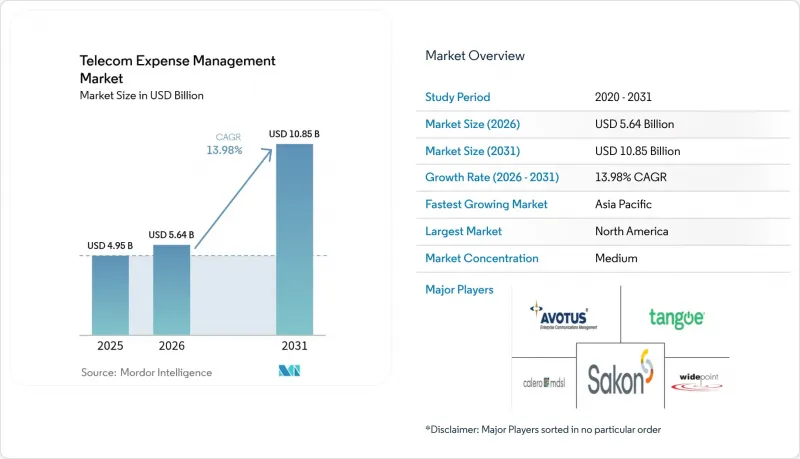
據 Mordor Intelligence 稱,2025 年通訊費用管理市場價值為 49.5 億美元,預計到 2031 年將達到 108.5 億美元,而 2026 年為 56.4 億美元,預測期(2026-2031 年)的複合年成長率為 13.98%。
本報告按解決方案(發票管理、設備管理、採購、審計、使用情況報告、爭議管理等)、服務(託管、雲端、專業服務)、部署類型(本地部署、雲端部署、混合部署)、組織規模(大型企業、中小企業)、最終用戶(銀行、金融服務和保險 (BFSI)、製造業、IT、醫療保健、政府)和地區進行細分。市場預測以美元 (USD) 為單位。
全球電信成本管理市場趨勢及洞察
需要將通訊成本視覺化,並解決複雜的收費系統。
由私人網路、邊緣工作負載和物聯網鏈路組成的混合生態系統,正在建構一個無法透過人工流程大規模實現的收費層。 Valicom 的審計發現,超過 35% 的通訊帳單存在錯誤,影響了計費準確性、未使用線路和終止處理。基於使用量的 5G 和雲端套餐的普及增加了高額帳單的風險,迫使財務和網路團隊轉向結合使用遙測數據和預測性基準測試的即時儀表板。隨著營運商向基於 API 的網路切片轉型,更多變數被引入,要求企業主動應對複雜且層層疊加的收費系統。財務經理還面臨著按業務部門和管轄區分配成本的合規義務,這加速了從電子表格追蹤向專業通訊費用管理平台的轉變。
利用人工智慧/分析技術實現發票審核自動化
人工智慧 (AI) 正在將費用管理從定期審核轉變為持續最佳化。據 Tangoe 稱,機器學習模型可在檔案匯入後幾分鐘內檢測出異常情況、違約行為和最佳化機會。畢馬威指出,自動化發票工作流程可提高準確性,同時減少 60-80% 的人工工作量,使分析師能夠專注於談判而非核對。先進的平台將使用模式與生產力指標相匹配,從而指導適當的擴展決策,使成本與業務價值保持一致。持續學習循環可完善政策建議,加強供應商合規性,並進一步提升通訊費用管理 (TEM) 市場帶來的成本節約。
資料安全問題限制了TEM外包。
在監管嚴格的產業中,企業往往不願意向外部揭露通訊使用文件,包括高度敏感的營運數據。勒索軟體攻擊的日益猖獗和跨境隱私法規的不斷加深,延長了實質審查流程,導致供應商成本增加、銷售週期延長。混合部署模式(原始資料儲存在本地,分析在雲端進行)雖然可以降低部分風險,但會降低最佳化的深度。為了消除客戶的擔憂,並在通訊成本管理市場獲得更廣泛的應用,供應商需要投資 SOC2 認證、零信任架構以及特定區域的資料主權管理。
細分市場分析
到 2025 年,發票管理將佔通訊費用管理市場佔有率的 35.57%,這表明企業仍然高度重視帳單的準確性和費用分配管理。此解決方案內建的工作流程可從數千張發票資料中檢驗費用、明細項目和稅額,從而確保在複雜的多供應商環境中預算的一致性。 Valicom 的審計通常發現 15-20% 的支出可以收回,這凸顯了發票管理的重要性。然而,一場戰略轉型正在進行中。使用情況管理和報告功能正以 14.04% 的複合年成長率快速成長,表明企業對即時儀表板的需求日益成長,這些儀表板可以防止意外的超額收費,而不是依賴事後結算。
通訊費用管理市場正將傳統的帳單處理引擎與人工智慧驅動的分析相結合,以預測流量消耗是否符合策略閾值,並在帳單截止日期前自動產生建議。隨著 5G 切片、邊緣工作負載和統一通訊即服務 (UCaaS) 的擴展,企業需要預測性洞察來動態組合服務層級。供應商正透過整合機器學習模型和直覺的視覺化層來響應這一需求,這種轉變正推動該領域從「事後管理」轉向「主動最佳化」。
到2025年,託管服務將主導電信成本管理市場,佔據41.82%的市場佔有率,因為董事會正在推動從固定技術成本轉向基於績效的可變服務費用的轉變。服務提供者提供定價基準庫、與營運商的議價能力以及大多數公司無法自行建立的持續流程管治。託管雲端服務領域成長最快,年複合成長率達14.15%,這主要得益於訂閱的柔軟性和便利的升級方式。
平台融合正在模糊託管解決方案和自託管解決方案之間的界線。許多供應商現在將諮詢功能與SaaS主機結合,使客戶能夠在不更換平台的情況下靈活調整服務等級。這種使用模式對那些在擴大收購的同時盡可能減少IT人員的私募股權公司也極具吸引力。這些互動確保了這兩種交付模式在通訊成本管理市場的發展藍圖中緊密交織。
區域分析
預計到2025年,北美將佔全球收入的35.42%。這得益於成熟的採購框架、嚴格的SOX和FCC報告規則,以及與電信業者關係密切的成熟服務供應商生態系統。美國跨國公司管理龐大的跨境語音、數據和物聯網資產,並日益依賴精細化的分析來獲取合約談判優勢,並在各業務部門之間合理分配支出。有關電子費率、C頻段清理和綠色頻譜競標的監管獎勵持續重塑收費結構,刺激電信費用管理市場的穩定需求。
亞太地區正引領市場成長,預計2026年至2031年複合年成長率將達14.18%。根據GSMA預測,到2030年,該地區21億行動用戶預計將為GDP貢獻8,800億美元。用戶的激增正在加速日本、韓國和印度等製造地私有網路的試點部署。 Expereo的研究表明,該地區貢獻了全球約60%的資料中心容量成長,並為企業連接基礎設施帶來了新的供應商組合。在外匯波動和管理體制日益多元化的背景下,財務長們正在實施複雜的電信費用管理工具,以整合營運商計費、規範稅務處理並適應不斷變化的折扣方案。
在歐洲,GDPR、生態設計指令以及更嚴格的碳排放報告要求(強制企業量化電信相關範圍3的排放量)推動了電信成本管理市場的穩定成長。跨國電信業者使用不同的範本和稅碼開立發票,這促進了人工智慧驅動的標準化引擎的應用。在中東和非洲地區,隨著5G部署、智慧城市計畫和公共部門現代化,計費生態系統變得更加複雜,市場也出現了復甦跡象。在以巴西和阿根廷為首的南美洲,為了因應貨幣波動和不斷上漲的電信成本,市場正轉向以SaaS為基礎的解決方案。這些細微的區域差異共同維持了電信成本管理市場多元化的成長軌跡,使其免受局部宏觀經濟衝擊的影響。
其他好處:
- Excel格式的市場預測(ME)表
- 3個月的分析師支持
目錄
第1章:引言
- 研究假設和市場定義
- 調查範圍
第2章:調查方法
第3章執行摘要
第4章 市場狀況
- 市場概覽
- 市場促進因素
- 自帶設備辦公室 (BYOD) 的普及和行動工作人員的引入
- 需要將通訊成本視覺化,並解決收費系統。
- 利用託管服務將資本支出 (CapEx) 遷移到營運支出 (OpEx)。
- 透過人工智慧/分析整合實現發票自動化審核
- 專用5G網路正在產生新的支出項目。
- 永續性壓力對範圍 3 通訊使用情況的報告構成影響
- 市場限制因素
- 資料安全問題限制了 TEM(模板管理設備)的外包。
- 發票格式不統一,缺乏統一標準。
- 影子IT會掩蓋使用數據的準確性。
- TEM分析專家短缺
- 價值供應鏈分析
- 監理情勢
- 技術展望
- 波特五力分析
- 宏觀經濟影響分析(包括新冠疫情和通貨膨脹)
第5章 市場規模與成長預測
- 透過解決方案
- 帳單管理
- 行動性和裝置管理
- 購買與購買
- 費用審核與最佳化
- 使用情況管理和報告生成
- 衝突管理
- 庫存管理
- UCC成本管理
- 其他解決方案
- 按服務
- 託管服務
- 託管/雲端服務
- 專業服務
- 部署模式
- 現場
- 雲/SaaS
- 混合
- 按組織規模
- 大公司
- 小型企業
- 按最終用戶行業分類
- BFSI
- 零售和消費品
- 製造業
- IT/通訊
- 醫療保健和生命科學
- 能源公用事業
- 政府/公共部門
- 其他終端用戶產業
- 按地區
- 北美洲
- 美國
- 加拿大
- 墨西哥
- 歐洲
- 英國
- 德國
- 法國
- 義大利
- 西班牙
- 俄羅斯
- 其他歐洲國家
- 亞太地區
- 中國
- 印度
- 日本
- 韓國
- 澳洲和紐西蘭
- 東協(新加坡、印尼、泰國)
- 其他亞太國家
- 南美洲
- 巴西
- 阿根廷
- 哥倫比亞
- 其他南美國家
- 中東
- 沙烏地阿拉伯
- 阿拉伯聯合大公國
- 土耳其
- 以色列
- 其他中東國家
- 非洲
- 南非
- 奈及利亞
- 肯亞
- 其他非洲國家
- 北美洲
第6章 競爭情勢
- 市場集中度
- 策略趨勢
- 市佔率分析
- 公司簡介
- Tangoe Inc.
- Calero-MDSL
- Cass Information Systems Inc.
- Sakon Inc.
- Tellennium Inc.
- WidePoint Corporation
- Avotus Corporation
- Valicom Corporation
- Upland Software Inc.(Cimpl)
- CGI Inc.
- Accenture PLC(Network Services)
- TeleManagement Technologies Inc.
- Auditmacs
- Dimension Data(NTT Ltd.)
- Mitel Networks Corp.
- Intrado Corporation(West)
- Advantix Solutions Group
- Comview Corporation(Calero)
- Subex Ltd.
- Xigo(Verizon)
- Basware Corp.
第7章 市場機會與未來展望
According to Mordor Intelligence, the telecom expense management market size was valued at USD 4.95 billion in 2025 and estimated to grow from USD 5.64 billion in 2026 to reach USD 10.85 billion by 2031, at a CAGR of 13.98% during the forecast period (2026-2031).
This report is Segmented by Solution (Invoice Management, Device Management, Sourcing, Auditing, Usage Reporting, Dispute Management, and More), Service (Managed, Cloud, Professional), Deployment (On-Premise, Cloud, Hybrid), Organization Size (Large, SME), End-User (BFSI, Manufacturing, IT, Healthcare, Government), and Geography. The Market Forecasts are Provided in Terms of Value (USD).
Global Telecom Expense Management Market Trends and Insights
Need for Visibility into Telecom Spend and Tariff Complexity
Hybrid ecosystems of private networks, edge workloads, and IoT links create billing layers that manual processes cannot reconcile at scale. Valicom audits show error rates in more than 35% of telecom invoices, affecting rate accuracy, zero-use lines, and end-of-life services. Consumption-based 5G and cloud bundles intensify the risk of bill shock, forcing finance and network teams to migrate toward real-time dashboards that pair usage telemetry with predictive benchmarks. Operator migration to API-based network slicing adds another variable set, challenging enterprises to stay ahead of cascading tariff structures. Finance controllers also face compliance duties that require cost allocation by business unit and jurisdiction, accelerating the shift from spreadsheet tracking to specialized telecom expense management market platforms.
Integration of AI/Analytics for Automated Invoice Auditing
Artificial intelligence recasts expense oversight from periodic review to perpetual optimization. Tangoe reports that machine-learning models flag anomalies, contract breaches, and optimization opportunities within minutes of file ingestion. KPMG notes that automated invoice workflows reduce manual effort by 60-80% while lifting accuracy rates, freeing analysts to negotiate instead of reconcile. Advanced platforms map usage patterns against productivity metrics, guiding right-sizing decisions that align cost with business value. Continuous learning loops refine policy recommendations, tightening vendor compliance and elevating savings delivered by the telecom expense management market.
Data-Security Concerns Limiting TEM Outsourcing
Highly regulated sectors hesitate to expose telecom usage files containing sensitive operational data. Rising ransomware incidents and cross-border privacy regimes deepen due-diligence cycles, adding cost and elongating sales cycles for providers. Hybrid deployment models that keep raw data on-premise but run analytics in the cloud mitigate some risk yet decrease optimization depth. Providers must invest in SOC2-type attestations, zero-trust architectures, and region-specific data-sovereignty controls to ease concerns and unlock broader uptake within the telecom expense management market.
Other drivers and restraints analyzed in the detailed report include:
- Proliferation of BYOD and Mobile Workforce Adoption
- Shift from CapEx to OpEx via Managed Services
- Shadow-IT Obscuring Usage Data Accuracy
For complete list of drivers and restraints, kindly check the Table Of Contents.
Segment Analysis
Invoice management retained 35.57% of the telecom expense management market share in 2025, underscoring enterprises' persistent focus on billing accuracy and allocation discipline. The solution's embedded workflows validate rates, line items, and taxes across thousands of invoice feeds, defending budget integrity in complex multi-vendor estates. Valicom audits routinely uncover 15-20% recoverable spend, highlighting why invoice control remains foundational. Yet a strategic pivot is underway: usage management and reporting is scaling at a 14.04% CAGR, signaling hunger for real-time dashboards that avoid surprise overages instead of reconciling them after the fact.
The telecom expense management market now pairs traditional invoice engines with AI-driven analytics that forecast consumption against policy thresholds, automatically generating recommendations before the billing cut-off. As 5G slicing, edge workloads, and UCaaS grow, enterprises demand predictive insights to mix and match service tiers dynamically. Vendors respond by embedding machine-learning models and intuitive visualization layers, a shift that moves the category from post-pay hygiene to proactive optimization.
Managed services led with 41.82% of the telecom expense management market size in 2025 as boards pushed to convert fixed technology costs into variable service fees linked to outcomes. Providers furnish rate-benchmark libraries, carrier negotiation muscle, and continuous process governance that most enterprises cannot develop internally. The hosted-cloud services slice expands fastest at 14.15% CAGR, propelled by subscription flexibility and hassle-free upgrades.
Platform convergence is blurring lines between managed and hosted modes. Many vendors now bundle advisory muscle with SaaS consoles, letting clients dial service levels up or down without re-platforming. The consumption model also appeals to private-equity-backed enterprises that maintain lean IT headcount while scaling acquisitions. This interplay keeps both delivery models intertwined within the telecom expense management market roadmap.
Complete Report Scope:
- By Solution
- Invoice Management
- Mobility and Device Management
- Sourcing and Procurement
- Expense Auditing and Optimization
- Usage Management and Reporting
- Dispute Management
- Inventory Management
- UCC Cost Management
- Other Solutions
- By Service
- Managed Service
- Hosted / Cloud Service
- Professional Services
- By Deployment Mode
- On-premise
- Cloud / SaaS
- Hybrid
- By Organization Size
- Large Enterprises
- Small and Medium Enterprises
- By End-user Industry
- BFSI
- Retail and Consumer Goods
- Manufacturing
- IT and Telecom
- Healthcare and Life Sciences
- Energy and Utilities
- Government and Public Sector
- Other End-user Industries
- By Geography
- North America
- United States
- Canada
- Mexico
- Europe
- United Kingdom
- Germany
- France
- Italy
- Spain
- Russia
- Rest of Europe
- Asia-Pacific
- China
- India
- Japan
- South Korea
- Australia and New Zealand
- ASEAN (Singapore, Indonesia, Thailand)
- Rest of Asia-Pacific
- South America
- Brazil
- Argentina
- Colombia
- Rest of South America
- Middle East
- Saudi Arabia
- United Arab Emirates
- Turkey
- Israel
- Rest of Middle East
- Africa
- South Africa
- Nigeria
- Kenya
- Rest of Africa
- North America
Geography Analysis
North America commanded 35.42% revenue in 2025, driven by mature procurement frameworks, strict SOX and FCC reporting rules, and an entrenched ecosystem of service providers offering deep carrier relationships. U.S. multinationals juggle vast cross-border voice, data, and IoT estates, heightening reliance on granular analytics to sharpen contract negotiations and allocate spend by business unit. Regulatory incentives around e-rate, C-band clearing, and green-spectrum auctions continue to reshape billing constructs, offering the telecom expense management market steady demand stimuli.
Asia-Pacific is the sprint leader with a 14.18% CAGR between 2026 and 2031. GSMA projects 2.1 billion mobile subscribers feeding USD 880 billion into regional GDP by 2030. This subscriber swell accelerates private-network pilots across manufacturing hubs in Japan, South Korea, and India. Expereo observes that the region drives roughly 60% of global data-center capacity growth, layering new vendor mixes onto enterprise connectivity stacks. As currencies fluctuate and regulatory regimes diversify, CFOs adopt sophisticated telecom expense management market tools to consolidate carrier bills, normalize tax treatments, and keep pace with dynamic discount schedules.
Europe maintains a steady climb powered by GDPR, eco-design directives, and rising carbon-reporting obligations that force enterprises to quantify telecom-linked Scope-3 footprint. Multi-country operators issue invoices in varied templates and tax codes, fuelling uptake of AI-driven normalization engines. Middle East and Africa show green-shoot potential as 5G rollouts, smart-city ambitions, and public-sector modernization inject complexity into billing ecosystems. South America, led by Brazil and Argentina, turns to SaaS-based solutions to battle currency volatility and telecom inflation. Collectively, geographic nuance sustains a diversified growth trajectory for the telecom expense management market, shielding it from isolated macro shocks.
- Tangoe Inc.
- Calero-MDSL
- Cass Information Systems Inc.
- Sakon Inc.
- Tellennium Inc.
- WidePoint Corporation
- Avotus Corporation
- Valicom Corporation
- Upland Software Inc. (Cimpl)
- CGI Inc.
- Accenture PLC (Network Services)
- TeleManagement Technologies Inc.
- Auditmacs
- Dimension Data (NTT Ltd.)
- Mitel Networks Corp.
- Intrado Corporation (West)
- Advantix Solutions Group
- Comview Corporation (Calero)
- Subex Ltd.
- Xigo (Verizon)
- Basware Corp.
Additional Benefits:
- The market estimate (ME) sheet in Excel format
- 3 months of analyst support
TABLE OF CONTENTS
1 INTRODUCTION
- 1.1 Study Assumptions and Market Definition
- 1.2 Scope of the Study
2 RESEARCH METHODOLOGY
3 EXECUTIVE SUMMARY
4 MARKET LANDSCAPE
- 4.1 Market Overview
- 4.2 Market Drivers
- 4.2.1 Proliferation of BYOD and mobile workforce adoption
- 4.2.2 Need for visibility into telecom spend and tariff complexity
- 4.2.3 Shift from CapEx to OpEx via managed services
- 4.2.4 Integration of AI/analytics for automated invoice auditing
- 4.2.5 Private-5G networks creating new expense categories
- 4.2.6 Sustainability pressure for Scope-3 telecom usage reporting
- 4.3 Market Restraints
- 4.3.1 Data-security concerns limiting TEM outsourcing
- 4.3.2 Fragmented invoice formats and lack of standards
- 4.3.3 Shadow-IT obscuring usage data accuracy
- 4.3.4 Talent shortage in TEM analytics specialists
- 4.4 Value / Supply-Chain Analysis
- 4.5 Regulatory Landscape
- 4.6 Technological Outlook
- 4.7 Porter's Five Forces Analysis
- 4.7.1 Bargaining Power of Suppliers
- 4.7.2 Bargaining Power of Buyers/Consumers
- 4.7.3 Threat of New Entrants
- 4.7.4 Threat of Substitute Products
- 4.7.5 Intensity of Competitive Rivalry
- 4.8 Macroeconomic Impact Analysis (incl. COVID-19 and Inflation)
5 MARKET SIZE AND GROWTH FORECASTS (VALUE)
- 5.1 By Solution
- 5.1.1 Invoice Management
- 5.1.2 Mobility and Device Management
- 5.1.3 Sourcing and Procurement
- 5.1.4 Expense Auditing and Optimization
- 5.1.5 Usage Management and Reporting
- 5.1.6 Dispute Management
- 5.1.7 Inventory Management
- 5.1.8 UCC Cost Management
- 5.1.9 Other Solutions
- 5.2 By Service
- 5.2.1 Managed Service
- 5.2.2 Hosted / Cloud Service
- 5.2.3 Professional Services
- 5.3 By Deployment Mode
- 5.3.1 On-premise
- 5.3.2 Cloud / SaaS
- 5.3.3 Hybrid
- 5.4 By Organization Size
- 5.4.1 Large Enterprises
- 5.4.2 Small and Medium Enterprises
- 5.5 By End-user Industry
- 5.5.1 BFSI
- 5.5.2 Retail and Consumer Goods
- 5.5.3 Manufacturing
- 5.5.4 IT and Telecom
- 5.5.5 Healthcare and Life Sciences
- 5.5.6 Energy and Utilities
- 5.5.7 Government and Public Sector
- 5.5.8 Other End-user Industries
- 5.6 By Geography
- 5.6.1 North America
- 5.6.1.1 United States
- 5.6.1.2 Canada
- 5.6.1.3 Mexico
- 5.6.2 Europe
- 5.6.2.1 United Kingdom
- 5.6.2.2 Germany
- 5.6.2.3 France
- 5.6.2.4 Italy
- 5.6.2.5 Spain
- 5.6.2.6 Russia
- 5.6.2.7 Rest of Europe
- 5.6.3 Asia-Pacific
- 5.6.3.1 China
- 5.6.3.2 India
- 5.6.3.3 Japan
- 5.6.3.4 South Korea
- 5.6.3.5 Australia and New Zealand
- 5.6.3.6 ASEAN (Singapore, Indonesia, Thailand)
- 5.6.3.7 Rest of Asia-Pacific
- 5.6.4 South America
- 5.6.4.1 Brazil
- 5.6.4.2 Argentina
- 5.6.4.3 Colombia
- 5.6.4.4 Rest of South America
- 5.6.5 Middle East
- 5.6.5.1 Saudi Arabia
- 5.6.5.2 United Arab Emirates
- 5.6.5.3 Turkey
- 5.6.5.4 Israel
- 5.6.5.5 Rest of Middle East
- 5.6.6 Africa
- 5.6.6.1 South Africa
- 5.6.6.2 Nigeria
- 5.6.6.3 Kenya
- 5.6.6.4 Rest of Africa
- 5.6.1 North America
6 COMPETITIVE LANDSCAPE
- 6.1 Market Concentration
- 6.2 Strategic Moves
- 6.3 Market Share Analysis
- 6.4 Company Profiles (includes Global level Overview, Market level overview, Core Segments, Financials as available, Strategic Information, Market Rank/Share for key companies, Products and Services, and Recent Developments)
- 6.4.1 Tangoe Inc.
- 6.4.2 Calero-MDSL
- 6.4.3 Cass Information Systems Inc.
- 6.4.4 Sakon Inc.
- 6.4.5 Tellennium Inc.
- 6.4.6 WidePoint Corporation
- 6.4.7 Avotus Corporation
- 6.4.8 Valicom Corporation
- 6.4.9 Upland Software Inc. (Cimpl)
- 6.4.10 CGI Inc.
- 6.4.11 Accenture PLC (Network Services)
- 6.4.12 TeleManagement Technologies Inc.
- 6.4.13 Auditmacs
- 6.4.14 Dimension Data (NTT Ltd.)
- 6.4.15 Mitel Networks Corp.
- 6.4.16 Intrado Corporation (West)
- 6.4.17 Advantix Solutions Group
- 6.4.18 Comview Corporation (Calero)
- 6.4.19 Subex Ltd.
- 6.4.20 Xigo (Verizon)
- 6.4.21 Basware Corp.
7 MARKET OPPORTUNITIES AND FUTURE OUTLOOK
- 7.1 White-space and Unmet-Need Assessment

 2034年通訊成本管理市場預測:按組件、部署類型、功能、組織規模、最終用戶和地區分類的全球分析
 通訊成本管理市場規模、佔有率和成長分析:按組件、部署類型、企業規模、應用、最終用戶產業、銷售管道和地區分類-2026-2033年產業預測
 2026年全球電信費用管理市場報告
 通訊成本管理市場:按類型、技術平台、部署模式和最終用戶分類-2026-2032年全球市場預測
 全球通訊成本管理市場規模、佔有率、趨勢和成長分析報告(2026-2034年)
 通訊成本管理市場-全球產業規模、佔有率、趨勢、機會、預測:按解決方案、服務、部署方式、地區和競爭對手分類,2021-2031年成本管理系統市場按組件、組織規模、應用、部署類型和最終用戶行業分類 - 全球預測 2026-2032