


 |
市場調查報告書
商品編碼
2124558
工業雷射系統:市場佔有率分析、產業趨勢與統計、成長預測(2026-2031)Industrial Laser System - Market Share Analysis, Industry Trends & Statistics, Growth Forecasts (2026 - 2031) |
||||||

※ 本網頁內容可能與最新版本有所差異。詳細情況請與我們聯繫。
根據 Mordor Intelligence 預測,工業雷射系統市場將從 2025 年的 63.7 億美元成長到 2026 年的 67.1 億美元,然後在 2031 年達到 87.2 億美元,2026 年至 2031 年的複合年成長率為 5.38%。
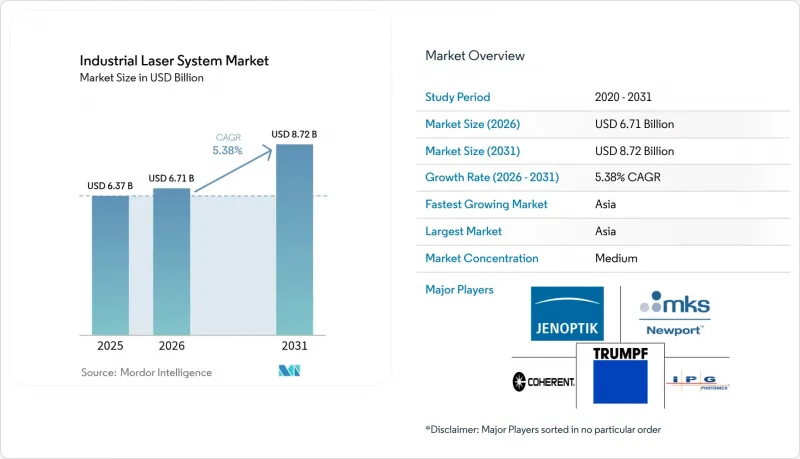
本報告按雷射類型(光纖雷射、固體雷射等)、功率範圍(低功率(小於1千瓦)、中功率(1-6千瓦)等)、應用(切割、焊接/硬焊、打標/雕刻等)、終端用戶產業(半導體/電子、汽車、醫療設備等)和地區進行細分。市場預測以美元計價。
全球工業雷射系統市場趨勢與洞察
汽車製造業金屬切割製程正迅速從機械切割轉向雷射切割。
汽車製造商正在將光纖雷射生產線標準化,以縮短底盤和電池外殼的生產週期,提高邊緣質量,並最大限度地減少廢品。一家德國工廠報告稱,在用6千瓦光纖雷射設備取代等離子切割機後,加工時間縮短了40%。亞洲電動車製造商也紛紛效仿,引進多千瓦級設備,以應對不斷成長的汽車產量,同時支援輕量化鋁鋼混合動力設計。類似的趨勢也出現在為歐洲2035年逐步淘汰內燃機做準備的供應商中,這鞏固了工業雷射系統市場的長期需求。
5G/AI晶片製造技術的日益普及推動了對用於亞微米通孔的雷射的需求。
在先進的3奈米和2奈米製程節點上,飛秒雷射鑽孔技術對於維持多層基板中的訊號完整性至關重要。在台灣、韓國和美國,能夠利用100飛秒脈衝避開熱影響區的高精度平台正在被引進。儘管由於光元件製造商努力擴大產能,交貨週期已超過一年,但晶片晶圓代工廠仍在持續訂購多台設備,這推動了工業雷射系統市場的擴張。
超過 6 kW 的資本密集系統限制了二級契約製造對其的採用。
目前,高功率切割機的售價超過50萬美元,而基礎設施成本(例如冷卻器、三相佈線、1級防護外殼等)可能使支出翻倍。東南亞、拉丁美洲和東歐的中小型製造商面臨外匯波動和租賃選擇不足的問題,儘管原始設備製造商(OEM)大力推廣切割更厚金屬板材,但這些因素仍然減緩了雷射切割機的普及速度。因此,儘管生產效率的提升顯而易見,但工業雷射系統市場某些細分領域的需求仍無法滿足。
細分市場分析
預計到2025年,光纖光源將佔銷售額的51.25%。這反映了其結構堅固、電源效率高以及易於與運動平台整合等優點。在汽車和半導體製造業,光纖光源的優勢尤其顯著,因為在這些產業,單位時間內的運作至關重要。隨著鐿二極體價格的持續下降,光纖系統中工業雷射系統的市場規模預計將以5.25%的複合年成長率成長。雖然超快雷射市場規模較小,但隨著電子、醫療和顯示行業的客戶採用脈衝寬度小於200飛秒的雷射器,其複合年成長率也達到了6.05%。冷卻技術和光參量啁啾脈衝放大(OPCPA)泵浦架構的創新正在提高平均功率輸出,從而實現了以往只有連續波(CW)設備才能實現的大批量生產。
固體和盤片式雷射適用於切割特殊合金和厚銅等特定波長,而二氧化碳雷射器由於對金屬中長波長的利用效率較低,因此應用範圍僅限於厚壓克力和木材等材料。直接二極體陣列雷射具有寬廣的光束品質容差和50%的電效率,可降低包覆、硬化和聚合物焊接等應用的運作成本。準分子雷射系統繼續應用於半導體光刻和導管鑽孔,而量子級聯雷射目前仍處於研發階段。然而,它們有望在本十年後半期推動中紅外線燒蝕市場的發展。總體而言,這些趨勢使得工業雷射系統市場保持了高度的技術多樣性。
由於投資成本和鈑金加工速度的平衡性,預計到2025年,功率在1-6千瓦範圍內的系統將佔據近一半的市場佔有率。汽車零件分包商更傾向於價格實惠的4千瓦切割機,這種切割機能夠以30公尺/分鐘的速度加工2毫米厚的鋼板。儘管高功率的型號不斷湧現,但預計該輸出範圍內的工業雷射系統市場佔有率將保持穩定。功率超過6千瓦的平台正以5.85%的複合年成長率成長,主要得益於造船廠、橋樑施工現場和重型設備製造商等需要一次性加工100毫米厚鋼板的行業。早期採用者表示,節省的人力成本使他們能夠在兩年內收回高昂的投資成本。
功率低於 1 kW 的奈秒連續波雷射用於加工印刷電路基板、感測器外殼和支架,在這些應用中,熱控制比速度更為重要。原始設備製造商 (OEM) 將這些低功率頭與振鏡掃描器結合使用,可在保持 10 µm 定位精度的同時,實現 500 mm/s 的雕刻速度。這些組合方案確保了工業雷射系統市場擁有廣泛的功率範圍,從而提供適用於任何材料厚度和生產效率目標的雷射。
區域分析
預計到2025年,亞太地區將佔全球銷售額的45.70%,並在2031年之前維持6.35%的複合年成長率。中國的「中國製造2025」政策正在為半導體超大型晶圓廠、電動車生產線和太陽能發電廠提供資金支持,這些項目正在使用高亮度光纖系統進行切割和焊接。韓國和日本的顯示器製造商正在訂購飛秒平台,以推進其OLED和microLED專案。東南亞的契約製造製造商正在採用1-3千瓦的切割機來加工消費性電子產品機殼,這得益於政府強制降低進口關稅的政策。強大的本地服務網路、豐富的工程人才和廣泛的供應鏈維持了較高的資本效率,鞏固了該地區在工業雷射系統市場的主導地位。
在歐洲,雷射技術的應用正加速發展,尤其是在德國、義大利和瑞典。隨著高階品牌轉向採用鋁製車身本體和電池外殼,每輛車配備的雷射數量也不斷增加。歐盟的「Fit-for-55」法規強制要求在渦輪葉片紋理加工和氫氣管道焊接中使用高功率雷射,這也進一步推動了市場需求。瑞典和法國的電池超級工廠正在採用整合線上X光檢測的雷射焊接生產線,而圖盧茲和漢堡的航太工廠則在投資用於結構支架的雷射粉末層熔融(LPBF)技術。總而言之,一系列政策、永續性目標和工程傳統的結合,確保了歐洲在工業雷射系統市場保持核心地位。
在北美,受國防、航太和國內半導體產業回流的推動,工業雷射系統市場正穩步擴張。 《晶片與科學法案》為通孔加工工具提供了資金獎勵,美國國防部正在資助建造兆瓦級光纖雷射演示裝置。一家墨西哥一級汽車零件供應商正轉向使用4千瓦的設備,以滿足原始設備製造商(OEM)的可追溯性標準;一家加拿大礦業設備製造商正在部署一台20千瓦的設備來加工淬火回火鋼板。拉丁美洲、中東和非洲仍然是新興市場機會。巴西的農業機械、沙烏地阿拉伯的海水淡化廠和南非的鐵路車輛製造廠正在試點部署中中功率雷射器,但由於資金籌措挑戰和缺乏現場服務基礎設施,其應用仍然有限。儘管如此,工業雷射系統市場的整體成長潛力已得到廣泛認可。
其他好處:
- Excel格式的市場預測(ME)表
- 3個月的分析師支持
目錄
第1章:引言
- 市場分析與定義的前提條件
- 分析範圍
第2章 分析方法
第3章執行摘要
第4章 市場狀況
- 市場概覽
- 市場促進因素
- 汽車製造中金屬切割製程從機械切割到雷射切割的快速轉變
- 5G部署和AI晶片製造對亞微米通孔雷射的需求
- 歐洲主導的電動車超級工廠電池組焊接需求
- 亞洲地區超快雷射在OLED和microLED加工的應用日益廣泛。
- 雷射積層製造技術在航太領域(主要在美國)用於減輕重量
- 歐盟的「Fit-for-55」計畫正在推廣雷射表面紋理技術,用於製造節能型渦輪機。
- 市場限制因素
- 超過 6 kW 的資本密集系統限制了二級合約製造商採用這些系統。
- 與維修線進行嚴格的 IEC/EN 60825-1 安全再認證相關的成本。
- 下一代電池箔材熱影響區(HAZ)中的微裂紋
- 中國稀土元素(Yb、Nd)供應鏈的不穩定性推高了雷射的物料清單(BOM)成本。
- 產業生態系分析
- 監理展望
- 技術展望
- 波特五力分析
第5章:預測市場規模與成長率
- 依雷射類型
- 光纖雷射
- 固體雷射
- Nd:YAG
- 光碟雷射
- 二氧化碳雷射
- 準分子雷射
- 直接二極體雷射
- 其他雷射(超快雷射、準連續波雷射、量子級聯雷射)
- 輸出範圍
- 低功率(小於1千瓦)
- 中功率(1-6千瓦)
- 高功率(6千瓦或以上)
- 透過使用
- 切割
- QR 圖切割
- 3D切割
- 焊接和硬焊
- 標記和雕刻
- 穿孔/微加工
- 表面處理(塗層、硬化、紋理處理)
- 積層製造
- 切割
- 按最終用戶行業分類
- 車
- 半導體和電子學
- 航太/國防
- 醫療設備
- 能源(電池、太陽能)
- 重型設備/工具
- 珠寶和手工藝品
- 其他(包裝、一般製造業)
- 按地區
- 北美洲
- 美國
- 加拿大
- 墨西哥
- 歐洲
- 德國
- 英國
- 法國
- 北歐的
- 其他歐洲國家
- 南美洲
- 巴西
- 其他南美國家
- 亞太地區
- 中國
- 日本
- 印度
- 東南亞
- 其他亞太國家
- 中東和非洲
- 中東
- 波灣合作理事會(GCC)成員國
- 土耳其
- 其他中東國家
- 非洲
- 南非
- 其他非洲國家
- 中東
- 北美洲
第6章 競爭情勢
- 市場集中度
- 策略趨勢
- 市佔率分析
- 公司簡介
- TRUMPF GmbH+Co. KG
- Coherent Corp.
- IPG Photonics Corporation
- Han's Laser Technology Industry Group Co., Ltd.
- Jenoptik AG
- nLIGHT, Inc.
- II-VI Incorporated
- Newport Corporation(MKS Instruments)
- Lumentum Holdings Inc.
- Fanuc Corporation
- Prima Industrie SpA
- Bystronic Laser AG
- Amada Co., Ltd.
- Miyachi Unitek(Amada Weld Tech)
- Rofin-Sinar Technologies
- GWEIKE Laser
- Trotec Laser GmbH
- Epilog Laser
- ACSYS Lasertechnik GmbH
- Alpha Laser GmbH
- Lasea SA
- LaserStar Technologies Corp.
第7章 市場機會與未來展望
According to Mordor Intelligence, the industrial laser system market size is expected to grow from USD 6.37 billion in 2025 to USD 6.71 billion in 2026 and is forecast to reach USD 8.72 billion by 2031 at 5.38% CAGR over 2026-2031.
This report is Segmented by Laser Type (Fiber Lasers, Solid-State Lasers, and More), Power Range (Low Power (Less Than 1 KW), Medium Power (1-6 KW), and More), Application (Cutting, Welding and Brazing, Marking and Engraving, and More), End-User Industry (Semiconductor and Electronics, Automotive, Medical Devices, and More), and Geography. The Market Forecasts are Provided in Terms of Value (USD).
Global Industrial Laser System Market Trends and Insights
Rapid transition from mechanical to laser-based metal cutting in automotive manufacturing
Automakers are standardizing fiber laser lines to shorten chassis and battery-enclosure cycles, boost edge quality, and minimize scrap. German plants report 40% shorter processing time when swapping plasma cutters for 6 kW fiber units. Asian EV producers follow with multi-kilowatt installations that keep pace with rising vehicle output while supporting aluminum-steel hybrid designs prized for lightweighting. The same trend reaches suppliers preparing for Europe's 2035 internal-combustion phase-out, cementing long-term demand across the industrial laser system market.
Proliferation of 5G/AI chip fabrication demanding sub-micron via-hole lasers
Advanced nodes at 3 nm and 2 nm require femtosecond drilling to preserve signal integrity in multilayer substrates. Taiwan, South Korea, and the United States are installing high-precision platforms whose 100-fs pulses avoid heat-affected zones. Delivery lead times have stretched past one year because optical-component makers struggle to expand capacity, yet chip foundries continue signing multi-tool contracts that widen the industrial laser system market.
Capital-intensive >6 kW systems limit penetration into tier-2 job shops
High-power units now cost upward of USD 500,000, and the infrastructure-chillers, three-phase wiring, Class 1 enclosures-can double that outlay. Smaller fabricators in Southeast Asia, Latin America, and Eastern Europe face currency swings and scarce leasing options, slowing adoption even as OEMs push for thicker-plate cutting. As a result, segments of the industrial laser system market remain under-served despite clear productivity gains
Other drivers and restraints analyzed in the detailed report include:
- Battery-pack welding needs in e-mobility gigafactories-Europe-led
- Growing adoption of ultrafast lasers for OLED and micro-LED processing-Asia
- Stringent IEC/EN 60825-1 safety re-certification costs for retrofitted lines
For complete list of drivers and restraints, kindly check the Table Of Contents.
Segment Analysis
Fiber sources accounted for 51.25% of revenue in 2025, reflecting their rugged build, high wall-plug efficiency, and easy integration with motion platforms. Their dominance is visible in automotive and semiconductor fabs that depend on hour-by-hour uptime. The industrial laser system market size for fiber systems is expected to expand at 5.25% CAGR, supported by ongoing price drops in ytterbium diodes. Ultrafast lasers, despite a smaller base, add 6.05% CAGR as electronics, medical, and display customers adopt pulse widths under 200 fs. Cooling innovations and OPCPA pumping architectures raise average power, enabling mass-production throughput that once favored continuous-wave tools.
Solid-state and disc architectures serve niche wavelengths that suit exotic alloys or thick copper cutting, whereas CO2 units retreat to thick acrylic or wood applications because their long wavelength lacks efficiency in metals. Direct-diode arrays address cladding, hardening, and polymer welding tasks where beam quality tolerance is higher and 50% electrical efficiency lowers operating cost. Excimer systems persist in semiconductor lithography and catheter hole drilling, while quantum cascade designs sit in R&D but could unlock mid-IR ablation markets later in the decade. Collectively, these dynamics keep technology diversity high within the industrial laser system market.
Systems rated 1-6 kW generated almost half of 2025 revenue as they balance capital cost against sheet-metal speed. Automotive sub-contractors favor 4 kW cutters that process 2 mm steel at 30 m/min while remaining affordable. The industrial laser system market share for this band is projected to remain stable even as high-power units gain ground. Platforms above 6 kW grow 5.85% CAGR thanks to shipyards, bridge yards, and heavy-equipment makers that need 100 mm-thick steel processing in single passes. Early adopters report labor savings that compensate for higher capex within two years.
Below 1 kW, nanosecond and continuous-wave tools process printed circuit boards, sensor housings, and stents where heat control trumps speed. OEMs pair these low-power heads with galvanometer scanners to achieve 500 mm/s engraving while holding 10 µm positional accuracy. Together, the tiers ensure every material thickness and productivity target has a matching laser, maintaining a broad power-range spectrum across the industrial laser system market.
Complete Report Scope:
- By Laser Type
- Fiber Lasers
- Solid-State Lasers
- Nd:YAG
- Disc Lasers
- CO2 Lasers
- Excimer Lasers
- Direct Diode Lasers
- Other Lasers (Ultrafast, QCW, QCL)
- By Power Range
- Low Power (Less than 1 kW)
- Medium Power (1-6 kW)
- High Power (Above 6 kW)
- By Application
- Cutting
- 2D Cutting
- 3D Cutting
- Welding and Brazing
- Marking and Engraving
- Drilling and Micro-Processing
- Surface Treatment (Cladding, Hardening, Texturing)
- Additive Manufacturing
- Cutting
- By End-user Industry
- Automotive
- Semiconductor and Electronics
- Aerospace and Defense
- Medical Devices
- Energy (Battery, Solar)
- Heavy Machinery and Tools
- Jewelry and Artisanal
- Others (Packaging, General Mfg.)
- By Geography
- North America
- United States
- Canada
- Mexico
- Europe
- Germany
- United Kingdom
- France
- Nordics
- Rest of Europe
- South America
- Brazil
- Rest of South America
- Asia-Pacific
- China
- Japan
- India
- South-East Asia
- Rest of Asia-Pacific
- Middle East and Africa
- Middle East
- Gulf Cooperation Council Countries
- Turkey
- Rest of Middle East
- Africa
- South Africa
- Rest of Africa
- Middle East
- North America
Geography Analysis
Asia-Pacific commanded 45.70% of 2025 revenue and is projected at a 6.35% CAGR through 2031. China's "Made-in-China 2025" policy funds semiconductor mega-fabs, EV lines, and photovoltaic plants that turn to high-brightness fiber systems for cutting and welding. South Korean and Japanese display makers order femtosecond platforms to advance OLED and micro-LED projects. Southeast Asian contract manufacturers embrace 1-3 kW cutters for appliance chassis, aided by government import-duty relief. Local service networks, surplus engineering talent, and extensive supply chains keep capital efficiency high, reinforcing leadership in the industrial laser system market
Europe follows with strong installation momentum anchored in Germany, Italy, and Sweden. Automotive laser content per vehicle rises as premium brands shift toward aluminum body-in-white and battery enclosures. EU "Fit-for-55" rules require turbine blade texturing and hydrogen-ready pipeline welding; both favor high-power lasers. Battery gigafactory build-outs in Sweden and France adopt laser welding lines synced with inline X-ray inspection, while aerospace hubs in Toulouse and Hamburg invest in laser powder bed fusion for structural brackets. Overall, policy, sustainability targets, and engineering heritage combine to keep Europe central to the industrial laser system market.
North America shows steady expansion propelled by defense, aerospace, and domestic semiconductor reshoring efforts. The CHIPS and Science Act frees capital incentives for via-hole drilling tools, and the Pentagon funds megawatt fiber laser demonstrators. Tier-1 automotive suppliers in Mexico transition to 4 kW units to meet OEM traceability standards, while Canadian mining-equipment builders install 20 kW machines to process quenched-and-tempered plate. Latin America and the Middle East & Africa remain emerging opportunities: Brazilian agri-machinery, Saudi desalination plants, and South African railcar factories pilot mid-power lasers, yet penetration stays low due to financing gaps and limited field service. Nonetheless, growth potential is recognized across the wider industrial laser system market.
- TRUMPF GmbH + Co. KG
- Coherent Corp.
- IPG Photonics Corporation
- Han's Laser Technology Industry Group Co., Ltd.
- Jenoptik AG
- nLIGHT, Inc.
- II-VI Incorporated
- Newport Corporation (MKS Instruments)
- Lumentum Holdings Inc.
- Fanuc Corporation
- Prima Industrie S.p.A.
- Bystronic Laser AG
- Amada Co., Ltd.
- Miyachi Unitek (Amada Weld Tech)
- Rofin-Sinar Technologies
- GWEIKE Laser
- Trotec Laser GmbH
- Epilog Laser
- ACSYS Lasertechnik GmbH
- Alpha Laser GmbH
- Lasea S.A.
- LaserStar Technologies Corp.
Additional Benefits:
- The market estimate (ME) sheet in Excel format
- 3 months of analyst support
TABLE OF CONTENTS
1 INTRODUCTION
- 1.1 Study Assumptions and Market Definition
- 1.2 Scope of the Study
2 RESEARCH METHODOLOGY
3 EXECUTIVE SUMMARY
4 MARKET LANDSCAPE
- 4.1 Market Overview
- 4.2 Market Drivers
- 4.2.1 Rapid Transition from Mechanical to Laser?Based Metal Cutting in Automotive Manufacturing
- 4.2.2 Proliferation of 5G/AI Chip Fabrication Demanding Sub-Micron Via-Hole Lasers
- 4.2.3 Battery-Pack Welding Needs in e-Mobility Gigafactories-Europe-Led
- 4.2.4 Growing Adoption of Ultrafast Lasers for OLED and Micro-LED Processing-Asia
- 4.2.5 Laser-Based Additive Manufacturing in Aerospace Lightweighting-U.S.-Centric
- 4.2.6 EU "Fit-for-55" Drives Laser Surface-Texturing for Energy-Efficient Turbines
- 4.3 Market Restraints
- 4.3.1 Capital-Intensive Above 6 kW Systems Limit Penetration into Tier-2 Job-Shops
- 4.3.2 Stringent IEC/EN 60825-1 Safety Re-Certification Costs for Retrofitted Lines
- 4.3.3 Heat-Affected Zone (HAZ) Micro-Cracking in Next-Gen Battery Foils
- 4.3.4 Volatile Rare-Earth (Yb, Nd) Supply Chain from China Elevates Laser BOM Cost
- 4.4 Industry Ecosystem Analysis
- 4.5 Regulatory Outlook
- 4.6 Technological Outlook
- 4.7 Porter's Five Forces Analysis
- 4.7.1 Bargaining Power of Suppliers
- 4.7.2 Bargaining Power of Buyers
- 4.7.3 Threat of New Entrants
- 4.7.4 Threat of Substitutes
- 4.7.5 Intensity of Rivalry
5 MARKET SIZE AND GROWTH FORECASTS (VALUES)
- 5.1 By Laser Type
- 5.1.1 Fiber Lasers
- 5.1.2 Solid-State Lasers
- 5.1.2.1 Nd:YAG
- 5.1.2.2 Disc Lasers
- 5.1.3 CO2 Lasers
- 5.1.4 Excimer Lasers
- 5.1.5 Direct Diode Lasers
- 5.1.6 Other Lasers (Ultrafast, QCW, QCL)
- 5.2 By Power Range
- 5.2.1 Low Power (Less than 1 kW)
- 5.2.2 Medium Power (1-6 kW)
- 5.2.3 High Power (Above 6 kW)
- 5.3 By Application
- 5.3.1 Cutting
- 5.3.1.1 2D Cutting
- 5.3.1.2 3D Cutting
- 5.3.2 Welding and Brazing
- 5.3.3 Marking and Engraving
- 5.3.4 Drilling and Micro-Processing
- 5.3.5 Surface Treatment (Cladding, Hardening, Texturing)
- 5.3.6 Additive Manufacturing
- 5.3.1 Cutting
- 5.4 By End-user Industry
- 5.4.1 Automotive
- 5.4.2 Semiconductor and Electronics
- 5.4.3 Aerospace and Defense
- 5.4.4 Medical Devices
- 5.4.5 Energy (Battery, Solar)
- 5.4.6 Heavy Machinery and Tools
- 5.4.7 Jewelry and Artisanal
- 5.4.8 Others (Packaging, General Mfg.)
- 5.5 By Geography
- 5.5.1 North America
- 5.5.1.1 United States
- 5.5.1.2 Canada
- 5.5.1.3 Mexico
- 5.5.2 Europe
- 5.5.2.1 Germany
- 5.5.2.2 United Kingdom
- 5.5.2.3 France
- 5.5.2.4 Nordics
- 5.5.2.5 Rest of Europe
- 5.5.3 South America
- 5.5.3.1 Brazil
- 5.5.3.2 Rest of South America
- 5.5.4 Asia-Pacific
- 5.5.4.1 China
- 5.5.4.2 Japan
- 5.5.4.3 India
- 5.5.4.4 South-East Asia
- 5.5.4.5 Rest of Asia-Pacific
- 5.5.5 Middle East and Africa
- 5.5.5.1 Middle East
- 5.5.5.1.1 Gulf Cooperation Council Countries
- 5.5.5.1.2 Turkey
- 5.5.5.1.3 Rest of Middle East
- 5.5.5.2 Africa
- 5.5.5.2.1 South Africa
- 5.5.5.2.2 Rest of Africa
- 5.5.5.1 Middle East
- 5.5.1 North America
6 COMPETITIVE LANDSCAPE
- 6.1 Market Concentration
- 6.2 Strategic Moves
- 6.3 Market Share Analysis
- 6.4 Company Profiles {(includes Global level Overview, Market level overview, Core Segments, Financials as available, Strategic Information, Market Rank/Share for key companies, Products and Services, and Recent Developments)}
- 6.4.1 TRUMPF GmbH + Co. KG
- 6.4.2 Coherent Corp.
- 6.4.3 IPG Photonics Corporation
- 6.4.4 Han's Laser Technology Industry Group Co., Ltd.
- 6.4.5 Jenoptik AG
- 6.4.6 nLIGHT, Inc.
- 6.4.7 II-VI Incorporated
- 6.4.8 Newport Corporation (MKS Instruments)
- 6.4.9 Lumentum Holdings Inc.
- 6.4.10 Fanuc Corporation
- 6.4.11 Prima Industrie S.p.A.
- 6.4.12 Bystronic Laser AG
- 6.4.13 Amada Co., Ltd.
- 6.4.14 Miyachi Unitek (Amada Weld Tech)
- 6.4.15 Rofin-Sinar Technologies
- 6.4.16 GWEIKE Laser
- 6.4.17 Trotec Laser GmbH
- 6.4.18 Epilog Laser
- 6.4.19 ACSYS Lasertechnik GmbH
- 6.4.20 Alpha Laser GmbH
- 6.4.21 Lasea S.A.
- 6.4.22 LaserStar Technologies Corp.
7 MARKET OPPORTUNITIES AND FUTURE OUTLOOK
- 7.1 White-Space and Unmet-Need Assessment

 2026-2030年全球工業雷射市場
 工業雷射市場:依雷射類型、功率輸出、冷卻方式、加工材料、應用及終端用戶產業分類-2026-2032年全球市場預測
 工業雷射系統市場 - 全球產業規模、佔有率、趨勢、機會、預測:按類型、功率、最終用戶產業、地區和競爭格局分類,2021-2031年
 工業雷射系統市場:按雷射類型、應用、最終用戶產業和地區分類
 工業雷射系統市場報告:按類型、應用、最終用戶產業和地區分類(2026-2034 年)
 工業雷射系統市場機會、成長要素、產業趨勢分析及2026-2035年預測超快工業雷射市場:按應用、最終用戶、雷射源類型、脈衝持續時間、波長和功率輸出分類的全球預測,2026-2032年
 2026年全球工業雷射系統市場報告
 全球工業雷射市場:市場規模、佔有率、成長率、產業分析、依類型、應用和地區劃分的分析以及未來預測(2026-2034年)
 工業雷射系統市場規模、佔有率和成長分析(按雷射類型、功率範圍、應用和地區分類)-2026-2033年產業預測