


 |
市場調查報告書
商品編碼
2124541
熱敏紙:市場佔有率分析、產業趨勢與統計、成長預測(2026-2031)Thermal Paper - Market Share Analysis, Industry Trends & Statistics, Growth Forecasts (2026 - 2031) |
||||||

※ 本網頁內容可能與最新版本有所差異。詳細情況請與我們聯繫。
根據 Mordor Intelligence 預測,熱敏紙市場規模預計將在 2026 年達到 48.8 億美元,到 2031 年達到 63.2 億美元,年複合成長率為 5.32%。
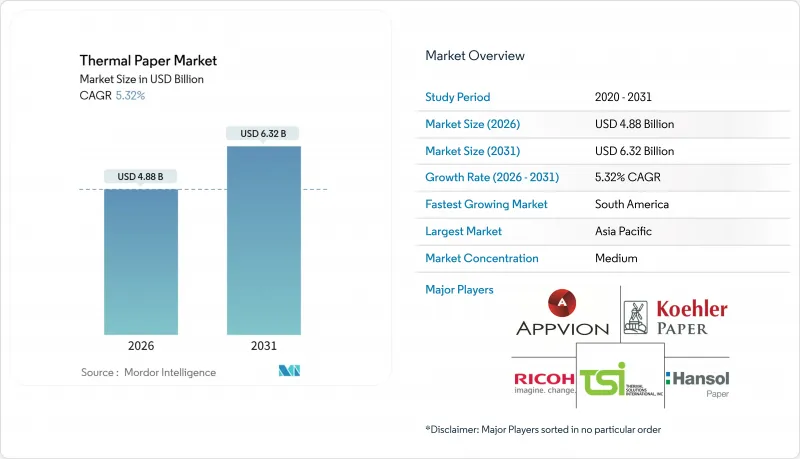
本報告按產品類型(帶面塗層、無面塗層、不含雙酚A等)、紙張重量(相當於55克/平方米、56-70克/平方米、70克/平方米及以上)、幅寬(57毫米、58-79毫米、80毫米)、終端用戶行業(零售、物流、票務、彩票和遊戲、銀行和其他金融、地區進行市場分類和醫療保健地區。市場預測以美元計價。
全球熱感紙市場趨勢及洞察
新興市場零售POS系統的擴展
電子支付生態系統的快速發展推動了新型硬體的普及和紙捲的持續消耗。在印度,預計到2025年1月,熱感紙設備的安裝量將達到1,120萬台,增幅達29%,這與基於QR碼的交易激增相一致。儘管如此,列印收據對於商品和服務稅(GST)的合規性仍然至關重要。印尼、越南和海灣合作理事會(GCC)國家也出現了類似的趨勢,即使數位管道日益普及,低成本熱敏紙的大量訂單也正在形成。設備供應商將收據卷與服務合約捆綁銷售,加強了與造紙商和加工商的合作關係,而小規模企業採用熱敏紙的補貼也進一步推動了銷售量成長。因此,熱敏紙市場的銷售管道正在向先前依賴手寫發票的小規模企業群拓展。
物流和電子商務領域對標籤的需求不斷成長
隨著小包裹量的成長,履約中心的標籤消耗量成長速度超過了零售收據的成長速度。預計到2034年,全球倉庫自動化投資將從2024年的265億美元增加至1,160億美元,這意味著每個倉庫安裝的印表機數量將大幅增加。 GS1藍圖在2031年前從一維條碼過渡到2D條碼,這要求提高塗層均勻性和影像解析度。由於末端配送環節標籤缺陷的罰款,加工商開始指定使用56-70克/平方米的中等克重紙張,並採用堅固的面塗層,從而將收入轉移到能夠可靠控制紙張厚度的造紙商手中。在物流行業需求和線上食品雜貨銷售成長的推動下,這一領域正成為熱敏紙市場的主要成長引擎。
紙漿和隱色染料的價格波動很大。
預計到2025年11月,木漿生產者物價指數將達到213.2,加工紙的生產者物價指數也將進一步上漲,這將對下游產業的盈利帶來壓力。特種隱色染料依賴金屬催化劑,而這些催化劑目前在中國受到出口限制,這將進一步加劇化學品成本的飆升。歐洲造紙企業面臨能源價格飆升和排放法規日益嚴格的雙重壓力,利潤率下滑最為嚴重。避險策略和向紙漿業務的後向整合至關重要,但中小企業缺乏實施這些策略所需的規模,這將加速熱敏紙市場的產業整合。
細分市場分析
2025年的銷售額主要由面塗層產品主導,這反映了收銀台對列印品質的高要求。然而,隨著主要零售商遵守歐洲和加州的食品接觸法規,不含雙酚A(BPA)的產品正以7.90%的速度成長。 Appvion和三菱Hitec的無酚技術獲得了ISEGA和FDA的食品安全認證,正在佔據優質貨架空間。採用紫外線纖維和防篡改指示器的特殊安全級產品受到彩票和票務機構的青睞。即使通用型非面塗佈紙的市佔率下降,這些產品仍保持著一定的市場需求。隨著更多地區採用歐盟標準,預計到2031年,無酚熱感紙細分市場的規模將穩定成長。
大型企業,包括那些提供從紙漿到造紙一體化生產的企業,正利用其化學技術專長來獲取更安全產品的認證;而依賴第三方大捲紙的加工商則面臨著客戶流失的風險,競爭格局也日益兩極分化。儘管認證成本高昂,但它能為領先採用者帶來顯著優勢,使他們能夠與全球各地要求供應符合化學法規的快餐連鎖店簽訂多年合約。
寬度為 55 克/平方米或以下的捲筒熱感紙在雜貨店和折扣零售商中持續銷售量,因為它們能降低基材成本,從而減少直接材料成本,並延長印表機的運作。然而,訂單趨勢表明,全通路履約中心正在轉向使用 56-70 克/平方公尺的材料,因為機械搬運需要更高的抗撕裂性和條碼清晰度。隨著托運人採用更厚的基材來減少分類錯誤,這種中等重量的熱感紙的市場佔有率預計將繼續成長。根據 GS1 的研究,70% 的倉庫每週都會出現讀取失敗的情況,這促使採購團隊優先考慮塗層堅固耐用的材料。
對於貨櫃碼頭標籤和航空行李標籤而言,寬度為70克/平方公尺或以上的超高耐久性紙張仍然至關重要。三菱的無底紙「LL 77」系列透過去除矽塗層底紙展現出卓越的永續性,其更厚的結構也抵消了黏合劑的成本。對於造紙商而言,在廣泛的克重範圍內靈活控制厚度和含水量,是擴大熱敏紙市場佔有率的關鍵,尤其對於那些尋求單一供應商提供多種標籤類型的加工商而言更是如此。
區域分析
亞太地區在2025年仍維持47.23%的銷售佔有率,佔據主導地位。印度POS終端的快速普及以及中國垂直整合的供應鏈促進了規模經濟,而日本和韓國則對高規格的醫藥級和電子級產品需求旺盛。儘管金融科技應用程式日益普及,但政府鼓勵使用可列印的電子購物憑證的舉措維持了消費基準。澳洲和紐西蘭推行了以再生纖維為優先的永續性目標,但旅遊業的自助列印服務緩解了銷售量的下滑。
南美洲正經歷最快的成長,預計到2031年將實現6.41%的複合年成長率,巴西和阿根廷正從現金支付過渡到銀行卡和QR碼相結合的支付體系。強制性電子帳單的使用與其說是相互取代,不如說是相互補充,因為小包裹在運輸過程中仍然需要貼上識別標籤。國內造紙商正在對沖貨運風險,但來自亞洲的進口紙張在成本方面仍然具有競爭力,迫使本地生產商更加重視提升服務彈性。
歐洲的前景較為溫和。 2025年生效的雙酚A禁令促使整個歐洲大陸進行成本高昂的配方調整,但紙漿原料價格的波動和嚴格的回收法規也對盈利構成壓力。德國擁有兩條全球最大的無酚生產線,維持技術優勢。在英國,預計2029年引入的電子增值稅系統將進一步減少發票數量,但鹿特丹和安特衛普周邊物流中心的標籤庫存仍在持續消耗。
在北美,市場呈現成熟與創新並存的態勢。 FDA序列化法規推動了藥品標籤的升級,而電子商務則使小包裹標籤的需求保持強勁。然而,零售業正在試點僅透過簡訊發送QR碼收據,導致下游捲紙訂單減少。墨西哥供應鏈的本地化推動了對加工商的新投資,旨在為近岸工廠供貨。
中東和非洲雖然仍處於發展階段,但未來充滿潛力。波灣合作理事會(GCC)成員國正在投資建造智慧城市交通系統,該系統需要使用尺寸僅為57毫米的緊湊型車票;與此同時,土耳其的出口型造紙廠正充分利用其毗鄰歐洲的地理優勢。撒哈拉以南非洲地區面臨進口關稅的複雜性,但行動支付終端正在催生基層需求,隨著基礎設施的完善,預計這項需求將進一步成長。
其他好處:
- Excel格式的市場預測(ME)表
- 3個月的分析師支持
目錄
第1章:引言
- 市場分析與定義的前提條件
- 分析範圍
第2章 分析方法
第3章執行摘要
第4章 市場狀況
- 市場概覽
- 市場促進因素
- 新興市場零售POS系統的擴展
- 物流和電子商務領域對標籤的需求不斷成長
- 藥品強制性序列化和冷鏈標籤
- 過渡到不含雙酚A和苯酚的配方
- 整合RFID嵌入式智慧熱敏標籤
- 溫度敏感型(TTI)票務創新
- 市場限制因素
- 紙漿和隱色染料的價格波動很大。
- 數位收據和電子帳單的普及情況
- 雙酚類化學品的監管
- 歐盟對亞洲製造的熱敏紙捲徵收碳邊境調節稅
- 產業價值鏈分析
- 監理情勢
- 技術展望
- 宏觀經濟因素的影響
- 波特五力分析
第5章:預測市場規模與成長率
- 依產品類型
- 附面漆
- 無面漆
- 不含雙酚A
- 不含酚類物質
- 特殊顏色/安全等級
- 按紙張重量
- 55克/平方米或更少
- 56~70 gsm
- 70克/平方米或更高
- 寬度格式
- 57 mm
- 58~79 mm
- 80 mm
- 按最終用戶行業分類
- 零售
- 物流
- 門票銷售、彩券、遊戲
- 銀行與金融
- 醫療和製藥
- 停車和公共交通
- 其他終端用戶產業
- 按地區
- 北美洲
- 美國
- 加拿大
- 墨西哥
- 歐洲
- 德國
- 英國
- 法國
- 義大利
- 西班牙
- 俄羅斯
- 其他歐洲國家
- 亞太地區
- 中國
- 日本
- 印度
- 韓國
- 澳洲
- 其他亞太國家
- 中東
- 沙烏地阿拉伯
- 阿拉伯聯合大公國
- 土耳其
- 其他中東國家
- 非洲
- 南非
- 奈及利亞
- 其他非洲國家
- 南美洲
- 巴西
- 阿根廷
- 其他南美國家
- 北美洲
第6章 競爭情勢
- 市場集中度
- 策略趨勢
- 市佔率分析
- 公司簡介
- Oji Holdings Corporation
- Koehler Paper SE
- Ricoh Company Ltd.
- Appvion LLC
- Mitsubishi HiTec Paper Europe GmbH
- Hansol Paper Co. Ltd.
- Kanzaki Specialty Papers Inc.
- Jujo Thermal Ltd.
- Iconex LLC
- Twin Rivers Paper Company Inc.
- Thermal Solutions International Inc.
- Henan JiangHE Paper Co. Ltd.
- Rotolificio Bergamasco SRL
- Bizerba SE and Co. KG
- Paper Rolls Plus
- Panda Paper Roll
- Telemark Diversified Graphics
- Nakagawa Mfg(USA)Inc.
- Shenzhen Shen Paper Co.
- Jiangsu Wampolet Paper Co.
第7章 市場機會與未來展望
According to Mordor Intelligence, the thermal paper market size reached USD 4.88 billion in 2026 and is projected to attain USD 6.32 billion by 2031, expanding at a 5.32% CAGR.
This report is Segmented by Product Type (Top-Coated, Non-Top-Coated, BPA-Free, and More), Basis Weight (Equal To 55 Gsm, 56-70 Gsm, and Above 70 Gsm), Width Format (57 Mm, 58-79 Mm, and 80 Mm), End-User Industry (Retail, Logistics, Ticketing Lottery and Gaming, Banking and Financial, Medical and Pharmaceutical, and More), and Geography. The Market Forecasts are Provided in Terms of Value (USD).
Global Thermal Paper Market Trends and Insights
Retail-POS Expansion In Emerging Economies
Rapid growth in electronic-payment ecosystems is stimulating fresh hardware installations and recurring roll consumption. India's installed base rose to 11.2 million terminals by January 2025, a 29% jump that paralleled a surge in QR-based transactions, yet printed receipts remain mandatory for goods-and-services tax compliance. Similar patterns in Indonesia, Vietnam, and the Gulf Cooperation Council are locking in high-volume orders for low-cost grades even as digital channels proliferate. Equipment vendors bundling receipt rolls with service contracts are reinforcing mill-converter relationships, and subsidies for small-merchant onboarding amplify incremental tonnage. Consequently, the thermal paper market is witnessing channel diversification into micro-merchant segments that historically relied on handwritten invoices.
Growth Of Logistics And E-commerce Label Demand
Fulfillment centers are scaling label consumption faster than retail receipts as parcel throughput rises. Warehouse-automation outlays are forecast to lift global spend from USD 26.5 billion in 2024 to USD 116 billion by 2034, translating into exponential printer deployments per facility. GS1's roadmap to migrate from 1-D to 2-D codes by 2031 necessitates tighter coating uniformity and higher image resolution. Label failure penalties in last-mile operations incentivize converters to specify mid-range 56-70 gsm grades with robust top coats, steering revenue toward mills capable of consistent caliper control. The logistics pull, combined with e-grocery expansion, is turning the segment into the primary growth engine of the thermal paper market.
Volatile Pulp And Leuco-Dye Input Prices
Producer price indices for wood pulp hit 213.2 in November 2025, while converted-paper indices climbed even higher, squeezing downstream profitability. Specialty leuco dyes depend on metal catalysts now subject to Chinese export curbs, amplifying chemical cost spikes. European mills confronted by elevated energy tariffs and tighter emission caps face the sharpest margin erosion. Hedging strategies and backward-integration into pulp have become critical, yet small and mid-sized players lack scale, accelerating consolidation within the thermal paper market.
Other drivers and restraints analyzed in the detailed report include:
- Mandatory Pharma Serialization And Cold-Chain Labeling
- Shift To BPA-Free And Phenol-Free Formulations
- Digital Receipts And E-Invoicing Uptake
For complete list of drivers and restraints, kindly check the Table Of Contents.
Segment Analysis
Top-coated variants dominated 2025 revenue, a reflection of stringent print-quality needs at checkout counters. BPA-free lines, however, are achieving a 7.90% growth clip as leading retailers align with food-contact legislation in Europe and California. Phenol-free technology from Appvion and Mitsubishi HiTec is carving premium shelf space, supported by ISEGA and FDA food-safety validations. Specialty security grades employ ultraviolet fibers and tamper indicators favored by lotteries and ticketing bodies, retaining niche demand even as commoditized non-top-coated stock loses share. The thermal paper market size for phenol-free sub-segments is expected to scale steadily through 2031 as additional jurisdictions copy EU norms.
Competitive positioning is bifurcating as integrated pulp-to-paper majors capitalize on chemistry know-how to certify safer products, whereas converters relying on third-party jumbo rolls risk customer churn. Elevated certification fees, though significant, grant early movers defensible advantages, allowing them to negotiate multi-year contracts with global quick-service-restaurant chains keen on chemical-compliant supplies.
<=55 gsm rolls continue to drive volumes in grocery and discount retail because reduced basis cuts direct material outlay and extends printer uptime. However, order books show a migration toward 56-70 gsm material in omnichannel fulfillment centers, where mechanical handling demands tear resistance and barcode clarity. The thermal paper market share of this mid-weight band will keep rising as shippers standardize on thicker substrates that lower mis-sort incidents. GS1 surveys reveal weekly readability failures in 70% of warehouses, prompting procurement teams to prioritize robust coatings.
Above-70 gsm super-durable grades remain indispensable in container-terminal stickers and airline baggage tags. Mitsubishi's linerless LL 77 series exemplifies how heavier constructions can offset adhesive costs while eliminating siliconized liners, boosting sustainability credentials. For mills, elasticity in caliper and moisture control across a wide weight span offers an avenue to deepen wallet share among converters seeking a single supplier for multiple label classes within the thermal paper market.
Complete Report Scope:
- By Product Type
- Top-Coated
- Non-Top-Coated
- BPA-Free
- Phenol-Free
- Specialty Color and Security Grades
- By Basis Weight
- Equal to 55 gsm
- 56 - 70 gsm
- Above 70 gsm
- By Width Format
- 57 mm
- 58 - 79 mm
- 80 mm
- By End-User Industry
- Retail
- Logistics
- Ticketing, Lottery and Gaming
- Banking and Financial
- Medical and Pharmaceutical
- Parking and Transit
- Other End-User Industry
- By Geography
- North America
- United States
- Canada
- Mexico
- Europe
- Germany
- United Kingdom
- France
- Italy
- Spain
- Russia
- Rest of Europe
- Asia-Pacific
- China
- Japan
- India
- South Korea
- Australia
- Rest of Asia-Pacific
- Middle East
- Saudi Arabia
- United Arab Emirates
- Turkey
- Rest of Middle East
- Africa
- South Africa
- Nigeria
- Rest of Africa
- South America
- Brazil
- Argentina
- Rest of South America
- North America
Geography Analysis
Asia-Pacific retained a commanding 47.23% revenue slice in 2025. India's surging POS footprint and China's vertically integrated supply chain anchor scale economics, while Japan and South Korea absorb high-spec pharma and electronics grades. Government programs that incentivize digital but printable proof of purchase preserve baseline consumption even as fintech apps spread. Australia and New Zealand pursue sustainability goals that favor recycled fibers, yet volume attrition is mitigated by tourism-related kiosk printing.
South America is the fastest climber, clocking a 6.41% CAGR through 2031 as Brazil and Argentina transition from cash to card-plus-QR ecosystems. Mandated electronic invoicing complements, not cannibalizes, thermal label usage because outbound parcels still require adhesive identifiers. Domestic mills hedge freight volatility, but Asian imports remain competitive on pure cost, pressuring local producers to focus on service agility.
Europe's outlook is more muted. The bisphenol-A prohibition effective 2025 catalyzed costly reformulation across the continent, while pulp input volatility and stringent recyclability rules weigh on profitability. Germany hosts two of the largest phenol-free lines worldwide, maintaining a technology edge. The United Kingdom's 2029 electronic VAT schema forebodes further decline in receipt volumes, though logistics hubs around Rotterdam and Antwerp continue to soak up label stocks.
North America mixes maturity with innovation. FDA serialization is driving pharmaceutical label upgrades, and e-commerce keeps parcel sticker volumes buoyant. Yet retail divisions are piloting QR-code-only receipts delivered via SMS, trimming downstream roll orders. Supply-chain localization inside Mexico is injecting fresh converter investments to serve nearshoring factories.
The Middle East and Africa remain nascent but promising. Gulf Cooperation Council states invest in smart-city transit systems requiring compact 57 mm tickets, and Turkey's export-oriented mills leverage proximity to Europe. Sub-Saharan Africa faces import-duty complexities, but mobile-money kiosks are seeding grass-roots demand that will compound as infrastructure solidifies.
- Oji Holdings Corporation
- Koehler Paper SE
- Ricoh Company Ltd.
- Appvion LLC
- Mitsubishi HiTec Paper Europe GmbH
- Hansol Paper Co. Ltd.
- Kanzaki Specialty Papers Inc.
- Jujo Thermal Ltd.
- Iconex LLC
- Twin Rivers Paper Company Inc.
- Thermal Solutions International Inc.
- Henan JiangHE Paper Co. Ltd.
- Rotolificio Bergamasco SRL
- Bizerba SE and Co. KG
- Paper Rolls Plus
- Panda Paper Roll
- Telemark Diversified Graphics
- Nakagawa Mfg (USA) Inc.
- Shenzhen Shen Paper Co.
- Jiangsu Wampolet Paper Co.
Additional Benefits:
- The market estimate (ME) sheet in Excel format
- 3 months of analyst support
TABLE OF CONTENTS
1 INTRODUCTION
- 1.1 Study Assumptions and Market Definition
- 1.2 Scope of the Study
2 RESEARCH METHODOLOGY
3 EXECUTIVE SUMMARY
4 MARKET LANDSCAPE
- 4.1 Market Overview
- 4.2 Market Drivers
- 4.2.1 Retail-POS Expansion in Emerging Economies
- 4.2.2 Growth of Logistics and E-commerce Label Demand
- 4.2.3 Mandatory Pharma Serialisation and Cold-Chain Labelling
- 4.2.4 Shift to BPA-Free and Phenol-Free Formulations
- 4.2.5 Integration of RFID-Embedded Smart Thermal Tags
- 4.2.6 Temperature-Indicating (TTI) Ticket Innovation
- 4.3 Market Restraints
- 4.3.1 Volatile Pulp and Leuco-Dye Input Prices
- 4.3.2 Digital Receipts and E-Invoicing Uptake
- 4.3.3 Regulatory Scrutiny on Bisphenol Chemicals
- 4.3.4 EU Carbon-Border Taxes on Asian Thermal Rolls
- 4.4 Industry Value Chain Analysis
- 4.5 Regulatory Landscape
- 4.6 Technological Outlook
- 4.7 Impact of Macroeconomic Factors
- 4.8 Porter's Five Forces Analysis
- 4.8.1 Threat of New Entrants
- 4.8.2 Bargaining Power of Suppliers
- 4.8.3 Bargaining Power of Buyers
- 4.8.4 Threat of Substitutes
- 4.8.5 Competitive Rivalry
5 MARKET SIZE AND GROWTH FORECASTS (VALUE)
- 5.1 By Product Type
- 5.1.1 Top-Coated
- 5.1.2 Non-Top-Coated
- 5.1.3 BPA-Free
- 5.1.4 Phenol-Free
- 5.1.5 Specialty Color and Security Grades
- 5.2 By Basis Weight
- 5.2.1 Equal to 55 gsm
- 5.2.2 56 - 70 gsm
- 5.2.3 Above 70 gsm
- 5.3 By Width Format
- 5.3.1 57 mm
- 5.3.2 58 - 79 mm
- 5.3.3 80 mm
- 5.4 By End-User Industry
- 5.4.1 Retail
- 5.4.2 Logistics
- 5.4.3 Ticketing, Lottery and Gaming
- 5.4.4 Banking and Financial
- 5.4.5 Medical and Pharmaceutical
- 5.4.6 Parking and Transit
- 5.4.7 Other End-User Industry
- 5.5 By Geography
- 5.5.1 North America
- 5.5.1.1 United States
- 5.5.1.2 Canada
- 5.5.1.3 Mexico
- 5.5.2 Europe
- 5.5.2.1 Germany
- 5.5.2.2 United Kingdom
- 5.5.2.3 France
- 5.5.2.4 Italy
- 5.5.2.5 Spain
- 5.5.2.6 Russia
- 5.5.2.7 Rest of Europe
- 5.5.3 Asia-Pacific
- 5.5.3.1 China
- 5.5.3.2 Japan
- 5.5.3.3 India
- 5.5.3.4 South Korea
- 5.5.3.5 Australia
- 5.5.3.6 Rest of Asia-Pacific
- 5.5.4 Middle East
- 5.5.4.1 Saudi Arabia
- 5.5.4.2 United Arab Emirates
- 5.5.4.3 Turkey
- 5.5.4.4 Rest of Middle East
- 5.5.5 Africa
- 5.5.5.1 South Africa
- 5.5.5.2 Nigeria
- 5.5.5.3 Rest of Africa
- 5.5.6 South America
- 5.5.6.1 Brazil
- 5.5.6.2 Argentina
- 5.5.6.3 Rest of South America
- 5.5.1 North America
6 COMPETITIVE LANDSCAPE
- 6.1 Market Concentration
- 6.2 Strategic Moves
- 6.3 Market Share Analysis
- 6.4 Company Profiles (includes Global level Overview, Market level overview, Core Segments, Financials as available, Strategic Information, Market Rank/Share for key companies, Products and Services, and Recent Developments)
- 6.4.1 Oji Holdings Corporation
- 6.4.2 Koehler Paper SE
- 6.4.3 Ricoh Company Ltd.
- 6.4.4 Appvion LLC
- 6.4.5 Mitsubishi HiTec Paper Europe GmbH
- 6.4.6 Hansol Paper Co. Ltd.
- 6.4.7 Kanzaki Specialty Papers Inc.
- 6.4.8 Jujo Thermal Ltd.
- 6.4.9 Iconex LLC
- 6.4.10 Twin Rivers Paper Company Inc.
- 6.4.11 Thermal Solutions International Inc.
- 6.4.12 Henan JiangHE Paper Co. Ltd.
- 6.4.13 Rotolificio Bergamasco SRL
- 6.4.14 Bizerba SE and Co. KG
- 6.4.15 Paper Rolls Plus
- 6.4.16 Panda Paper Roll
- 6.4.17 Telemark Diversified Graphics
- 6.4.18 Nakagawa Mfg (USA) Inc.
- 6.4.19 Shenzhen Shen Paper Co.
- 6.4.20 Jiangsu Wampolet Paper Co.
7 MARKET OPPORTUNITIES AND FUTURE OUTLOOK
- 7.1 White-Space and Unmet-Need Assessment

 無酚熱敏紙市場規模、佔有率和成長分析:按產品類型、塗層類型、應用、最終用戶和地區分類-2026-2033年產業預測
 熱感紙市場-2026-2032年全球市場預測
 熱敏紙市場規模、佔有率、趨勢和預測:按技術、應用和地區分類(2026-2034 年)
 全球熱感紙市場規模、佔有率、趨勢和成長分析報告(2026-2034年)
 2026年全球熱感紙市場報告日本熱敏紙市場報告:按技術、應用和地區分類(2026-2034年)
 記錄紙市場規模、佔有率及成長分析(按類型、應用和地區分類)-2026-2033年產業預測
 熱敏紙市場規模、佔有率和成長分析(按類型、寬度、技術、應用、最終用途和地區分類)-2026-2033年產業預測
 熱敏紙市場 - 全球產業規模、佔有率、趨勢、機會及預測,按應用(POS、標籤、彩票及遊戲、其他)、地區和競爭格局分類,2020-2030 年預測
 全球記錄紙市場