


 |
市場調查報告書
商品編碼
2124528
中東和非洲紙漿和造紙市場:市場佔有率分析、行業趨勢和統計數據以及成長預測(2026-2031 年)Middle East and Africa Pulp and Paper - Market Share Analysis, Industry Trends & Statistics, Growth Forecasts (2026 - 2031) |
||||||

※ 本網頁內容可能與最新版本有所差異。詳細情況請與我們聯繫。
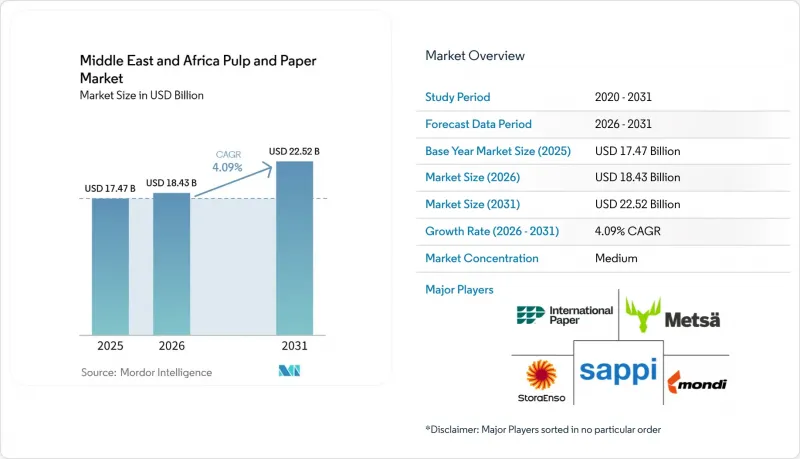
根據 Mordor Intelligence 預測,中東和非洲的紙漿和造紙市場規模將從 2025 年的 174.7 億美元和 2026 年的 184.3 億美元成長到 2031 年的 225.2 億美元,2026 年至 2031 年的年複合成長率(CAGR)率為 4.09%。
本報告按等級(未漂白牛皮紙漿、機械漿、再生漿等)、應用(印刷書寫紙、報紙紙張、衛生紙等)、終端用戶行業(食品飲料包裝等)、產品類型(印刷紙等)、生產過程(化學製漿法等)和地區進行細分。市場預測以美元計價。
中東和非洲紙漿和造紙市場的趨勢和洞察
電子商務訂單履約量增加
數位商務正在改變沙烏地阿拉伯和阿拉伯聯合大公國這兩個次區域對瓦楞紙箱的需求。兩國業者正在採用尺寸合適、模切工藝精良的瓦楞紙板,以減輕運輸重量。這種轉變推動了對更輕的瓦楞紙板和更堅固的襯紙的需求,並在同一生產週期內持續成長。沙烏地阿拉伯的非石油私部門活動指數在2025年的大部分時間都維持在53以上,這支撐了商業活動和包裝需求,使其不受石油週期的影響。非洲大陸自由貿易協定(AfCFTA)的數位貿易協定正在支持內陸國家的最後一公里物流,在以往以重複使用和非正規包裝為主的地區,創造了對瓦楞包裝的額外需求。隨著造紙商投資生產更輕、更堅固的瓦楞紙板以滿足不斷變化的物流需求,中東和非洲的紙漿和造紙市場將從中受益。
政府關於逐步淘汰塑膠的法規
塑膠法規的實施使得紙質包裝成為多個產品類型的必需品。阿拉伯聯合大公國(阿拉伯聯合大公國)在2025年和2026年擴大了其法規的適用範圍,涵蓋了更多餐飲服務用品,包括杯子、蓋子、刀叉餐具和盤子。肯亞、奈及利亞、衣索比亞和埃及也在2025年推出了關於包裝材料和生產者責任的措施。這些措施正在影響餐飲服務、零售和消費品行業的包裝,使得用紙製品取代受監管的塑膠製品成為可能。這種轉變也推動了透過生產者責任制擴大廢紙回收範圍。因此,中東和非洲的紙漿和紙張市場將主要由監管合規要求驅動的需求支撐,而非消費者偏好。
再生纖維進口價格波動
許多造紙廠依賴從歐洲、北美和亞洲進口的瓦楞紙箱和混合廢紙。這種依賴性使得它們的成本基礎極易受到全球纖維價格和運輸成本波動的影響。對於使用再生紙漿的沿岸地區造紙廠而言,這種成本風險尤其顯著,因為它們對低成本進口的依賴限制了它們將成本上漲轉嫁給客戶的能力。 2026年海運航線的中斷也導致紙漿運輸的運費和保險費上漲。為了應對這種情況,造紙廠正在尋求長期供應契約,安裝能夠處理混合紙包的滾筒碎漿機,並與國內回收系統整合。雖然這些措施可以增強抗風險能力,但它們需要營運資金,而小規模加工企業資金籌措資金。
細分市場分析
到2025年,漂白化學漿將佔銷售額的32.07%,成為該地區的主要紙漿等級。這種紙漿供應給需要穩定纖維品質和抗張強度的衛生紙和高白度瓦楞紙板廠。 MEPCO子公司Juthor於2025年在阿卜杜拉國王經濟城啟動了TM6衛生紙生產線的建設。該計畫投資9,200萬美元,旨在將年衛生紙產能提高6萬噸。該生產線將採用安德里茨(ANDRITZ)的設備,設計運作速度為2100公尺/分鐘。雖然用於溶解的木漿規模仍然較小,但土耳其和埃及黏膠短纖維叢集對可追溯纖維素原料的需求正在成長。 Cycore公司新增的11萬噸產能將…
薩皮公司正在增強自身能力以滿足這一需求。未漂白牛皮紙漿在包裝袋和重型運輸包裝中仍然發揮重要作用,因為在這些應用中,破損強度比白度更為重要。預計再生紙漿將成為成長最快的紙漿等級,到2031年複合年成長率將達到4.84%。其成長與生產者延伸責任制(EPR)法規下回收網路的建立以及處理混合紙包的造紙廠設備的升級密切相關。滾筒碎漿機和改良的分類線將使利用更多種類的原料生產商業紙漿成為可能。預計再生紙漿不會取代需要高性能應用的漂白化學紙漿。相反,它可以減少機械紙漿和二級進口紙漿的使用。在沙烏地阿拉伯、埃及和土耳其,正在進行使用小麥秸稈、椰棗葉和甘蔗渣等農業廢棄物進行再生紙漿試驗。
到2025年,瓦楞紙板原紙將佔中東和非洲紙漿和造紙市場32.12%的佔有率,成為最大的應用類別。預計其成長速度也將最快,到2031年複合年成長率將達到4.98%。電子商務履約和生鮮食品出口正在推動瓦楞紙板的需求成長。沙烏地阿拉伯和阿拉伯聯合大公國的企業正在尋求尺寸合適的包裝規格以減輕運輸重量,從而增加了對更輕的瓦楞紙漿和更強韌的襯紙的需求。生活用紙是成長速度第二快的應用,因為海灣合作理事會(GCC)的產能正在供應人均消費量有限的非洲市場。新的生產設施採用空氣乾燥技術,以實現更柔軟的質地,並提高本地生產的生活用紙的競爭力。隨著消費品公司根據減少塑膠使用的措施調整其包裝規格,瓦楞紙板也從中受益。
隨著廣告和閱讀日益轉向數位管道,印刷用紙、書寫用紙和報紙紙張的產量正在下降。特種紙雖然規模較小,但利潤豐厚,主要用於藥品標籤、食品包裝薄膜及工業離型紙等應用。在南非和土耳其,一些原本用於生產印刷用紙和書寫用紙的加工能力正被重新用於生產特殊阻隔紙和功能性塗料。這使得生產商能夠在滿足不斷成長的消費品需求的同時,充分利用現有設施。向歐洲零售通路出口農產品的公司必須滿足於2025年7月生效的可追溯性和包裝要求。這些要求可能會推高箱板紙的認證溢價。在中東和非洲的紙漿和造紙市場,出口型農業供應鏈對認證瓦楞紙板的需求仍然存在。即使在低成本包裝材料面臨壓力的情況下,這也保障了對高性能包裝材料的需求。
其他好處:
- Excel格式的市場預測(ME)表
- 3個月的分析師支持
目錄
第1章:引言
- 研究假設和市場定義
- 調查範圍
第2章:調查方法
第3章執行摘要
第4章 市場狀況
- 市場概覽
- 宏觀經濟因素對市場的影響
- 市場促進因素
- 電子商務訂單履約量增加
- 政府關於逐步淘汰塑膠的法規
- 衛生用品和紙巾產品的消費量增加
- 生鮮食品出口擴大,紙箱需求增加
- 海灣合作理事會國家對綜合造紙能力的投資
- 農業殘餘纖維的商業化
- 市場限制因素
- 再生纖維進口價格波動
- 撒哈拉以南非洲製造地長期電力供應不穩定
- 該地區林業資源短缺
- 海運物流中斷與外匯波動
- 產業價值鏈分析
- 監理情勢
- 技術展望
- 波特五力分析
第5章 市場規模與成長預測
- 按年級
- 漂白化學紙漿(BCP)
- 用於溶解的木漿(DWP)
- 未漂白牛皮紙漿
- 機械漿
- 再生紙漿
- 透過使用
- 列印/書寫
- 報紙紙張
- 組織
- 紙板
- 貨櫃紙板
- 特種紙
- 按最終用途行業分類
- 食品和飲料包裝
- 消費品包裝
- 衛生用品
- 出版/教育
- 工業和專業應用
- 依產品類型
- 繪圖紙
- 包裝紙
- 棉紙
- 特種紙
- 透過工藝技術
- 化學製漿工藝
- 機械製漿
- 再生纖維的加工
- 按地區
- 中東
- 沙烏地阿拉伯
- 阿拉伯聯合大公國
- 土耳其
- 其他中東國家
- 非洲
- 南非
- 肯亞
- 其他非洲國家
- 中東
第6章 競爭情勢
- 市場集中度
- 策略趨勢
- 市佔率分析
- 公司簡介
- Metsa Group
- Smurfit WestRock plc
- International Paper Company
- Mondi plc
- Sappi Limited
- Middle East Paper Company
- Mpact Limited
- Billerud AB
- Stora Enso Oyj
- Svenska Cellulosa Aktiebolaget SCA
- Nine Dragons Paper(Holdings)Limited
- Asia Pulp & Paper Co., Ltd.
- Kimberly-Clark Corporation
- Huhtamaki Oyj
- Nampak Limited
- United Carton Industries Company
- Arabian Packaging Co. LLC
- Napco National Company
- Obeikan Investment Group
第7章 市場機會與未來展望
According to Mordor Intelligence, the Middle East and Africa pulp and paper market size is projected to expand from USD 17.47 billion in 2025 and USD 18.43 billion in 2026 to USD 22.52 billion by 2031, registering a CAGR of 4.09% between 2026 and 2031.
This report is Segmented by Grade (Unbleached Kraft Pulp, Mechanical Pulp, Recycled Pulp, and More), Application (Printing and Writing, Newsprint, Tissue, and More), End-Use Industry (Food and Beverage Packaging, and More), Product Type (Graphic Papers, and More), Process Technology (Chemical Pulping, and More), and Geography. The Market Forecasts are Provided in Terms of Value (USD).
Middle East and Africa Pulp and Paper Market Trends and Insights
Accelerating E-Commerce Fulfillment Volumes
Digital commerce is changing corrugated-box demand across the two subregions. Operators in Saudi Arabia and the UAE are adopting right-sized and die-cut corrugated formats that reduce shipment weight. This shift increases demand for lightweight fluting media and stronger testliners within the same production cycle. Saudi Arabia's non-oil private-sector activity remained above 53 for much of 2025, which supported commercial activity and packaging demand outside the oil cycle. The AfCFTA digital trade protocol is supporting last-mile logistics in landlocked economies, creating additional demand for corrugated packaging, where reused or informal formats had been common. The Middle East and Africa pulp and paper markets can benefit as mills invest in lighter, stronger grades that meet changing logistics needs.
Government Plastic Phase-Out Regulations
Plastic restrictions are making paper-based packaging necessary in several product categories. The UAE extended its restrictions in 2025 and 2026 to cover more food-service items, including cups, lids, cutlery, and plates. Kenya, Nigeria, Ethiopia, and Egypt also introduced measures that affect packaging materials and producer responsibilities in 2025. These measures influence food service, retail, and consumer goods packaging, where paper formats can replace restricted plastic products. The change also supports wider post-consumer paper collection through producer-responsibility systems. The Middle East and Africa pulp and paper market, therefore, gains demand support linked to compliance requirements rather than discretionary consumer preferences.
Recycled-Fiber Import Price Volatility
Many mills depend on imported old corrugated containers and mixed wastepaper from Europe, North America, and Asia. This dependence makes their cost base sensitive to changes in global fiber prices and shipping costs. The cost exposure is particularly important for Gulf mills using recycled furnish, where low-cost imports limit the ability to pass increases through to customers. Disruption along maritime routes during 2026 also raised freight and insurance costs for fiber shipments. Mills are responding by offering longer supply contracts, drum pulpers capable of processing mixed bales, and links to domestic collection systems. These measures can improve resilience, but they require working capital and are harder for smaller converters to fund.
Other drivers and restraints analyzed in the detailed report include:
- Rising Hygiene and Tissue Consumption
- Fresh Produce Export Growth and Corrugated Demand
- Chronic Power Supply Instability in Sub-Saharan Manufacturing Hubs
For complete list of drivers and restraints, kindly check the Table Of Contents.
Segment Analysis
Bleached Chemical Pulp accounted for 32.07% of revenue in 2025, making it the leading grade in the regional mix. It supplies tissue and high-brightness cartonboard mills that require consistent fiber quality and tensile performance. MEPCO's Juthor subsidiary started construction of its TM6 tissue line at King Abdullah Economic City in 2025. The project is a USD 92 million investment and is designed to add 60,000 tonnes of annual tissue capacity. The line uses ANDRITZ equipment and was designed for an operating speed of 2,100 m/min. Dissolving Wood Pulp remains smaller, but Turkish and Egyptian viscose-staple-fiber clusters are increasing demand for traceable cellulose inputs. The 110,000-tonne Saiccor capacity addition supports
Sappi's ability to serve this demand. Unbleached Kraft Pulp remains important for sacks and heavy-duty transit packaging where burst strength is more valuable than brightness. Recycled Pulp is projected to be the fastest-growing grade at a 4.84% CAGR through 2031. Its expansion is linked to the development of collection networks under extended producer responsibility rules and to mill upgrades that process mixed-paper bales. Drum pulpers and improved screening lines can produce commercial furnish from a more varied range of input materials. Recycled Pulp is not expected to replace Bleached Chemical Pulp in applications that require premium performance. Instead, it can reduce use of Mechanical Pulp and secondary-grade imports. Agricultural-residue trials using wheat straw, date-palm fronds, and bagasse are under way in Saudi Arabia, Egypt, and Turkey.
Containerboard accounted for 32.12% of the Middle East and Africa pulp and paper market in 2025, making it the largest application category. It is also projected to record the fastest growth at a 4.98% CAGR through 2031. E-commerce fulfillment and fresh-produce exports are increasing demand for corrugated-board grades. Saudi Arabian and UAE operators are seeking right-sized formats that lower shipment weight. This raises demand for lightweight fluting media and stronger testliners. Tissue is the next-fastest-growing application, as GCC capacity serves African markets with limited per-capita consumption. New machines use through-air-drying technology to offer premium softness and improve the competitiveness of locally produced tissue. Cartonboard also benefits when consumer goods companies revise packaging specifications to meet plastic-reduction commitments.
Printing and Writing papers and Newsprint face declining volume as advertising and reading increasingly move to digital channels. Specialty Papers remain a smaller but higher-margin category for pharmaceutical labels, food-safe wraps, and industrial release liners. In South Africa and Turkey, some converting capacity originally used for Printing and Writing grades is being adapted for specialty barriers and functional coatings. This allows producers to use existing equipment while serving growing consumer-goods requirements. Produce exporters to European retail channels must meet traceability and packaging requirements that took effect in July 2025. These requirements can support a certification premium for Containerboard. The Middle East and Africa pulp and paper market continues to need certified corrugated grades for export-oriented agricultural supply chains. This protects demand for higher-performing packaging material despite pressure on lower-cost grades.
Complete Report Scope:
- By Grade
- Bleached Chemical Pulp (BCP)
- Dissolving Wood Pulp (DWP)
- Unbleached Kraft Pulp
- Mechanical Pulp
- Recycled Pulp
- By Application
- Printing and Writing
- Newsprint
- Tissue
- Cartonboard
- Containerboard
- Specialty Papers
- By End-use Industry
- Food and Beverage Packaging
- Consumer Goods Packaging
- Hygiene Products
- Publishing and Education
- Industrial and Specialty Applications
- By Product Type
- Graphic Papers
- Packaging Papers
- Tissue Papers
- Specialty Papers
- By Process Technology
- Chemical Pulping
- Mechanical Pulping
- Recycled Fibre Processing
- By Geography
- Middle East
- Saudi Arabia
- United Arab Emirates
- Turkey
- Rest of Middle East
- Africa
- South Africa
- Kenya
- Rest of Africa
- Middle East
List of Companies Covered in this Report:
- Metsa Group
- Smurfit WestRock plc
- International Paper Company
- Mondi plc
- Sappi Limited
- Middle East Paper Company
- Mpact Limited
- Billerud AB
- Stora Enso Oyj
- Svenska Cellulosa Aktiebolaget SCA
- Nine Dragons Paper (Holdings) Limited
- Asia Pulp & Paper Co., Ltd.
- Kimberly-Clark Corporation
- Huhtamaki Oyj
- Nampak Limited
- United Carton Industries Company
- Arabian Packaging Co. L.L.C.
- Napco National Company
- Obeikan Investment Group
Additional Benefits:
- The market estimate (ME) sheet in Excel format
- 3 months of analyst support
TABLE OF CONTENTS
1 INTRODUCTION
- 1.1 Study Assumptions and Market Definition
- 1.2 Scope of the Study
2 RESEARCH METHODOLOGY
3 EXECUTIVE SUMMARY
4 MARKET LANDSCAPE
- 4.1 Market Overview
- 4.2 Impact of Macroeconomic Factors on the Market
- 4.3 Market Drivers
- 4.3.1 Accelerating E-Commerce Fulfillment Volumes
- 4.3.2 Government Plastic Phase-Out Regulations
- 4.3.3 Rising Hygiene and Tissue Consumption
- 4.3.4 Fresh Produce Export Growth and Corrugated Demand
- 4.3.5 GCC Investment in Integrated Paper Capacity
- 4.3.6 Agricultural-Residue Fiber Commercialization
- 4.4 Market Restraints
- 4.4.1 Recycled-Fiber Import Price Volatility
- 4.4.2 Chronic Power Supply Instability in Sub-Saharan Manufacturing Hubs
- 4.4.3 Limited Regional Forestry Resources
- 4.4.4 Maritime Logistics Disruptions and Currency Fluctuations
- 4.5 Industry Value Chain Analysis
- 4.6 Regulatory Landscape
- 4.7 Technological Outlook
- 4.8 Porter's Five Forces Analysis
- 4.8.1 Threat of New Entrants
- 4.8.2 Bargaining Power of Suppliers
- 4.8.3 Bargaining Power of Buyers
- 4.8.4 Threat of Substitutes
- 4.8.5 Intensity of Competitive Rivalry
5 MARKET SIZE AND GROWTH FORECASTS (VALUE)
- 5.1 By Grade
- 5.1.1 Bleached Chemical Pulp (BCP)
- 5.1.2 Dissolving Wood Pulp (DWP)
- 5.1.3 Unbleached Kraft Pulp
- 5.1.4 Mechanical Pulp
- 5.1.5 Recycled Pulp
- 5.2 By Application
- 5.2.1 Printing and Writing
- 5.2.2 Newsprint
- 5.2.3 Tissue
- 5.2.4 Cartonboard
- 5.2.5 Containerboard
- 5.2.6 Specialty Papers
- 5.3 By End-use Industry
- 5.3.1 Food and Beverage Packaging
- 5.3.2 Consumer Goods Packaging
- 5.3.3 Hygiene Products
- 5.3.4 Publishing and Education
- 5.3.5 Industrial and Specialty Applications
- 5.4 By Product Type
- 5.4.1 Graphic Papers
- 5.4.2 Packaging Papers
- 5.4.3 Tissue Papers
- 5.4.4 Specialty Papers
- 5.5 By Process Technology
- 5.5.1 Chemical Pulping
- 5.5.2 Mechanical Pulping
- 5.5.3 Recycled Fibre Processing
- 5.6 By Geography
- 5.6.1 Middle East
- 5.6.1.1 Saudi Arabia
- 5.6.1.2 United Arab Emirates
- 5.6.1.3 Turkey
- 5.6.1.4 Rest of Middle East
- 5.6.2 Africa
- 5.6.2.1 South Africa
- 5.6.2.2 Kenya
- 5.6.2.3 Rest of Africa
- 5.6.1 Middle East
6 COMPETITIVE LANDSCAPE
- 6.1 Market Concentration
- 6.2 Strategic Moves
- 6.3 Market Share Analysis
- 6.4 Company Profiles (includes Global Level Overview, Market Level Overview, Core Segments, Financials as available, Strategic Information, Market Rank/Share, Products and Services, Recent Developments)
- 6.4.1 Metsa Group
- 6.4.2 Smurfit WestRock plc
- 6.4.3 International Paper Company
- 6.4.4 Mondi plc
- 6.4.5 Sappi Limited
- 6.4.6 Middle East Paper Company
- 6.4.7 Mpact Limited
- 6.4.8 Billerud AB
- 6.4.9 Stora Enso Oyj
- 6.4.10 Svenska Cellulosa Aktiebolaget SCA
- 6.4.11 Nine Dragons Paper (Holdings) Limited
- 6.4.12 Asia Pulp & Paper Co., Ltd.
- 6.4.13 Kimberly-Clark Corporation
- 6.4.14 Huhtamaki Oyj
- 6.4.15 Nampak Limited
- 6.4.16 United Carton Industries Company
- 6.4.17 Arabian Packaging Co. L.L.C.
- 6.4.18 Napco National Company
- 6.4.19 Obeikan Investment Group
7 MARKET OPPORTUNITIES AND FUTURE OUTLOOK
- 7.1 White-Space and Unmet-Need Assessment

 加工紙漿市場:按等級、纖維類型、加工方法和應用分類的全球市場預測,2026-2032年高速紙漿洗滌機市場:依原料來源、技術、類型、產能、應用和最終用途產業分類-全球預測,2026-2032年
 2034年全球紙漿與造紙自動化市場機會與策略
 紙漿及造紙市場分析及預測(至2035年):依類型、產品、服務、技術、應用、材料類型、製程、最終用戶、安裝類型、設備分類
 紙漿及造紙酶市場機會、成長要素、產業趨勢分析及2026年至2035年預測
 全球紙漿和造紙市場:市場規模、份額、成長率、產業分析、類型、應用和區域分析,未來預測(2026-2034)
 紙漿和造紙市場規模、佔有率和成長分析(按類別、類型、應用、銷售管道和地區分類)-2026-2033年產業預測
 2032 年紙漿和造紙市場預測:按產品類型、原料、製造流程、應用、最終用戶和地區進行的全球分析