


 |
市場調查報告書
商品編碼
2124507
可控壓力鑽井服務:市場佔有率分析、產業趨勢與統計、成長預測(2026-2031 年)Managed Pressure Drilling Services - Market Share Analysis, Industry Trends & Statistics, Growth Forecasts (2026 - 2031) |
||||||

※ 本網頁內容可能與最新版本有所差異。詳細情況請與我們聯繫。
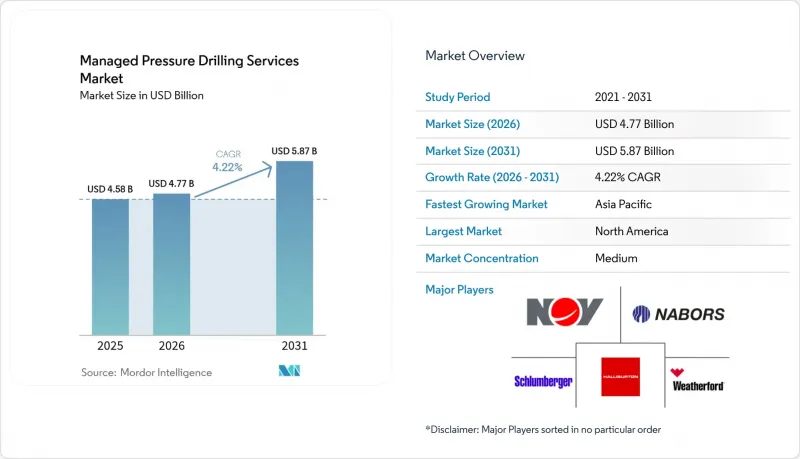
根據 Mordor Intelligence 預測,受控壓力鑽井服務市場規模將從 2025 年的 45.8 億美元成長到 2026 年的 47.7 億美元,然後在 2031 年達到 58.7 億美元,2026 年至 2031 年的複合年成長率為 4.22%。
本報告按技術(例如,恆定井眼壓力)、服務類型(例如,設備租賃、營運/實施)、壓力條件(低壓和高壓)、井類型(生產井、探勘、維修)、環境(常規、非常規等)、應用(陸上和海上)以及地區(北美、亞太地區及其他地區)進行分類。
全球可控鑽井服務市場趨勢與洞察
深海領域的資本投資正迅速復甦。
自2022年起,獲準的深海鑽井預算將超過每年2,000億美元,扭轉2015年至2020年的投資低迷局面,並推動對可控壓力鑽井服務開發的新需求。雪佛龍公司價值57億美元的「Anchor」計畫清楚地展現了這一轉變,該計畫採用20000 psi的系統,利用先進的MPD技術,在極其緊迫的時限內安全鑽井。預計到2025年,鑽井船的利用率將接近97%,隨著具備先進壓力控制能力的鑽機優先使用,承包商將能夠提供更高的日租金。由於每個獲批的深海項目通常都涉及在探勘、評估和生產階段鑽探多口MPD井,服務需求將進一步成長。對於尋求獲得多年訂單儲備的服務供應商,技術差異化仍然是至關重要的競爭優勢。
中東和北非地區高溫高壓井開發快速成長
中東和北非(MENA)地區的國有石油公司正瞄準壓力超過15,000磅/平方英寸(psi)、溫度超過350華氏度(約177攝氏度)的儲存,這使得可控壓力鑽井(MPD)服務成為安全鑽井的關鍵市場解決方案。哈里伯頓和Neighbors公司在阿曼開展的自動化旋轉和滑動鑽井作業清晰地表明,人工智慧驅動的MPD正迅速成為一項標準作業流程。沙烏地阿拉伯、阿拉伯聯合大公國(阿拉伯聯合大公國)和卡達的法規結構現已強制要求對超過指定壓力閾值的油井採用MPD,從而加速了其應用。隨著高溫高壓(HPHT)專案的擴展,擁有成熟的HPHT工具包和充足人員的服務供應商將擁有明顯的優勢。
鑽機的每日成本波動很大,給 MPD 預算帶來了壓力。
2024年,惡劣環境下半潛式鑽機的日租金達到39萬至51萬美元,創九年來新高,給可自由支配的鑽井支出帶來了壓力。由於MPD服務通常佔單井總成本的15%至25%,租金飆升迫使營運商延遲部署或縮減作業規模。諸如道達爾能源公司持有高性能鑽井船多數股權等所有權模式,凸顯了各方為控制成本飆升所做的努力。儘管預計到2026年鑽機租金將逐步趨於穩定,但繁榮與蕭條的周期性波動促使各方在MPD預算方面採取謹慎的態度。
細分市場分析
到2025年,穩態底部壓力法將佔可控壓力鑽井服務市場規模的46.10%,反映出其在大陸棚、高溫高壓(HPHT)和陸上油井的廣泛適用性。然而,隨著深水作業者利用雙梯度系統能夠解耦泥漿密度和立管壓力,從而降低井下應力並提高抗井湧能力,預計到2031年,雙梯度系統的年複合成長率將達到5.95%。
雙梯度技術的蓬勃發展與整合式海底泵的引入不謀而合,這些海底泵與地面控制迴路同步,可實現快速壓力補償。人工智慧感測器能夠更精確地分析井底壓力,並減少井眼膨脹。泥漿帽鑽井技術目前仍是應對完全漏失情況的專項技術,而回流控制技術則應用於頁岩氣側井鑽探,但兩者都受益於自動化浪潮席捲整個可控壓力鑽井服務市場。
到2025年,設備租賃收入將佔總收入的47.70%,因為營運商避免了對專用歧管、節流閥和旋轉控制設備等相關設備的資本投資。受勞動力短缺和風險分擔激勵措施的推動,受控壓力鑽井服務市場(包括營運和執行獎勵)的規模預計將以5.55%的複合年成長率快速成長。
整合式合約包含硬體、認證人員、即時分析和效能保證,使營運商能夠利用最新工具集,同時轉移執行風險。對設計和工程服務的需求保持穩定,特別是對於需要客製化流體分析模型的前緣高溫高壓(HPHT)和碳捕集與封存(CCS)井。隨著承包商加快各國工人的認證和遠端營運中心的建立,對培訓和支援的需求也增加。
區域分析
2025年,北美地區在銷售額方面保持38.10%的領先優勢,這主要得益於頁岩氣再壓裂、二疊紀盆地高溫高壓(HPHT)井以及墨西哥灣超深水井的開發,從而提振了MPD(壓力控制鑽井)的需求。由於早期採用了人工智慧驅動的壓力自動化技術和完善的培訓體系,服務成本保持了競爭力。墨西哥的Trión油田在綜合SLB鑽井合約的支持下,進一步鞏固了MPD在墨西哥這家國營石油公司中的區域市場地位。
亞太地區是可控壓力鑽井服務市場成長最快的區域,預計到2031年將以6.82%的複合年成長率成長。在中國,鑽探8公里深的順北油井以及四川省的超壓頁岩地層需要精確的壓力控制,以防止硫化氫流入。印度的鑽井鑽機數量預計將從2024年的111台增加到2028年的142台,這將進一步擴大對高壓高溫井(HPHT)鑽井以及拉賈斯坦邦陸上評估鑽井專案所需的壓力控制鑽井設備(MPD)的需求。在東南亞,馬來西亞和印尼的深海天然氣開發前景再次升溫,而澳洲正在根據其淨零排放目標準備捕碳封存(CCS)試點井。
在歐洲,受北海高溫高壓井、波羅的海碳捕集與封存(CCS)先導計畫以及德國和法國地熱開發中心的推動,預計將穩定成長。歐盟嚴格的油井完整性法規將最大允許鑽井(MPD)納入地熱和CCS井的許可條件,進一步提升了對MPD技術的需求。挪威在所有油田推廣MPD技術,正推動最佳實踐在歐洲的進一步傳播。
在中東和非洲地區,沙烏地阿拉伯和卡達高滲透性硬質碳酸鹽岩的開發,以及奈米比亞和安哥拉正在進行的新深海開發項目,都推動了該地區的石油市場成長。國有石油公司和高滲透性碳酸鹽岩的開發需求支撐了強勁的需求,但現場人員的短缺仍然是一個瓶頸。巴西的鹽層下油氣和阿根廷傳統天然氣市場成長。
其他好處:
- Excel格式的市場預測(ME)表
- 3個月的分析師支持
目錄
第1章:引言
- 研究假設和市場定義
- 調查範圍
第2章:調查方法
第3章執行摘要
第4章 市場狀況
- 市場概覽
- 市場促進因素
- 深海領域的資本投資正加速復甦。
- 中東和北非(MENA)地區高溫高壓油井開發快速成長
- 2025年起北美頁岩氣回注浪潮
- 人工智慧驅動的地下壓力自動化
- CCS和氫兼容井設計標準
- 歐盟強制實施地熱井多用途排放(MPD)規定。
- 市場限制因素
- 鑽機每日成本的波動給 MPD 預算帶來了壓力。
- 全球範圍內,具備MPD認證船員資格的人才庫有限。
- 合資企業的資料所有權糾紛持續不斷。
- 北極近海鑽井液排放法規已加強。
- 供應鏈分析
- 監理情勢
- 技術展望
- 波特五力模型
第5章 市場規模與成長預測
- 透過技術
- 穩態底部壓力
- 瘋狂鑽井
- 雙梯度鑽孔
- 回流控制鑽井
- 其他新興技術
- 按服務類型
- 設計與工程
- 設備租賃
- 運行與執行
- 培訓和支持
- 按壓力條件
- 低壓/窄窗
- 高壓高溫(HPHT)
- 按井類型
- 野貓/探勘
- 開發與生產
- 鍛鍊和重新入場
- 透過鑽井環境
- 傳統型烴
- 非常規油氣傳統型(頁岩氣、緻密氣、煤層氣)
- 地熱
- 碳捕獲與封存和氫氣儲存
- 透過使用
- 陸上
- 離岸
- 按地區
- 北美洲
- 美國
- 加拿大
- 墨西哥
- 歐洲
- 德國
- 英國
- 法國
- 義大利
- 西班牙
- 俄羅斯
- 其他歐洲國家
- 亞太地區
- 中國
- 印度
- 日本
- 韓國
- 東南亞國協
- 其他亞太國家
- 南美洲
- 巴西
- 阿根廷
- 其他南美國家
- 中東和非洲
- 沙烏地阿拉伯
- 阿拉伯聯合大公國
- 南非
- 埃及
- 其他中東和非洲國家
- 北美洲
第6章 競爭情勢
- 市場集中度
- 策略趨勢(併購、聯盟、購電協議)
- 市場佔有率分析(主要公司的市場排名和佔有率)
- 公司簡介
- Halliburton Company
- Schlumberger Ltd
- Weatherford International plc
- NOV Inc.
- Nabors Industries Ltd
- Global MPD Services
- Ensign Energy Services Inc.
- Air Drilling Associates Inc.
- Blade Energy Partners Ltd
- Exceed(XCD)Holdings Ltd
- Pruitt MPD
- Beyond Energy Services & Technology
- Scientific Drilling International
- Secure Drilling(Petrofac)
- Wild Well Control
- Archer Ltd
- Helmerich & Payne(MPD unit)
- Welltec A/S
- Cougar Drilling Solutions
- GOSCO Drilling Solutions
第7章 市場機會與未來展望
According to Mordor Intelligence, the managed pressure drilling services market size is expected to grow from USD 4.58 billion in 2025 to USD 4.77 billion in 2026 and is forecast to reach USD 5.87 billion by 2031 at 4.22% CAGR over 2026-2031.
This report is Segmented by Technology (Constant Bottom-Hole Pressure, and More), Service Type (Equipment Rental, Operations & Execution, and More), Pressure Regime (Low-Pressure and High-Pressure), Well Type (Production, Exploration, and Work-Over), Environment (Conventional, Unconventional, and More), Application (Onshore and Offshore), and Geography (North America, Asia-Pacific, and More)
Global Managed Pressure Drilling Services Market Trends and Insights
Accelerating Deep-water CAPEX Rebound
Sanctioned deepwater budgets have exceeded USD 200 billion annually since 2022, reversing the 2015-2020 investment drought and fuelling fresh demand for managed pressure drilling services market deployments. Chevron's USD 5.7 billion Anchor project illustrates the shift, employing 20,000 psi systems that rely on sophisticated MPD to drill safely in ultra-narrow windows. Drillship utilisation nearing 97% in 2025 prioritises rigs fitted with advanced pressure control, allowing contractors to command premium dayrates. Each sanctioned deepwater campaign typically entails multiple MPD-enabled wells across exploration, appraisal, and production phases, compounding service demand. Technology differentiation remains a pivotal competitive lever for service providers positioning for multi-year contract backlogs.
Surge in HPHT Well Development in MENA
National oil companies across the Middle East and North Africa target reservoirs exceeding 15,000 psi and 350 °F, where managed pressure drilling services market solutions become indispensable for safe wellbore construction. Automated rotary and slide drilling executed in Oman by Halliburton and Nabors underscores how AI-enhanced MPD is fast becoming standard operating practice . Regulatory frameworks in Saudi Arabia, the UAE, and Qatar now require MPD on wells surpassing defined pressure thresholds, accelerating adoption. As HPHT projects proliferate, service providers with proven HPHT toolkits and crew availability enjoy a clear advantage.
Volatile Rig-day Rates Squeezing MPD Budgets
Harsh-environment semisubs commanded USD 390,000-510,000 per day in 2024, a nine-year high that narrowed discretionary drilling spend. MPD services typically add 15-25% to total well costs, so sudden rate spikes lead operators to defer or downgrade deployments. Ownership models such as TotalEnergies' majority stake in a high-spec drillship highlight efforts to tame escalating costs. While rig rates are expected to ease modestly by 2026, the boom-bust cycle underpins cautious MPD budgeting.
Other drivers and restraints analyzed in the detailed report include:
- Post-2025 Shale Refrac Wave in North America
- AI-driven Downhole Pressure Automation
- Limited Global Pool of Certified MPD Crews
For complete list of drivers and restraints, kindly check the Table Of Contents.
Segment Analysis
Constant bottom-hole pressure methods contributed 46.10% to the managed pressure drilling services market size in 2025, reflecting their broad applicability across shelf, HPHT, and onshore wells. However, dual-gradient systems are climbing at a 5.95% CAGR to 2031 as deepwater operators exploit their ability to decouple mudweight from riser pressure, lowering downhole stress and improving kick tolerance.
The dual-gradient surge coincides with integrated seabed pump deployments synchronizing with surface control loops for rapid pressure corrections. AI-linked sensors fine-tune bottomhole pressure analytics, cutting wellbore ballooning events. Mud-cap drilling remains niche for total-loss scenarios, and return-flow control methods serve laterals in shale plays, yet both benefit from the broader automation wave permeating the managed pressure drilling services market.
Equipment rental held 47.70% revenue in 2025 as operators avoided capital commitments tied to specialised manifolds, chokes, and rotating control devices. The managed pressure drilling services market size for operations and execution packages is forecast to rise faster at a 5.55% CAGR, propelled by crew scarcity and risk-sharing incentives.
Integrated contracts bundle hardware with certified personnel, real-time analytics, and performance guarantees, letting operators transfer execution risk while accessing the latest toolsets. Design and engineering services maintain a stable demand, particularly for frontier HPHT and CCS wells requiring bespoke hydraulics modelling. Training and support demand is swelling as contractors race to certify national crews and enable remote operations centres.
Complete Report Scope:
- By Technology
- Constant Bottom-Hole Pressure
- Mud-Cap Drilling
- Dual-Gradient Drilling
- Return-Flow Control Drilling
- Other Emerging Techniques
- By Service Type
- Design and Engineering
- Equipment Rental
- Operations and Execution
- Training and Support
- By Pressure Regime
- Low-Pressure/Narrow Window
- High-Pressure/High-Temperature (HPHT)
- By Well Type
- Wildcat/Exploration
- Development Production
- Work-over and Re-entry
- By Drilling Environment
- Conventional Hydrocarbon
- Unconventional (Shale, Tight, CBM)
- Geothermal
- CCS and Hydrogen Storage
- By Application
- Onshore
- Offshore
- By Geography
- North America
- United States
- Canada
- Mexico
- Europe
- Germany
- United Kingdom
- France
- Italy
- Spain
- Russia
- Rest of Europe
- Asia-Pacific
- China
- India
- Japan
- South Korea
- ASEAN Countries
- Rest of Asia-Pacific
- South America
- Brazil
- Argentina
- Rest of South America
- Middle East and Africa
- Saudi Arabia
- United Arab Emirates
- South Africa
- Egypt
- Rest of Middle East and Africa
- North America
Geography Analysis
North America preserved a 38.10% revenue lead in 2025 as shale refracs, Permian HPHT horizontals, and Gulf of Mexico ultra-deepwater wells collectively boosted MPD demand. Early adoption of AI-enabled pressure automation and an established training infrastructure keeps service costs competitive. Mexico's Trion field, backed by SLB's integrated drilling contract, signals deeper regional penetration of MPD for national oil companies.
Asia-Pacific is the fastest-growing managed pressure drilling services market segment, set for a 6.82% CAGR to 2031. China's push into 8-km deep Shunbei wells and Sichuan over-pressured shales requires precise pressure envelopes to avoid H2S influx. India's rig count is projected to rise from 111 in 2024 to 142 by 2028, creating incremental MPD demand for offshore KG basin HPHT wells and onshore Rajasthan appraisal campaigns. Southeast Asia revives deepwater gas prospects in Malaysia and Indonesia, while Australia preps CCS pilot wells aligned with net-zero targets.
Europe shows steady growth fuelled by North Sea HPHT wells, Baltic CCS pilots, and geothermal hotspots in Germany and France. The EU's stringent well-integrity rules embed MPD in licensing conditions for geothermal and CCS wells, reinforcing technology pull. Norway's full-field MPD adoption standard further diffuses best practice across the continent.
The Middle East and Africa benefit from HPHT carbonate developments in Saudi Arabia and Qatar, plus emerging deepwater campaigns in Namibia and Angola. National oil company mandates and HPHT targets underpin robust demand, though crew localisation remains a bottleneck. Brazil's pre-salt and Argentina's unconventional Vaca Muerta drive anchor South America's growth.
- Halliburton Company
- Schlumberger Ltd
- Weatherford International plc
- NOV Inc.
- Nabors Industries Ltd
- Global MPD Services
- Ensign Energy Services Inc.
- Air Drilling Associates Inc.
- Blade Energy Partners Ltd
- Exceed (XCD) Holdings Ltd
- Pruitt MPD
- Beyond Energy Services & Technology
- Scientific Drilling International
- Secure Drilling (Petrofac)
- Wild Well Control
- Archer Ltd
- Helmerich & Payne (MPD unit)
- Welltec A/S
- Cougar Drilling Solutions
- GOSCO Drilling Solutions
Additional Benefits:
- The market estimate (ME) sheet in Excel format
- 3 months of analyst support
TABLE OF CONTENTS
1 Introduction
- 1.1 Study Assumptions & Market Definition
- 1.2 Scope of the Study
2 Research Methodology
3 Executive Summary
4 Market Landscape
- 4.1 Market Overview
- 4.2 Market Drivers
- 4.2.1 Accelerating deep-water CAPEX rebound
- 4.2.2 Surge in HPHT well development in MENA
- 4.2.3 Post-2025 shale refrac wave in North America
- 4.2.4 AI-driven downhole pressure automation
- 4.2.5 CCS & hydrogen-ready well design standards
- 4.2.6 Mandatory MPD adoption for geothermal wells in EU
- 4.3 Market Restraints
- 4.3.1 Volatile rig-day rates squeezing MPD budgets
- 4.3.2 Limited global pool of certified MPD crews
- 4.3.3 Persistent data-ownership disputes in JV wells
- 4.3.4 Stricter drilling-fluid discharge limits in offshore Arctic
- 4.4 Supply-Chain Analysis
- 4.5 Regulatory Landscape
- 4.6 Technological Outlook
- 4.7 Porter's Five Forces
- 4.7.1 Bargaining Power of Suppliers
- 4.7.2 Bargaining Power of Buyers
- 4.7.3 Threat of New Entrants
- 4.7.4 Threat of Substitutes
- 4.7.5 Intensity of Rivalry
5 Market Size & Growth Forecasts
- 5.1 By Technology
- 5.1.1 Constant Bottom-Hole Pressure
- 5.1.2 Mud-Cap Drilling
- 5.1.3 Dual-Gradient Drilling
- 5.1.4 Return-Flow Control Drilling
- 5.1.5 Other Emerging Techniques
- 5.2 By Service Type
- 5.2.1 Design and Engineering
- 5.2.2 Equipment Rental
- 5.2.3 Operations and Execution
- 5.2.4 Training and Support
- 5.3 By Pressure Regime
- 5.3.1 Low-Pressure/Narrow Window
- 5.3.2 High-Pressure/High-Temperature (HPHT)
- 5.4 By Well Type
- 5.4.1 Wildcat/Exploration
- 5.4.2 Development Production
- 5.4.3 Work-over and Re-entry
- 5.5 By Drilling Environment
- 5.5.1 Conventional Hydrocarbon
- 5.5.2 Unconventional (Shale, Tight, CBM)
- 5.5.3 Geothermal
- 5.5.4 CCS and Hydrogen Storage
- 5.6 By Application
- 5.6.1 Onshore
- 5.6.2 Offshore
- 5.7 By Geography
- 5.7.1 North America
- 5.7.1.1 United States
- 5.7.1.2 Canada
- 5.7.1.3 Mexico
- 5.7.2 Europe
- 5.7.2.1 Germany
- 5.7.2.2 United Kingdom
- 5.7.2.3 France
- 5.7.2.4 Italy
- 5.7.2.5 Spain
- 5.7.2.6 Russia
- 5.7.2.7 Rest of Europe
- 5.7.3 Asia-Pacific
- 5.7.3.1 China
- 5.7.3.2 India
- 5.7.3.3 Japan
- 5.7.3.4 South Korea
- 5.7.3.5 ASEAN Countries
- 5.7.3.6 Rest of Asia-Pacific
- 5.7.4 South America
- 5.7.4.1 Brazil
- 5.7.4.2 Argentina
- 5.7.4.3 Rest of South America
- 5.7.5 Middle East and Africa
- 5.7.5.1 Saudi Arabia
- 5.7.5.2 United Arab Emirates
- 5.7.5.3 South Africa
- 5.7.5.4 Egypt
- 5.7.5.5 Rest of Middle East and Africa
- 5.7.1 North America
6 Competitive Landscape
- 6.1 Market Concentration
- 6.2 Strategic Moves (M&A, Partnerships, PPAs)
- 6.3 Market Share Analysis (Market Rank/Share for key companies)
- 6.4 Company Profiles (includes Global level Overview, Market level overview, Core Segments, Financials as available, Strategic Information, Products & Services, and Recent Developments)
- 6.4.1 Halliburton Company
- 6.4.2 Schlumberger Ltd
- 6.4.3 Weatherford International plc
- 6.4.4 NOV Inc.
- 6.4.5 Nabors Industries Ltd
- 6.4.6 Global MPD Services
- 6.4.7 Ensign Energy Services Inc.
- 6.4.8 Air Drilling Associates Inc.
- 6.4.9 Blade Energy Partners Ltd
- 6.4.10 Exceed (XCD) Holdings Ltd
- 6.4.11 Pruitt MPD
- 6.4.12 Beyond Energy Services & Technology
- 6.4.13 Scientific Drilling International
- 6.4.14 Secure Drilling (Petrofac)
- 6.4.15 Wild Well Control
- 6.4.16 Archer Ltd
- 6.4.17 Helmerich & Payne (MPD unit)
- 6.4.18 Welltec A/S
- 6.4.19 Cougar Drilling Solutions
- 6.4.20 GOSCO Drilling Solutions
7 Market Opportunities & Future Outlook
- 7.1 White-space & Unmet-need Assessment

 全球可控壓力鑽井服務市場:機會與策略展望(至2035年)
 壓力控制鑽井服務市場規模、佔有率、趨勢和預測:按技術、應用和地區分類,2026-2034 年
 可控壓力鑽井市場-全球產業規模、佔有率、趨勢、機會及預測(依技術、應用、區域及競爭格局分類,2021-2031年)
 可控壓力鑽井市場規模、佔有率、成長、全球產業分析:依類型、應用、區域洞察和預測(2026-2034 年)
 可控壓力鑽井市場規模、佔有率及成長分析(按技術、工具、應用及地區分類)-2026-2033年產業預測
 2032 年控壓鑽井市場預測:按工具類型、技術、應用、最終用戶和地區進行的全球分析
 2021-2031 年管理壓力鑽井市場規模和預測、全球和區域佔有率、趨勢和成長機會分析報告範圍:按技術、應用和地理分類