


 |
市場調查報告書
商品編碼
2124505
雲端通訊平台:市場佔有率分析、產業趨勢與統計、成長預測(2026-2031)Cloud Communication Platform - Market Share Analysis, Industry Trends & Statistics, Growth Forecasts (2026 - 2031) |
||||||

※ 本網頁內容可能與最新版本有所差異。詳細情況請與我們聯繫。
預計到 2026 年,雲端通訊平台市場規模將達到 234.7 億美元,年複合成長率為 14.22%,到 2031 年將達到 456.3 億美元。
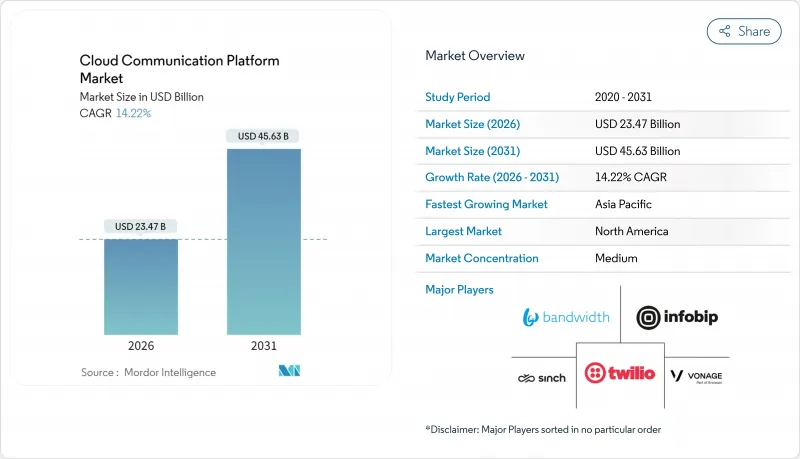
本報告按組件(解決方案(CPaaS、UCaaS、WebRTC閘道器、客服中心API)、服務(專業服務和託管服務))、部署類型(公共雲端、私有雲端、混合雲端)、行業(IT和電信、銀行、金融服務和保險、醫療保健、零售等)、企業規模(大型企業和中小企業)以及地區進行細分。市場預測以價值(美元)表示。
全球雲端通訊平台市場趨勢與洞察
CPaaS 和全通路 API 的普及
企業正在將傳統的客服中心拆分成微服務,並透過統一的API整合簡訊、WhatsApp、語音和視訊功能,使行銷團隊無需IT支援即可進行宣傳活動。無程式碼工作流程建立器將創意到上線的週期從數月縮短至數天,零售品牌透過整合與即時庫存資訊相關的「點擊通話」按鈕來提高轉換率。與Salesforce、Shopify和SAP的即用型連接器無需自訂編碼,為擁有大規模市場的平台帶來了結構性優勢。這些全通路API正在改變供應商之間的差異化格局,使其不再僅限於電話功能,而是涵蓋整個生態系統的廣度。因此,在雲端通訊平台市場,那些能夠培養強大的開發團體並加速價值實現的供應商備受青睞。
混合辦公和遠距辦公模式的迅速普及
到2025年,財富500強企業中將有68%實施永久性混合辦公政策,這將加速從依賴VPN的軟電話向基於瀏覽器的WebRTC客戶端的轉變,後者可提供按需語音和視訊通訊。微軟Teams Phone透過將PSTN呼叫整合到協作工作流程中,其授權數量已超過1500萬。企業也擴大採用計量型契約,將閒置容量的風險轉移給供應商。 ISO 27001等安全框架如今已成為平台的基本要求,這些平台必須保護企業防火牆以外的家庭網路終端。因此,平台藍圖強調零信任網路存取和持續的設備健康檢查。隨著傳統硬體升級預算轉向持續的API使用,這一趨勢正在推動雲端通訊平台市場擴張。
資料安全和隱私漏洞
2024 年 Snowflake 事件導致通話細節和支付資料洩露,使得 SaaS 供應商的網路保險費飆升 23%。如今,企業在簽署多年 API 協議前,都會要求對靜態資料進行加密、採用客戶管理的金鑰,並要求 24 小時內發出違規通知。 2024 年揭露的 Microsoft Teams 漏洞加速了供應商向零信任架構和 FedRAMP High 認證的轉變,這些供應商希望獲得美國公共部門客戶。因此,市場正轉向能夠提供第三方認證(例如 SOC 2 Type II 和 FIPS 140-2檢驗)的平台,這迫使小規模的供應商進行整合。
細分市場分析
到2025年,解決方案收入佔總收入的66.78%,但專業服務和託管服務正以15.80%的複合年成長率成長,因為遷移傳統PBX環境和將通訊API整合到CRM工作流程中需要專業技能。遵守MiFID II通話錄音規定的金融機構和遵守HIPAA規定的醫療機構擴大將架構設計和運作監控外包。到2025年,CPaaS的使用時長將超過1.2兆分鐘,這標誌著通訊方式正從固定電話轉向事件驅動型通訊。整合語音轉錄、聊天和電子郵件流的客服中心API正吸引著那些希望縮短平均處理時間並提高營運效率的公司的注意。
雖然CPaaS固有的付費使用制降低了資本支出(Capex),但也增加了整合工作的負擔,導致供應商將諮詢、遷移和最佳化等服務整合到收費方案中。缺乏負責人的中型企業依賴託管服務合作夥伴來監控API延遲和管理營運商互連。因此,能夠跨多個生態系統認證工程師的服務供應商,例如Salesforce、SAP和Epic,正在雲端通訊平台市場中脫穎而出,而功能的商品化則正在壓縮純軟體企業的利潤空間。
隨著企業將敏捷性和無限可擴展性置於優先地位,預計到 2025 年,公共雲端將佔採用收入的 72.59%。然而,由於銀行、金融和保險 (BFSI) 行業的工作負載需要往返傳輸時間小於 10 毫秒,而公共雲端無法始終保證這一點,混合雲端正以 15.30% 的複合年成長率快速成長。混合配置透過將訊號伺服器保留在本地,同時將分析和儲存路由到雲端,從而兼顧了控制和可擴展性。微軟的「主權雲端」區域承諾將音訊和轉錄資料儲存在歐盟境內,這正是在地化策略的一個範例,有助於微軟贏得公共部門合約。
儘管國防機構仍需要空氣間隙環境,但仍在使用私有雲端,但隨著零信任架構被證明足以應對許多敏感工作負載,私有雲的市場佔有率正在萎縮。小規模的CPaaS供應商正與本地基礎設施供應商合作,提供本地託管服務而無需自建資料中心,從而擴大了其地理覆蓋範圍,但同時也犧牲了部分利潤。因此,混合雲部署已成為長期趨勢,而非過渡階段,這將擴大雲端通訊平台在混合環境中進行編配和可觀測性工具的市場規模。
區域分析
預計到2025年,北美將佔全球收入的38.47%,這主要得益於財富500強企業向統一通訊即服務(UCaaS)的遷移,以及客服中心即服務(CCaaS)新創公司獲得大量創業融資。美國企業已逐步淘汰Avaya和思科PBX系統,以降低資本支出(Capex)並適應遠距辦公的需求。同時,加拿大雙語政策的實施也增加了對雙語互動語音應答(IVR)和座席路由的需求。墨西哥的近岸業務流程外包(BPO)產業透過吸引來自美國零售商的西班牙語流量,進一步擴大了該地區的雲端通訊平台市場,這些零售商尋求的是經濟高效且符合文化背景的支援服務。
亞太地區預計到2031年將以15.00%的複合年成長率成長,這主要得益於印度12億美元的「數位印度」寬頻計畫和中國的數據在地化法律,後者正在加劇國內平台和跨國平台之間的選擇困境。印度強制推行基於區塊鏈的通話認證,迫使供應商整合分散式帳本,雖然延長了產品上市時間,但也提高了可靠性。在東南亞,透過對話式商務,使用者可以透過WhatsApp Business API直接進行交易,繞過固定電話,實現聊天執行緒內的端到端訂購。日本和韓國正在主導5G網路切片試點項目,以確保遠端醫療和工廠自動化領域的通話質量,從而將雲端通訊平台市場拓展到對延遲零容忍的場景。
歐洲的普及受到號碼方案碎片化和竊聽法律限制的阻礙,這些限制迫使各國採取各自不同的實施方案。英國脫歐後的分歧導致英國引入了專門的資料保護方案,這使得跨大西洋平台的部署更加複雜。德國對GDPR的嚴格解讀最初減緩了人工智慧語音分析的普及,但隨著供應商實施了明確的雙方同意流程,情況有所改善。法國和義大利正在推動公民熱線的數位化,而沙烏地阿拉伯和阿拉伯聯合大公國則在其國家數位化議程中強制推行全通路行政服務。非洲的成長主要集中在寬頻基礎設施不穩定的市場中使用簡訊和USSD,但巴西不斷提高的互聯互通費用更有利於國內電信營運商,這使得南美市場的經濟結構向本地供應商傾斜。
其他好處:
- Excel格式的市場預測(ME)表
- 3個月的分析師支持
目錄
第1章:引言
- 研究假設和市場定義
- 調查範圍
第2章:調查方法
第3章執行摘要
第4章 市場狀況
- 市場概覽
- 市場促進因素
- CPaaS 和全通路 API 的普及
- 混合辦公和遠距辦公模式的迅速普及。
- 公司中「自帶設備辦公室 (BYOD)」文化的傳播
- 透過邊緣運算實現超低延遲的客戶體驗
- 面向關鍵流量的 QoS 關鍵型 5G 獨立組網網路切片
- 用於合規性的AI語音生物識別
- 市場限制因素
- 資料安全和隱私漏洞
- 跨國通訊限制碎片化
- 私有 5G 網路的興起正在降低我們對雲端的依賴。
- 仔細審視超大規模資料中心的碳足跡
- 產業價值鏈分析
- 監理情勢
- 技術展望
- 宏觀經濟因素對市場的影響
- 波特五力分析
第5章 市場規模與成長預測
- 按組件
- 解決方案
- Communications Platform as a Service(CPaaS)
- 整合通訊即服務 (UCaaS)
- WebRTC閘道器
- 客服中心API
- 服務
- 專業服務
- 託管服務
- 解決方案
- 依部署類型
- 公共雲端
- 私有雲端
- 混合雲端
- 按行業分類
- 資訊科技/通訊
- 銀行業、金融服務業及保險業
- 衛生保健
- 零售與電子商務
- 政府/公共部門
- 製造業
- 旅遊與飯店
- 教育
- 按公司規模
- 大公司
- 小型企業
- 按地區
- 北美洲
- 美國
- 加拿大
- 墨西哥
- 南美洲
- 巴西
- 阿根廷
- 其他南美國家
- 歐洲
- 英國
- 德國
- 法國
- 義大利
- 西班牙
- 比荷盧經濟聯盟
- 北歐的
- 俄羅斯
- 其他歐洲國家
- 亞太地區
- 中國
- 日本
- 印度
- 韓國
- 澳洲和紐西蘭
- 東南亞國家
- 其他亞太國家
- 中東
- 沙烏地阿拉伯
- 阿拉伯聯合大公國
- 卡達
- 科威特
- 土耳其
- 其他中東國家
- 非洲
- 南非
- 奈及利亞
- 肯亞
- 埃及
- 其他非洲國家
- 北美洲
第6章 競爭情勢
- 市場集中度
- 策略性舉措和資金籌措趨勢
- 市佔率分析
- 公司簡介
- Twilio Inc.
- Vonage Holdings Corp.
- Cisco Systems Inc.
- 8x8 Inc.
- Sinch AB
- Infobip Ltd.
- Bandwidth Inc.
- RingCentral Inc.
- Amazon Web Services Inc.
- Microsoft Corp.
- Google LLC
- Mitel Networks Corp.
- Avaya Holdings Corp.
- NetFortris Inc.
- West IP Communications Inc.
- Telestax Inc.
- Plivo Inc.
- CallFire Inc.
- Ozonetel Communications Pvt. Ltd.
- MessageBird BV
- Telnyx LLC
第7章 市場機會與未來展望
According to Mordor Intelligence, the cloud communication platform market reached USD 23.47 billion in 2026 and, at a 14.22% CAGR, is projected to attain USD 45.63 billion by 2031.
This report is Segmented by Component (Solutions (CPaaS, Ucaas, Webrtc Gateways, Contact-Center APIs), Services (Professional, and Managed Services)), Deployment Type (Public, Private, and Hybrid Cloud), Industry Vertical (IT and Telecom, BFSI, Healthcare, Retail, and More), Enterprise Size (Large Enterprises, and SMEs), and Geography. The Market Forecasts are Provided in Terms of Value (USD).
Global Cloud Communication Platform Market Trends and Insights
Proliferation of CPaaS and Omni-Channel APIs
Enterprises are decomposing legacy contact centers into microservices that orchestrate SMS, WhatsApp, voice, and video through unified APIs, enabling marketing teams to launch campaigns without requiring IT support. No-code workflow builders shorten idea-to-launch cycles from months to days, and retail brands embed click-to-call buttons tied to live inventory feeds, boosting conversion rates. Adoption is highest where pre-built connectors to Salesforce, Shopify, and SAP eliminate the need for custom coding, giving platforms with large integration marketplaces a structural advantage. These omni-channel APIs shift vendor differentiation from raw telephony features toward ecosystem breadth. As a result, the cloud communication platform market rewards providers who cultivate robust developer communities that accelerate time-to-value.
Rapid Adoption of Hybrid and Remote Work Models
Permanent hybrid work policies at 68% of Fortune 500 firms in 2025 fueled migration from VPN-bound softphones to browser-based WebRTC clients that provision voice and video on demand. Microsoft Teams Phone has surpassed 15 million seats by bundling PSTN calling within collaboration workflows, and enterprises are increasingly negotiating usage-based contracts that shift idle-capacity risk to vendors. Security frameworks such as ISO 27001 are now baseline requirements for platforms that must defend home-network endpoints outside corporate firewalls. In turn, platform roadmaps emphasize zero-trust network access and continuous device posture checks. This trend enlarges the cloud communication platform market by converting erstwhile hardware refresh budgets into recurring API consumption.
Data-Security and Privacy Vulnerabilities
The 2024 Snowflake incident exposed call detail records and payment data, driving a 23% spike in cyber-insurance premiums for SaaS providers. Enterprises now demand encryption-at-rest, customer-managed keys, and 24-hour breach notification clauses before signing multi-year API contracts. Microsoft Teams vulnerabilities publicized in 2024 accelerated zero-trust adoption and FedRAMP High certification pursuits among vendors courting U.S. public sector buyers. The result is a flight to platforms that can display third-party attestations, such as SOC 2 Type II and FIPS 140-2 validation, pushing smaller providers toward consolidation.
Other drivers and restraints analyzed in the detailed report include:
- Edge Computing-Enabled Ultra-Low-Latency Experiences
- 5G Stand-Alone Network Slicing for QoS-Critical Traffic
- Fragmented Cross-Border Telecommunications Regulation
For complete list of drivers and restraints, kindly check the Table Of Contents.
Segment Analysis
Solutions controlled 66.78% of 2025 revenue, yet Professional and Managed Services are growing at a 15.80% CAGR, as migrating legacy PBX estates and integrating communication APIs into CRM workflows demand specialist skills. Financial institutions complying with MiFID II call-recording rules and healthcare providers adhering to HIPAA increasingly outsource architecture design and uptime monitoring. CPaaS usage minutes surpassed 1.2 trillion in 2025, marking a significant shift from desk phones to event-driven communications. Contact-center APIs that unify transcribed voice, chat, and email streams lower average handle time, attracting enterprises seeking operational efficiencies.
The consumption-based pricing inherent to CPaaS reduces capex yet raises integration workload, so vendors bundle consulting, migration, and optimization into recurring packages. Mid-market firms lacking DevOps staff lean on managed services partners that monitor API latency and handle carrier interconnects. Consequently, service providers that certify engineers on multiple ecosystems, such as Salesforce, SAP, and Epic, differentiate themselves in the cloud communication platform market, while pure software margins compress as functionality becomes commoditized.
Public Cloud accounted for 72.59% of 2025 deployment revenue as enterprises prized agility and limitless scaling. However, Hybrid Cloud is advancing at a 15.30% CAGR because BFSI workloads demand sub-10 millisecond round-trip times that public regions cannot always guarantee. Hybrid setups keep signaling servers on-premises while routing analytics and storage to the cloud, blending control with elasticity. Microsoft's Sovereign Cloud regions promise EU residency for recordings and transcripts, exemplifying localization tactics that win public-sector deals.
Private Cloud persists in defense agencies requiring air-gapped environments, yet its share diminishes as zero-trust overlays prove adequate for many confidential workloads. Smaller CPaaS vendors strike alliances with regional infrastructure providers to deliver local hosting without building data centers, trading gross margin for geographic reach. Hybrid adoption is therefore a permanent posture rather than a migration waypoint, expanding the cloud communication platform market size for orchestration and observability tools that span mixed estates.
Complete Report Scope:
- By Component
- Solutions
- Communications Platform as a Service (CPaaS)
- Unified Communications as a Service (UCaaS)
- WebRTC Gateways
- Contact-Center APIs
- Services
- Professional Services
- Managed Services
- Solutions
- By Deployment Type
- Public Cloud
- Private Cloud
- Hybrid Cloud
- By Industry Vertical
- Information Technology and Telecommunications
- Banking, Financial Services and Insurance
- Healthcare
- Retail and E-Commerce
- Government and Public Sector
- Manufacturing
- Travel and Hospitality
- Education
- By Enterprise Size
- Large Enterprises
- Small and Medium-Sized Enterprises
- By Geography
- North America
- United States
- Canada
- Mexico
- South America
- Brazil
- Argentina
- Rest of South America
- Europe
- United Kingdom
- Germany
- France
- Italy
- Spain
- Benelux
- Nordics
- Russia
- Rest of Europe
- Asia-Pacific
- China
- Japan
- India
- South Korea
- Australia and New Zealand
- Southeast Asian Nations
- Rest of Asia-Pacific
- Middle East
- Saudi Arabia
- United Arab Emirates
- Qatar
- Kuwait
- Turkey
- Rest of Middle East
- Africa
- South Africa
- Nigeria
- Kenya
- Egypt
- Rest of Africa
- North America
Geography Analysis
North America accounted for 38.47% of the 2025 global revenue, driven by Fortune 500 UCaaS migrations and substantial venture funding for contact-center-as-a-service startups. U.S. enterprises retired Avaya and Cisco PBXs to cut capex and accommodate remote workers, while Canada's bilingual mandates spurred demand for dual-language IVR and agent routing. Mexico's nearshore BPO sector captured Spanish-language traffic from U.S. retailers seeking cost-effective yet culturally aligned support, further enlarging the regional cloud communication platform market.
The Asia-Pacific region is forecast to grow at a 15.00% CAGR through 2031, driven by India's USD 1.2 billion Digital India broadband program and China's data localization statutes, which bifurcate domestic and multinational platform choices. India's blockchain-based call authentication mandate pushed vendors to integrate distributed ledgers, lengthening time-to-market but raising trust. Southeast Asia leapfrogged fixed telephony by transacting directly over WhatsApp Business APIs, with conversational commerce normalizing end-to-end ordering inside chat threads. Japan and South Korea are leading 5G slicing pilots that ensure call quality for telemedicine and factory automation, expanding the cloud communication platform market into latency-critical scenarios.
Europe's uptake is moderated by fragmented numbering and lawful-intercept rules that force country-specific deployments. Post-Brexit divergence introduced a separate UK data-protection regime, complicating the rollouts of transatlantic platforms. Germany's strict GDPR interpretation initially slowed the adoption of AI voice analytics until vendors implemented explicit dual-party consent flows. France and Italy are digitizing their citizen hotlines, while Saudi Arabia and the United Arab Emirates are mandating omnichannel government services under their national digital agendas. Africa's growth centers on SMS and USSD engagement in markets with sporadic broadband, whereas Brazil's interconnection fee hike favored domestic carriers, tilting South American market economics toward local providers.
- Twilio Inc.
- Vonage Holdings Corp.
- Cisco Systems Inc.
- 8x8 Inc.
- Sinch AB
- Infobip Ltd.
- Bandwidth Inc.
- RingCentral Inc.
- Amazon Web Services Inc.
- Microsoft Corp.
- Google LLC
- Mitel Networks Corp.
- Avaya Holdings Corp.
- NetFortris Inc.
- West IP Communications Inc.
- Telestax Inc.
- Plivo Inc.
- CallFire Inc.
- Ozonetel Communications Pvt. Ltd.
- MessageBird B.V.
- Telnyx LLC
Additional Benefits:
- The market estimate (ME) sheet in Excel format
- 3 months of analyst support
TABLE OF CONTENTS
1 INTRODUCTION
- 1.1 Study Assumptions and Market Definition
- 1.2 Scope of the Study
2 RESEARCH METHODOLOGY
3 EXECUTIVE SUMMARY
4 MARKET LANDSCAPE
- 4.1 Market Overview
- 4.2 Market Drivers
- 4.2.1 Proliferation of CPaaS and Omni-Channel APIs
- 4.2.2 Rapid Adoption of Hybrid and Remote Work Models
- 4.2.3 Growing Bring-Your-Own-Device Culture in Enterprises
- 4.2.4 Edge Computing-Enabled Ultra-Low-Latency Customer Experiences
- 4.2.5 5G Stand-Alone Network Slicing for QoS-Critical Traffic
- 4.2.6 Artificial Intelligence-Driven Voice Biometrics for Compliance
- 4.3 Market Restraints
- 4.3.1 Data-Security and Privacy Vulnerabilities
- 4.3.2 Fragmented Cross-Border Telecommunications Regulation
- 4.3.3 Emergence of Private 5G Networks Diluting Cloud Reliance
- 4.3.4 Carbon-Footprint Scrutiny on Hyperscale Data Centers
- 4.4 Industry Value Chain Analysis
- 4.5 Regulatory Landscape
- 4.6 Technological Outlook
- 4.7 Impact of Macroeconomic Factors on the Market
- 4.8 Porter's Five Forces Analysis
- 4.8.1 Bargaining Power of Suppliers
- 4.8.2 Bargaining Power of Buyers
- 4.8.3 Threat of New Entrants
- 4.8.4 Threat of Substitutes
- 4.8.5 Intensity of Competitive Rivalry
5 MARKET SIZE AND GROWTH FORECASTS (VALUE)
- 5.1 By Component
- 5.1.1 Solutions
- 5.1.1.1 Communications Platform as a Service (CPaaS)
- 5.1.1.2 Unified Communications as a Service (UCaaS)
- 5.1.1.3 WebRTC Gateways
- 5.1.1.4 Contact-Center APIs
- 5.1.2 Services
- 5.1.2.1 Professional Services
- 5.1.2.2 Managed Services
- 5.1.1 Solutions
- 5.2 By Deployment Type
- 5.2.1 Public Cloud
- 5.2.2 Private Cloud
- 5.2.3 Hybrid Cloud
- 5.3 By Industry Vertical
- 5.3.1 Information Technology and Telecommunications
- 5.3.2 Banking, Financial Services and Insurance
- 5.3.3 Healthcare
- 5.3.4 Retail and E-Commerce
- 5.3.5 Government and Public Sector
- 5.3.6 Manufacturing
- 5.3.7 Travel and Hospitality
- 5.3.8 Education
- 5.4 By Enterprise Size
- 5.4.1 Large Enterprises
- 5.4.2 Small and Medium-Sized Enterprises
- 5.5 By Geography
- 5.5.1 North America
- 5.5.1.1 United States
- 5.5.1.2 Canada
- 5.5.1.3 Mexico
- 5.5.2 South America
- 5.5.2.1 Brazil
- 5.5.2.2 Argentina
- 5.5.2.3 Rest of South America
- 5.5.3 Europe
- 5.5.3.1 United Kingdom
- 5.5.3.2 Germany
- 5.5.3.3 France
- 5.5.3.4 Italy
- 5.5.3.5 Spain
- 5.5.3.6 Benelux
- 5.5.3.7 Nordics
- 5.5.3.8 Russia
- 5.5.3.9 Rest of Europe
- 5.5.4 Asia-Pacific
- 5.5.4.1 China
- 5.5.4.2 Japan
- 5.5.4.3 India
- 5.5.4.4 South Korea
- 5.5.4.5 Australia and New Zealand
- 5.5.4.6 Southeast Asian Nations
- 5.5.4.7 Rest of Asia-Pacific
- 5.5.5 Middle East
- 5.5.5.1 Saudi Arabia
- 5.5.5.2 United Arab Emirates
- 5.5.5.3 Qatar
- 5.5.5.4 Kuwait
- 5.5.5.5 Turkey
- 5.5.5.6 Rest of Middle East
- 5.5.6 Africa
- 5.5.6.1 South Africa
- 5.5.6.2 Nigeria
- 5.5.6.3 Kenya
- 5.5.6.4 Egypt
- 5.5.6.5 Rest of Africa
- 5.5.1 North America
6 COMPETITIVE LANDSCAPE
- 6.1 Market Concentration
- 6.2 Strategic Moves and Funding Landscape
- 6.3 Market Share Analysis
- 6.4 Company Profiles (Includes Global Level Overview, Market Level Overview, Core Segments, Financials as Available, Strategic Information, Market Rank/Share for Key Companies, Products and Services, and Recent Developments)
- 6.4.1 Twilio Inc.
- 6.4.2 Vonage Holdings Corp.
- 6.4.3 Cisco Systems Inc.
- 6.4.4 8x8 Inc.
- 6.4.5 Sinch AB
- 6.4.6 Infobip Ltd.
- 6.4.7 Bandwidth Inc.
- 6.4.8 RingCentral Inc.
- 6.4.9 Amazon Web Services Inc.
- 6.4.10 Microsoft Corp.
- 6.4.11 Google LLC
- 6.4.12 Mitel Networks Corp.
- 6.4.13 Avaya Holdings Corp.
- 6.4.14 NetFortris Inc.
- 6.4.15 West IP Communications Inc.
- 6.4.16 Telestax Inc.
- 6.4.17 Plivo Inc.
- 6.4.18 CallFire Inc.
- 6.4.19 Ozonetel Communications Pvt. Ltd.
- 6.4.20 MessageBird B.V.
- 6.4.21 Telnyx LLC
7 MARKET OPPORTUNITIES AND FUTURE OUTLOOK
- 7.1 White-Space and Unmet-Need Assessment

 全球雲端通訊平台市場規模、佔有率、趨勢和成長分析報告(2026-2034)
 網路通訊雲端市場分析及預測(至2035年):類型、產品、服務、技術、組件、應用、部署、最終用戶、解決方案、模式
 社群雲市場:全球市場預測,2026-2032年
 雲端通訊市場預測至2034年—按解決方案、部署模式、組織規模、最終用戶和地區分類的全球分析
 2026年全球雲端通訊市場報告學校通訊平台市場預測至2034年:按組件、通訊方式、通路、部署類型和最終用戶分類的全球分析2026年全球雲端通訊平台市場報告2026年全球社群雲端市場報告雲端通訊平台市場:依定價模式、通訊類型、組織規模、部署模式與產業分類-2026-2032年全球預測
 社區雲市場報告:按組件、應用、產業和地區分類(2026-2034 年)