


 |
市場調查報告書
商品編碼
2124500
住宅冷卻式熱泵熱水和暖氣系統:市場佔有率分析、行業趨勢和統計數據以及成長預測(2026-2031 年)Residential Air To Water Heat Pump - Market Share Analysis, Industry Trends & Statistics, Growth Forecasts (2026 - 2031) |
||||||

※ 本網頁內容可能與最新版本有所差異。詳細情況請與我們聯繫。
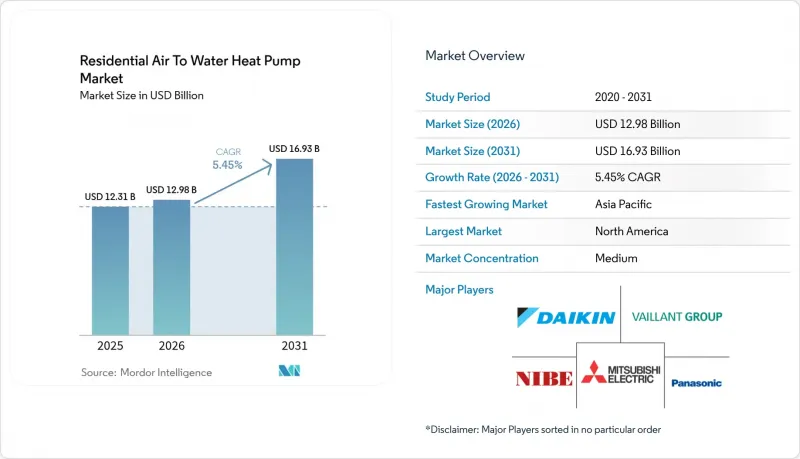
預計住宅空氣冷卻式熱泵熱水和供暖系統的市場規模將從 2025 年的 123.1 億美元成長到 2026 年的 129.8 億美元,然後從 2026 年到 2031 年以 5.45% 的複合年成長率成長,到 2031 年達到 169.3 億美元。
本報告按類型(分離式空調、一體式空調、一體式空調等)、製冷量(小於10千瓦、10-20千瓦、大於10千瓦)、製冷劑(R410A、R32等)、應用領域(獨棟住宅、多用戶住宅)、安裝類型(新建、維修/更換)和地區進行分類。市場預測以美元計價。
全球住宅冷卻式熱泵熱水和暖氣系統市場趨勢及洞察
歐盟範圍內禁止使用石化燃料鍋爐,正加速熱泵的維修。
從2025年開始,住宅將強制逐步淘汰燃氣鍋爐,到2040年將推廣至所有替換房屋,這項政策消除了關於推薦熱水供暖解決方案的剩餘不確定性。這項嚴格的截止日期將鞏固未來幾十年對空氣源熱泵的需求,因為空氣源熱泵可以透過現有散熱器實現較高的出水溫度。在荷蘭等市場,高達30%的安裝成本補貼正在增加住宅的經濟效益。如今,可預測的監管合規時間表不再是零星的獎勵,而是指導原始設備製造商(OEM)的生產力計畫和分銷商的庫存水準。此外,由於燃氣鍋爐更換的年度碳排放稅更高,該政策縮短了投資回收期。這些因素共同推動了住宅空氣源熱泵市場在歐洲成為「預設技術」。
受烏克蘭局勢影響,天然氣價格波動加劇了歐洲各地天然氣總擁有成本(TCO)的差距。
與2022年之前的平均值相比,西北歐的現貨天然氣價格已上漲三倍,顯著提高了熱泵的生命週期成本優勢。政府分析顯示,德國家庭改用熱泵後,每年的暖氣成本最多可降低60%。對於先前將熱泵視為「環保奢侈品」的中等收入住宅而言,這樣的節省尤其具有吸引力。這種價格波動是結構性的,而非週期性的,因為歐盟能源政策旨在永久減少對管道天然氣的依賴,並實現能源多元化。這一趨勢正在逐年增強住宅空氣源熱泵市場的比較優勢。
在歐盟人口稠密的郊區,電網容量限制導致併網延遲。
電力線路當初建設時假設電氣化率較低,但隨著6-10千瓦機組在整個電網中的安裝,其尖峰負載正急劇增加。德國每年50萬台機組的安裝目標可能會讓冬季高峰用電需求高達10吉瓦,迫使電力公司優先考慮併網。農村地區的併網成本超過每戶1,200歐元,而都市區的併網成本相對較低。這種成本差異將減緩電網容量有限地區住宅空冷式熱泵供暖和熱水系統的初期普及,直到電網升級改造工程跟上需求為止。
細分市場分析
到2025年,分離式空調將佔總銷售量的41.35%,因為安裝商優先考慮與傳統鍋爐迴路類似的熟悉配置佈局。這種主導地位意味著分離式空調在住宅空冷式熱泵熱水和暖氣系統市場佔據了相當大的佔有率。然而,結合了熱泵和鍋爐的混合式機組正以8.83%的複合年成長率快速成長,這主要得益於家庭在極端寒冷天氣下對備用燃燒設備的需求不斷成長。此細分市場的成長反映的是消費者規避風險的心理,而非技術上的必要性,因為最新的R290型號即使在-20°C的環境溫度下也能保持65°C的熱水。由於現場數據顯示純熱泵的可靠性,對混合式產品的需求可能會趨於平穩。一體式和多合一機組適用於安裝空間有限的維修項目,從而擴大了住宅空冷式熱泵熱水和加熱系統市場的應用範圍。
分離式產品由於大規模生產降低了硬體成本,因此維持了入門級產品的競爭力價格。而混合式產品雖然價格較高,但卻能提供安心保障等附加價值,尤其受到寒冷大陸性氣候地區消費者的青睞。原始設備製造商(OEM)正在將連網溫控器和智慧切換演算法捆綁銷售,以自動最佳化運行條件。這套軟體層使品牌之間形成差異化,並推動住宅空冷式熱泵熱水器和熱水系統產業轉型為以服務為中心的獲利模式。
2025年,功率低於10千瓦的機型佔總裝機量的54.30%,非常適合典型的獨棟住宅。同時,功率超過20千瓦的機型以8.14%的複合年成長率(CAGR)位居榜首,這主要得益於多用戶住宅和豪華住宅開發商傾向於選擇集中式供暖系統。到2031年,這種成長動能可望使20千瓦以上機型在住宅空冷式熱泵熱水和暖氣系統中的市場佔有率增加一倍。威斯曼(Wiesmann)的40千瓦Vitocal 250-A PRO機型展示了高功率丙烷機組如何滿足老舊建築對高散熱器溫差( Delta )的需求。
10-20千瓦級的系統彌合了郊區獨棟住宅和小規模多用戶住宅之間的差距。在碳排放法規日益嚴格的背景下,法國、義大利和加拿大部分地區的這一中等容量範圍正在迅速擴張。隨著流體溫度升高至攝氏70度C,不同容量範圍之間的界線變得模糊,引發了人們對未來市場細分合理性的質疑。然而,由於安裝流程、冷媒充填量限制和電網連接配置等方面的顯著差異,這些容量範圍在住宅用空冷式熱泵熱水和暖氣系統市場中仍然是重要的分類標準。
區域分析
由於其完善的熱水管道基礎設施和積極的碳排放政策,預計到2025年,歐洲將佔全球銷售額的33.60%。然而,宏觀經濟逆風和監管不確定性導致2024年銷售額下降了22%。法國和義大利對國家補貼計畫的審查嚴重影響了消費者信心,凸顯了住宅空冷式熱泵熱水和暖氣系統市場對政策的敏感度。儘管如此,布魯塞爾方面仍設定了2030年歐洲累計安裝量達到6000萬套的目標,這比目前的水準有了顯著成長。
在北美,2024年下半年出貨量成長了15%,顯示出復甦跡象。聯邦和省級政府的補貼獎勵,在某些郵遞區號區域甚至高達1萬美元,正在推動住宅空氣冷卻式熱泵加熱和熱水系統市場的發展。在地採購規則正在重塑供應鏈。例如,肯塔基州新建的壓縮機廠預計將縮短30%的前置作業時間。加拿大各省正在擴大寒冷氣候區,加速蒸氣噴射壓縮機的研發,並提高寒冷草原地區的季節性能源效率。
亞太地區以7.82%的複合年成長率領先,主要得益於中國龐大的市場規模和不斷提高的電氣化率。 2024年,儘管出口訂單成長放緩,但預計國內製造商的出貨量仍將成長13%,凸顯了國內市場的強勁成長動能。中東市場雖然目前規模較小,但由於區域供冷業者正在維修其可逆式水循環環形回路系統以適應冬季運行,其成長率也達到了7.82%。日本和韓國的技術較為先進,但對多用戶住宅燃氣鍋爐根深蒂固的文化觀念是導致其在住宅空冷式熱泵熱水和供暖系統市場這一細分領域的普及速度相對緩慢的原因之一。
其他好處:
- Excel格式的市場預測(ME)表
- 3個月的分析師支持
目錄
第1章:引言
- 研究假設和市場定義
- 調查範圍
第2章:調查方法
第3章執行摘要
第4章 市場狀況
- 市場概覽
- 市場促進因素
- 歐盟範圍內禁止使用石化燃料鍋爐,正加速熱泵的過渡。
- 烏克蘭局勢引發的天然氣價格波動加劇了歐洲各地天然氣總擁有成本 (TCO) 的差距。
- 根據美國《通貨膨脹降低法案》,SEER 值超過 15 的熱泵可獲得退稅。
- 低全球暖化潛勢 (GWP) 的 R290/R32 機型更容易符合燃料排放分階段減量法規。
- 在零度以下的氣候條件下,變頻壓縮機正在提高季節性能係數(COP)。
- 屋頂光電發電市電平價促進了中國自用暖氣的普及
- 市場限制因素
- 在歐盟人口稠密的郊區,由於電網容量有限,網路連線會延誤。
- 由於熱水供暖系統熟練安裝人員短缺,人事費用不斷上漲。
- 都市區因噪音法規而對室外空調機組的安裝位置有所限制
- 東亞多用戶住宅消費者對燃氣鍋爐的偏好
- 價值供應鏈分析
- 監理展望
- 技術展望
- 波特五力分析
- 新冠疫情對熱泵產業的影響
第5章 市場規模與成長預測
- 按類型
- 分離式系統
- 單體系統
- 一體化整合型
- 混合式(熱泵+鍋爐)
- 按容量(千瓦)
- 小於10千瓦
- 10~20 kW
- 超過20千瓦
- 透過冷媒
- R410A
- R32
- R290(丙烷)
- CO2(R744)
- 透過使用
- 獨立式住宅
- 多用戶住宅
- 按安裝類型
- 新建工程
- 改裝/更換
- 按地區
- 北美洲
- 美國
- 加拿大
- 墨西哥
- 南美洲
- 巴西
- 阿根廷
- 其他南美國家
- 歐洲
- 德國
- 法國
- 義大利
- 英國
- 西班牙
- 其他歐洲國家
- 中東
- UAE
- 沙烏地阿拉伯
- 土耳其
- 其他中東國家
- 非洲
- 南非
- 埃及
- 奈及利亞
- 其他非洲國家
- 亞太地區
- 中國
- 日本
- 韓國
- 澳洲
- 印度
- 其他亞太國家
- 北美洲
第6章 競爭情勢
- 市場集中度
- 策略趨勢
- 市佔率分析
- 公司簡介
- Daikin Industries Ltd
- Mitsubishi Electric Corp.
- Panasonic Corp.
- Vaillant Group
- NIBE Industrier AB
- Ariston Thermo SpA
- Viessmann Climate Solutions
- Bosch Thermotechnology
- Carrier Global Corp.
- LG Electronics Inc.
- Samsung Electronics Co.
- Stiebel Eltron GmbH
- Glen Dimplex Group
- Hitachi Heat Pump Systems
- Gree Electric Appliances
- Midea Group Co.
- Ferroli SpA
- Baxi Heating(BDR Thermea)
- Clivet SpA
- Swegon Group AB
- AO Smith Corp.
- Johnson Controls International
- Danfoss A/S
- Thermia Heat Pumps
第7章 市場機會與未來展望
According to Mordor Intelligence, the residential air-to-water heat pump market size is expected to grow from USD 12.31 billion in 2025 to USD 12.98 billion in 2026 and is forecast to reach USD 16.93 billion by 2031 at 5.45% CAGR over 2026-2031.
This report is Segmented by Type (Split Systems, Monobloc Systems, All-In-One Integrated, and More), Capacity (Less Than 10 KW, 10 - 20 KW, and More), Refrigerant (R410A, R32, and More), Application (Single, Multi-Family Residences), Installation Type (New Construction, Retrofit/Replacement), and Geography. The Market Forecasts are Provided in Terms of Value (USD).
Global Residential Air To Water Heat Pump Market Trends and Insights
EU-wide ban on fossil-fuel boilers accelerating heat-pump retrofits
Mandatory phase-outs that start in 2025 for new homes and extend to replacements by 2040 remove any remaining ambiguity over the preferred hydronic heating solution. This hard deadline locks in multi-decade demand for air-to-water units able to deliver high flow temperatures via existing radiators. Subsidies covering up to 30% of installed cost in markets such as the Netherlands sweeten the economics for homeowners. Instead of sporadic incentive spikes, a predictable compliance calendar now guides OEM capacity planning and distributor stocking levels. The policy also shortens payback periods because gas-boiler replacements face higher carbon levies each year. Taken together, the measure pushes the residential air to water heat pump market toward default-technology status across Europe.
Post-Ukraine gas-price volatility widening TCO gap in Europe
Spot gas prices across northwest Europe ran three times above the pre-2022 average, tilting lifetime costs sharply in favor of heat pumps. Government analysis shows German households can cut annual heating bills by up to 60% after switching. Such savings resonate with middle-income owners who previously viewed heat pumps as a green luxury. Volatility is structural, not cyclical, because EU energy policy seeks permanent diversification away from pipeline gas. That dynamic deepens the comparative advantage of the residential air to water heat pump market every winter.
Grid-capacity caps delaying hook-ups in dense EU suburbs
Distribution feeders built for low electrification levels face sharp peak-load jumps as entire streets add 6-10 kW units. Germany's 500,000-unit annual target could raise peak winter demand by 10 GW, forcing utilities to triage connections. Rural tie-in fees climb above EUR 1,200 per dwelling, while urban districts fare better. This mismatch slows early-stage volumes for the residential air to water heat pump market in grid-constrained neighbourhoods until reinforcement work catches up.
Other drivers and restraints analyzed in the detailed report include:
- US Inflation Reduction Act rebates for >= 15 SEER heat pumps
- Low-GWP R290 / R32 models easing F-Gas phase-down compliance
- Shortage of hydronic-skilled installers inflating labor cost
For complete list of drivers and restraints, kindly check the Table Of Contents.
Segment Analysis
Split units held 41.35% of revenue in 2025 as installers value familiar component layouts that mirror legacy boiler circuits. That dominance translates into a sizeable slice of the residential air to water heat pump market. Hybrid pump-and-boiler packages, however, are racing ahead at a 8.83% CAGR as households want backup combustion during polar cold snaps. The segment's growth reflects behavioral risk aversion more than technical necessity, because modern R290 models sustain 65 °C supply water at -20 °C ambient. Over time, as field data validates pure-pump reliability, hybrid appeal is likely to plateau. Monobloc and all-in-one variants court space-constrained retrofits, adding useful breadth to this residential air to water heat pump market.
Split offerings benefit from mass-production economics that compress hardware costs, keeping entry prices competitive. Conversely, hybrids command premium pricing but deliver perceived peace of mind, a value proposition resonating in cold continental climates. OEMs are bundling connected thermostats and intelligent switchover algorithms to optimize operating points automatically. This software layer differentiates brands and nudges the residential air to water heat pump industry toward service-centric revenue streams.
< 10 kW units represented 54.30% of installs in 2025, a natural fit for typical detached homes. At the other end, >20 kW machines posted the quickest 8.14% CAGR as developers of multi-dwelling blocks and luxury residences opt for central plants. That surge means the > 20 kW slice of the residential air to water heat pump market size could double by 2031. Viessmann's 40 kW Vitocal 250-A PRO illustrates how high-output propane units tackle older buildings where radiator delta-T demands are high.
Systems in the 10-20 kW tier bridge suburban villas and small apartment houses. As carbon caps tighten, this mid-range is broadening fastest in France, Italy and parts of Canada. With flow temperatures climbing to 70 °C, the capacity brackets converge, raising questions about future segmentation relevance. Nevertheless, installer workflows, refrigerant charge limits and grid-connection forms still differ enough to keep the capacity bands meaningful within the residential air to water heat pump market.
Complete Report Scope:
- By Type
- Split Systems
- Monobloc Systems
- All-in-One Integrated
- Hybrid (HP + Boiler)
- By Capacity (kW)
- Less than 10 kW
- 10 - 20 kW
- Greater than 20 kW
- By Refrigerant
- R410A
- R32
- R290 (Propane)
- CO2 (R744)
- By Application
- Single-Family Homes
- Multi-Family Residences
- By Installation Type
- New Construction
- Retrofit / Replacement
- By Geography
- North America
- United States
- Canada
- Mexico
- South America
- Brazil
- Argentina
- Rest of South America
- Europe
- Germany
- France
- Italy
- United Kingdom
- Spain
- Rest of Europe
- Middle East
- UAE
- Saudi Arabia
- Turkey
- Rest of Middle East
- Africa
- South Africa
- Egypt
- Nigeria
- Rest of Africa
- Asia-Pacific
- China
- Japan
- South Korea
- Australia
- India
- Rest of Asia-Pacific
- North America
Geography Analysis
Europe retained 33.60% of global revenue in 2025 thanks to dense hydronic infrastructure and aggressive carbon policy. Nevertheless, macro headwinds and regulatory ambiguity shaved 22% off unit sales during 2024. National subsidy resets in France and Italy weighed on consumer sentiment, illustrating policy sensitivity inside the residential air to water heat pump market. Still, Brussels sees 60 million cumulative European installs as a 2030 milestone, implying a steep climb from today's base.
North America rebounded late-2024 with a 15% jump in shipments. Federal and state rebate stacks have pushed total incentives toward USD 10,000 in some ZIP codes, driving momentum in the residential air to water heat pump market. Local content rules are re-shaping supply chains; for example, the new Kentucky compressor plant will cut lead times by 30%. Canadian provinces add cold-climate tiers that spur R&D on vapor-injection compressors, raising seasonal efficiencies in frigid Prairies.
Asia-Pacific posts the fastest 7.82% CAGR led by China's scale and rising electrification quotas. Domestic producers shipped 13% more units in 2024, even as export orders softened, highlighting robust internal momentum. The Middle East, while small today, matches that 7.82% growth rate as district-cooling operators retrofit reversible water-loop systems for winter service. Japan and South Korea remain technologically advanced but culturally attached to gas boilers in multi-family blocks, explaining a more modest uptake pace in that slice of the residential air to water heat pump market.
- Daikin Industries Ltd
- Mitsubishi Electric Corp.
- Panasonic Corp.
- Vaillant Group
- NIBE Industrier AB
- Ariston Thermo SpA
- Viessmann Climate Solutions
- Bosch Thermotechnology
- Carrier Global Corp.
- LG Electronics Inc.
- Samsung Electronics Co.
- Stiebel Eltron GmbH
- Glen Dimplex Group
- Hitachi Heat Pump Systems
- Gree Electric Appliances
- Midea Group Co.
- Ferroli SpA
- Baxi Heating ( BDR Thermea )
- Clivet SpA
- Swegon Group AB
- A.O. Smith Corp.
- Johnson Controls International
- Danfoss A/S
- Thermia Heat Pumps
Additional Benefits:
- The market estimate (ME) sheet in Excel format
- 3 months of analyst support
TABLE OF CONTENTS
1 INTRODUCTION
- 1.1 Study Assumptions and Market Definition
- 1.2 Scope of the Study
2 RESEARCH METHODOLOGY
3 EXECUTIVE SUMMARY
4 MARKET LANDSCAPE
- 4.1 Market Overview
- 4.2 Market Drivers
- 4.2.1 EU-wide ban on fossil-fuel boilers accelerating heat-pump retrofits
- 4.2.2 Post-Ukraine gas-price volatility widening TCO gap in Europe
- 4.2.3 U.S. Inflation Reduction Act rebates for greater than 15 SEER heat pumps
- 4.2.4 Low-GWP R290 / R32 models easing F-Gas Phase-Down compliance
- 4.2.5 Inverter compressors lifting seasonal COP in sub-zero climates
- 4.2.6 Rooftop solar parity unlocking self-consumption heating in China
- 4.3 Market Restraints
- 4.3.1 Grid-capacity caps delaying hook-ups in dense EU suburbs
- 4.3.2 Shortage of hydronic-skilled installers inflating labor cost
- 4.3.3 Urban noise-regulation setbacks on outdoor-unit placement
- 4.3.4 Consumer preference for gas boilers in East-Asian multi-family
- 4.4 Value / Supply-Chain Analysis
- 4.5 Regulatory Outlook
- 4.6 Technological Outlook
- 4.7 Porter's Five Forces Analysis
- 4.7.1 Bargaining Power of Suppliers
- 4.7.2 Bargaining Power of Consumers
- 4.7.3 Threat of New Entrants
- 4.7.4 Threat of Substitutes
- 4.7.5 Intensity of Competitive Rivalry
- 4.8 Impact of COVID-19 on the Heat-Pump Industry
5 MARKET SIZE AND GROWTH FORECASTS (VALUE)
- 5.1 By Type
- 5.1.1 Split Systems
- 5.1.2 Monobloc Systems
- 5.1.3 All-in-One Integrated
- 5.1.4 Hybrid (HP + Boiler)
- 5.2 By Capacity (kW)
- 5.2.1 Less than 10 kW
- 5.2.2 10 - 20 kW
- 5.2.3 Greater than 20 kW
- 5.3 By Refrigerant
- 5.3.1 R410A
- 5.3.2 R32
- 5.3.3 R290 (Propane)
- 5.3.4 CO2 (R744)
- 5.4 By Application
- 5.4.1 Single-Family Homes
- 5.4.2 Multi-Family Residences
- 5.5 By Installation Type
- 5.5.1 New Construction
- 5.5.2 Retrofit / Replacement
- 5.6 By Geography
- 5.6.1 North America
- 5.6.1.1 United States
- 5.6.1.2 Canada
- 5.6.1.3 Mexico
- 5.6.2 South America
- 5.6.2.1 Brazil
- 5.6.2.2 Argentina
- 5.6.2.3 Rest of South America
- 5.6.3 Europe
- 5.6.3.1 Germany
- 5.6.3.2 France
- 5.6.3.3 Italy
- 5.6.3.4 United Kingdom
- 5.6.3.5 Spain
- 5.6.3.6 Rest of Europe
- 5.6.4 Middle East
- 5.6.4.1 UAE
- 5.6.4.2 Saudi Arabia
- 5.6.4.3 Turkey
- 5.6.4.4 Rest of Middle East
- 5.6.5 Africa
- 5.6.5.1 South Africa
- 5.6.5.2 Egypt
- 5.6.5.3 Nigeria
- 5.6.5.4 Rest of Africa
- 5.6.6 Asia-Pacific
- 5.6.6.1 China
- 5.6.6.2 Japan
- 5.6.6.3 South Korea
- 5.6.6.4 Australia
- 5.6.6.5 India
- 5.6.6.6 Rest of Asia-Pacific
- 5.6.1 North America
6 COMPETITIVE LANDSCAPE
- 6.1 Market Concentration
- 6.2 Strategic Moves
- 6.3 Market Share Analysis
- 6.4 Company Profiles {(includes Global level Overview, Market level Overview, Core Segments, Financials, Strategic Information, Market Rank/Share, Products and Services, Recent Developments)}
- 6.4.1 Daikin Industries Ltd
- 6.4.2 Mitsubishi Electric Corp.
- 6.4.3 Panasonic Corp.
- 6.4.4 Vaillant Group
- 6.4.5 NIBE Industrier AB
- 6.4.6 Ariston Thermo SpA
- 6.4.7 Viessmann Climate Solutions
- 6.4.8 Bosch Thermotechnology
- 6.4.9 Carrier Global Corp.
- 6.4.10 LG Electronics Inc.
- 6.4.11 Samsung Electronics Co.
- 6.4.12 Stiebel Eltron GmbH
- 6.4.13 Glen Dimplex Group
- 6.4.14 Hitachi Heat Pump Systems
- 6.4.15 Gree Electric Appliances
- 6.4.16 Midea Group Co.
- 6.4.17 Ferroli SpA
- 6.4.18 Baxi Heating ( BDR Thermea )
- 6.4.19 Clivet SpA
- 6.4.20 Swegon Group AB
- 6.4.21 A.O. Smith Corp.
- 6.4.22 Johnson Controls International
- 6.4.23 Danfoss A/S
- 6.4.24 Thermia Heat Pumps
7 MARKET OPPORTUNITIES AND FUTURE OUTLOOK
- 7.1 White-Space and Unmet-Need Assessment

 2026-2030年全球住宅A2W熱泵市場
 住宅熱泵市場 - 全球產業規模、佔有率、趨勢、機會、預測:按類型、容量、地區和競爭格局分類,2021-2031年
 住宅Wi-Fi供應商的市場佔有率
 2026年全球住宅熱泵市場報告
 全球住宅熱泵產業,2024-2035