


 |
市場調查報告書
商品編碼
2124499
歐洲智慧停車:市場佔有率分析、產業趨勢與統計及成長預測(2026-2031)Europe Smart Parking - Market Share Analysis, Industry Trends & Statistics, Growth Forecasts (2026 - 2031) |
||||||

※ 本網頁內容可能與最新版本有所差異。詳細情況請與我們聯繫。
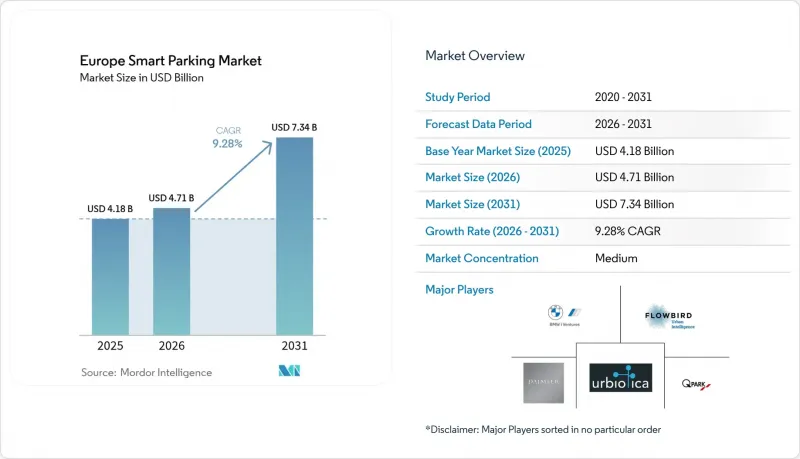
根據 Mordor Intelligence 預測,歐洲智慧停車市場規模預計將在 2025 年達到 41.8 億美元,2026 年達到 47.1 億美元,到 2031 年達到 73.4 億美元,2026 年至 2031 年的複合年成長率為 9.28%。
本報告按供應商類型(停車場營運商、停車管理公司、基礎設施供應商等)、解決方案(硬體、軟體、服務)、技術(地下和超音波感測器、具備電動車充電功能的停車場等)、最終用戶(市政當局、政府機構、交通樞紐等)和地區進行細分。市場預測以價值(美元)表示。
歐洲智慧停車市場的趨勢與洞察
電動車導致停車位短缺
到2024年,註冊的電池式電動車(BEV)數量將超過100萬輛,公共充電站數量也將超過100萬輛,分析師預測到2030年這一數字將翻倍。這將迫使營運商對其設施維修,需要增加電力容量、安裝管道並整合支付系統。根據《替代燃料基礎設施條例》,所有成員國都必須在2030年前為每10輛電動車安裝一個公共充電樁,將停車場轉變為分散式能源樞紐。像E.ON這樣的能源公司已為充電網路累計400億歐元(452億美元),目前正與汽車製造商合作試飛V2G(車輛到電網)服務。雖然這些措施正在創造新的收入來源,但也帶來了營運上的複雜性,因為停車場管理人員必須遵守計量法規並管理尖峰時段的收費。整合停車和充電數據的市政當局可以實現氣候目標,利用堵塞收費系統的協同效應,並將電動車專用停車位定位為優質地段。
行動支付和停車應用程式的興起
疫情期間,非接觸式支付迅速普及。到2025年,英國非接觸式停車費的普及率將達到81%,絕大多數用戶更傾向使用車用或智慧型手機支付。 EasyPark系統預計到2025年將在4000個城市處理超過2.5億次停車交易,這標誌著停車方式正從投幣式停車計時器向提供詳細使用數據的數位化支付方式發生顯著轉變。簽帳金融卡和信用卡分別將交易手續費上限設定為0.2%和0.3%,降低了即使是小規模的市政當局實施卡片付款系統的成本門檻。此外,行動應用程式還支援即時推播通知、與出行獎勵計劃整合以及動態定價試驗——這些都是固定式自助繳費機無法實現的功能。隨著路邊停車管理向數據主導發展,使用數位化支付的企業可以獲得更深入的洞察,從而最佳化定價並縮短尋找停車位的時間,進而有助於改善人口密集城區空氣品質。
初始感測器和土木工程成本
市政當局為每個停車位安裝地下感測器(包括挖掘、佈線和回程傳輸連接)花費 300 至 500 美元。這筆費用阻礙了停車收入有限的小規模城市採用智慧停車系統。捷克一項使用 3676 個感測器的試點計畫顯示,平均電池壽命僅五年多一點,這對融資拮据的市政當局來說無疑是一筆持續的開支。在歷史保護區,由於需要考古監督和在挖掘過程中遵守嚴格的修復標準,成本進一步增加。基於攝影機的系統雖然降低了土木工程成本,但會產生更高的許可費和資料隱私合規成本。由於缺乏外部津貼或績效資金籌措,許多市政當局選擇分階段更換停車計時器,而不是全面實施智慧停車系統,減緩了智慧停車系統的整體普及速度。
細分市場分析
複合年成長率 (CAGR) 達 11.02%,成長最快。這種快速成長正在蠶食停車業者在 2025 年所佔的 39.87% 的市場佔有率,並加劇了依賴固定價格和長期合約的特許經營業者的壓力。 JustPark、ParkBee 和 Parclick 等平台憑藉著即時車位資訊、透明定價和會員獎勵等優勢,打造了傳統現金支付或自助繳費機無法實現的無縫用戶體驗,極具吸引力。因此,歐洲智慧停車市場的格局正朝著數據驅動型平台轉變,這些平台無需實體建設即可跨國拓展業務。
停車場營運商在機場和市中心停車領域仍然保持著戰略優勢,但對其應用程式進行現代化改造、實施動態定價以及與電動車充電網路合作對於維持盈利能力至關重要。隨著市政當局強制要求開放數據,堅持使用專有系統的營運商將面臨被出行即服務 (MaaS) 聚合商淘汰的風險。 P2P 平台仍面臨諸如分區、保險和稅收等障礙,但隨著這些框架的成熟,其低資本密集度將使其在歐洲智慧停車市場保持成長的前沿地位。
預計到2031年,託管服務將以10.14%的複合年成長率成長。這反映出市政當局對基於績效的合約的需求,這種合約將與運作和數據準確性相關的風險轉移給了供應商。包含軟體授權、感測器維護和分析儀表板在內的捆綁包,有助於預算緊張的市政當局將巨額資本投資轉化為可預測的營運成本。到2025年,軟體將佔歐洲智慧停車市場佔有率的44.91%,這表明該行業正在從以硬體為中心的部署轉向整合即時可用性數據並支援API連接的雲端原生平台。
儘管硬體仍然至關重要,但隨著感測器價格下降和多廠商互通性成為標準,硬體正逐漸商品化。服務公司透過快速部署、KPI保障和整合專業知識脫穎而出,使市政管理人員無需聘請內部資料科學家即可滿足監管期限要求。隨著越來越多的市政當局採用基於績效的競標,能夠提供從部署到服務結束的全面支持的供應商在歐洲智慧停車市場中佔據優勢,有望獲得持續的收入。
其他好處:
- Excel格式的市場預測(ME)表
- 3個月的分析師支持
目錄
第1章:引言
- 研究假設和市場定義
- 調查範圍
第2章:調查方法
第3章執行摘要
第4章 市場狀況
- 市場概覽
- 市場促進因素
- 電動車導致停車位短缺
- 行動支付和停車應用程式的開發
- 歐盟智慧城市資金支持旅遊即服務(MaaS)試點項目
- 企業範圍 3 脫碳目標
- 根據修訂後的智慧交通系統指令,歐盟有資料共用義務
- 「15分鐘城市」分區規劃正在加速人行道建設的改革。
- 市場限制因素
- 初始感測器和土木工程成本
- 分散式地方政府採購週期
- GDPR 下關於車牌自動辨識分析的規定
- 優先考慮電動車的路邊停車位減少,導致付費停車位減少。
- 宏觀經濟因素對市場的影響
- 監理情勢
- 技術展望
- 產業價值鏈分析
- 波特五力分析
- 產業生態系分析
- 案例研究,歐洲主要實施案例
- 投資分析
第5章 市場規模與成長預測
- 按提供者類型
- 停車場營運商
- 停車管理公司
- 基礎設施提供者(硬體和軟體)
- 點對點(P2P)停車平台
- 聚合器和市場
- 透過解決方案
- 硬體
- 軟體
- 服務
- 透過技術
- 探地感測器和超音波感測器
- 攝影機、電腦視覺和車牌自動識別
- 物聯網連接平台
- 行動應用和數位支付
- 電動車充電功能的停車
- 最終用戶
- 地方政府和政府
- 商業停車場和購物中心
- 交通樞紐(機場、鐵路)
- 企業園區及商務園區
- 住宅和混合用途開發
- 按地區
- 德國
- 英國
- 法國
- 西班牙
- 義大利
- 荷蘭
- 北歐的
- 其他歐洲國家
第6章 競爭情勢
- 市場集中度
- 策略舉措和趨勢
- 市佔率分析
- 公司簡介
- APCOA Parking Holdings GmbH
- EasyPark Group AB
- Indigo Group SA
- Q-Park NV
- Flowbird SASU
- Parkopedia Ltd.
- Urbiotica SL
- Cleverciti Systems GmbH
- JustPark Parking Ltd.
- Parclick SL
- ParkBee BV
- RingGo Ltd.
- Telpark(Empark Aparcamientos y Servicios SA)
- Parklio doo
- ParkHub Inc.
- FlashParking, Inc.
- ParkAir Systems AB
- Daimler Mobility
- Park+Mobility BV
- Bosch Service Solutions SE(Parking-as-a-Service)
- BMW i Ventures(ParkNow Heritage Assets)
第7章 市場機會與未來展望
According to Mordor Intelligence, the Europe smart parking market size is projected to be USD 4.18 billion in 2025, USD 4.71 billion in 2026, and reach USD 7.34 billion by 2031, growing at a CAGR of 9.28% from 2026 to 2031.
This report is Segmented by Provider Type (Parking Operators, Parking Management Companies, Infrastructure Providers, and More), Solution (Hardware, Software, and Services), Technology (In-Ground and Ultrasonic Sensors, EV-Charging Integrated Parking, and More), End-User (Municipalities and Government, Transport Hubs, and More), and Geography. The Market Forecasts are Provided in Terms of Value (USD).
Europe Smart Parking Market Trends and Insights
EV-Driven Parking Space Stress
Battery-electric vehicle registrations passed 1 million public charging points in 2024, and analysts see that figure doubling by 2030, forcing operators to retrofit facilities with power upgrades, conduit, and payment integration. The Alternative Fuels Infrastructure Regulation compels every member state to provide one public charger for every 10 EVs by 2030, converting parking areas into distributed energy nodes. Energy utilities such as E.ON have earmarked EUR 40 billion (USD 45.2 billion) for charging networks and are now piloting vehicle-to-grid services with automotive OEMs. These initiatives create fresh revenue streams but introduce operational complexity as parking managers must comply with metering rules and manage peak-tariff exposure. Municipalities that blend parking and charging data can unlock congestion-pricing synergies while meeting climate targets, positioning EV-ready bays as premium real estate.
Rise of Mobile Payments and Parking Apps
Contactless transactions became mainstream during the pandemic, and by 2025 the United Kingdom recorded 81% penetration for parking fees, with most users preferring in-car or smartphone payments. EasyPark processed more than 250 million parking sessions across 4,000 cities in 2025, highlighting the shift from coin-operated meters to digital sessions that capture granular occupancy data. Interchange-fee caps, 0.2% for debit and 0.3% for credit, lowered the cost barrier for small municipalities to adopt card-based systems . Mobile apps also enable real-time push notifications, bundled mobility rewards, and dynamic pricing experiments that were impossible with static kiosks. As curb management becomes data-rich, operators leveraging digital payments gain insights to calibrate tariffs and reduce cruising time, improving air quality in dense urban cores
Up-Front Sensor and Civil-Works Costs
Municipalities spend USD 300-500 per bay to install in-ground sensors, covering excavation, cabling, and backhaul connectivity, a burden that deters smaller cities with modest parking revenues. A Czech pilot using 3,676 sensors showed an average lifespan of just over five years before battery replacement, adding a recurring outlay for cash-strapped councils. Heritage zones further inflate costs because trenching requires archaeological supervision and adherence to strict restoration codes. Camera-based systems lower civil-works outlays but carry higher licensing fees and data-privacy compliance costs. Without external grants or outcome-based financing, many towns choose incremental meter upgrades rather than full smart-parking rollouts, slowing overall penetration.
Other drivers and restraints analyzed in the detailed report include:
- EU Smart-City Funding for MaaS Pilots
- Corporate Scope-3 Decarbonization Targets
- Fragmented Municipal Procurement Cycles
For complete list of drivers and restraints, kindly check the Table Of Contents.
Segment Analysis
Peer-to-peer players recorded the fastest growth trajectory, with an 11.02% projected CAGR through 2031, as asset-light models monetize idle residential driveways and off-peak office lots. This surge is eating into the 39.87% share parking operators held in 2025, pressuring concessionaires that rely on fixed tariffs and long-term contracts. Marketplaces such as JustPark, ParkBee, and Parclick advertise real-time availability, transparent pricing, and loyalty perks, creating a seamless user journey that traditional cash or kiosk environments cannot match. The Europe smart parking market is therefore witnessing a power shift toward data-driven platforms that can scale across borders without laying concrete.
Parking operators retain strategic advantages in airports and city-center garages, yet they must modernize apps, embed dynamic pricing, and partner with EV-charging networks to defend margins. As municipalities mandate open data, operators that cling to proprietary systems risk being sidelined in MaaS aggregators. Peer-to-peer hosts still navigate zoning, insurance, and tax hurdles, but once these frameworks mature, their low capital intensity will keep them at the growth frontier of the Europe smart parking market.
Managed services are forecast to expand at a 10.14% CAGR to 2031, reflecting municipal appetite for outcome-based contracts that shift uptime and data-accuracy risk to vendors. Bundled packages that include software licenses, sensor maintenance, and analytics dashboards help budget-constrained cities convert large capital outlays into predictable operating expenses. Software already held 44.91% of Europe smart parking market share in 2025, illustrating the sector's pivot from hardware-centric deployments to cloud-native platforms that aggregate real-time occupancy feeds and support API connectivity.
Hardware remains critical but is inching toward commoditization as sensor prices fall and multi-vendor interoperability becomes the norm. Services firms differentiate through rapid deployment, KPI guarantees, and integration expertise, enabling city managers to meet regulatory timelines without hiring in-house data scientists. As more municipalities adopt performance-based tenders, vendors offering cradle-to-grave support are well positioned to capture recurring revenue in the Europe smart parking market.
Complete Report Scope:
- By Provider Type
- Parking Operators
- Parking Management Companies
- Infrastructure Providers (HW and SW)
- Peer-to-Peer (P2P) Parking Platforms
- Aggregators and Marketplaces
- By Solution
- Hardware
- Software
- Services
- By Technology
- In-Ground and Ultrasonic Sensors
- Camera and Computer-Vision and ANPR
- IoT Connectivity Platforms
- Mobile Apps and Digital Payments
- EV-Charging Integrated Parking
- By End-User
- Municipalities and Government
- Commercial Car-Parks and Malls
- Transport Hubs (Airports, Rail)
- Corporate Campuses and Business Parks
- Residential and Mixed-Use Developments
- By Region
- Germany
- United Kingdom
- France
- Spain
- Italy
- Netherlands
- Nordics
- Rest of Europe
List of Companies Covered in this Report:
- APCOA Parking Holdings GmbH
- EasyPark Group AB
- Indigo Group S.A.
- Q-Park NV
- Flowbird SASU
- Parkopedia Ltd.
- Urbiotica SL
- Cleverciti Systems GmbH
- JustPark Parking Ltd.
- Parclick S.L.
- ParkBee B.V.
- RingGo Ltd.
- Telpark (Empark Aparcamientos y Servicios S.A.)
- Parklio d.o.o.
- ParkHub Inc.
- FlashParking, Inc.
- ParkAir Systems AB
- Daimler Mobility
- Park+ Mobility B.V.
- Bosch Service Solutions SE (Parking-as-a-Service)
- BMW i Ventures (ParkNow Heritage Assets)
Additional Benefits:
- The market estimate (ME) sheet in Excel format
- 3 months of analyst support
TABLE OF CONTENTS
1 INTRODUCTION
- 1.1 Study Assumptions and Market Definition
- 1.2 Scope of the Study
2 RESEARCH METHODOLOGY
3 EXECUTIVE SUMMARY
4 MARKET LANDSCAPE
- 4.1 Market Overview
- 4.2 Market Drivers
- 4.2.1 EV-Driven Parking Space Stress
- 4.2.2 Rise of Mobile Payments and Parking Apps
- 4.2.3 EU Smart-City Funding for MaaS Pilots
- 4.2.4 Corporate Scope-3 Decarbonization Targets
- 4.2.5 EU Data-Sharing Mandates Under Revised ITS Directive
- 4.2.6 15-Minute-City Zoning Accelerating Curb Reforms
- 4.3 Market Restraints
- 4.3.1 Up-Front Sensor and Civil-Works Costs
- 4.3.2 Fragmented Municipal Procurement Cycles
- 4.3.3 GDPR-Driven Restrictions on ANPR Analytics
- 4.3.4 EV-First Kerb Allocation Shrinking Paid Bays
- 4.4 Impact of Macroeconomic Factors on the Market
- 4.5 Regulatory Landscape
- 4.6 Technological Outlook
- 4.7 Industry Value Chain Analysis
- 4.8 Porter's Five Forces Analysis
- 4.8.1 Bargaining Power of Suppliers
- 4.8.2 Bargaining Power of Buyers
- 4.8.3 Threat of New Entrants
- 4.8.4 Threat of Substitutes
- 4.8.5 Intensity of Competitive Rivalry
- 4.9 Industry Ecosystem Analysis
- 4.10 Case Studies, Flagship European Deployments
- 4.11 Investment Analysis
5 MARKET SIZE AND GROWTH FORECASTS (VALUE)
- 5.1 By Provider Type
- 5.1.1 Parking Operators
- 5.1.2 Parking Management Companies
- 5.1.3 Infrastructure Providers (HW and SW)
- 5.1.4 Peer-to-Peer (P2P) Parking Platforms
- 5.1.5 Aggregators and Marketplaces
- 5.2 By Solution
- 5.2.1 Hardware
- 5.2.2 Software
- 5.2.3 Services
- 5.3 By Technology
- 5.3.1 In-Ground and Ultrasonic Sensors
- 5.3.2 Camera and Computer-Vision and ANPR
- 5.3.3 IoT Connectivity Platforms
- 5.3.4 Mobile Apps and Digital Payments
- 5.3.5 EV-Charging Integrated Parking
- 5.4 By End-User
- 5.4.1 Municipalities and Government
- 5.4.2 Commercial Car-Parks and Malls
- 5.4.3 Transport Hubs (Airports, Rail)
- 5.4.4 Corporate Campuses and Business Parks
- 5.4.5 Residential and Mixed-Use Developments
- 5.5 By Region
- 5.5.1 Germany
- 5.5.2 United Kingdom
- 5.5.3 France
- 5.5.4 Spain
- 5.5.5 Italy
- 5.5.6 Netherlands
- 5.5.7 Nordics
- 5.5.8 Rest of Europe
6 COMPETITIVE LANDSCAPE
- 6.1 Market Concentration
- 6.2 Strategic Moves and Developments
- 6.3 Market Share Analysis
- 6.4 Company Profiles (includes Global Level Overview, Market Level Overview, Core Segments, Financials as available, Strategic Information, Market Rank/Share, Products and Services, Recent Developments)
- 6.4.1 APCOA Parking Holdings GmbH
- 6.4.2 EasyPark Group AB
- 6.4.3 Indigo Group S.A.
- 6.4.4 Q-Park NV
- 6.4.5 Flowbird SASU
- 6.4.6 Parkopedia Ltd.
- 6.4.7 Urbiotica SL
- 6.4.8 Cleverciti Systems GmbH
- 6.4.9 JustPark Parking Ltd.
- 6.4.10 Parclick S.L.
- 6.4.11 ParkBee B.V.
- 6.4.12 RingGo Ltd.
- 6.4.13 Telpark (Empark Aparcamientos y Servicios S.A.)
- 6.4.14 Parklio d.o.o.
- 6.4.15 ParkHub Inc.
- 6.4.16 FlashParking, Inc.
- 6.4.17 ParkAir Systems AB
- 6.4.18 Daimler Mobility
- 6.4.19 Park+ Mobility B.V.
- 6.4.20 Bosch Service Solutions SE (Parking-as-a-Service)
- 6.4.21 BMW i Ventures (ParkNow Heritage Assets)
7 MARKET OPPORTUNITIES AND FUTURE OUTLOOK
- 7.1 White-Space and Unmet-Need Assessment
- 7.2 Opportunity Hotspots
- 7.3 Strategic Roadmap for Stakeholders

 智慧停車系統市場機會、成長要素、產業趨勢分析及2026-2035年預測
 PaaS(停車即服務)市場:全球市場預測(2026-2032)智慧停車市場:按組件、停車類型、應用、部署方式和最終用戶分類-2026-2032年全球市場預測
 智慧停車市場預測至2034年—按組件、停車類型、部署模式、最終用戶和地區分類的全球分析超本地化停車租賃市場預測——全球分析(按空間類型、租賃期限、預訂方式、平台類型、技術、最終用戶和地區分類)——2034年超當地語系化智慧停車解決方案市場預測至2034年-全球分析(按組件、技術、解決方案類型、部署模式、應用、最終用戶和地區分類)
 2026年全球數位雙胞胎智慧停車系統市場報告2026年全球智慧停車系統市場報告
 智慧停車市場規模、佔有率、趨勢和預測:按系統、技術、組件、解決方案、產業、停車地點和地區分類,2026-2034 年
 智慧停車系統市場分析及預測(至2035年):按類型、產品、服務、技術、組件、應用、部署、最終用戶和解決方案分類