


 |
市場調查報告書
商品編碼
2124450
真空斷路器:市場佔有率分析、產業趨勢與統計、成長預測(2026-2031)Vacuum Interrupter - Market Share Analysis, Industry Trends & Statistics, Growth Forecasts (2026 - 2031) |
||||||

※ 本網頁內容可能與最新版本有所差異。詳細情況請與我們聯繫。
據 Mordor Intelligence 稱,真空斷路器市場預計到 2026 年價值 32.4 億美元,高於 2025 年的 30.7 億美元,預計到 2031 年將達到 42.2 億美元。
預計 2026 年至 2031 年的複合年成長率為 5.42%。
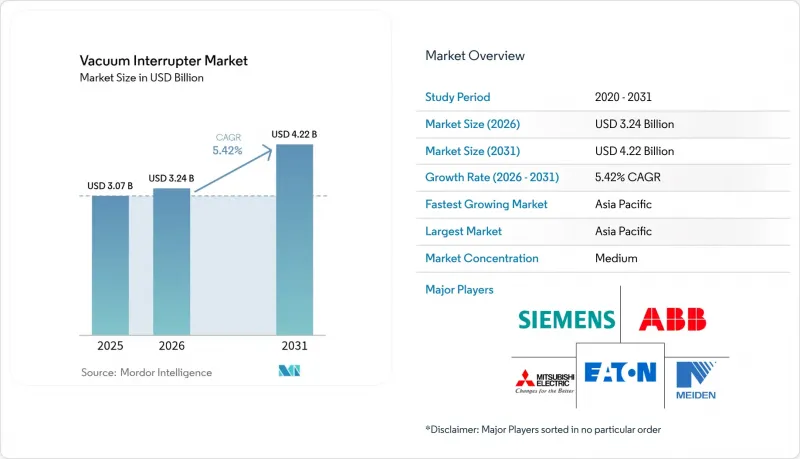
本報告按應用(斷路器、接觸器、重合器等)、電壓等級(15 kV、15.1–27 kV、27.1–38 kV 和 38 kV 及以上)、最終用戶行業(公共產業、工業、可再生能源和獨立發電商、商業和資料中心)、安裝類型(室內開關設備和室外安裝電線杆安裝)以及內部開關設備和室外安裝桿式安裝區域進行。
全球真空斷路器市場趨勢及洞察
智慧電網的部署和對中壓開關設備的需求。
分散式能源的快速成長對開關設備提出了更高的要求,使其能夠應對頻繁的帶載運作和瞬時故障隔離。因此,美國和西歐的電力公司優先採用基於真空斷路器的開關設備來實現先進的饋線自動化,這佔據了真空斷路器市場新訂單的很大一部分。在監管機構將停機時間與績效獎勵掛鉤,以及聯邦經濟獎勵策略用於增強電網韌性的地區,真空斷路器的應用正在加速。整合到現代斷路器中的數位感測器為電力公司提供了實現自癒網路所需的運作可視性,而免維護的真空裝置設計則降低了生命週期成本。這些優勢共同支撐了清晰的訂單前景,預計訂單量將持續到2028年,尤其是在15 kV至27 kV饋線電壓等級方面。
老舊輸配電基礎設施的更新
北美和歐洲的電力公司資產組合平均使用年限超過40年,其資產管理專案是真空斷路器市場的大規模採購來源。操作員在淘汰油浸式和SF6斷路器時,正轉向使用真空設備,以減少溫室氣體排放並降低維修車輛出勤次數。積壓的維護工作進一步延長了更換週期,而現有的多年資本支出計畫表明,2030年後對維修的需求仍然穩定。高壓多斷路斷路器設計在72千伏和145千伏變電站中日益普及,推高了平均售價,並加速了產品組合向高價值觸點材料合金的轉變。
額定電壓為 40 kV 或以上的設備單價較高
對於超過 40 kV 的電壓,該設計需要多個斷路間隙和先進的電壓級電容器,這使得資本投資成本達到單斷路設計的兩到三倍。拉丁美洲和非洲的電力公司對價格仍然非常敏感,並繼續使用傳統的空氣絕緣設備,減緩了真空斷路器市場高壓部分的銷售成長。儘管製造商正在亞洲新建工廠以實現規模經濟,但價格的顯著穩定可能要到 2029 年或更晚才能實現,而且預計這一阻礙因素將在整個預測期內持續存在。
細分市場分析
電路斷流器在真空斷路器市場中佔最大佔有率,預計2025年銷售額將佔35.62%。此類產品主要用於電力公司優先考慮電氣壽命長、維護頻率低的配電變電站。然而,隨著配電自動化日益普及,成長動能正轉向重合器,預計到2031年,重合器的複合年成長率將達到5.72%。電力公司正在屋頂太陽能發電和電動車充電設施所在的支線饋線中部署重合器,透過快速故障隔離和自動恢復供電來提高可靠性指標。先進的微處理器控制技術能夠實現適用於逆變器電源的多脈衝波形,使真空斷路器成為首選的滅弧核心。接觸器和負載隔離開關推動穩定的工業需求,主要來自水泥、金屬和煉油廠的馬達控制中心和電容器組切換應用。這些細分市場為整個真空斷路器市場提供了韌性,因為它們的訂單週期與一般工業資本投資一致。
重合閘運轉固有的高佔空比凸顯了真空接點相對於油浸式和SF6氣吹式接點的優勢,因為反覆跳脫會導致機械連接性能劣化。美國中西部一家電力公司的現場數據顯示,自採用真空設計以來,每個重合閘的維護次數減少了60%,直接降低了營運成本。這項證實的成本優勢支撐了供應商的訂單訂單,並推動了與真空斷路器芯體捆綁的軟體化饋線自動化解決方案的普及。因此,即使整體資本計畫保持不變,真空斷路器市場仍持續佔據不斷成長的饋線維修預算。
15.1 kV 至 27 kV 電壓等級仍是市場主力軍,預計 2025 年將佔總銷售量的 47.65%。配電級饋線和工業園區通常都採用此電壓等級,電力公司也傾向於選擇標準化的安裝面積,以便快速進行卡車上門更換。然而,38 kV 及以上電壓等級的成長最為迅速,這主要得益於可再生能源豐富的輸電線路走廊,其複合年成長率 (CAGR) 達到 6.21%。隨著 72 kV 和 145 kV 多斷路器原型在歐洲氣候試驗箱中介電強度測試的驗證,以及 252 kV 平台近期在 KEMA 實驗室通過短路測試,市場範圍正在不斷擴大。從 2031 年起,部分地區的電網法規將禁止在 145 kV 環網中引入新的 SF6 氣體絕緣設備,這將促使電網營運商加快向真空替代設備的過渡,從而擴大真空斷路器市場的高階產品線。
能夠承受高能量電弧的高精煉CuCr50接觸合金對於提升電壓等級至關重要。專利申請表明,採用奈米晶微結構可將陰極腐蝕降低35%,優於傳統配方。擁有此類合金的供應商具備定價權,且其收入往往更傾向於高壓產品。同時,15 kV以下電壓等級的斷路器市場,其主要客戶是商業建築和屋頂太陽能電站的配電盤製造商,由於銷售週期短,該市場在緩解週期性變化對電力公司資本預算的影響方面發揮著重要作用。整體而言,多樣化的電壓需求維持了真空斷路器市場均衡成長的趨勢。
區域分析
預計到2025年,亞太地區將佔全球銷售額的41.05%,年複合成長率達5.88%。這主要得益於中國國內電網的強化、印度本土化進程的加速以及東南亞城市軌道交通建設的進展。政府支持的製造業獎勵正在縮短國內電力公司的採購前置作業時間,提高該地區的電力自給率,並刺激本地需求。本土化在印度尤為顯著,該國基於績效的激勵機制可對國產開關設備提供高達出廠價4%的補貼,鼓勵跨國供應商與當地金屬封閉式配電盤製造商建立合資企業或簽署許可協議。
在北美,隨著使用超過40年的設備接近使用壽命終點,持續的更新換代投資正在興起。美國聯邦政府已撥款130億美元用於增強電網韌性,其中一部分資金正用於投資中壓斷路器。德克薩斯州、路易斯安那州和加州的極端天氣事件加速了分段立管和重合閘的部署,而維吉尼亞和俄亥俄州超大規模資料中心的集中則推動了私人資本投資。因此,儘管該地區真空斷路器市場佔有率成長率相對較低,但仍保持著相當可觀的佔有率。
在歐洲,相關政策正與淨零排放目標接軌,計劃從2026年起禁止在24千伏以下線路安裝新的SF6設備,從2031年起禁止在52千伏以上線路安裝新的SF6設備,並強制要求在配電和輸電線路採用真空解決方案。 420千伏特的試點計畫已證明其技術可行性,一個由多家公共產業組成的採購聯盟競標趨勢都依賴於能夠最大限度減少檢查和維修頻率的高耐久性設備,而長壽命真空斷路器已被納入競標規範的核心要素。
其他好處:
- Excel格式的市場預測(ME)表
- 3個月的分析師支持
目錄
第1章:引言
- 研究假設和市場定義
- 調查範圍
第2章:調查方法
第3章執行摘要
第4章 市場狀況
- 市場概覽
- 市場促進因素
- 智慧電網的引進和對中壓開關設備的需求。
- 老舊輸配電基礎設施的更新
- 資料中心電力網路的快速擴張
- 亞洲鐵路支線電氣化
- 電力公司向無SF6生態設計轉型
- 在印度和中東及北非地區強製本地化。
- 市場限制因素
- 額定電壓為 40 kV 或以上的設備單價較高
- 固態斷路器帶來的替代品威脅
- 與接觸材料合金相關的智慧財產權問題
- 陶瓷外殼供應鏈中的脆弱性
- 供應鏈分析
- 技術展望
- 波特五力分析
- 評估宏觀經濟趨勢對市場的影響
第5章 市場規模與成長預測
- 透過使用
- 電路斷流器
- 承包商
- 重合器
- 負載切斷開關
- 其他(電容器組、接地)
- 電壓等級
- 15 kV
- 15.1~27 kV
- 27.1~38 kV
- 超過38千伏
- 按最終用戶行業分類
- 公用事業
- 工業(石油天然氣、採礦、水泥)
- 可再生能源和獨立發電
- 商業設施和資料中心
- 按安裝類型
- 室內開關設備
- 戶外桿式安裝型
- 按地區
- 北美洲
- 美國
- 加拿大
- 墨西哥
- 歐洲
- 德國
- 英國
- 法國
- 義大利
- 西班牙
- 俄羅斯
- 其他歐洲國家
- 亞太地區
- 中國
- 日本
- 印度
- 韓國
- ASEAN
- 澳洲和紐西蘭
- 其他亞太國家
- 南美洲
- 巴西
- 阿根廷
- 其他南美國家
- 中東和非洲
- 中東
- 沙烏地阿拉伯
- UAE
- 土耳其
- 其他中東國家
- 非洲
- 南非
- 奈及利亞
- 其他非洲國家
- 中東
- 北美洲
第6章 競爭情勢
- 市場集中度
- 策略趨勢
- 市佔率分析
- 公司簡介
- ABB Ltd
- Siemens AG
- Eaton Corporation plc
- Toshiba Corp.
- Mitsubishi Electric Corp.
- Meidensha Corp.
- Schneider Electric SE
- General Electric(GE Grid Solutions)
- CG Power and Industrial Solutions
- LS ELECTRIC Co., Ltd.
- Hitachi Energy
- Hyundai Electric and Energy Systems
- Kirloskar Electric Co. Ltd.
- Wuhan Feite Electric Co. Ltd.
- Shaanxi Joyelectric Intl. Co. Ltd.
- Zhejiang Xuhong Vacuum Electric Appliance
- Vacuum Interrupters Inc.
- Bilcare Electric(China)
- Changzhou Huaguang Vacuum Electric
- Allied Power Products(US)
第7章 市場機會與未來展望
According to Mordor Intelligence, vacuum interrupter market size in 2026 is estimated at USD 3.24 billion, growing from 2025 value of USD 3.07 billion with 2031 projections showing USD 4.22 billion, growing at 5.42% CAGR over 2026-2031.
This report is Segmented by Application (Circuit Breaker, Contactor, Recloser, and More), Voltage Class (15 KV, 15. 1-27 KV, 27. 1-38 KV, and Above 38 KV), End-User Industry (Utilities, Industrial, Renewables and IPP, and Commercial and Data Centers), Installation Type (Indoor Switchgear and Outdoor Pole-Mounted), and Geography.
Global Vacuum Interrupter Market Trends and Insights
Smart-grid rollout and MV switchgear demand
Proliferating distributed energy resources require switchgear that supports frequent on-load operations and instantaneous fault isolation. Utilities in the United States and Western Europe, therefore, prioritize vacuum interrupter-based switchgear for advanced feeder automation, driving a meaningful share of incremental orders in the vacuum interrupter market. Adoption accelerates where regulators link performance incentives to outage duration, and where federal stimulus packages finance grid resilience. Digital sensors embedded in modern interrupters provide utilities with the operational visibility needed for self-healing networks, while the maintenance-free vacuum device design trims lifecycle costs. These benefits collectively underpin a visible order pipeline that extends through 2028, particularly for 15 kV-27 kV feeder classes.
Aging T&D infrastructure replacements
North American and European utilities face equipment fleets averaging more than four decades, turning asset-management programs into sizable procurement funnels for the vacuum interrupter market. Operators retiring oil-filled or SF6-based breakers now specify vacuum devices to limit greenhouse-gas exposure and to reduce service truck rolls. Deferred maintenance backlogs compound the replacement cycle, and multiyear capital-expenditure plans already in execution point to stable retrofit volumes that stretch well beyond 2030. Higher-voltage multi-break designs are making inroads into 72 kV and 145 kV substations, boosting average selling prices and lifting the value mix toward premium contact-material alloys.
High unit cost at above 40 kV ratings
Above 40 kV, designs require multiple interruption gaps and sophisticated voltage-grading capacitors, which push capital cost to two-to-three times that of single-break formats. Utilities in Latin America and Africa-regions still price-sensitive-therefore stick with conventional air-insulated gear, muting volume growth for the high-voltage slice of the vacuum interrupter market. Although manufacturers pursue economies of scale at new Asian plants, significant price parity may not arrive before 2029, keeping this restraint in play through the forecast horizon.
Other drivers and restraints analyzed in the detailed report include:
- Rapid expansion of data-center power networks
- Electrification of railway feeders in Asia
- Substitution threat from solid-state breakers
For complete list of drivers and restraints, kindly check the Table Of Contents.
Segment Analysis
Circuit breakers constitute the largest slice of the vacuum interrupter market size, retaining 35.62% of 2025 revenues. The category serves primary distribution substations where utilities value long electrical life and low maintenance cycles. Growth, however, tilts toward reclosers, which post a 5.72% CAGR through 2031 as distribution automation spreads. Utilities deploy reclosers on lateral feeders with rooftop solar and electric-vehicle loading, where rapid fault isolation and auto-reenergization boost reliability indices. Advanced microprocessor controls now allow multiple-shot profiles adapted to inverter-based resources, securing vacuum devices as the preferred arc-quenching core. Contactors and load-break switches deliver steady industrial demand, chiefly from motor control centers and capacitor-bank switching in cement, metals, and oil-refining complexes. These niches add resilience to the overall vacuum interrupter market because their order cycles correlate with general industrial capital expenditure.
The high duty cycle inherent to recloser operation underscores the superiority of vacuum contacts versus oil or SF6 puffer mechanisms, whose mechanical linkages degrade under repetitive trips. Field data from US Midwest utilities show maintenance call-outs per recloser dropping by 60% after migration to vacuum designs, directly lowering operating expenditure. That demonstrable cost advantage underpins vendor order books and propels software-enabled feeder automation solutions bundled with vacuum interrupter cores. As a result, the vacuum interrupter market continues to capture incremental feeder retrofit budgets even where overall capital plans remain flat.
The 15.1 kV-27 kV bracket remains the workhorse, commanding 47.65% of 2025 revenues. Distribution-level feeders and industrial campuses typically fall in this range, and utilities prefer standardized footprints for quick truck roll replacements. Nevertheless, the above-38 kV segment is the fastest climber at a 6.21% CAGR, buoyed by renewable-rich transmission corridors. Multi-break 72 kV and 145 kV prototypes have proven dielectric strength in European climate chambers, and a 252 kV platform recently passed short-circuit tests at KEMA Laboratories, widening market scope. Where regional grid codes now ban new SF6 gas gear in 145 kV rings starting 2031, network owners pivot early to vacuum alternatives, inflating the premium end of the vacuum interrupter market.
Voltage scaling depends on refined CuCr50 contact alloys that resist high-energy arcing; patent filings suggest nanocrystalline microstructures cut cathode erosion by 35% compared with conventional formulations. Suppliers owning these alloys enjoy pricing power, further skewing revenue toward high-voltage SKUs. Meanwhile, the sub-15 kV slice caters to panel builders for commercial buildings and rooftop solar farms, a segment with shorter sales cycles that cushions cyclical swings in utility capital budgets. Overall, diverse voltage demand maintains a balanced growth profile across the vacuum interrupter market.
Complete Report Scope:
- By Application
- Circuit Breaker
- Contactor
- Recloser
- Load Break Switch
- Others (Capacitor bank, Earthing)
- By Voltage Class
- 15 kV
- 15.1-27 kV
- 27.1-38 kV
- above 38 kV
- By End-User Industry
- Utilities
- Industrial (Oil and Gas, Mining, Cement)
- Renewables and IPP
- Commercial and Data Centers
- By Installation Type
- Indoor Switchgear
- Outdoor Pole-mounted
- By Geography
- North America
- United States
- Canada
- Mexico
- Europe
- Germany
- United Kingdom
- France
- Italy
- Spain
- Russia
- Rest of Europe
- Asia-Pacific
- China
- Japan
- India
- South Korea
- ASEAN
- Australia and New Zealand
- Rest of Asia-Pacific
- South America
- Brazil
- Argentina
- Rest of South America
- Middle East and Africa
- Middle East
- Saudi Arabia
- UAE
- Turkey
- Rest of Middle East
- Africa
- South Africa
- Nigeria
- Rest of Africa
- Middle East
- North America
Geography Analysis
Asia-Pacific retained 41.05% of global revenue in 2025 and is expanding at 5.88% CAGR, benefiting from China's internal grid reinforcement, India's localization push, and Southeast Asia's metro-rail build-outs. Government-backed manufacturing incentives cut procurement lead times for domestic utilities, enhancing the region's self-sufficiency and undergirding regional demand. Localization is especially pronounced in India, where performance-linked incentive schemes reimburse up to 4% of ex-works value for indigenous switchgear, steering multinational suppliers toward joint ventures and licensing deals with local metal-clad panel fabricators.
North America shows steady replacement spending as equipment exceeding 40 years approaches the end of its life. Federal funding in the United States earmarks USD 13 billion for grid resilience, and parts of that allocation flow into medium-voltage breakers. Extreme-weather events in Texas, Louisiana, and California accelerate sectionalizer and recloser deployment, while hyperscale data-center clustering in Virginia and Ohio drives private capital spending. Consequently, the region preserves a healthy slice of the vacuum interrupter market despite lower headline growth.
Europe aligns policy with net-zero objectives, outlawing newly installed SF6 gear up to 24 kV from 2026 and above 52 kV from 2031, thereby mandating vacuum solutions for both distribution and transmission. Pilot installations at 420 kV prove technical feasibility, and multi-utility procurement consortia tender frameworks for million-euro contracts extending to 2029. South America and the Middle East, and Africa together account for a smaller base but deliver above-average percentage growth thanks to rural electrification, industrial diversification in the Gulf, and mining expansion in Chile and Peru. Each region's demand profile relies on durable equipment that minimizes service visits, embedding long-life vacuum interrupters at the core of tender specifications.
- ABB Ltd
- Siemens AG
- Eaton Corporation plc
- Toshiba Corp.
- Mitsubishi Electric Corp.
- Meidensha Corp.
- Schneider Electric SE
- General Electric (GE Grid Solutions)
- CG Power and Industrial Solutions
- LS ELECTRIC Co., Ltd.
- Hitachi Energy
- Hyundai Electric and Energy Systems
- Kirloskar Electric Co. Ltd.
- Wuhan Feite Electric Co. Ltd.
- Shaanxi Joyelectric Intl. Co. Ltd.
- Zhejiang Xuhong Vacuum Electric Appliance
- Vacuum Interrupters Inc.
- Bilcare Electric (China)
- Changzhou Huaguang Vacuum Electric
- Allied Power Products (US)
Additional Benefits:
- The market estimate (ME) sheet in Excel format
- 3 months of analyst support
TABLE OF CONTENTS
1 INTRODUCTION
- 1.1 Study Assumptions and Market Definition
- 1.2 Scope of the Study
2 RESEARCH METHODOLOGY
3 EXECUTIVE SUMMARY
4 MARKET LANDSCAPE
- 4.1 Market Overview
- 4.2 Market Drivers
- 4.2.1 Smart-grid rollout and MV switchgear demand
- 4.2.2 Aging TandD infrastructure replacements
- 4.2.3 Rapid expansion of data-center power networks
- 4.2.4 Electrification of railway feeders in Asia
- 4.2.5 Shift to SF6-free eco-designs by utilities
- 4.2.6 Localization mandates in India and MENA
- 4.3 Market Restraints
- 4.3.1 High unit cost at above 40 kV ratings
- 4.3.2 Substitution threat from solid-state breakers
- 4.3.3 IP issues on contact material alloys
- 4.3.4 Supply-chain fragility of ceramic envelopes
- 4.4 Supply Chain Analysis
- 4.5 Technological Outlook
- 4.6 Porter's Five Forces Analysis
- 4.6.1 Bargaining Power of Buyers
- 4.6.2 Bargaining Power of Suppliers
- 4.6.3 Threat of New Entrants
- 4.6.4 Threat of Substitutes
- 4.6.5 Intensity of Competitive Rivalry
- 4.7 Assessment of the Impact of Macroeconomic Trends on the Market
5 MARKET SIZE AND GROWTH FORECASTS (VALUE)
- 5.1 By Application
- 5.1.1 Circuit Breaker
- 5.1.2 Contactor
- 5.1.3 Recloser
- 5.1.4 Load Break Switch
- 5.1.5 Others (Capacitor bank, Earthing)
- 5.2 By Voltage Class
- 5.2.1 15 kV
- 5.2.2 15.1-27 kV
- 5.2.3 27.1-38 kV
- 5.2.4 above 38 kV
- 5.3 By End-User Industry
- 5.3.1 Utilities
- 5.3.2 Industrial (Oil and Gas, Mining, Cement)
- 5.3.3 Renewables and IPP
- 5.3.4 Commercial and Data Centers
- 5.4 By Installation Type
- 5.4.1 Indoor Switchgear
- 5.4.2 Outdoor Pole-mounted
- 5.5 By Geography
- 5.5.1 North America
- 5.5.1.1 United States
- 5.5.1.2 Canada
- 5.5.1.3 Mexico
- 5.5.2 Europe
- 5.5.2.1 Germany
- 5.5.2.2 United Kingdom
- 5.5.2.3 France
- 5.5.2.4 Italy
- 5.5.2.5 Spain
- 5.5.2.6 Russia
- 5.5.2.7 Rest of Europe
- 5.5.3 Asia-Pacific
- 5.5.3.1 China
- 5.5.3.2 Japan
- 5.5.3.3 India
- 5.5.3.4 South Korea
- 5.5.3.5 ASEAN
- 5.5.3.6 Australia and New Zealand
- 5.5.3.7 Rest of Asia-Pacific
- 5.5.4 South America
- 5.5.4.1 Brazil
- 5.5.4.2 Argentina
- 5.5.4.3 Rest of South America
- 5.5.5 Middle East and Africa
- 5.5.5.1 Middle East
- 5.5.5.1.1 Saudi Arabia
- 5.5.5.1.2 UAE
- 5.5.5.1.3 Turkey
- 5.5.5.1.4 Rest of Middle East
- 5.5.5.2 Africa
- 5.5.5.2.1 South Africa
- 5.5.5.2.2 Nigeria
- 5.5.5.2.3 Rest of Africa
- 5.5.5.1 Middle East
- 5.5.1 North America
6 COMPETITIVE LANDSCAPE
- 6.1 Market Concentration
- 6.2 Strategic Moves
- 6.3 Market Share Analysis
- 6.4 Company Profiles (includes Global level Overview, Market level overview, Core Segments, Financials as available, Strategic Information, Market Rank/Share, Products and Services, Recent Developments)
- 6.4.1 ABB Ltd
- 6.4.2 Siemens AG
- 6.4.3 Eaton Corporation plc
- 6.4.4 Toshiba Corp.
- 6.4.5 Mitsubishi Electric Corp.
- 6.4.6 Meidensha Corp.
- 6.4.7 Schneider Electric SE
- 6.4.8 General Electric (GE Grid Solutions)
- 6.4.9 CG Power and Industrial Solutions
- 6.4.10 LS ELECTRIC Co., Ltd.
- 6.4.11 Hitachi Energy
- 6.4.12 Hyundai Electric and Energy Systems
- 6.4.13 Kirloskar Electric Co. Ltd.
- 6.4.14 Wuhan Feite Electric Co. Ltd.
- 6.4.15 Shaanxi Joyelectric Intl. Co. Ltd.
- 6.4.16 Zhejiang Xuhong Vacuum Electric Appliance
- 6.4.17 Vacuum Interrupters Inc.
- 6.4.18 Bilcare Electric (China)
- 6.4.19 Changzhou Huaguang Vacuum Electric
- 6.4.20 Allied Power Products (US)
7 MARKET OPPORTUNITIES AND FUTURE OUTLOOK
- 7.1 White-space and Unmet-need Assessment

 壓力真空排氣口市場規模、佔有率和成長分析:按產品類型、材料、應用、最終用戶、安裝方式和地區分類 - 產業預測,2026-2033年
 陶瓷真空斷路器市場規模、佔有率和成長分析:按額定電壓、應用、安裝類型、最終用戶和地區分類-2026-2033年產業預測
 全球真空斷路器市場:機會與策略展望(至2035年)
 真空斷路器市場:2026-2032年全球市場預測(按觸點結構類型、額定電壓、機殼類型、銷售管道、應用和最終用戶分類)
 真空斷路器市場規模、佔有率、成長及全球產業分析:按類型、應用和地區分類的洞察,2026-2034 年預測
 2026年全球真空斷路器市場研究報告
 真空斷路器市場規模、佔有率和成長分析(按設計類型、絕緣類型、應用、最終用途和地區分類)-2026-2033年產業預測
 真空斷路器市場-全球產業規模、佔有率、趨勢、機會及預測(按設計類型、最終用途、應用、地區和競爭細分,2020-2030 年預測)真空斷路器市場:未來預測(2025-2030)
 全球旋轉真空壓力過濾器市場按類型、過濾介質、應用、最終用戶和地區分類:趨勢、競爭格局和預測(2019-2031 年)