


 |
市場調查報告書
商品編碼
2124425
溶劑:市場佔有率分析、行業趨勢和統計數據、成長預測(2026-2031 年)Solvents - Market Share Analysis, Industry Trends & Statistics, Growth Forecasts (2026 - 2031) |
||||||

※ 本網頁內容可能與最新版本有所差異。詳細情況請與我們聯繫。
據 Mordor Intelligence 稱,2025 年溶劑市場價值為 335.7 億美元,預計到 2031 年將達到 443 億美元,而 2026 年為 351.6 億美元,預測期內(2026-2031 年)的複合年預計成長率為 4.73%。
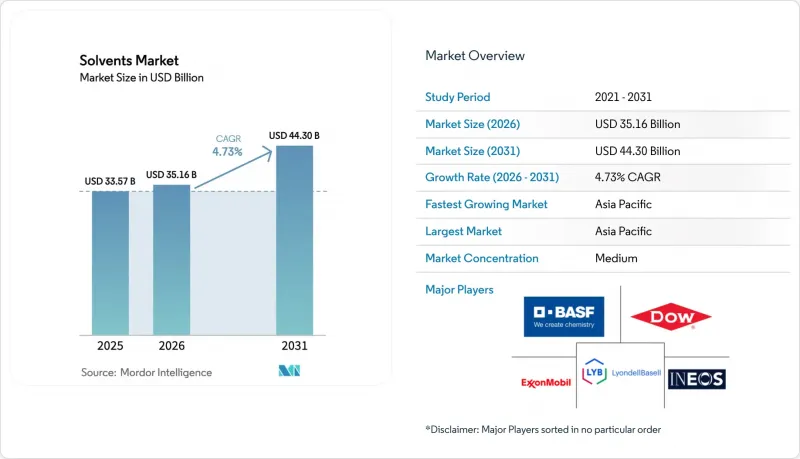
本報告按原料(生物基溶劑和石油化工基溶劑)、類型(含氧溶劑、烴類溶劑、鹵代溶劑)、應用(油漆和塗料、黏合劑、藥品等)以及地區(亞太地區、北美地區、歐洲地區、南美地區、中東和非洲地區)進行細分。市場預測以美元計價。
全球溶劑市場趨勢及洞察
油漆和塗料行業需求激增
到2025年,建築和工業塗料將佔全球溶劑產量的近一半,而對揮發性有機化合物(VOC)含量的監管上限正在加速轉向以丙酮、丁酮和乙酸酯為主要成分的配方。美國在2024年實施的氣霧劑塗料國家排放標準將VOC含量限制在45%(重量比),迫使配方生產商用低VOC含氧化合物取代碳氫化合物混合物。中國已將低VOC塗料的強制使用範圍擴大到翻新塗料和家具塗料,並於2025年將其納入強制使用範圍,導致符合標準的乙二醇醚的需求實現兩位數成長。同時,預計到2030年將超過1,200億美元的中東管道維修預算,也支撐了對依賴高溶解性含氧載體的環氧樹脂和聚氨酯塗料的需求。因此,通用碳氫化合物供應商的利潤率面臨壓力,而特種含氧產品生產商則透過監管配方獲得了10-15%的溢價。
加速亞太地區新興產業叢集的藥品生產
到2025年,印度和中國將佔全球活性藥物成分(API)產量的38%。這主要得益於價值20億美元的生產連結獎勵計畫以及出口導向製造園區的蓬勃發展。光是海南島自由貿易港在2024年至2025年間就吸引了80億美元的醫藥相關資本投資,所產生的溶劑需求將超過每年12萬噸。在越南,新建設API工廠的10年免稅政策預計將在2030年前推動15億美元的出口額,進一步刺激該地區對高純度乙醇、異丙醇和四氫呋喃的需求。儘管這些市場的環境法規相對寬鬆,但國際人用藥品註冊技術協調會議(ICH)提出的殘留溶劑法規修訂案預計將收緊純度標準。這將有利於擁有完善的品管系統和檢驗的回收循環的供應商。
原物料價格波動與石油基溶劑利潤率承壓
2024年至2025年間,布蘭特原油價格在每桶70美元至85美元之間波動,10美元的價格變動導致一體化溶劑業務的利潤率變化了100至150個基點。 2025年1月挪威天然氣供應中斷後,歐洲業者進一步受到天然氣原料價格飆升至每兆瓦時45歐元的衝擊,導致裂解裝置計畫外停產,石腦油基溶劑產量下降。小規模、缺乏避險計畫或未與煉油廠整合的獨立工廠收入下降了5%至8%,並加速了資產出售。雖然生物基路線可以降低一定的風險,但它們也受到玉米和糖價格波動的影響,而且與大規模裂解裝置相比,其規模劣勢導致現金成本更高。
細分市場分析
2025年,石油化工級溶劑仍維持84.23%的市場佔有率,而生物基替代品的複合年成長率(CAGR)為8.13%,幾乎是整體溶劑市場成長率的兩倍。隨著歐盟碳強度評估和加州低碳承諾與可交易碳權額度掛鉤,預計到2031年,生物基溶劑的市場規模將超過80億美元。 2025年,嘉吉公司將其生質乙醇產量提高了5萬噸,用於為其聲稱已貼有碳標籤的藥物合成提供原料。貝爾赫姆集團(Groupe Berchem)的木質素衍生剝線鉗已獲得ISO 14001認證,並在歐洲清洗生產線中作為N-甲基吡咯烷酮的替代品而日益普及。
在價格敏感的黏合劑和金屬清洗領域,由於成本因素,石油化學溶劑仍然佔據主導地位。殼牌和埃克森美孚目前正聯合利用裂解裝置加工經認證的生物基石腦油,生產無需專用生產設施的可再生標籤物料平衡溶劑。此舉旨在保護市場佔有率,同時應對非政府組織對其監管鏈(CoC)記錄可靠性的嚴格審查。隨著監管日益嚴格,溶劑市場預計將更加兩極化。生物基或物料平衡溶劑將在受監管地區供應,而由於亞太地區的成長,對石油化學溶劑的需求將保持強勁。
區域分析
預計到2025年,亞太地區將佔據全球溶劑市場佔有率的42.35%,並在2031年之前以5.21%的複合年成長率持續成長。 2024年至2025年間,印度在其製藥中心吸引了45億美元的外國直接投資,將使溶劑需求量每年增加9萬噸。在中國,隨著二線城市住宅建設的恢復,預計2025年塗料產量將增加6%,這將促使國內主要企業增加12萬噸的溶劑產能。越南的稅收優惠政策預計在2031年前進一步推動該地區溶劑需求增加2萬噸。
在北美,揮發性有機化合物(VOC)法規正促使消費模式從碳氫化合物混合物轉向含氧化合物和生物基產品。美國環保署(EPA)於2024年收緊了化學品儲存槽蒸氣回收的法規,迫使政府為此投入3億至5億美元。這導致人們傾向於使用不受管制的丙酮和乙酸甲酯作為重組溶劑。在墨西哥,儘管預計2025年汽車產量將達到380萬輛,且芳香族化合物將於2027年後被禁用,但汽車零件製造商(OEM)塗料的消費量仍保持5%的成長率。
歐洲溶劑需求主要受德國一項耗資12億歐元的溶劑回收升級改造計畫的推動,該計畫將使新溶劑的需求量減少高達40%。在法國,一座年產3萬噸生物丙醇的工廠計畫於2025年運作,該廠將用於低VOC塗料生產線。南美、中東和非洲的需求也在不斷成長,其中來自巴西的除草劑配方和來自富含乙烷的海灣國家的溶劑出口,填補了各地區的細分市場。
其他好處:
- Excel格式的市場預測(ME)表
- 3個月的分析師支持
目錄
第1章:引言
- 研究假設和市場定義
- 調查範圍
第2章:調查方法
第3章執行摘要
第4章 市場狀況
- 市場概覽
- 市場促進因素
- 油漆和塗料行業需求激增
- 加速亞太地區新興產業叢集的藥品生產
- 北美和歐盟收緊 VOC 排放上限,正在推動溶劑替代的趨勢。
- 溶劑型聚合物回收技術的快速發展
- 人工智慧驅動的封閉回路型溶劑回收系統可降低終端用戶的營運成本。
- 市場限制因素
- 原物料價格波動及石油基溶劑利潤率承壓
- 高規格油墨中生物溶劑組合藥物的總擁有成本高
- 越來越多的汽車零件製造商計劃從 2027 年起禁止在汽車內裝零件中使用芳香族溶劑。
- 價值鏈分析
- 波特五力模型
第5章 市場規模與成長預測
- 來源
- 生物基溶劑
- 石油化工溶劑
- 按類型
- 含氧溶劑
- 烴類溶劑
- 鹵代溶劑
- 透過使用
- 油漆和塗料
- 黏合劑
- 製藥
- 個人護理
- 聚合物生產
- 其他用途(印刷油墨、殺蟲劑、金屬清潔劑)
- 按地區
- 亞太地區
- 中國
- 印度
- 日本
- 韓國
- 馬來西亞
- 泰國
- 印尼
- 越南
- 其他亞太國家
- 北美洲
- 美國
- 加拿大
- 墨西哥
- 歐洲
- 德國
- 英國
- 法國
- 義大利
- 西班牙
- 北歐國家
- 土耳其
- 俄羅斯
- 其他歐洲國家
- 南美洲
- 巴西
- 阿根廷
- 哥倫比亞
- 其他南美國家
- 中東和非洲
- 沙烏地阿拉伯
- 卡達
- 阿拉伯聯合大公國
- 南非
- 奈及利亞
- 埃及
- 其他中東和非洲國家
- 亞太地區
第6章 競爭情勢
- 市場集中度
- 策略趨勢
- 市佔率和排名分析
- 公司簡介
- ADM
- Arkema
- Ashland
- BASF SE
- Bharat Petroleum Corporation Limited
- Braskem
- Cargill, Incorporated
- Celanese Corporation
- Chevron Phillips Chemical Company LLC
- Clariant
- Dow
- Eastman Chemical Company
- Exxon Mobil Corporation
- Gandhar Oil Refinery(India)Limited
- GROUPE BERKEM
- Honeywell International Inc.
- Huntsman International LLC
- Idemitsu Kosan Co., Ltd.
- INEOS
- LyondellBasell Industries Holdings BV
- OXEA
- Sasol Limited
- Shell plc
- Solvay
- TotalEnergies SE
第7章 市場機會與未來展望
According to Mordor Intelligence, the solvents market size was valued at USD 33.57 billion in 2025 and is estimated to grow from USD 35.16 billion in 2026 to reach USD 44.30 billion by 2031, at a CAGR of 4.73% during the forecast period (2026-2031).
This report is Segmented by Source (Bio-Based Solvents and Petrochemical-Based Solvents), Type (Oxygenated Solvents, Hydrocarbon Solvents, and Halogenated Solvents), Application (Paints and Coatings, Adhesives, Pharmaceuticals, and More), and Geography (Asia-Pacific, North America, Europe, South America, Middle East and Africa). Market Forecasts are Provided in Terms of Value (USD).
Global Solvents Market Trends and Insights
Surging Demand From Paints And Coatings
Architectural and industrial coatings absorbed nearly half of global solvent output in 2025, and regulatory ceilings on VOC content are accelerating reformulation toward acetone, methyl ethyl ketone, and acetate esters. The U.S. National Emission Standards for aerosol coatings that became effective in 2024 limit VOC to 45% by weight, prompting formulators to displace hydrocarbon blends with low-VOC oxygenates. China extended its low-VOC coatings mandate in 2025 to refinishing and furniture lines, triggering a double-digit jump in demand for compliant glycol ethers. Simultaneously, Middle Eastern pipeline refurbishment budgets exceeding USD 120 billion through 2030 are sustaining epoxy and polyurethane coatings that rely on high-solvency oxygenated carriers. Commodity hydrocarbon suppliers, therefore, face margin pressure, while specialty oxygenated producers command 10%-15% price premiums in compliant formulations.
Accelerating Pharmaceutical Manufacturing In Emerging Asia-Pacific Clusters
India and China produced 38% of global active pharmaceutical ingredients in 2025, lifted by Production-Linked Incentives worth USD 2 billion and a surge of export-oriented manufacturing parks. Hainan's Free Trade Port alone attracted USD 8 billion of pharma capital expenditure in 2024-2025, adding solvent demand surpassing 120,000 metric tons per year. Vietnam's ten-year tax holidays for greenfield API plants are set to pull in USD 1.5 billion of exports by 2030, further lifting regional uptake of high-purity ethanol, isopropanol, and tetrahydrofuran. Although these markets apply lighter environmental oversight, planned International Council for Harmonisation (ICH) residual-solvent updates will tighten purity targets, favoring suppliers with robust quality systems and validated recovery loops.
Feedstock Volatility And Margin Pressure For Petro-Solvents
Brent crude oscillated between USD 70 and USD 85 per barrel during 2024-2025, translating each USD 10 move into a 100- to 150-basis-point swing in integrated solvent margins. European operators endured an additional spike in natural-gas feedstock to EUR 45 per megawatt-hour after Norwegian outages in January 2025, triggering unplanned cracker shutdowns and curtailing naphtha-sourced solvent output. Smaller standalone units, lacking hedging programs or refinery integration, recorded revenue declines of 5%-8% and accelerated asset divestitures. Although bio-routes offer partial insulation, volatility in corn and sugar prices introduces parallel risk profiles, and scale disadvantages keep cash costs higher than large cracker complexes.
Other drivers and restraints analyzed in the detailed report include:
- Tightening VOC Caps In North America And EU Encouraging Solvent Substitution
- Rapid Scale-Up Of Solvent-Based Polymer Recycling Technologies
- High Cost-Of-Ownership For Bio-Solvent Formulations In High-Spec Inks
For complete list of drivers and restraints, kindly check the Table Of Contents.
Segment Analysis
Petrochemical grades retained 84.23% solvents market share in 2025, yet bio-based alternatives are advancing at an 8.13% CAGR that nearly doubles overall solvents market growth. The solvents market size attributable to bio routes is projected to surpass USD 8 billion by 2031 as EU carbon-intensity scoring and California's low-carbon mandates translate into tradable credits. Cargill expanded bio-ethanol output by 50,000 metric tons in 2025 to supply pharmaceutical syntheses with carbon-label claims. Groupe Berkem's lignin-derived stripper landed ISO 14001 certification and is displacing N-methyl-2-pyrrolidone in European cleaning lines.
In price-sensitive adhesives and metal cleaning, petrochemical solvents still dominate on cost grounds. Shell and ExxonMobil now co-process certified bio-naphtha within crackers, producing mass-balance solvents that carry renewable labels without dedicated units-a tactic that shields share while facing scrutiny from NGOs over chain-of-custody credibility. As regulatory intensity rises, the solvents market is likely to bifurcate further: bio-based or mass-balance streams serve regulated regions, while Asia-Pacific growth keeps petrochemical demand buoyant.
Complete Report Scope:
- By Source
- Bio-based Solvents
- Petrochemical-based Solvents
- By Type
- Oxygenated Solvents
- Hydrocarbon Solvents
- Halogenated Solvents
- By Application
- Paints and Coatings
- Adhesives
- Pharmaceuticals
- Personal Care
- Polymer Production
- Other Applications (Printing Inks, Agricultural Chemicals, and Metal Cleaning)
- By Geography
- Asia-Pacific
- China
- India
- Japan
- South Korea
- Malaysia
- Thailand
- Indonesia
- Vietnam
- Rest of Asia-Pacific
- North America
- United States
- Canada
- Mexico
- Europe
- Germany
- United Kingdom
- France
- Italy
- Spain
- Nordic
- Turkey
- Russia
- Rest of Europe
- South America
- Brazil
- Argentina
- Colombia
- Rest of South America
- Middle East and Africa
- Saudi Arabia
- Qatar
- United Arab Emirates
- South Africa
- Nigeria
- Egypt
- Rest of Middle East and Africa
- Asia-Pacific
Geography Analysis
Asia-Pacific generated 42.35% of the solvents market share in 2025 and is forecast to expand at a 5.21% CAGR through 2031. India secured USD 4.5 billion of foreign direct investment into pharma hubs between 2024-2025, boosting solvent uptake by 90,000 metric tons annually. China's coatings output rose 6% in 2025 as residential construction in tier-2 cities resumed, prompting domestic giants to add 120,000 metric tons of solvent capacity. Vietnam's tax incentives could lift regional demand by another 20,000 metric tons by 2031.
In North America, VOC regulations redirect consumption from hydrocarbon blends toward oxygenated and bio-based streams. The U.S. EPA tightened vapor-recovery rules for chemical storage tanks in 2024, compelling a USD 300-500 million spend on compliance that favors exempt acetone and methyl acetate as reformulation solvents. Mexico's 3.8 million vehicle output in 2025 sustains 5% growth in OEM coatings consumption, even as aromatic bans loom post-2027.
Europe's solvent demand is led by Germany's EUR 1.2 billion solvent-recovery upgrades that cut virgin demand by up to 40%. France commissioned a 30,000-metric-ton bio-propanol plant in 2025 to serve low-VOC coatings lines. South America and the Middle East and Africa are witnessing rising demand, with Brazil's herbicide formulations and Gulf ethane-advantaged solvent exports filling regional niches.
- ADM
- Arkema
- Ashland
- BASF SE
- Bharat Petroleum Corporation Limited
- Braskem
- Cargill, Incorporated
- Celanese Corporation
- Chevron Phillips Chemical Company LLC
- Clariant
- Dow
- Eastman Chemical Company
- Exxon Mobil Corporation
- Gandhar Oil Refinery (India) Limited
- GROUPE BERKEM
- Honeywell International Inc.
- Huntsman International LLC
- Idemitsu Kosan Co., Ltd.
- INEOS
- LyondellBasell Industries Holdings BV
- OXEA
- Sasol Limited
- Shell plc
- Solvay
- TotalEnergies SE
Additional Benefits:
- The market estimate (ME) sheet in Excel format
- 3 months of analyst support
TABLE OF CONTENTS
1 Introduction
- 1.1 Study Assumptions and Market Definition
- 1.2 Scope of the Study
2 Research Methodology
3 Executive Summary
4 Market Landscape
- 4.1 Market Overview
- 4.2 Market Drivers
- 4.2.1 Surging demand from paints and coatings
- 4.2.2 Accelerating pharmaceutical manufacturing in emerging Asia-Pacific clusters
- 4.2.3 Tightening VOC caps in North-America and EU encouraging solvent substitution
- 4.2.4 Rapid scale-up of solvent-based polymer recycling technologies
- 4.2.5 AI-driven, closed-loop solvent-recovery systems cutting opex for end-users
- 4.3 Market Restraints
- 4.3.1 Feed-stock volatility and margin pressure for petro-solvents
- 4.3.2 High cost-of-ownership for bio-solvent formulations in high-spec inks
- 4.3.3 Growing OEM bans on aromatic solvents in automotive interiors post-2027
- 4.4 Value Chain Analysis
- 4.5 Porter's Five Forces
- 4.5.1 Bargaining Power of Suppliers
- 4.5.2 Bargaining Power of Buyers
- 4.5.3 Threat of New Entrants
- 4.5.4 Threat of Substitute Products and Services
- 4.5.5 Degree of Competition
5 Market Size and Growth Forecasts (Value)
- 5.1 By Source
- 5.1.1 Bio-based Solvents
- 5.1.2 Petrochemical-based Solvents
- 5.2 By Type
- 5.2.1 Oxygenated Solvents
- 5.2.2 Hydrocarbon Solvents
- 5.2.3 Halogenated Solvents
- 5.3 By Application
- 5.3.1 Paints and Coatings
- 5.3.2 Adhesives
- 5.3.3 Pharmaceuticals
- 5.3.4 Personal Care
- 5.3.5 Polymer Production
- 5.3.6 Other Applications (Printing Inks, Agricultural Chemicals, and Metal Cleaning)
- 5.4 By Geography
- 5.4.1 Asia-Pacific
- 5.4.1.1 China
- 5.4.1.2 India
- 5.4.1.3 Japan
- 5.4.1.4 South Korea
- 5.4.1.5 Malaysia
- 5.4.1.6 Thailand
- 5.4.1.7 Indonesia
- 5.4.1.8 Vietnam
- 5.4.1.9 Rest of Asia-Pacific
- 5.4.2 North America
- 5.4.2.1 United States
- 5.4.2.2 Canada
- 5.4.2.3 Mexico
- 5.4.3 Europe
- 5.4.3.1 Germany
- 5.4.3.2 United Kingdom
- 5.4.3.3 France
- 5.4.3.4 Italy
- 5.4.3.5 Spain
- 5.4.3.6 Nordic
- 5.4.3.7 Turkey
- 5.4.3.8 Russia
- 5.4.3.9 Rest of Europe
- 5.4.4 South America
- 5.4.4.1 Brazil
- 5.4.4.2 Argentina
- 5.4.4.3 Colombia
- 5.4.4.4 Rest of South America
- 5.4.5 Middle East and Africa
- 5.4.5.1 Saudi Arabia
- 5.4.5.2 Qatar
- 5.4.5.3 United Arab Emirates
- 5.4.5.4 South Africa
- 5.4.5.5 Nigeria
- 5.4.5.6 Egypt
- 5.4.5.7 Rest of Middle East and Africa
- 5.4.1 Asia-Pacific
6 Competitive Landscape
- 6.1 Market Concentration
- 6.2 Strategic Moves
- 6.3 Market Share/Ranking Analysis
- 6.4 Company Profiles (includes Global level Overview, Market level overview, Core Segments, Financials as available, Strategic Information, Market Rank/Share for key companies, Products and Services, and Recent Developments)
- 6.4.1 ADM
- 6.4.2 Arkema
- 6.4.3 Ashland
- 6.4.4 BASF SE
- 6.4.5 Bharat Petroleum Corporation Limited
- 6.4.6 Braskem
- 6.4.7 Cargill, Incorporated
- 6.4.8 Celanese Corporation
- 6.4.9 Chevron Phillips Chemical Company LLC
- 6.4.10 Clariant
- 6.4.11 Dow
- 6.4.12 Eastman Chemical Company
- 6.4.13 Exxon Mobil Corporation
- 6.4.14 Gandhar Oil Refinery (India) Limited
- 6.4.15 GROUPE BERKEM
- 6.4.16 Honeywell International Inc.
- 6.4.17 Huntsman International LLC
- 6.4.18 Idemitsu Kosan Co., Ltd.
- 6.4.19 INEOS
- 6.4.20 LyondellBasell Industries Holdings BV
- 6.4.21 OXEA
- 6.4.22 Sasol Limited
- 6.4.23 Shell plc
- 6.4.24 Solvay
- 6.4.25 TotalEnergies SE
7 Market Opportunities and Future Outlook
- 7.1 White-space and Unmet-need Assessment

 2026-2030年全球有機溶劑市場
 2026-2030年全球碳捕集溶劑市場
 2. 五通市場 – 2026-2032年全球市場預測脂肪族溶劑和稀釋劑市場:按產品類型、化學品類型、純度、應用和分銷管道分類-2026-2032年全球市場預測
 生物基溶劑市場預測至2034年-按產品類型、原料、來源、應用、最終用戶和地區分類的全球分析超臨界二氧化碳渦輪機市場預測至2034年:按渦輪機類型、功率容量、應用、最終用戶和地區分類的全球分析
 全球溶劑市場規模、佔有率、趨勢和成長分析報告(2026-2034年)
 有機溶劑市場規模、佔有率和成長分析:按類型、等級、應用、最終用途和地區分類-2026-2033年產業預測
 2026-2030年全球油田生物溶劑市場碳捕集溶劑市場預測至2034年-按溶劑類型、捕集技術、應用和地區分類的全球分析