


 |
市場調查報告書
商品編碼
2124413
汽車動力方向盤馬達:市場佔有率分析、產業趨勢與統計及成長預測(2026-2031)Automotive Power Steering Motor - Market Share Analysis, Industry Trends & Statistics, Growth Forecasts (2026 - 2031) |
||||||

※ 本網頁內容可能與最新版本有所差異。詳細情況請與我們聯繫。
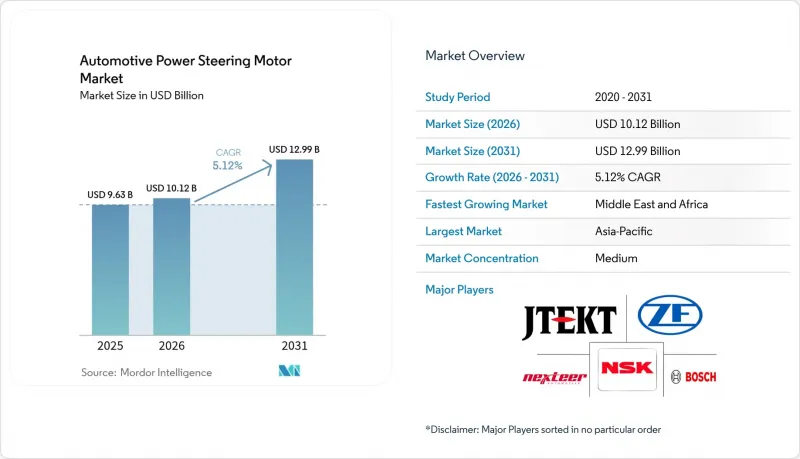
據 Mordor Intelligence 稱,汽車動力方向盤馬達市場預計到 2026 年價值 101.2 億美元,高於 2025 年的 96.3 億美元,預計到 2031 年將達到 129.9 億美元。
預計 2026 年至 2031 年的複合年成長率為 5.12%。
本報告按車輛類型(乘用車、輕型商用車等)、動力方向盤系統(液壓式等)、產品類型(齒條式電動輔助轉向系統等)、馬達技術(無刷直流馬達等)、車輛驅動系統(內燃機、純電動等)、銷售管道(原廠配套和售後市場)以及地區進行細分。市場預測以美元計價。
全球汽車動力方向盤馬達市場趨勢及洞察
過渡到EPS(電動公車)以提高燃油效率並符合二氧化碳排放法規
監管壓力正推動電動輔助轉向系統 (EPS) 的普及,汽車製造商希望與液壓系統相比,燃油效率提高 2-4%。這項技術無需持續消耗 2-6 匹馬力的引擎驅動液壓幫浦。歐盟到 2025 年將二氧化碳排放量控制在 95 克/公里以內的目標,以及中國的雙軌制政策,使得合規的迫切性超越了傳統的成本效益計算。這種監管勢頭正在加速 EPS 的普及,即使在低價位車型領域也是如此。在此之前,由於 EPS 的初始成本較高,製造商一直避免在該領域採用這項技術。由於 EPS 系統僅在需要時提供轉向輔助,而不是保持恆定的液壓,因此汽車製造商可以在不影響車輛性能的前提下,實現所有車型的排放氣體。商用車製造商也在擴大 EPS 的應用範圍,以滿足嚴格的排放氣體標準,同時透過免除液壓油維護和提高燃油效率來降低總擁有成本 (TCO)。
中國和印度電動車產量快速成長
中國電池式電動車(BEV)產量的激增催生了對電動輔助轉向(EPS)馬達的集中需求。比亞迪等國內製造商和新興企業需要的是針對電動車架構最佳化的轉向系統,而非針對內燃機(ICE)汽車的改裝。在印度,新興的電氣化政策進一步推動了這項需求。塔塔汽車等汽車製造商正在建立本地化體系,在地採購80%的電動車零件(包括馬達自主生產)實現本地化,以減少對進口的依賴。雖然這種區域性的需求集中為能夠建立本地化生產體系的EPS電機製造商帶來了供應鏈效率,但也使市場面臨稀土元素材料採購和技術轉移方面的地緣政治風險。
2025年至2027年間半導體供應鏈將趨緊
汽車半導體短缺持續影響電動輔助轉向(EPS)馬達的生產。特別是,電源管理積體電路和馬達控制處理器的前置作業時間延長,導致生產計劃中斷,並推高了零件成本。汽車產業向800V電氣架構的轉型加劇了這項挑戰,因為這需要產能有限且具有嚴格汽車認證要求的專用碳化矽半導體。儘管汽車應用的盈利更高,但由於半導體供應商優先供應大規模生產的家用電子電器,EPS製造商面臨供應緊張的困境。這種供應緊張迫使製造商簽訂長期供應合約並保持庫存緩衝,增加了營運資金需求,同時限制了生產柔軟性,難以應對需求的波動。
細分市場分析
乘用車繼續主導市場,預計到2025年將佔據汽車動力方向盤馬達市場91.48%的佔有率,這主要得益於監管合規要求以及消費者對需要精準電子轉向控制的高級駕駛輔助系統(ADAS)的需求。由於功率需求較高以及對耐用性的擔憂,重型商用車採用EPS系統的速度相對較慢。然而,電動商用車新應用的出現為高扭力馬達設計創造了新的機會。預計輕型商用車將呈現最快的成長速度,2026年至2031年的複合年成長率(CAGR)將達到7.12%,其市場佔有率將超過乘用車,儘管佔有率仍然較小。這是因為車隊營運商重視EPS系統帶來的整體擁有成本(TCO)優勢,例如降低維護成本和提高燃油效率。
商用車的轉型反映了更廣泛的車隊電氣化要求,營運商正在尋求將轉向、煞車和動力傳動系統控制相結合的整合解決方案,以最佳化車輛效率並降低營運複雜性。車隊管理系統越來越需要遠距離診斷和預測性維護功能,而這些功能則由整合感測器和通訊協定的電動輔助轉向系統 (EPS) 實現。這為能夠提供具有遠端監控功能的車隊最佳化解決方案的供應商創造了差異化機會,這些解決方案可以延長保養週期並降低停機成本。
預計到2025年,電動方向盤將佔據汽車動力方向盤馬達市場70.31%的佔有率,並在2031年之前以8.18%的複合年成長率成長,這反映了該技術從提高燃油效率的措施發展成為先進車輛功能的基礎。雖然隨著汽車製造商為了降低複雜性和實現電氣化而逐步淘汰液壓部件,液壓動力方向盤系統的需求正在下降,但該技術仍應用於需要最大轉向力的大型車輛。電液動力方向盤則是一種過渡技術,適用於製造商升級現有平台,它將馬達輔助與液壓備用相結合,以滿足純電動輔助轉向系統無法提供的更高功率輸出應用。
隨著電動輔助轉向系統(EPS)技術成為高級駕駛輔助系統(ADAS)和自動駕駛技術開發的必要組成部分,其成長速度正以前所未有的速度超越以往的普及曲線。由於EPS系統具備軟體更新功能以及與車輛穩定性控制系統整合等特性,汽車製造商正擴大採用該系統。這促使供應商之間建立夥伴關係,其範圍已從零件供應擴展到軟體開發和檢驗服務。這種轉變正在將EPS供應商從單純的機械零件供應商轉變為能夠提供包含嵌入式智慧和互聯功能的綜合轉向解決方案的整合技術合作夥伴。
區域分析
亞太地區在中國汽車生產領域的主導地位以及電池式電動車銷量激增的推動下,預計到2025年將繼續佔據全球汽車動力方向盤馬達市場54.55%的佔有率。該地區的電機生產受益於其半導體後端組裝基礎設施和高密度磁鐵價值鏈。日本和韓國的一級供應商在精密演算法設計方面處於主導,而中國供應商則利用規模經濟優勢拓展出口市場。印度憑藉本地化獎勵提升了新型電動車的國內價值,從而進一步增強了其發展勢頭。
儘管目前中東和非洲地區的規模仍然相對較小,但預計到2031年,該地區將呈現最高的成長率,年複合成長率將達到9.35%,這主要得益於摩洛哥和沙烏地阿拉伯出口導向組裝廠的發展。政府支持的工業園區透過稅收優惠和可再生能源定價,降低了方向盤馬達廠的營運成本。此外,該地區的成長透過為關鍵零件採購帶來地域多元化,緩解了人們對歐洲供應風險的擔憂。
在歐洲和北美,汽車電氣化和L2+級駕駛輔助系統的穩定發展,刺激了對符合ISO/SAE 21434網路安全標準的可升級馬達的需求。歐盟的碰撞安全標準和排放氣體法規正促使電動方向盤系統(EPS)成為所有車型標配。同時,美國正利用美墨加協定(USMCA)吸引零件生產落腳墨西哥工業走廊。半導體短缺仍然是一個不利因素,但多角化採購策略和回流津貼正在緩解供應衝擊。總體而言,成熟地區佔據了汽車動力方向盤馬達市場超過三分之一的佔有率,預計未來的成長將主要由軟體貨幣化和支援自動駕駛的轉向模組驅動。
其他好處:
- Excel格式的市場預測(ME)表
- 3個月的分析師支持
目錄
第1章:引言
- 研究假設和市場定義
- 調查範圍
第2章:調查方法
第3章執行摘要
第4章 市場狀況
- 市場概覽
- 市場促進因素
- 過渡到EPS(電動公車)以符合燃油效率和二氧化碳排放法規
- 中國和印度電動車產量快速成長
- ADAS整合與線控轉向藍圖
- 東協和墨西哥一級供應商本地化
- 碳化矽逆變器的成本正在下降。
- OEM 空中下載 (OTA) 扭力圖更新
- 市場限制因素
- 2025-2027年半導體供應鏈面臨的壓力
- 低價位汽車的電動輔助轉向系統 (EPS) 維修成本很高。
- 稀土元素磁鐵價格波動
- 網路安全合規的成本負擔
- 價值供應鏈分析
- 監理情勢
- 技術展望
- 波特五力模型
第5章 市場規模與成長預測
- 車輛類型
- 搭乘用車
- 輕型商用車
- 大型商用車輛
- 按動力方向盤類型
- 液壓動力方向盤(HPS)
- 電液動力方向盤(EHPS)
- 電動方向盤(EPS)
- 依產品類型
- 機架輔助 EPS(REPS)
- 柱輔助EPS(CEPS)
- 齒輪輔助電動方向盤(PEPS)
- 雙小齒輪輔助轉向系統 (DPEPS)
- 平行軸型 EPS(PA-EPS)
- 馬達技術
- 無刷直流馬達
- 有刷直流電機
- 依推進類型
- 內燃機(ICE)
- 混合動力電動車(HEV/PHEV)
- 電池式電動車(BEV)
- 插電式混合動力電動車
- 按銷售管道
- OEM
- 售後市場
- 按地區
- 北美洲
- 美國
- 加拿大
- 其他北美國家
- 南美洲
- 巴西
- 阿根廷
- 其他南美國家
- 歐洲
- 德國
- 法國
- 英國
- 義大利
- 西班牙
- 俄羅斯
- 其他歐洲國家
- 亞太地區
- 中國
- 日本
- 印度
- 韓國
- 印尼
- 越南
- 菲律賓
- 澳洲
- 其他亞太國家
- 中東和非洲
- 沙烏地阿拉伯
- 阿拉伯聯合大公國
- 埃及
- 土耳其
- 南非
- 其他中東和非洲國家
- 北美洲
第6章 競爭情勢
- 市場集中度
- 策略趨勢
- 市佔率分析
- 公司簡介
- JTEKT Corporation
- Robert Bosch GmbH
- Nexteer Automotive Corp.
- ZF Friedrichshafen AG
- NSK Ltd.
- Hyundai Mobis Co. Ltd.
- Hitachi Astemo CO. Ltd.
- Thyssenkrupp AG
- Mando Corp.
- DENSO Corporation
- Nidec Corporation
- Mitsubishi Electric Corp.
- DY Auto
- BorgWarner Inc.
第7章 市場機會與未來展望
According to Mordor Intelligence, automotive power steering motor market size in 2026 is estimated at USD 10.12 billion, growing from 2025 value of USD 9.63 billion with 2031 projections showing USD 12.99 billion, growing at 5.12% CAGR over 2026-2031.
This report is Segmented by Vehicle Type (Passenger Cars, Light Commercial Vehicles, and More), Power-Steering Type (Hydraulic, and More), Product Type (Rack-Assist EPS, and More), Motor Technology (Brushless DC Motor and More), Vehicle Propulsion (ICE, BEV and More), Sales Channel (OEM and Aftermarket), and Geography. The Market Forecasts are Provided in Terms of Value (USD).
Global Automotive Power Steering Motor Market Trends and Insights
Shift to EPS for Fuel-Economy and CO2 Compliance
Regulatory pressure drives EPS adoption as automakers seek 2-4% fuel economy improvements over hydraulic systems, with the technology eliminating engine-driven hydraulic pumps that consume 2-6 horsepower continuously. European Union's CO2 emission targets of 95g/km by 2025 and China's dual-credit policy create compliance urgency that extends beyond traditional cost-benefit calculations. This regulatory momentum accelerates EPS penetration in budget vehicle segments where manufacturers previously avoided the technology due to higher upfront costs. The shift enables automakers to achieve fleet-wide emission reductions without compromising vehicle performance, as EPS systems provide steering assistance only when needed rather than maintaining constant hydraulic pressure. Commercial vehicle manufacturers increasingly adopt EPS to meet stringent emission standards while reducing total cost of ownership through eliminated hydraulic fluid maintenance and improved fuel efficiency.
Rapid Electrified-Vehicle Production in China and India
China's BEV production surge creates concentrated demand for EPS motors, with domestic manufacturers like BYD and emerging players requiring steering systems optimized for electric vehicle architectures rather than ICE retrofits. India's emerging electrification policies compound this demand, as automakers like Tata Motors achieve 80% localization for EV components, including in-house motor production to reduce import dependency. This regional concentration creates supply chain efficiencies for EPS motor manufacturers capable of establishing local production capabilities, while also exposing the market to geopolitical risks around rare-earth material access and technology transfer requirements.
Semiconductor Supply-Chain Tightness 2025-27
Automotive-grade semiconductor shortages continue affecting EPS motor production, with power management ICs and motor control processors experiencing extended lead times that disrupt manufacturing schedules and increase component costs. The automotive industry's transition to 800V electrical architectures compounds this challenge, requiring specialized silicon carbide semiconductors with limited production capacity and stringent automotive qualification requirements. EPS manufacturers face allocation constraints from semiconductor suppliers prioritizing higher-volume consumer electronics over automotive applications, despite automotive's higher per-unit profitability. This supply tightness forces longer-term supply agreements and inventory buffers that increase working capital requirements while limiting production flexibility to respond to demand fluctuations.
Other drivers and restraints analyzed in the detailed report include:
- Integration with ADAS and Steer-by-Wire Roadmaps
- Tier-1 Vendor Localization in ASEAN and Mexico
- High EPS Repair Cost for Budget-Car Segments
For complete list of drivers and restraints, kindly check the Table Of Contents.
Segment Analysis
Passenger cars maintain market dominance at 91.48% of the automotive power steering motor market share in 2025, driven by regulatory compliance requirements and consumer demand for advanced driver assistance features that require precise electronic steering control. Heavy commercial vehicles adopt EPS systems more gradually due to higher power requirements and durability concerns. However, emerging applications in electric commercial vehicles create new opportunities for high-torque motor designs. Light commercial vehicles exhibit the fastest growth at 7.12% CAGR 2026-2031, outpacing passenger cars despite representing a smaller market share, as fleet operators prioritize total cost of ownership benefits from EPS systems, including reduced maintenance and improved fuel efficiency.
The commercial vehicle transition reflects broader fleet electrification mandates, where operators seek integrated solutions combining steering, braking, and powertrain controls to optimize vehicle efficiency and reduce operational complexity. Fleet management systems increasingly require remote diagnostics and predictive maintenance capabilities that EPS systems enable through integrated sensors and communication protocols. This creates differentiation opportunities for suppliers capable of delivering fleet-optimized solutions with extended service intervals and remote monitoring capabilities that reduce downtime costs.
Electric power steering commands 70.31% of the automotive power steering motor market share in 2025 while growing at 8.18% CAGR through 2031, reflecting the technology's evolution from a fuel economy solution to an enabling platform for advanced vehicle features. Hydraulic power steering systems face declining demand as automakers eliminate hydraulic components to reduce complexity and enable electrification, though the technology persists in heavy-duty applications requiring maximum steering force. Electro-hydraulic power steering serves as transitional technology for manufacturers upgrading existing platforms, combining electric motor assistance with hydraulic backup for applications requiring higher power output than pure EPS systems can deliver.
The EPS growth trajectory accelerates beyond traditional adoption curves as the technology becomes a prerequisite for ADAS integration and autonomous driving development. Automakers increasingly specify EPS systems for their software update capabilities and integration with vehicle stability control, creating vendor partnerships that extend beyond component supply to software development and validation services. This shift transforms EPS suppliers from mechanical component providers to integrated technology partners capable of delivering complete steering solutions with embedded intelligence and connectivity features.
Complete Report Scope:
- By Vehicle Type
- Passenger Cars
- Light Commercial Vehicles
- Heavy Commercial Vehicles
- By Power-Steering Type
- Hydraulic Power Steering (HPS)
- Electro-hydraulic Power Steering (EHPS)
- Electric Power Steering (EPS)
- By Product Type
- Rack-Assist EPS (REPS)
- Column-Assist EPS (CEPS)
- Pinion-Assist EPS (PEPS)
- Dual-Pinion EPS (DPEPS)
- Parallel-Axis EPS (PA-EPS)
- By Motor Technology
- Brushless DC Motor
- Brushed DC Motor
- By Propulsion Type
- Internal-Combustion Engine (ICE)
- Hybrid Electric Vehicle (HEV/PHEV)
- Battery Electric Vehicle (BEV)
- Plug-in Hybrid Electric Vehicles
- By Sales Channel
- OEM
- Aftermarket
- By Geography
- North America
- United States
- Canada
- Rest of North America
- South America
- Brazil
- Argentina
- Rest of South America
- Europe
- Germany
- France
- United Kingdom
- Italy
- Spain
- Russia
- Rest of Europe
- Asia-Pacific
- China
- Japan
- India
- South Korea
- Indonesia
- Vietnam
- Philippines
- Australia
- Rest of Asia-Pacific
- Middle East and Africa
- Saudi Arabia
- United Arab Emirates
- Egypt
- Turkey
- South Africa
- Rest of Middle East and Africa
- North America
Geography Analysis
Asia-Pacific retained a 54.55% of the automotive power steering motor market in 2025, thanks to China's leadership in vehicle output and accelerating battery-electric volumes. Localized motor production benefits from regional semiconductor back-end assembly and a dense magnet supply chain. Japanese and Korean Tier-1s lead in precision algorithm design, while Chinese suppliers push scale advantages into export markets. India amplifies momentum with localization incentives that raise domestic value content on new EV models.
While still small, the Middle East and Africa region is forecast to post the fastest 9.35% CAGR to 2031 as Morocco and Saudi Arabia nurture export-oriented assembly plants. Government-backed industrial zones provide tax holidays and renewable-energy pricing that lower operating costs for steering-motor plants. Regional growth also mitigates Europe's supply-risk concerns by adding geographical diversity in critical component sourcing.
Europe and North America transition steadily toward electrification and Level 2+ driver assistance, stimulating demand for motors capable of ISO/SAE 21434 cyber-secure updates. EU crash-worthiness and emissions rules cement EPS as a default specification across vehicle classes. At the same time, the United States leverages the USMCA trade pact to draw component production into Mexican industrial corridors. Semiconductor shortages remain a headwind, but multi-sourcing strategies and onshoring grants help cushion supply shocks. Combined, mature regions account for over one-third of the automotive power steering motor market, with future expansion tied mainly to software monetization and autonomous-ready steering modules.
- JTEKT Corporation
- Robert Bosch GmbH
- Nexteer Automotive Corp.
- ZF Friedrichshafen AG
- NSK Ltd.
- Hyundai Mobis Co. Ltd.
- Hitachi Astemo CO. Ltd.
- Thyssenkrupp AG
- Mando Corp.
- DENSO Corporation
- Nidec Corporation
- Mitsubishi Electric Corp.
- DY Auto
- BorgWarner Inc.
Additional Benefits:
- The market estimate (ME) sheet in Excel format
- 3 months of analyst support
TABLE OF CONTENTS
1 Introduction
- 1.1 Study Assumptions and Market Definition
- 1.2 Scope of the Study
2 Research Methodology
3 Executive Summary
4 Market Landscape
- 4.1 Market Overview
- 4.2 Market Drivers
- 4.2.1 Shift to EPS for fuel-economy and CO2 compliance
- 4.2.2 Rapid electrified-vehicle production in China and India
- 4.2.3 Integration with ADAS and steer-by-wire roadmaps
- 4.2.4 Tier-1 vendor localization in ASEAN and Mexico
- 4.2.5 Silicon-carbide inverter cost declines
- 4.2.6 OEM over-the-air torque-map updates
- 4.3 Market Restraints
- 4.3.1 Semiconductor supply-chain tightness 2025-27
- 4.3.2 High EPS repair cost for budget-car segments
- 4.3.3 Rare-earth magnet price volatility
- 4.3.4 Cyber-security compliance cost burden
- 4.4 Value / Supply-Chain Analysis
- 4.5 Regulatory Landscape
- 4.6 Technological Outlook
- 4.7 Porter's Five Forces
- 4.7.1 Bargaining Power of Suppliers
- 4.7.2 Bargaining Power of Buyers/Consumers
- 4.7.3 Threat of New Entrants
- 4.7.4 Threat of Substitutes
- 4.7.5 Intensity of Competitive Rivalry
5 Market Size and Growth Forecasts (Value (USD))
- 5.1 By Vehicle Type
- 5.1.1 Passenger Cars
- 5.1.2 Light Commercial Vehicles
- 5.1.3 Heavy Commercial Vehicles
- 5.2 By Power-Steering Type
- 5.2.1 Hydraulic Power Steering (HPS)
- 5.2.2 Electro-hydraulic Power Steering (EHPS)
- 5.2.3 Electric Power Steering (EPS)
- 5.3 By Product Type
- 5.3.1 Rack-Assist EPS (REPS)
- 5.3.2 Column-Assist EPS (CEPS)
- 5.3.3 Pinion-Assist EPS (PEPS)
- 5.3.4 Dual-Pinion EPS (DPEPS)
- 5.3.5 Parallel-Axis EPS (PA-EPS)
- 5.4 By Motor Technology
- 5.4.1 Brushless DC Motor
- 5.4.2 Brushed DC Motor
- 5.5 By Propulsion Type
- 5.5.1 Internal-Combustion Engine (ICE)
- 5.5.2 Hybrid Electric Vehicle (HEV/PHEV)
- 5.5.3 Battery Electric Vehicle (BEV)
- 5.5.4 Plug-in Hybrid Electric Vehicles
- 5.6 By Sales Channel
- 5.6.1 OEM
- 5.6.2 Aftermarket
- 5.7 By Geography
- 5.7.1 North America
- 5.7.1.1 United States
- 5.7.1.2 Canada
- 5.7.1.3 Rest of North America
- 5.7.2 South America
- 5.7.2.1 Brazil
- 5.7.2.2 Argentina
- 5.7.2.3 Rest of South America
- 5.7.3 Europe
- 5.7.3.1 Germany
- 5.7.3.2 France
- 5.7.3.3 United Kingdom
- 5.7.3.4 Italy
- 5.7.3.5 Spain
- 5.7.3.6 Russia
- 5.7.3.7 Rest of Europe
- 5.7.4 Asia-Pacific
- 5.7.4.1 China
- 5.7.4.2 Japan
- 5.7.4.3 India
- 5.7.4.4 South Korea
- 5.7.4.5 Indonesia
- 5.7.4.6 Vietnam
- 5.7.4.7 Philippines
- 5.7.4.8 Australia
- 5.7.4.9 Rest of Asia-Pacific
- 5.7.5 Middle East and Africa
- 5.7.5.1 Saudi Arabia
- 5.7.5.2 United Arab Emirates
- 5.7.5.3 Egypt
- 5.7.5.4 Turkey
- 5.7.5.5 South Africa
- 5.7.5.6 Rest of Middle East and Africa
- 5.7.1 North America
6 Competitive Landscape
- 6.1 Market Concentration
- 6.2 Strategic Moves
- 6.3 Market Share Analysis
- 6.4 Company Profiles (includes Global level Overview, Market level overview, Core Segments, Financials as available, Strategic Information, Market Rank/Share, Products and Services, Recent Developments)
- 6.4.1 JTEKT Corporation
- 6.4.2 Robert Bosch GmbH
- 6.4.3 Nexteer Automotive Corp.
- 6.4.4 ZF Friedrichshafen AG
- 6.4.5 NSK Ltd.
- 6.4.6 Hyundai Mobis Co. Ltd.
- 6.4.7 Hitachi Astemo CO. Ltd.
- 6.4.8 Thyssenkrupp AG
- 6.4.9 Mando Corp.
- 6.4.10 DENSO Corporation
- 6.4.11 Nidec Corporation
- 6.4.12 Mitsubishi Electric Corp.
- 6.4.13 DY Auto
- 6.4.14 BorgWarner Inc.
7 Market Opportunities and Future Outlook
- 7.1 White-space and Unmet-need Assessment

 2026年全球汽車動力方向盤機馬達市場報告
 汽車動力方向盤馬達市場規模、佔有率和成長分析:按馬達類型、轉向系統類型、車輛類型、銷售管道、組件、最終用戶和地區分類-2026-2033年產業預測
 2025-2029年全球汽車動力方向盤馬達市場
 全球汽車方向盤馬達市場