


 |
市場調查報告書
商品編碼
2124405
語音克隆:市場佔有率分析、產業趨勢與統計、成長預測(2026-2031)Voice Cloning - Market Share Analysis, Industry Trends & Statistics, Growth Forecasts (2026 - 2031) |
||||||

※ 本網頁內容可能與最新版本有所差異。詳細情況請與我們聯繫。
據 Mordor Intelligence 稱,2025 年語音克隆市場價值 24 億美元,預計將從 2026 年的 30.2 億美元成長到 2031 年的 95.3 億美元,預測期(2026-2031 年)的複合年成長率為 25.84%。
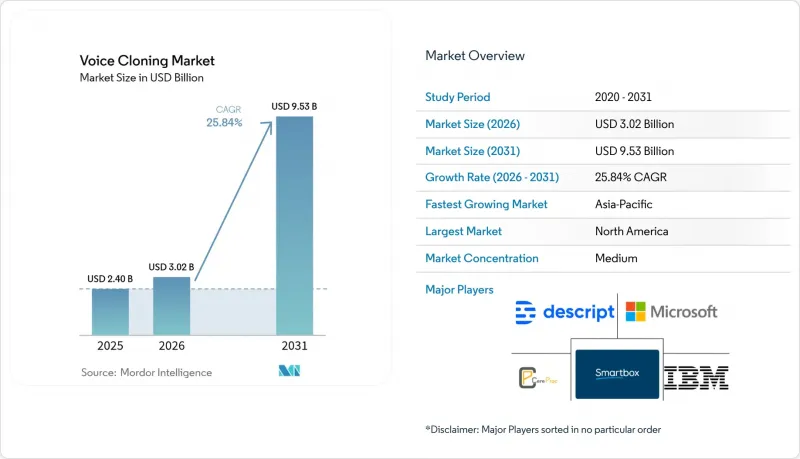
本報告按部署類型(本地部署、雲端部署)、元件(解決方案、服務)、語音複製技術(級聯 TTS、基於神經網路和深度學習的 TTS、其他)、應用程式(聊天機器人和語音助理、其他)、最終用戶產業(IT 和電信、BFSI、其他)和地區進行分類。
全球語音克隆市場趨勢及洞察
北美串流媒體平台採用人工智慧生成的個人化語音進行媒體在地化。
各大串流媒體工作室現在正利用神經語音克隆技術產生在地化對話,從而同步推出多語言版本的節目內容。該技術保留了原始演員的語音特徵。製作團隊表示,從傳統的配音工作流程轉向這種技術,成本降低了 40%,配音週期縮短了 60%。這一新的經濟優勢使得即使是規模小規模的節目也能實現高品質的在地化,從而擴大了全球影響力。預計到 2024 年,海外觀眾將佔用戶的 60% 以上,因此,投資高品質、可擴展的語音工作流程已成為經營團隊的首要任務。競爭壓力迫使即使是那些行動較慢的公司也加快了現代化進程,語音克隆市場也持續保持兩位數的成長。
亞洲零售業迅速將語音複製技術應用於對話式商務
中國、日本和韓國的零售商正在將品牌專屬語音角色整合到購物應用程式中,引導顧客完成購買流程。在主要電商平台上的先導計畫已實現轉換率提升23%。語音助理不僅能像實體店一樣提供建議,還能擴展以應對數百萬次的並發會話。行動購物者可以享受免持操作,減少在小螢幕上操作的不便。亞太地區已佔全球行動商務銷售額的60%以上,對話式語音技術正從新興技術發展成為必需品。隨著全球品牌效仿這一成熟模式,預計亞太地區的領先優勢將擴展到全球。
深度造假語音詐騙導致銀行、金融服務和保險 (BFSI) 行業的 KYC 合規成本激增。
2024年,語音詐騙嘗試激增138%,暴露了銀行和保險公司使用的第一代語音生物識別系統的漏洞。目前,金融機構對所有高風險來電實施多層生物辨識驗證、行為分析和強化人工審核。這些措施增加了每筆交易的檢驗成本,延長了客戶等待時間,並在一定程度上抵消了語音複製技術所承諾的效率提升。為此,美國和歐洲的監管機構正在修訂KYC(了解你的客戶)指南,納入更明確的合成語音監管規定,進一步增加了合規工作量。多家全球銀行報告稱,由於加強了語音安全措施,過去一年與合規相關的總支出增加了27%。在檢測工具和浮水印技術成熟之前,許多公司可能會推遲或限制在其面向客戶的工作流程中採用新的語音克隆技術。
細分市場分析
預計到2025年,雲端託管平台將佔據語音複製市場10.3億美元的佔有率,佔總營收的42.80%,並有望在2031年之前以29.82%的複合年成長率成長。靈活的資源擴展、全球邊緣節點和付費使用制,使雲端成為新試點部署的首選。供應商藍圖目前優先考慮即時串流質量,往返延遲低於100毫秒,從而緩解了人們對傳統延遲的擔憂。服務等級協定 (SLA) 保證99.9%的運轉率,為客服中心和直播等關鍵用例提供了保障。雲端生態系還簡化了對翻譯和情感分析等相關人工智慧服務的訪問,減輕了產品經理的整合負擔。由於金融服務和醫療保健行業的資料居住要求,本地部署仍然佔57.20%的收入。這些買家需要嚴格控制生物識別數據,並且通常會利用雲端的突發容量,將本地GPU叢集與混合編配結合,以滿足尖峰時段需求。領先的供應商正在提供基於Docker的語音引擎和Kubernetes Helm Chart,使DevOps團隊能夠將語音複製功能整合到現有的CI/CD工作流程中。邊緣運算透過將訓練集中在雲端,同時將推理模組部署到客戶擁有的閘道器以執行對延遲敏感的任務,進一步模糊了本地部署和混合部署的界限。隨著隱私保護型聯邦學習技術的日益成熟,從完全本地部署到混合環境的轉變將持續進行,語音克隆市場中純本地部署環境的比例預計將隨著時間的推移而下降。
到2025年,解決方案將佔總收入的71.10%,而服務板塊的複合年成長率(CAGR)為28.93%,超過了軟體授權的22.61%。目前,各公司正專注於部署管治、模型微調和合規措施設計,所有這些都需要專家諮詢。部署合作夥伴正在組建由語言學家、倫理學家和DevSecOps工程師組成的多領域團隊,以確保語音克隆策略符合品牌和法律要求。新服務範例包括“語音DNA審計”,該服務記錄說話者的權利,為未來可能發生的爭議做好準備。同時,平台供應商不斷突破基於神經網路的可複製性的極限。基於變壓器的引擎可以從不到30秒的參考音訊中產生可操作的複製語音,從而簡化人才經紀公司和醫療領域的部署流程。低位元率轉碼器最佳化可在不損失諧波細節的情況下將頻寬降低60%,從而實現車載資訊娛樂系統的無線傳輸。管治模組會使用加密雜湊值記錄所有合成請求,從而建立符合新頒布的人工智慧稽核法規的不可竄改的追蹤記錄。這些進步提高了解決方案業務的收入下限,同時服務收入也在成長,從而維持了語音複製市場的平衡。
區域分析
在矽谷研究叢集和好萊塢媒體需求的推動下,北美預計將在2025年佔據38.70%的營收佔有率。串流媒體平台正在規範神經配音工作流程,並建立事實上的品質標準,這項標準正被全球製作公司所接受。監管力道顯著。美國聯邦貿易委員會(FTC)發起的「語音克隆挑戰賽」要求技術專家提案內容認證解決方案,這促使供應商將浮水印功能原生整合到產品中。儘管監管更加嚴格,創業融資。亞太地區是成長的主要驅動力,預計到2031年將維持27.42%的複合年成長率。中國在多語言克隆技術的研究方面處於主導,這得益於其龐大的電子商務生態系統對方言適應性的需求。日本的健康科技公司正在推出專為老年人設計的合成語音,以解決老齡化社會中的溝通障礙。韓國遊戲發行商正在嘗試即時角色語音變形技術,這項新型互動機制引起了廣泛關注。印度是一個語言複雜且極具潛力的市場,透過支援本地語言,有望吸引數億新用戶。這些趨勢共同推動亞太地區成為語音克隆市場成長最快的地區。歐洲則專注於管治和無障礙存取。歐盟人工智慧法引入了透明度條款,要求在使用合成語音時進行資訊揭露,並要求供應商提供審計儀錶板。歐洲無障礙存取法進一步鞏固了公共數位服務領域對語音機器人的需求。德國工業界正在考慮在工廠環境中引入語音機器人,而在英國,各大銀行正在使用克隆語音來測試客戶服務負責人。合規方面的障礙雖然會延長銷售週期,但最終有助於建立信任,並確保語音克隆技術在整個歐洲大陸的持續普及。
其他好處
- Excel格式的市場預測(ME)表
- 三個月的分析師支持
目錄
第1章:引言
- 本研究的假設與市場定義
- 調查範圍
第2章:調查方法
第3章執行摘要
第4章 市場狀況
- 市場概覽
- 市場促進因素
- 北美串流媒體平台採用人工智慧生成的個人化語音進行媒體在地化。
- 亞洲零售業迅速將語音複製技術應用於對話式商務
- 歐洲制定無障礙法規,以促進合成語音在公共數位服務中的廣泛應用。
- SaaS語音API的商業化加速了全球雲端運算的普及。
- 多語言數位廣告的廣泛應用
- 數位化身的興起
- 市場限制因素
- 深度造假語音詐騙導致銀行、金融服務和保險 (BFSI) 行業的 KYC 合規成本激增。
- GPU的高運算成本阻礙了中小企業採用即時神經合成技術。
- 各地監管法規缺乏統一性阻礙了經濟成長。
- 由於倫理同意方面的障礙以及由此導致的實施複雜性,人們越來越擔心個人語音資料被濫用。
- 價值供應鏈分析
- 監管和技術展望
- 波特五力分析
- 新冠疫情對語音克隆市場的影響
第5章 市場規模與成長預測
- 依部署類型
- 現場
- 雲
- 按組件
- 解決方案
- 服務
- 按類型分類的語音克隆技術
- 串聯TTS
- 參數/統計 TTS
- 使用神經網路和深度學習的TTS
- 透過使用
- 聊天機器人和語音助手
- 無障礙和輔助技術
- 數位互動遊戲
- 配音和在地化
- 客戶服務和互動式語音應答系統
- 語音義肢假體與個性化語音
- 按最終用戶行業分類
- 資訊科技/通訊
- BFSI
- 醫療保健和生命科學
- 媒體與娛樂
- 教育
- 觀光觀光
- 零售與電子商務
- 政府/國防
- 按地區
- 北美洲
- 美國
- 加拿大
- 南美洲
- 巴西
- 阿根廷
- 其他南美國家
- 歐洲
- 德國
- 英國
- 法國
- 西班牙
- 義大利
- 其他歐洲國家
- 亞太地區
- 中國
- 日本
- 印度
- 韓國
- 澳洲
- 其他亞太國家
- 中東和非洲
- 沙烏地阿拉伯
- 阿拉伯聯合大公國
- 南非
- 其他中東和非洲國家
- 北美洲
第6章 競爭情勢
- 市場集中度
- 策略趨勢
- 市佔率分析
- 公司簡介
- Microsoft Corporation
- Amazon Web Services, Inc.
- Google LLC
- IBM Corporation
- Apple Inc.
- Baidu, Inc.
- Descript, Inc.
- Acapela Group SA
- CereProc Ltd.
- Resemble AI, Inc.
- VocaliD, Inc.
- ElevenLabs, Inc.
- LumenVox LLC
- iSpeech, Inc.
- Smartbox Assistive Technology Ltd.
- WellSaid Labs, Inc.
- ReadSpeaker Holding BV
- NeoSpeech, Inc.
- Sonantic Ltd.
- rSpeak Technologies Ltd.
第7章 市場機會與未來展望
According to Mordor Intelligence, the voice cloning market size was valued at USD 2.40 billion in 2025 and estimated to grow from USD 3.02 billion in 2026 to reach USD 9.53 billion by 2031, at a CAGR of 25.84% during the forecast period (2026-2031).
This report is Segmented by Deployment Type (On-Premise, Cloud), Component (Solution, Service), Voice-Cloning Method (Concatenative TTS, Neural and Deep-Learning-Based TTS, and More), Application (Chatbots and Voice Assistants and More), End-User Vertical (IT and Telecommunications, BFSI, and More), and Geography.
Global Voice Cloning Market Trends and Insights
Adoption of AI-generated Personal Voices for Media Localization by North-American Streaming Platforms
Major streaming studios now release multi-language premieres simultaneously by rendering localized dialogue with neural voice clones that preserve the original actor's vocal fingerprint. Production teams report 40% cost savings and 60% faster dubbing cycles after switching from traditional voice-over workflows. The new economics allow smaller catalog titles to secure high-quality localization, widening global reach. As international viewers contributed more than 60% of new subscriptions in 2024, investing in premium yet scalable voice workflows became a board-level priority. Competitive pressure is forcing late adopters to modernize rapidly, sustaining double-digit momentum in the voice cloning market.
Rapid Integration of Voice Cloning in Conversational Commerce across Asian Retail
Chinese, Japanese, and Korean retailers embed branded voice personalities inside shopping apps to guide purchasing journeys. Pilot projects boosted conversion rates by 23% on flagship e-commerce platforms. Voice cloning restores the advisory element of brick-and-mortar retail, yet scales to millions of concurrent sessions. Mobile shoppers benefit from hands-free navigation, reducing friction on small screens. With Asia Pacific already accounting for more than 60% of global mobile commerce revenue, conversational voice is evolving from novelty to necessity. This regional lead will ripple outward as global brands mimic proven templates.
Deepfake Voice Fraud Escalating KYC Compliance Costs for BFS
Voice fraud attempts surged 138% in 2024, exposing gaps in first-generation voice biometric systems used by banks and insurers. Financial institutions now layer liveness checks, behavioral analytics, and stepped-up manual reviews onto every high-risk call. These countermeasures raise per-transaction verification costs and prolong customer wait times, eroding some of the efficiency gains that voice cloning promised. Regulators in the United States and Europe have responded by updating KYC guidelines to include explicit controls for synthetic speech, adding more compliance tasks. Several global banks report that voice-specific security upgrades have lifted overall compliance spending by 27% in the past year. Until detection and watermarking tools mature, many firms will defer or limit new voice cloning deployments in customer-facing workflows.
Other drivers and restraints analyzed in the detailed report include:
- Accessibility Mandates Driving Synthetic Speech in European Public Digital Services
- SaaS Voice-API Monetization Accelerating Cloud Deployments Worldwide
- High GPU Compute Costs Hindering SME Adoption of Real-time Neural Synthesis
For complete list of drivers and restraints, kindly check the Table Of Contents.
Segment Analysis
Cloud-hosted platforms represented USD 1.03 billion of the voice cloning market size in 2025, equal to 42.80% revenue share, and are advancing at a 29.82% CAGR to 2031 Flexible resource scaling, global edge nodes, and pay-as-you-go billing make cloud the default choice for new pilots. Vendor roadmaps now prioritize real-time streaming quality at sub-100 ms round-trip, dissolving historical latency concerns. Service level agreements offer 99.9% uptime, reassuring critical use cases in contact centers and live broadcasts. Cloud ecosystems also simplify access to adjacent AI services like translation and sentiment analysis, lowering integration friction for product managers. On-premise installations still command 57.20% revenue share owing to data residency mandates in financial services and healthcare. These buyers require airtight control of biometric data and often pair internal GPU clusters with hybrid orchestration to tap burst cloud capacity for peak demand. Leading suppliers are shipping Docker-ready voice engines and Kubernetes Helm charts, letting DevOps teams integrate voice cloning into existing CI/CD workflows. Edge computing further blurs boundaries by placing inference modules on customer-owned gateways for latency-sensitive tasks while centralizing training in the cloud. As privacy preserving federated learning matures, migration paths from strictly on-premise to hybrid footprints will continue, shrinking pure on-prem holdings over time within the voice cloning market.
Solutions captured 71.10% of 2025 revenue, yet services are climbing at 28.93% CAGR versus 22.61% for software licences Enterprises now emphasize deployment governance, model fine-tuning, and compliance policy design, all of which demand specialized consulting. Implementation partners staff multidisciplinary teams of linguists, ethicists, and DevSecOps engineers to align voice cloning strategies with brand and legal requirements. New service offerings include voice DNA audits that catalog speaker rights for future disputes. Meanwhile, platform vendors keep pushing the envelope on neural fidelity. Transformer-based engines can build a viable clone from under 30 s of reference audio, streamlining onboarding for talent agencies and medical use cases. Low-bit-rate codec optimization cuts bandwidth by 60% without clipping harmonic detail, enabling over-the-air delivery in automotive infotainment. Governance modules now log every synthesis request with cryptographic hashes, creating immutable trails that satisfy emerging AI audit laws. These advances reinforce the solutions segment's revenue floor even as service billings expand, maintaining balance inside the voice cloning market.
Complete Report Scope:
- By Deployment Type
- On-Premise
- Cloud
- By Component
- Solution
- Service
- By Voice-Cloning Method
- Concatenative TTS
- Parametric/Statistical TTS
- NeuralandDeep-Learning-based TTS
- By Application
- ChatbotsandVoice Assistants
- AccessibilityandAssistive Technologies
- DigitalandInteractive Games
- DubbingandLocalization
- Customer ServiceandIVR
- Voice ProstheticsandPersonalized Speech
- By End-user Vertical
- ITandTelecommunications
- BFSI
- HealthcareandLife Sciences
- MediaandEntertainment
- Education
- TravelandTourism
- RetailandE-commerce
- GovernmentandDefense
- By Geography
- North America
- United States
- Canada
- South America
- Brazil
- Argentina
- Rest of South America
- Europe
- Germany
- United Kingdom
- France
- Spain
- Italy
- Rest of Europe
- Asia Pacific
- China
- Japan
- India
- South Korea
- Australia
- Rest of Asia Pacific
- Middle East and Africa
- Saudi Arabia
- United Arab Emirates
- South Africa
- Rest of Middle East and Africa
- North America
Geography Analysis
North America commanded 38.70% of 2025 revenue, anchored by Silicon Valley research clusters and Hollywood media demand. Streaming platforms standardize neural dubbing workflows, setting de facto quality bars that ripple through global production houses. Regulatory scrutiny is palpable: the Federal Trade Commission's Voice Cloning Challenge invites technologists to propose content authentication solutions, a move that pressures vendors to embed watermarking natively.Despite tighter oversight, venture funding remains buoyant, sustaining a vibrant startup pipeline that feeds enterprise procurement pipelines. Asia Pacific is the growth engine, posting a 27.42% CAGR through 2031. China spearheads multilingual cloning research, driven by its vast e-commerce ecosystems, which require dialect agility. Japanese health-tech firms are deploying synthetic voices tailored for senior citizens, addressing the communication gaps of an aging population. South Korean game publishers experiment with real-time character voice morphing, spotlighting new engagement mechanics. India presents a fertile, linguistically complex market where regional language support can unlock hundreds of millions of new users. Together, these dynamics position Asia Pacific as the fastest-advancing region in the voice cloning market. Europe's narrative centers on governance and accessibility. The EU AI Act introduces transparency clauses that obligate disclosures when synthetic voices are used, compelling vendors to ship audit dashboards. The European Accessibility Act further entrenches demand within public digital services. Germany's industrial sector explores voice-enabled robotics on factory floors, while the United Kingdom pilots cloned-voice customer reps across leading banks. Although compliance hurdles extend sales cycles, they ultimately elevate trust, ensuring sustained uptake across continental markets.
- Microsoft Corporation
- Amazon Web Services, Inc.
- Google LLC
- IBM Corporation
- Apple Inc.
- Baidu, Inc.
- Descript, Inc.
- Acapela Group SA
- CereProc Ltd.
- Resemble AI, Inc.
- VocaliD, Inc.
- ElevenLabs, Inc.
- LumenVox LLC
- iSpeech, Inc.
- Smartbox Assistive Technology Ltd.
- WellSaid Labs, Inc.
- ReadSpeaker Holding BV
- NeoSpeech, Inc.
- Sonantic Ltd.
- rSpeak Technologies Ltd.
Additional Benefits:
- The market estimate (ME) sheet in Excel format
- 3 months of analyst support
TABLE OF CONTENTS
1 INTRODUCTION
- 1.1 Study AssumptionsandMarket Definition
- 1.2 Scope of the Study
2 RESEARCH METHODOLOGY
3 EXECUTIVE SUMMARY
4 MARKET LANDSCAPE
- 4.1 Market Overview
- 4.2 Market Drivers
- 4.2.1 Adoption of AI-generated Personal Voices for Media Localization by North-American Streaming Platforms
- 4.2.2 Rapid Integration of Voice Cloning in Conversational Commerce across Asian Retail
- 4.2.3 Accessibility Mandates Driving Synthetic Speech in European Public Digital Services
- 4.2.4 SaaS Voice-API Monetization Accelerating Cloud Deployments Worldwide
- 4.2.5 Growing Adoption of Multilingual Digital Advertising
- 4.2.6 The Emergence of Digital Avatars
- 4.3 Market Restraints
- 4.3.1 Deepfake Voice Fraud Escalating KYC Compliance Costs for BFSI
- 4.3.2 High GPU Compute Costs Hindering SME Adoption of Real-time Neural Synthesis
- 4.3.3 Fragmented Regulation Across Regions is Restraining the Growth
- 4.3.4 Ethical Consent Hurdles Raising Concerns Over Unauthorized Use of Personal Voice Data and Complicating Adoption
- 4.4 Value/Supply-Chain Analysis
- 4.5 Regulatory or Technological Outlook
- 4.6 Porter's Five Forces Analysis
- 4.6.1 Threat of New Entrants
- 4.6.2 Bargaining Power of Buyers/Consumers
- 4.6.3 Bargaining Power of Suppliers
- 4.6.4 Threat of Substitute Products
- 4.6.5 Intensity of Competitive Rivalry
- 4.7 Impact of COVID-19 on the Voice Cloning Market
5 MARKET SIZE AND GROWTH FORECASTS (VALUE)
- 5.1 By Deployment Type
- 5.1.1 On-Premise
- 5.1.2 Cloud
- 5.2 By Component
- 5.2.1 Solution
- 5.2.2 Service
- 5.3 By Voice-Cloning Method
- 5.3.1 Concatenative TTS
- 5.3.2 Parametric/Statistical TTS
- 5.3.3 NeuralandDeep-Learning-based TTS
- 5.4 By Application
- 5.4.1 ChatbotsandVoice Assistants
- 5.4.2 AccessibilityandAssistive Technologies
- 5.4.3 DigitalandInteractive Games
- 5.4.4 DubbingandLocalization
- 5.4.5 Customer ServiceandIVR
- 5.4.6 Voice ProstheticsandPersonalized Speech
- 5.5 By End-user Vertical
- 5.5.1 ITandTelecommunications
- 5.5.2 BFSI
- 5.5.3 HealthcareandLife Sciences
- 5.5.4 MediaandEntertainment
- 5.5.5 Education
- 5.5.6 TravelandTourism
- 5.5.7 RetailandE-commerce
- 5.5.8 GovernmentandDefense
- 5.6 By Geography
- 5.6.1 North America
- 5.6.1.1 United States
- 5.6.1.2 Canada
- 5.6.2 South America
- 5.6.2.1 Brazil
- 5.6.2.2 Argentina
- 5.6.2.3 Rest of South America
- 5.6.3 Europe
- 5.6.3.1 Germany
- 5.6.3.2 United Kingdom
- 5.6.3.3 France
- 5.6.3.4 Spain
- 5.6.3.5 Italy
- 5.6.3.6 Rest of Europe
- 5.6.4 Asia Pacific
- 5.6.4.1 China
- 5.6.4.2 Japan
- 5.6.4.3 India
- 5.6.4.4 South Korea
- 5.6.4.5 Australia
- 5.6.4.6 Rest of Asia Pacific
- 5.6.5 Middle East and Africa
- 5.6.5.1 Saudi Arabia
- 5.6.5.2 United Arab Emirates
- 5.6.5.3 South Africa
- 5.6.5.4 Rest of Middle East and Africa
- 5.6.1 North America
6 COMPETITIVE LANDSCAPE
- 6.1 Market Concentration
- 6.2 Strategic Moves
- 6.3 Market Share Analysis
- 6.4 Company Profiles (includes Global Level Overview, Market Level Overview, Core Segments, Financials as available, Strategic Information, Market Rank/Share for key companies, ProductsandServices, and Recent Developments)
- 6.4.1 Microsoft Corporation
- 6.4.2 Amazon Web Services, Inc.
- 6.4.3 Google LLC
- 6.4.4 IBM Corporation
- 6.4.5 Apple Inc.
- 6.4.6 Baidu, Inc.
- 6.4.7 Descript, Inc.
- 6.4.8 Acapela Group SA
- 6.4.9 CereProc Ltd.
- 6.4.10 Resemble AI, Inc.
- 6.4.11 VocaliD, Inc.
- 6.4.12 ElevenLabs, Inc.
- 6.4.13 LumenVox LLC
- 6.4.14 iSpeech, Inc.
- 6.4.15 Smartbox Assistive Technology Ltd.
- 6.4.16 WellSaid Labs, Inc.
- 6.4.17 ReadSpeaker Holding BV
- 6.4.18 NeoSpeech, Inc.
- 6.4.19 Sonantic Ltd.
- 6.4.20 rSpeak Technologies Ltd.
7 MARKET OPPORTUNITIES AND FUTURE OUTLOOK
- 7.1 White-spaceandUnmet-need Assessment

 全球語音克隆市場規模、佔有率、趨勢和成長分析報告(2026-2034)
 AI語音克隆市場規模、佔有率和成長分析:按技術、應用、最終用戶、部署模式和地區分類-2026-2033年產業預測
 2026年全球語音克隆市場報告2026年全球人工智慧語音克隆市場報告
 語音克隆市場分析及預測(至2035年):依類型、產品類型、服務、技術、組件、應用、最終用戶、功能及部署類型分類
 語音克隆市場-全球產業規模、佔有率、趨勢、機會和預測:按組件、部署模式、應用、最終用戶、地區和競爭格局分類,2021-2031年AI語音克隆市場-全球產業規模、佔有率、趨勢、機會及預測(按組件、部署模式、應用、產業垂直領域、地區及競爭格局分類,2021-2031年預測)2025年語音銀行全球市場報告
 2032 年人工智慧語音克隆市場預測:按組件、部署模式、技術、應用和地區進行的全球分析
 全球語音銀行市場評估:依組件、依部署、依應用、依技術、依最終用戶、依地區、機會、預測,2017-2031年