


 |
市場調查報告書
商品編碼
2124398
高速應用開發:市場佔有率分析、產業趨勢與統計、成長預測(2026-2031)Rapid Application Development - Market Share Analysis, Industry Trends & Statistics, Growth Forecasts (2026 - 2031) |
||||||

※ 本網頁內容可能與最新版本有所差異。詳細情況請與我們聯繫。
根據 Mordor Intelligence 預測,高速應用開發市場規模預計在 2025 年達到 571.2 億美元,2026 年將成長至 795.3 億美元,2031 年將達到 4,164.2 億美元,預測期(2026-2031 年)複合年成長率為 39.23%。
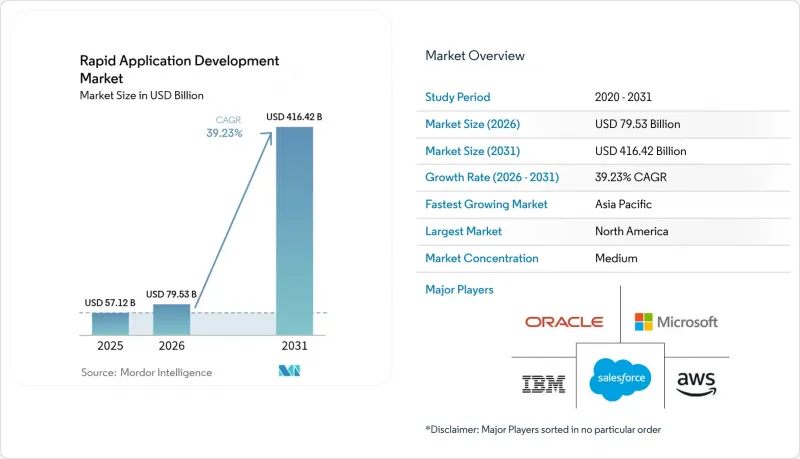
本報告按類型(低程式碼開發平台、無程式碼開發平台)、部署模式(本地部署、雲端部署)、組織規模(中小企業、大型企業)、最終用戶產業(零售和電子商務、資訊科技、能源和公共產業、製造業及其他)以及地區進行細分。市場預測以美元(USD)計價。
全球快速應用開發(RAD)市場趨勢與洞察
將創新和尖端技術融入商業
企業正朝著微服務、事件驅動架構和無伺服器運算方向發展,快速應用開發 (RAD) 平台也不斷演進,透過視覺化連接器整合這些元件。 ServiceNow 和 Appian 提供預先建置的微服務模板,可將工作流程引擎的配置時間從數天縮短至數分鐘。製造商正利用 Siemens Mendix 將物聯網感測器資料與運行在網路邊緣的低程式碼儀表板融合,實現預測性維護用例。這些整合透過將複雜的底層架構抽像到聲明式模型背後,降低了技術債務,同時確保應用程式在策略成熟後仍保持雲端獨立性。北美和歐洲是發展最先進的地區,5G 部署和成熟的 DevOps 文化為持續改善循環提供了支援。
低程式碼平台需求的成長源自於軟體開發人員的短缺。
美國勞工統計局在2024年預測,2022年至2032年間,軟體開發人員的就業人數將成長25%,超過供應成長速度。低程式碼工具透過拖放介面,使業務分析師能夠建立Web和行動應用程式,從而緩解了這一短缺問題,也讓高級工程師能夠專注於核心演算法。 OutSystems的一項調查顯示,74%的組織計劃在未來一年內使用低程式碼交付至少10個應用程式,其中31%的組織利用嵌入式人工智慧來加速交付。摩根大通等金融機構在實施Appian後,將貸款核准週期從18個月縮短至6週。隨著2024年開發人員薪資漲幅超過15%,營運預算壓力日益增大,對「公民開發人員」計畫的需求也隨之上升,旨在最大限度地利用有限的人才資源。
高度監管產業的安全和資料管治問題
金融服務和醫療保健機構在審計追蹤、加密和資料居住方面面臨嚴格的要求,但許多快速應用開發 (RAD) 平台直到最近才開始著手解決這些問題。開放式 Web 應用程式安全專案 (OWASP) 報告了使用者建置應用程式中常見的漏洞,例如「不安全的直接物件參考」。德意志銀行限制低程式碼的使用範圍,僅限於非面向客戶的工作流程,直到供應商獲得 SOC 2 II 型和 ISO 27001 認證。醫療保健機構指出預設權限設定存在 HIPAA 合規性缺陷,導致產品發布延遲。更嚴格的框架(例如 GDPR)要求建立區域資料中心,促使 Betty Blocks 等供應商在法蘭克福開設資料中心,以服務其歐洲客戶。在平台能夠預設提供端到端管治之前,高度監管行業的採用率可能會落後於監管較少的行業。
細分市場分析
到2025年,低程式碼平台將在快速應用開發市場佔據63.70%的市場。這主要得益於微軟Power Platform和OutSystems的推動,它們將拖放式設計與可選的自訂程式碼相結合,以最佳化效能關鍵路徑。預計到2031年,無程式碼平台將以41.20%的複合年成長率成長,因為業務用戶將利用Airtable和Quickbase等平台來建立核准工作流程和儀錶板,而無需IT部門的參與。這一趨勢表明,企業越來越相信視覺化工具能夠提高部門內部的生產力,同時IT部門也將繼續負責公司範圍內的系統監管。
無程式碼技術的發展並非旨在取代低程式碼技術,而是對其進行補充。各部門通常會先嘗試使用無程式碼技術進行快速原型製作,然後隨著使用者數量的成長或即時資料同步需求的增加,再遷移到低程式碼技術。這種互動方式透過使工具的複雜性與工作負載需求相匹配,拓展了快速應用開發市場,從而促進了不同技能水平的多元化用戶群更廣泛地採用無程式碼技術。
預計到2025年,雲端採用將佔總營收的73.15%,並將以40.95%的複合年成長率持續成長至2031年,涵蓋新增工作負載和遷移需求。整合身分識別管理、付費使用制和即時協作等功能,使雲端平台相對於本地部署解決方案具有顯著優勢。
在資料主權和空氣間隙網路至關重要的場景下,例如國防設施和某些金融機構,仍會使用本地部署解決方案。 Oracle APEX 和混合型 OutSystems 堆疊可以滿足這些需求,但它們的總體擁有成本 (TCO) 仍然高於基於雲端的解決方案。隨著合規框架的不斷發展,越來越多的用戶正在遷移到雲端,這進一步鞏固了雲端作為快速應用開發市場主要成長引擎的地位。
區域分析
北美地區擁有成熟的IT預算和廣泛的公民開發者計劃,預計到2025年將佔全球收入的38.90%。微軟、Salesforce和ServiceNow利用其廣泛的實施合作夥伴生態系統,讓財富500強企業能夠輕鬆採用其平台。在加拿大,公共部門實施了快速應用開發(RAD)以在遵守當地資料保留法律的前提下實現舊有系統的現代化。墨西哥一家製造工廠正在與其美國合作夥伴共用基於AWS Honeycode的供應商門戶,展現了跨境工作流程數位化進程的進展。
預計到2031年,亞太地區的複合年成長率將達到41.95%,成為所有地區中成長最快的地區。印度的「數位印度」舉措和中國的「十四五」規劃鼓勵當地企業盡可能減少客製化編碼所花費的時間,從而推動了低代碼套件(例如Zoho Creator和阿里雲)的普及。在日本,快速應用開發(RAD)正被用來彌補勞動力老化導致的開發人員短缺問題。同時,澳洲的銀行正在採用低程式碼技術以滿足開放銀行的要求。諸如中國的《個人資訊保護法》等本地資料保護條例迫使供應商建置區域資料中心,但這項投資也擴大了不同市場的潛在需求。
歐洲、南美以及中東和非洲地區都在穩步做出貢獻。雖然GDPR合規性提高了安全功能的標準,並減緩了高度監管領域的採用速度,但對具備強大審計日誌和本地託管功能的平台的需求正在加速成長。巴西的中小型企業更傾向於能夠應對收入波動的訂閱式快速應用開發(RAD)工具。波灣合作理事會(GCC)成員國正在資助基於ServiceNow和OutSystems的電子政府項目,而肯亞的新創公司則正在利用行動優先的RAD套件來跳過桌面開發階段。
其他好處
- Excel格式的市場預測(ME)表
- 3個月的分析師支持
目錄
第1章:引言
- 研究假設和市場定義
- 調查範圍
第2章:調查方法
第3章執行摘要
第4章 市場狀況
- 市場概覽
- 市場促進因素
- 將創新和尖端技術融入商業
- 能夠根據公司不斷變化的需求柔軟性客製化解決方案。
- 低程式碼平台需求的成長源自於軟體開發人員的短缺。
- 加速中小企業數位轉型計劃
- 將人工智慧驅動的應用程式生成功能整合到快速應用開發 (RAD) 工具中
- 擴大專案範圍,以連結公司和開發人員,符合IT管理審查的要求
- 市場限制因素
- 缺乏能夠擴展、管理和保障 RAD 部署的熟練專業人員。
- 高度監管領域的安全和資料管治問題
- 由於專有元元資料模型而導致的供應商鎖定風險
- 複雜且運算密集型工作負載下的效能限制
- 產業價值鏈分析
- 監理情勢
- 技術展望
- 宏觀經濟因素的影響
- 波特五力分析
第5章 市場規模與成長預測
- 按類型
- 低程式碼開發平台
- 無程式碼開發平台
- 部署模式
- 現場
- 雲
- 按組織規模
- 小型企業
- 大公司
- 按最終用戶行業分類
- 銀行業、金融服務業及保險業
- 零售與電子商務
- 政府/國防
- 衛生保健
- 資訊科技
- 能源與公共產業
- 製造業
- 其他
- 按地區
- 北美洲
- 美國
- 加拿大
- 墨西哥
- 南美洲
- 巴西
- 阿根廷
- 其他南美國家
- 歐洲
- 德國
- 英國
- 法國
- 義大利
- 西班牙
- 俄羅斯
- 其他歐洲國家
- 亞太地區
- 中國
- 日本
- 印度
- 韓國
- 澳洲
- 其他亞太國家
- 中東和非洲
- 中東
- 沙烏地阿拉伯
- 阿拉伯聯合大公國
- 土耳其
- 其他中東國家
- 非洲
- 南非
- 奈及利亞
- 埃及
- 其他非洲地區
- 中東
- 北美洲
第6章 競爭情勢
- 市場集中度
- 策略趨勢
- 市佔率分析
- 公司簡介
- Microsoft Corporation
- Salesforce Inc.
- Oracle Corporation
- International Business Machines Corporation
- Amazon Web Services Inc.
- Appian Corporation
- ServiceNow Inc.
- Zoho Corporation Private Limited
- OutSystems-Software em Rede SA
- LANSA Inc.
- Mendix Technology BV
- Pegasystems Inc.
- Siemens AG(Mendix)
- Google LLC(AppSheet)
- Airtable Inc.
- Quickbase Inc.
- Betty Blocks BV
- Temenos AG(Temenos Quantum,原名 Kony)
- Creatio EOOD
- Nintex Global Ltd.
- WaveMaker Inc.
- Neptune Software AS
第7章 市場機會與未來展望
According to Mordor Intelligence, the rapid application development market size was valued at USD 57.12 billion in 2025 and estimated to grow from USD 79.53 billion in 2026 to reach USD 416.42 billion by 2031, at a CAGR of 39.23% during the forecast period (2026-2031).
This report is Segmented by Type (Low-Code Development Platforms, No-Code Development Platforms), Deployment Mode (On-Premise, Cloud), Organization Size (Small and Medium Enterprises, Large Enterprises), End-User Industry (Retail and E-Commerce, Information Technology, Energy and Utilities, Manufacturing, and More), and Geography. The Market Forecasts are Provided in Terms of Value (USD).
Global Rapid Application Development Market Trends and Insights
Innovation in Businesses and Integration of Advanced Technologies
Enterprises are pivoting to microservices, event-driven architectures, and serverless compute, and RAD platforms have evolved to integrate these components through visual connectors. ServiceNow and Appian expose pre-built microservice templates that shorten provisioning time for workflow engines from days to minutes. Manufacturers exploit Siemens Mendix to fuse IoT sensor data with low-code dashboards that run at the network edge, unlocking predictive maintenance use cases. These integrations reduce technical debt by abstracting complex infrastructure behind declarative models, while ensuring that applications remain cloud-agnostic as strategies mature. Adoption is most advanced in North America and Europe, where 5G rollouts and mature DevOps cultures support continuous improvement cycles.
Rising Demand for Low-Code Platforms Amid Software-Developer Shortages
The United States Bureau of Labor Statistics projected in 2024 that software developer employment would grow 25% from 2022 to 2032, outpacing supply growth. Low-code tools mitigate the shortfall by enabling business analysts to build web and mobile apps through drag-and-drop interfaces, freeing senior engineers to focus on core algorithms. An OutSystems study reported that 74% of organizations planned to deliver at least 10 applications via low-code in the next year, with 31% using embedded AI for faster delivery. Financial institutions such as JPMorgan Chase compressed loan-origination cycles from 18 months to 6 weeks after adopting Appian. Wage inflation exceeding 15% for developers in 2024 raised pressure on operating budgets and boosted demand for citizen-developer programs that stretch limited talent.
Security and Data-Governance Concerns Within Highly Regulated Sectors
Financial services and healthcare institutions face strict mandates for audit trails, encryption, and data residency that many RAD platforms only recently addressed. The Open Web Application Security Project reported common weaknesses such as insecure direct object references in citizen-built apps. Deutsche Bank limited low-code use to non-customer-facing workflows until vendors achieved SOC 2 Type II and ISO 27001 certifications. Healthcare providers cited HIPAA compliance gaps in default permission settings, delaying production launches. Stricter frameworks, such as GDPR, require regional data centers, prompting vendors like Betty Blocks to open a Frankfurt facility for European customers. Until platforms deliver end-to-end governance as the default, adoption in regulated verticals will lag behind less-regulated industries.
Other drivers and restraints analyzed in the detailed report include:
- Accelerating Digital Transformation Initiatives Among Small and Medium Enterprises
- AI-Assisted Application Generation Capabilities Embedded in RAD Tools
- Lack of Skilled Professionals to Scale, Govern, and Secure RAD Deployments
For complete list of drivers and restraints, kindly check the Table Of Contents.
Segment Analysis
Low-code platforms held a 63.70% market share in the rapid application development market in 2025, led by Microsoft Power Platform and OutSystems, which combine drag-and-drop design with optional custom code for performance-critical paths. No-code platforms are forecast to grow at a 41.20% CAGR through 2031 as business users tap Airtable and Quickbase to build approval workflows and dashboards without IT involvement. This trajectory illustrates growing trust in visual tools for departmental productivity while IT retains oversight for enterprise-wide systems.
No-code growth complements rather than replaces low-code. Departments often experiment with no-code for rapid prototyping and later migrate to low-code when user counts increase or real-time data synchronization is required. The interplay expands the rapid application development market by matching tool complexity to workload requirements, driving broader adoption across mixed skill profiles.
Cloud deployment accounted for 73.15% of revenue in 2025 and is forecast to expand at a 40.95% CAGR through 2031, capturing both new workloads and migrations. Bundled identity management, consumption-based billing, and real-time collaboration give cloud platforms a decisive advantage over on-premise alternatives.
On-premise solutions persist where data sovereignty or air-gapped networks are mandatory, for example, in defense installations and select financial institutions. Oracle APEX and hybrid OutSystems stacks cater to these needs; however, the total cost of ownership remains higher than that of cloud equivalents. As compliance frameworks evolve, more users switch, reinforcing cloud as the primary growth engine for the rapid application development market.
Complete Report Scope:
- By Type
- Low-Code Development Platforms
- No-Code Development Platforms
- By Deployment Mode
- On-Premise
- Cloud
- By Organization Size
- Small and Medium Enterprises
- Large Enterprises
- By End-User Industry
- Banking, Financial Services and Insurance
- Retail and E-Commerce
- Government and Defense
- Healthcare
- Information Technology
- Energy and Utilities
- Manufacturing
- Other End-User Industries
- By Geography
- North America
- United States
- Canada
- Mexico
- South America
- Brazil
- Argentina
- Rest of South America
- Europe
- Germany
- United Kingdom
- France
- Italy
- Spain
- Russia
- Rest of Europe
- Asia Pacific
- China
- Japan
- India
- South Korea
- Australia
- Rest of Asia Pacific
- Middle East and Africa
- Middle East
- Saudi Arabia
- United Arab Emirates
- Turkey
- Rest of Middle East
- Africa
- South Africa
- Nigeria
- Egypt
- Rest of Africa
- Middle East
- North America
Geography Analysis
North America accounted for 38.90% of 2025 revenue, driven by mature IT budgets and widespread citizen-developer programs. Microsoft, Salesforce, and ServiceNow leverage extensive ecosystems of implementation partners, making platform adoption straightforward for Fortune 500 companies. Canada's public sector adopted RAD to refresh legacy systems while meeting local data-residency laws. Mexico's manufacturing plants share supplier portals built on AWS Honeycode with U.S. partners, illustrating cross-border workflow digitization.
Asia Pacific is projected to grow at 41.95% CAGR through 2031, the highest regional pace. India's Digital India initiative and China's 14th Five-Year Plan encourage local firms to minimize custom coding hours, fueling the uptake of Zoho Creator and Alibaba Cloud's low-code suites. Japan uses RAD to offset developer shortages amid an aging workforce, while Australia's banks adopt low-code to comply with open banking requirements. Local data-protection rules, such as China's PIPL, force vendors to establish regional data centers; yet, this investment expands addressable demand across diverse markets.
Europe, South America, the Middle East, and Africa make steady contributions. GDPR compliance raised the bar for security features, slowing uptake in highly regulated sectors yet accelerating demand for platforms with robust audit logs and on-shore hosting. Brazil's SMEs prefer subscription-priced RAD tools that match revenue volatility. Gulf Cooperation Council states fund e-government programs built on ServiceNow and OutSystems, and Kenya's startups leverage mobile-first RAD suites to leapfrog desktop development.
List of Companies Covered in this Report:
- Microsoft Corporation
- Salesforce Inc.
- Oracle Corporation
- International Business Machines Corporation
- Amazon Web Services Inc.
- Appian Corporation
- ServiceNow Inc.
- Zoho Corporation Private Limited
- OutSystems - Software em Rede S.A.
- LANSA Inc.
- Mendix Technology B.V.
- Pegasystems Inc.
- Siemens AG (Mendix)
- Google LLC (AppSheet)
- Airtable Inc.
- Quickbase Inc.
- Betty Blocks B.V.
- Temenos AG (Temenos Quantum, formerly Kony)
- Creatio EOOD
- Nintex Global Ltd.
- WaveMaker Inc.
- Neptune Software AS
Additional Benefits:
- The market estimate (ME) sheet in Excel format
- 3 months of analyst support
TABLE OF CONTENTS
1 INTRODUCTION
- 1.1 Study Assumptions and Market Definition
- 1.2 Scope of the Study
2 RESEARCH METHODOLOGY
3 EXECUTIVE SUMMARY
4 MARKET LANDSCAPE
- 4.1 Market Overview
- 4.2 Market Drivers
- 4.2.1 Innovation In Businesses And Integration Of Advanced Technologies
- 4.2.2 Flexibility To Customise Solutions as Per Dynamic Enterprise Requirements
- 4.2.3 Rising Demand For Low-Code Platforms Amid Software-Developer Shortages
- 4.2.4 Accelerating Digital Transformation Initiatives Among Small And Medium Enterprises
- 4.2.5 AI-Assisted Application Generation Capabilities Embedded in RAD Tools
- 4.2.6 Corporate Citizen-Developer Programs Scaling Under Revised IT Governance
- 4.3 Market Restraints
- 4.3.1 Lack Of Skilled Professionals to Scale, Govern and Secure RAD Deployments
- 4.3.2 Security And Data-Governance Concerns Within Highly Regulated Sectors
- 4.3.3 Vendor Lock-In Risks Owing to Proprietary Meta-Data Models
- 4.3.4 Performance Limitations for Complex, Compute-Intensive Workloads
- 4.4 Industry Value Chain Analysis
- 4.5 Regulatory Landscape
- 4.6 Technological Outlook
- 4.7 Impact of Macroeconomic Factors
- 4.8 Porter's Five Forces Analysis
- 4.8.1 Bargaining Power of Suppliers
- 4.8.2 Bargaining Power of Consumers
- 4.8.3 Threat of New Entrants
- 4.8.4 Intensity of Competitive Rivalry
- 4.8.5 Threat of Substitute Products
5 MARKET SIZE AND GROWTH FORECASTS (VALUE)
- 5.1 By Type
- 5.1.1 Low-Code Development Platforms
- 5.1.2 No-Code Development Platforms
- 5.2 By Deployment Mode
- 5.2.1 On-Premise
- 5.2.2 Cloud
- 5.3 By Organization Size
- 5.3.1 Small and Medium Enterprises
- 5.3.2 Large Enterprises
- 5.4 By End-User Industry
- 5.4.1 Banking, Financial Services and Insurance
- 5.4.2 Retail and E-Commerce
- 5.4.3 Government and Defense
- 5.4.4 Healthcare
- 5.4.5 Information Technology
- 5.4.6 Energy and Utilities
- 5.4.7 Manufacturing
- 5.4.8 Other End-User Industries
- 5.5 By Geography
- 5.5.1 North America
- 5.5.1.1 United States
- 5.5.1.2 Canada
- 5.5.1.3 Mexico
- 5.5.2 South America
- 5.5.2.1 Brazil
- 5.5.2.2 Argentina
- 5.5.2.3 Rest of South America
- 5.5.3 Europe
- 5.5.3.1 Germany
- 5.5.3.2 United Kingdom
- 5.5.3.3 France
- 5.5.3.4 Italy
- 5.5.3.5 Spain
- 5.5.3.6 Russia
- 5.5.3.7 Rest of Europe
- 5.5.4 Asia Pacific
- 5.5.4.1 China
- 5.5.4.2 Japan
- 5.5.4.3 India
- 5.5.4.4 South Korea
- 5.5.4.5 Australia
- 5.5.4.6 Rest of Asia Pacific
- 5.5.5 Middle East and Africa
- 5.5.5.1 Middle East
- 5.5.5.1.1 Saudi Arabia
- 5.5.5.1.2 United Arab Emirates
- 5.5.5.1.3 Turkey
- 5.5.5.1.4 Rest of Middle East
- 5.5.5.2 Africa
- 5.5.5.2.1 South Africa
- 5.5.5.2.2 Nigeria
- 5.5.5.2.3 Egypt
- 5.5.5.2.4 Rest of Africa
- 5.5.5.1 Middle East
- 5.5.1 North America
6 COMPETITIVE LANDSCAPE
- 6.1 Market Concentration
- 6.2 Strategic Moves
- 6.3 Market Share Analysis
- 6.4 Company Profiles (includes Global level Overview, Market level overview, Core Segments, Financials as available, Strategic Information, Market Rank/Share for key companies, Products and Services, and Recent Developments)
- 6.4.1 Microsoft Corporation
- 6.4.2 Salesforce Inc.
- 6.4.3 Oracle Corporation
- 6.4.4 International Business Machines Corporation
- 6.4.5 Amazon Web Services Inc.
- 6.4.6 Appian Corporation
- 6.4.7 ServiceNow Inc.
- 6.4.8 Zoho Corporation Private Limited
- 6.4.9 OutSystems - Software em Rede S.A.
- 6.4.10 LANSA Inc.
- 6.4.11 Mendix Technology B.V.
- 6.4.12 Pegasystems Inc.
- 6.4.13 Siemens AG (Mendix)
- 6.4.14 Google LLC (AppSheet)
- 6.4.15 Airtable Inc.
- 6.4.16 Quickbase Inc.
- 6.4.17 Betty Blocks B.V.
- 6.4.18 Temenos AG (Temenos Quantum, formerly Kony)
- 6.4.19 Creatio EOOD
- 6.4.20 Nintex Global Ltd.
- 6.4.21 WaveMaker Inc.
- 6.4.22 Neptune Software AS
7 MARKET OPPORTUNITIES AND FUTURE OUTLOOK
- 7.1 White-Space and Unmet-Need Assessment


