


 |
市場調查報告書
商品編碼
2124397
加密資產管理:市場佔有率分析、產業趨勢與統計、成長預測(2026-2031)Crypto Asset Management - Market Share Analysis, Industry Trends & Statistics, Growth Forecasts (2026 - 2031) |
||||||

※ 本網頁內容可能與最新版本有所差異。詳細情況請與我們聯繫。
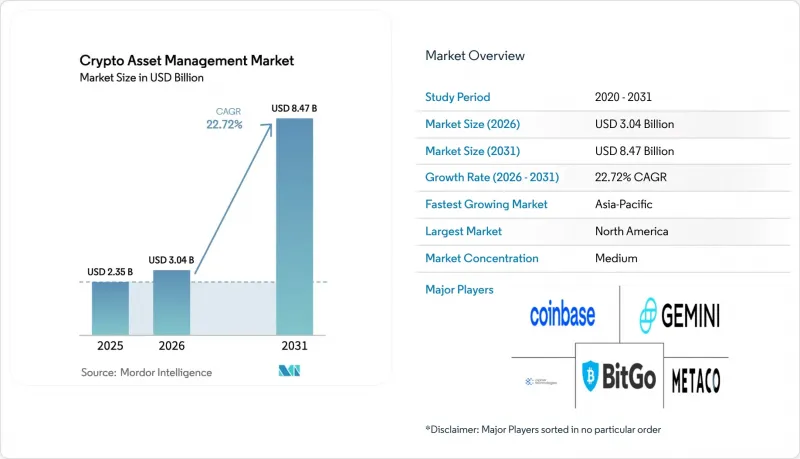
根據 Mordor Intelligence 預測,加密貨幣投資市場規模預計將在 2025 年達到 23.5 億美元,2026 年達到 30.4 億美元,到 2031 年達到 84.7 億美元,2026 年至 2031 年的複合年成長率為 22.72%。
本報告按類型(解決方案和服務)、部署模式(雲端、本地部署、混合部署)、最終用戶行業(例如,銀行、金融服務和保險業)、用戶類型(例如,機構投資者)、投資策略(例如,被動指數基金、主動式管理基金)、資產類別(例如,比特幣、以太幣歐洲)和地區(例如,歐洲)進行分類。市場預測以美元計價。
全球加密貨幣投資市場趨勢及洞察
傳統金融機構的介紹
傳統金融機構如今將數位資產與股票和債券置於同等地位。貝萊德在推出iShares比特幣信託基金後的12個月內募集了400億美元,超過了迄今為止任何比特幣投資產品的總資金流入量。富達數位資產於2025年4月擴展了其託管服務,將以太坊質押納入其中,使退休基金能夠在不增加投資團隊的情況下獲得協議獎勵。摩根大通旗下的Onyx平台在2024年處理了超過1兆美元的代幣化回購交易,顯示基於區塊鏈的平台能夠處理高額結算量。這些進展表明,符合信託標準的基礎設施不再是市場瓶頸。因此,加密資產管理市場在長期資產配置方面正日益與傳統資產類別展開直接競爭。
越來越關注監護安全和保險解決方案。
託管架構已從單密鑰冷資料儲存發展到多方運算 (MPC) 和硬體安全模組。 2024 年,Fireblocks 保護了超過 4 兆美元的交易,且未發生任何加密漏洞。 2024 年 6 月,BitGo 與 Marsh 合作設立了 2.5 億美元的保險基金,以解決董事會層級對資產負債表保護的擔憂。 2024 年 9 月,Gemini 推出了經德勤審計的儲備金證明機制,讓客戶即時驗證其隔離資產。這些措施已將託管安全從一個單純的技術問題轉變為一項必要的合規要求,加速了機構投資者資金流入加密資產管理市場。
缺乏統一的法規結構
根據普華永道估計,監管分散化導致跨國資產管理公司的合規成本增加30%至40%。美國供應商除了要遵守州級匯款許可證要求外,還要應對聯邦執法措施。同時,歐盟加密資產監管條例(MiCA)仍未獲得歐盟以外其他司法管轄區的互認。儘管新加坡和阿拉伯聯合大公國正在吸引尋求更清晰指導的公司,但全球參與者仍面臨註冊、審計和報告要求的重疊問題。這種不確定性阻礙了加密資產管理市場的快速擴張,並減緩了資本形成,直到主要中心建立統一的標準。
細分市場分析
到2025年,解決方案將佔總收入的68.67%。這反映了託管、代幣化和交易軟體在加密資產管理市場中佔據的傳統主導地位。同時,服務板塊預計到2031年將以24.22%的複合年成長率成長,超過加密資產管理市場的整體成長率。諮詢服務目前涵蓋MiCA許可、美國轉讓定價規則和DeFi智慧合約審計等領域。託管服務受到希望獲得質押獎勵但又不想承擔驗證者管理責任的家族辦公室的青睞。
隨著核心託管功能與競爭對手之間的差距縮小,差異化競爭的重點正轉向整合方面的專業知識。 2025年4月,富達數位資產宣布推出託管質押服務,該服務負責處理驗證器營運、稅務文件準備以及交易風險補償。德勤指出,機構投資者從舊有系統遷移到新系統通常需要12到18個月的時間才能重建符合《薩班斯-奧克斯利法案》要求的審計追蹤,這為服務整合商創造了獲取高利潤業務的機會。因此,業務收益很可能成為下一個利潤來源,這將改變加密資產管理市場供應商的服務定價方式。
到2025年,雲端採用率將佔市場佔有率的82.04%,這主要得益於資產管理公司對高可靠性運算能力和收費模式的重視。然而,混合架構預計到2031年將以23.83%的複合年成長率成長,超過加密資產管理市場的整體成長率。歐盟《數位營運彈性法案》(DORA) 的監管要求規定,金融機構必須維護本地容錯移轉計畫。 2025年3月,BitGo透過提供混合託管服務滿足了這項需求,該服務將延遲降低了40%,同時將金鑰保留在本地,並在雲端編配。
混合模式還能滿足中國和俄羅斯等限制跨境資料傳輸的國家的資料主權要求。對於機構投資者而言,這種方法將監管保障與雲端運算強大的分析能力結合。因此,混合解決方案將成為標準之選,重塑加密資產管理市場的供應商藍圖和支出模式。
區域分析
北美地區在2025年貢獻了39.34%的收入。這主要得益於比特幣和以太坊實體ETF核准後,新增300億美元的資金流入。加拿大和美國的退休基金較早進入市場,而像Anchorage這樣的託管機構也獲得了聯邦信託牌照。隨著美國商品期貨交易委員會(CFTC)對數位資產實施風險監管,預計美國資本池將進一步擴大,進而提升加密資產管理市場的流動性。
預計到2031年,亞太地區的複合年成長率將達到24.79%。日本的《支付服務法》於2024年4月生效,該法強制要求交易所隔離資產並維持50%的資本緩衝。韓國的《虛擬資產使用者保護法》於2024年7月生效,該法強制要求提供保險並進行獨立審計。香港在2024年發放了12張平台牌照,讓零售交易在類似股票的監管條件下進行。新加坡繼續保持在該地區的領先地位,並根據嚴格的洗錢防制標準向20多家數位支付代幣提供者發放了牌照。這些措施共同提振了機構投資者和消費者的信心,並提升了該地區在加密資產管理市場中的地位。
在歐洲,MiCA(加密資產監管)護照系統已取得成功,為在多個成員國營運的公司降低了40%的合規成本。主導的中東地區在2024年籌集了超過50億美元的創業投資投資,使杜拜和利雅德成為加密資產中心。在非洲,穩定幣的應用主要集中在奈及利亞、肯亞和南非,這些國家利用穩定幣穩定跨國支付。在南美洲,巴西和阿根廷的需求最為集中,兩國公民正透過穩定幣機制對沖通膨風險。這些新興地區共同為加密資產管理市場帶來了多元化的成長機會。
其他好處:
- Excel格式的市場預測(ME)表
- 3個月的分析師支持
目錄
第1章:引言
- 研究假設和市場定義
- 調查範圍
第2章:調查方法
第3章執行摘要
第4章 市場狀況
- 市場概覽
- 市場促進因素
- 傳統金融機構實施
- 人們對監護安全和保險解決方案的興趣日益濃厚。
- 明確主要經濟體的監管規定
- DeFi協定與CeFi平台的整合
- 經合組織國家退休基金資產配置的實證研究
- 碳中和加密貨幣基金的出現
- 市場限制因素
- 缺乏統一的法規結構
- 市場波動性和流動性風險加劇
- 缺乏為機構投資者承保保險的能力
- ESG(環境、社會和治理)方面與能源消耗相關的問題
- 產業價值鏈分析
- 監理情勢
- 技術展望
- 宏觀經濟因素對市場的影響
- 波特五力分析
第5章 市場規模與成長預測
- 按類型
- 解決方案
- 託管解決方案
- 標記化解決方案
- 匯款和匯款解決方案
- 交易解決方案
- 報告和分析解決方案
- 服務
- 諮詢服務
- 託管服務
- 整合和實施服務
- 解決方案
- 部署模式
- 雲
- 現場
- 混合
- 按最終用戶行業分類
- BFSI
- 零售與電子商務
- 媒體與娛樂
- 衛生保健
- 旅遊與飯店
- 政府/公共部門
- 其他終端用戶產業(能源和物流)
- 依使用者類型
- 機構投資者
- 富裕階層
- 加密貨幣基金
- 個人投資者
- 家族辦公室
- 公司財務部
- 透過投資策略
- 被動指數基金
- 主動式管理基金
- DeFi收益耕作
- 質押和借貸
- 套利策略
- 按資產類別
- 比特幣(BTC)
- 以太坊(ETH)
- 穩定幣
- Altcoin(不包括比特幣和以太坊)
- 代幣化證券
- 按地區
- 北美洲
- 美國
- 加拿大
- 墨西哥
- 歐洲
- 英國
- 德國
- 法國
- 義大利
- 其他歐洲國家
- 亞太地區
- 中國
- 日本
- 印度
- 韓國
- 其他亞洲國家
- 中東
- 以色列
- 沙烏地阿拉伯
- 阿拉伯聯合大公國
- 土耳其
- 其他中東國家
- 非洲
- 南非
- 埃及
- 其他非洲國家
- 南美洲
- 巴西
- 阿根廷
- 其他南美國家
- 北美洲
第6章 競爭情勢
- 市場集中度
- 策略趨勢
- 市佔率分析
- 公司簡介
- Coinbase Global Inc.
- Fidelity Digital Assets
- BitGo Inc.
- Binance Holdings Ltd.
- Gemini Trust Company LLC
- Anchorage Digital
- Fireblocks Ltd.
- Metaco SA
- Crypto Finance AG
- Paxos Trust Company LLC
- Bakkt Holdings Inc.
- Ledger Enterprise Solutions
- Cipher Technologies Management LP
- Amberdata Inc.
- ICONOMI Ltd.
- CoinShares International Ltd.
- Galaxy Digital Holdings Ltd.
- Bitwise Asset Management
- Copper Technologies Ltd.
- Hex Trust Ltd.
第7章 市場機會與未來展望
According to Mordor Intelligence, the crypto asset management market size is projected to be USD 2.35 billion in 2025, USD 3.04 billion in 2026, and reach USD 8.47 billion by 2031, growing at a CAGR of 22.72% from 2026 to 2031.
This report is Segmented by Type (Solutions, and Services), Deployment Mode (Cloud, On-Premise, and Hybrid), End-User Industry (BFSI, and More), User Type (Institutional Investors, and More), Investment Strategy (Passive Index Funds, Actively Managed Funds, and More), Asset Class (Bitcoin, Ethereum, and More), and Geography (Europe, and More). The Market Forecasts are Provided in Terms of Value (USD).
Global Crypto Asset Management Market Trends and Insights
Institutional Adoption by Traditional Financial Firms
Traditional financial institutions now position digital assets alongside equities and bonds. BlackRock captured USD 40 billion within 12 months of launching its iShares Bitcoin Trust, surpassing inflows to all earlier Bitcoin vehicles. Fidelity Digital Assets broadened its custody suite to include Ethereum staking in April 2025, enabling pension plans to earn protocol rewards without adding operational teams. JPMorgan's Onyx processed more than USD 1 trillion in tokenized repo trades during 2024, proving that blockchain rails handle high-value settlement volumes. The progress indicates that fiduciary-grade infrastructure is no longer a market bottleneck. As a result, the crypto asset management market increasingly competes head-to-head with traditional asset classes for long-term allocations.
Rising Focus on Custody Security and Insurance Solutions
Custody architecture has evolved from single-key cold storage to multiparty computation (MPC) and hardware security modules. Fireblocks secured over USD 4 trillion in transfers during 2024 without a single cryptographic breach. BitGo placed a USD 250 million insurance tower in partnership with Marsh in June 2024, addressing board-level concerns about balance-sheet protection. Gemini launched proof-of-reserves attestations audited by Deloitte in September 2024, giving clients real-time visibility into segregated holdings. These measures have moved custody security from a technical talking point to a mandatory compliance requirement, accelerating institutional inflows into the crypto asset management market.
Lack of a Centralised Regulatory Framework
Fragmented rules inflate compliance cost by 30-40% for cross-border managers, according to PwC estimates. U.S. providers juggle state money-transmitter licenses alongside federal enforcement actions, while MiCA still lacks reciprocity with non-EU jurisdictions. Singapore and the United Arab Emirates attract firms seeking clearer guidelines, but global players still face duplicate legal entities, audits, and reporting requirements. The uncertainty hampers rapid scaling in the crypto asset management market and slows capital formation until equivalent standards emerge across major hubs.
Other drivers and restraints analyzed in the detailed report include:
- Regulatory Clarity in Major Economies
- Integration of DeFi Protocols with CeFi Platforms
- High Market Volatility and Liquidity Risks
For complete list of drivers and restraints, kindly check the Table Of Contents.
Segment Analysis
Solutions captured 68.67% of revenue in 2025, reflecting the historical dominance of custody, tokenization, and trading software that underpins the crypto asset management market. Services, however, are expected to grow at a 24.22% CAGR through 2031, faster than the overall crypto asset management market. Consulting engagements now address MiCA licensing, U.S. transfer-pricing rules, and DeFi smart-contract audits. Managed offerings appeal to family offices that want staking rewards without validator oversight.
Competitive parity in core custody features is pushing differentiation toward integration expertise. Fidelity Digital Assets unveiled a managed staking service in April 2025 that handles validator operations, tax paperwork, and slashing-risk coverage. Deloitte notes that institutions migrating from legacy systems often require 12-18 months to re-architect audit trails in line with Sarbanes-Oxley, giving service integrators room to capture higher-margin work. As a result, service revenue will likely form the next profit pool, changing how suppliers price offerings inside the crypto asset management market.
Cloud deployments commanded an 82.04% share in 2025 because asset managers value elastic compute and pay-as-you-grow pricing. Yet hybrid architectures are projected to expand at a 23.83% CAGR through 2031, outpacing overall crypto asset management market growth. Regulatory requirements under the EU's Digital Operational Resilience Act (DORA) oblige financial firms to maintain on-premises failover plans. BitGo answered that need with a hybrid custody service in March 2025 that splits key storage on-premises while orchestrating transactions in the cloud, cutting latency by 40%.
Hybrid models also meet data sovereignty mandates in China and Russia that restrict cross-border transfers. For institutional clients, the approach combines regulatory assurance with the cloud's analytical horsepower. Consequently, hybrid solutions will become a default option, reshaping vendor roadmaps and spending patterns in the crypto asset management market.
Complete Report Scope:
- By Type
- Solutions
- Custody Solutions
- Tokenisation Solutions
- Transfer and Remittance Solutions
- Trading Solutions
- Reporting and Analytics Solutions
- Services
- Consulting Services
- Managed Services
- Integration and Implementation Services
- Solutions
- By Deployment Mode
- Cloud
- On-premise
- Hybrid
- By End-User Industry
- BFSI
- Retail and Ecommerce
- Media and Entertainment
- Healthcare
- Travel and Hospitality
- Government and Public Sector
- Other End-User Industries (Energy and Logistics)
- By User Type
- Institutional Investors
- High Net-Worth Individuals
- Crypto Funds
- Retail Investors
- Family Offices
- Corporate Treasuries
- By Investment Strategy
- Passive Index Funds
- Actively Managed Funds
- DeFi Yield Farming
- Staking and Lending
- Arbitrage Strategies
- By Asset Class
- Bitcoin (BTC)
- Ethereum (ETH)
- Stablecoins
- Altcoins (ex-BTC and ETH)
- Tokenised Securities
- By Geography
- North America
- United States
- Canada
- Mexico
- Europe
- United Kingdom
- Germany
- France
- Italy
- Rest of Europe
- Asia-Pacific
- China
- Japan
- India
- South Korea
- Rest of Asia
- Middle East
- Israel
- Saudi Arabia
- United Arab Emirates
- Turkey
- Rest of Middle East
- Africa
- South Africa
- Egypt
- Rest of Africa
- South America
- Brazil
- Argentina
- Rest of South America
- North America
Geography Analysis
North America accounted for 39.34% of 2025 revenue because spot Bitcoin and Ethereum ETF approvals funnelled USD 30 billion in new capital. Canadian and U.S. pension funds joined early, while custodians such as Anchorage won federal trust charters. As the Commodity Futures Trading Commission refines digital-asset risk rules, United States capital pools are expected to deepen further, anchoring liquidity for the crypto asset management market.
Asia Pacific is projected to grow at a 24.79% CAGR through 2031. Japan's Payment Services Act, effective April 2024, imposes segregated custody and 50% capital buffers for exchanges. South Korea's July 2024 Virtual Asset User Protection Act requires insurance coverage and independent audits. Hong Kong granted 12 platform licenses in 2024, permitting retail trading under market-surveillance conditions that match equities. Singapore remains a regional lighthouse by licensing 20-plus digital payment token providers under strict anti-money-laundering standards. These measures collectively underpin institutional and consumer trust, propelling the region's role in the crypto asset management market.
Europe benefits from MiCA's passporting regime, which cuts compliance costs by 40% for firms operating across multiple member states. The Middle East, led by the United Arab Emirates and Saudi Arabia, pulled in more than USD 5 billion in venture capital in 2024, establishing Dubai and Riyadh as crypto hubs. African adoption clusters around Nigeria, Kenya, and South Africa, where stablecoins stabilize cross-border payments. South American demand concentrates in Brazil and Argentina as citizens hedge inflation through stablecoin rails. Combined, these emerging regions diversify growth opportunities for the crypto asset management market.
- Coinbase Global Inc.
- Fidelity Digital Assets
- BitGo Inc.
- Binance Holdings Ltd.
- Gemini Trust Company LLC
- Anchorage Digital
- Fireblocks Ltd.
- Metaco SA
- Crypto Finance AG
- Paxos Trust Company LLC
- Bakkt Holdings Inc.
- Ledger Enterprise Solutions
- Cipher Technologies Management LP
- Amberdata Inc.
- ICONOMI Ltd.
- CoinShares International Ltd.
- Galaxy Digital Holdings Ltd.
- Bitwise Asset Management
- Copper Technologies Ltd.
- Hex Trust Ltd.
Additional Benefits:
- The market estimate (ME) sheet in Excel format
- 3 months of analyst support
TABLE OF CONTENTS
1 INTRODUCTION
- 1.1 Study Assumptions and Market Definition
- 1.2 Scope of the Study
2 RESEARCH METHODOLOGY
3 EXECUTIVE SUMMARY
4 MARKET LANDSCAPE
- 4.1 Market Overview
- 4.2 Market Drivers
- 4.2.1 Institutional Adoption by Traditional Financial Firms
- 4.2.2 Rising Focus on Custody Security and Insurance Solutions
- 4.2.3 Regulatory Clarity in Major Economies
- 4.2.4 Integration of DeFi Protocols with CeFi Platforms
- 4.2.5 Pension-Fund Allocation Experiments in OECD Countries
- 4.2.6 Emergence of Carbon-Neutral Crypto Funds
- 4.3 Market Restraints
- 4.3.1 Lack of a Centralised Regulatory Framework
- 4.3.2 High Market Volatility and Liquidity Risks
- 4.3.3 Shortage of Institutional-Grade Insurance Capacity
- 4.3.4 ESG Concerns over Energy Consumption
- 4.4 Industry Value-Chain Analysis
- 4.5 Regulatory Landscape
- 4.6 Technological Outlook
- 4.7 Impact of Macroeconomic Factors on the Market
- 4.8 Porter's Five Forces Analysis
- 4.8.1 Bargaining Power of Suppliers
- 4.8.2 Bargaining Power of Buyers
- 4.8.3 Threat of New Entrants
- 4.8.4 Threat of Substitute Products
- 4.8.5 Intensity of Competitive Rivalry
5 MARKET SIZE AND GROWTH FORECASTS (VALUE)
- 5.1 By Type
- 5.1.1 Solutions
- 5.1.1.1 Custody Solutions
- 5.1.1.2 Tokenisation Solutions
- 5.1.1.3 Transfer and Remittance Solutions
- 5.1.1.4 Trading Solutions
- 5.1.1.5 Reporting and Analytics Solutions
- 5.1.2 Services
- 5.1.2.1 Consulting Services
- 5.1.2.2 Managed Services
- 5.1.2.3 Integration and Implementation Services
- 5.1.1 Solutions
- 5.2 By Deployment Mode
- 5.2.1 Cloud
- 5.2.2 On-premise
- 5.2.3 Hybrid
- 5.3 By End-User Industry
- 5.3.1 BFSI
- 5.3.2 Retail and Ecommerce
- 5.3.3 Media and Entertainment
- 5.3.4 Healthcare
- 5.3.5 Travel and Hospitality
- 5.3.6 Government and Public Sector
- 5.3.7 Other End-User Industries (Energy and Logistics)
- 5.4 By User Type
- 5.4.1 Institutional Investors
- 5.4.2 High Net-Worth Individuals
- 5.4.3 Crypto Funds
- 5.4.4 Retail Investors
- 5.4.5 Family Offices
- 5.4.6 Corporate Treasuries
- 5.5 By Investment Strategy
- 5.5.1 Passive Index Funds
- 5.5.2 Actively Managed Funds
- 5.5.3 DeFi Yield Farming
- 5.5.4 Staking and Lending
- 5.5.5 Arbitrage Strategies
- 5.6 By Asset Class
- 5.6.1 Bitcoin (BTC)
- 5.6.2 Ethereum (ETH)
- 5.6.3 Stablecoins
- 5.6.4 Altcoins (ex-BTC and ETH)
- 5.6.5 Tokenised Securities
- 5.7 By Geography
- 5.7.1 North America
- 5.7.1.1 United States
- 5.7.1.2 Canada
- 5.7.1.3 Mexico
- 5.7.2 Europe
- 5.7.2.1 United Kingdom
- 5.7.2.2 Germany
- 5.7.2.3 France
- 5.7.2.4 Italy
- 5.7.2.5 Rest of Europe
- 5.7.3 Asia-Pacific
- 5.7.3.1 China
- 5.7.3.2 Japan
- 5.7.3.3 India
- 5.7.3.4 South Korea
- 5.7.3.5 Rest of Asia
- 5.7.4 Middle East
- 5.7.4.1 Israel
- 5.7.4.2 Saudi Arabia
- 5.7.4.3 United Arab Emirates
- 5.7.4.4 Turkey
- 5.7.4.5 Rest of Middle East
- 5.7.5 Africa
- 5.7.5.1 South Africa
- 5.7.5.2 Egypt
- 5.7.5.3 Rest of Africa
- 5.7.6 South America
- 5.7.6.1 Brazil
- 5.7.6.2 Argentina
- 5.7.6.3 Rest of South America
- 5.7.1 North America
6 COMPETITIVE LANDSCAPE
- 6.1 Market Concentration
- 6.2 Strategic Moves
- 6.3 Market Share Analysis
- 6.4 Company Profiles (includes Global Level Overview, Market Level Overview, Core Segments, Financials as available, Strategic Information, Market Rank/Share for key companies, Products and Services, and Recent Developments)
- 6.4.1 Coinbase Global Inc.
- 6.4.2 Fidelity Digital Assets
- 6.4.3 BitGo Inc.
- 6.4.4 Binance Holdings Ltd.
- 6.4.5 Gemini Trust Company LLC
- 6.4.6 Anchorage Digital
- 6.4.7 Fireblocks Ltd.
- 6.4.8 Metaco SA
- 6.4.9 Crypto Finance AG
- 6.4.10 Paxos Trust Company LLC
- 6.4.11 Bakkt Holdings Inc.
- 6.4.12 Ledger Enterprise Solutions
- 6.4.13 Cipher Technologies Management LP
- 6.4.14 Amberdata Inc.
- 6.4.15 ICONOMI Ltd.
- 6.4.16 CoinShares International Ltd.
- 6.4.17 Galaxy Digital Holdings Ltd.
- 6.4.18 Bitwise Asset Management
- 6.4.19 Copper Technologies Ltd.
- 6.4.20 Hex Trust Ltd.
7 MARKET OPPORTUNITIES AND FUTURE OUTLOOK
- 7.1 White-Space and Unmet-Need Assessment


