


 |
市場調查報告書
商品編碼
2124395
虛擬專用伺服器:市場佔有率分析、行業趨勢和統計數據、成長預測(2026-2031)Virtual Private Server - Market Share Analysis, Industry Trends & Statistics, Growth Forecasts (2026 - 2031) |
||||||

※ 本網頁內容可能與最新版本有所差異。詳細情況請與我們聯繫。
根據 Mordor Intelligence 預測,虛擬專用伺服器 (VPS) 市場規模將從 2025 年的 52 億美元成長到 2026 年的 59.9 億美元,然後在 2031 年達到 121.7 億美元,2026 年至 2031 年的複合年成長率為 15.22%。
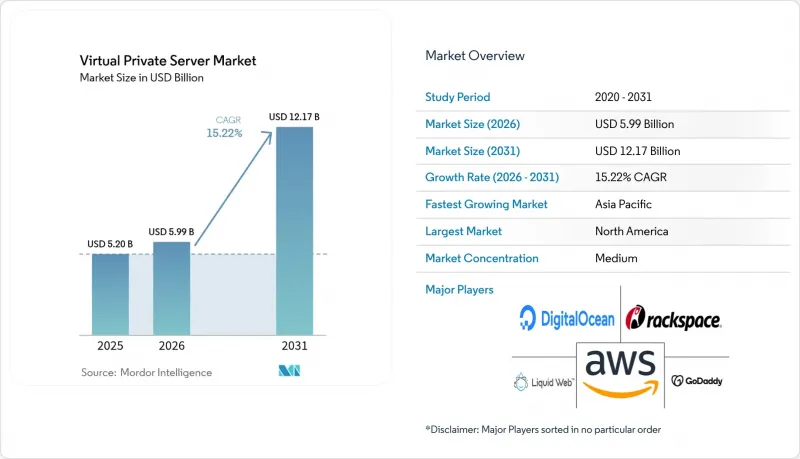
本報告按部署類型(託管型VPS和非託管型VPS)、作業系統(Linux、Windows及其他)、組織規模(大型企業和中小企業)、最終用戶產業(IT與電信、銀行、金融服務和保險等)以及地區進行細分。市場預測以美元計價。
全球虛擬專用伺服器 (VPS) 市場趨勢與洞察
企業安全問題日益嚴重
安全性仍然是企業採用虛擬主機的首要因素,因為企業需要共同託管無法提供的精細化網路控制。超過 56% 的企業報告稱,到 2024 年將遭受與 VPN 相關的網路攻擊,這項數據正促使買家轉向具有可程式設計存取規則的隔離虛擬伺服器。歐洲企業正在進一步加速這一趨勢,以便在遵守 GDPR 的同時,為監管機構保留完整的審計追蹤記錄。提供 ISO 27001 認證、硬體信任根和即時威脅監控的供應商正在將這些保障措施納入其高級訂閱計畫中。
對經濟高效的擴充性和運轉率的需求
嚴格的預算管理促使人們對虛擬專用伺服器 (VPS) 方案的興趣日益濃厚,因為 VPS 能以遠低於專用伺服器的成本提供媲美專用伺服器的效能。採用雲端服務的中小型企業表示,透過將 VPS 作為數位商務的基礎,他們的總成本降低了 2.1 倍。容器化進一步推動了這一趨勢,92% 的受訪公司在其生產環境中運行容器,91% 的公司依賴 Kubernetes編配。因此,供應商正著重推廣具有自癒能力的叢集以及按小時收費、並能根據實際資源使用量線性擴展的模式。
共用/專用雲端與超大規模雲端之間競爭激烈。
像AWS、Azure和Google這樣的超大規模資料中心業者正利用規模經濟優勢,以低於專用主機供應商的價格提供微型實例,而共同託管供應商則透過提供VPS等級的資源保證,模糊了兩者之間的界線。對於可中斷的工作負載,競價型執行個體和搶佔式虛擬機器的價格可以低至75%,這迫使中型供應商除了價格之外,還需要在其他方面脫穎而出。
細分市場分析
到2025年,託管服務將主導市場,佔據67.85%的銷售額,因為企業將修補程式、監控和合規性工作外包給了專業服務商。目前,一級服務供應商正在整合Kubernetes Operator、即時DDoS攻擊防護和基礎設施即程式碼(IaC)模板,以維持此優勢。非託管虛擬專用伺服器(VPS)保持著令人矚目的成長勢頭,預計到2031年複合年成長率(CAGR)將達到16.62%,其用戶群包括業餘愛好者、遊戲伺服器管理員、區塊鏈驗證者以及其他尋求根級權限的用戶。預計到2031年,非託管虛擬專用伺服器的市場規模將達到41.6億美元,顯示市場需求呈現兩極化趨勢。
託管服務正擴大採用人工智慧叢集,透過匯集GPU和共用模型庫來縮短開發週期。 UpCloud於2025年4月首次推出的「免費出站頻寬」服務,正逐漸成為服務供應商區別於仍收費出站頻寬的超超大規模資料中心業者商的關鍵因素。未來,數據傳輸費用的透明度可能成為客戶獲取的決定性因素,尤其對於經營高流量電商網站的中小型企業而言更是如此。
預計到 2025 年,Linux 的市佔率將保持在 55.60%,並以 16.21% 的複合年成長率持續成長至 2031 年。 Docker 和 Kubernetes 等雲端原生工具原生支援 Linux 命名空間,進一步鞏固了其作為微服務部署預設平台的地位。 Windows VPS 在法律、金融和製造等行業中佔據了 .NET 和 Active Directory 工作負載的重要細分市場,但不斷上漲的授權成本使其市場佔有率成長速度落後於 Linux。輕量級 Linux 發行版(有些甚至小於 200MB)可在邊緣裝置上快速啟動,滿足智慧零售和工業IoT等新興的低延遲應用場景。
隨著人工智慧的快速發展,供應商紛紛提供預先配置的 Ubuntu 和 Rocky Linux 映像,這些鏡像整合了 CUDA、cuDNN 和 PyTorch,將資料科學團隊的模型部署時間從幾天縮短到幾小時。安全性方面也優勢顯著。即時核心修補程式可減少停機時間,而 SELinux 和 AppArmor 則無需第三方代理即可提供強制存取控制。
區域分析
預計到2025年,北美將佔據虛擬專用伺服器(VPS)市場37.10%的佔有率,這得益於其密集的、營運商中立的資料中心生態系統和充足的企業IT預算。鳳凰城和蒙特婁等次市場正呈現兩位數的容量成長,超過了土地資源和可再生能源組合已趨於飽和的沿海樞紐地區。該地區的供應商正利用成熟的購電協議(PPA)來確保碳中和能源供應,以應對未來各州日益嚴格的氣候變遷法規。
預計到2031年,亞太地區將以15.82%的複合年成長率實現最高成長,這主要得益於政府的數位經濟措施和光纖回程回程傳輸的快速部署。託管電力需求預計將從2023年的10,233兆瓦成長到2028年的19,069兆瓦,複合年成長率達13.3%,這將為虛擬專用伺服器(VPS)節點的擴張提供支撐。阿里雲和AWS等領先企業正在雅加達、海得拉巴和大阪開設新的可用區,以擴大該地區的電力供應規模,並促進本地託管服務提供商之間的競爭標竿。
在歐洲,對數據主權和永續性的重視正在塑造獨特的市場應用趨勢。即將生效的《歐洲資料法》要求服務提供者保證資料可攜性和公平終止條款,並鼓勵買家考慮支援開放API的虛擬專用伺服器(VPS)供應商。阿姆斯特丹和法蘭克福的電網限制正促使營運商轉向馬德里、華沙和米蘭等新興樞紐城市,這些城市為綠色設施提供優惠的稅收政策。嚴格的能源報告要求推動了浸沒式冷卻和餘熱再利用技術的應用,並將永續性目標與特定的資本投資項目連結起來。
其他好處
- Excel格式的市場預測(ME)表
- 3個月的分析師支持
目錄
第1章:引言
- 研究假設和市場定義
- 調查範圍
第2章:調查方法
第3章執行摘要
第4章 市場狀況
- 市場概覽
- 市場促進因素
- 企業安全問題日益嚴重
- 對經濟高效的擴充性和運轉率的需求
- 中小企業數位商務的蓬勃發展正在推動VPS的普及。
- VPS 作為多重雲端遷移中的橋樑解決方案
- 需要支援 GPU 的替代雲 VPS 的 AI/ML 邊緣工作負載
- 主權雲端和資料居住要求正在推動本地 VPS 的普及。
- 市場限制因素
- 共用/專用雲端與超大規模雲端之間競爭激烈。
- 中小企業客戶缺乏DevOps技能
- 伺服器硬體供應鏈的波動正在推高成本。
- 由於永續發展法規,資料中心營運成本(OPEX)增加。
- 價值鏈分析
- 監理情勢
- 技術展望
- 波特五力分析
- 投資分析
- 評估宏觀經濟趨勢對市場的影響
第5章 市場規模與成長預測
- 依部署類型
- 託管VPS
- 非託管VPS
- 透過作業系統
- Linux
- Windows
- 其他
- 按組織規模
- 大公司
- 中小企業
- 按最終用戶行業分類
- 資訊科技/通訊
- BFSI
- 零售與電子商務
- 醫療保健和生命科學
- 製造業
- 政府/公共部門
- 其他
- 按地區
- 北美洲
- 美國
- 加拿大
- 墨西哥
- 歐洲
- 德國
- 英國
- 法國
- 義大利
- 西班牙
- 其他歐洲國家
- 亞太地區
- 中國
- 日本
- 印度
- 韓國
- 澳洲
- 其他亞太國家
- 南美洲
- 巴西
- 阿根廷
- 其他南美國家
- 中東和非洲
- 中東
- 沙烏地阿拉伯
- 阿拉伯聯合大公國
- 土耳其
- 其他中東國家
- 非洲
- 南非
- 埃及
- 奈及利亞
- 其他非洲地區
- 中東
- 北美洲
第6章 競爭情勢
- 市場集中度
- 策略舉措和趨勢
- 市佔率分析
- 公司簡介
- Amazon Web Services(AWS)
- GoDaddy Inc.
- DigitalOcean, Inc.
- United Internet AG(IONOS)
- OVHcloud
- Rackspace Technology
- Liquid Web, LLC
- Endurance International Group(Newfold Digital)
- DreamHost, LLC
- A2 Hosting, Inc.
- Vultr Holdings Corporation
- InMotion Hosting
- Linode(Akamai Technologies)
- Hetzner Online GmbH
- Leaseweb Global BV
- Namecheap, Inc.
- Hostinger International Ltd.
- Alibaba Cloud
- Microsoft Azure
- Google Cloud Platform
第7章 市場機會與未來展望
According to Mordor Intelligence, the virtual private server market size is expected to grow from USD 5.20 billion in 2025 to USD 5.99 billion in 2026 and is forecast to reach USD 12.17 billion by 2031 at 15.22% CAGR over 2026-2031.
This report is Segmented by Deployment Type (Managed VPS and Unmanaged VPS), Operating System (Linux, Windows, and Other Operating System), Organization Size (Large Enterprises and Small and Medium Enterprises (SMEs)), End-User Vertical (IT and Telecommunication, BFSI, and More), and Geography. The Market Forecasts are Provided in Terms of Value (USD).
Global Virtual Private Server Market Trends and Insights
Rising Enterprise Security Concerns
Security remains the most influential adoption trigger because organizations need granular network controls unavailable in shared hosting. More than 56% of companies reported VPN-related cyberattacks during 2024, a statistic pushing buyers toward isolated virtual servers with programmable access rules. European businesses intensify this move to satisfy GDPR while maintaining full audit trails for regulators. Providers showcasing ISO 27001 certifications, hardware-root-of-trust, and real-time threat monitoring are translating these assurances into premium subscription tiers.
Demand for Cost-Effective Scalability and Uptime
Budget discipline fuels interest in VPS plans that mimic dedicated-server performance but at fractional cost. SMEs adopting cloud services report 2.1 times aggregate cost savings when VPS underpins their digital-commerce stack. Containerization strengthens this trend, with 92% of surveyed organizations running containers in production and 91% relying on Kubernetes orchestration. Vendors therefore emphasize auto-healing clusters and hourly billing models that scale linearly with actual resource draw.
Intense Price Competition
Hyperscalers like AWS, Azure, and Google exploit economies of scale to launch micro-instances that undercut specialist hosts, while shared-hosting providers blur the line with VPS-grade resource guarantees. Spot and pre-emptible VMs can be 75% cheaper for interruptible workloads, challenging mid-tier vendors to differentiate beyond raw price.
Other drivers and restraints analyzed in the detailed report include:
- SME Digital-Commerce Boom Driving VPS Uptake
- VPS as Bridge Solution in Multi-Cloud Migration
- Limited DevOps Skills in SME Customer Base
For complete list of drivers and restraints, kindly check the Table Of Contents.
Segment Analysis
Managed services dominated with 67.85% revenue share in 2025 because enterprises offload patching, monitoring, and compliance to specialists. Tier-one providers now embed Kubernetes operators, real-time DDoS scrubbing, and Infrastructure-as-Code templates to sustain this lead. Unmanaged VPS still posts a compelling 16.62% CAGR through 2031, with hobbyists, game-server admins, and blockchain validators drawn to root-level freedom. The virtual private server market size for unmanaged plans is projected to reach USD 4.16 billion by 2031, demonstrating the dual-track nature of demand.
Managed portfolios increasingly include AI-ready clusters with pooled GPUs and shared model libraries that shorten development sprints. Zero-cost egress offers-first rolled out by UpCloud in April 2025-are spreading through the provider landscape as a differentiator against hyperscalers that still charge for outbound bandwidth. Over time, transparency on data-transfer pricing could become a decisive conversion lever, especially for SMEs hosting high-traffic e-commerce stores.
Linux retained 55.60% share in 2025 and is expected to advance at 16.21% CAGR through 2031. Cloud-native tooling such as Docker and Kubernetes natively targets Linux namespaces, elevating the platform as default for microservices deployment. Windows VPS fills a critical niche for .NET and Active Directory workloads in sectors like legal, finance, and manufacturing, but rising license costs keep its share below the Linux trajectory. Lightweight Linux distributions-some less than 200 MB-boot in seconds on edge devices, satisfying emerging low-latency use cases in smart retail and industrial IoT.
The AI surge prompts vendors to ship pre-configured Ubuntu or Rocky Linux images containing CUDA, cuDNN, and PyTorch, cutting model-deployment times from days to hours for data-science teams. Security advantages also matter: live-kernel patching reduces downtime, and SELinux or AppArmor provide mandatory-access controls without third-party agents.
Complete Report Scope:
- By Deployment Type
- Managed VPS
- Unmanaged VPS
- By Operating System
- Linux
- Windows
- Other Operating System
- By Organization Size
- Large Enterprises
- Small and Medium Enterprises (SMEs)
- By End-user Vertical
- IT and Telecommunication
- BFSI
- Retail and E-commerce
- Healthcare and Life Sciences
- Manufacturing
- Government and Public Sector
- Others
- By Geography
- North America
- United States
- Canada
- Mexico
- Europe
- Germany
- United Kingdom
- France
- Italy
- Spain
- Rest of Europe
- Asia-Pacific
- China
- Japan
- India
- South Korea
- Australia
- Rest of Asia-Pacific
- South America
- Brazil
- Argentina
- Rest of South America
- Middle East and Africa
- Middle East
- Saudi Arabia
- United Arab Emirates
- Turkey
- Rest of Middle East
- Africa
- South Africa
- Egypt
- Nigeria
- Rest of Africa
- Middle East
- North America
Geography Analysis
North America controlled 37.10% of virtual private server market share in 2025, powered by dense carrier-neutral data-center ecosystems and well-funded enterprise IT budgets. Secondary markets like Phoenix and Montreal post double-digit capacity growth because land availability and renewable-energy mix outperform saturated coastal hubs. Providers here leverage mature power-purchase agreements to secure carbon-neutral energy, anticipating stricter state-level climate statutes.
Asia-Pacific is projected to record the fastest CAGR at 15.82% through 2031, supported by government digital-economy blueprints and rapid fiber backhaul deployment. Colocation power is expected to rise from 10,233 MW in 2023 to 19,069 MW by 2028, reflecting a 13.3% compound rate that underpins VPS node expansion. Major players such as Alibaba Cloud and AWS open new availability zones in Jakarta, Hyderabad, and Osaka, scaling regional supply and spurring competitive price benchmarking among local hosts.
Europe's focus on data-sovereignty and sustainability shapes a distinct adoption profile. The impending European Data Act forces providers to guarantee portability and fair exit clauses, encouraging buyers to consider open-API VPS suppliers. Power-grid constraints in Amsterdam and Frankfurt push operators toward emerging hubs in Madrid, Warsaw, and Milan where municipalities offer favorable tax incentives for green facilities. Strict energy-reporting obligations foster adoption of immersion cooling and waste-heat reuse, translating sustainability goals into concrete capital-expenditure lines.
- Amazon Web Services (AWS)
- GoDaddy Inc.
- DigitalOcean, Inc.
- United Internet AG (IONOS)
- OVHcloud
- Rackspace Technology
- Liquid Web, LLC
- Endurance International Group (Newfold Digital)
- DreamHost, LLC
- A2 Hosting, Inc.
- Vultr Holdings Corporation
- InMotion Hosting
- Linode (Akamai Technologies)
- Hetzner Online GmbH
- Leaseweb Global B.V.
- Namecheap, Inc.
- Hostinger International Ltd.
- Alibaba Cloud
- Microsoft Azure
- Google Cloud Platform
Additional Benefits:
- The market estimate (ME) sheet in Excel format
- 3 months of analyst support
TABLE OF CONTENTS
1 INTRODUCTION
- 1.1 Study Assumptions and Market Definition
- 1.2 Scope of the Study
2 RESEARCH METHODOLOGY
3 EXECUTIVE SUMMARY
4 MARKET LANDSCAPE
- 4.1 Market Overview
- 4.2 Market Drivers
- 4.2.1 Rising security concerns among enterprises
- 4.2.2 Demand for cost-effective scalability and uptime
- 4.2.3 SMEs' digital-commerce boom driving VPS uptake
- 4.2.4 VPS as bridge solution in multi-cloud migration
- 4.2.5 AI/ML edge workloads needing GPU-ready alt-cloud VPS
- 4.2.6 Sovereign-cloud and data-residency mandates spurring local VPS
- 4.3 Market Restraints
- 4.3.1 Intense price competition vs shared/dedicated and hyperscale cloud
- 4.3.2 Limited DevOps skills in SME customer base
- 4.3.3 Server-hardware supply-chain volatility inflating costs
- 4.3.4 Sustainability regulations raising data-center OPEX
- 4.4 Value Chain Analysis
- 4.5 Regulatory Landscape
- 4.6 Technological Outlook
- 4.7 Porter's Five Forces Analysis
- 4.7.1 Bargaining Power of Suppliers
- 4.7.2 Bargaining Power of Buyers
- 4.7.3 Threat of New Entrants
- 4.7.4 Threat of Substitutes
- 4.7.5 Intensity of Competitive Rivalry
- 4.8 Investment Analysis
- 4.9 Assessment of the Impact of Macroeconomic Trends on the Market
5 MARKET SIZE AND GROWTH FORECASTS (VALUE)
- 5.1 By Deployment Type
- 5.1.1 Managed VPS
- 5.1.2 Unmanaged VPS
- 5.2 By Operating System
- 5.2.1 Linux
- 5.2.2 Windows
- 5.2.3 Other Operating System
- 5.3 By Organization Size
- 5.3.1 Large Enterprises
- 5.3.2 Small and Medium Enterprises (SMEs)
- 5.4 By End-user Vertical
- 5.4.1 IT and Telecommunication
- 5.4.2 BFSI
- 5.4.3 Retail and E-commerce
- 5.4.4 Healthcare and Life Sciences
- 5.4.5 Manufacturing
- 5.4.6 Government and Public Sector
- 5.4.7 Others
- 5.5 By Geography
- 5.5.1 North America
- 5.5.1.1 United States
- 5.5.1.2 Canada
- 5.5.1.3 Mexico
- 5.5.2 Europe
- 5.5.2.1 Germany
- 5.5.2.2 United Kingdom
- 5.5.2.3 France
- 5.5.2.4 Italy
- 5.5.2.5 Spain
- 5.5.2.6 Rest of Europe
- 5.5.3 Asia-Pacific
- 5.5.3.1 China
- 5.5.3.2 Japan
- 5.5.3.3 India
- 5.5.3.4 South Korea
- 5.5.3.5 Australia
- 5.5.3.6 Rest of Asia-Pacific
- 5.5.4 South America
- 5.5.4.1 Brazil
- 5.5.4.2 Argentina
- 5.5.4.3 Rest of South America
- 5.5.5 Middle East and Africa
- 5.5.5.1 Middle East
- 5.5.5.1.1 Saudi Arabia
- 5.5.5.1.2 United Arab Emirates
- 5.5.5.1.3 Turkey
- 5.5.5.1.4 Rest of Middle East
- 5.5.5.2 Africa
- 5.5.5.2.1 South Africa
- 5.5.5.2.2 Egypt
- 5.5.5.2.3 Nigeria
- 5.5.5.2.4 Rest of Africa
- 5.5.5.1 Middle East
- 5.5.1 North America
6 COMPETITIVE LANDSCAPE
- 6.1 Market Concentration
- 6.2 Strategic Moves and Developments
- 6.3 Market Share Analysis
- 6.4 Company Profiles (includes Global level Overview, Market level overview, Core Segments, Financials as available, Strategic Information, Market Rank/Share for key companies, Products and Services, and Recent Developments)
- 6.4.1 Amazon Web Services (AWS)
- 6.4.2 GoDaddy Inc.
- 6.4.3 DigitalOcean, Inc.
- 6.4.4 United Internet AG (IONOS)
- 6.4.5 OVHcloud
- 6.4.6 Rackspace Technology
- 6.4.7 Liquid Web, LLC
- 6.4.8 Endurance International Group (Newfold Digital)
- 6.4.9 DreamHost, LLC
- 6.4.10 A2 Hosting, Inc.
- 6.4.11 Vultr Holdings Corporation
- 6.4.12 InMotion Hosting
- 6.4.13 Linode (Akamai Technologies)
- 6.4.14 Hetzner Online GmbH
- 6.4.15 Leaseweb Global B.V.
- 6.4.16 Namecheap, Inc.
- 6.4.17 Hostinger International Ltd.
- 6.4.18 Alibaba Cloud
- 6.4.19 Microsoft Azure
- 6.4.20 Google Cloud Platform
7 MARKET OPPORTUNITIES AND FUTURE OUTLOOK
- 7.1 White-space and Unmet-Need Assessment

 全球虛擬專用伺服器 (VPS) 市場規模、佔有率、趨勢和成長分析報告(2026-2034 年)
 虛擬專用伺服器 (VPS) 市場規模、佔有率和成長分析:按類型、作業系統、層級、企業規模、最終用戶產業、銷售管道和地區分類-2026-2033 年產業預測
 虛擬專用伺服器 (VPS) 市場:按服務類型、作業系統和最終用途分類-2026-2032 年全球市場預測
 全球虛擬專用伺服器市場
 虛擬專用伺服器市場報告:按類型、作業系統、組織規模、產業和地區分類(2026-2034 年)
 虛擬專用伺服器市場 - 全球產業規模、佔有率、趨勢、機會、預測:按類型、作業系統、組織規模、產業垂直領域、地區和競爭對手分類,2021-2031 年
 全球虛擬專用伺服器市場規模研究與預測,按作業系統和組織規模、垂直和區域預測 2025-2035