


 |
市場調查報告書
商品編碼
2124387
採購分析:市場佔有率分析、產業趨勢與統計、成長預測(2026-2031)Procurement Analytics - Market Share Analysis, Industry Trends & Statistics, Growth Forecasts (2026 - 2031) |
||||||

※ 本網頁內容可能與最新版本有所差異。詳細情況請與我們聯繫。
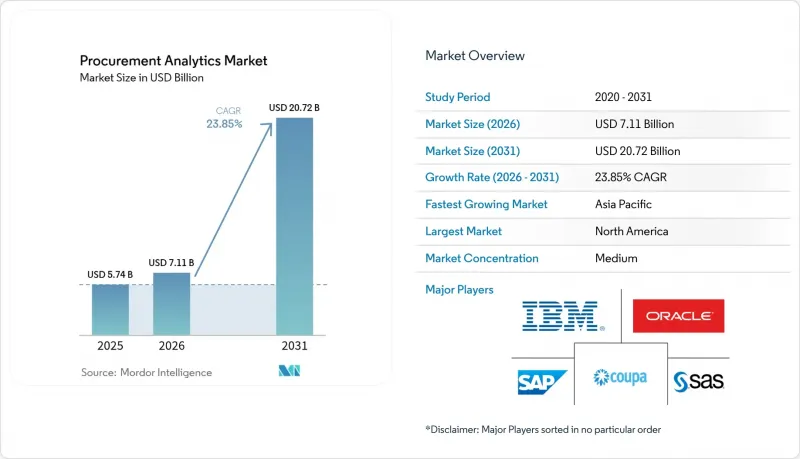
據 Mordor Intelligence 稱,採購分析市場預計到 2026 年價值 71.1 億美元,高於 2025 年的 57.4 億美元,預計到 2031 年將達到 207.2 億美元。
預計 2026 年至 2031 年的複合年成長率為 23.85%。
本報告按類型(軟體和服務)、部署模式(本地部署和雲端部署)、應用(支出分析、風險分析、供應鏈分析等)、最終用戶行業(製造業、運輸和物流業、零售和電子商務等)、組織規模(大型企業和中小企業)以及地區進行細分。市場預測以價值(美元)表示。
全球採購分析市場趨勢與洞察
以SaaS為中心的採購套件藍圖
企業正從分散的本地部署工具轉向整合式雲端原生套件,這些套件按需提供、可擴展,能夠實現全組織範圍的支出視覺性,並加快分析部署進度。這種趨勢在中型企業中尤其明顯,這些企業先前缺乏資金投資企業級基礎設施,但現在正受惠於訂閱定價和自動續約模式。這些平台一旦運作,即可整合分散式資料來源,最佳化採購流程,並為即時監控合規性的機器學習模型奠定基礎。提供預先建置連接器和低程式碼介面的供應商透過縮短價值實現時間並最大限度地減少對稀缺整合人才的依賴,正在獲得競爭優勢。
生成式人工智慧輔助駕駛功能已整合到採購到付款流程中
將生成式人工智慧模組整合到訂購、合約簽訂和供應商績效工作流程中,正在將採購模式從被動回應轉變為洞察主導。財富 500 強企業透過利用人工智慧起草採購文件、對自由格式的支出資料進行分類以及提取談判籌碼,實現了兩位數的處理時間縮短。然而,由於高度敏感的商業數據需要嚴格的管治,因此只有少數公司允許不受限制地存取這些模型。供應商正在透過在其平台中提供基於策略的存取控制、本地化語言模型和資訊脫敏功能來解決這個問題,從而在不阻礙創新的前提下滿足資料保護官的要求。
採購資料工程師短缺
58% 的公司難以招募到既了解資料工程原理又精通品類管理細微之處的分析人才。這種人才短缺導致人事費用上升和引進週期延長,因為不堪重負的團隊必須同時處理資料清洗、標準化和模型維護等任務。雖然一些公司正嘗試透過採用低程式碼資料管道或將模型建立專案外包給供應商來彌補這一差距,但知識轉移仍然是一個持續存在的瓶頸。
細分市場分析
儘管服務業務的收入基數相對較小,但其複合年成長率高達 26.45%,超過了平臺本身的成長率,因為企業逐漸意識到,專業的實施能夠帶來持續的成效。諮詢團隊會舉辦研討會,幫助客戶調整內部無法複製的資料模型,並指導供應商入駐和變更管理。江森自控在全球部署了 14 家工廠的 800 家供應商,凸顯了整合工作所需的規模。因此,儘管軟體業務的佔有率仍保持在 70.62%,但採購分析市場中的服務業務預計將快速成長。交叉培訓計劃、最佳實踐庫和基於結果的定價模式,透過將費用與成本節約掛鉤,進一步推動了服務的普及。儘管平台提供者不斷改進其自助設定嚮導,但由於對資料品質的期望不斷提高,對專業服務的需求依然強勁。擁有內部諮詢部門的供應商可以透過許可和服務雙管齊下,而純粹的顧問公司則專注於複雜的 ERP 系統共存和多語言供應商支援宣傳活動。隨著平台功能日益標準化,差異化的重點正在轉移到實施支援工具和特定領域的操作手冊上,以加快實現價值的時間。
預計到2025年,雲端服務將佔採購分析市場收入的64.35%,鞏固其作為領先交付模式的地位。避免硬體升級、自動修補程式和基於使用量的擴充功能進一步提升了雲端服務的經濟優勢。 Weinor實施雲端套件後,訂單週期縮短了高達41%,相當於全職員工的生產力提升。雖然在本地資料儲存至關重要的監管行業中,本地部署環境仍然佔據主導地位,但即使是這些買家也越來越傾向於混合模式,即利用公共雲端AI引擎,同時將敏感記錄託管在私有雲端中。邊緣運算架構正在成為一項差異化優勢,即使在連接不穩定的工廠環境中也能實現近乎即時的分析。獲得超大規模資料中心業者和託管服務供應商預先認證的供應商正在加速客戶採用雲端服務,同時滿足主權約束。因此,隨著中小企業完全跳過本地部署階段,採購分析市場的雲端採用率預計將進一步擴大。
區域分析
到2025年,北美將佔全球銷售額的36.95%,引領採購分析市場。成熟的雲端基礎設施、密集的專業服務供應商生態系統以及持續的關稅不確定性,正促使企業投資於即時成本建模引擎。對大學和公共產業的調查顯示,超過60%的供應商表達了與關稅相關的擔憂,迫使採購方部署用於情境規劃的儀表板。聯邦政府為關鍵材料回流提供的激勵措施,為採購分析增添了新的維度,要求分析工具能夠整合補貼追蹤和在地採購比例基準。亞太地區正以26.10%的複合年成長率成長,這主要得益於製造業主導的數位轉型和配套的電子政府專案。亞太地區的成長速度最快。中國和東南亞政府主導的「工業4.0」津貼,正在資助將機器資料流與採購關鍵績效指標(KPI)連接的自動化技術。跨國原始設備製造商(OEM)正在新加坡設立採購中心,以利用其「雲端優先」的政策,並將共享服務擴展到東協地區的各工廠。日本企業集團歷來對公共雲端工作負載持謹慎態度,如今卻開始採用主權雲區域,這種區域能夠利用多年採購檔案進行人工智慧模型訓練,同時又能遵守國內隱私法規。歐洲的絕對支出緊隨北美之後。 ESG合規性正將供應鏈透明度視為一項策略議題,與降低成本同等重要,並提倡董事會關注。法國的「數位主權憲章」正在推動對本地託管套件的需求,而英國脫歐後的關稅環境則增加了對統一關稅分類工具的需求。尋求近岸外包合約的東歐製造商正在投資風險分析模組,以量化地緣政治風險和物流交貨前置作業時間的波動。
其他好處:
- Excel格式的市場預測(ME)表
- 3個月的分析師支持
目錄
第1章:引言
- 研究假設和市場定義
- 調查範圍
第2章:調查方法
第3章執行摘要
第4章 市場狀況
- 市場概覽
- 市場促進因素
- 以SaaS為優先的採購套件藍圖
- 將生成式人工智慧輔助駕駛系統整合到採購到付款流程中
- 中型企業買家的雲端原生總體擁有成本經濟效益
- 強制性ESG關聯供應商評估
- 近岸外包策略的預測風險分析
- 用於尾部消費的自主購買機器人
- 市場限制因素
- 採購資料工程師短缺
- 在 ERP 整合框架之外進行的「影子 IT」支出。
- 限制跨境託管的資料主權法規
- 生成式人工智慧的GPU定價為多租戶成本模型帶來了挑戰。
- 產業價值鏈分析
- 技術展望
- 監理情勢
- 產業吸引力—五力分析
- 供應商的議價能力
- 買方的議價能力
- 新進入者的威脅
- 替代品的威脅
- 競爭公司之間的競爭
- 宏觀經濟因素對市場的影響
第5章 市場規模與成長預測
- 按類型
- 軟體
- 服務
- 不同的發展
- 現場
- 雲
- 透過使用
- Spend Analytics
- 風險分析
- 供應鏈分析
- 合約管理
- 需求預測
- 供應商績效管理
- 按最終用戶行業分類
- 製造業
- 運輸/物流
- 零售與電子商務
- BFSI
- IT/通訊
- 醫療保健和生命科學
- 能源公用事業
- 其他終端用戶產業
- 按組織規模
- 大公司
- 中小企業
- 按地區
- 北美洲
- 美國
- 加拿大
- 墨西哥
- 南美洲
- 巴西
- 阿根廷
- 智利
- 其他南美國家
- 歐洲
- 德國
- 英國
- 法國
- 義大利
- 西班牙
- 俄羅斯
- 其他歐洲國家
- 亞太地區
- 中國
- 日本
- 印度
- 韓國
- 新加坡
- 馬來西亞
- 澳洲
- 其他亞太國家
- 中東和非洲
- 中東
- 沙烏地阿拉伯
- 阿拉伯聯合大公國
- 土耳其
- 其他中東國家
- 非洲
- 南非
- 奈及利亞
- 埃及
- 其他非洲國家
- 中東
- 北美洲
第6章 競爭情勢
- 市場集中度
- 策略趨勢
- 市佔率分析
- 公司簡介
- SAP SE
- Oracle Corporation
- IBM Corporation
- SAS Institute Inc.
- Coupa Software Inc.
- Zycus Inc.
- Jaggaer LLC
- GEP Worldwide LLC
- Ivalua Inc.
- Basware Oyj
- Sievo Oy
- SpendHQ LLC
- Proactis Holdings PLC
- Rosslyn Data Technologies PLC
- Simfoni Analytics Ltd.
- Spendscape by McKinsey
- Bridgei2i Analytics Solutions
- Genpact Ltd.
- Accenture PLC
- Deloitte Touche Tohmatsu Ltd.
- Infosys Ltd.
- Capgemini SE
- WNS Global Services
- Xoomworks Procurement
- Infor Inc.
第7章 市場機會與未來趨勢
- 評估閒置頻段和未滿足的需求
According to Mordor Intelligence, procurement analytics market size in 2026 is estimated at USD 7.11 billion, growing from 2025 value of USD 5.74 billion with 2031 projections showing USD 20.72 billion, growing at 23.85% CAGR over 2026-2031.
This report is Segmented by Type (Software and Services), Deployment (On-Premise and Cloud), Application (Spend Analytics, Risk Analytics, Supply Chain Analytics, and More), End-User Industry (Manufacturing, Transportation and Logistic, Retail and E-Commerce, and More), Organization Size (Large Enterprises and Small and Medium Enterprises), and Geography. The Market Forecasts are Provided in Terms of Value (USD).
Global Procurement Analytics Market Trends and Insights
SaaS-first procurement-suite road-maps
Companies are retiring fragmented on-premise tools in favor of unified, cloud-native suites that scale on demand, enable organization-wide spend visibility, and accelerate analytics roll-out schedules. Adoption momentum is most evident among mid-market firms that lacked the capital for enterprise-grade infrastructure, yet now benefit from subscription pricing and automated updates. Once operational, these platforms consolidate disparate data sources, laying the groundwork for machine-learning models that optimize sourcing events and monitor compliance in real time. Vendors that bundle prebuilt connectors and low-code interfaces are gaining an edge because they shorten time-to-value and minimize reliance on scarce integration talent.
Generative-AI copilots embedded in source-to-pay
Generative AI modules embedded inside requisition, contract, and supplier-performance workflows are transforming procurement from reactive to insight-led operations. Fortune-500 adopters report double-digit cuts in processing time after letting AI draft sourcing documents, classify open-text spend, and surface negotiation levers. Nevertheless, only a minority of enterprises allow unrestricted model access because sensitive commercial data requires rigorous governance. Vendors are responding by shipping policy-based access controls, localized language models, and in-platform redaction features that satisfy data-protection officers without stalling innovation.
Shortage of procurement-data engineers
Fifty-eight percent of enterprises struggle to recruit analytics talent who grasp both data-engineering principles and category-management nuances. The scarcity inflates wage bills and prolongs deployment cycles as over-extended teams juggle cleansing, normalization, and model-maintenance tasks. Some firms offset the gap by adopting low-code data-pipelines or outsourcing model-build projects to vendors, yet knowledge transfer remains a persistent bottleneck.
Other drivers and restraints analyzed in the detailed report include:
- Cloud-native TCO economics for mid-market buyers
- ESG-linked supplier scoring mandates
- "Shadow IT" spend outside ERP integration
For complete list of drivers and restraints, kindly check the Table Of Contents.
Segment Analysis
Services held a comparatively small revenue base but are rising at 26.45% CAGR, outpacing platform growth as enterprises acknowledge that skilled implementation drives sustained outcomes. Advisory teams perform data-model tuning, supplier-onboarding, and change-management workshops that customers cannot replicate internally. Johnson Controls' global roll-out, which linked 800 suppliers across 14 plants, underscored the scale of integration work required. The procurement analytics market size for services is therefore projected to expand rapidly, even though software retains a 70.62% share. Cross-training initiatives, best-practice libraries, and outcome-based pricing models are further boosting service uptake by aligning fees with realized savings.Platform providers continue reinforcing self-service configuration wizards, yet growing data-quality expectations keep professional services in demand. Vendors with embedded advisory arms can monetize both license and services streams, while pure-play consultancies specialize in complex ERP co-existence or multi-lingual supplier-enablement campaigns. As platform functionality standardizes, differentiation tilts toward implementation accelerators and domain-specific playbooks that cut time-to-value.
Cloud accounts for 64.35% of 2025 revenue, confirming its status as the dominant delivery model for the procurement analytics market. The economics improve when factoring in avoided hardware refreshes, automated patching, and usage-based scaling. Weinor's adoption of a cloud suite trimmed requisition cycle times by up to 41%, equating to a full-time employee's productivity gain. On-premise persists in regulated verticals that mandate local data residency, but even these buyers favor hybrid models that host sensitive records in private clouds while consuming AI engines from public clouds.Edge-ready architecture is emerging as a differentiator, enabling near-real-time analytics at factory sites with intermittent connectivity. Vendors that pre-certify with hyperscalers and colocation providers accelerate customer deployments while satisfying sovereignty constraints. Consequently, the procurement analytics market share of cloud deployments is set to widen further as smaller firms leapfrog on-premise generations altogether.
Complete Report Scope:
- By Type
- Software
- Services
- By Deployment
- On-Premise
- Cloud
- By Application
- Spend Analytics
- Risk Analytics
- Supply Chain Analytics
- Contract Management
- Demand Forecasting
- Supplier Performance Management
- By End-user Industry
- Manufacturing
- Transportation and Logistics
- Retail and E-commerce
- BFSI
- IT and Telecommunication
- Healthcare and Life Sciences
- Energy and Utilities
- Other End-user Industries
- By Organization Size
- Large Enterprises
- Small and Medium Enterprises (SMEs)
- By Geography
- North America
- United States
- Canada
- Mexico
- South America
- Brazil
- Argentina
- Chile
- Rest of South America
- Europe
- Germany
- United Kingdom
- France
- Italy
- Spain
- Russia
- Rest of Europe
- Asia-Pacific
- China
- Japan
- India
- South Korea
- Singapore
- Malaysia
- Australia
- Rest of Asia-Pacific
- Middle East and Africa
- Middle East
- Saudi Arabia
- United Arab Emirates
- Turkey
- Rest of Middle East
- Africa
- South Africa
- Nigeria
- Egypt
- Rest of Africa
- Middle East
- North America
Geography Analysis
North America led the procurement analytics market with 36.95% revenue in 2025. Mature cloud infrastructure, a dense ecosystem of specialized service providers, and continued tariff uncertainty encourage enterprises to invest in real-time cost-modeling engines. Universities and utilities confirm that more than 60% of their suppliers express tariff-related concerns, pushing buyers to deploy scenario-planning dashboards. Federal incentives for reshoring critical materials add another dimension, requiring analytics that integrate subsidy tracking and local-content thresholds.Asia-Pacific delivers 26.10% CAGR due to manufacturing-led digitization and supportive e-governance programs. Asia-Pacific posts the fastest growth. Government-led manufacturing 4.0 grants in China and South-East Asia subsidize automation that pairs machine-data streams with procurement KPIs. Multinational OEMs locate sourcing centers in Singapore to tap its cloud-first regulations, then extend shared services across ASEAN plants. Japanese conglomerates, historically cautious about public-cloud workloads, are adopting sovereign-cloud zones that satisfy domestic privacy statutes while enabling AI model training on multi-year purchasing archives.Europe ranks close behind North America in absolute spend. ESG compliance drives analytics to the boardroom, where supply-chain transparency becomes as strategic as price savings. France's digital-sovereignty charter propels demand for regionally hosted suites, while the United Kingdom's post-Brexit customs landscape amplifies the need for harmonized tariff-classification tools. Eastern European manufacturers, aiming to capture near-shoring contracts, invest in risk-analytics modules that quantify geopolitical exposure and logistics lead-time variability.
- SAP SE
- Oracle Corporation
- IBM Corporation
- SAS Institute Inc.
- Coupa Software Inc.
- Zycus Inc.
- Jaggaer LLC
- GEP Worldwide LLC
- Ivalua Inc.
- Basware Oyj
- Sievo Oy
- SpendHQ LLC
- Proactis Holdings PLC
- Rosslyn Data Technologies PLC
- Simfoni Analytics Ltd.
- Spendscape by McKinsey
- Bridgei2i Analytics Solutions
- Genpact Ltd.
- Accenture PLC
- Deloitte Touche Tohmatsu Ltd.
- Infosys Ltd.
- Capgemini SE
- WNS Global Services
- Xoomworks Procurement
- Infor Inc.
Additional Benefits:
- The market estimate (ME) sheet in Excel format
- 3 months of analyst support
TABLE OF CONTENTS
1 INTRODUCTION
- 1.1 Study Assumptions and Market Definition
- 1.2 Scope of the Study
2 RESEARCH METHODOLOGY
3 EXECUTIVE SUMMARY
4 MARKET LANDSCAPE
- 4.1 Market Overview
- 4.2 Market Drivers
- 4.2.1 SaaS-first procurement-suite road-maps
- 4.2.2 Generative-AI copilots embedded in Source-to-Pay
- 4.2.3 Cloud-native TCO economics for mid-market buyers
- 4.2.4 ESG-linked supplier scoring mandates
- 4.2.5 Predictive risk analytics for near-shoring strategies
- 4.2.6 Autonomous purchasing bots for tail-spend
- 4.3 Market Restraints
- 4.3.1 Shortage of procurement-data engineers
- 4.3.2 "Shadow IT" spend outside ERP integration
- 4.3.3 Data-sovereignty regulations limiting cross-border hosting
- 4.3.4 Multi-tenant cost models challenged by Gen-AI GPU pricing
- 4.4 Industry Value Chain Analysis
- 4.5 Technological Outlook
- 4.6 Regulatory Landscape
- 4.7 Industry Attractiveness - Porter's Five Forces Analysis
- 4.7.1 Bargaining Power of Suppliers
- 4.7.2 Bargaining Power of Buyers
- 4.7.3 Threat of New Entrants
- 4.7.4 Threat of Substitutes
- 4.7.5 Intensity of Competitive Rivalry
- 4.8 Impact of Macroeconomic Factors on the Market
5 MARKET SIZE AND GROWTH FORECASTS (VALUES)
- 5.1 By Type
- 5.1.1 Software
- 5.1.2 Services
- 5.2 By Deployment
- 5.2.1 On-Premise
- 5.2.2 Cloud
- 5.3 By Application
- 5.3.1 Spend Analytics
- 5.3.2 Risk Analytics
- 5.3.3 Supply Chain Analytics
- 5.3.4 Contract Management
- 5.3.5 Demand Forecasting
- 5.3.6 Supplier Performance Management
- 5.4 By End-user Industry
- 5.4.1 Manufacturing
- 5.4.2 Transportation and Logistics
- 5.4.3 Retail and E-commerce
- 5.4.4 BFSI
- 5.4.5 IT and Telecommunication
- 5.4.6 Healthcare and Life Sciences
- 5.4.7 Energy and Utilities
- 5.4.8 Other End-user Industries
- 5.5 By Organization Size
- 5.5.1 Large Enterprises
- 5.5.2 Small and Medium Enterprises (SMEs)
- 5.6 By Geography
- 5.6.1 North America
- 5.6.1.1 United States
- 5.6.1.2 Canada
- 5.6.1.3 Mexico
- 5.6.2 South America
- 5.6.2.1 Brazil
- 5.6.2.2 Argentina
- 5.6.2.3 Chile
- 5.6.2.4 Rest of South America
- 5.6.3 Europe
- 5.6.3.1 Germany
- 5.6.3.2 United Kingdom
- 5.6.3.3 France
- 5.6.3.4 Italy
- 5.6.3.5 Spain
- 5.6.3.6 Russia
- 5.6.3.7 Rest of Europe
- 5.6.4 Asia-Pacific
- 5.6.4.1 China
- 5.6.4.2 Japan
- 5.6.4.3 India
- 5.6.4.4 South Korea
- 5.6.4.5 Singapore
- 5.6.4.6 Malaysia
- 5.6.4.7 Australia
- 5.6.4.8 Rest of Asia-Pacific
- 5.6.5 Middle East and Africa
- 5.6.5.1 Middle East
- 5.6.5.1.1 Saudi Arabia
- 5.6.5.1.2 United Arab Emirates
- 5.6.5.1.3 Turkey
- 5.6.5.1.4 Rest of Middle East
- 5.6.5.2 Africa
- 5.6.5.2.1 South Africa
- 5.6.5.2.2 Nigeria
- 5.6.5.2.3 Egypt
- 5.6.5.2.4 Rest of Africa
- 5.6.5.1 Middle East
- 5.6.1 North America
6 COMPETITIVE LANDSCAPE
- 6.1 Market Concentration
- 6.2 Strategic Moves
- 6.3 Market Share Analysis
- 6.4 Company Profiles (includes Global level Overview, Market level overview, Core Segments, Financials as available, Strategic Information, Market Rank/Share for key companies, Products and Services, and Recent Developments)
- 6.4.1 SAP SE
- 6.4.2 Oracle Corporation
- 6.4.3 IBM Corporation
- 6.4.4 SAS Institute Inc.
- 6.4.5 Coupa Software Inc.
- 6.4.6 Zycus Inc.
- 6.4.7 Jaggaer LLC
- 6.4.8 GEP Worldwide LLC
- 6.4.9 Ivalua Inc.
- 6.4.10 Basware Oyj
- 6.4.11 Sievo Oy
- 6.4.12 SpendHQ LLC
- 6.4.13 Proactis Holdings PLC
- 6.4.14 Rosslyn Data Technologies PLC
- 6.4.15 Simfoni Analytics Ltd.
- 6.4.16 Spendscape by McKinsey
- 6.4.17 Bridgei2i Analytics Solutions
- 6.4.18 Genpact Ltd.
- 6.4.19 Accenture PLC
- 6.4.20 Deloitte Touche Tohmatsu Ltd.
- 6.4.21 Infosys Ltd.
- 6.4.22 Capgemini SE
- 6.4.23 WNS Global Services
- 6.4.24 Xoomworks Procurement
- 6.4.25 Infor Inc.
7 MARKET OPPORTUNITIES AND FUTURE TRENDS
- 7.1 White-Space and Unmet-Need Assessment

 採購分析市場-2026-2032年全球市場預測
 2026年全球採購分析市場報告
 採購分析市場分析及預測(至2035年):依類型、產品類型、服務、技術、組件、應用、部署類型、最終用戶及功能分類
 全球採購分析市場規模、佔有率、趨勢和成長分析報告(2026-2034)全球採購分析市場:市場規模、佔有率、成長率、產業分析、依類型、應用和地區劃分的分析及預測(2026-2034 年)
 採購分析市場規模、佔有率和成長分析(按組件、部署類型、組織規模、應用、最終用戶和地區分類)-2026-2033年產業預測
 2025-2029 年全球採購分析市場