


 |
市場調查報告書
商品編碼
2124355
瀝青鋪築機:市場佔有率分析、產業趨勢與統計、成長預測(2026-2031)Asphalt Pavers - Market Share Analysis, Industry Trends & Statistics, Growth Forecasts (2026 - 2031) |
||||||

※ 本網頁內容可能與最新版本有所差異。詳細情況請與我們聯繫。
根據 Mordor Intelligence 預測,瀝青攤舖機市場規模將從 2025 年的 30.7 億美元成長到 2026 年的 32.3 億美元,到 2031 年將達到 41.5 億美元,2026 年至 2031 年的複合年成長率為 5.13%。
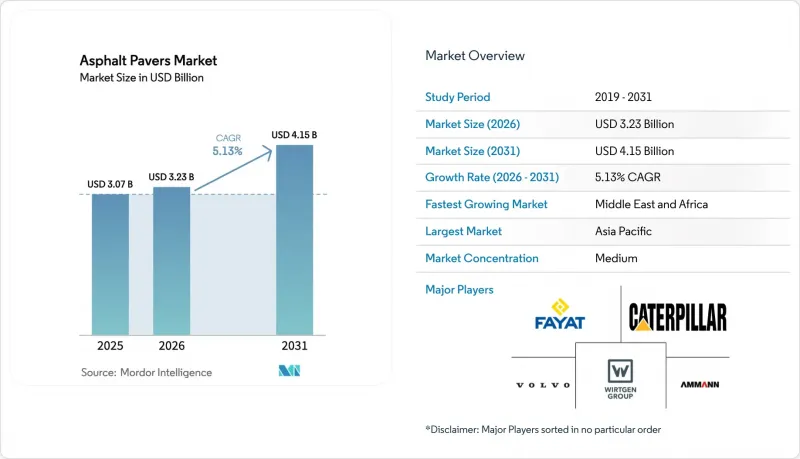
本報告按類型(履帶式攤舖機、輪式攤舖機等)、路面寬度(小於1.5米、1.5至2.3米或以上)、應用領域(高速公路和主要道路、城市道路等)、最終用戶(政府和公共機構、私人建築承包商等)以及地區(北美等)進行細分。市場預測以價值(美元)和數量(台)表示。
全球瀝青攤舖機市場趨勢及洞察
亞太地區的快速道路建設與都市化
快速的都市化正推動亞太地區高速公路和城市道路建設項目激增。中國廣東省計劃在2025年建成12,000公里新高速公路,印度則計劃在2027年改善17,000公里道路,預計未來幾年訂單。在「一帶一路」計劃的資助下,印尼和越南正在支持大型高速公路計畫的競標,預計到2025年,每條高速公路的建設成本將超過50億美元。同時,印度農村地區的社區道路正在引入更小巧、更緊湊的攤舖機。亞洲開發銀行(亞銀)估計,到2030年,亞洲開發中國家每年將需要1.7兆美元的基礎建設投資,這必將推動瀝青鋪築機市場的成長速度超過歐洲和北美。
加快北美基礎建設資金籌措
美國《基礎建設投資與就業法案》撥款1,100億美元用於道路和橋樑建設,其中約76%的資金已規定在2025年中期前使用完畢。各省交通部門優先考慮預防性維護,導致對薄層罩面用熨平板和噴灑式攤舖機的需求增加。加拿大的「投資加拿大」計畫已在公共交通、綠色基礎設施和社會基礎設施方面投資335億加元,推動了履帶式攤舖機(配備低溫套件)的普及。強制使用溫拌瀝青使得即使在低至攝氏10度的溫度下也能進行攤舖作業,從而延長工期4-6週,並提高機器的年運轉率。
先進攤舖機的初始投資和維護成本較高。
配備遠端資訊處理功能的履帶式攤舖機售價在 45 萬至 65 萬美元之間,對於許多小規模承包商而言難以承受。維護需求也更為複雜,因為感測器陣列、液壓系統和內建軟體都需要經過原廠認證的服務供應商,而這類服務提供者在農村地區十分稀缺。進口關稅和融資管道有限進一步推高了新興市場的總服務供應商成本,導致買家傾向於選擇不含高階電子設備的入門級機型。中國品牌雖然以大幅折扣的價格提供功能豐富的機器,但由於技術差距,在監管嚴格的市場中吸引力不足。
細分市場分析
2025年,履帶式攤舖機的銷售量佔比達到56.36%,顯示承包商對其在鬆軟地面和陡坡上的作業表現充滿信心。在都市區道路翻新中,輪式攤舖機因其快速移動能夠減少停機時間而仍是首選。然而,履帶式攤舖機高速模式的加入導致其市場佔有率下降。熨平板攤舖機市場表現突出,預計到2031年將以6.88%的複合年成長率成長,這主要得益於道路養護預算優先考慮薄層罩面和粘結耐磨層。美國各州的養護支出使得2025年公路資金的很大一部分將用於預防性養護,從而推動了伸縮式熨平板攤舖機的訂單成長。這種需求也提升了智慧熨平板攤舖機的訂單,智慧熨平板攤舖機能夠根據溫度波動自動補償夯實振動頻率。
預計到2025年,電動履帶式攤舖機將問世,降低夜間攤舖噪音,並有助於在人口密集的城市中實現零排放法規的要求。同時,輪式攤舖機正在縮小轉彎半徑並引入半自動駕駛功能,以保持其競爭力。熨平板供應商目前正在整合感測器,用於測量路面層的密度和溫度,從而為專案業主提供可用於審計的報告,並增加售後服務軟體的收入。不同類型機器的融合預示著多功能平台的出現,這些平台可以透過外接模組在高速公路、地方道路和路面加鋪層施工任務之間切換。
寬度為2.4米至2.55米的標準型攤舖機預計在2025年將佔總銷售量的35.87%,適用於大多數地區的單車道公路。然而,由於機場跑道和多車道公路需要更快的攤舖速度和更少的冷接縫,寬度超過2.55公尺的攤舖機正以7.58%的複合年成長率成長。在中國,未來引入自動駕駛卡車所需的3.75公尺車道寬度要求推動了對更寬攤舖機的需求,能夠同時攤舖雙車道的攤舖機正在研發中。寬度小於1.5公尺的緊湊型攤舖機適用於自行車道和人行道,並受益於歐洲城市規劃擴大汽車禁行區域的趨勢。
機場競標一再指出,航班延誤造成的損失每小時可達 5 萬至 10 萬美元,這充分證明了投資配備連續作業能力的寬軌攤舖機的必要性。歐洲原始設備製造商 (OEM) 已抓住這一機遇,其旗艦機型已在 2025 年前贏得了法蘭克福和阿姆斯特丹等地備受矚目的跑道建設項目。在雅加達和胡志明市狹窄的城市巷道中,對寬度小於 1.5 公尺的攤舖機的需求日益成長,亞洲製造商正憑藉配備橡膠履帶的輕型設計,在這個利潤豐厚的市場中佔據一席之地。如今,買家不再僅根據標價來評估攤舖機,而是更多地考慮專案的整體經濟效益,並且根據應用的緊迫性進一步細分市場需求。
區域分析
預計到2025年,亞太地區將佔總收入的37.92%,並以5.09%的複合年成長率成長,這主要得益於印度的「印度公路網」(Bharatmala)項目和中國的省級公路建設。中東和非洲地區雖然絕對規模小規模,但預計到2031年將以6.57%的複合年成長率加速成長,這主要得益於石油投資的國家項目為多車道高速公路和機場擴建提供的資金。沙烏地阿拉伯已在其「2030願景」中撥款400億美元用於交通基礎設施建設,而阿拉伯聯合大公國正在對2500公里的聯邦公路進行現代化改造,以支持自動駕駛汽車的測試。在「一帶一路」計劃資助的撒哈拉以南非洲計畫中,低成本的中國製造攤舖機備受青睞,但由於遠端資訊處理技術和排放氣體法規方面的技術差距,這些設備難以進入北美和歐盟的競標市場。
在北美,道路建設的複合年成長率 (CAGR) 為 3.15%,這主要得益於聯邦政府持續的預算撥款以及各州為應對氣候變遷而推出的適應性項目,這些項目需要用於溫拌瀝青和噴灑式路面鋪設的設備。在歐洲,由於財政限制嚴重限制了新建設,道路建設的複合年成長率較為溫和,為 2.88%,但「歐洲綠色交易」正鼓勵各市政當局採用電動攤舖機進行夜間作業。南美洲的成長率為 2.01%,反映了外匯波動和公共債務負擔,但巴西的「Rota 2030」道路改善計畫(與電動車充電走廊相關)為中期發展提供了助力。大洋洲的成長率為 2.89%,主要得益於紐西蘭的抗震維修和澳洲分階段的基礎建設計畫。
監理差異影響著產品規格。歐盟第五階段引擎排放標準推高了單價,但也設置了合規壁壘,保護了高階OEM製造商的利益。中東買家要求產品具備耐高溫和防塵性能,以應對沙漠氣候。印度將於2024年推出的IS 16246標準規定了砂漿加熱的均勻性和壓實度標準,從而抑制了低價進口產品的湧入。這種監管碎片化迫使全球製造商管理區域認證組合,增加了研發成本和庫存持有成本。
其他好處:
- Excel格式的市場預測(ME)表
- 3個月的分析師支持
目錄
第1章:引言
- 研究假設和市場定義
- 調查範圍
第2章:調查方法
第3章執行摘要
第4章 市場狀況
- 市場概覽
- 市場促進因素
- 全部區域道路建設和都市化快速推進
- 加快北美基礎建設資金籌措
- 整合遠端資訊處理和坡度控制技術可提高投資報酬率
- 採用溫拌瀝青延長了鋪路季節。
- 人口稠密的城市對小型攤舖機的需求日益成長。
- 採用噴塗紙黏合覆膜技術。
- 市場限制因素
- 先進攤舖機的初始投資和維護成本較高。
- 設備租賃經營模式的拓展
- 瀝青價格波動導致採購週期不穩定。
- 技術密集機械設備熟練操作人員短缺
- 價值供應鏈分析
- 監理情勢
- 技術展望
- 波特五力模型
第5章 市場規模與成長預測
- 按類型
- 履帶式攤舖機
- 輪式攤舖機
- 長篇大論
- 按路面面積
- 小於1.5米
- 1.5~2.3 m
- 2.4~2.55 m
- 2.55公尺或以上
- 透過使用
- 高速公路和主要道路
- 都市區的道路和街道
- 停車場和私人道路
- 機場跑道和滑行道
- 最終用戶
- 政府和公共機構
- 私人建築承包商
- 租賃設備公司
- 按地區
- 北美洲
- 美國
- 加拿大
- 其他北美國家
- 南美洲
- 巴西
- 阿根廷
- 其他南美國家
- 歐洲
- 德國
- 英國
- 法國
- 義大利
- 其他歐洲國家
- 亞太地區
- 中國
- 印度
- 日本
- 韓國
- 其他亞太國家
- 中東和非洲
- 阿拉伯聯合大公國
- 沙烏地阿拉伯
- 土耳其
- 埃及
- 南非
- 其他中東和非洲國家
- 北美洲
第6章 競爭情勢
- 市場集中度
- 策略趨勢
- 市佔率分析
- 公司簡介
- Caterpillar Inc.
- Volvo Construction Equipment AB
- Wirtgen Group
- Fayat Group
- Ammann Group
- Astec Industries Inc.
- XCMG Construction Machinery Co. Ltd.
- SANY Heavy Industry Co. Ltd.
- Komatsu Ltd.
- Zoomlion Heavy Industry Sci-Tech Co. Ltd.
- Sakai Heavy Industries Ltd.
- Shantui Construction Machinery Co. Ltd.
- LeeBoy Inc.
- Sumitomo Construction Machinery Co. Ltd.
- Weiler Inc.
- Mauldin Paving Products
第7章 市場機會與未來展望
According to Mordor Intelligence, the asphalt paver market size is expected to grow from USD 3.07 billion in 2025 to USD 3.23 billion in 2026 and is forecast to reach USD 4.15 billion by 2031 at a 5.13% CAGR over 2026-2031.
This report is Segmented by Type (Tracked Pavers, Wheeled Pavers, and More), Paving Range (Less Than 1. 5 M, 1. 5-2. 3 M, and More), Application (Highways and Major Roads, Urban Roads and Streets, and More), End-User (Government and Public Agencies, Private Construction Contractors, and More), and Geography (North America and More). Market Forecasts are Provided in Terms of Value (USD) and Volume (Units).
Global Asphalt Pavers Market Trends and Insights
Surge in Road-Building and Urbanization Across APAC
Rapid urbanization is spurring a wave of highway and municipal road projects in the Asia-Pacific. China's Guangdong had plans to complete 12,000 km of new expressways in 2025, and India aims for 17,000 km of upgrades by 2027, guaranteeing multi-year order books for tracked machines. Belt and Road financing is underwriting arterial-road tenders in Indonesia and Vietnam, each exceeding USD 5 billion in 2025, while tier-2 Indian cities are adding compact pavers for neighborhood streets. The Asian Development Bank estimates that developing Asia needs USD 1.7 trillion in annual infrastructure investment through 2030, assuring that the asphalt paver market will outpace Western regions in absolute unit growth.
Accelerated Infrastructure Funding in North America
The U.S. Infrastructure Investment and Jobs Act earmarked USD 110 billion for roads and bridges, with around 76% of the funds already obligated by mid-2025. State transportation departments are emphasizing preventive maintenance, raising demand for thin-overlay screeds and spray-bonded pavers. Canada's Investing in Canada program is injecting CAD 33.5 billion into public transit, green infrastructure, and social infrastructure, guiding specifications toward tracked pavers with cold-weather packages. Warm-mix asphalt mandates enable paving in temperatures as low as 10 °C, adding four to six extra working weeks and lifting annual machine utilization.
High Capital and Maintenance Costs of Advanced Pavers
Telematics-equipped tracked pavers can list between USD 450,000 and USD 650,000, pricing many smaller contractors out of the ownership model. Maintenance needs grow more complex as sensor suites, hydraulics, and embedded software demand OEM-certified service providers, seldom found in rural regions. Import tariffs and limited access to credit further raise the total cost of ownership in emerging economies, pushing buyers toward basic models that skip premium electronics. Chinese brands offer stripped-down machines at a robust discount, but the technology gap narrows their appeal in regulated markets.
Other drivers and restraints analyzed in the detailed report include:
- Integration of Telematics and Grade-Control Boosting ROI
- Warm-Mix Asphalt Adoption Extending Paving Seasons
- Expansion of Equipment Rental Business Model
For complete list of drivers and restraints, kindly check the Table Of Contents.
Segment Analysis
Tracked pavers captured 56.36% of 2025 revenue, illustrating contractor trust in their traction on soft base layers and steep grades. Wheeled variants remain favored for urban resurfacing because quicker relocation lowers idle time, yet their market share is eroding as tracked models add higher travel-speed modes. The screed segment stands out with a 6.88% CAGR to 2031, propelled by pavement-preservation budgets that emphasize thin overlays and bonded-wearing courses. State maintenance outlays in the United States channeled the majority of 2025 highway funds into preventive treatments, boosting orders for extendable screeds. This demand reinforced the appeal of intelligent screeds that auto-correct tamper frequency for temperature swings.
Electrified tracked machines debuted in 2025, promising quieter night paving and compliance with zero-emission mandates in dense cities. Wheeled pavers have responded with tighter turning radii and semi-autonomous steering to remain relevant. Screed suppliers now integrate sensors that capture mat density and temperature, feeding project owners with audit-ready reports and elevating after-sales software revenue. The convergence of type categories foreshadows multi-role platforms able to toggle between highway, street, and overlay duties through bolt-on modules.
Standard 2.4-2.55 m widths yielded 35.87% of 2025 revenue, matching single-lane highway specifications in most regions. Yet machines above 2.55 m are growing at 7.58% CAGR as airport runways and multi-lane expressways demand faster passes and fewer cold joints. China's 3.75 m lane requirements for future autonomous trucking push even wider screeds, inspiring models that place two lanes in one go. Compact ranges under 1.5 m cover bike paths and pedestrian precincts, benefiting from European city plans that expand car-free zones.
Airport tenders routinely cite airline delay costs of USD 50,000-100,000 per hour, justifying investment in wide pavers capable of relentless throughput. European OEMs have capitalized, with flagship units securing high-profile runway jobs at Frankfurt and Amsterdam during 2025. Narrow urban alleys in Jakarta and Ho Chi Minh City are fueling uptake of sub-1.5 m pavers, a sweet spot that Asian manufacturers are exploiting with lightweight, rubber-track designs. Buyers now evaluate range categories through total project economics rather than sticker price, further segmenting demand by application urgency.
Complete Report Scope:
- By Type
- Tracked Pavers
- Wheeled Pavers
- Screeds
- By Paving Range
- Less than 1.5 m
- 1.5 to 2.3 m
- 2.4 to 2.55 m
- Above 2.55 m
- By Application
- Highways and Major Roads
- Urban Roads and Streets
- Parking Lots and Driveways
- Airport Runways and Taxiways
- By End-User
- Government and Public Agencies
- Private Construction Contractors
- Rental Equipment Companies
- By Geography
- North America
- United States
- Canada
- Rest of North America
- South America
- Brazil
- Argentina
- Rest of South America
- Europe
- Germany
- United Kingdom
- France
- Italy
- Rest of Europe
- Asia-Pacific
- China
- India
- Japan
- South Korea
- Rest of Asia-Pacific
- Middle East and Africa
- United Arab Emirates
- Saudi Arabia
- Turkey
- Egypt
- South Africa
- Rest of Middle-East and Africa
- North America
Geography Analysis
Asia-Pacific contributed 37.92% of 2025 revenue and is advancing at a 5.09% CAGR, anchored by India's Bharatmala highway program and provincial expressways in China. Middle East and Africa, though smaller in absolute terms, will accelerate at 6.57% CAGR through 2031 as oil-funded sovereign plans finance multilane corridors and airport expansions. Saudi Arabia earmarked USD 40 billion for transport under Vision 2030, and the UAE is modernizing 2,500 km of federal highways to support autonomous-vehicle pilots. Sub-Saharan African projects financed under Belt and Road terms favor lower-cost Chinese pavers, yet technology gaps in telematics and emission compliance limit penetration in North American and EU tenders.
North America is growing at a 3.15% CAGR thanks to ongoing federal appropriations and state-level climate-resilience programs that call for warm-mix asphalt and spray-overlay gear. Europe registers a modest 2.88% CAGR as fiscal constraints weigh on new build, though the European Green Deal pushes municipalities toward electric pavers for night work. South America's 2.01% rate reflects currency volatility and public-debt overhang, yet Brazil's Rota 2030 road upgrades linked to EV charging corridors provide a mid-term tailwind. Oceania sits at 2.89% CAGR, driven by seismic-resilience retrofits in New Zealand and Australia's rolling infrastructure plan.
Divergent regulation shapes product specifications. The EU's Stage V engine rules raise unit cost but create a compliance moat protecting premium OEMs. Middle Eastern buyers demand high-temperature and dust-filtration features to withstand desert climates. India's IS 16246 standard, introduced in 2024, enforces screed-heating uniformity and compaction thresholds, pruning the influx of low-end imports. Such fragmentation compels global manufacturers to run region-specific certification portfolios, inflating R&D and inventory carrying costs.
- Caterpillar Inc.
- Volvo Construction Equipment AB
- Wirtgen Group
- Fayat Group
- Ammann Group
- Astec Industries Inc.
- XCMG Construction Machinery Co. Ltd.
- SANY Heavy Industry Co. Ltd.
- Komatsu Ltd.
- Zoomlion Heavy Industry Sci-Tech Co. Ltd.
- Sakai Heavy Industries Ltd.
- Shantui Construction Machinery Co. Ltd.
- LeeBoy Inc.
- Sumitomo Construction Machinery Co. Ltd.
- Weiler Inc.
- Mauldin Paving Products
Additional Benefits:
- The market estimate (ME) sheet in Excel format
- 3 months of analyst support
TABLE OF CONTENTS
1 Introduction
- 1.1 Study Assumptions and Market Definition
- 1.2 Scope of the Study
2 Research Methodology
3 Executive Summary
4 Market Landscape
- 4.1 Market Overview
- 4.2 Market Drivers
- 4.2.1 Surge in Road-building and Urbanization Across APAC
- 4.2.2 Accelerated Infrastructure Funding in North America
- 4.2.3 Integration of Telematics and Grade-Control Boosting ROI
- 4.2.4 Warm-Mix Asphalt Adoption Extending Paving Seasons
- 4.2.5 Growing Demand for Compact Pavers in Dense Cities
- 4.2.6 Adoption of Spray-Paver Bonded-Overlay Technology
- 4.3 Market Restraints
- 4.3.1 High Capital and Maintenance Costs of Advanced Pavers
- 4.3.2 Expansion of Equipment Rental Business Model
- 4.3.3 Bitumen-Price Volatility Destabilizing Purchase Cycles
- 4.3.4 Skilled-Operator Shortages for Tech-Intensive Machines
- 4.4 Value / Supply-Chain Analysis
- 4.5 Regulatory Landscape
- 4.6 Technological Outlook
- 4.7 Porter's Five Forces
- 4.7.1 Threat of New Entrants
- 4.7.2 Bargaining Power of Buyers
- 4.7.3 Bargaining Power of Suppliers
- 4.7.4 Threat of Substitutes
- 4.7.5 Intensity of Competitive Rivalry
5 Market Size and Growth Forecasts (Value and Volume)
- 5.1 By Type
- 5.1.1 Tracked Pavers
- 5.1.2 Wheeled Pavers
- 5.1.3 Screeds
- 5.2 By Paving Range
- 5.2.1 Less than 1.5 m
- 5.2.2 1.5 to 2.3 m
- 5.2.3 2.4 to 2.55 m
- 5.2.4 Above 2.55 m
- 5.3 By Application
- 5.3.1 Highways and Major Roads
- 5.3.2 Urban Roads and Streets
- 5.3.3 Parking Lots and Driveways
- 5.3.4 Airport Runways and Taxiways
- 5.4 By End-User
- 5.4.1 Government and Public Agencies
- 5.4.2 Private Construction Contractors
- 5.4.3 Rental Equipment Companies
- 5.5 By Geography
- 5.5.1 North America
- 5.5.1.1 United States
- 5.5.1.2 Canada
- 5.5.1.3 Rest of North America
- 5.5.2 South America
- 5.5.2.1 Brazil
- 5.5.2.2 Argentina
- 5.5.2.3 Rest of South America
- 5.5.3 Europe
- 5.5.3.1 Germany
- 5.5.3.2 United Kingdom
- 5.5.3.3 France
- 5.5.3.4 Italy
- 5.5.3.5 Rest of Europe
- 5.5.4 Asia-Pacific
- 5.5.4.1 China
- 5.5.4.2 India
- 5.5.4.3 Japan
- 5.5.4.4 South Korea
- 5.5.4.5 Rest of Asia-Pacific
- 5.5.5 Middle East and Africa
- 5.5.5.1 United Arab Emirates
- 5.5.5.2 Saudi Arabia
- 5.5.5.3 Turkey
- 5.5.5.4 Egypt
- 5.5.5.5 South Africa
- 5.5.5.6 Rest of Middle-East and Africa
- 5.5.1 North America
6 Competitive Landscape
- 6.1 Market Concentration
- 6.2 Strategic Moves
- 6.3 Market Share Analysis
- 6.4 Company Profiles (Includes Global Level Overview, Market Level Overview, Core Segments, Financials as Available, Strategic Information, Market Rank/Share for Key Companies, Products and Services, SWOT Analysis, and Recent Developments)
- 6.4.1 Caterpillar Inc.
- 6.4.2 Volvo Construction Equipment AB
- 6.4.3 Wirtgen Group
- 6.4.4 Fayat Group
- 6.4.5 Ammann Group
- 6.4.6 Astec Industries Inc.
- 6.4.7 XCMG Construction Machinery Co. Ltd.
- 6.4.8 SANY Heavy Industry Co. Ltd.
- 6.4.9 Komatsu Ltd.
- 6.4.10 Zoomlion Heavy Industry Sci-Tech Co. Ltd.
- 6.4.11 Sakai Heavy Industries Ltd.
- 6.4.12 Shantui Construction Machinery Co. Ltd.
- 6.4.13 LeeBoy Inc.
- 6.4.14 Sumitomo Construction Machinery Co. Ltd.
- 6.4.15 Weiler Inc.
- 6.4.16 Mauldin Paving Products
7 Market Opportunities and Future Outlook
- 7.1 White-Space and Unmet-Need Assessment

 2026年全球道路攤舖機械市場報告
 靜壓式攤舖機市場預測至2034年-按類型、材料、應用、最終用戶和地區分類的全球分析2026年全球磚鋪路面市場報告
 瀝青鋪築機市場:按類型、產量、銷售管道、應用和最終用戶分類-2026-2032年全球市場預測
 日本瀝青鋪築機市場規模、佔有率、趨勢和預測:按類型、攤舖範圍和地區分類,2026-2034年2026年全球瀝青攤舖設備市場報告
 商業鋪路石板市場規模、佔有率和成長分析(按材料、形狀、應用、表面類型、顏色和地區分類)—產業預測(2026-2033 年)
 連鎖鋪路磚市場-全球產業規模、佔有率、趨勢、機會和預測,按產品類型、形狀、最終用途產業、地區和競爭細分,2020-2030 年商業鋪路磚市場-全球產業規模、佔有率、趨勢、機會和預測(按材料、應用、地區和競爭細分,2020-2030 年)
 全球連鎖混凝土路面市場