


 |
市場調查報告書
商品編碼
2124347
雲端終端保護:市場佔有率分析、產業趨勢與統計及成長預測(2026-2031 年)Cloud Endpoint Protection - Market Share Analysis, Industry Trends & Statistics, Growth Forecasts (2026 - 2031) |
||||||

※ 本網頁內容可能與最新版本有所差異。詳細情況請與我們聯繫。
據 Mordor Intelligence 稱,雲端終端保護市場預計到 2026 年價值 25.9 億美元,高於 2025 年的 22.7 億美元,預計到 2031 年將達到 49.9 億美元。
預計 2026 年至 2031 年的複合年成長率為 14.04%。
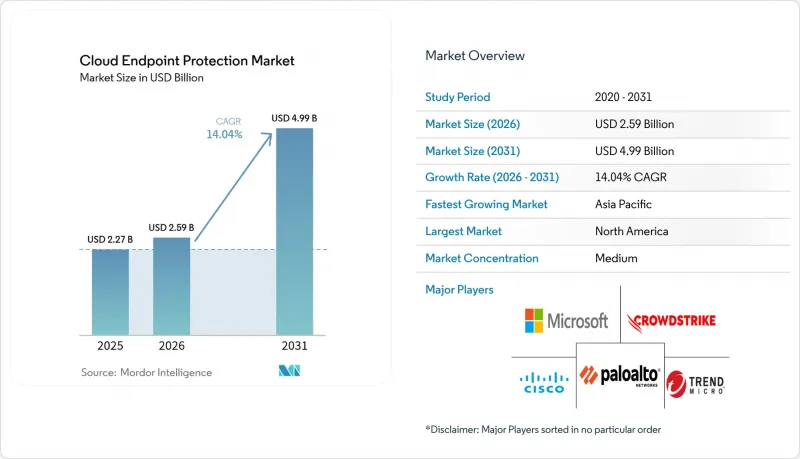
本報告按組件(解決方案、服務)、企業規模(中小企業、大型企業)、部署類型(私有雲端、公共雲端等)、最終用戶行業(銀行、金融服務和保險、政府機構、醫療保健等)、安全類型(防毒/反惡意軟體等)和地區進行細分。市場預測以價值(美元)表示。
全球雲端終端保護市場趨勢與洞察
遠距辦公和自備設備辦公(BYOD)的普及
隨著混合辦公模式的興起,傳統的網路邊界正在消失,迫使安全團隊保護那些很少連接到企業區域網路的裝置。微軟的「安全未來計畫」展示了超大規模資料中心業者如何將安全保護整合到其所有雲端資產中,並保護所有終端的安全。思科的《零信任架構指南》重點介紹了自備設備辦公室 (BYOD) 環境中的裝置級檢驗。因此,市場正朝著整合終端保護、身分識別和遠端存取功能的平台進行重大轉變,從而擴大了雲端終端保護市場。
複雜的網路攻擊和資料外洩事件激增。
人工智慧攻擊者利用深度造假偽造誘餌、利用現有資源的惡意負荷以及多階段勒索軟體等技術。根據 Proofpoint 的研究顯示,2024 年亞太地區與深度造假詐騙相關的流量激增 600%。與中國有關的攻擊者持續進行了長達五年的秘密宣傳活動,目標是未打補丁的邊緣設備。供應商正在透過人工智慧驅動的 XDR(擴展數據審查)來應對,這些 XDR 整合了跨端點和雲端工作負載的遙測數據,以實現自動化故障分類,從而鞏固了買家對透過雲端交付的端點安全的偏好。
網路安全人才短缺推高了服務成本。
全球範圍內熟練安全專業人員的短缺推高了事件回應和託管服務的成本,隨著威脅數量的增加,預算壓力也隨之增加。為了緩解這項壓力,微軟承諾在2025年培訓25萬名美國從業人員。不斷上漲的人事費用限制了支出彈性,並減緩了雲端終端保護市場的短期成長。
細分市場分析
該解決方案在雲端點保護市場佔據最大佔有率,營收佔比高達 62.15%。儘管核心檢測、回應和反惡意軟體引擎仍然至關重要,但買家現在更傾向於從人工智慧的觀點對其進行評估。端點偵測與回應 (EDR) 模組正在快速發展,CrowdStrike 已申請工作流程自動化專利,以加快分析師的故障分類速度。相較之下,託管服務以 14.72% 的複合年成長率 (CAGR) 佔據主導地位,因為企業面臨人才短缺和監管審計帶來的全天候支援需求。
服務市場的快速成長主要得益於承包MDR、整合和培訓的交付。 LevelBlue 的 MSSP 遷移藍圖展示了通路合作夥伴如何透過遠端 SOC 營運創造持續收入。供應商正透過將策略調整、零信任藍圖制定和合規性報告等諮詢服務捆綁在一起,鞏固服務在雲端點保護市場中的結構性驅動作用,從而最大限度地提升客戶終身價值。
到 2025 年,大型企業將佔雲端終端安全防護市場 57.45% 的佔有率。這主要得益於其數百萬美元的安全預算以及對早期創新技術的積極擁抱。大型企業的試點部署正在影響供應商的產品藍圖,尤其是在人工智慧驅動的威脅狩獵領域。同時,中小企業預計將實現 16.65% 的複合年成長率,這表明透過 SaaS 定價和 SOC 外包,高級防禦措施正被廣泛採用。 SonicWall 也證實了中小企業對 EDR 功能的日益成長的需求,而這項功能曾經被認為「僅適用於大型銀行」。
成本的可預測性和快速部署使得訂閱模式成為預算有限的企業的理想選擇。同時,雲端主機內建的自動化合規功能也緩解了稽核方面的擔憂。因此,中小企業正在重塑其在整個雲端終端安全保護市場的市場策略,供應商也開始提供一鍵式套餐,並採用基於使用量的收費和精心設計的策略手冊。
區域分析
北美擁有成熟的管理體制和對雲端安全領域的長期投入,預計到2025年將佔全球收入的40.35%。在聯邦政府「零信任藍圖」和大規模SaaS應用程式的推動下,更新周期依然活躍。該地區的企業率先採用人工智慧驅動的XDR平台,積極制定功能藍圖,並增加對下一代終端安全套件的投入。創業投資和網路安全新創企業的集中湧現進一步推動了創新,並鞏固了北美在雲端終端安全保護市場的地位。
亞太地區是成長最快的市場,複合年成長率高達14.88%。該地區受益於超大規模資料中心業者的大量資金流入,例如微軟在馬來西亞投資22億美元建設人工智慧中心、亞馬遜在印度投資127億美元進行擴張,以及谷歌在新加坡投資67億美元進行擴張。勒索軟體和深度造假詐騙的激增迫使企業採用先進的EDR和XDR功能,使亞太地區成為雲端終端安全保護市場的下一個前沿陣地。
在歐洲,受NIS2指令下嚴厲處罰措施的推動,預計將保持穩定成長。德國、英國和法國在採用以人工智慧為中心的終端安全技術方面主導,以滿足「尖端」合規標準。隨著資料主權問題日益受到關注,市場對能夠維護遙測資料在地化和資料居住的供應商的需求不斷成長,該地區在雲端終端安全保護市場中繼續佔據著重要的戰略地位。
其他好處:
- Excel格式的市場預測(ME)表
- 3個月的分析師支持
目錄
第1章:引言
- 研究假設和市場定義
- 調查範圍
第2章:調查方法
第3章執行摘要
第4章 市場狀況
- 市場概覽
- 市場促進因素
- 遠距辦公和自備設備辦公(BYOD)的普及
- 複雜網路攻擊與資料外洩事件激增
- 關於資料保護和隱私的監管義務
- 基於 SaaS 的安全模型所提供的擴充性能夠節省成本。
- 將 XDR 與 AI 驅動的自動化相結合可以提高投資回報率。
- 零信任架構的採用正在加速終端升級。
- 市場限制因素
- 網路安全人才短缺推高了服務成本。
- 多重雲端環境下的部署複雜性
- 中小企業的價格敏感度
- 安全工具中遙測資料隱私的檢驗
- 價值供應鏈分析
- 監理情勢
- 技術展望
- 波特五力模型
第5章 市場規模及成長預測(以金額為準)
- 按組件
- 解決方案
- 防毒/反惡意軟體
- 端點檢測與響應 (EDR)
- 防火牆
- 應用程式/裝置控制
- 服務
- 託管服務
- 諮詢與整合
- 培訓和支持
- 解決方案
- 按公司規模
- 中小企業
- 大公司
- 按部署模式
- 公共雲端
- 私有雲端
- 混合雲端
- 按安全類型
- 防毒/反惡意軟體
- 端點檢測與響應 (EDR)
- 防火牆
- 設備控制
- 網路釣魚防範措施
- 應用程式控制
- 其他
- 按最終用戶行業分類
- 銀行、金融服務和保險(BFSI)
- 政府
- 衛生保健
- 能源與電力
- 零售與電子商務
- IT/通訊
- 製造業
- 教育
- 媒體與娛樂
- 其他
- 按地區
- 北美洲
- 美國
- 加拿大
- 墨西哥
- 南美洲
- 巴西
- 阿根廷
- 其他南美國家
- 歐洲
- 德國
- 英國
- 法國
- 義大利
- 西班牙
- 俄羅斯
- 其他歐洲國家
- 亞洲
- 中國
- 印度
- 日本
- 韓國
- 東南亞
- 其他亞洲國家
- 中東和非洲
- 中東
- 阿拉伯聯合大公國
- 沙烏地阿拉伯
- 土耳其
- 其他中東國家
- 非洲
- 南非
- 奈及利亞
- 其他非洲國家
- 中東
- 北美洲
第6章 競爭情勢
- 市場集中度
- 策略趨勢
- 市佔率分析
- 公司簡介
- Bitdefender
- CrowdStrike
- Microsoft
- SentinelOne
- Kaspersky
- Sophos
- VMware
- Cisco
- McAfee
- Trend Micro
- Fortinet
- Broadcom(Symantec)
- Avast
- Palo Alto Networks
- Check Point Software
- Carbon Black
- ESET
- Cybereason
- Malwarebytes
- Trellix
第7章 市場機會與未來展望
According to Mordor Intelligence, cloud endpoint protection market size in 2026 is estimated at USD 2.59 billion, growing from 2025 value of USD 2.27 billion with 2031 projections showing USD 4.99 billion, growing at 14.04% CAGR over 2026-2031.
This report is Segmented Into by Component (Solutions, Services), Enterprise Size (Small and Medium Enterprises, Large Enterprises), Deployment Mode (Private Cloud, Public Cloud, and More), End-User Industry (BFSI, Government, Healthcare, and More), by Security Type (Antivirus / Anti-Malware and More) and Geography. The Market Forecasts are Provided in Terms of Value (USD)
Global Cloud Endpoint Protection Market Trends and Insights
Proliferation of remote work & BYOD
The normalization of hybrid schedules has erased the traditional network perimeter, forcing security teams to protect devices that rarely touch the corporate LAN. Microsoft's Secure Future Initiative demonstrates how hyperscalers embed protection across cloud assets to secure any endpoint, anywhere . Cisco's Zero Trust Architecture Guide stresses device-level verification in Bring-Your-Own-Device environments. The outcome is a decisive shift toward unified platforms that merge endpoint protection, identity, and remote access functions, thereby enlarging the cloud endpoint protection market.
Surge in sophisticated cyber-attacks & data breaches
AI-enabled adversaries employ deep-fake lures, living-off-the-land payloads, and multistage ransomware. Proofpoint logged a 600% spike in deep-fake scam chatter in APAC during 2024. China-linked actors sustained five years of clandestine campaigns targeting unpatched edge devices. Vendors answer with AI-driven XDR that stitches telemetry across endpoints and cloud workloads to automate triage, cementing buyer preference for cloud-delivered endpoint security.
Cyber-talent shortage inflates service costs
The worldwide shortfall of qualified defenders raises billable rates for incident response and managed services, squeezing budgets even as threat volumes climb. Microsoft pledged to train 250,000 U.S. practitioners by 2025 to alleviate the pinch. Elevated labor pricing curbs spending elasticity, moderating near-term growth within the cloud endpoint protection market.
Other drivers and restraints analyzed in the detailed report include:
- Regulatory mandates for data protection & privacy
- Cost-saving scalability of SaaS-based security models
- Deployment complexity in multi-cloud estates
For complete list of drivers and restraints, kindly check the Table Of Contents.
Segment Analysis
Solutions generated the largest slice of the cloud endpoint protection market translating into 62.15% revenue share. Core detection, response, and anti-malware engines remain indispensable building blocks, yet buyers now evaluate them through an AI-first lens. Endpoint Detection and Response modules are evolving rapidly, with CrowdStrike patenting workflow automation that speeds analyst triage. Managed services, by contrast, posted the steepest 14.72% CAGR as organizations grapple with talent shortages and regulatory audits that demand 24X7 coverage.
The services boom is anchored by turnkey MDR, integration, and training offerings. LevelBlue's MSSP transition blueprint exemplifies how channel partners monetize recurring revenue via remote SOC operations. Vendors are bundling advisory services-policy tuning, Zero Trust road-mapping, compliance reporting-to maximize lifetime value, thereby cementing services as a structural driver within the cloud endpoint protection market.
Large enterprises contributed 57.45% of the cloud endpoint protection market share in 2025, underpinned by multi-million-dollar security budgets and appetites for early-stage innovation. Their pilots often shape vendor product-roadmaps, especially around AI-assisted threat hunting. Yet SMEs scored a 16.65% CAGR, proving that SaaS pricing and outsourced SOCs democratize sophisticated defenses. SonicWall confirms heightened SMB uptake of EDR capabilities once considered "big-bank only".
Cost predictability and rapid onboarding make subscription models appealing to finance-constrained firms. Meanwhile, compliance automation embedded in cloud consoles eases audit anxiety. Hence the SME segment is reshaping go-to-market tactics across the cloud endpoint protection market, prompting vendors to launch one-click packages with usage-based billing and curated playbooks.
Complete Report Scope:
- By Component
- Solutions
- Antivirus / Anti-malware
- Endpoint Detection and Response (EDR)
- Firewall
- Application / Device Control
- Services
- Managed Services
- Consulting and Integration
- Training and Support
- Solutions
- By Enterprise Size
- Small and Medium Enterprises (SMEs)
- Large Enterprises
- By Deployment Model
- Public Cloud
- Private Cloud
- Hybrid Cloud
- By Security Type
- Antivirus / Anti-malware
- Endpoint Detection and Response
- Firewall
- Device Control
- Anti-phishing
- Application Control
- Others
- By End-user Industry
- Banking, Financial Services and Insurance (BFSI)
- Government
- Healthcare
- Energy and Power
- Retail and E-commerce
- IT and Telecom
- Manufacturing
- Education
- Media and Entertainment
- Others
- By Geography
- North America
- United States
- Canada
- Mexico
- South America
- Brazil
- Argentina
- Rest of South America
- Europe
- Germany
- United Kingdom
- France
- Italy
- Spain
- Russia
- Rest of Europe
- Asia
- China
- India
- Japan
- South Korea
- Southeast Asia
- Rest of Asia
- Middle East and Africa
- Middle East
- United Arab Emirates
- Saudi Arabia
- Turkey
- Rest of Middle East
- Africa
- South Africa
- Nigeria
- Rest of Africa
- Middle East
- North America
Geography Analysis
North America generated 40.35% of 2025 revenue owing to mature regulatory regimes and long-standing investments in cloud security. Federal Zero Trust blueprints and large-scale SaaS adoption keep refresh cycles brisk. The region's enterprises adopted AI-driven XDR platforms early, shaping feature roadmaps and anchoring spend on next-generation endpoint suites. Venture capital funding and cybersecurity start-up density further fertilize innovation, strengthening North America's position within the cloud endpoint protection market.
Asia-Pacific is the fastest-growing theatre, expanding at a 14.88% CAGR. The region benefits from hyperscaler capital flows such as Microsoft's USD 2.2 billion Malaysian AI hub, Amazon's USD 12.7 billion India build-out, and Google's USD 6.7 billion Singapore expansion. A pronounced spike in ransomware and deep-fake scams compels enterprises to adopt advanced EDR and XDR capabilities, making APAC the next frontier for the cloud endpoint protection market.
Europe commands steady growth underpinned by the NIS2 Directive's stringent penalties. Germany, the United Kingdom, and France spearhead adoption of AI-centric endpoint technologies to meet "state-of-the-art" compliance thresholds. Data-sovereignty sensitivities drive demand for vendors that can localize telemetry and sustain residency assurances, ensuring the region remains strategically salient in the cloud endpoint protection market.
- Bitdefender
- CrowdStrike
- Microsoft
- SentinelOne
- Kaspersky
- Sophos
- VMware
- Cisco
- McAfee
- Trend Micro
- Fortinet
- Broadcom (Symantec)
- Avast
- Palo Alto Networks
- Check Point Software
- Carbon Black
- ESET
- Cybereason
- Malwarebytes
- Trellix
Additional Benefits:
- The market estimate (ME) sheet in Excel format
- 3 months of analyst support
TABLE OF CONTENTS
1 INTRODUCTION
- 1.1 Study Assumptions and Market Definition
- 1.2 Scope of the Study
2 RESEARCH METHODOLOGY
3 EXECUTIVE SUMMARY
4 MARKET LANDSCAPE
- 4.1 Market Overview
- 4.2 Market Drivers
- 4.2.1 Proliferation of remote work and BYOD
- 4.2.2 Surge in sophisticated cyber-attacks & data breaches
- 4.2.3 Regulatory mandates for data protection & privacy
- 4.2.4 Cost-saving scalability of SaaS-based security models
- 4.2.5 Integration of XDR & AI-driven automation boosts ROI
- 4.2.6 Zero-trust adoption accelerates endpoint upgrades
- 4.3 Market Restraints
- 4.3.1 Cyber-talent shortage inflates service costs
- 4.3.2 Deployment complexity in multi-cloud estates
- 4.3.3 Price sensitivity among SMEs
- 4.3.4 Scrutiny of telemetry-data privacy in security tools
- 4.4 Value / Supply-Chain Analysis
- 4.5 Regulatory Landscape
- 4.6 Technological Outlook
- 4.7 Porters Five Forces
- 4.7.1 Bargaining Power of Suppliers
- 4.7.2 Bargaining Power of Buyers
- 4.7.3 Threat of New Entrants
- 4.7.4 Threat of Substitutes
- 4.7.5 Intensity of Competitive Rivalry
5 MARKET SIZE AND GROWTH FORECASTS (VALUE )
- 5.1 By Component
- 5.1.1 Solutions
- 5.1.1.1 Antivirus / Anti-malware
- 5.1.1.2 Endpoint Detection and Response (EDR)
- 5.1.1.3 Firewall
- 5.1.1.4 Application / Device Control
- 5.1.2 Services
- 5.1.2.1 Managed Services
- 5.1.2.2 Consulting and Integration
- 5.1.2.3 Training and Support
- 5.1.1 Solutions
- 5.2 By Enterprise Size
- 5.2.1 Small and Medium Enterprises (SMEs)
- 5.2.2 Large Enterprises
- 5.3 By Deployment Model
- 5.3.1 Public Cloud
- 5.3.2 Private Cloud
- 5.3.3 Hybrid Cloud
- 5.4 By Security Type
- 5.4.1 Antivirus / Anti-malware
- 5.4.2 Endpoint Detection and Response
- 5.4.3 Firewall
- 5.4.4 Device Control
- 5.4.5 Anti-phishing
- 5.4.6 Application Control
- 5.4.7 Others
- 5.5 By End-user Industry
- 5.5.1 Banking, Financial Services and Insurance (BFSI)
- 5.5.2 Government
- 5.5.3 Healthcare
- 5.5.4 Energy and Power
- 5.5.5 Retail and E-commerce
- 5.5.6 IT and Telecom
- 5.5.7 Manufacturing
- 5.5.8 Education
- 5.5.9 Media and Entertainment
- 5.5.10 Others
- 5.6 By Geography
- 5.6.1 North America
- 5.6.1.1 United States
- 5.6.1.2 Canada
- 5.6.1.3 Mexico
- 5.6.2 South America
- 5.6.2.1 Brazil
- 5.6.2.2 Argentina
- 5.6.2.3 Rest of South America
- 5.6.3 Europe
- 5.6.3.1 Germany
- 5.6.3.2 United Kingdom
- 5.6.3.3 France
- 5.6.3.4 Italy
- 5.6.3.5 Spain
- 5.6.3.6 Russia
- 5.6.3.7 Rest of Europe
- 5.6.4 Asia
- 5.6.4.1 China
- 5.6.4.2 India
- 5.6.4.3 Japan
- 5.6.4.4 South Korea
- 5.6.4.5 Southeast Asia
- 5.6.4.6 Rest of Asia
- 5.6.5 Middle East and Africa
- 5.6.5.1 Middle East
- 5.6.5.1.1 United Arab Emirates
- 5.6.5.1.2 Saudi Arabia
- 5.6.5.1.3 Turkey
- 5.6.5.1.4 Rest of Middle East
- 5.6.5.2 Africa
- 5.6.5.2.1 South Africa
- 5.6.5.2.2 Nigeria
- 5.6.5.2.3 Rest of Africa
- 5.6.5.1 Middle East
- 5.6.1 North America
6 COMPETITIVE LANDSCAPE
- 6.1 Market Concentration
- 6.2 Strategic Moves
- 6.3 Market Share Analysis
- 6.4 Company Profiles (includes Global level Overview, Market level overview, Core Segments, Financials as available, Strategic Information, Market Rank/Share for key companies, Products & Services, and Recent Developments)
- 6.4.1 Bitdefender
- 6.4.2 CrowdStrike
- 6.4.3 Microsoft
- 6.4.4 SentinelOne
- 6.4.5 Kaspersky
- 6.4.6 Sophos
- 6.4.7 VMware
- 6.4.8 Cisco
- 6.4.9 McAfee
- 6.4.10 Trend Micro
- 6.4.11 Fortinet
- 6.4.12 Broadcom (Symantec)
- 6.4.13 Avast
- 6.4.14 Palo Alto Networks
- 6.4.15 Check Point Software
- 6.4.16 Carbon Black
- 6.4.17 ESET
- 6.4.18 Cybereason
- 6.4.19 Malwarebytes
- 6.4.20 Trellix
7 MARKET OPPORTUNITIES AND FUTURE OUTLOOK
- 7.1 White-space and Unmet-Need Assessment

 雲端終端保護市場 - 全球產業規模、佔有率、趨勢、機會、預測:按組件、組織規模、最終用戶、地區和競爭對手分類,2021-2031 年
 2026年全球雲端終端安全市場報告
 終端安全防護平台市場:按解決方案類型、作業系統、分銷管道、最終用戶產業、部署模式和企業規模分類 - 全球預測(2026-2032 年)
 端點保護平台 (EPP) 市場分析及預測(至 2035 年):按類型、產品、服務、技術、組件、應用、部署模式和最終用戶分類中階終端保護軟體市場(依終端類型、安全技術、部署類型及產業垂直領域分類)-全球預測(2026-2032年)端點保護平台市場 - 全球產業規模、佔有率、趨勢、機會與預測(按解決方案、按部署、按應用、按地區、按競爭分類,2020-2030 年預測)