


 |
市場調查報告書
商品編碼
2124345
網路加密:市場佔有率分析、產業趨勢與統計、成長預測(2026-2031)Network Encryption - Market Share Analysis, Industry Trends & Statistics, Growth Forecasts (2026 - 2031) |
||||||

※ 本網頁內容可能與最新版本有所差異。詳細情況請與我們聯繫。
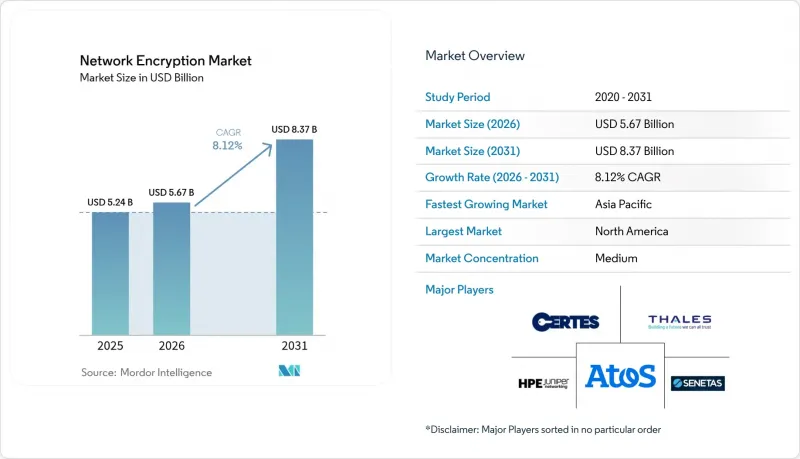
根據 Mordor Intelligence 預測,網路加密市場規模將從 2025 年的 52.4 億美元成長到 2026 年的 56.7 億美元,然後在 2031 年達到 83.7 億美元,2026 年至 2031 年的複合年成長率為 8.12%。
本報告按部署類型(雲端、本地部署)、組件(硬體、解決方案和服務)、組織規模(中小企業、大型企業)、最終用戶產業(電信與IT、銀行、金融服務和保險、政府、媒體與娛樂、醫療保健、國防與航太以及其他最終用戶產業)和地區進行細分。市場預測以美元計價。
全球網路加密市場趨勢與洞察
網路安全漏洞增加
2024年,勒索軟體攻擊和國家支持的入侵日益頻繁且手段愈加複雜,促使企業董事會加快對所有傳輸資料通道進行加密的投資。美國、歐洲和亞太地區多個司法管轄區的資訊揭露法對未受保護的資料外洩處以重罰,迫使企業不僅要加密外部通訊,還要加密內部東西向流量。保險承保人收緊了保單條款,只有投保人能夠證明其已實施全網加密措施,才能獲得保費折扣。因此,採購部門現在將網路層級加密視為一項基本控制措施,而不僅僅是一種可選的安全措施,即使在整體IT預算緊縮的情況下,也推動了這方面的持續投入。提供易於部署的設備和自動化策略引擎的供應商正在迅速擴大其市場佔有率。
加速採用基於雲端的工作負載
雲端遷移使得加密成為至關重要的因素,因為多重雲端環境的工作負載可以在幾秒鐘內啟動和停止。原生雲端網路服務現在整合了進階加密功能,讓安全團隊能夠集中管治金鑰,同時應用程式擁有者也能保持 DevOps 的速度。服務網格框架整合了透明的 TLS 終止,無需開發人員編寫加密呼叫程式碼。付費使用制的定價模式降低了中小企業 (SME) 的進入門檻,使他們無需大量資本投入即可建立企業級安全。因此,以雲端為中心的加密平台正經歷兩位數的成長,從而推動了對配套金鑰管理即服務 (KMAAS) 解決方案的需求。
網路加密解決方案實施成本高昂
全面部署通常需要專用設備、諮詢服務和員工培訓,對於中型企業而言,專案成本可能飆升至 50 萬至 500 萬美元。在新興市場,由於該地貨幣波動導致進口硬體價格上漲,預算壓力更為嚴峻。此外,傳統交換器和路由器可能缺乏內建加密加速功能,迫使企業進行成本高昂的基礎設施升級。雖然託管服務可以減輕資本投資負擔,但持續的訂閱費用仍然是中小企業的一大負擔。因此,對價格敏感的買家會推遲或縮小專案規模,從而限制了非監管行業領域短期內採用該技術的可能性。
細分市場分析
預計到2031年,雲端採用率將以9.87%的最高複合年成長率成長,但即使到了2025年,本地部署仍佔據網路加密市場佔有率的56.74%。儘管銀行、金融和保險(BFSI)以及政府部門在舊有應用程式累積的豐富部署經驗,以及嚴格的資料主權法規,支撐著本地部署的需求,但雲端原生加密解決方案正逐漸成為新型數位服務的標準配置。領先的供應商正在將金鑰生命週期管理和自動憑證續約功能捆綁在一起,以減輕安全團隊的維運負擔。
隨著企業將關鍵業務工作負載保留在本地,同時將開發、分析和客戶導向的服務路由到雲端骨幹網,混合模式正在興起。這種「雙速」架構允許用戶在不放棄現有投資的情況下嘗試計量型方案。提供可在本地設備和公有公共雲端虛擬設備之間運行的統一策略引擎的供應商正在提高客戶留存率。隨著後量子演算法的普及,雲端平台可能會提供更快的升級週期,並將長期需求轉向託管加密模式。
即使到了2025年,硬體仍將佔據網路加密市場49.01%的佔有率,因為超高速鏈路仍將依賴ASIC和FPGA來維持線速效能。然而,解決方案和服務領域將實現10.05%的複合年成長率,這表明安全領域正朝著靈活的、軟體控制的方向發展。企業正在強調將API驅動的編配與基礎設施即程式碼(IaC)工作流程結合,從而能夠在幾秒鐘內實現動態隧道建立和策略變更。
託管安全服務提供者將加密功能整合到捆綁式服務中,這些服務結合了威脅偵測、憑證自動化和零信任分段。人工智慧 (AI) 透過分析金鑰使用模式和預測憑證到期日期來輔助管理,從而減少意外服務中斷。此外,模組化授權模式可讓客戶擴展頻寬和演算法套件,而無需進行大規模系統更新。在預測期內,雖然晶片級加密模組將日益商品化,但差異化因素將轉向軟體分析、合規性報告和更廣泛的整合能力。
區域分析
預計到2025年,北美將佔全球銷售額的33.45%,這主要得益於零信任架構的早期應用、充足的網路安全預算以及眾多主流加密廠商的地理位置優勢。一項要求在2026年前過渡到抗量子攻擊系統的聯邦指令,進一步加速了北美地區的系統升級。同樣,美國電信業者正在將內聯加密技術與其全國性的5G項目捆綁銷售,加快了設備升級週期。
亞太地區預計將維持最高的成長率,到2031年將達到8.86%的複合年成長率,主要得益於中國、印度和東南亞地區對雲端運算的大規模投資。區域監管機構正在收緊資料居住法規,迫使企業實施本地管理的金鑰庫。各國政府正將經濟刺激資金投入量子研究和5G基礎建設,間接津貼具備加密功能的硬體。日本金融機構正在試行結合經典密碼學和格密碼學的雙演算法方案,這顯示後量子密碼學轉型浪潮即將到來。
歐洲仍然是一個至關重要的市場,而基於GDPR的處罰措施正在推動對加密技術的持續投資。即將實施的《網路彈性法案》將把安全要求擴展到連網產品,從而間接擴大加密管道的範圍。德國和法國的電信業者正在將流量層加密整合到其開放式無線存取網(Open RAN)部署中,而斯堪地那維亞國家則在量子金鑰傳輸(QKD)骨幹網路的初步試驗中主導。中東、非洲和南美洲的採用也在穩步推進,但技能短缺和預算限制正促使客戶轉向託管服務和雲端部署模式。
其他好處:
- Excel格式的市場預測(ME)表
- 3個月的分析師支持
目錄
第1章:引言
- 研究假設和市場定義
- 調查範圍
第2章:調查方法
第3章執行摘要
第4章 市場狀況
- 市場概覽
- 宏觀經濟因素的影響
- 市場促進因素
- 網路安全漏洞增加
- 雲端工作負載的採用正在加速。
- 隨著 5G 部署的快速增加,高速線上加密的需求也日益成長。
- GDPR 和 HIPAA 等合規要求正在推動加密技術的普及。
- 人們越來越擔心量子運算對傳統密碼技術的威脅。
- 資料傳輸層中零信任架構的廣泛應用
- 市場限制因素
- 網路加密解決方案實施成本高昂
- 對高速網路效能開銷和延遲的擔憂
- 多廠商環境下的互通性問題
- 熟練密碼學家短缺
- 產業價值鏈分析
- 監理情勢
- 技術展望
- 波特五力分析
第5章 市場規模與成長預測
- 依部署類型
- 雲
- 現場
- 按組件
- 硬體
- 解決方案和服務
- 按組織規模
- 小型企業
- 大公司
- 按最終用戶行業分類
- 通訊/IT
- BFSI
- 政府
- 媒體與娛樂
- 衛生保健
- 國防/航太
- 其他終端用戶產業
- 按地區
- 北美洲
- 美國
- 加拿大
- 墨西哥
- 歐洲
- 德國
- 英國
- 法國
- 俄羅斯
- 其他歐洲國家
- 亞太地區
- 中國
- 日本
- 印度
- 韓國
- 澳洲
- 其他亞太國家
- 中東和非洲
- 中東
- 沙烏地阿拉伯
- 阿拉伯聯合大公國
- 其他中東國家
- 非洲
- 南非
- 埃及
- 其他非洲國家
- 中東
- 南美洲
- 巴西
- 阿根廷
- 其他南美國家
- 北美洲
第6章 競爭情勢
- 市場集中度
- 策略趨勢
- 市佔率分析
- 公司簡介
- Thales Trusted Cyber Technologies
- Juniper Networks Inc.
- Atos SE
- Certes Networks Inc.
- Senetas Corporation Limited
- Viasat Inc.
- Raytheon Technologies Corporation
- Securosys SA
- PacketLight Networks Ltd.
- Rohde and Schwarz Cybersecurity GmbH
- Colt Technology Services Group Limited
- Ciena Corporation
- Cisco Systems Inc.
- Huawei Technologies Co. Ltd.
- Nokia Corporation
- ADVA Optical Networking SE
- Arista Networks Inc.
- Fortinet Inc.
- Palo Alto Networks Inc.
- Microchip Technology Inc.
第7章 市場機會與未來展望
第8章 投資分析
According to Mordor Intelligence, the network encryption market size is expected to grow from USD 5.24 billion in 2025 to USD 5.67 billion in 2026 and is forecast to reach USD 8.37 billion by 2031 at 8.12% CAGR over 2026-2031.
This report is Segmented by Deployment Type (Cloud, On-Premise), Component (Hardware, Solutions and Services), Organization Size (Small and Medium-Sized Enterprises, Large-Sized Enterprises), End-User Industry (Telecom and IT, BFSI, Government, Media and Entertainment, Healthcare, Defence and Aerospace, Other End-User Industries), and Geography. The Market Forecasts are Provided in Terms of Value (USD).
Global Network Encryption Market Trends and Insights
Increasing Number of Network Security Breaches
Ransomware campaigns and state-sponsored intrusions grew in frequency and sophistication during 2024, driving boards to accelerate encryption investments across data-in-motion channels. Breach disclosure laws in the United States, Europe, and several Asia-Pacific jurisdictions impose heavy penalties for unprotected data exposure, prompting enterprises to encrypt internal east-west traffic alongside external communications. Insurance underwriters have tightened policy terms, granting premium discounts only when policyholders can prove ubiquitous encryption coverage. As a result, procurement teams now treat network-level encryption as a baseline control, rather than an optional safeguard, which propels continuous spending even when broader IT budgets are tightened. Vendors able to deliver easy-to-deploy appliances and automated policy engines gain rapid traction.
Accelerating Adoption of Cloud-Based Workloads
Cloud migration places new emphasis on encryption agility, because workloads spin up and down within seconds across multi-cloud footprints. Native cloud networking services now incorporate advanced encryption, enabling security teams to centralize key governance while application owners maintain DevOps velocity. Service mesh frameworks integrate transparent TLS termination, removing the need for developers to code encryption calls. Consumption-based pricing lowers entry barriers for SMEs, enabling them to match the security posture of larger peers without capital purchases. Consequently, cloud-centric encryption platforms experience double-digit growth, driving demand for complementary key management-as-a-service offerings.
High Implementation Cost of Network Encryption Solutions
Comprehensive deployments often require specialized appliances, consulting services, and staff training, driving project outlays from USD 500,000 to well above USD 5 million for mid-sized enterprises. Budget pressure is more acute in emerging economies where local currency fluctuations inflate imported hardware prices. Additionally, legacy switches and routers may lack built-in crypto acceleration, forcing expensive infrastructure refreshes. Managed services do offset capital burdens, but small businesses still struggle with recurring subscription fees. As a result, price-sensitive buyers defer or narrow project scope, limiting near-term penetration in segments outside regulated verticals.
Other drivers and restraints analyzed in the detailed report include:
- Surge in 5G Rollouts Requiring High-Speed Inline Encryption
- Compliance Mandates Such as GDPR and HIPAA
- Performance Overhead and Latency Concerns in High-Speed Networks
For complete list of drivers and restraints, kindly check the Table Of Contents.
Segment Analysis
Cloud implementations are projected to register the fastest 9.87% CAGR through 2031, yet on-premise deployments still represented 56.74% of the network encryption market share in 2025. The large installed base of legacy applications and stringent data sovereignty rules in BFSI and government sectors anchor on-premise demand, while new digital services default to cloud-native encryption offerings. Major providers bundle key lifecycle management and automated certificate rotation, lowering the operational burden for security teams.
Hybrid patterns emerge as organizations retain mission-critical workloads on-site but route development, analytics, and customer-facing services through cloud backbones. This two-speed architecture allows buyers to experiment with consumption-based encryption without abandoning their existing investments. Vendors that supply unified policy engines capable of extending across on-premises gear and virtual appliances in public clouds gain account stickiness. As post-quantum algorithms become mainstream, cloud platforms offer faster upgrade cycles, potentially tilting long-term volume toward hosted encryption models.
Hardware retained 49.01% of the network encryption market share in 2025, as ultrafast links still rely on ASICs and FPGAs to maintain line-rate performance. Yet the solutions and services segment posts a 10.05% CAGR, illustrating the pivot toward flexible, software-controlled security. Enterprises value API-driven orchestration that integrates with infrastructure-as-code workflows, enabling the dynamic creation of tunnels and policy changes within seconds.
Managed security service providers integrate encryption into bundled offerings that combine threat detection, certificate automation, and zero-trust segmentation. Artificial intelligence assists by analyzing key usage patterns and predicting certificate expirations, reducing unplanned outages. Modular licensing also allows customers to scale bandwidth or algorithm suites without forklift upgrades. Over the forecast period, chip-level crypto blocks will become commoditized, while differentiation will shift to software analytics, compliance reporting, and broader integration capabilities.
Complete Report Scope:
- By Deployment Type
- Cloud
- On-premise
- By Component
- Hardware
- Solutions and Services
- By Organization Size
- Small and Medium-Sized Enterprises
- Large-Sized Enterprises
- By End-User Industry
- Telecom and IT
- BFSI
- Government
- Media and Entertainment
- Healthcare
- Defence and Aerospace
- Other End-User Industries
- By Geography
- North America
- United States
- Canada
- Mexico
- Europe
- Germany
- United Kingdom
- France
- Russia
- Rest of Europe
- Asia-Pacific
- China
- Japan
- India
- South Korea
- Australia
- Rest of Asia-Pacific
- Middle East and Africa
- Middle East
- Saudi Arabia
- United Arab Emirates
- Rest of Middle East
- Africa
- South Africa
- Egypt
- Rest of Africa
- Middle East
- South America
- Brazil
- Argentina
- Rest of South America
- North America
Geography Analysis
North America accounted for 33.45% of the revenue in 2025, underpinned by early zero-trust adoption, rich cyber budgets, and proximity to most leading encryption vendors. Federal mandates requiring quantum-resistant migration by 2026 further accelerate domestic upgrades. U.S. carriers likewise bundle inline encryption into nationwide 5G programs, stimulating equipment refresh cycles.
The Asia Pacific is projected to deliver the fastest 8.86% CAGR through 2031, driven by significant cloud investments in China, India, and Southeast Asia. Regional regulators tighten data residency rules, prompting enterprises to deploy locally managed key stores. Governments channel stimulus funds toward quantum research and 5G infrastructure, indirectly subsidizing encryption-capable hardware. Japanese financial institutions are piloting dual-algorithm schemes that combine classical and lattice-based ciphers, signaling an upcoming wave of post-quantum transitions.
Europe remains a pivotal market, as GDPR fines motivate ongoing spending on encryption. The forthcoming Cyber Resilience Act extends mandatory security controls to connected products, indirectly broadening the scope of encrypted channels. Telecom operators in Germany and France are integrating traffic-layer encryption into their Open RAN rollouts, while Scandinavian countries are leading early trials of quantum key distribution backbones. The Middle East and Africa, as well as South America, show rising adoption, although skills shortages and budget constraints push customers toward managed services and cloud deployment models.
- Thales Trusted Cyber Technologies
- Juniper Networks Inc.
- Atos SE
- Certes Networks Inc.
- Senetas Corporation Limited
- Viasat Inc.
- Raytheon Technologies Corporation
- Securosys SA
- PacketLight Networks Ltd.
- Rohde and Schwarz Cybersecurity GmbH
- Colt Technology Services Group Limited
- Ciena Corporation
- Cisco Systems Inc.
- Huawei Technologies Co. Ltd.
- Nokia Corporation
- ADVA Optical Networking SE
- Arista Networks Inc.
- Fortinet Inc.
- Palo Alto Networks Inc.
- Microchip Technology Inc.
Additional Benefits:
- The market estimate (ME) sheet in Excel format
- 3 months of analyst support
TABLE OF CONTENTS
1 INTRODUCTION
- 1.1 Study Assumptions and Market Definition
- 1.2 Scope of the Study
2 RESEARCH METHODOLOGY
3 EXECUTIVE SUMMARY
4 MARKET LANDSCAPE
- 4.1 Market Overview
- 4.2 Impact of Macroeconomic Factors
- 4.3 Market Drivers
- 4.3.1 Increasing Number of Network Security Breaches
- 4.3.2 Accelerating Adoption of Cloud-Based Workloads
- 4.3.3 Surge in 5G Rollouts Requiring High-Speed Inline Encryption
- 4.3.4 Compliance Mandates such as GDPR and HIPAA Driving Encryption Adoption
- 4.3.5 Growing Concern Over Quantum Computing Threats to Classical Cryptography
- 4.3.6 Rising Adoption of Zero Trust Architectures at Data Transport Layer
- 4.4 Market Restraints
- 4.4.1 High Implementation Cost of Network Encryption Solutions
- 4.4.2 Performance Overhead and Latency Concerns in High-Speed Networks
- 4.4.3 Interoperability Issues Across Multi-Vendor Environments
- 4.4.4 Shortage of Skilled Cryptography Professionals
- 4.5 Industry Value Chain Analysis
- 4.6 Regulatory Landscape
- 4.7 Technological Outlook
- 4.8 Porter's Five Forces Analysis
- 4.8.1 Bargaining Power of Suppliers
- 4.8.2 Bargaining Power of Buyers
- 4.8.3 Threat of New Entrants
- 4.8.4 Threat of Substitute Products
- 4.8.5 Intensity of Competitive Rivalry
5 MARKET SIZE AND GROWTH FORECASTS (VALUE)
- 5.1 By Deployment Type
- 5.1.1 Cloud
- 5.1.2 On-premise
- 5.2 By Component
- 5.2.1 Hardware
- 5.2.2 Solutions and Services
- 5.3 By Organization Size
- 5.3.1 Small and Medium-Sized Enterprises
- 5.3.2 Large-Sized Enterprises
- 5.4 By End-User Industry
- 5.4.1 Telecom and IT
- 5.4.2 BFSI
- 5.4.3 Government
- 5.4.4 Media and Entertainment
- 5.4.5 Healthcare
- 5.4.6 Defence and Aerospace
- 5.4.7 Other End-User Industries
- 5.5 By Geography
- 5.5.1 North America
- 5.5.1.1 United States
- 5.5.1.2 Canada
- 5.5.1.3 Mexico
- 5.5.2 Europe
- 5.5.2.1 Germany
- 5.5.2.2 United Kingdom
- 5.5.2.3 France
- 5.5.2.4 Russia
- 5.5.2.5 Rest of Europe
- 5.5.3 Asia-Pacific
- 5.5.3.1 China
- 5.5.3.2 Japan
- 5.5.3.3 India
- 5.5.3.4 South Korea
- 5.5.3.5 Australia
- 5.5.3.6 Rest of Asia-Pacific
- 5.5.4 Middle East and Africa
- 5.5.4.1 Middle East
- 5.5.4.1.1 Saudi Arabia
- 5.5.4.1.2 United Arab Emirates
- 5.5.4.1.3 Rest of Middle East
- 5.5.4.2 Africa
- 5.5.4.2.1 South Africa
- 5.5.4.2.2 Egypt
- 5.5.4.2.3 Rest of Africa
- 5.5.4.1 Middle East
- 5.5.5 South America
- 5.5.5.1 Brazil
- 5.5.5.2 Argentina
- 5.5.5.3 Rest of South America
- 5.5.1 North America
6 COMPETITIVE LANDSCAPE
- 6.1 Market Concentration
- 6.2 Strategic Moves
- 6.3 Market Share Analysis
- 6.4 Company Profiles (includes Global Level Overview, Market Level Overview, Core Segments, Financials as Available, Strategic Information, Market Rank/Share for Key Companies, Products and Services, and Recent Developments)
- 6.4.1 Thales Trusted Cyber Technologies
- 6.4.2 Juniper Networks Inc.
- 6.4.3 Atos SE
- 6.4.4 Certes Networks Inc.
- 6.4.5 Senetas Corporation Limited
- 6.4.6 Viasat Inc.
- 6.4.7 Raytheon Technologies Corporation
- 6.4.8 Securosys SA
- 6.4.9 PacketLight Networks Ltd.
- 6.4.10 Rohde and Schwarz Cybersecurity GmbH
- 6.4.11 Colt Technology Services Group Limited
- 6.4.12 Ciena Corporation
- 6.4.13 Cisco Systems Inc.
- 6.4.14 Huawei Technologies Co. Ltd.
- 6.4.15 Nokia Corporation
- 6.4.16 ADVA Optical Networking SE
- 6.4.17 Arista Networks Inc.
- 6.4.18 Fortinet Inc.
- 6.4.19 Palo Alto Networks Inc.
- 6.4.20 Microchip Technology Inc.
7 MARKET OPPORTUNITIES AND FUTURE OUTLOOK
- 7.1 White-Space and Unmet-Need Assessment


