


 |
市場調查報告書
商品編碼
2124329
固體電解質:市場佔有率分析、產業趨勢與統計、成長預測(2026-2031)Solid Electrolyte - Market Share Analysis, Industry Trends & Statistics, Growth Forecasts (2026 - 2031) |
||||||

※ 本網頁內容可能與最新版本有所差異。詳細情況請與我們聯繫。
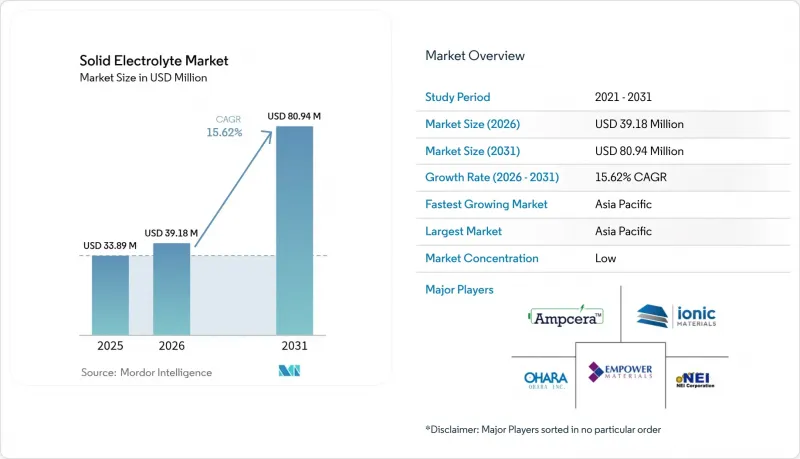
根據 Mordor Intelligence 預測,固體電解質市場規模將從 2025 年的 3,389 萬美元成長到 2026 年的 3,918 萬美元,然後在 2031 年達到 8,094 萬美元,2026 年至 2031 年的複合年成長率為 15.62%。
本報告材料類型(例如硫化物陶瓷、鹵化物陶瓷)、電池類型(例如電動車驅動電池)、製造方法(例如流延成型/冷壓、積層製造/3D列印)、厚度(小於25µm、25-100µm、大於100µm)、最終用途行業(例如美國醫療、醫療設備)和美國地區進行研究分類設備、歐洲領域)。
全球固體電解質市場趨勢與洞察
電動車安全法規正朝著固體電解質技術的方向發展。
歐盟新的電池指令要求嚴格防止熱失控,而固體電解質比液態鋰離子電池更容易滿足這項標準。日本已於2024年底批准豐田的固態電池電動車項目,這表明監管機構對陶瓷隔膜在高能量應用中的應用已達成共識。在航空航太領域,美國聯邦航空管理局(FAA)正在評估固體電解質,以滿足下一代飛機動力系統低可燃性的要求。這些進展表明,世界各地的監管機構正在朝著通用的安全理念努力,將固體電解質技術從未來平台設計的「可選」提升為「強制性」要求。因此,汽車製造商採用固體電解質不僅是為了提升性能,也是為了未來在各個市場獲得型號合格證。
OEM研發:500Wh/kg以上電池的競爭
寧德時代(CATL)於2024年推出的凝聚態電池原型展現了突破性的約500 Wh/kg能量密度,證實了固體電解質是實現超輕型汽車電池組的基礎。隨後實驗室的展示結果穩定提升至711 Wh/kg,凸顯了理論上限的快速拓展。這項工作還包括實現15分鐘以內的快速充電目標,這需要陶瓷和鹵化物電解質具備優異的耐高溫性能。目前,各廠商正將這種化學成分置於其2027-2030年產品週期的核心位置,加大對硫化物、鹵化物和氧化物材料的採購力度,並促成數十億美元的供應合約。
燒結和沈積製程需要大量資本投入。
傳統的硫化物和氧化物陶瓷通常需要超過 900 度C 的燒結溫度,即使是中等規模的生產線,也可能需要超過 5,000 萬美元的資本投資。賓州州立大學的低溫燒結方法將製程溫度降低至 150 度C,從而降低了能源需求和燒結爐的投資 [PSU.EDU]。初步的技術經濟評估估計,薄鋰金屬負極的成本為每平方公尺4.30 美元,與 2.10 美元的目標成本仍有差距。這凸顯了製造商正在努力克服的挑戰。採用真空絕熱光聚合技術製造 LLZO 形狀,可以實現零件的近淨成形,省去了多次研磨和拋光步驟,並進一步降低了基礎設施需求。
細分市場分析
硫化物陶瓷憑藉其諸多優勢,例如Li₆PS₅Cl的電導率超過1 mS cm⁻¹,以及成熟的流延成型工藝,預計到2025年將佔據固體電解質市場42.12%的佔有率。然而,該領域也面臨著成本高和易受潮等挑戰,這些挑戰推動了鹵化物和氧化物陶瓷的同步發展。儘管到2025年鹵化物陶瓷的市場佔有率仍然小規模,但其優異的氧化穩定性使其易於與高壓正極材料結合,預計到2031年,鹵化物陶瓷將保持最高的複合年成長率(CAGR),達到18.74%。目前,研發工作正集中在富含Cl⁻、Br⁻和F⁻的骨架結構,以期在不因吸濕而導致性能劣化的情況下維持高電導率。
製造商在為特定終端用途選擇化學成分時,會綜合考慮抗氧化性、原料供應和加工良率。氧化物石榴石,例如摻鉭LLZO,在燒結溫度高且易受潮的應用領域中仍扮演重要角色。聚合物和玻璃陶瓷混合材料在一些小眾的軟性電子產品應用領域有所應用,但其銷售量仍處於次要地位。這些因素共同造就了固體電解質市場,既確保了供應的彈性,也促進了智慧財產權的競爭。
預計到2025年,電動車動力電池組將佔固體電解質電池市場52.40%的佔有率,年複合成長率達18.52%,這主要得益於全球汽車製造商計劃在2020年代末推出固態電池車型。 60-100千瓦時汽車電池組的規模化需求促使供應商瞄準擁有千兆瓦時產能的工廠,從而節省成本,而這些成本節省也將惠及其他小規模的細分市場。家用電子電器持續保持穩定的市場佔有率,其中智慧型手機、筆記型電腦和AR設備佔據主導地位,這得益於外形規格的優勢以及攜帶式電池嚴格的安全標準。
其餘領域包括固定式儲能、航太、醫療植入和工業IoT,每個領域都專注於特定的特性,例如循環壽命、耐溫性、生物相容性和小型化。源自汽車產業研發的技術所產生的漣漪效應正在加速這些次要領域的性能提升,進一步鞏固了電動車專案在決定更廣泛的固體電解質市場材料供應和設備標準方面的主導地位。
區域分析
預計到2025年,亞太地區將佔全球銷售額的57.75%,複合年成長率(CAGR)將達到17.65%。這主要得益於以中國、日本和韓國為中心的垂直整合供應鏈,涵蓋鋰原料提煉、陶瓷粉末合成、電池組裝和模組整合等環節。寧德時代(CATL)、Panasonic)、LG能源解決方案以及眾多材料製造商正在調整投資計劃,從而有效降低了全部區域的成本。此外,韓國350億美元的電池舉措等政府扶持計畫也推動了該地區的成長。
在北美,市場正加速發展,這主要得益於稅額扣抵抵免條件的陶瓷隔膜和硫化物粉末工廠,以及美國《通膨控制法案》和能源部提供的津貼。汽車製造商與大學衍生公司之間的夥伴關係正致力於縮小產量差距,並確保國內原料來源的合格。到2030年,該地區預計將運作多條吉瓦級固體電解質生產線,使其在全球供應中的佔有率從目前的個位數提升至20%左右。
歐洲正透過「歐洲電池法規」和政府支持的合資工廠追求戰略自主。大眾汽車的電池部門PowerCo已獲得固體電解質的智慧財產權許可,並正推動在德國和瑞典建設計畫。固態電池技術具有更長的使用壽命和更高的可回收性,由於強調永續性、循環經濟和本地供應鏈的政策,正受到廣泛關注。總而言之,這些發展表明力量平衡正在重新調整,亞洲保持其優勢,而大西洋彼岸的強大挑戰者正在崛起。
其他好處:
- Excel格式的市場預測(ME)表
- 3個月的分析師支持
目錄
第1章:引言
- 研究假設和市場定義
- 調查範圍
第2章:調查方法
第3章執行摘要
第4章 市場狀況
- 市場概覽
- 市場促進因素
- 電動車的安全法規正轉向固態電池技術。
- OEM廠商正在就超過500Wh/kg的電池展開研發競爭。
- 創業投資流入及從試點生產線擴大規模
- 需要超薄電池的消費性微型設備
- 用於電網級儲能的鈉基固體電解質
- 國防需求:工作溫度範圍為-50 度C至+150 度C的電源裝置
- 市場限制因素
- 與燒結和沈積相關的高額資本支出(CAPEX)
- 陶瓷加工產量下降
- 鋰金屬枝晶在硫化物基體中的滲透
- Li2S供不應求及高純度 P2S5 的供應鏈
- 供應鏈分析
- 監理情勢
- 技術展望
- 波特五力模型
第5章 市場規模與成長預測
- 材料類型
- 氧化物陶瓷(LLZO、LIPON、鈣鈦礦、LISICON)
- 硫化物陶瓷(鋁硫鐵礦、LGPS族、硫代LISICON)
- 磷酸鹽陶瓷(NASICON、LISICON-P)
- 鹵化物陶瓷
- 聚合物電解質(PEO、PAN、PVDF、PBI 等)
- 複雜/雙相電解質
- 玻璃和玻璃陶瓷(LIPON、LiPON-Si)
- 其他
- 依電池類型
- 家用電子電器電池
- 電動車驅動電池
- 用於能源儲存系統的電池
- 航太和國防電池
- 醫療植入電池
- 工業和物聯網感測器電池
- 透過製造方法
- 膠帶成型/冷壓
- 熱壓燒結(HIP)
- 原子/分子層沉積法
- 溶劑/刮刀澆鑄
- 積層製造/3D列印
- 按厚度
- 小於25微米
- 25~100µm
- 100微米或以上
- 按最終用途行業分類
- 車
- 家用電子產品
- 固定式儲能
- 航太/國防
- 醫療器材
- 工業設備
- 按地區
- 北美洲
- 美國
- 加拿大
- 墨西哥
- 歐洲
- 德國
- 英國
- 法國
- 義大利
- 北歐國家
- 俄羅斯
- 其他歐洲國家
- 亞太地區
- 中國
- 印度
- 日本
- 韓國
- 東南亞國協
- 其他亞太國家
- 南美洲
- 巴西
- 阿根廷
- 其他南美國家
- 中東和非洲
- 沙烏地阿拉伯
- 阿拉伯聯合大公國
- 南非
- 埃及
- 其他中東和非洲國家
- 北美洲
第6章 競爭情勢
- 市場集中度
- 策略趨勢(併購、聯盟、購電協議)
- 市場佔有率分析(主要公司的市場排名和佔有率)
- 公司簡介
- Toyota Motor Corp(Solid-State Program)
- QuantumScape Corp
- Solid Power Inc.
- ProLogium Technology Co. Ltd
- CATL(Contemporary Amperex Technology Co.)
- Samsung SDI
- LG Energy Solution
- Panasonic Energy
- Ilika plc
- NEI Corporation
- Ohara Inc.
- Ampcera Corp
- Ionic Materials Inc.
- Empower Materials
- Tosoh Corporation
- Murata Manufacturing Co.
- GS Yuasa Corp
- Hitachi Zosen Corporation
- BYD Co. Ltd
- SK On Co. Ltd
- Mitsubishi Chemical Group
- Toshima Manufacturing Co. Ltd
第7章 市場機會與未來展望
According to Mordor Intelligence, the solid electrolyte market size is expected to grow from USD 33.89 million in 2025 to USD 39.18 million in 2026 and is forecast to reach USD 80.94 million by 2031 at 15.62% CAGR over 2026-2031.
This report is Segmented by Material Type (Sulfide Ceramics, Halide Ceramics, and More), Battery Type (EV Traction Batteries, and More), Manufacturing Method (Tape Casting/Cold Pressing, Additive Manufacturing/3-D Printing, and More), Thickness (Below 25µm, 25 To 100µm, and Above 100µm), End-Use Industry (Automotive, Medical Devices, and More), and Geography (North America, Europe, Asia-Pacific, and More).
Global Solid Electrolyte Market Trends and Insights
EV Safety Regulations Shifting Toward Solid-State Chemistry
New battery directives in the European Union require stringent thermal runaway prevention, a criterion that is met more readily by solid electrolytes than by liquid-filled lithium-ion cells. Japan issued safety approvals for Toyota's solid-state EV program in late 2024, signalling regulatory comfort with ceramic separators in high-energy applications. In aviation, the Federal Aviation Administration is evaluating solid electrolytes to meet low-flammability targets for next-gen aircraft power systems.These actions align global regulators behind a common safety rationale that elevates solid-state chemistry from optional to essential in upcoming platform designs. Automakers therefore integrate solid electrolytes not only for performance but also to secure future type approval across markets.
OEM R&D Race for >500 Wh/kg Batteries
Breakthrough energy densities around 500 Wh/kg, showcased by CATL's condensed-state cell prototypes in 2024, validate solid electrolytes as the enabling architecture for ultra-light vehicle packs. Subsequent lab demonstrations, climbing toward 711 Wh/kg, underscore a rapidly expanding theoretical ceiling. The pursuit encompasses charge-rate targets of sub-15 minutes, which demand high-temperature tolerance that ceramic or halide electrolytes provide. Competing OEMs now view the chemistry as central to their 2027-2030 product cycles, intensifying procurement of sulfide, halide, and oxide materials and stimulating multibillion-dollar supply contracts.
High Sintering & Deposition CAPEX
Conventional sulfide and oxide ceramics often require furnace cycles above 900 °C, driving equipment outlays that can exceed USD 50 million for a mid-scale line. Penn State's cold-sinter method lowers process temperature to 150 °C, cutting both energy demand and kiln investment [PSU.EDU]. Early techno-economic assessments place the thin lithium-metal anode cost at USD 4.3 m2 against a USD 2.1 m2 target, illustrating the economic gap manufacturers seek to bridge. The adoption of VAT photopolymerisation for LLZO geometries further reduces infrastructure needs by printing parts near-net shape, thereby bypassing multiple grinding and polishing steps.
Other drivers and restraints analyzed in the detailed report include:
- Venture-Capital Inflows & Pilot-Line Scale-Ups
- Consumer Micro-Devices Needing Ultra-Thin Cells
- Ceramic Processing Yield Losses
For complete list of drivers and restraints, kindly check the Table Of Contents.
Segment Analysis
Sulfide ceramics delivered 42.12% solid electrolyte market share in 2025 on the strength of Li6PS5Cl conductivities surpassing 1 mS cm-1 and well-understood tape-casting routes. The segment nevertheless faces cost and moisture sensitivity challenges that encourage the parallel development of halide and oxide options. Halide ceramics, although holding a modest base in 2025, are expected to register the fastest 18.74% CAGR through 2031, as their superior oxidative stability simplifies high-voltage cathode pairing. R&D focuses on Cl-, Br-, and F-rich frameworks that maintain high conductivity without hygroscopic degradation.
Manufacturers weigh oxidative tolerance, raw-material availability, and processing yield when selecting chemistries for specific end uses. Oxide garnets, such as Ta-doped LLZO, retain relevance where the risk of moisture ingress is high, despite their higher sintering temperatures. Polymer and glass-ceramic hybrids serve niche flexible electronics but remain secondary volume drivers. The cumulative effect keeps the overall solid electrolyte market size diversified across at least four main chemistries, ensuring supply resilience while fuelling intellectual-property competition.
EV traction packs captured 52.40% of the solid electrolyte market size in 2025 and are expected to expand at an 18.52% CAGR as global automakers schedule solid-state models for late-decade launch windows. The scale requirements of 60-100 kWh vehicle packs compel suppliers to target gigawatt-hour factories, which in turn subsidise cost learning, benefiting smaller segments. Consumer electronics continue to hold a steady share, with smartphones, laptops, and AR devices leading the way, aided by form-factor advantages and stringent safety standards for passenger-carried batteries.
Stationary energy storage, aerospace, medical implants, and industrial IoT collectively compose the remainder, each valuing specific attributes-cycle life, temperature resilience, biocompatibility, or miniaturisation. Technology spill-over from automotive R&D thus accelerates performance gains in these secondary arenas, reinforcing the dominant role of EV programmes in dictating material supply and equipment standards throughout the broader solid electrolyte market.
Complete Report Scope:
- By Material Type
- Oxide Ceramics (LLZO, LIPON, Perovskite, LISICON)
- Sulfide Ceramics (Argyrodite, LGPS family, Thio-LISICON)
- Phosphate Ceramics (NASICON, LISICON-P)
- Halide Ceramics
- Polymer Electrolytes (PEO, PAN, PVDF, PBI, etc.)
- Composite/Biphasic Electrolytes
- Glass and Glass-Ceramics (LIPON, LiPON-Si)
- Others
- By Battery Type
- Consumer Electronics Batteries
- EV Traction Batteries
- Energy-Storage System Batteries
- Aerospace and Defence Batteries
- Medical Implant Batteries
- Industrial and IoT Sensor Batteries
- By Manufacturing Method
- Tape Casting/Cold Pressing
- Hot Pressing and Sinter-HIP
- Atomic/Molecular Layer Deposition
- Solvent/Doctor-Blade Casting
- Additive Manufacturing/3-D Printing
- By Thickness
- Below 25 µm
- 25 to 100 µm
- Above 100 µm
- By End-use Industry
- Automotive
- Consumer Electronics
- Stationary Energy Storage
- Aerospace and Defence
- Medical Devices
- Industrial Equipment
- By Geography
- North America
- United States
- Canada
- Mexico
- Europe
- Germany
- United Kingdom
- France
- Italy
- NORDIC Countries
- Russia
- Rest of Europe
- Asia-Pacific
- China
- India
- Japan
- South Korea
- ASEAN Countries
- Rest of Asia-Pacific
- South America
- Brazil
- Argentina
- Rest of South America
- Middle East and Africa
- Saudi Arabia
- United Arab Emirates
- South Africa
- Egypt
- Rest of Middle East and Africa
- North America
Geography Analysis
The Asia-Pacific region controlled 57.75% of the revenue in 2025 and is forecast to realize an 17.65% CAGR, driven by vertically integrated supply chains, encompassing raw lithium refining, ceramic powder synthesis, cell assembly, and module integration, co-located within China, Japan, and South Korea. CATL, Panasonic, LG Energy Solution, and a suite of material makers coordinate investment pipelines that keep regional cost floors low. Government programmes such as South Korea's USD 35 billion battery initiative reinforce the region's trajectory.
North America is accelerating on the back of the U.S. Inflation Reduction Act and Department of Energy grants, promoting the construction of ceramic separator and sulfide powder plants that are eligible for tax credits. Partnerships uniting automakers with university spin-offs focus on closing process-yield gaps and qualifying domestic raw material streams. By 2030, the region could host multiple multi-gigawatt solid electrolyte lines, raising its contribution to global supply from the current single digits toward the low-20% range.
Europe pursues strategic autonomy through the European Battery Regulation and joint-venture factories underwritten by national governments. Volkswagen's battery arm, PowerCo, licenses solid electrolyte intellectual property to anchor planned German and Swedish plants capable of 40 GWh annual output. The policy emphasis on sustainability, circular economy, and local supply chains makes solid-state chemistry attractive due to its longer service life and improved recyclability. Combined, these moves indicate a rebalancing in which Asia retains primacy but faces credible trans-Atlantic challengers.
- Toyota Motor Corp (Solid-State Program)
- QuantumScape Corp
- Solid Power Inc.
- ProLogium Technology Co. Ltd
- CATL (Contemporary Amperex Technology Co.)
- Samsung SDI
- LG Energy Solution
- Panasonic Energy
- Ilika plc
- NEI Corporation
- Ohara Inc.
- Ampcera Corp
- Ionic Materials Inc.
- Empower Materials
- Tosoh Corporation
- Murata Manufacturing Co.
- GS Yuasa Corp
- Hitachi Zosen Corporation
- BYD Co. Ltd
- SK On Co. Ltd
- Mitsubishi Chemical Group
- Toshima Manufacturing Co. Ltd
Additional Benefits:
- The market estimate (ME) sheet in Excel format
- 3 months of analyst support
TABLE OF CONTENTS
1 Introduction
- 1.1 Study Assumptions & Market Definition
- 1.2 Scope of the Study
2 Research Methodology
3 Executive Summary
4 Market Landscape
- 4.1 Market Overview
- 4.2 Market Drivers
- 4.2.1 EV safety regulations shifting toward solid-state chemistry
- 4.2.2 OEM R&D race for >500 Wh/kg batteries
- 4.2.3 Venture-capital inflows & pilot-line scale-ups
- 4.2.4 Consumer micro-devices needing ultra-thin cells
- 4.2.5 Sodium solid electrolytes for grid-scale storage
- 4.2.6 Defence requirement for -50 °C to +150 °C power packs
- 4.3 Market Restraints
- 4.3.1 High sintering & deposition CAPEX
- 4.3.2 Ceramic processing yield losses
- 4.3.3 Li-metal dendrite breach in sulfide matrices
- 4.3.4 Scarce Li2S & high-purity P2S5 supply chain
- 4.4 Supply-Chain Analysis
- 4.5 Regulatory Landscape
- 4.6 Technological Outlook
- 4.7 Porter's Five Forces
- 4.7.1 Bargaining Power of Suppliers
- 4.7.2 Bargaining Power of Consumers
- 4.7.3 Threat of New Entrants
- 4.7.4 Threat of Substitutes
- 4.7.5 Intensity of Competitive Rivalry
5 Market Size & Growth Forecasts
- 5.1 By Material Type
- 5.1.1 Oxide Ceramics (LLZO, LIPON, Perovskite, LISICON)
- 5.1.2 Sulfide Ceramics (Argyrodite, LGPS family, Thio-LISICON)
- 5.1.3 Phosphate Ceramics (NASICON, LISICON-P)
- 5.1.4 Halide Ceramics
- 5.1.5 Polymer Electrolytes (PEO, PAN, PVDF, PBI, etc.)
- 5.1.6 Composite/Biphasic Electrolytes
- 5.1.7 Glass and Glass-Ceramics (LIPON, LiPON-Si)
- 5.1.8 Others
- 5.2 By Battery Type
- 5.2.1 Consumer Electronics Batteries
- 5.2.2 EV Traction Batteries
- 5.2.3 Energy-Storage System Batteries
- 5.2.4 Aerospace and Defence Batteries
- 5.2.5 Medical Implant Batteries
- 5.2.6 Industrial and IoT Sensor Batteries
- 5.3 By Manufacturing Method
- 5.3.1 Tape Casting/Cold Pressing
- 5.3.2 Hot Pressing and Sinter-HIP
- 5.3.3 Atomic/Molecular Layer Deposition
- 5.3.4 Solvent/Doctor-Blade Casting
- 5.3.5 Additive Manufacturing/3-D Printing
- 5.4 By Thickness
- 5.4.1 Below 25 µm
- 5.4.2 25 to 100 µm
- 5.4.3 Above 100 µm
- 5.5 By End-use Industry
- 5.5.1 Automotive
- 5.5.2 Consumer Electronics
- 5.5.3 Stationary Energy Storage
- 5.5.4 Aerospace and Defence
- 5.5.5 Medical Devices
- 5.5.6 Industrial Equipment
- 5.6 By Geography
- 5.6.1 North America
- 5.6.1.1 United States
- 5.6.1.2 Canada
- 5.6.1.3 Mexico
- 5.6.2 Europe
- 5.6.2.1 Germany
- 5.6.2.2 United Kingdom
- 5.6.2.3 France
- 5.6.2.4 Italy
- 5.6.2.5 NORDIC Countries
- 5.6.2.6 Russia
- 5.6.2.7 Rest of Europe
- 5.6.3 Asia-Pacific
- 5.6.3.1 China
- 5.6.3.2 India
- 5.6.3.3 Japan
- 5.6.3.4 South Korea
- 5.6.3.5 ASEAN Countries
- 5.6.3.6 Rest of Asia-Pacific
- 5.6.4 South America
- 5.6.4.1 Brazil
- 5.6.4.2 Argentina
- 5.6.4.3 Rest of South America
- 5.6.5 Middle East and Africa
- 5.6.5.1 Saudi Arabia
- 5.6.5.2 United Arab Emirates
- 5.6.5.3 South Africa
- 5.6.5.4 Egypt
- 5.6.5.5 Rest of Middle East and Africa
- 5.6.1 North America
6 Competitive Landscape
- 6.1 Market Concentration
- 6.2 Strategic Moves (M&A, Partnerships, PPAs)
- 6.3 Market Share Analysis (Market Rank/Share for key companies)
- 6.4 Company Profiles (includes Global level Overview, Market level overview, Core Segments, Financials as available, Strategic Information, Products & Services, and Recent Developments)
- 6.4.1 Toyota Motor Corp (Solid-State Program)
- 6.4.2 QuantumScape Corp
- 6.4.3 Solid Power Inc.
- 6.4.4 ProLogium Technology Co. Ltd
- 6.4.5 CATL (Contemporary Amperex Technology Co.)
- 6.4.6 Samsung SDI
- 6.4.7 LG Energy Solution
- 6.4.8 Panasonic Energy
- 6.4.9 Ilika plc
- 6.4.10 NEI Corporation
- 6.4.11 Ohara Inc.
- 6.4.12 Ampcera Corp
- 6.4.13 Ionic Materials Inc.
- 6.4.14 Empower Materials
- 6.4.15 Tosoh Corporation
- 6.4.16 Murata Manufacturing Co.
- 6.4.17 GS Yuasa Corp
- 6.4.18 Hitachi Zosen Corporation
- 6.4.19 BYD Co. Ltd
- 6.4.20 SK On Co. Ltd
- 6.4.21 Mitsubishi Chemical Group
- 6.4.22 Toshima Manufacturing Co. Ltd
7 Market Opportunities & Future Outlook
- 7.1 White-Space & Unmet-Need Assessment


