


 |
市場調查報告書
商品編碼
2124324
群眾外包測試:市場佔有率分析、行業趨勢和統計數據、成長預測(2026-2031)Crowdsourced Testing - Market Share Analysis, Industry Trends & Statistics, Growth Forecasts (2026 - 2031) |
||||||

※ 本網頁內容可能與最新版本有所差異。詳細情況請與我們聯繫。
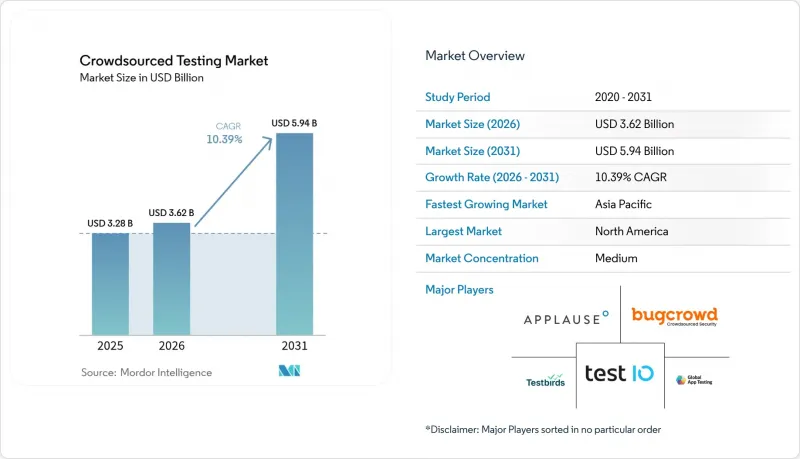
根據 Mordor Intelligence 預測,群眾外包測試市場規模將從 2025 年的 32.8 億美元成長到 2026 年的 36.2 億美元,然後在 2031 年達到 59.4 億美元,2026 年至 2031 年的複合年成長率為 10.39%。
本報告按平台(Web、行動、其他)、組織規模(中小企業、大型企業)、測試類型(功能測試、效能測試、安全與穿透測試、其他)、最終用戶產業(銀行、金融服務和保險 (BFSI)、IT 和電信、其他)以及地區進行細分。市場預測以美元 (USD) 為單位。
全球群眾外包測試市場趨勢與洞察
人工智慧驅動的群眾外包編配能夠實現即時回饋。
機器學習演算法簡化了測試人員的選擇、任務分配和結果總結流程,使全球應用測試平台的專案週期縮短了 40%,缺陷偵測準確率也得到了提升。與持續整合 (CI) 管線的無縫整合,顯著減少了敏捷發布週期中的延遲。隨著測試人員元資料的成長,演算法的準確性也隨之提高,從而形成綜效,但也增加了企業客戶的轉換成本。這些趨勢鞏固了群眾外包測試市場先行者的長期競爭優勢。
擴大應用程式安全合規性的穿透測試義務
歐盟《數位營運彈性法案》等法規強制要求金融機構定期穿透測試,迫使它們利用能夠模擬各種攻擊途徑的外部漏洞評估社群。 Bugcrowd 在 2024 年處理了超過 1.84 億次安全測試,凸顯了內部資源與現代威脅情勢之間日益擴大的差距。透過將內部安全團隊與群眾外包穿透測試項目結合,金融機構的漏洞檢測率提高了 45%,從而確立了安全測試作為永續成長領域的地位。
對資料隱私和智慧財產權外洩的擔憂。
使用專有程式碼的公司不願將預發布版本暴露給開放的測試網路。研究表明,基於區塊鏈的審計追蹤技術在保護智慧財產權的同時保持透明度,正日益受到關注,但監管方面的模糊性和跨境資料傳輸規則仍然阻礙著其廣泛應用。
細分市場分析
到2025年,行動應用將佔據群眾外包測試市場46.85%的佔有率。這主要受設備碎片化驅動,因為設備碎片化需要跨數百種行動電話型號檢驗。隨著5G的普及和對延遲敏感的應用場景日益增多,行動相關的群眾外包測試市場預計將持續成長。物聯網和穿戴式裝置雖然目前市場規模較小,但預計到2031年將以11.62%的複合年成長率成長,因為智慧家庭、工業應用和醫療保健等領域的終端需求激增。根據美國國家標準與技術研究院(NIST)物聯網諮詢委員會的說法,互通性和安全性仍然是最大的挑戰,這進一步提高了多感測器邊緣環境的測試要求。 Web和桌面端合計佔據剩餘市場佔有率,但其佔有率正逐漸被行動優先的策略蠶食。
5G和物聯網的融合正在產生次要影響,因為它要求在超低延遲環境下進行端對端測試。傳統的實驗室環境很少能模擬真實世界的網路抖動,但運行在運作網路上的分散式測試人員可以更早地檢測到缺陷。因此,投資者繼續支持那些優先考慮在真實環境中進行大規模測試的平台,從而鞏固其在群眾外包測試市場的領先地位。
預計到2025年,大型企業將佔總收入的55.60%,它們可能會結合內部和外部測試人員進行使用者驗收測試、在地化或安全迭代。然而,中小企業(SME)的複合年成長率最高,達到10.55%,因為它們的變動成本模式與精實預算相符。研究表明,中小企業正在利用群眾外包測試顯著降低初始基礎設施投資,同時擴大在時間緊迫的情況下原本難以觸及的市場覆蓋範圍。隨著創業投資資金回流到早期軟體公司,群眾外包測試市場的中小企業客戶儲備依然充足。
平台供應商正在調整定價策略,以降低准入門檻,並提供基於使用量的訂閱模式,該模式會根據建置頻率自動擴展。這種方式使新創公司能夠將測試整合到其開發週期中,而無需簽訂多年契約,從而進一步擴大群眾外包測試行業的潛在基本客群。
區域分析
預計到2025年,北美將佔總收入的36.10%,這得益於成熟的DevOps應用以及對SOX、HIPAA和各州資料隱私法律的嚴格遵守。強大的創投生態系統正在推動工具的持續創新,企業買家高度重視能夠融入現有CI/CD管線的AI驅動型測試編配。隨著主流平台日趨成熟,客戶正逐漸從企劃為基礎合約轉向訂閱制契約,從而穩定了群眾外包測試市場的整體收入前景。
亞太地區預計將成為成長最快的地區,到2031年複合年成長率將達到12.10%,這主要得益於中國、印度和東南亞「行動優先」的數位化策略。根據GSMA統計,該地區擁有18億行動用戶,行動網際網路佔GDP的5.3%,凸顯了大量應用需要實際檢驗。政府在智慧城市和消費金融科技領域的舉措,推動了對本地語言、設備和網路測試覆蓋的需求,使得區域測試人員群體成為不可或缺的寶貴資源。
歐洲約佔全球支出的四分之一。 GDPR、《數位服務法案》和NIS 2指令均要求嚴格的軟體保障,從而推動了穿透測試測試和合規性測試的訂單。各平台正在投資測試人員認證和安全資料處理框架,以滿足歐洲嚴格的隱私法規。與此同時,南美、中東和非洲仍處於發展階段,但基礎設施差距正在迅速縮小。智慧型手機的普及和金融科技的擴張為兩位數成長奠定了基礎,但測試人員的品管和跨境資料處理方面的法規仍然是挑戰。
其他好處
- Excel格式的市場預測(ME)表
- 3個月的分析師支持
目錄
第1章:引言
- 研究假設和市場定義
- 調查範圍
第2章:調查方法
第3章執行摘要
第4章 市場狀況
- 市場概覽
- 市場促進因素
- 作業系統、裝置和應用程式數量的增加
- 向敏捷和DevOps的轉變需要持續的品質保證(QA)。
- 利用全球測試人員資源,以經濟高效的方式擴展品質保證能力。
- 應用程式安全合規性穿透測試的強制實施工作正在推進。
- 人工智慧驅動的群眾外包編配能夠實現即時回饋。
- 行動和物聯網應用經濟的擴張
- 市場限制因素
- 對資料隱私和智慧財產權外洩的擔憂。
- 測試人員素質差異和管治的挑戰
- 主要地區雲端工作者獲取成本不斷上升
- 受監管產業領域知識匱乏
- 供應鏈分析
- 監理情勢
- 技術展望
- 波特五力模型
- 價格分析
- 宏觀經濟因素對市場的影響
第5章 市場規模與成長預測
- 按平台
- Web
- 移動的
- 桌面
- 穿戴式裝置和物聯網
- 其他
- 按組織規模
- 中小企業
- 大公司
- 按測試類型
- 功能測試
- 性能測試
- 安全穿透測試
- 其他
- 按最終用戶行業分類
- BFSI
- 資訊科技/通訊
- 零售與電子商務
- 醫療保健和生命科學
- 媒體與娛樂
- 其他
- 按地區
- 北美洲
- 美國
- 加拿大
- 墨西哥
- 南美洲
- 巴西
- 阿根廷
- 其他南美國家
- 歐洲
- 德國
- 英國
- 法國
- 西班牙
- 義大利
- 其他歐洲國家
- 亞太地區
- 中國
- 印度
- 日本
- 韓國
- 澳洲
- 其他亞太國家
- 中東和非洲
- GCC
- 土耳其
- 南非
- 其他中東和非洲國家
- 北美洲
第6章 競爭情勢
- 市場集中度
- 策略趨勢
- 市佔率分析
- 公司簡介
- Applause App Quality Inc.
- Global App Testing
- test IO Inc.
- Testbirds GmbH
- Cobalt Labs Inc.
- Bugcrowd Inc.
- Synack Inc.
- Rainforest QA Inc.
- Digivante Ltd.
- Flatworld Solutions Pvt Ltd
- Qualitest Group
- QA InfoTech(QAIT)
- Infosys Ltd(Digital Assurance)
- Planit Testing
- Qualitrix Technologies Pvt Ltd
- CrowdSource Testing SpA
- Cigniti Technologies Ltd
- Frugal Testing
- Ubertesters Inc.
- Testlio Inc.
- UserTesting Inc.
- Digisphere Solutions(99tests)
第7章 市場機會與未來展望
According to Mordor Intelligence, the crowdsource testing market size is expected to grow from USD 3.28 billion in 2025 to USD 3.62 billion in 2026 and is forecast to reach USD 5.94 billion by 2031 at 10.39% CAGR over 2026-2031.
This report is Segmented by Platform (Web, Mobile, and More), by Organization Size (SMEs and Large Enterprises), by Testing Type (Functional Testing, Performance Testing, Security/Pen-Testing, and More), by End-User Vertical (BFSI, IT and Telecom, and More), by Geography. The Market Forecasts are Provided in Terms of Value (USD).
Global Crowdsourced Testing Market Trends and Insights
AI-assisted crowd orchestration unlocks real-time feedback
Machine-learning algorithms streamline tester selection, task routing, and result aggregation, reducing project turn-around times by 40% and boosting defect-detection accuracy on Global App Testing's platform. Seamless integration with continuous-integration pipelines removes prominent delays in agile release cycles. As tester metadata grows, algorithmic precision improves, creating reinforcing network effects that raise switching costs for enterprise customers. These dynamics reinforce the long-run competitive advantage of early movers in the crowdsource testing market.
Growing pen-testing mandates for app-sec compliance
Regulations such as the EU Digital Operational Resilience Act compel financial institutions to conduct recurring penetration tests, pushing enterprises toward external vulnerability-assessment communities capable of simulating diverse attack vectors. Bugcrowd processed more than 184 million security tests in 2024, underscoring the widening gap between internal resources and modern threat landscapes. When financial firms blended in-house security teams with crowdsourced penetration programs, vulnerability detection improved by 45%, cementing security testing as a durable growth pocket.
Data-privacy and IP-leakage concerns
Enterprises handling proprietary code hesitate to expose pre-release builds on open tester networks. Research highlights blockchain-anchored audit trails that secure intellectual property while maintaining transparency, yet regulatory ambiguity and cross-border data-transfer rules still discourage broad adoption.
Other drivers and restraints analyzed in the detailed report include:
- Cost-efficient scaling of QA via global tester pools
- Shift to agile and DevOps requiring continuous QA
- Fragmented tester quality and governance gaps
For complete list of drivers and restraints, kindly check the Table Of Contents.
Segment Analysis
Mobile applications accounted for 46.85% of crowdsource testing market share in 2025 on the back of device fragmentation that obliges validation across hundreds of handset models. The crowdsource testing market size tied to mobile is forecast to expand as 5G adoption heightens latency-sensitive use cases. IoT and wearables, while still a smaller base, are pacing at an 11.62% CAGR to 2031 as smart-home, industrial, and healthcare endpoints multiply. According to the US NIST IoT Advisory Board, interoperability and security remain top challenges, magnifying testing requirements in multisensor edge environments. Web and desktop segments together form the remainder but are ceding share to mobile-first initiatives.
Second-order effects arise from the 5G-IoT convergence that mandates end-to-end testing in ultra-low-latency contexts. Traditional lab setups rarely replicate real-world network jitter, whereas distributed testers operating on live networks surface defects earlier. Consequently, investors continue to back platforms that prioritize field-based testing at scale, reinforcing the leadership of the crowdsource testing market.
Large enterprises retained 55.60% of 2025 revenue, often blending in-house and external testers for user acceptance, localization, or security sprints. Still, SMEs produced the fastest 10.55% CAGR because variable-cost models align with lean budgeting. Studies show SMEs leveraging crowdsource testing and slashing upfront infrastructure outlays while broadening coverage across markets otherwise unreachable on tight timelines. With venture funding cycling back into early-stage software firms, the pipeline of SME customers for the crowdsource testing market remains strong.
Platform providers adapt pricing tiers to lower entry barriers, offering usage-based subscriptions that automatically scale with build frequency. This approach embeds testing into the development cadence of start-ups without locking them into multi-year contracts, further enlarging the crowdsource testing industry's addressable base.
Complete Report Scope:
- By Platform
- Web
- Mobile
- Desktop
- Wearables and IoT
- Others
- By Organization Size
- Small and Medium-sized Enterprises (SMEs)
- Large Enterprises
- By Testing Type
- Functional Testing
- Performance Testing
- Security / Pen-Testing
- Others
- By End-user Vertical
- BFSI
- IT and Telecom
- Retail and E-commerce
- Healthcare and Life Sciences
- Media and Entertainment
- Others
- By Geography
- North America
- United States
- Canada
- Mexico
- South America
- Brazil
- Argentina
- Rest of South America
- Europe
- Germany
- United Kingdom
- France
- Spain
- Italy
- Rest of Europe
- Asia-Pacific
- China
- India
- Japan
- South Korea
- Australia
- Rest of Asia-Pacific
- Middle East and Africa
- GCC
- Turkey
- South Africa
- Rest of Middle East and Africa
- North America
Geography Analysis
North America accounted for 36.10% of 2025 revenue, anchored by mature DevOps adoption and strict compliance regimes such as SOX, HIPAA, and state-level data-privacy statutes. Deep venture ecosystems spur continual tooling innovation, and enterprise buyers value AI-enabled test orchestration that fits existing CI/CD pipelines. As major platforms mature, clients increasingly shift from project-based to subscription engagements, stabilizing revenue visibility across the crowdsource testing market.
Asia-Pacific is the fastest-growing geography at a 12.10% CAGR to 2031, fueled by mobile-first digital agendas in China, India, and Southeast Asia. GSMA counts 1.8 billion mobile subscribers in the region, with mobile internet contributing 5.3% of GDP, highlighting vast application footprints requiring real-world validation. Government initiatives around smart cities and consumer fintech heighten the need for local language, device, and network testing coverage, positioning regional tester communities as priceless assets.
Europe captures roughly one-quarter of global spend. GDPR, the Digital Services Act, and the NIS 2 Directive all demand rigorous software assurance, boosting penetration and compliance testing engagements. Platforms invest in tester certification and secure data-handling frameworks to satisfy stringent European privacy rules. Meanwhile, South America and the Middle East, and Africa remain nascent but are closing infrastructure gaps quickly. Smartphone adoption and fintech expansion set the stage for double-digit growth, though tester-quality governance and cross-border data provisions remain hurdles.
- Applause App Quality Inc.
- Global App Testing
- test IO Inc.
- Testbirds GmbH
- Cobalt Labs Inc.
- Bugcrowd Inc.
- Synack Inc.
- Rainforest QA Inc.
- Digivante Ltd.
- Flatworld Solutions Pvt Ltd
- Qualitest Group
- QA InfoTech (QAIT)
- Infosys Ltd (Digital Assurance)
- Planit Testing
- Qualitrix Technologies Pvt Ltd
- CrowdSource Testing SpA
- Cigniti Technologies Ltd
- Frugal Testing
- Ubertesters Inc.
- Testlio Inc.
- UserTesting Inc.
- Digisphere Solutions (99tests)
Additional Benefits:
- The market estimate (ME) sheet in Excel format
- 3 months of analyst support
TABLE OF CONTENTS
1 INTRODUCTION
- 1.1 Study Assumptions and Market Definition
- 1.2 Scope of the Study
2 RESEARCH METHODOLOGY
3 EXECUTIVE SUMMARY
4 MARKET LANDSCAPE
- 4.1 Market Overview
- 4.2 Market Drivers
- 4.2.1 Rise in OS / Device / App Proliferation
- 4.2.2 Shift to Agile and DevOps Requiring Continuous QA
- 4.2.3 Cost-efficient Scaling of QA via Global Tester Pools
- 4.2.4 Growing Pen-Testing Mandates for App-Sec Compliance
- 4.2.5 AI-assisted Crowd Orchestration Unlocks Real-time Feedback
- 4.2.6 Expansion of Mobile and IoT App Economies
- 4.3 Market Restraints
- 4.3.1 Data-privacy and IP-leakage Concerns
- 4.3.2 Fragmented Tester Quality and Governance Gaps
- 4.3.3 Rising Crowd-worker Acquisition Costs in Tier-1 Regions
- 4.3.4 Limited Domain Knowledge for Regulated Industries
- 4.4 Supply Chain Analysis
- 4.5 Regulatory Landscape
- 4.6 Technological Outlook
- 4.7 Porters Five Forces
- 4.7.1 Threat of New Entrants
- 4.7.2 Bargaining Power of Buyers
- 4.7.3 Bargaining Power of Suppliers
- 4.7.4 Threat of Substitutes
- 4.7.5 Intensity of Competitive Rivalry
- 4.8 Pricing Analysis
- 4.9 Impact of Macro Economic Factors on the Market
5 MARKET SIZE AND GROWTH FORECASTS (VALUE)
- 5.1 By Platform
- 5.1.1 Web
- 5.1.2 Mobile
- 5.1.3 Desktop
- 5.1.4 Wearables and IoT
- 5.1.5 Others
- 5.2 By Organization Size
- 5.2.1 Small and Medium-sized Enterprises (SMEs)
- 5.2.2 Large Enterprises
- 5.3 By Testing Type
- 5.3.1 Functional Testing
- 5.3.2 Performance Testing
- 5.3.3 Security / Pen-Testing
- 5.3.4 Others
- 5.4 By End-user Vertical
- 5.4.1 BFSI
- 5.4.2 IT and Telecom
- 5.4.3 Retail and E-commerce
- 5.4.4 Healthcare and Life Sciences
- 5.4.5 Media and Entertainment
- 5.4.6 Others
- 5.5 By Geography
- 5.5.1 North America
- 5.5.1.1 United States
- 5.5.1.2 Canada
- 5.5.1.3 Mexico
- 5.5.2 South America
- 5.5.2.1 Brazil
- 5.5.2.2 Argentina
- 5.5.2.3 Rest of South America
- 5.5.3 Europe
- 5.5.3.1 Germany
- 5.5.3.2 United Kingdom
- 5.5.3.3 France
- 5.5.3.4 Spain
- 5.5.3.5 Italy
- 5.5.3.6 Rest of Europe
- 5.5.4 Asia-Pacific
- 5.5.4.1 China
- 5.5.4.2 India
- 5.5.4.3 Japan
- 5.5.4.4 South Korea
- 5.5.4.5 Australia
- 5.5.4.6 Rest of Asia-Pacific
- 5.5.5 Middle East and Africa
- 5.5.5.1 GCC
- 5.5.5.2 Turkey
- 5.5.5.3 South Africa
- 5.5.5.4 Rest of Middle East and Africa
- 5.5.1 North America
6 COMPETITIVE LANDSCAPE
- 6.1 Market Concentration
- 6.2 Strategic Moves
- 6.3 Market Share Analysis
- 6.4 Company Profiles (includes Global level Overview, Market level overview, Core Segments, Financials as available, Strategic Information, Market Rank/Share for key companies, Products and Services, and Recent Developments)
- 6.4.1 Applause App Quality Inc.
- 6.4.2 Global App Testing
- 6.4.3 test IO Inc.
- 6.4.4 Testbirds GmbH
- 6.4.5 Cobalt Labs Inc.
- 6.4.6 Bugcrowd Inc.
- 6.4.7 Synack Inc.
- 6.4.8 Rainforest QA Inc.
- 6.4.9 Digivante Ltd.
- 6.4.10 Flatworld Solutions Pvt Ltd
- 6.4.11 Qualitest Group
- 6.4.12 QA InfoTech (QAIT)
- 6.4.13 Infosys Ltd (Digital Assurance)
- 6.4.14 Planit Testing
- 6.4.15 Qualitrix Technologies Pvt Ltd
- 6.4.16 CrowdSource Testing SpA
- 6.4.17 Cigniti Technologies Ltd
- 6.4.18 Frugal Testing
- 6.4.19 Ubertesters Inc.
- 6.4.20 Testlio Inc.
- 6.4.21 UserTesting Inc.
- 6.4.22 Digisphere Solutions (99tests)
7 MARKET OPPORTUNITIES AND FUTURE OUTLOOK
- 7.1 White-space and Unmet-need Assessment

 群眾外包測試市場機會、成長促進因素、產業趨勢分析及2026-2035年預測
 群眾外包測試市場-2026-2032年全球市場預測
 2026年全球群眾外包測試市場報告
 群眾外包測試市場分析及預測(至2035年):按類型、產品類型、服務、技術、組件、應用、部署類型、最終用戶、模式和階段分類
 全球群眾外包測試市場規模、佔有率、趨勢和成長分析報告(2026-2034)全球眾包測試市場:市場規模、佔有率、成長率、產業分析、依類型、應用和地區劃分的分析以及未來預測(2026-2034)
 2026-2030年全球群眾外包測試市場POS測試服務市場按類型、組織規模、部署模式、最終用戶和應用程式分類 - 全球預測(2026-2032年)
 群眾外包測試市場-全球產業規模、佔有率、趨勢、機會和預測,按平台類型、群眾外包類型、最終用戶產業、地區和競爭格局分類,2021-2031年預測
 群眾外包測試市場規模、佔有率和成長分析(按測試類型、平台、組織規模、部署模式、垂直行業和地區分類)—產業預測(2026-2033 年)