


 |
市場調查報告書
商品編碼
2124322
企業無線區域網路:市場佔有率分析、產業趨勢與統計、成長預測(2026-2031 年)Enterprise WLAN - Market Share Analysis, Industry Trends & Statistics, Growth Forecasts (2026 - 2031) |
||||||

※ 本網頁內容可能與最新版本有所差異。詳細情況請與我們聯繫。
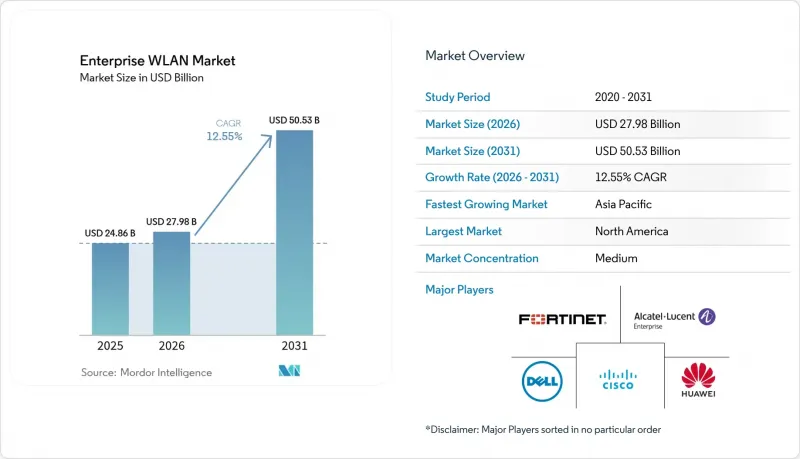
據 Mordor Intelligence 稱,2025 年企業 WLAN 市值為 248.6 億美元,預計到 2031 年將達到 505.3 億美元,而 2026 年為 279.8 億美元,預測期(2026-2031 年)的複合年成長率為 12.55%。
本報告按組件(硬體、軟體、服務)、組織規模(大型企業、中小企業)、最終用戶行業(零售、醫療保健、銀行、金融服務和保險、製造業、教育及其他)、部署模式(本地部署、雲端管理)和地區進行細分。市場預測以美元計價。
全球企業無線區域網路市場趨勢與洞察
Wi-Fi 6/6E 升級週期的激增正在推動效能的顯著提升。
主要亮點
- 6GHz頻段中1200MHz頻段的開放,使企業首次能夠利用連續的超寬頻頻道建構多GigabitWLAN。此外,Wi-Fi 7的多鏈路操作提高了吞吐量並降低了延遲。這種確定性的性能對於視訊協作、身臨其境型培訓和擴增實境(AR)驅動的維護至關重要,促使40%的大型企業加快了升級計畫。印度監管機構估計,2024年至2034年間,6GHz頻段分配帶來的累積經濟活動將達到4.03兆美元,凸顯了其宏觀經濟影響。然而,更高的功率預算和PoE++交換器是先決條件,這促使買家同時升級其存取層和交換層。
混合工作模式所需的網路轉型
混合辦公模式已成為標準做法,這要求企業能夠在辦公室和家庭之間無縫漫遊,實現精細化的存取控制,並具備應用層級品質 (QoS) 保障。企業平均每年投入 1.157 億美元用於先進的無線項目,以實現統一的用戶體驗、VPN 層級的安全性以及基於數據分析的容量規劃。 Passpoint (IEEE 802.11u) 簡化了員工和訪客的安全註冊流程,減少了服務台諮詢,並提高了身分驗證的可靠性。隨著資訊長 (CIO) 將網路現代化需求與辦公室的柔軟性相結合,企業無線區域網路 (WLAN) 市場正從中受益。
持續的供應鏈中斷限制了經濟成長。
對於某些資料中心產品,網路專用積體電路 (ASIC) 的前置作業時間可能長達 52 週,迫使買家要麼推遲部署,要麼採用雲端替代方案來降低對硬體的依賴。擁有多元化供應商的廠商能夠更好地應對供不應求,並抓住轉移的需求。 Extreme Networks 表示,其在疫情期間展現出的韌性為其在醫療設施維修項目中創造了新的銷售機會。
細分市場分析
到2025年,硬體銷售額將佔總銷售額的60.55%,這主要得益於市場對高密度Wi-Fi 6E網路基地台的需求,以確保禮堂、工廠、醫院和其他場所的應用效能。供應商透過捆綁三頻設計、整合物聯網無線電和高級射頻分析功能來支援其高價策略。目前,企業級WLAN市場正在升級交換機,以提供90W PoE供電以及2.5Gbps或5Gbps多千兆以太網,從而驅動下一代存取點。軟體市場規模較小,但隨著AI原生雲控制、保障分析和以威脅為中心的微隔離變得至關重要,其複合年成長率(CAGR)也達到了13.75%。 Mist AI和思科DNA中心展示如何將控制器邏輯、網路資料湖和機器學習整合,從而提供單一介面操作體驗。
網路基地台韌體和授權的訂閱模式,已將曾經的經常性資本支出轉變為持續的收入來源,吸引了投資者並縮短了續約週期。同時,企業缺乏射頻規劃和零信任設計的內部技能,導致專業服務服務和託管服務蓬勃發展。諮詢顧問統籌現場勘測、頻譜審計和合規性檢驗,從而加強了供應商與生態系統的整合。
到2025年,大型企業將佔據企業無線區域網路(WLAN)市場57.35%的佔有率,這反映出多園區環境對大規模身分驗證、策略引擎和容錯能力的需求。整合到SASE框架中的SD分支架構與財富1000強企業的安全需求高度契合。同時,中小企業(SME)預計將以12.95%的複合年成長率(CAGR)實現最高成長,這主要得益於基於訂閱的“WLAN即服務”(WLAN-as-a-Service)模式,該模式無需控制器硬體,也無需大量前期投入。雲端部署和自動化射頻最佳化使小規模IT團隊擺脫了複雜的命令列介面(CLI)工作流程,使他們無需聘請認證無線工程師即可利用企業級功能。
供應商正在將企業功能重構為分層服務,強調快速部署、成長導向的授權模式以及行動優先的控制面板。在MSP通路中,將WLAN與寬頻和VoIP捆綁銷售,進一步加深了其在零售、酒店和專業服務行業的滲透。在持續的勞動力短缺背景下,中小企業(SME)正轉向外包監控任務,這推動了服務層級的不斷成長,與雲端管理解決方案的日益普及相一致。
區域分析
預計到2025年,北美將貢獻最大的收入佔有率,達到38.40%。這主要得益於FCC支援的6GHz頻段分配計劃,預計將在2023年至2024年間創造8,700億美元的經濟價值。根據Infotech Lead報道,2024年第二季美國出貨量年減30.6%,但隨著訂單積壓的清理,季比回升15.3%。聯邦政府的寬頻資金投入、智慧建築獎勵以及蓬勃發展的託管服務管道,都支撐了醫療保健、教育和金融服務領域的支出。
預計亞太地區將在2026年至2031年間以13.05%的複合年成長率實現最高成長。中國仍將是最大的市場,這主要得益於支持數位化工廠和園區發展的產業政策。印度政策智庫估計,到2034年,這些政策的累積影響將達到4.03兆美元,預計將進一步刺激企業無線區域網路市場的需求。東協成員國正在擴大製造地並推進機場現代化,這兩項措施都需要高密度Wi-Fi和零信任網路分段。
在歐洲,發展勢頭並不均衡。根據InfotechLead通報,受宏觀經濟不利因素影響,2024年第二季出貨量年減22.3%,但隨著庫存水準恢復正常,第三季略有回升。 「歐洲6G網路生態系統願景」優先考慮人工智慧原生和整合感知能力,而頻率監管機構正在推動建立通用框架以加速供應商創新。這些措施預計將影響企業WLAN的升級,因為5G-Advanced和Wi-Fi 7之間的互通性是園區環境的設計目標之一。
中東和非洲雖然規模仍相對較小,但隨著各國政府加大對智慧城市的投資,該地區的物聯網市場正達到兩位數成長。阿拉伯聯合大公國政府部門正在聯邦大樓部署整合Wi-Fi和物聯網網路,而南非零售商則採用雲端管理的無線區域網路(WLAN)來支援全通路商務。拉丁美洲雖然基數較低,但在2023年第三季實現了235%的年成長,這主要得益於供應瓶頸的緩解和貨幣穩定性的提高。該地區的酒店和採礦業對用於客戶服務和遠端連接的人工智慧無線區域網路表現出特別濃厚的興趣。
其他好處
- Excel格式的市場預測(ME)表
- 3個月的分析師支持
目錄
第1章:引言
- 研究假設和市場定義
- 調查範圍
第2章:調查方法
第3章執行摘要
第4章 市場狀況
- 市場概覽
- 市場促進因素
- Wi-Fi 6/6E升級週期激增
- 自備設備辦公室(BYOD)和混合辦公模式的迅速普及。
- 企業物聯網節點密度爆炸性成長
- 雲端管理的無線區域網路降低了整體擁有成本。
- 6GHz頻段頻率分配(全球)
- 智慧建築刺激資金
- 市場限制因素
- 晶片組供應鏈的波動
- Wi-Fi 設計與安全的技能差距
- 企業轉向私有5G網路的風險
- 網路安全保險費上漲
- 價值鏈分析
- 監理情勢
- 技術展望
- 波特五力分析
- 新冠疫情影響評估
- 投資分析
第5章 市場規模與成長預測
- 按組件
- 硬體
- 網路基地台
- 無線區域網路控制器
- 無線熱點閘道器
- 軟體
- 無線區域網路安全
- 無線區域網路管理
- 無線區域網路分析
- 其他軟體
- 服務
- 專業服務
- 託管服務
- 硬體
- 按組織規模
- 大公司
- 中小企業
- 按最終用戶行業分類
- 銀行業、金融服務業及保險業
- 衛生保健
- 零售
- 資訊科技/通訊
- 製造業
- 教育
- 飯店業
- 其他
- 部署模式
- 現場
- 雲端管理
- 按地區
- 北美洲
- 美國
- 加拿大
- 墨西哥
- 南美洲
- 阿根廷
- 巴西
- 其他南美國家
- 歐洲
- 英國
- 德國
- 法國
- 義大利
- 其他歐洲國家
- 亞太地區
- 中國
- 日本
- 韓國
- 印度
- 其他亞太國家
- 中東和非洲
- 阿拉伯聯合大公國
- 沙烏地阿拉伯
- 南非
- 其他中東和非洲國家
- 北美洲
第6章 競爭情勢
- 市場集中度
- 策略趨勢
- 市佔率分析
- 公司簡介
- Cisco Systems
- Hewlett Packard Enterprise Aruba
- Huawei Technologies
- Juniper Networks(Mist)
- Extreme Networks
- CommScope-Ruckus
- Dell Technologies
- Fortinet
- Ubiquiti Inc.
- Arista Networks
- Cambium Networks
- Zebra Technologies
- Netgear
- TP-Link Technologies
- Arista Networks
- Ruijie Networks
- Alcatel-Lucent Enterprise
- Huawei Technologies
- EnGenius Networks
- Cambium Networks
第7章 市場機會與未來展望
According to Mordor Intelligence, the enterprise WLAN market size was valued at USD 24.86 billion in 2025 and estimated to grow from USD 27.98 billion in 2026 to reach USD 50.53 billion by 2031, at a CAGR of 12.55% during the forecast period (2026-2031).
This report is Segmented by Component (Hardware, Software, and Services), Organization Size (Large Enterprises, Small and Medium-Sized Enterprises), End-User Vertical (Retail, Healthcare, Banking, Financial Services, and Insurance, Manufacturing, Education, and More), Deployment Mode (On-Premises and Cloud-Managed), and Geography. The Market Forecasts are Provided in Terms of Value (USD).
Global Enterprise WLAN Market Trends and Insights
Surge in Wi-Fi 6/6E Upgrade Cycles Drives Performance Leap
Key Highlights
- Opening 1,200 MHz of 6 GHz spectrum gives enterprises the first contiguous stretch of ultra-wide channels for multigigabit WLAN, and multi-link operation in Wi-Fi 7 boosts throughput while trimming latency. Video collaboration, immersive training, and AR-assisted maintenance demand such deterministic performance, prompting 40% of large organizations to bring forward refresh schedules. Indian regulators value the 6 GHz allocation at USD 4,030 billion in cumulative economic activity for 2024-2034, underscoring its macro impact.Yet higher power budgets and POE++ switches are prerequisites, nudging buyers to coordinate access-layer and switching upgrades in tandem.
Hybrid Work Models Demand Network Transformation
Hybrid work is now standard practice, requiring seamless roaming, granular access control, and application-level QoS across offices and homes. Enterprises allocate an average of USD 115.7 million over three years for advanced wireless projects to enable unified user experiences, VPN-grade security, and analytics-driven capacity planning. Passpoint (IEEE 802.11u) simplifies secure onboarding for employees and guests, lowering help-desk tickets while tightening identity assurance. The enterprise WLAN market benefits as CIOs align network modernization with workplace flexibility mandates
Persistent Supply-Chain Disruptions Constrain Growth
Lead times for network ASICs stretch up to 52 weeks in some data-center SKUs, prompting buyers to postpone rollouts or adopt cloud alternatives that lessen hardware dependence. Vendors with diversified suppliers weather shortages better and capture displaced demand. Extreme Networks cites pandemic-era resilience that unlocked new sales in healthcare refits.
Other drivers and restraints analyzed in the detailed report include:
- IoT Density Drives Network Architecture Evolution
- Cloud Management Transforms Operational Economics
- Cybersecurity Skills Gap Threatens Network Security
For complete list of drivers and restraints, kindly check the Table Of Contents.
Segment Analysis
Hardware contributed 60.55% of 2025 revenue, powered by demand for high-density Wi-Fi 6E access points that safeguard application performance in auditoriums, factories, and hospitals. Vendors bundle tri-radio designs, integrated IoT radios, and advanced RF analytics that justify premium price points. The enterprise WLAN market is now cycling through switch upgrades that supply 2.5 Gbps or 5 Gbps multigig Ethernet plus 90 W POE to drive next-generation APs. The software category, though smaller, is climbing at a 13.75% CAGR as AI-native cloud control, assurance analytics, and threat-centric micro-segmentation become indispensable. Mist AI and Cisco DNA Center illustrate how controller logic, network data lakes, and machine learning converge into single-pane experiences.
Access point firmware and license subscriptions convert once-periodic capital spending into recurring revenue, enticing investors and compressing refresh intervals. Meanwhile, professional and managed services flourish because organizations lack in-house RF planning and zero-trust design skills. Consultants orchestrate site surveys, spectrum audits, and compliance validation, adding stickiness to vendor ecosystems
Large enterprises held 57.35% of the enterprise WLAN market share in 2025, reflecting multi-campus estates that demand scaled authentication, policy engines, and resiliency. SD-branch architectures feeding into SASE frameworks align well with Fortune 1000 security mandates. Yet SMEs post the strongest 12.95% CAGR, encouraged by subscription-based WLAN as a service that removes controller hardware and heavy upfront cost. Cloud onboarding and automated RF optimization free smaller IT teams from arcane CLI workflows, making enterprise-grade features accessible without hiring certified wireless engineers.
Vendors repackage enterprise functionality into tiered offerings that emphasize quick deployment, pay-as-you-grow licensing, and mobile-first dashboards. MSP channels bundle WLAN with broadband and VoIP, deepening penetration among retail, hospitality, and professional services. As talent shortages persist, SMEs turn to outsourced monitoring, driving a services layer that grows in lockstep with cloud-managed adoption.
Complete Report Scope:
- By Component
- Hardware
- Access Points
- WLAN Controllers
- Wireless Hotspot Gateways
- Software
- WLAN Security
- WLAN Management
- WLAN Analytics
- Other Software
- Services
- Professional Services
- Managed Services
- Hardware
- By Organization Size
- Large Enterprises
- Small and Medium-sized Enterprises (SME)
- By End-user Vertical
- Banking, Financial Services and Insurance
- Healthcare
- Retail
- IT and Telecommunications
- Manufacturing
- Education
- Hospitality
- Other Verticals
- By Deployment Mode
- On-premises
- Cloud-managed
- By Geography
- North America
- United States
- Canada
- Mexico
- South America
- Argentina
- Brazil
- Rest of South America
- Europe
- United Kingdom
- Germany
- France
- Italy
- Rest of Europe
- Asia-Pacific
- China
- Japan
- South Korea
- India
- Rest of Asia Pacific
- Middle East and Africa
- United Arab Emirates
- Saudi Arabia
- South Africa
- Rest of Middle and Africa
- North America
Geography Analysis
North America generated the highest revenue with a 38.40% share in 2025, buoyed by FCC-backed 6 GHz allocations that created an estimated USD 870 billion in economic value during 2023-2024. United States shipments swung sharply, down 30.6% year over year in Q2 2024, then rebounded 15.3% sequentially as backlogs cleared, according to InfotechLead. Federal broadband funding, smart-building incentives, and a vibrant managed services channel sustain spending across healthcare, education, and financial services.
Asia Pacific posts the fastest 13.05% CAGR between 2026 and 2031. China remains the biggest market, steered by industrial policies that favor digital factories and campus rollouts. India's policy think tank values unlicensed 6 GHz at USD 4,030 billion in cumulative impact through 2034, further catalyzing enterprise WLAN market demand. ASEAN members expand manufacturing footprints and modernize airports, both requiring high-density Wi-Fi and zero-trust segmentation.
Europe shows mixed momentum. Shipments sank 22.3% year over year in Q2 2024 amid macro headwinds, then ticked up modestly in Q3 as inventory normalization progressed, according to InfotechLead. The European Vision for 6G Network Ecosystems prioritizes AI-native and integrated sensing features, and spectrum regulators push common frameworks to accelerate vendor innovation.These initiatives will shape enterprise WLAN upgrades because interoperability between 5G-Advanced and Wi-Fi 7 is a design goal for campus environments.
The Middle East and Africa remain smaller but record double-digit growth as governments invest in smart cities. United Arab Emirates ministries deploy converged Wi-Fi/IoT networks in federal buildings, while South African retailers adopt cloud-managed WLAN to support omnichannel commerce. Latin America, starting from a low base, registered 235% year-over-year growth in Q3 2023 after supply bottlenecks eased and currency stability improved. The region's hospitality and mining sectors show particular interest in AI-assisted WLAN for guest services and remote site connectivity.
- Cisco Systems
- Hewlett Packard Enterprise Aruba
- Huawei Technologies
- Juniper Networks (Mist)
- Extreme Networks
- CommScope - Ruckus
- Dell Technologies
- Fortinet
- Ubiquiti Inc.
- Arista Networks
- Cambium Networks
- Zebra Technologies
- Netgear
- TP-Link Technologies
- Arista Networks
- Ruijie Networks
- Alcatel-Lucent Enterprise
- Huawei Technologies
- EnGenius Networks
- Cambium Networks
Additional Benefits:
- The market estimate (ME) sheet in Excel format
- 3 months of analyst support
TABLE OF CONTENTS
1 INTRODUCTION
- 1.1 Study Assumptions and Market Definition
- 1.2 Scope of the Study
2 RESEARCH METHODOLOGY
3 EXECUTIVE SUMMARY
4 MARKET LANDSCAPE
- 4.1 Market Overview
- 4.2 Market Drivers
- 4.2.1 Surge in Wi-Fi 6/6E upgrade cycles
- 4.2.2 Rapid adoption of BYOD and hybrid work
- 4.2.3 Exploding enterprise IoT node density
- 4.2.4 Cloud-managed WLAN lowers TCO
- 4.2.5 6 GHz spectrum allocations (global)
- 4.2.6 Smart-building stimulus funds
- 4.3 Market Restraints
- 4.3.1 Chip-set supply-chain volatility
- 4.3.2 Skills gap in Wi-Fi design and security
- 4.3.3 Enterprise private-5G substitution risk
- 4.3.4 Rising cybersecurity insurance premiums
- 4.4 Value Chain Analysis
- 4.5 Regulatory Landscape
- 4.6 Technological Outlook
- 4.7 Porter's Five Forces Analysis
- 4.7.1 Bargaining Power of Suppliers
- 4.7.2 Bargaining Power of Buyers
- 4.7.3 Threat of New Entrants
- 4.7.4 Threat of Substitutes
- 4.7.5 Competitive Rivalry
- 4.8 COVID-19 Impact Assessment
- 4.9 Investment Analysis
5 MARKET SIZE AND GROWTH FORECASTS (VALUE)
- 5.1 By Component
- 5.1.1 Hardware
- 5.1.1.1 Access Points
- 5.1.1.2 WLAN Controllers
- 5.1.1.3 Wireless Hotspot Gateways
- 5.1.2 Software
- 5.1.2.1 WLAN Security
- 5.1.2.2 WLAN Management
- 5.1.2.3 WLAN Analytics
- 5.1.2.4 Other Software
- 5.1.3 Services
- 5.1.3.1 Professional Services
- 5.1.3.2 Managed Services
- 5.1.1 Hardware
- 5.2 By Organization Size
- 5.2.1 Large Enterprises
- 5.2.2 Small and Medium-sized Enterprises (SME)
- 5.3 By End-user Vertical
- 5.3.1 Banking, Financial Services and Insurance
- 5.3.2 Healthcare
- 5.3.3 Retail
- 5.3.4 IT and Telecommunications
- 5.3.5 Manufacturing
- 5.3.6 Education
- 5.3.7 Hospitality
- 5.3.8 Other Verticals
- 5.4 By Deployment Mode
- 5.4.1 On-premises
- 5.4.2 Cloud-managed
- 5.5 By Geography
- 5.5.1 North America
- 5.5.1.1 United States
- 5.5.1.2 Canada
- 5.5.1.3 Mexico
- 5.5.2 South America
- 5.5.2.1 Argentina
- 5.5.2.2 Brazil
- 5.5.2.3 Rest of South America
- 5.5.3 Europe
- 5.5.3.1 United Kingdom
- 5.5.3.2 Germany
- 5.5.3.3 France
- 5.5.3.4 Italy
- 5.5.3.5 Rest of Europe
- 5.5.4 Asia-Pacific
- 5.5.4.1 China
- 5.5.4.2 Japan
- 5.5.4.3 South Korea
- 5.5.4.4 India
- 5.5.4.5 Rest of Asia Pacific
- 5.5.5 Middle East and Africa
- 5.5.5.1 United Arab Emirates
- 5.5.5.2 Saudi Arabia
- 5.5.5.3 South Africa
- 5.5.5.4 Rest of Middle and Africa
- 5.5.1 North America
6 COMPETITIVE LANDSCAPE
- 6.1 Market Concentration
- 6.2 Strategic Moves
- 6.3 Market Share Analysis
- 6.4 Company Profiles (includes Global level Overview, Market level overview, Core Segments, Financials as available, Strategic Information, Market Rank/Share for key companies, Products and Services, and Recent Developments)
- 6.4.1 Cisco Systems
- 6.4.2 Hewlett Packard Enterprise Aruba
- 6.4.3 Huawei Technologies
- 6.4.4 Juniper Networks (Mist)
- 6.4.5 Extreme Networks
- 6.4.6 CommScope - Ruckus
- 6.4.7 Dell Technologies
- 6.4.8 Fortinet
- 6.4.9 Ubiquiti Inc.
- 6.4.10 Arista Networks
- 6.4.11 Cambium Networks
- 6.4.12 Zebra Technologies
- 6.4.13 Netgear
- 6.4.14 TP-Link Technologies
- 6.4.15 Arista Networks
- 6.4.16 Ruijie Networks
- 6.4.17 Alcatel-Lucent Enterprise
- 6.4.18 Huawei Technologies
- 6.4.19 EnGenius Networks
- 6.4.20 Cambium Networks
7 MARKET OPPORTUNITIES AND FUTURE OUTLOOK
- 7.1 White-space and Unmet-need Assessment

 企業無線區域網路市場-2026-2032年全球市場預測
 企業WLAN供應商市場佔有率企業無線區域網路基礎設施
 2026年全球企業無線區域網路市場報告
 企業無線區域網路市場:市場規模、佔有率、成長率、全球產業分析、按類型、應用和地區分類的分析以及未來預測(2026-2034 年)
 企業無線區域網路市場分析及預測(至2035年):依類型、產品類型、服務、技術、元件、應用、部署類型、最終用戶、解決方案及功能分類企業級 WLAN 基礎設施供應商
 企業 WLAN 市場規模、佔有率和成長分析(按組件、位置、技術、組織規模、行業和地區):行業預測 (2025-2032)