


 |
市場調查報告書
商品編碼
2124317
聚酯短纖維(PSF):市場佔有率分析、行業趨勢和統計數據以及成長預測(2026-2031 年)Polyester Staple Fiber (PSF) - Market Share Analysis, Industry Trends & Statistics, Growth Forecasts (2026 - 2031) |
||||||

※ 本網頁內容可能與最新版本有所差異。詳細情況請與我們聯繫。
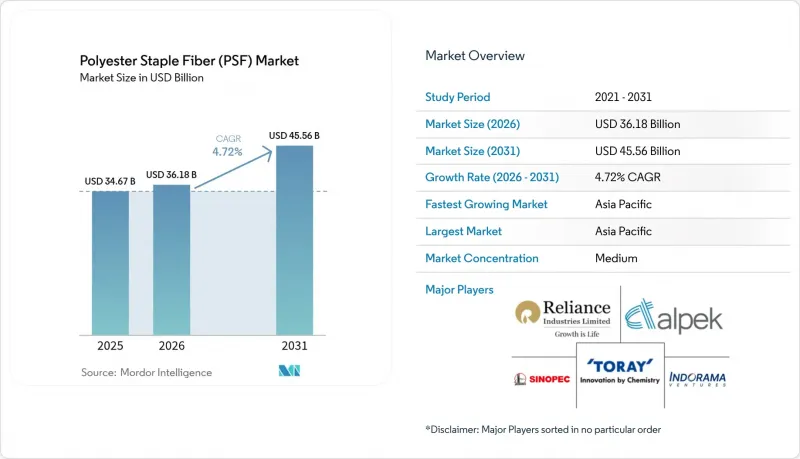
據 Mordor Intelligence 稱,聚酯短纖維 (PSF) 市場預計將從 2025 年的 346.7 億美元成長到 2026 年的 361.8 億美元,到 2031 年達到 455.6 億美元,2026 年至 2031 年的複合成長率為 4.72%。
本報告按產品類型(實心、中空)、來源(原生料、混合料、再生料)、應用領域(紡織品、家居佈置、汽車、過濾、建築及其他)和地區(亞太、北美、歐洲、南美、中東和非洲)進行細分。市場預測以美元計價。
全球聚酯短纖維(PSF)市場趨勢與洞察
快時尚品牌對再生PSF(Photosports Fiber)的需求激增。
品牌方為擴大再生材料的使用而做出的努力正逐步轉化為多年期契約,而再生聚苯乙烯泡沫塑膠(rPSF)的價格仍然高於原生纖維。 H&M已投資Syre公司,該公司計劃擴大其化學回收規模,以實現其2024年再生聚酯纖維的使用目標。遠東集團已擴大其再生聚對苯二甲酸乙二醇酯(rPET)的產能,但由於其大部分再生材料來自寶特瓶,因此與包裝行業的原料競爭日益激烈。 Indorama與嘉仁化工的合作預計將進一步擴大紡織品到紡織品的加工能力,凸顯了解聚在實現閉合迴路系統中的重要性日益增加。同時,ZDHC將於2024年發布的新指南將收緊對廢水和化學品的監管,這將進一步加劇小規模回收商的資金籌措挑戰,並可能導致市場重組,最終由一體化營運商主導。
擴大東南亞不織布衛生用品的生產能力
受人事費用較低、貿易路線優惠以及尿布普及率上升等因素的推動,不織布投資正從中國沿海地區轉向越南、印尼和泰國。泰國的合成纖維產量在2024年有所增加。同時,中石化億徵的標竿性無揮發性有機化合物(VOC)熔融直接生產線正在為東協地區的新工廠樹立標竿。根據EDANA和INDA的數據,衛生用不織布目前佔全球產量的大部分。此外,聚苯乙烯纖維(PSF)的拉伸強度和吸水性使其成為芯層和吸收層的理想纖維。印度尿布市場的擴張正在提振當地需求,為2027年實現兩位數的產能成長鋪路。此外,避免長途出口降低了物流成本,提高了計畫的經濟效益,並鞏固了東協作為新興衛生用聚苯乙烯纖維中心的地位。
原油價格波動導致原物料價格波動
2025年,與原油價格掛鉤的對二甲苯成本上漲速度超過了纖維價格,嚴重衝擊了PTA和MEG的利潤率。這導致中國多家PTA工廠關閉。與中國一體化煉廠相比,高度依賴進口的歐洲和東協地區也面臨原物料價格飆升的困境。這種差距不僅降低了這兩個地區的競爭力,也加速了產業結構調整的浪潮。為了因應市場動態的變化,Indorama關閉了位於加拿大的PTA工廠,Alpek也暫時停止了位於Cedar Creek的rPET生產。這兩項措施都是在利潤率轉為負值後採取的。儘管中國工信部正在倡導控制產能,但全球局勢卻截然不同。 PET設計產能的顯著過剩加劇了人們對結構性供應過剩的擔憂。此外,原物料成本的波動也為長期合約蒙上了陰影,使整個PSF供應鏈的資本規劃前景更加複雜。
細分市場分析
到2025年,實心聚酯短纖維(PSF)將佔據60.28%的市場。這主要得益於其在服裝、家居佈置和衛生不織布的應用,這些領域高度重視其韌性和色牢度。實心纖維以其抗起毛球性和耐長期壓縮性而聞名,在滌棉混紡布料和室內裝潢材料中需求持續成長,並超越了天然纖維。同時,中空纖維的複合年成長率(CAGR)為5.86%,這主要得益於汽車製造商、戶外服裝品牌和隔熱材料製造商對輕量化和隔熱性能的優先考慮。學術研究表明,中空聚酯纖維的導熱係數約為0.04 W/m·K,與玻璃纖維相當,同時避免了玻璃纖維的皮膚刺激性和吸濕性等缺點。汽車製造商目前已開始在車門板複合材料中使用低熔點中空聚酯纖維,從而實現快速真空成型,並符合電動車的生產目標。在建築領域,中空棉因其優於傳統礦物棉的優勢(例如更易於操作和防黴)而備受關注。隨著電動車平台的快速發展和環保建築標準的普及,預計到2031年,實心纖維棉的產量仍將保持領先地位,但中空纖維棉的吸引力有望進一步提升。
區域分析
預計亞太地區將在2025年佔據73.65%的市場佔有率,並在2031年之前以5.44%的複合年成長率成長。中國的聚酯產能鞏固了該地區的成本優勢。然而,由於預計2025年PTA利潤率將有所下降,政府正在採取「限制過度競爭」的措施以防止產能過剩。在印度,與生產連結獎勵計畫和MITRA大型產業園正在推動人工紡紗生產線的擴張,預計這將擴大該國聚酯短纖維市場在預測期內的規模。同時,泰國、越南和印尼正在擺脫對中國高成本產品的依賴,並加大對不織布衛生用品領域的投資。這些國家受益於較低的能源成本以及連接東協與美國和歐盟的貿易走廊,從而確保了強勁的銷售成長。日本和韓國正致力於高性能纖維的研發,東麗株式會社在韓國的資本投資就證明了這一點,兩國正從通用型聚苯乙烯泡沫塑膠(PSF)轉向高利潤的碳纖維和醯胺纖維。
在北美,供應鏈正在反傾銷措施的保護下進行重組。這些措施雖然支持了國內生產商,但也造成了依賴性,需要每年進口PET才能滿足需求。作為一項戰略舉措,信實工業(Reliance Industries)和印多拉瑪(Indorama)正相繼推出計劃,以解決美國產能瓶頸問題,旨在透過關稅實現進口替代。在大西洋彼岸,歐洲正面臨更嚴格的環境法規。微塑膠法規促使買家轉向低排放等級和創新回收技術,而當地生產商則面臨能源成本飆升的壓力。然而,儘管阿爾派克(Alpek)已提高產能並重啟了其位於威爾頓(Wilton)的PET生產線,但由於對二甲苯價格波動,其未來仍不明朗。
南美洲和中東/非洲市場雖然在全球紡織品生產中所佔佔有率較小,但由於基礎設施項目的快速擴張和人口趨勢,其成長潛力遠超平均水準。在沙烏地阿拉伯,NEOM新城正在站穩腳跟;在杜拜,3D列印建築標準的實施刺激了對PSF增強混凝土的初步需求。巴西正在進行策略轉型,轉向聚酯混紡布料以降低棉花價格波動風險,而貨幣貶值帶來的出口競爭力提升進一步推動了這項轉型。儘管這些新興地區的人均紡織品消費量落後於其他地區,但在財政獎勵策略和都市化進程的推動下,預計未來幾年這些地區的需求將會成長。
其他好處
- Excel格式的市場預測(ME)表
- 3個月的分析師支持
目錄
第1章:引言
- 研究假設和市場定義
- 調查範圍
第2章:調查方法
第3章執行摘要
第4章 市場狀況
- 市場概覽
- 市場促進因素
- 快時尚品牌對再生聚苯乙烯泡沫塑膠的需求激增
- 擴大東南亞不織布衛生用品的生產能力
- 從棉紡到聚酯纖維的轉變是由原棉價格波動所驅動的。
- 輕量化、低噪音、NVH 組件正在推動 PSF 在汽車中的應用。
- 纖維增強3D列印混凝土板的快速成長
- 市場限制因素
- 原油價格波動導致原物料價格波動
- 美國和歐盟對PSF徵收反傾銷稅
- 歐盟加強對微塑膠排放的監管
- 價值鏈分析
- 波特五力模型
第5章 市場規模與成長預測
- 依產品類型
- 中實
- 中空的
- 按供應來源
- 處女
- 混合物
- 回收材料
- 透過使用
- 紡織品
- 家居佈置
- 車
- 過濾
- 建造
- 其他
- 按地區
- 亞太地區
- 中國
- 印度
- 日本
- 韓國
- ASEAN
- 其他亞太國家
- 北美洲
- 美國
- 加拿大
- 墨西哥
- 歐洲
- 德國
- 英國
- 法國
- 義大利
- 西班牙
- 其他歐洲國家
- 南美洲
- 巴西
- 阿根廷
- 其他南美國家
- 中東和非洲
- 沙烏地阿拉伯
- 南非
- 其他中東和非洲國家
- 亞太地區
第6章 競爭情勢
- 市場集中度
- 策略趨勢
- 市佔率和排名分析
- 公司簡介
- Alpek
- Barnet
- Bombay Dyeing
- BoReTech Environmental Engineering Co., Ltd.
- Diyou Fibre(M)Sdn Bhd
- Far Eastern Group
- Hang Zhou Benma Chemfibre and Spinning Co.,Ltd.
- Huvis Corp
- Indorama Corporation
- Komal Fibres
- Nirmal Fibres(P)Ltd.
- Reliance Industries Limited
- Sanfame Group
- Shubhalakshmi
- SINOPEC YIZHENG CHEMICAL FIBRE LIMITED
- Thai polyester Co., Ltd.
- Tongkun Holding Group
- TORAY INDUSTRIES, INC.
- XINDA
第7章 市場機會與未來展望
According to Mordor Intelligence, the polyester staple fiber market size is expected to increase from USD 34.67 billion in 2025 to USD 36.18 billion in 2026 and reach USD 45.56 billion by 2031, growing at a CAGR of 4.72% over 2026-2031.
This report is Segmented by Product Type (Solid and Hollow), Origin (Virgin, Blended, and Recycled), Application (Textile, Home Furnishing, Automotive, Filtration, Construction, and Other Applications), and Geography (Asia-Pacific, North America, Europe, South America, and Middle-East and Africa). The Market Forecasts are Provided in Terms of Value (USD).
Global Polyester Staple Fiber (PSF) Market Trends and Insights
Surge in Demand for Recycled PSF from Fast-Fashion Brands
Brand commitments to boost recycled content are now solidifying into multi-year contracts, with rPSF prices sitting higher than virgin fiber. H&M, hitting recycled polyester in 2024, backed Syre with an investment to scale up chemical recycling. Far Eastern Group expanded its rPET capacity, but with most of its recycled input sourced from bottles, it's facing heightened competition from the packaging sector for feedstock. Indorama's collaboration with Jiaren Chemical is set to introduce additional capacity for textile-to-textile processing, underscoring the growing importance of depolymerization in achieving a closed-loop system. Meanwhile, new guidelines from ZDHC in 2024 tighten controls on wastewater and chemicals, creating steeper capital challenges for smaller recyclers and favoring market consolidation among integrated players.
Expansion of Non-Woven Hygiene Capacity in Southeast Asia
Non-woven investments are shifting from coastal China to Vietnam, Indonesia, and Thailand, driven by lower labor costs, preferential trade corridors, and increasing regional diaper penetration. Thailand's output of man-made fibers saw growth in 2024. Meanwhile, Sinopec Yizheng's benchmark zero-VOC melt-direct line is setting the standard for new plants in ASEAN. Data from EDANA and INDA highlight that hygiene non-wovens now represent a significant portion of the global volume. Additionally, the tensile strength and absorbency of PSF make it the preferred fiber for both core and acquisition layers. With India's diaper market on the rise, local off-take is bolstered, paving the way for double-digit capacity expansions until 2027. Furthermore, logistics savings from avoiding long-haul exports enhance project economics, solidifying ASEAN's position as the emerging hub for hygiene-grade PSF.
Raw-Material Price Swings Linked to Crude-Oil Volatility
In 2025, as crude-linked paraxylene costs surged faster than fiber prices, PTA and MEG margins took a sharp hit. This led to the closure of several PTA units in China. Europe and ASEAN, both heavily reliant on imports, grappled with higher feedstock prices compared to China's integrated refineries. This disparity not only diminished their competitiveness but also hastened a wave of rationalization. In response to the shifting market dynamics, Indorama closed its Canadian PTA plant, and Alpek paused its Cedar Creek rPET operations, both actions taken as profit spreads turned negative. While China's Ministry of Industry has advocated for capacity discipline, the global landscape tells a different story: with a significant nameplate capacity for PET, a structural oversupply looms large. Furthermore, the erratic nature of feedstock costs casts a shadow over long-term contracts, complicating capital-planning visibility throughout the PSF chain.
Other drivers and restraints analyzed in the detailed report include:
- Substitution of Cotton with Polyester Amid Raw-Cotton Price Volatility
- Lightweight, Low-Noise NVH Components Boost Automotive PSF Use
- Anti-Dumping Duties on PSF in the United States and EU
For complete list of drivers and restraints, kindly check the Table Of Contents.
Segment Analysis
In 2025, solid Polyester Staple Fiber (PSF) commanded a 60.28% share of the market, primarily driven by its applications in apparel, home furnishings, and hygiene non-wovens, where its tenacity and colorfastness are highly valued. Solid fibers, known for their resistance to pilling and prolonged compression, have seen sustained demand in blended polyester-cotton fabrics and upholstery, outpacing their natural counterparts. Meanwhile, hollow grades are climbing at a 5.86% CAGR, fueled by automakers, outdoor apparel brands, and insulation providers who prioritize weight savings and thermal efficiency. Academic studies highlight hollow polyester's thermal conductivity at approximately 0.04 W/m*K, on par with fiberglass, but without the downsides of skin irritation and moisture retention. Automotive OEMs are now turning to low-melting-point hollow variants for door-panel composites, enabling rapid vacuum-forming and aligning with electric vehicle production targets. In the construction sector, hollow batts are gaining traction, offering advantages like easier handling and mold resistance over traditional mineral wool. With the surge of electric vehicle platforms and green construction standards, the appeal of hollow PSF is set to soar, even as solid fiber maintains its volume lead through 2031.
Complete Report Scope:
- By Product Type
- Solid
- Hollow
- By Origin
- Virgin
- Blended
- Recycled
- By Application
- Textile
- Home Furnishing
- Automotive
- Filtration
- Construction
- Other Applications
- By Geography
- Asia-Pacific
- China
- India
- Japan
- South Korea
- ASEAN
- Rest of Asia-Pacific
- North America
- United States
- Canada
- Mexico
- Europe
- Germany
- United Kingdom
- France
- Italy
- Spain
- Rest of Europe
- South America
- Brazil
- Argentina
- Rest of South America
- Middle East and Africa
- Saudi Arabia
- South Africa
- Rest of Middle East and Africa
- Asia-Pacific
Geography Analysis
Asia-Pacific cemented 73.65% market share in 2025 and is on track for a 5.44% CAGR through 2031. China's polyester capacity solidifies the region's cost leadership. However, with PTA margins compressing in 2025, the government has intervened with "anti-involution" measures to prevent over-building. In India, bolstered by Production-Linked Incentives and the MITRA mega-parks, the addition of man-made spinning lines is projected to elevate the country's Polyester Staple Fiber market size over the forecast period. Meanwhile, Thailand, Vietnam, and Indonesia are capitalizing on non-woven hygiene investments, shifting from pricier China. They benefit from lower energy tariffs and trade corridors with ASEAN-U.S./EU, ensuring robust offtake. Japan and South Korea are honing in on high-performance fibers, as evidenced by Toray's capex in Korea, signaling a shift towards premium-margin carbon and aramid grades over the commodity PSF.
North America, under the protective umbrella of anti-dumping measures, is reshaping its supply chain. While these shields bolster domestic producers, they also create a dependency, necessitating PET imports annually to meet demand. In a strategic move, Reliance Industries and Indorama have both rolled out debottlenecking programs in the U.S., aiming to leverage tariff-induced import substitution. Across the Atlantic, Europe grapples with tightening environmental regulations. With microplastic legislation nudging buyers towards low-shedding grades and recycling innovations, local producers face pressures from soaring energy costs. Yet, Alpek's revival of its Wilton PET line, adding capacity, remains on edge due to fluctuations in paraxylene prices.
While South America and the combined regions of the Middle-East and Africa account small portion of the global volume, burgeoning infrastructure pipelines and demographic trends hint at a potential for above-average growth. In Saudi Arabia, NEOM is setting the stage, and in Dubai, 3D-print building codes are igniting an early demand for PSF-reinforced concrete. Brazil, in a strategic shift, is turning to polyester blends to buffer against cotton's volatility, a move further supported by a depreciated currency enhancing its export competitiveness. Despite trailing in per-capita fiber consumption, these emerging regions are witnessing a multi-year uplift, fueled by fiscal stimulus and urbanization.
- Alpek
- Barnet
- Bombay Dyeing
- BoReTech Environmental Engineering Co., Ltd.
- Diyou Fibre (M) Sdn Bhd
- Far Eastern Group
- Hang Zhou Benma Chemfibre and Spinning Co.,Ltd.
- Huvis Corp
- Indorama Corporation
- Komal Fibres
- Nirmal Fibres (P) Ltd.
- Reliance Industries Limited
- Sanfame Group
- Shubhalakshmi
- SINOPEC YIZHENG CHEMICAL FIBRE LIMITED
- Thai polyester Co., Ltd.
- Tongkun Holding Group
- TORAY INDUSTRIES, INC.
- XINDA
Additional Benefits:
- The market estimate (ME) sheet in Excel format
- 3 months of analyst support
TABLE OF CONTENTS
1 Introduction
- 1.1 Study Assumptions and Market Definition
- 1.2 Scope of the Study
2 Research Methodology
3 Executive Summary
4 Market Landscape
- 4.1 Market Overview
- 4.2 Market Drivers
- 4.2.1 Surge in demand for recycled PSF from fast-fashion brands
- 4.2.2 Expansion of non-woven hygiene capacity in Southeast Asia
- 4.2.3 Substitution of cotton with polyester amid raw-cotton price volatility
- 4.2.4 Lightweight, low-noise NVH components boost automotive PSF use
- 4.2.5 Rapid growth of fibre-reinforced 3-D printed concrete panels
- 4.3 Market Restraints
- 4.3.1 Raw-material price swings linked to crude-oil volatility
- 4.3.2 Anti-dumping duties on PSF in the United States and EU
- 4.3.3 Tightened EU micro-plastic shedding legislation
- 4.4 Value Chain Analysis
- 4.5 Porter's Five Forces
- 4.5.1 Bargaining Power of Suppliers
- 4.5.2 Bargaining Power of Buyers
- 4.5.3 Threat of New Entrants
- 4.5.4 Threat of Substitutes
- 4.5.5 Competitive Rivalry
5 Market Size and Growth Forecasts (Value)
- 5.1 By Product Type
- 5.1.1 Solid
- 5.1.2 Hollow
- 5.2 By Origin
- 5.2.1 Virgin
- 5.2.2 Blended
- 5.2.3 Recycled
- 5.3 By Application
- 5.3.1 Textile
- 5.3.2 Home Furnishing
- 5.3.3 Automotive
- 5.3.4 Filtration
- 5.3.5 Construction
- 5.3.6 Other Applications
- 5.4 By Geography
- 5.4.1 Asia-Pacific
- 5.4.1.1 China
- 5.4.1.2 India
- 5.4.1.3 Japan
- 5.4.1.4 South Korea
- 5.4.1.5 ASEAN
- 5.4.1.6 Rest of Asia-Pacific
- 5.4.2 North America
- 5.4.2.1 United States
- 5.4.2.2 Canada
- 5.4.2.3 Mexico
- 5.4.3 Europe
- 5.4.3.1 Germany
- 5.4.3.2 United Kingdom
- 5.4.3.3 France
- 5.4.3.4 Italy
- 5.4.3.5 Spain
- 5.4.3.6 Rest of Europe
- 5.4.4 South America
- 5.4.4.1 Brazil
- 5.4.4.2 Argentina
- 5.4.4.3 Rest of South America
- 5.4.5 Middle East and Africa
- 5.4.5.1 Saudi Arabia
- 5.4.5.2 South Africa
- 5.4.5.3 Rest of Middle East and Africa
- 5.4.1 Asia-Pacific
6 Competitive Landscape
- 6.1 Market Concentration
- 6.2 Strategic Moves
- 6.3 Market Share(%)/Ranking Analysis
- 6.4 Company Profiles (includes Global level Overview, Market level overview, Core Segments, Financials as available, Strategic Information, Products and Services, and Recent Developments)
- 6.4.1 Alpek
- 6.4.2 Barnet
- 6.4.3 Bombay Dyeing
- 6.4.4 BoReTech Environmental Engineering Co., Ltd.
- 6.4.5 Diyou Fibre (M) Sdn Bhd
- 6.4.6 Far Eastern Group
- 6.4.7 Hang Zhou Benma Chemfibre and Spinning Co.,Ltd.
- 6.4.8 Huvis Corp
- 6.4.9 Indorama Corporation
- 6.4.10 Komal Fibres
- 6.4.11 Nirmal Fibres (P) Ltd.
- 6.4.12 Reliance Industries Limited
- 6.4.13 Sanfame Group
- 6.4.14 Shubhalakshmi
- 6.4.15 SINOPEC YIZHENG CHEMICAL FIBRE LIMITED
- 6.4.16 Thai polyester Co., Ltd.
- 6.4.17 Tongkun Holding Group
- 6.4.18 TORAY INDUSTRIES, INC.
- 6.4.19 XINDA
7 Market Opportunities and Future Outlook
- 7.1 White-space and Unmet-Need Assessment
- 7.2 Growing Awareness Regarding Recycled Polyester Staple Fiber

 聚酯短纖維市場-2026-2032年全球市場預測
 全球聚酯短纖維市場規模、佔有率、趨勢及成長分析報告(2026-2034年)
 聚酯短纖維市場規模、佔有率和趨勢分析報告:按原料、產品、應用、地區和細分市場分類(2026-2033 年)
 聚酯短纖維市場規模、佔有率、趨勢和預測:按原料、產品、應用和地區分類,2026-2034年
 聚酯短纖維(PSF)市場分析與預測(至2035年):類型、產品、應用、技術、最終用戶、材料類型、製程、功能、安裝類型
 聚酯短纖維市場規模、佔有率及成長分析(按類型、產地、最終用戶和地區分類)-2026-2033年產業預測
 阻燃聚酯短纖維:全球市佔率及排名、總收入及需求預測(2025-2031年)聚酯短纖維市場-2025年至2030年的預測
 聚酯短纖維的全球市場:類型 (固態·中空)·原料 (原生·混合·回收)·用途 (纖維·住宅設備·汽車·過濾·其他)、各地區的機會及預測 (2018-2032年)
 2032 年聚酯短纖維市場預測:按產品類型、原料、光澤、顏色、應用和地區進行的全球分析