


 |
市場調查報告書
商品編碼
2124316
雲端備份:市場佔有率分析、產業趨勢與統計資料、成長預測(2026-2031)Cloud Backup - Market Share Analysis, Industry Trends & Statistics, Growth Forecasts (2026 - 2031) |
||||||

※ 本網頁內容可能與最新版本有所差異。詳細情況請與我們聯繫。
據 Mordor Intelligence 稱,2025 年雲端備份市場價值為 53.6 億美元,預計到 2031 年將達到 216.2 億美元,而 2026 年為 71.3 億美元,預測期(2026-2031 年)的複合年成長率為 24.84%。
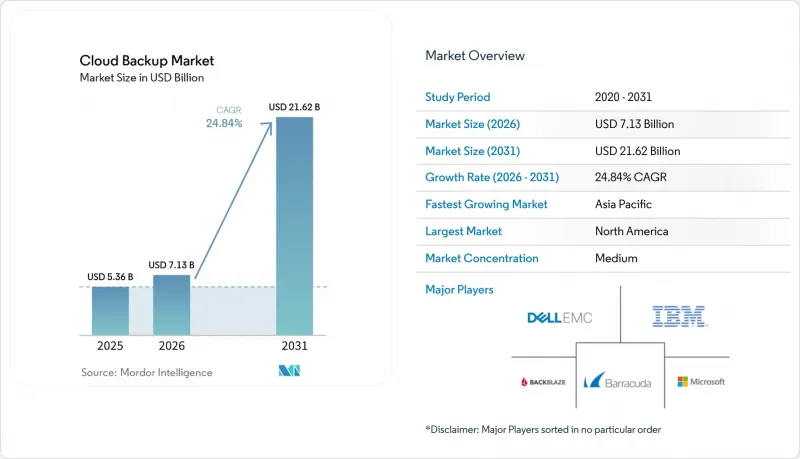
本報告按元件(解決方案和服務)、部署模式(公共雲端等)、最終用戶產業(銀行、金融服務、保險、IT、電信等)、服務供應商(託管服務供應商等)、組織規模(大型企業、中小企業)和地區進行細分。市場預測以美元計價。
全球雲端備份市場趨勢與洞察
資料產生量的爆炸性成長需要價格合理且可擴展的儲存方案。
到 2024 年,企業將產生 120 ZB 的數據,這將給固定計量收費的儲存陣列帶來巨大壓力。按需付費的雲端備份可以根據活躍資料集的大小靈活調整成本,並消除三年一次的硬體升級週期。像 Amazon S3 Glacier Instant Retrieval 這樣的超大規模資料中心業者冷儲存層提供低於每 GB 1 美分的價格,使資料保留超過十年而無需承擔過高的成本。邊緣快取僅發送已變更的資料區塊,從而緩解了頻寬限制,而備份遙測分析則有助於進行主動容量規劃。這些因素共同推動了對雲端備份的持續需求。
企業加速採用SaaS平台正在推動整合備份的需求。
儘管微軟 365 在 2024 年的付費許可證數量突破了 4 億,但微軟的「責任共擔模式」並未涵蓋應用層保護。因此,企業正在採用工作負載感知工具,以便在 93 天的「回收站」期限過後,仍能對 Exchange、SharePoint 和 OneDrive 資料進行簡介。 Salesforce 和 Google Workspace 也存在類似的缺陷,目前平均每個企業使用 130 種不同的 SaaS 工具。一個能夠協調不同 API 間細粒度簡介的統一策略引擎至關重要,而雲端備份市場也被視為 SaaS管治的核心支柱。
對資料主權和跨境傳輸制定嚴格的規定
中國的《個人資訊保護法》規定個人資料必須保存在境內,而印度的《資料保護和隱私法》則賦予政府權力,可以指定哪些類別的資料受到限制。歐洲出口商在資料傳輸前必須檢驗第三國的監控法律,這增加了實質審查的負擔。這些法規迫使跨國公司在每個司法管轄區建立重複的儲存庫,並推高了基礎設施成本,同時也刺激了區域內雲端備份市場的支出。
細分市場分析
到2025年,解決方案合約將佔總收入的63.19%,但服務板塊預計成長更快,複合年成長率將達到25.99%。雲端備份市場服務板塊的規模反映了對架構設計、策略腳本編寫和託管測試日益成長的需求。採用多租戶SaaS、容器叢集和傳統大型機組合方案的公司正在將整合工作外包給專業公司,這推高了合約價值。供應商正在引入人工智慧技術來對資料進行分類並自動分配儲存層,從而在提高合規性的同時降低儲存營運成本。
該服務的成長主要得益於按需計量收費的訂閱模式,這種模式將儲存、軟體和支援服務捆綁在一起。以受保護的工作負載收取固定收費,簡化了財務部門的採購流程。對備份完整性進行獨立檢驗是一項監管要求,這推動了對第三方審計服務的需求。擁有 ISO 27001 或 SOC 2 認證的託管服務供應商(MSP) 正在獲得高價值契約,並支援雲端備份市場的長期擴張。
儘管公共雲端在2025年仍以48.41%的市場佔有率領跑,但隨著企業在滿足國內監管要求和超大規模資料中心業者雲端服務商的經濟效益之間尋求平衡,混合雲端預計將以25.59%的複合年成長率成長。隨著監管機構強制要求資料本地化,以及企業董事會要求異地冗餘,混合雲端備份的市場佔有率將會上升。混合拓撲結構還支援分層恢復;關鍵業務工作負載可以在幾分鐘內從本地副本恢復,而歸檔資料則可以在幾個小時內從雲端儲存庫恢復。
邊緣運算進一步提升了混合解決方案的重要性。商店、工廠和通訊基地台透過在非尖峰時段時段將本地簡介複製到中央雲端來釋放頻寬。將於2024年生效的歐盟資料法將要求服務提供者實施資料可攜性,這將降低遷移風險並進一步加速混合解決方案的普及。總體而言,靈活的部署選項仍然是雲端備份市場的關鍵購買標準。
區域分析
北美地區預計在2025年佔全球收入的35.06%,這主要得益於早期雲端採用和成熟的業務永續營運計畫。儘管遵守HIPAA、薩班斯-奧克斯利法案以及各州的資料外洩法規迫在眉睫,但超大規模超大規模資料中心業者的密集部署正在降低延遲並實現區域內復原。預計到2031年,亞太地區的複合年成長率將達到26.89%,成為全球成長最快的地區。中國的《個人資訊保護法》和印度的《資料保護和隱私法》均強制要求資料儲存在國內,這導致了架構碎片化,但也刺激了在地化支出,並推動了兩國雲端備份市場的發展。
歐洲的發展趨勢以GDPR和標準合約條款為特徵,這些條款強制規定了細粒度的資料出口管制。在歐盟可用區託管資料的服務提供者在採購中享有優先權,而不可篡改的存檔有助於滿足第17條規定的「刪除權」要求,同時又不損害記錄的完整性。南美洲、中東和非洲仍然是發展中但極具吸引力的市場。巴西的《一般資料保護法》(LGPD)體現了GDPR的理念,並正在推廣加密和報告要求。海灣國家正在建立主權雲以吸引外國直接投資。
對延遲敏感的工作負載正促使企業跨多個區域複製資料。 AWS 在全球營運 33 個區域,Azure 則超過 60 個,因此能夠實現精細化的資料儲存位置選擇。位於商店、工廠或行動電話的邊緣微型資料中心又增加了一層保障,需要在同步到中央儲存庫之前建立本地簡介。這些地域差異共同建構了雲端備份市場中強大的區域資料管道。
其他好處:
- Excel格式的市場預測(ME)表
- 3個月的分析師支持
目錄
第1章:引言
- 研究假設和市場定義
- 調查範圍
第2章:調查方法
第3章執行摘要
第4章 市場狀況
- 市場概覽
- 市場促進因素
- 隨著資料產生量的爆炸性成長,對價格合理且擴充性的儲存的需求日益成長。
- 企業加速採用 SaaS 平台,推動了整合備份解決方案的需求。
- 企業雲端運算的日益成熟
- 人們越來越關注資料保護和彈性方面的監管要求。
- 為了滿足勒索軟體保險合規要求,不可變儲存技術的應用正在迅速成長。
- 擴大人工智慧資料分類的應用範圍,以最佳化備份佔用空間
- 市場限制因素
- 嚴格的資料主權和跨境資料傳輸法規
- 多租戶雲端持續存在隱私和安全隱患。
- 由於超大規模資料中心業者的出現,資料傳輸成本急劇上升,阻礙了經濟復甦的可行性。
- 操作技術(OT) 工作負載的邊緣級備份解決方案短缺
- 產業價值鏈分析
- 監理情勢
- 技術展望
- 波特五力分析
- 宏觀經濟因素對市場的影響
第5章 市場規模與成長預測
- 按組件
- 解決方案
- 服務
- 按部署模式
- 公共雲端
- 私有雲端
- 混合雲端
- 按最終用戶行業分類
- 銀行業、金融服務業及保險業
- IT/通訊
- 媒體與娛樂
- 零售
- 衛生保健
- 製造業
- 政府/公共部門
- 教育
- 其他終端用戶產業
- 透過服務供應商
- 託管服務提供者
- 雲端服務供應商
- 電信營運商
- 其他服務供應商
- 按組織規模
- 大公司
- 小型企業
- 按地區
- 北美洲
- 美國
- 加拿大
- 墨西哥
- 南美洲
- 巴西
- 阿根廷
- 其他南美國家
- 歐洲
- 德國
- 英國
- 法國
- 義大利
- 西班牙
- 荷蘭
- 俄羅斯
- 其他歐洲國家
- 亞太地區
- 中國
- 日本
- 印度
- 韓國
- 澳洲和紐西蘭
- ASEAN
- 其他亞太國家
- 中東
- 沙烏地阿拉伯
- 阿拉伯聯合大公國
- 土耳其
- 其他中東國家
- 非洲
- 南非
- 奈及利亞
- 埃及
- 其他非洲國家
- 北美洲
第6章 競爭情勢
- 市場集中度
- 策略趨勢
- 市佔率分析
- 公司簡介
- Amazon Web Services, Inc.
- Microsoft Corporation
- IBM Corporation
- Dell Technologies Inc.
- Google LLC
- Veeam Software Group GmbH
- Veritas Technologies LLC
- Commvault Systems, Inc.
- Acronis International GmbH
- Cohesity, Inc.
- Rubrik, Inc.
- Arcserve, LLC
- Barracuda Networks, Inc.
- Backblaze, Inc.
- Carbonite, LLC
- NetApp, Inc.
- Druva Inc.
- Hewlett Packard Enterprise Company
- Oracle Corporation
- Fujitsu Limited
- Cisco Systems, Inc.
- Iron Mountain Incorporated
- Asigra Inc.
第7章 市場機會與未來展望
According to Mordor Intelligence, the cloud backup market size was valued at USD 5.36 billion in 2025 and is estimated to grow from USD 7.13 billion in 2026 to reach USD 21.62 billion by 2031, at a CAGR of 24.84% during the forecast period (2026-2031).
This report is Segmented by Component (Solution, and Services), Deployment Model (Public Cloud, and More), End-User Industry (Banking Financial Services and Insurance, IT and Telecom, and More), Service Provider (Managed Service Provider, and More), Organization Size (Large Enterprises, and Small and Medium-Sized Enterprises), and Geography. The Market Forecasts are Provided in Terms of Value (USD).
Global Cloud Backup Market Trends and Insights
Massive Growth in Data Generation Requiring Affordable, Scalable Storage
Enterprises created 120 zettabytes of data in 2024, straining fixed-capacity arrays. Consumption-based cloud backup aligns cost with active datasets and removes three-year hardware refresh cycles. Hyperscalers' cold object tiers such as Amazon S3 Glacier Instant Retrieval deliver sub-cent-per-gigabyte pricing, enabling decade-long retention without disproportionate spend. Edge caching that transmits only changed blocks mitigates bandwidth limitations, while analytics on backup telemetry support proactive capacity planning. These factors collectively underpin sustained demand for the cloud backup market.
Accelerated Enterprise Adoption of SaaS Platforms Driving Integrated Backup Demand
Microsoft 365 surpassed 400 million paid seats in 2024, yet Microsoft's shared-responsibility model excludes application-layer protection. Enterprises therefore deploy workload-aware tools that snapshot Exchange, SharePoint, and OneDrive data outside the 93-day recycle-bin window. Similar gaps exist for Salesforce and Google Workspace, and the average company now uses 130 SaaS tools. Unified policy engines that orchestrate granular snapshots across disparate APIs have become critical, elevating the cloud backup market as a core pillar of SaaS governance.
Stringent Data-Sovereignty and Cross-Border Transfer Restrictions
China's PIPL forces personal data to remain onshore, while India's DPDP empowers the government to designate restricted categories. European exporters must verify third-country surveillance laws before transfer, inflating due-diligence overhead. These rules drive multinationals to duplicate repositories across jurisdictions, raising infrastructure costs yet stimulating regional spending within the cloud backup market.
Other drivers and restraints analyzed in the detailed report include:
- Rising Enterprise-Wide Cloud Computing Maturity Levels
- Heightened Regulatory Focus on Data-Protection and Resiliency Mandates
- Escalating Hyperscaler Data-Egress Charges Hindering Recovery Economics
For complete list of drivers and restraints, kindly check the Table Of Contents.
Segment Analysis
Solution contracts commanded 63.19% revenue in 2025, yet services are forecast to grow faster at 25.99% CAGR. The cloud backup market size for services reflects rising demand for architecture design, policy scripting, and managed testing. Enterprises that juggle multi-tenant SaaS, container clusters, and legacy mainframes outsource integration to specialists, lifting deal values. Vendors embed AI to classify data and assign retention tiers automatically, tightening compliance posture while lowering storage overhead.
Services growth is reinforced by consumption subscriptions that bundle storage, software, and support. Metallic charges per protected workload, which simplifies procurement for finance teams. Independent validation of backup integrity has become a regulatory staple, boosting third-party audit services. Managed Service Providers with ISO 27001 or SOC 2 certifications capture premium contracts, supporting long-run expansion of the cloud backup market.
Public cloud led 2025 demand at 48.41%, yet hybrid cloud is projected to advance at 25.59% CAGR as firms reconcile in-country mandates with hyperscaler economics. The cloud backup market share for hybrid designs rises when regulators prescribe data localization while boards insist on offsite redundancy. Hybrid topology also supports tiered recovery: mission-critical workloads restore from on-premises copies within minutes, whereas archival data recovers from cloud repositories over hours.
Edge computing widens hybrid relevance. Stores, plants, and towers replicate local snapshots to central clouds during off-peak windows, preserving bandwidth headroom. The EU Data Act, effective in 2024, obliges providers to enable portability, trimming migration risk and further bolstering hybrid adoption. Overall, flexible deployment choice remains a leading purchase criterion in the cloud backup market.
Complete Report Scope:
- By Component
- Solution
- Services
- By Deployment Model
- Public Cloud
- Private Cloud
- Hybrid Cloud
- By End-User Industry
- Banking, Financial Services and Insurance
- IT and Telecom
- Media and Entertainment
- Retail
- Healthcare
- Manufacturing
- Government and Public Sector
- Education
- Other End-User Industries
- By Service Provider
- Managed Service Provider
- Cloud Service Provider
- Telecom and Communication Provider
- Other Service Providers
- By Organization Size
- Large Enterprises
- Small and Medium-Sized Enterprises
- By Geography
- North America
- United States
- Canada
- Mexico
- South America
- Brazil
- Argentina
- Rest of South America
- Europe
- Germany
- United Kingdom
- France
- Italy
- Spain
- Netherlands
- Russia
- Rest of Europe
- Asia Pacific
- China
- Japan
- India
- South Korea
- Australia and New Zealand
- ASEAN
- Rest of Asia Pacific
- Middle East
- Saudi Arabia
- United Arab Emirates
- Turkey
- Rest of Middle East
- Africa
- South Africa
- Nigeria
- Egypt
- Rest of Africa
- North America
Geography Analysis
North America held 35.06% of 2025 revenue thanks to early cloud adoption and mature continuity planning. HIPAA, Sarbanes-Oxley, and state breach laws create compliance urgency, while dense hyperscaler footprints cut latency and enable in-region restores. Asia Pacific is projected to expand at 26.89% CAGR to 2031, the quickest worldwide. China's PIPL and India's DPDP enforce in-country storage, fragmenting architectures yet spurring localized spending that lifts the cloud backup market in both nations.
Europe's landscape is defined by GDPR plus Standard Contractual Clauses that demand granular export controls. Providers hosting data inside EU availability zones enjoy procurement preference, and immutable archives help satisfy Article 17 "right to erasure" requests without compromising record integrity. South America, the Middle East and Africa remain nascent but attractive. Brazil's LGPD mirrors GDPR, driving encryption and reporting requirements; Gulf states are building sovereign clouds to attract foreign direct investment.
Latency-sensitive workloads lead firms to replicate across multiple regions. AWS counts 33 global regions and Azure runs over 60, permitting fine-grained vault placement. Edge micro-data centers in stores, factories, or cell towers add another layer, requiring local snapshots before synchronizing to central repositories. These geographic nuances collectively reinforce robust regional pipelines for the cloud backup market.
- Amazon Web Services, Inc.
- Microsoft Corporation
- IBM Corporation
- Dell Technologies Inc.
- Google LLC
- Veeam Software Group GmbH
- Veritas Technologies LLC
- Commvault Systems, Inc.
- Acronis International GmbH
- Cohesity, Inc.
- Rubrik, Inc.
- Arcserve, LLC
- Barracuda Networks, Inc.
- Backblaze, Inc.
- Carbonite, LLC
- NetApp, Inc.
- Druva Inc.
- Hewlett Packard Enterprise Company
- Oracle Corporation
- Fujitsu Limited
- Cisco Systems, Inc.
- Iron Mountain Incorporated
- Asigra Inc.
Additional Benefits:
- The market estimate (ME) sheet in Excel format
- 3 months of analyst support
TABLE OF CONTENTS
1 INTRODUCTION
- 1.1 Study Assumptions and Market Definition
- 1.2 Scope of the Study
2 RESEARCH METHODOLOGY
3 EXECUTIVE SUMMARY
4 MARKET LANDSCAPE
- 4.1 Market Overview
- 4.2 Market Drivers
- 4.2.1 Massive Growth in Data Generation Requiring Affordable, Scalable Storage
- 4.2.2 Accelerated Enterprise Adoption of SaaS Platforms Driving Integrated Backup Demand
- 4.2.3 Rising Enterprise-wide Cloud Computing Maturity Levels
- 4.2.4 Heightened Regulatory Focus on Data-Protection & Resiliency Mandates
- 4.2.5 Surge in Adoption of Immutable Storage for Ransomware Insurance Compliance
- 4.2.6 Growing Use of AI-Based Data Classification to Optimize Backup Footprints
- 4.3 Market Restraints
- 4.3.1 Stringent Data-Sovereignty and Cross-Border Transfer Restrictions
- 4.3.2 Persistent Privacy and Security Concerns Around Multi-Tenant Clouds
- 4.3.3 Escalating Hyperscaler Data-Egress Charges Hindering Recovery Economics
- 4.3.4 Scarcity of Edge-Grade Backup Solutions for Operational-Technology Workloads
- 4.4 Industry Value-Chain Analysis
- 4.5 Regulatory Landscape
- 4.6 Technological Outlook
- 4.7 Porter's Five Forces Analysis
- 4.7.1 Bargaining Power of Suppliers
- 4.7.2 Bargaining Power of Buyers
- 4.7.3 Threat of New Entrants
- 4.7.4 Threat of Substitute Products
- 4.7.5 Intensity of Competitive Rivalry
- 4.8 Impact of Macroeconomic Factors on the Market
5 MARKET SIZE AND GROWTH FORECASTS (VALUE)
- 5.1 By Component
- 5.1.1 Solution
- 5.1.2 Services
- 5.2 By Deployment Model
- 5.2.1 Public Cloud
- 5.2.2 Private Cloud
- 5.2.3 Hybrid Cloud
- 5.3 By End-User Industry
- 5.3.1 Banking, Financial Services and Insurance
- 5.3.2 IT and Telecom
- 5.3.3 Media and Entertainment
- 5.3.4 Retail
- 5.3.5 Healthcare
- 5.3.6 Manufacturing
- 5.3.7 Government and Public Sector
- 5.3.8 Education
- 5.3.9 Other End-User Industries
- 5.4 By Service Provider
- 5.4.1 Managed Service Provider
- 5.4.2 Cloud Service Provider
- 5.4.3 Telecom and Communication Provider
- 5.4.4 Other Service Providers
- 5.5 By Organization Size
- 5.5.1 Large Enterprises
- 5.5.2 Small and Medium-Sized Enterprises
- 5.6 By Geography
- 5.6.1 North America
- 5.6.1.1 United States
- 5.6.1.2 Canada
- 5.6.1.3 Mexico
- 5.6.2 South America
- 5.6.2.1 Brazil
- 5.6.2.2 Argentina
- 5.6.2.3 Rest of South America
- 5.6.3 Europe
- 5.6.3.1 Germany
- 5.6.3.2 United Kingdom
- 5.6.3.3 France
- 5.6.3.4 Italy
- 5.6.3.5 Spain
- 5.6.3.6 Netherlands
- 5.6.3.7 Russia
- 5.6.3.8 Rest of Europe
- 5.6.4 Asia Pacific
- 5.6.4.1 China
- 5.6.4.2 Japan
- 5.6.4.3 India
- 5.6.4.4 South Korea
- 5.6.4.5 Australia and New Zealand
- 5.6.4.6 ASEAN
- 5.6.4.7 Rest of Asia Pacific
- 5.6.5 Middle East
- 5.6.5.1 Saudi Arabia
- 5.6.5.2 United Arab Emirates
- 5.6.5.3 Turkey
- 5.6.5.4 Rest of Middle East
- 5.6.6 Africa
- 5.6.6.1 South Africa
- 5.6.6.2 Nigeria
- 5.6.6.3 Egypt
- 5.6.6.4 Rest of Africa
- 5.6.1 North America
6 COMPETITIVE LANDSCAPE
- 6.1 Market Concentration
- 6.2 Strategic Moves
- 6.3 Market Share Analysis
- 6.4 Company Profiles (includes Global Level Overview, Market Level Overview, Core Segments, Financials as available, Strategic Information, Market Rank/Share for Key Companies, Products and Services, and Recent Developments)
- 6.4.1 Amazon Web Services, Inc.
- 6.4.2 Microsoft Corporation
- 6.4.3 IBM Corporation
- 6.4.4 Dell Technologies Inc.
- 6.4.5 Google LLC
- 6.4.6 Veeam Software Group GmbH
- 6.4.7 Veritas Technologies LLC
- 6.4.8 Commvault Systems, Inc.
- 6.4.9 Acronis International GmbH
- 6.4.10 Cohesity, Inc.
- 6.4.11 Rubrik, Inc.
- 6.4.12 Arcserve, LLC
- 6.4.13 Barracuda Networks, Inc.
- 6.4.14 Backblaze, Inc.
- 6.4.15 Carbonite, LLC
- 6.4.16 NetApp, Inc.
- 6.4.17 Druva Inc.
- 6.4.18 Hewlett Packard Enterprise Company
- 6.4.19 Oracle Corporation
- 6.4.20 Fujitsu Limited
- 6.4.21 Cisco Systems, Inc.
- 6.4.22 Iron Mountain Incorporated
- 6.4.23 Asigra Inc.
7 MARKET OPPORTUNITIES AND FUTURE OUTLOOK
- 7.1 White-Space and Unmet-Need Assessment

 2026年全球備份軟體解決方案市場報告
 雲端備份市場:按組件、部署方式、組織規模、技術和產業分類-全球市場預測(2026-2032 年)
 雲端備份市場:按元件、部署模式、組織規模、產業和地區分類
 雲端備份市場規模、佔有率、趨勢和預測:按組件、服務供應商、組織規模、部署類型、行業和地區分類,2026-2034 年2026年全球雲端災害復原市場報告2026年全球軟體即服務(SaaS) 備份軟體市場報告2026年全球雲端備份市場報告
 雲端備份市場分析及預測(至2035年):按類型、產品類型、服務、技術、組件、應用、部署類型、最終用戶、解決方案和模式分類電子檔案系統市場:2026-2032年全球預測(按組件、組織規模、部署類型、部署模式和應用分類)
 雲端備份市場規模、佔有率和成長分析(按組件、解決方案、組織規模、部署模式、服務供應商、最終用途和地區分類)-2026-2033年產業預測