


 |
市場調查報告書
商品編碼
2124296
低溫泵:市場佔有率分析、產業趨勢與統計、成長預測(2026-2031)Cryogenic Pump - Market Share Analysis, Industry Trends & Statistics, Growth Forecasts (2026 - 2031) |
||||||

※ 本網頁內容可能與最新版本有所差異。詳細情況請與我們聯繫。
據 Mordor Intelligence 稱,低溫泵市場預計到 2026 年價值 26.3 億美元,高於 2025 年的 25 億美元,預計到 2031 年將達到 33.7 億美元。
預計 2026 年至 2031 年的複合年成長率為 5.10%。
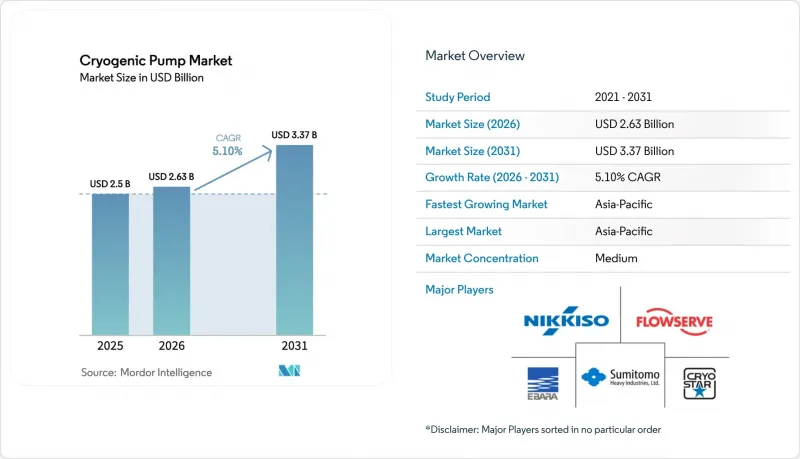
本報告按類型(動力泵和容積泵)、低溫氣體(氮氣、氧氣、氬氣、液化天然氣、氫氣、氦氣)、最終用戶(能源和發電、化學品和石化、醫療和生物技術、航太和航太發射服務等)以及地區(北美、歐洲、亞太地區、南美、中東和非洲)進行分類。
全球低溫泵市場趨勢及洞察
液化天然氣基礎設施投資激增
2025年至2030年間,預計每年運作約2,900億立方公尺液化天然氣(LNG)出口產能,這將是該產業史上規模最大的成長浪潮。普拉克明斯(Prakmins)、科珀斯克里斯蒂三期(Corpus Christi Phase III)以及卡達的諾斯菲爾德東部(Northfield East)等項目,正推動著對能夠處理低至-162 度C低溫環境的泵浦的巨大需求。在歐洲,斯塔德碼頭(Stade Terminal)的兩個24萬立方公尺儲存槽需要多級離心式幫浦來實現船舶與陸地之間的快速輸送。包括日機裝(Nikkiso)在內的供應商正在歐洲建立服務中心,以縮短檢修週期;同時,製程許可方透過採用變速驅動裝置,將電力消耗量降低高達7%。長期服務協議確保了高達99%的運轉率,從而保障了合約餘額。
醫療和半導體製造業對工業氣體的需求不斷成長。
受核磁共振造影系統引入和向 2 奈米半導體節點轉型(需要超高純度環境)的推動,預計到 2035 年,氦氣需求將翻倍。美國《晶片製造和供應法案》(CHIPS Act) 將撥款 300 億美元用於新建晶圓廠,要求工程總承包 (EPC) 公司提供氮氣、氬氣和氦氣供應系統,這些系統通常與承包低溫泵撬裝系統捆綁銷售。精密隔膜泵可確保無油氣體輸送,符合 ISO 14644-1 1 級無塵室標準。在亞洲,台灣、韓國和中國當地晶圓產能的提升推動了對高揚程往復泵的訂單成長,這種泵可在 25 巴的排放壓力下循環氦氣,與傳統迴路相比,氣體損失可減少 15%。
高額資本支出和複雜的維護
潛水式低溫泵撬裝設備可能佔液化天然氣(LNG)裝置安裝成本的4%至6%,但自2021年以來,ASME第九卷認證焊工的薪資溢價已超過20%。由於承包商破產導致的「黃金之路」LNG專案延誤凸顯了預算風險。此外,泵浦的維修需要專用工具,而這些工具在全球只有少數幾家服務中心擁有,這導致維修週期延長。地緣政治緊張局勢加劇了低溫鋼和因科鎳合金(Inconel)的關稅,推高了材料成本,促使營運商協商供應商管理庫存(VMI)計劃以分散供應風險。
細分市場分析
由於動態動力學設計(主要是離心式泵浦)能夠在最大限度減少運動部件的同時實現高容積流量,預計到2025年,這類泵將佔據低溫泵市場81.16%的佔有率。在LNG接收站,採用開式蝸殼結構的軸承間離心式幫浦是首選,因為它們能夠在-162 度C的低溫下最大限度地降低淨正吸入壓頭(NPSH)要求。隨著亞洲和歐洲再氣化能力的擴張,預計該細分市場將保持主導地位。相較之下,容積式泵浦技術適用於精確計量和高壓氫氣應用,在這些應用中,流量穩定性比流量更為重要。受用於交通運輸和分散式發電的液氫分銷網路成長的推動,預計容積式泵浦的複合年成長率將達到5.62%。
離心式幫浦浦型號配備蒸氣回流管路以減少氣蝕,從而將檢修週期延長至 60,000 小時以上。軸流泵專為尖峰用電調節(LNG) 輸送而設計,適用於相對較低的尖峰負載。混流泵為浮體式儲存再氣化裝置 (FSRU) 提供混合性能。往復泵屬於容積式泵,採用無油活塞環以抑制碳氫化合物污染,這是燃料電池氫氣品質的關鍵指標。螺旋泵適用於冶金氬氣加工的連續運行,而隔膜泵則為 3 奈米半導體濕式製程台提供無顆粒流體。運作條件的多樣化確保每種類型的泵浦都能找到其專屬的市場定位,從而在整個設計領域保持良性競爭。這種細分市場也為售後市場提供了收入來源,加強了原始設備製造商 (OEM) 與工廠營運商在產品生命週期內的合作,因為不同的架構需要不同的密封套件和備用轉子。
區域分析
2025年,亞太地區以37.92%的市佔率領先低溫幫浦市場。這主要得益於中國27座已投入運作中的LNG接收站以及加氫站的快速擴張。隨著印度、日本和韓國加快無污染燃料進口並擴大半導體產能,預計到2031年,該地區的複合年成長率將達到5.38%。本地原始設備製造商(OEM)正在擴大本地組裝以降低物流成本,而跨國公司則透過向合資夥伴授權智慧財產權(IP)來遵守採購法規。中國唐山二期接收站擁有5,844億立方英尺的儲存容量,是推動大規模級泵浦需求的典型案例。同時,西安小規模液化天然氣樞紐每年新增140萬噸液化產能,帶動了可部署在偏遠工業園區的撬裝式泵浦的訂單成長。
預計到2028年,北美液化天然氣出口量將達到244億立方英尺/日,維持強勁成長動能。該地區正憑藉其在液態氫領域的主導地位,逐步成為技術培養箱。該地區擁有15個液氫生產設施,日產量達326噸。美國供應商正利用其接近性航太巨頭的優勢以及對氫能中心的津貼,將先進的振動診斷分析功能整合到其泵浦產品中。在加拿大,一條新的液氫走廊正在形成,將魯珀特王子港與內陸卡車運輸網路連接起來,從而提升了對專為拖車卸貨而最佳化的中型泵的需求。在墨西哥,航太叢集內工業氣體的擴張進一步拓展了該地區的商業機會。
歐洲正轉向進口基礎設施以應對俄羅斯天然氣供不應求。在德國施塔德終端,與氨氣相容的基本負載泵正在安裝,為未來的燃料轉型做好準備。斯堪地那維亞造船廠正在進行液態氫燃料庫測試,這需要配備快速釋放接頭的可攜式幫浦模組。中東出口商繼續使用成本效益高的原料氣體,但沙烏地阿拉伯和阿拉伯聯合大公國新建的藍氫工廠正在整合液氫物流鏈,這需要低溫泵。非洲和南美洲仍在發展中,但用於離網發電的小規模液化天然氣項目正在推進,為泵浦需求的逐步成長奠定了基礎。
其他好處:
- Excel格式的市場預測(ME)表
- 3個月的分析師支持
目錄
第1章:引言
- 研究假設和市場定義
- 調查範圍
第2章:調查方法
第3章執行摘要
第4章 市場狀況
- 市場概覽
- 市場促進因素
- 液化天然氣基礎設施投資激增
- 醫療領域和半導體製造廠對工業氣體的需求不斷成長。
- 全球氫能經濟的擴張
- 經合組織國家老舊空分裝置的更換
- 用於超大規模量子計算資料中心的低溫泵
- 商業航太發射中推進劑處理的要求
- 市場限制因素
- 高額資本支出 (CAPEX) 和維護複雜性
- 液化天然氣價格波動導致工程延長。
- 特種合金供應鏈供不應求
- 關於氨作為船用燃料的監管不確定性。
- 供應鏈分析
- 監理情勢
- 技術展望
- 波特五力模型
第5章 市場規模與成長預測
- 按類型
- 動力(動能)泵
- 離心式
- 軸流泵
- 混合流量泵
- 容積式泵
- 往復式
- 擰緊
- 隔膜
- 動力(動能)泵
- 低溫氣體
- 氮
- 氧
- 氬氣
- LNG
- 氫
- 氦
- 最終用戶
- 能源和發電
- 化工/石油化工
- 醫療保健和生物技術
- 冶金與金屬加工
- 半導體和電子學
- 航太和航太發射服務
- 按地區
- 北美洲
- 美國
- 加拿大
- 墨西哥
- 歐洲
- 德國
- 英國
- 法國
- 義大利
- 俄羅斯
- 其他歐洲國家
- 亞太地區
- 中國
- 印度
- 日本
- 韓國
- 東南亞國協
- 其他亞太國家
- 南美洲
- 巴西
- 阿根廷
- 其他南美國家
- 中東和非洲
- 沙烏地阿拉伯
- 阿拉伯聯合大公國
- 南非
- 埃及
- 其他中東和非洲國家
- 北美洲
第6章 競爭情勢
- 市場集中度
- 策略趨勢(併購、聯盟、購電協議)
- 市場佔有率分析(主要公司的市場排名和市場佔有率)
- 公司簡介
- Nikkiso Co., Ltd.
- Ebara Corporation
- Flowserve Corporation
- Sumitomo Heavy Industries, Ltd.
- Cryostar SAS
- Weir Group PLC
- Fives Group
- KSB SE & Co. KGaA
- Beijing Long March Tianmin Hi-Tech
- PHPK Technologies
- Atlas Copco(Leybold)
- Dover(PSG & Cryo-Mach)
- Chart Industries
- Ruhrpumpen Group
- Technex Ltd.
- Shinko NSE
- Cryomec AG
- CYY Energy
- Zhejiang Sanhuan Hi-Tech
- Barber-Nichols
- Trillium Flow Technologies
第7章 市場機會與未來展望
According to Mordor Intelligence, cryogenic pump market size in 2026 is estimated at USD 2.63 billion, growing from 2025 value of USD 2.5 billion with 2031 projections showing USD 3.37 billion, growing at 5.10% CAGR over 2026-2031.
This report is Segmented by Type (Dynamic Pumps and Positive-Displacement Pumps), Cryogenic Gas (Nitrogen, Oxygen, Argon, LNG, Hydrogen, and Helium), End User (Energy and Power Generation, Chemicals and Petrochemicals, Healthcare and Biotechnology, Aerospace and Space Launch Services, and More), and Geography (North America, Europe, Asia-Pacific, South America, and Middle East and Africa).
Global Cryogenic Pump Market Trends and Insights
Surge in LNG Infrastructure Investments
Nearly 290 billion m3 per year of new LNG export capacity is slated to come online between 2025 and 2030, the largest wave in industry history. Projects such as Plaquemines, Corpus Christi Stage 3, and Qatar's North Field East underpin bulk demand for pumps rated down to -162 °C. In Europe, the Stade terminal hosts two 240,000 m3 storage tanks that require multi-stage centrifugal units sized for rapid ship-to-shore transfer. Vendors, including Nikkiso, have opened European service hubs to shorten overhaul cycles, while process licensors integrate variable-speed drives to trim power consumption by up to 7%. Contract backlogs are being locked in under long-term service agreements that guarantee availability thresholds exceeding 99% .
Rising Industrial-Gas Demand from Healthcare & Semiconductor Fabs
Helium demand is forecast to double by 2035, propelled by MRI installations and 2 nm semiconductor node transitions that need ultra-high-purity environments. The U.S. CHIPS Act channels USD 30 billion into new fabs, motivating EPC firms to bundle nitrogen, argon, and helium supply systems with turnkey cryogenic pump skids. Precision diaphragm pumps ensure oil-free delivery that meets ISO 14644-1 Class 1 cleanroom standards. In Asia, wafer capacity additions in Taiwan, South Korea, and mainland China are driving orders for high-head reciprocating pumps that recycle helium at 25 bar discharge pressure, cutting gas losses by 15% versus legacy loops .
High CAPEX & Maintenance Complexity
A submerged cryogenic pump skid can represent 4-6% of an LNG train's installed cost, while welders certified to American Society of Mechanical Engineers Section IX have commanded wage premiums surpassing 20% since 2021. The Golden Pass LNG project's delays, triggered by contractor insolvency, highlight budget exposure. Furthermore, pump repair windows require specialist tooling held by only a handful of service centers worldwide, extending turnaround intervals. Tariffs on cryogenic steel and Inconel exacerbated by geopolitical tensions inflate bills of material, prompting operators to negotiate vendor-managed inventory programs that amortize supply risk.
Other drivers and restraints analyzed in the detailed report include:
- Expansion of the Global Hydrogen Economy
- Replacement of Ageing ASUs in OECD Countries
- LNG Price Volatility Delaying Projects
For complete list of drivers and restraints, kindly check the Table Of Contents.
Segment Analysis
Dynamic kinetic designs, primarily centrifugal models, controlled 81.16% of the cryogenic pump market in 2025 because they deliver high volumetric flow with limited moving parts. LNG terminals favor between-bearings centrifugal pumps whose open-volute architecture minimizes NPSH requirements at -162 °C. The segment is forecast to maintain leadership as regasification capacity accelerates across Asia and Europe. Positive-displacement technology, by contrast, caters to precision dosing and high-pressure hydrogen service where flow stability outweighs capacity. These units are projected to post a 5.62% CAGR, buoyed by growth in liquid hydrogen distribution networks for mobility and distributed power.
Centrifugal models integrate vapor-return lines that reduce cavitation, extending overhaul intervals beyond 60,000 hours. Axial-flow variants target peak-shaving peak load LNG send-out, where differential pressures remain modest. Mixed-flow pumps provide hybrid performance for floating storage regasification units. Reciprocating pumps within the positive-displacement category employ oil-free piston rings that limit hydrocarbon contamination, a key metric for fuel-cell-grade hydrogen. Screw pumps support continuous duty in metallurgical argon service, whereas diaphragm pumps deliver particle-free flow for 3 nm semiconductor wet benches. Diversifying duty points ensures that every modality finds its niche, sustaining healthy competition across design paradigms. The segment's split also underpins after-market revenues, as different architectures require distinct seal kits and spare rotors, reinforcing OEM lifecycle engagement with plant operators.
Complete Report Scope:
- By Type
- Dynamic (Kinetic) Pumps
- Centrifugal
- Axial Flow
- Mixed Flow
- Positive-Displacement Pumps
- Reciprocating
- Screw
- Diaphragm
- Dynamic (Kinetic) Pumps
- By Cryogenic Gas
- Nitrogen
- Oxygen
- Argon
- LNG
- Hydrogen
- Helium
- By End User
- Energy and Power Generation
- Chemicals and Petrochemicals
- Healthcare and Biotechnology
- Metallurgy and Metal Processing
- Semiconductor and Electronics
- Aerospace and Space Launch Services
- By Geography
- North America
- United States
- Canada
- Mexico
- Europe
- Germany
- United Kingdom
- France
- Italy
- Russia
- Rest of Europe
- Asia-Pacific
- China
- India
- Japan
- South Korea
- ASEAN Countries
- Rest of Asia-Pacific
- South America
- Brazil
- Argentina
- Rest of South America
- Middle East and Africa
- Saudi Arabia
- United Arab Emirates
- South Africa
- Egypt
- Rest of Middle East and Africa
- North America
Geography Analysis
Asia Pacific led the cryogenic pump market in 2025 with 37.92% revenue share, anchored by China's 27 ongoing LNG terminals and aggressive hydrogen station rollouts. Regional CAGR is projected at 5.38% to 2031 as India, Japan, and South Korea accelerate clean-fuel imports and semiconductor capacity. Indigenous OEMs are scaling local assembly to cut logistics costs, while multinationals license IP to joint-venture partners to comply with procurement rules. China's Tangshan II terminal, featuring 584.4 bcf storage, typifies the massive duty points driving multi-stage pump demand. Simultaneously, the Xi'an small-scale LNG hub adds 1,400 ktpa liquefaction, boosting orders for skid-mounted pumps deployable in remote industrial parks.
North America maintains robust momentum backed by an 11.4 Bcf/d LNG export base forecast to reach 24.4 Bcf/d by 2028. Liquid hydrogen leadership, with 15 facilities producing 326 t/day, positions the region as a technology incubator. U.S. vendors leverage proximity to aerospace primes and hydrogen hub grants, embedding advanced vibration diagnostic analytics into pump offerings. Canada's emerging LH2 corridors link Prince Rupert to inland trucking fleets, spurring demand for mid-scale pumps optimized for trailer offloading. Mexico's industrial gas expansion in aerospace clusters further broadens regional opportunities.
Europe is pivoting toward import infrastructure to counter Russian gas shortfalls. Germany's Stade terminal integrates ammonia-ready baseload pumps, future-proofing against fuel transition. Scandinavian shipyards are trialing LH2 bunkering, requiring portable pump modules with rapid disconnect couplings. Middle East exporters continue capitalizing on cost-advantaged feedgas, but newer blue-hydrogen plants in Saudi Arabia and the UAE are incorporating LH2 logistics chains that necessitate ultra-low-temperature pumps. Africa and South America remain nascent yet are advancing small-scale LNG for off-grid power, laying the groundwork for incremental pump demand.
- Nikkiso Co., Ltd.
- Ebara Corporation
- Flowserve Corporation
- Sumitomo Heavy Industries, Ltd.
- Cryostar SAS
- Weir Group PLC
- Fives Group
- KSB SE & Co. KGaA
- Beijing Long March Tianmin Hi-Tech
- PHPK Technologies
- Atlas Copco (Leybold)
- Dover (PSG & Cryo-Mach)
- Chart Industries
- Ruhrpumpen Group
- Technex Ltd.
- Shinko NSE
- Cryomec AG
- CYY Energy
- Zhejiang Sanhuan Hi-Tech
- Barber-Nichols
- Trillium Flow Technologies
Additional Benefits:
- The market estimate (ME) sheet in Excel format
- 3 months of analyst support
TABLE OF CONTENTS
1 Introduction
- 1.1 Study Assumptions & Market Definition
- 1.2 Scope of the Study
2 Research Methodology
3 Executive Summary
4 Market Landscape
- 4.1 Market Overview
- 4.2 Market Drivers
- 4.2.1 Surge in LNG infrastructure investments
- 4.2.2 Rising industrial-gas demand from healthcare & semiconductor fabs
- 4.2.3 Expansion of the global hydrogen economy
- 4.2.4 Replacement of ageing ASUs in OECD countries
- 4.2.5 Cryogenic pumps for hyperscale quantum-computing data centers
- 4.2.6 Commercial space-launch propellant handling requirements
- 4.3 Market Restraints
- 4.3.1 High CAPEX & maintenance complexity
- 4.3.2 LNG price volatility delaying projects
- 4.3.3 Supply-chain shortages of specialty alloys
- 4.3.4 Regulatory uncertainty on ammonia as marine fuel
- 4.4 Supply-Chain Analysis
- 4.5 Regulatory Landscape
- 4.6 Technological Outlook
- 4.7 Porter's Five Forces
- 4.7.1 Bargaining Power of Suppliers
- 4.7.2 Bargaining Power of Consumers
- 4.7.3 Threat of New Entrants
- 4.7.4 Threat of Substitutes
- 4.7.5 Competitive Rivalry
5 Market Size & Growth Forecasts
- 5.1 By Type
- 5.1.1 Dynamic (Kinetic) Pumps
- 5.1.1.1 Centrifugal
- 5.1.1.2 Axial Flow
- 5.1.1.3 Mixed Flow
- 5.1.2 Positive-Displacement Pumps
- 5.1.2.1 Reciprocating
- 5.1.2.2 Screw
- 5.1.2.3 Diaphragm
- 5.1.1 Dynamic (Kinetic) Pumps
- 5.2 By Cryogenic Gas
- 5.2.1 Nitrogen
- 5.2.2 Oxygen
- 5.2.3 Argon
- 5.2.4 LNG
- 5.2.5 Hydrogen
- 5.2.6 Helium
- 5.3 By End User
- 5.3.1 Energy and Power Generation
- 5.3.2 Chemicals and Petrochemicals
- 5.3.3 Healthcare and Biotechnology
- 5.3.4 Metallurgy and Metal Processing
- 5.3.5 Semiconductor and Electronics
- 5.3.6 Aerospace and Space Launch Services
- 5.4 By Geography
- 5.4.1 North America
- 5.4.1.1 United States
- 5.4.1.2 Canada
- 5.4.1.3 Mexico
- 5.4.2 Europe
- 5.4.2.1 Germany
- 5.4.2.2 United Kingdom
- 5.4.2.3 France
- 5.4.2.4 Italy
- 5.4.2.5 Russia
- 5.4.2.6 Rest of Europe
- 5.4.3 Asia-Pacific
- 5.4.3.1 China
- 5.4.3.2 India
- 5.4.3.3 Japan
- 5.4.3.4 South Korea
- 5.4.3.5 ASEAN Countries
- 5.4.3.6 Rest of Asia-Pacific
- 5.4.4 South America
- 5.4.4.1 Brazil
- 5.4.4.2 Argentina
- 5.4.4.3 Rest of South America
- 5.4.5 Middle East and Africa
- 5.4.5.1 Saudi Arabia
- 5.4.5.2 United Arab Emirates
- 5.4.5.3 South Africa
- 5.4.5.4 Egypt
- 5.4.5.5 Rest of Middle East and Africa
- 5.4.1 North America
6 Competitive Landscape
- 6.1 Market Concentration
- 6.2 Strategic Moves (M&A, Partnerships, PPAs)
- 6.3 Market Share Analysis (Market Rank/Share for key companies)
- 6.4 Company Profiles (includes Global level Overview, Market level overview, Core Segments, Financials as available, Strategic Information, Products & Services, and Recent Developments)
- 6.4.1 Nikkiso Co., Ltd.
- 6.4.2 Ebara Corporation
- 6.4.3 Flowserve Corporation
- 6.4.4 Sumitomo Heavy Industries, Ltd.
- 6.4.5 Cryostar SAS
- 6.4.6 Weir Group PLC
- 6.4.7 Fives Group
- 6.4.8 KSB SE & Co. KGaA
- 6.4.9 Beijing Long March Tianmin Hi-Tech
- 6.4.10 PHPK Technologies
- 6.4.11 Atlas Copco (Leybold)
- 6.4.12 Dover (PSG & Cryo-Mach)
- 6.4.13 Chart Industries
- 6.4.14 Ruhrpumpen Group
- 6.4.15 Technex Ltd.
- 6.4.16 Shinko NSE
- 6.4.17 Cryomec AG
- 6.4.18 CYY Energy
- 6.4.19 Zhejiang Sanhuan Hi-Tech
- 6.4.20 Barber-Nichols
- 6.4.21 Trillium Flow Technologies
7 Market Opportunities & Future Outlook
- 7.1 White-Space & Unmet-Need Assessment

 低溫離心式幫浦市場規模、佔有率和成長分析:按泵浦類型、低溫流體、應用、終端用戶產業、泵浦容量和地區分類-2026-2033年產業預測
 低溫幫浦市場-2026-2032年全球市場預測
 液化天然氣泵:全球市場佔有率和排名、總收入和需求預測(2026-2032年)
 低溫泵市場:商業機會、成長要素、產業趨勢分析及2026-2035年預測
 低溫幫浦市場報告:按類型、終端用戶產業和地區分類(2026-2034 年)
 低溫泵市場:按類型、氣體、最終用戶和地區分類
 2026年全球低溫幫浦市場報告
 低溫泵市場 - 全球產業規模、佔有率、趨勢、機會及預測(按類型、應用、最終用途產業、地區和競爭格局分類,2021-2031年)
 全球低溫泵市場:市場規模、佔有率、成長率、產業分析、依類型、應用和地區劃分的分析及預測(2026-2034年)
 低溫泵市場規模、佔有率和成長分析(按安裝方向、設計、類型、低溫介質、最終用戶和地區分類)—產業預測,2026-2033年