


 |
市場調查報告書
商品編碼
2124282
壓力容器:市場佔有率分析、產業趨勢與統計、成長預測(2026-2031)Pressure Vessel - Market Share Analysis, Industry Trends & Statistics, Growth Forecasts (2026 - 2031) |
||||||

※ 本網頁內容可能與最新版本有所差異。詳細情況請與我們聯繫。
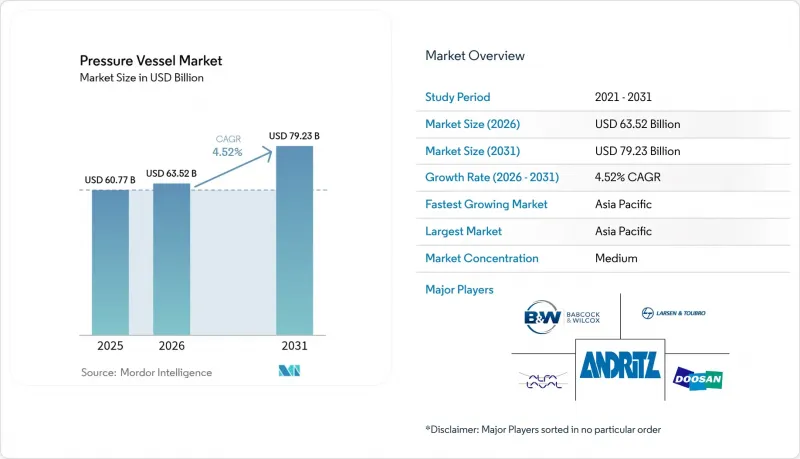
根據 Mordor Intelligence 預測,壓力容器市場規模將從 2025 年的 607.7 億美元成長到 2026 年的 635.2 億美元,然後在 2031 年達到 792.3 億美元,2026 年至 2031 年的複合年成長率為 4.52%。
本報告按材料(碳鋼、複合材料、複合鋼和合金鋼、其他)、耐壓等級(0-10 巴、100 巴及以上、其他)、應用(儲罐、工藝/反應器、熱交換器、鍋爐、其他(客製化容器、特殊容器、膨脹容器))、最終用戶行業(發電、石油和天然氣
全球壓力容器市場趨勢及洞察
升級新興國家的能源基礎設施
亞太地區各國政府正在加速推動煉油、石化和發電工程,這些項目需要大量經認證的壓力容器。東方電力為台山二號機組供應國產反應器壓力容器,便是從進口轉向本地製造的典型例證。印度和東南亞的工業園區正在為聯合循環發電廠和LNG接收站指定使用標準化壓力容器,從而將訂單從傳統的西方供應商轉移出去。開發銀行的資金支持縮短了專案週期,並加強了對區域製造商的產量保障。低廉的人事費用加上技術的快速進步,使得符合ASME和PED標準且具有價格競爭力的產品得以生產。這種跨區域的產能流動增強了壓力容器市場的製造韌性,同時也帶來了成本壓力。
全球液化天然氣貿易的擴張以及由此產生的對低溫儲存的需求
加拿大首批液化天然氣(LNG)從太平洋沿岸運往亞太地區,顯示隨著北美LNG供應量的成長,市場需要數百個雙層不銹鋼儲罐,這些儲罐能夠在負載波動的情況下維持-162 度C的低溫。耗資400億美元的加拿大LNG工廠正是這種規模的典型代表,其儲槽的設計能夠承受蒸發氣體和週期性熱應力。隨著LNG整合到船舶和重型卡車中,減輕重量和真空隔熱變得至關重要,儲罐的複雜性也隨之增加。這些技術壁壘有利於擁有成熟低溫技術訣竅的成熟企業,從而鞏固了專業供應商的市場佔有率。長期承購合約可以降低產量風險,並提高低溫儲罐製造商的訂單儲備可見度。
鋼材價格波動對OEM廠商的利潤率帶來了壓力。
2024年,歐洲表面消費量連續第四年萎縮,美國新加徵的進口關稅加劇了成本波動。壓力容器製造商在現貨價格飆升時面臨負利潤,因為他們簽訂的固定價格交付合約往往早於鈑金製造商最終確定季度附加費的幾個月。一些製造商正在加速向複合材料和雙相不銹鋼轉型以降低風險,但標準認證要求限制了快速轉型。此外,由於鈑金製造商在供應緊張時期要求加快結算,營運資金負擔也在加重。因此,價格波動正直接影響壓力容器市場的盈利。
細分市場分析
由於碳鋼仍將佔壓力容器市場47.35%的佔有率。然而,隨著氫能運輸的發展帶動複合材料壓力容器產量的增加,預計到2031年,複合材料壓力容器的市場規模將以7.05%的複合年成長率成長。不銹鋼在食品、製藥和生物技術服務領域繼續發揮重要作用,其優異的耐腐蝕性使其價格較高。複合鋼和合金鋼用於高溫石化反應器,而鋁則佔據著一個以重量為主要考慮的細分市場。複合材料重疊式壓力容器在700巴的工作條件下可實現60%的減重,因此在運輸和固定儲存領域中得到了更廣泛的應用。
壓力容器市場正採取措施,抓住新興複合材料市場的機遇,例如改造纏繞成型線並確保碳纖維供應合約。同時,鋼鐵製造商正透過引入電拋光生產線和雙相鋼來滿足嚴格的衛生標準,從而鞏固其市場佔有率。因此,材料多樣化加劇了競爭,法規核准既是障礙也是促進因素。核能應用複合材料內襯的認證仍然難以實現,儘管鋼鐵在這一高階領域仍佔據主導地位,但它未能阻止複合材料進入其他領域。
截至2025年,低壓容器(0-10巴)在散裝儲存和水處理領域佔據壓力容器市場佔有率的40.60%。由於氫氣儲槽和超臨界反應器需要極高的耐壓性能,預計到2031年,超高壓容器(100巴以上)的市場規模將以7.25%的複合年成長率成長。煉油廠和化工廠對中壓(10-50巴)和高壓(50-100巴)容器的需求預計將保持穩定。氫燃料電池汽車儲存氫氣的壓力為350-700巴,因此4型儲槽是其標準設計。
針對此細分市場的製造商正在投資汽車級壓力機、精密捲繞設備和內部爆破測試設備,以符合 ISO 19881 標準。每公斤儲氫成本是關鍵的競爭因素,推動了更薄內襯和先進纖維材料的研發。同時,低壓儲槽製造商則專注於模組化儲槽區和自動化軋延線,以在商品市場中保持獲利能力。這種兩極化凸顯了新技術如何重塑壓力容器市場的競爭叢集。
區域分析
預計到2025年,亞太地區將佔壓力容器市場44.62%的佔有率,並在2031年之前以6.05%的複合年成長率持續成長。中國核子反應爐島零件的在地化生產以及印度煉油廠建設的擴張,支撐了該地區大規模訂單。新日鐵和三菱重工向全球供應核子反應爐鍛件,鞏固了該地區在高規格領域的領先地位。韓國正利用其造船技術生產液化天然氣儲罐,而東協則投資興建採用700巴複合壓力容器(COPV)的加氫站。這些項目正在全部區域建立一個長期的製造生態系統。北美市場雖然已經成熟,但仍充滿機會。美國計劃在2050年將其核能發電從2024年的100吉瓦提高到300吉瓦,這意味著沿岸地區和不列顛哥倫比亞省對核子反應爐容器的需求將大幅成長,同時出口碼頭對低溫儲存設備的需求也將增加,從而帶動特種容器的訂單。煉油廠設備的升級改造和日益嚴格的美國職業安全與健康管理局(OSHA)法規也持續刺激國內市場的需求。然而,通用儲罐製造商正面臨亞洲進口產品的競爭。
在歐洲,脫碳是重中之重,資金正投入氫能基礎設施和小型模組化反應器的建設。設備指示(PED)的協調統一簡化了跨境銷售,但合規門檻也更高。鋼鐵價格和能源成本的波動擠壓了利潤空間,導致中型製造商之間出現整合。斯堪地那維亞和德國正在試驗建設「電轉電」(Power-to-X)工廠,超高壓容器也已被列入區域需求清單。總體而言,歐洲客戶願意為可追溯的供應鏈和碳足跡資訊揭露支付溢價。
南美、中東和非洲等新興地區呈現不同的成長軌跡。在巴西,隨著鹽層下油氣田的開發,下游基礎設施正在擴張;在墨西哥,煉油廠正在進行維修;在阿根廷,頁岩資源的商業化前景光明。沙烏地阿拉伯和阿拉伯聯合大公國等沿岸地區的石化產業叢集正在啟動超大型反應器和熱交換器的運作。非洲國家正在採用模組化化肥生產和氣化設備,同時依賴海外EPC承包商提供成套進口貨櫃。儘管這些地區規模較小,但它們共同推動了全球壓力容器市場需求的成長。
其他好處
- Excel格式的市場預測(ME)表
- 3個月的分析師支持
目錄
第1章:引言
- 研究假設和市場定義
- 調查範圍
第2章:調查方法
第3章執行摘要
第4章 市場狀況
- 市場概覽
- 市場促進因素
- 新興國家能源基礎建設
- 全球液化天然氣貿易的擴張以及由此導致的低溫儲存需求的成長。
- 亞洲新建設核能發電廠的復興
- 加強職業安全與健康法規(API 510、PED、ASME)
- 氫能流動性中複合材料重疊壓力容器(COPV)的應用
- 模組化小規模化學加工撬裝設備
- 市場限制因素
- 鋼材價格波動給整機製造商的利潤率帶來了壓力。
- 認證和合規週期越來越長。
- 第四代核子反應爐設計實用化的延誤
- 熟練焊工和檢驗員短缺
- 供應鏈分析
- 監理情勢
- 技術展望
- 波特五力模型
第5章 市場規模與成長預測
- 材料
- 碳鋼
- 防鏽的
- 複合鋼和合金鋼
- 複合材料
- 鋁及其他
- 按壓力等級
- 0-10 巴(低壓)
- 10-50 巴(中壓)
- 50-100 巴(高壓)
- 超過100巴(超高壓)
- 透過使用
- 儲存容器
- 製程/反應器
- 熱交換器
- 鍋爐
- 其他(客製化貨櫃、特殊貨櫃、擴容貨櫃)
- 按最終用戶行業分類
- 上游油氣產業
- 石油和天然氣的中下游領域
- 化工/石油化工
- 發電
- 飲食
- 製藥和生物技術
- 水和污水處理
- 其他
- 按地區
- 北美洲
- 美國
- 加拿大
- 墨西哥
- 歐洲
- 德國
- 英國
- 法國
- 義大利
- 俄羅斯
- 其他歐洲國家
- 亞太地區
- 中國
- 印度
- 日本
- 韓國
- ASEAN
- 其他亞太國家
- 南美洲
- 巴西
- 阿根廷
- 其他南美國家
- 中東和非洲
- 沙烏地阿拉伯
- 阿拉伯聯合大公國
- 南非
- 埃及
- 其他中東和非洲國家
- 北美洲
第6章 競爭情勢
- 市場集中度
- 策略趨勢(併購、聯盟、購電協議)
- 市場佔有率分析(主要公司的市場排名和佔有率)
- 公司簡介
- Babcock & Wilcox Enterprises Inc
- Doosan Enerbility Co. Ltd
- Alfa Laval AB
- Andritz AG
- Larsen & Toubro Ltd
- Ergil(Aager GmbH)
- IHI Plant Services Corp.
- Frames Group BV
- GEA Group AG
- Mitsubishi Heavy Industries Ltd
- CB&I(McDermott)
- Paul Mueller Company
- Halvorsen Company
- Westinghouse Electric Co.
- Hitachi Zosen Corp.
- Keller Technology
- Samuel Pressure Vessel Group
- Toyo Kanso Co.
- Parr Instrument Company
- Pressure Vessel Engineering(PVE)
第7章 市場機會與未來展望
According to Mordor Intelligence, the pressure vessel market size is expected to grow from USD 60.77 billion in 2025 to USD 63.52 billion in 2026 and is forecast to reach USD 79.23 billion by 2031 at 4.52% CAGR over 2026-2031.
This report is Segmented by Material (Carbon Steel, Composites, Clad and Alloy Steels, and More), Pressure Rating (0 To 10 Bar, Above 100 Bar, and More), Application (Storage Vessels, Process/Reactors, Heat Exchangers, Boilers, and Others), End-User Industry (Power Generation, Oil and Gas Mid/Downstream, Pharmaceuticals and Biotech, and More), and Geography (North America, Europe, Asia-Pacific, and More).
Global Pressure Vessel Market Trends and Insights
Energy Infrastructure Upgrades in Emerging Economies
Asia-Pacific governments accelerate refinery, petrochemical, and power-generation projects that require large quantities of certified vessels; Dongfang Electric's supply of domestic reactor pressure vessels for Taishan 2 underscores the shift from imports to local fabrication. Industrial parks across India and Southeast Asia specify standardised vessels for combined-cycle plants and LNG terminals, redistributing orders away from traditional Western suppliers. Funding from national development banks shortens project cycles and boosts volume guarantees for regional fabricators. Lower labour costs complement burgeoning technical skills, enabling price-competitive products that comply with ASME and PED codes. This geographic capacity migration adds manufacturing resilience and cost pressure within the pressure vessel market.
Rising Global LNG Trade and Associated Cryogenic Storage Demand
Canada's first Pacific-coast export cargo to Asia shows North American LNG flows demand hundreds of double-walled stainless-steel vessels that maintain -162 °C temperatures under variable loading. The USD 40 billion LNG Canada plant illustrates the scale, with tanks engineered to manage boil-off gas and cyclic thermal stresses. Vessel complexity grows when integrating onto LNG-fuelled ships and heavy-duty trucks, where weight reduction and vacuum insulation become mission-critical. These technical barriers favour incumbents with proven cryogenic know-how, consolidating market share among specialised suppliers. Long-term offtake contracts reduce volume risk, enabling large backlog visibility for cryogenic vessel manufacturers.
Volatile Steel Prices Squeezing OEM Margins
European apparent steel consumption shrank for the fourth year in 2024, and new US import tariffs have intensified cost swings. Pressure vessel makers negotiate fixed-price delivery contracts months before plate mills settle quarterly surcharges, creating negative margins when spot prices spike. Some producers accelerate substitution toward composites or duplex stainless grades to mitigate exposure, but code approvals limit rapid changeovers. Working-capital burdens also rise because mills demand quicker payment during tight supply cycles. Thus, price volatility directly constrains profitability in the pressure vessel market.
Other drivers and restraints analyzed in the detailed report include:
- Nuclear New-Build Resurgence in Asia
- Stricter Workplace Safety Regulations (API 510, PED, ASME)
- Lengthy Certification & Compliance Cycles
For complete list of drivers and restraints, kindly check the Table Of Contents.
Segment Analysis
Carbon steel retained 47.35% share of the pressure vessel market in 2025, thanks to low cost and broad code coverage. However, the composites' pressure vessel market size is projected to rise 7.05% CAGR to 2031 as hydrogen mobility scales production volumes. Stainless steel maintains an evergreen role in food, pharmaceutical, and biotech services, where corrosion resistance justifies its premium price. Clad and alloy steels address high-temperature petrochemical reactors, and aluminium occupies weight-sensitive niches. Composite overwrapped pressure vessels achieve 60% weight reduction at 700 bar service, expanding adoption into transport and stationary storage.
The pressure vessel market responds by retooling filament-winding lines and securing carbon-fibre supply agreements to capture the emerging composite opportunity. Steel fabricators defend their share by adding electropolishing lines and duplex alloys to meet stringent hygiene codes. Material diversification, therefore, intensifies competition, with regulatory approvals acting as both barrier and catalyst. Certifications for composite liners in nuclear service remain elusive, keeping steel dominant in that premium segment but not halting composite encroachment elsewhere.
Low-pressure vessels between 0 and 10 bar held 40.60% of the pressure vessel market share in 2025 across bulk storage and water treatment. The pressure vessel market size for ultra-high-pressure units above 100 bar will rise at a 7.25% CAGR to 2031 because hydrogen tanks and supercritical reactors require extreme ratings. Medium (10-50 bar) and high (50-100 bar) segments provide steady replacements in refining and chemical plants. Hydrogen fuel cell vehicles store at 350-700 bar, so Type 4 tanks become the design default.
Manufacturers targeting this segment invest in autofrettage presses, precision winding, and in-house burst-test rigs to comply with ISO 19881. Cost-per-kilogram of stored hydrogen becomes the competitive metric, driving thinner liners and advanced fibers. Conversely, low-pressure producers focus on modular tank farms and automated rolling lines to preserve margin in commodity markets. This bifurcation underscores how emerging technologies redefine competitive clusters within the pressure vessel market.
Complete Report Scope:
- By Material
- Carbon Steel
- Stainless Steel
- Clad and Alloy Steels
- Composites
- Aluminium and Others
- By Pressure Rating
- 0 to 10 bar (Low)
- 10 to 50 bar (Medium)
- 50 to 100 bar (High)
- Above 100 bar (Ultra-high)
- By Application
- Storage Vessels
- Process/Reactors
- Heat Exchangers
- Boilers
- Others (Custom vessels, Specialty vessels, Expansion vessels)
- By End-User Industry
- Oil and Gas Upstream
- Oil and Gas Mid/Downstream
- Chemical and Petrochemical
- Power Generation
- Food and Beverage
- Pharmaceuticals and Biotech
- Water and Wastewater
- Others
- By Geography
- North America
- United States
- Canada
- Mexico
- Europe
- Germany
- United Kingdom
- France
- Italy
- Russia
- Rest of Europe
- Asia Pacific
- China
- India
- Japan
- South Korea
- ASEAN Countries
- Rest of Asia Pacific
- South America
- Brazil
- Argentina
- Rest of South America
- Middle East and Africa
- Saudi Arabia
- United Arab Emirates
- South Africa
- Egypt
- Rest of Middle East and Africa
- North America
Geography Analysis
Asia-Pacific held 44.62% of the pressure vessel market in 2025 and is forecast to expand at a 6.05% CAGR through 2031. China's localisation of nuclear island components and India's refinery build-outs underpin large order books. Japan Steel Works and Mitsubishi Heavy Industries supply reactor forgings globally, reinforcing regional dominance in high-specification segments. South Korea leverages shipbuilding expertise to produce LNG tanks, and ASEAN economies invest in hydrogen refuelling stations that use 700 bar COPVs. These projects embed long-term manufacturing ecosystems across the region. North America represents a mature yet opportunity-rich landscape. The US aims to raise nuclear capacity from 100 GW in 2024 to 300 GW by 2050, implying that sizable reactor-grade vessel demand and export terminals along the Gulf Coast and British Columbia require cryogenic storage, sustaining specialised vessel orders. Replacement cycles in refineries and stricter OSHA rules create recurring domestic demand, although fabricators face competition from Asian imports on commodity tanks.
Europe prioritises decarbonisation, channelling funds into hydrogen infrastructure and small modular reactors. PED harmonisation simplifies cross-border sales but raises compliance thresholds. Steel price volatility and energy costs challenge margins, prompting consolidation among medium-sized fabricators. Scandinavia and Germany pilot Power-to-X plants, adding ultra-high-pressure vessels to local wish lists. Overall, European customers pay premiums for traceable supply chains and carbon-footprint disclosures.
Emerging regions such as South America, the Middle East, and Africa show divergent growth arcs. Brazil's pre-salt fields extend downstream infrastructure, Mexico retrofits refineries, and Argentina eyes shale monetisation. Gulf petrochemical clusters in Saudi Arabia and the UAE commission mega-scale reactors and heat exchangers. African nations pursue modular fertiliser and gasification units, leaning on foreign EPC contractors that bundle imported vessels. Collectively, these areas inject volume upside into the global pressure vessel market, albeit from smaller bases.
- Babcock & Wilcox Enterprises Inc
- Doosan Enerbility Co. Ltd
- Alfa Laval AB
- Andritz AG
- Larsen & Toubro Ltd
- Ergil (Aager GmbH)
- IHI Plant Services Corp.
- Frames Group BV
- GEA Group AG
- Mitsubishi Heavy Industries Ltd
- CB&I (McDermott)
- Paul Mueller Company
- Halvorsen Company
- Westinghouse Electric Co.
- Hitachi Zosen Corp.
- Keller Technology
- Samuel Pressure Vessel Group
- Toyo Kanso Co.
- Parr Instrument Company
- Pressure Vessel Engineering (PVE)
Additional Benefits:
- The market estimate (ME) sheet in Excel format
- 3 months of analyst support
TABLE OF CONTENTS
1 Introduction
- 1.1 Study Assumptions & Market Definition
- 1.2 Scope of the Study
2 Research Methodology
3 Executive Summary
4 Market Landscape
- 4.1 Market Overview
- 4.2 Market Drivers
- 4.2.1 Energy infrastructure upgrades in emerging economies
- 4.2.2 Rising global LNG trade and associated cryogenic storage demand
- 4.2.3 Nuclear new-build resurgence in Asia
- 4.2.4 Stricter workplace safety regulations (API 510, PED, ASME)
- 4.2.5 Adoption of composite overwrapped pressure vessels (COPVs) in hydrogen mobility
- 4.2.6 Modular small-scale chemical processing skids
- 4.3 Market Restraints
- 4.3.1 Volatile steel prices squeezing OEM margins
- 4.3.2 Lengthy certification & compliance cycles
- 4.3.3 Slow commercialization of Generation IV nuclear designs
- 4.3.4 Scarcity of skilled welders & inspectors
- 4.4 Supply-Chain Analysis
- 4.5 Regulatory Landscape
- 4.6 Technological Outlook
- 4.7 Porter's Five Forces
- 4.7.1 Bargaining Power of Suppliers
- 4.7.2 Bargaining Power of Buyers
- 4.7.3 Threat of New Entrants
- 4.7.4 Threat of Substitutes
- 4.7.5 Industry Rivalry
5 Market Size & Growth Forecasts
- 5.1 By Material
- 5.1.1 Carbon Steel
- 5.1.2 Stainless Steel
- 5.1.3 Clad and Alloy Steels
- 5.1.4 Composites
- 5.1.5 Aluminium and Others
- 5.2 By Pressure Rating
- 5.2.1 0 to 10 bar (Low)
- 5.2.2 10 to 50 bar (Medium)
- 5.2.3 50 to 100 bar (High)
- 5.2.4 Above 100 bar (Ultra-high)
- 5.3 By Application
- 5.3.1 Storage Vessels
- 5.3.2 Process/Reactors
- 5.3.3 Heat Exchangers
- 5.3.4 Boilers
- 5.3.5 Others (Custom vessels, Specialty vessels, Expansion vessels)
- 5.4 By End-User Industry
- 5.4.1 Oil and Gas Upstream
- 5.4.2 Oil and Gas Mid/Downstream
- 5.4.3 Chemical and Petrochemical
- 5.4.4 Power Generation
- 5.4.5 Food and Beverage
- 5.4.6 Pharmaceuticals and Biotech
- 5.4.7 Water and Wastewater
- 5.4.8 Others
- 5.5 By Geography
- 5.5.1 North America
- 5.5.1.1 United States
- 5.5.1.2 Canada
- 5.5.1.3 Mexico
- 5.5.2 Europe
- 5.5.2.1 Germany
- 5.5.2.2 United Kingdom
- 5.5.2.3 France
- 5.5.2.4 Italy
- 5.5.2.5 Russia
- 5.5.2.6 Rest of Europe
- 5.5.3 Asia Pacific
- 5.5.3.1 China
- 5.5.3.2 India
- 5.5.3.3 Japan
- 5.5.3.4 South Korea
- 5.5.3.5 ASEAN Countries
- 5.5.3.6 Rest of Asia Pacific
- 5.5.4 South America
- 5.5.4.1 Brazil
- 5.5.4.2 Argentina
- 5.5.4.3 Rest of South America
- 5.5.5 Middle East and Africa
- 5.5.5.1 Saudi Arabia
- 5.5.5.2 United Arab Emirates
- 5.5.5.3 South Africa
- 5.5.5.4 Egypt
- 5.5.5.5 Rest of Middle East and Africa
- 5.5.1 North America
6 Competitive Landscape
- 6.1 Market Concentration
- 6.2 Strategic Moves (M&A, Partnerships, PPAs)
- 6.3 Market Share Analysis (Market Rank/Share for key companies)
- 6.4 Company Profiles (includes Global level Overview, Market level overview, Core Segments, Financials as available, Strategic Information, Products & Services, and Recent Developments)
- 6.4.1 Babcock & Wilcox Enterprises Inc
- 6.4.2 Doosan Enerbility Co. Ltd
- 6.4.3 Alfa Laval AB
- 6.4.4 Andritz AG
- 6.4.5 Larsen & Toubro Ltd
- 6.4.6 Ergil (Aager GmbH)
- 6.4.7 IHI Plant Services Corp.
- 6.4.8 Frames Group BV
- 6.4.9 GEA Group AG
- 6.4.10 Mitsubishi Heavy Industries Ltd
- 6.4.11 CB&I (McDermott)
- 6.4.12 Paul Mueller Company
- 6.4.13 Halvorsen Company
- 6.4.14 Westinghouse Electric Co.
- 6.4.15 Hitachi Zosen Corp.
- 6.4.16 Keller Technology
- 6.4.17 Samuel Pressure Vessel Group
- 6.4.18 Toyo Kanso Co.
- 6.4.19 Parr Instrument Company
- 6.4.20 Pressure Vessel Engineering (PVE)
7 Market Opportunities & Future Outlook
- 7.1 White-space & Unmet-need Assessment

 壓力容器市場規模、佔有率和趨勢分析報告:按材質、壓力等級、壁厚、最終用途、地區和細分市場分類(2026-2033 年)
 壓力容器市場規模、佔有率、成長、全球產業分析、區域趨勢及2026年至2034年預測
 壓力容器市場預測至2034年-按產品類型、材料、壓力範圍、應用、最終用戶和地區分類的全球分析
 壓力容器市場:2026-2032年全球市場預測(依產品類型、材質、設計、熱源及最終用戶分類)
 全球壓力容器市場(至2031年):按類型(儲槽、加工容器)、材質(鋼、鈦、鎳合金、鋁、複合材料、其他)、壓力等級、終端用戶產業及地區分類
 壓力容器市場規模、佔有率、趨勢和預測:按材料、產品、應用和地區分類,2026-2034年
 2026年全球生命維持壓力容器市場報告分離壓力容器市場:依材料、產品類型、設計標準、容量和應用分類,全球預測(2026-2032)反應壓力容器市場:依容器類型、材料、壓力範圍、容量和最終用途產業分類,全球預測,2026-2032年熱壓力容器市場:按容器類型、材料、壓力等分類的全球預測,2026-2032年