


 |
市場調查報告書
商品編碼
2124269
零信任安全:市場佔有率分析、產業趨勢與統計及成長預測(2026-2031 年)Zero Trust Security - Market Share Analysis, Industry Trends & Statistics, Growth Forecasts (2026 - 2031) |
||||||

※ 本網頁內容可能與最新版本有所差異。詳細情況請與我們聯繫。
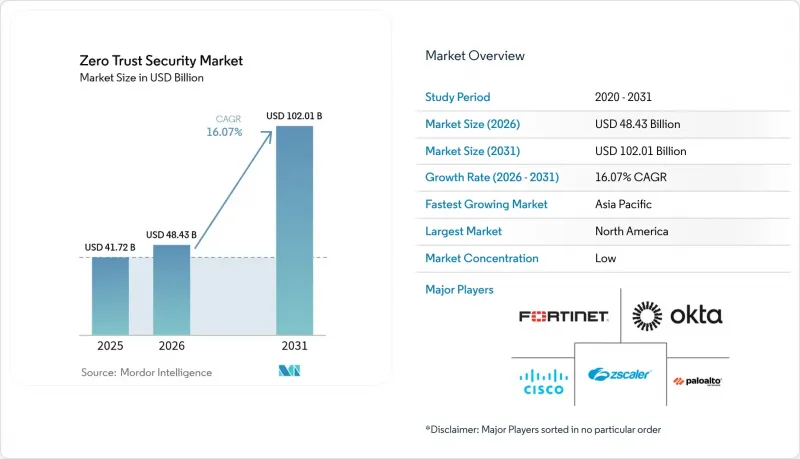
根據 Mordor Intelligence 預測,零信任安全市場規模將從 2025 年的 417.2 億美元成長到 2026 年的 484.3 億美元,然後在 2031 年達到 1020.1 億美元,2026 年至 2031 年的複合年成長率為 16.07%。
本報告按交付方式(解決方案和服務)、部署方式(本地部署和雲端部署)、組織規模(中小企業和大型企業)、身份驗證類型(單因素身份驗證和多因素身份驗證)、最終用戶行業(IT和電信、銀行、金融服務和保險、製造業等)以及地區進行細分。市場預測以美元計價。
全球零信任安全市場趨勢與洞察
資料外洩事件增多
到了2024年,零日漏洞數量增加了兩倍,勒索軟體在92%的行業中佔所有資料外洩事件的三分之一。 68%的事件是人為造成的,迫使企業在假定內部外洩的情況下實施持續檢驗。第三方漏洞增加了68%,迫使企業將零信任原則擴展到供應商。內部威脅平均每次事件造成金融機構1620萬美元的損失。因此,考慮到資料外洩的經濟影響,主動投資於零信任措施比事後昂貴的回應更具優勢。
遠距/混合辦公模式的擴展
隨著遠距辦公的普及,以 VPN 為中心的存取方式已不再有效。實施零信任架構的組織已將事件回應時間縮短了 83%,並將安全漏洞的成功率降低了 80%。 NTT DATA 的部署在 30 天內連接了 5 萬名用戶,展現了基於雲端的可擴展性。遠端瀏覽器隔離工具在不影響生產力的前提下,進一步保護了分散辦公的員工,從而推動了對零信任網路存取的持續需求。
整合舊有系統面臨的挑戰
幾十年前的應用程式通常缺乏現代身份驗證功能,迫使用戶使用客製化連接器,從而延長部署週期。醫療機構難以維修那些當初設計時未考慮安全性的網路醫療設備。製造企業在營運技術 (OT) 方面也面臨類似的限制,運作優先於安全性。提供預先配置整合解決方案的供應商可以緩解這些挑戰,並縮短專案投資回報週期。
細分市場分析
到2025年,解決方案將佔總收入的66.55%,透過整合策略引擎和分析儀表板支撐零信任安全市場。然而,由於企業依賴合作夥伴在混合環境中設計、部署和最佳化架構,服務板塊的複合年成長率將達到19.05%。
專業服務指南策略制定,而託管服務則可在不顯著增加人員配置的情況下實現持續最佳化。 Cimpress 對全球存取控制的轉型等備受矚目的案例凸顯了技術進步所需的組織變革管理,也解釋了為什麼零信任安全市場持續轉變為服務主導的價值交付模式。
到2025年,本地部署解決方案將佔支出的53.85%,這反映出受監管的工作負載仍將保留在企業資料中心內。雲端採用率正以19.66%的複合年成長率成長,吸引尋求即時擴展和簡化更新的企業。
混合模式正逐漸成為主流。敏感資料儲存在本地,而SaaS閘道器則負責身分識別管理和策略邏輯。隨著合規框架不斷發展,逐漸認可雲端資料儲存的管理,與雲端模式相關的零信任安全市場規模預計將迅速擴大,並在預測期內縮小與本地部署模式的差距。
區域分析
北美地區擁有成熟的監管體系、廣泛的雲端應用和集中的供應商,預計到2025年將佔全球收入的34.72%。聯邦政府的強制規定正迫使政府機構和承包商遷移到統一的架構,而紐約和多倫多等金融中心展現出的卓越應用水平有望輻射到其他行業。然而,隨著雲端原生新興企業在價格和自動化方面對老牌企業發起挑戰,競爭壓力正在加劇。
預計到2031年,亞太地區的複合年成長率將達到18.63%,位居全球之首。從新加坡到日本,各國政府都在製定網路安全藍圖,將零信任原則融入其中,使企業能夠繞過傳統防火牆,採用基於雲端的控制機制。微隔離技術正被應用於製造中心,以保護融合的IT和OT環境,進一步擴大了該地區的零信任安全市場。
歐洲的穩定發展得益於GDPR和鼓勵建構隱私保護架構的產業特定指令。提供精細審計追蹤和歐盟資料中心的供應商正獲得越來越多的支持。同時,中東和非洲地區由於數位政府對現代化建設的投資,湧現出新的機遇,但由於缺乏本地技能和基礎設施,普及速度仍然緩慢。
其他好處:
- Excel格式的市場預測(ME)表
- 三個月的分析師支持
目錄
第1章:引言
- 研究假設和市場定義
- 調查範圍
第2章:調查方法
第3章執行摘要
第4章 市場狀況
- 市場概覽
- 市場促進因素
- 資料外洩事件的數量正在增加。
- 遠距/混合辦公模式的擴展
- 加強監管要求
- 機器流量和 API 流量的爆炸性成長
- 利用智慧網路卡進行微分割
- 身分與網路的融合
- 市場限制因素
- 整合舊有系統面臨的挑戰
- 高昂的初始架構成本
- 透過影子IT規避SaaS
- 供應商之間的資料共用條款
- 產業價值鏈分析
- 監理情勢
- 技術展望
- 產業吸引力—五力分析
- 供應商的議價能力
- 買方的議價能力
- 新進入者的威脅
- 替代品的威脅
- 競爭公司之間的競爭
- 宏觀經濟因素對市場的影響
第5章 市場規模與成長預測
- 報價
- 解決方案
- 服務
- 部署模式
- 現場
- 雲
- 按組織規模
- 中小企業
- 大公司
- 身份驗證方法
- 單元素
- 多因素身份驗證
- 按最終用戶行業分類
- IT/通訊
- BFSI
- 製造業
- 衛生保健
- 能源公用事業
- 零售與電子商務
- 政府/國防
- 其他終端用戶產業
- 按地區
- 北美洲
- 美國
- 加拿大
- 墨西哥
- 南美洲
- 巴西
- 阿根廷
- 智利
- 其他南美國家
- 歐洲
- 德國
- 英國
- 法國
- 義大利
- 西班牙
- 俄羅斯
- 其他歐洲國家
- 亞太地區
- 中國
- 印度
- 日本
- 韓國
- 澳洲
- 新加坡
- 馬來西亞
- 其他亞太國家
- 中東和非洲
- 中東
- 阿拉伯聯合大公國
- 沙烏地阿拉伯
- 土耳其
- 其他中東國家
- 非洲
- 南非
- 奈及利亞
- 其他非洲國家
- 中東
- 北美洲
第6章 競爭情勢
- 市場集中度
- 策略趨勢
- 市佔率分析
- 公司簡介
- Palo Alto Networks Inc.
- Cisco Systems Inc.
- Zscaler Inc.
- Okta Inc.
- Fortinet Inc.
- CrowdStrike Holdings Inc.
- Check Point Software Tech.
- IBM Corporation
- Akamai Technologies Inc.
- Illumio Inc.
- Appgate Inc.
- Netskope Inc.
- Cloudflare Inc.
- Duo Security LLC
- BeyondTrust Corp.
- CyberArk Software Ltd.
- Ping Identity Corp.
- SailPoint Technologies
- One Identity LLC
- Banyan Security Inc.
- Zero Networks Ltd.
- Elisity Inc.
- Versa Networks Inc.
- Vectra AI Inc.
- Guardicore Ltd.(Cisco Networks)
第7章 市場機會與未來趨勢
- 評估閒置頻段和未滿足的需求
According to Mordor Intelligence, the zero trust security market size is expected to grow from USD 41.72 billion in 2025 to USD 48.43 billion in 2026 and is forecast to reach USD 102.01 billion by 2031 at 16.07% CAGR over 2026-2031.
This report is Segmented by Offering (Solutions and Services), Deployment Mode (On-Premise and Cloud), Organization Size (Small and Medium Enterprises and Large Enterprises), Authentication Type (Single-Factor and Multi-Factor), End-User Industry (IT and Telecom, BFSI, Manufacturing, and More), and Geography. The Market Forecasts are Provided in Terms of Value (USD).
Global Zero Trust Security Market Trends and Insights
Increasing number of data breaches
Zero-day vulnerabilities tripled in 2024, and ransomware represented one-third of all breaches across 92% of industries. Human factors contributed to 68% of incidents, pressing enterprises to adopt continuous verification that assumes internal compromise. Third-party weaknesses climbed 68%, forcing organizations to extend zero trust principles to suppliers. Insider threats cost financial institutions USD 16.2 million per event on average. Breach economics, therefore, favor preventative spending on zero trust controls over expensive post-incident remediation.
Expansion of remote/hybrid workforces
Permanent remote work invalidates VPN-centric access. Organizations that adopted zero trust architectures saw an 83% cut in incident-response times and an 80% drop in successful breaches. NTT DATA's rollout connected 50,000 users in 30 days, proving cloud-delivered scalability. Remote Browser Isolation tools further protect distributed staff without hindering productivity, fueling sustained demand for zero-trust network access.
Legacy integration hurdles
Decades-old applications often lack modern authentication hooks, forcing custom connectors that extend deployment schedules. Healthcare facilities struggle to retrofit network-enabled medical devices built without security in mind. Manufacturers face similar constraints with operational technology, where uptime trumps security. Vendors that package pre-configured integrations ease friction and shorten project payback.
Other drivers and restraints analyzed in the detailed report include:
- Rising regulatory mandates
- Explosion of machine and API traffic
- High up-front architecture cost
For complete list of drivers and restraints, kindly check the Table Of Contents.
Segment Analysis
Solutions accounted for 66.55% of 2025 revenue, anchoring the zero trust security market through integrated policy engines and analytics dashboards. However, services are rising at a 19.05% CAGR as enterprises rely on partners to design, deploy, and fine-tune architectures across hybrid landscapes.
Professional services guide strategy, while managed offerings deliver continuous optimization without ballooning headcount. High-profile rollouts-such as Cimpress transforming global access controls-underline the organizational change management needed alongside technology shifts, explaining why the zero trust security market continues to pivot toward service-led value delivery.
On-premise solutions preserved 53.85% of 2025 spending, reflecting regulated workloads that remain inside corporate data centers. Cloud deployments, growing at 19.66% CAGR, attract firms seeking instant scalability and simplified updates.
Hybrid patterns dominate: sensitive data stays on-site while SaaS gateways manage identity and policy logic. As compliance frameworks evolve to recognize cloud residency controls, the zero trust security market size attached to cloud models is expected to expand rapidly, narrowing the on-premise lead over the forecast period.
Complete Report Scope:
- By Offering
- Solutions
- Services
- By Deployment Mode
- On-premise
- Cloud
- By Organisation Size
- Small and Medium Enterprises (SMEs)
- Large Enterprises
- By Authentication Type
- Single-Factor
- Multi-Factor
- By End-user Industry
- IT and Telecom
- BFSI
- Manufacturing
- Healthcare
- Energy and Utilities
- Retail and E-commerce
- Government and Defense
- Other End-user Industries
- By Geography
- North America
- United States
- Canada
- Mexico
- South America
- Brazil
- Argentina
- Chile
- Rest of South America
- Europe
- Germany
- United Kingdom
- France
- Italy
- Spain
- Russia
- Rest of Europe
- Asia-Pacific
- China
- India
- Japan
- South Korea
- Australia
- Singapore
- Malaysia
- Rest of Asia-Pacific
- Middle East and Africa
- Middle East
- United Arab Emirates
- Saudi Arabia
- Turkey
- Rest of Middle East
- Africa
- South Africa
- Nigeria
- Rest of Africa
- Middle East
- North America
Geography Analysis
North America secured 34.72% of 2025 revenue through mature regulations, extensive cloud adoption, and vendor density. Federal mandates push agencies and contractors toward consistent architectures, while financial hubs in New York and Toronto showcase reference deployments that ripple across other verticals. Competitive pressure, however, is intensifying as newer cloud-native entrants challenge incumbents on price and automation.
Asia-Pacific commands the fastest CAGR at 18.63% to 2031. Governments from Singapore to Japan enact cybersecurity roadmaps that embed zero trust principles, letting firms leapfrog legacy firewalls in favor of cloud-delivered controls. Manufacturing clusters rely on micro-segmentation to protect converged IT/OT environments, further expanding the zero-trust security market in the region.
Europe's steady progression stems from GDPR and sector-specific directives that favor privacy-preserving architectures. Vendors that provide granular audit trails and EU-based data centers gain traction. Meanwhile, the Middle East and Africa register emerging potential as digital governments fund modernization, though adoption still lags due to limited local skill sets and infrastructure.
- Palo Alto Networks Inc.
- Cisco Systems Inc.
- Zscaler Inc.
- Okta Inc.
- Fortinet Inc.
- CrowdStrike Holdings Inc.
- Check Point Software Tech.
- IBM Corporation
- Akamai Technologies Inc.
- Illumio Inc.
- Appgate Inc.
- Netskope Inc.
- Cloudflare Inc.
- Duo Security LLC
- BeyondTrust Corp.
- CyberArk Software Ltd.
- Ping Identity Corp.
- SailPoint Technologies
- One Identity LLC
- Banyan Security Inc.
- Zero Networks Ltd.
- Elisity Inc.
- Versa Networks Inc.
- Vectra AI Inc.
- Guardicore Ltd. (Cisco Networks)
Additional Benefits:
- The market estimate (ME) sheet in Excel format
- 3 months of analyst support
TABLE OF CONTENTS
1 INTRODUCTION
- 1.1 Study Assumptions and Market Definition
- 1.2 Scope of the Study
2 RESEARCH METHODOLOGY
3 EXECUTIVE SUMMARY
4 MARKET LANDSCAPE
- 4.1 Market Overview
- 4.2 Market Drivers
- 4.2.1 Increasing number of data breaches
- 4.2.2 Expansion of remote/hybrid workforces
- 4.2.3 Rising regulatory mandates
- 4.2.4 Explosion of machine and API traffic
- 4.2.5 Smart-NIC micro-segmentation
- 4.2.6 Identity-network convergence
- 4.3 Market Restraints
- 4.3.1 Legacy integration hurdles
- 4.3.2 High up-front architecture cost
- 4.3.3 Shadow-IT SaaS bypass
- 4.3.4 Supplier data-sharing clauses
- 4.4 Industry Value Chain Analysis
- 4.5 Regulatory Landscape
- 4.6 Technological Outlook
- 4.7 Industry Attractiveness - Porter's Five Forces Analysis
- 4.7.1 Bargaining Power of Suppliers
- 4.7.2 Bargaining Power of Buyers
- 4.7.3 Threat of New Entrants
- 4.7.4 Threat of Substitutes
- 4.7.5 Intensity of Competitive Rivalry
- 4.8 Impact of Macroeconomic Factors on the Market
5 MARKET SIZE AND GROWTH FORECASTS (VALUES)
- 5.1 By Offering
- 5.1.1 Solutions
- 5.1.2 Services
- 5.2 By Deployment Mode
- 5.2.1 On-premise
- 5.2.2 Cloud
- 5.3 By Organisation Size
- 5.3.1 Small and Medium Enterprises (SMEs)
- 5.3.2 Large Enterprises
- 5.4 By Authentication Type
- 5.4.1 Single-Factor
- 5.4.2 Multi-Factor
- 5.5 By End-user Industry
- 5.5.1 IT and Telecom
- 5.5.2 BFSI
- 5.5.3 Manufacturing
- 5.5.4 Healthcare
- 5.5.5 Energy and Utilities
- 5.5.6 Retail and E-commerce
- 5.5.7 Government and Defense
- 5.5.8 Other End-user Industries
- 5.6 By Geography
- 5.6.1 North America
- 5.6.1.1 United States
- 5.6.1.2 Canada
- 5.6.1.3 Mexico
- 5.6.2 South America
- 5.6.2.1 Brazil
- 5.6.2.2 Argentina
- 5.6.2.3 Chile
- 5.6.2.4 Rest of South America
- 5.6.3 Europe
- 5.6.3.1 Germany
- 5.6.3.2 United Kingdom
- 5.6.3.3 France
- 5.6.3.4 Italy
- 5.6.3.5 Spain
- 5.6.3.6 Russia
- 5.6.3.7 Rest of Europe
- 5.6.4 Asia-Pacific
- 5.6.4.1 China
- 5.6.4.2 India
- 5.6.4.3 Japan
- 5.6.4.4 South Korea
- 5.6.4.5 Australia
- 5.6.4.6 Singapore
- 5.6.4.7 Malaysia
- 5.6.4.8 Rest of Asia-Pacific
- 5.6.5 Middle East and Africa
- 5.6.5.1 Middle East
- 5.6.5.1.1 United Arab Emirates
- 5.6.5.1.2 Saudi Arabia
- 5.6.5.1.3 Turkey
- 5.6.5.1.4 Rest of Middle East
- 5.6.5.2 Africa
- 5.6.5.2.1 South Africa
- 5.6.5.2.2 Nigeria
- 5.6.5.2.3 Rest of Africa
- 5.6.5.1 Middle East
- 5.6.1 North America
6 COMPETITIVE LANDSCAPE
- 6.1 Market Concentration
- 6.2 Strategic Moves
- 6.3 Market Share Analysis
- 6.4 Company Profiles (includes Global level Overview, Market level overview, Core Segments, Financials as available, Strategic Information, Market Rank/Share for key companies, Products and Services, and Recent Developments)
- 6.4.1 Palo Alto Networks Inc.
- 6.4.2 Cisco Systems Inc.
- 6.4.3 Zscaler Inc.
- 6.4.4 Okta Inc.
- 6.4.5 Fortinet Inc.
- 6.4.6 CrowdStrike Holdings Inc.
- 6.4.7 Check Point Software Tech.
- 6.4.8 IBM Corporation
- 6.4.9 Akamai Technologies Inc.
- 6.4.10 Illumio Inc.
- 6.4.11 Appgate Inc.
- 6.4.12 Netskope Inc.
- 6.4.13 Cloudflare Inc.
- 6.4.14 Duo Security LLC
- 6.4.15 BeyondTrust Corp.
- 6.4.16 CyberArk Software Ltd.
- 6.4.17 Ping Identity Corp.
- 6.4.18 SailPoint Technologies
- 6.4.19 One Identity LLC
- 6.4.20 Banyan Security Inc.
- 6.4.21 Zero Networks Ltd.
- 6.4.22 Elisity Inc.
- 6.4.23 Versa Networks Inc.
- 6.4.24 Vectra AI Inc.
- 6.4.25 Guardicore Ltd. (Cisco Networks)
7 MARKET OPPORTUNITIES AND FUTURE TRENDS
- 7.1 White-Space and Unmet-Need Assessment

 2026年零信任安全全球市場報告
 零信任安全市場:按組件、身分驗證類型、組織規模、部署模式和產業分類-2026-2032年全球市場預測
 零信任網路存取 (ZTNA) 市場:按產品/服務、部署類型、組織規模、應用、產業、國家和地區分類 - 全球產業分析、市場規模、市場佔有率和預測 (2026–2033)
 零信任安全平台市場預測至2034年-按元件、身分驗證方法、安全類型、部署模型、應用程式、最終使用者和地區分類的全球分析
 零信任安全市場:按交付方式、安全類型和地區分類零信任保全服務市場按組件、部署模式、組織規模和最終用戶產業分類,全球預測(2026-2032 年)
 零信任安全市場:依元件(解決方案、服務)、部署模式(雲端、本地部署、混合部署)、組織規模、身分驗證方法和產業劃分-全球預測至2036年
 全球零信任安全市場規模、佔有率、趨勢和成長分析報告(2026-2034年)全球零信任瀏覽器安全市場,2025-2030 年全球零信任安全市場:市場規模、佔有率、成長率、產業分析、依類型、應用和地區劃分的分析及預測(2026-2034 年)