


 |
市場調查報告書
商品編碼
2124239
金屬印刷包裝:市場佔有率分析、產業趨勢與統計、成長預測(2026-2031)Metal Print Packaging - Market Share Analysis, Industry Trends & Statistics, Growth Forecasts (2026 - 2031) |
||||||

※ 本網頁內容可能與最新版本有所差異。詳細情況請與我們聯繫。
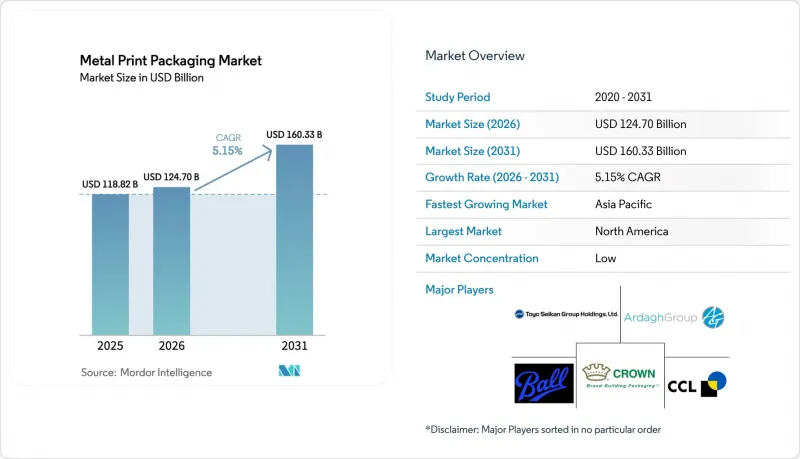
據 Mordor Intelligence 稱,2025 年金屬印刷和包裝市場價值為 1188.2 億美元,預計到 2031 年將達到 1603.3 億美元,而 2026 年為 1247 億美元,預測期(2026-2031 年)的複合年成長率為 5.15%。
本報告依印刷技術(膠印、彈性凸版印刷及其他)、承印物(鋁及其他)、產品類型(飲料罐、氣霧罐、瓶裝及啤酒桶及其他)、最終用途(食品飲料、個人護理及化妝品、藥品及醫療及其他)及地區進行細分。市場預測以美元(USD)計價。
全球金屬印刷和包裝市場趨勢及洞察
數位印刷技術的快速發展
數位印刷機的出現,徹底解決了平版印刷成本高達 8,000 至 12,000 美元而導致小批量訂單無利可圖的問題,使加工商即使面對 2,500 件的大批量訂單也能盈利。 Koenig & Bauer 的 600dpi MetJET ONE 印表機憑藉其線上分光光度計功能,可在生產線上實現色彩精準度,兼具靈活性和高品質影像。精釀啤酒釀造商已將其季節性 SKU 從每年 4 個增加到 12 個,將設計到商店的周期縮短至 48 小時,並提升了產品系列的新鮮度。歐洲服務商 NOMOQ 提供 204 罐裝產品的批量服務,每罐價格僅為 0.267 美元,低於收縮套標的價格,從而增加了試驗預算。 Crown Holdings 正在六個地點使用 Velox 噴墨生產線,加速數位經濟進一步滲透到金屬印刷包裝市場的個人護理和即飲咖啡管道。
罐裝飲料(啤酒、能量飲料)消費量成長
2024年,美國能量飲料銷量成長8.2%。這主要歸功於更纖細的16盎司罐裝飲料,其零售利潤率比標準尺寸高出0.15美元。預計到2025年,印度人均鋁罐消費量將達到6罐,到2031年將翻倍,因為即使在二線城市,冷鏈覆蓋範圍也在擴大。 2024年,中國飲料罐產量達420億個,其中即飲白酒和優質化進口啤酒推動產量增加9%。巴西Ambev公司計畫在2027年實現100%使用國產鋁罐,預計將創造20億個國內需求,並刺激南美洲產能的投資。這些趨勢將使金屬印刷包裝市場擺脫對北美飽和產量的依賴,推動中期市場擴張。
金屬和油墨等原物料價格的波動
2025年鋁三個月期貨價格在每噸2,340美元至2,760美元之間波動,給受固定價格供應合約約束的加工商帶來了沉重負擔。受中國工廠關閉的影響,二氧化鈦價格上漲至每噸3850美元,迫使複合材料生產商使用塗層更厚、透明度更低的鈦產品。剛果對鈷徵收10%的出口課稅,導致歐洲UV油墨乾燥器的成本每罐增加0.008美元。未進行避險地區的加工商利潤率下降超過150個基點,抑制了資本投資。雖然一體化製造商透過代工生產協議降低了風險,但南美和東南亞的中小型企業仍然脆弱,限制了對金屬印刷和包裝市場的投資。
細分市場分析
到2025年,膠印將佔據43.14%的市場佔有率,其成熟的印表機能夠在產量超過50萬件時將單罐成本控制在0.05美元以下。數位印刷系統以6.12%的複合年成長率快速發展,在應對力短交貨期方面具有顯著優勢,推動金屬印刷和包裝市場服務於精釀啤酒釀造商、精品護膚品牌和季節性能量飲料製造商。凹版印刷和柔版印刷仍應用於高階烈酒和氣霧劑產品領域,但由於揮發性有機化合物(VOC)法規和滾筒雕刻成本的增加,其競爭力正在下降。移印和燙金工藝佔據了超高階細分市場,市場佔有率低於3%,但透過壓印金屬效果確保了較高的利潤率。新型膠印生產線中採用的人工智慧套準控制系統能夠減少廢棄物,並在數位印刷機數量增加的情況下維持現有設備的效用。
Crown公司配備Velox設備的工廠能夠滿足2024年美國18,000種全新精釀啤酒SKU的需求,顯示數位印刷在成長中扮演關鍵角色。 Koenig & Bauer公司的MetalStar 3憑藉其線上缺陷檢測功能,將平版印刷廢料減少到0.5%以下,削弱了數位印刷在永續性。結合數位底印和膠印面印的混合工作流程正在加速技術融合,在柔軟性和優質光澤之間取得平衡。設備供應商正在將軟體訂閱與硬體捆綁銷售,並將收入模式轉向基於服務的運作保證。總而言之,印刷技術的不斷組合正在推動金屬印刷包裝市場在不放棄快速傳統資產的前提下,朝著大規模客製化的方向發展。
預計到2025年,鋁材將佔據45.32%的市場佔有率,年複合成長率達6.38%,主要得益於市場對低碳包裝的需求,例如可回收性、輕量化運輸以及CBAM(碳中碳鋁複合材料)。馬口鐵在湯料、番茄製品和寵物食品領域仍保持著強勁的地位,其優異的內壓性能彌補了15%的重量增加,但其碳足跡比鋁高出40%,迫使歐洲食品品牌尋求替代材料。無錫鋼每噸可節省80-100美元,但其成形性較差,限制了其在窄口飲料罐中的應用。混合雙金屬結構由於不同金屬連接處強度不足以及難以進行高速填充,市場佔有率仍不足2%。生命週期評估始終表明,使用再生鋁可減少95%的溫室氣體排放,鞏固了其在金屬印刷包裝市場成長中的地位。
寶鋼包裝決定於2025年將其馬口鐵生產線改造為鋁製飲料罐生產線,這清楚地展現了基材輕量化的發展趨勢。 2024年至2026年間,諾貝麗斯、波爾和特里維姆三家公司總合運作了超過150萬噸的新增鋁材軋延和鋁罐板材產能,為不斷成長的即飲飲料市場構建了供應基地。輕量化進程持續推進,罐體平均壁厚從2020年的0.097毫米降至2025年的0.088毫米,同時透過最佳化合金成分保持了抗彎強度。這些進步將使加工商能夠在不相應增加對原金屬需求的情況下,實現其在金屬印刷和包裝市場中的尺寸目標。儘管面臨大宗商品價格上漲等不利因素,但在全球品牌致力於循環經濟的推動下,鋁材投資計畫依然強勁。
區域分析
預計到2025年,北美將生產1,000億個飲料罐,佔39.31%的市佔率。這得歸功於美國10個州和加拿大所有省份成熟的押金返還制度。精釀啤酒廠透過數位化裝飾技術,推動了高利潤的小批量生產。此外,美國12條生產線上人工智慧偵測系統的應用,每年可減少420萬美元的廢棄物成本。完善的回收基礎設施使鋁罐的回收率達到75%,為國內重熔爐提供了原料來源,並減少了對進口原金屬的依賴。然而,人手不足推高了營運成本,促使加工商轉向托盤化和物流自動化。 CAMPACK和Ball在紐約州和喬治亞的分階段產能擴張,正在維持區域供需平衡,並鞏固北美在金屬印刷和包裝市場的佔有率。
預計到2031年,亞太地區將以7.08%的複合年成長率成長,主要促進因素包括印度人均消費量預計將增加至12罐,以及中國2024年罐頭產量將達到420億罐。廣東省和江蘇省的政府激勵措施正在支持國有企業擴大即飲雞尾酒、能量飲料和進口精釀啤酒的罐裝生產線。東洋制菓在廣東的合資企業年產能達5億罐,正在彌補日本出口的下滑,並向國內啤酒廠供應優質平版印刷罐。在越南和印尼等東南亞國家,罐裝咖啡的銷售量正保持兩位數成長,而澳洲精釀啤酒的蓬勃發展也推動了對小批量生產的需求,OnPak的Rockley生產線目前正在滿足這一需求。隨著中產階級購買力的增強和冷鏈的快速普及,預計亞太地區將在金屬印刷包裝市場的長期成長中繼續佔據關鍵地位。
歐洲是一個成熟但又充滿變革的市場,CBAM(碳中和金屬貿易協定)分階段實施的關稅正推動罐板金屬回歸國內市場。 2024年,德國、法國和英國共消耗了350億個飲料罐,但新的投資重點集中在以風能和太陽能為動力的碳最佳化熔爐上。 Ardagh和Crown都承諾在2030年將其範圍1和範圍2的排放量減少50%,以配合其企業客戶的減排目標。在東歐,波蘭和羅馬尼亞的產能正在擴張,加工商在尋求更低成本勞動力的同時,也希望留在歐盟的碳排放交易區內。目前貢獻最小的中東和非洲地區,在沙烏地阿拉伯「2030願景」的獎勵以及南非第一年62%的罐體回收率的推動下,正在加速成長。此外,一系列以鋁為重點的新工廠的宣布,也為擴大金屬印刷和包裝市場的地域覆蓋範圍奠定了基礎。
其他好處
- Excel格式的市場預測(ME)表
- 3個月的分析師支持
目錄
第1章:引言
- 研究假設和市場定義
- 調查範圍
第2章:調查方法
第3章執行摘要
第4章 市場狀況
- 市場概覽
- 市場促進因素
- 數位印刷技術的快速發展
- 罐裝飲料(啤酒、能量飲料)消費量成長
- 受永續性的驅動,對可無限循環利用金屬的需求日益成長。
- 高解析度噴墨技術能夠直接在罐頭上進行印刷,導致 SKU 數量迅速增加。
- 利用人工智慧驅動的線上視覺系統減少缺陷廢料。
- 歐盟的CBAM計劃促進了低碳罐的國內生產。
- 市場限制因素
- 金屬和油墨等原物料價格的波動
- 與替代包裝材料的競爭
- 擴大對 PFAS 的禁令將對含氟聚合物槽的塗層產生重大影響。
- 高純度再生鋁原料短缺
- 產業價值鏈分析
- 監理情勢
- 技術展望
- 波特五力分析
- 宏觀經濟因素的影響
第5章 市場規模與成長預測
- 透過印刷技術
- 膠印光刻
- 凹版印刷
- 柔版印刷
- 數位的
- 其他印刷技術
- 按基礎材料
- 鋁
- 鋼(馬口鐵)
- 無錫鋼板
- 其他基質
- 依產品類型
- 飲料罐
- 氣霧劑容器
- 瓶子和啤酒桶
- 管子和墨盒
- 其他
- 按最終用途
- 飲食
- 個人護理和化妝品
- 藥品和醫療保健
- 工業和家用化學品
- 其他
- 按地區
- 北美洲
- 美國
- 加拿大
- 墨西哥
- 南美洲
- 巴西
- 阿根廷
- 智利
- 其他南美國家
- 歐洲
- 德國
- 英國
- 法國
- 義大利
- 西班牙
- 其他歐洲國家
- 亞太地區
- 中國
- 日本
- 印度
- 韓國
- 澳洲
- 其他亞太國家
- 中東和非洲
- 中東
- 沙烏地阿拉伯
- 阿拉伯聯合大公國
- 土耳其
- 其他中東國家
- 非洲
- 南非
- 奈及利亞
- 肯亞
- 其他非洲地區
- 中東
- 北美洲
第6章 競爭情勢
- 市場集中度
- 策略趨勢
- 市佔率分析
- 公司簡介
- Ball Corporation
- Crown Holdings Inc.
- Ardagh Metal Packaging SA
- CANPACK SA
- Silgan Holdings Inc.
- Toyo Seikan Group Holdings Ltd.
- CCL Industries Inc.
- Envases Universales de Mexico SA de CV
- Trivium Packaging BV
- Showa Aluminum Can Corporation
- Orora Packaging Australia Pty Ltd
- CPMC Holdings Limited
- Massilly Holding SAS
- Nampak Limited
- Can-Pack India Private Limited
- Independent Can Company
- Envases CMF SA
- Jiangsu Baosteel Metal Products Co., Ltd.
- Guangzhou Pacific Tinplate Co., Ltd.
- Shanghai Baosteel Packaging Co., Ltd.
第7章 市場機會與未來展望
According to Mordor Intelligence, the metal print packaging market size was valued at USD 118.82 billion in 2025 and is estimated to grow from USD 124.70 billion in 2026 to reach USD 160.33 billion by 2031, at a CAGR of 5.15% during the forecast period (2026-2031).
This report is Segmented by Printing Technology (Offset Lithography, Flexography, and More), Substrate Material (Aluminium, and More ), Product Type (Beverage Cans, Aerosol Containers, Bottles and Growlers, and More), End-Use Application (Food and Beverage, Personal Care and Cosmetics, Pharmaceuticals and Healthcare, and More), and Geography. The Market Forecasts are Provided in Terms of Value USD.
Global Metal Print Packaging Market Trends and Insights
Rapid Evolution of Digital Print Technology
Digital presses eliminate the USD 8,000-12,000 plate cost that long made offset uneconomic for small jobs, enabling converters to profit on 2,500-unit lots. Koenig and Bauer's 600-dpi MetJET ONE delivers production-line color accuracy with inline spectrophotometry, pairing agility with premium graphics. Craft brewers now launch twelve seasonal SKUs per year instead of four, compressing design-to-shelf cycles to 48 hours and boosting portfolio freshness. European service NOMOQ prices runs of 204 cans at USD 0.267 each, undercutting shrink sleeves and extending experimentation budgets. Crown Holdings leverages Velox inkjet lines across six sites, positioning the metal print packaging market for deeper penetration of digital economics in personal-care and RTD coffee channels.
Growth in Canned Beverage Consumption
Energy drinks in the United States expanded 8.2% by volume in 2024, aided by slim 16-oz cans commanding USD 0.15 higher retail margins than standard formats. India's per-capita aluminium-can use reached six units in 2025 and is projected to double by 2031 as tier-2 cities gain cold-chain access. China produced 42 billion beverage cans in 2024, with baijiu-cocktail RTDs and imported-beer premiumization driving 9% output growth. Brazil's Ambev will source 100% domestic aluminium cans by 2027, adding 2 billion units of local demand and spurring South America capacity investments . These dynamics diversify the metal print packaging market beyond saturated North American volumes and reinforce medium-term expansion.
Volatility in Metal and Ink Input Prices
Aluminium three-month futures ranged from USD 2,340-2,760 /t in 2025, stressing converters locked into fixed-price supply contracts. Titanium dioxide hit USD 3,850 /t after Chinese plant shutdowns, forcing formulators to use heavier-coat, lower-opacity grades. A 10% Congolese cobalt export levy lifted UV-ink drier costs by USD 0.008 per can in Europe. Regional converters without hedging saw margin erosion exceeding 150 basis points, curbing capital spending. Integrated producers mitigate exposure via tolling deals, yet smaller firms in South America and Southeast Asia remain vulnerable, tempering metal print packaging market investment.
Other drivers and restraints analyzed in the detailed report include:
- Sustainability-Driven Demand for Infinitely Recyclable Metal
- Direct-to-Can High-Resolution Inkjet Unlocking SKU Proliferation
- Emerging PFAS Bans Disrupting Fluoropolymer Can Coatings
For complete list of drivers and restraints, kindly check the Table Of Contents.
Segment Analysis
Offset lithography contributed 43.14% of market share in 2025, capitalizing on mature presses that drop per-can costs under USD 0.05 once runs exceed 500,000 units. Digital systems, advancing at 6.12% CAGR, thrive on short-run agility, helping the metal print packaging market serve craft brewers, boutique skincare lines, and seasonal energy drinks. Gravure and flexography continue in luxury spirits and aerosols, yet VOC regulations and cylinder-engraving fees erode their competitiveness. Pad printing and hot stamping occupy ultra-premium niches, representing less than 3% of market revenue but commanding high margins through embossed metallic effects. AI-enabled registration control on new offset lines keeps waste low, stretching the installed base's relevance while digital press count rises.
Velox-equipped Crown facilities now satisfy 18,000 new U.S. craft-beer SKUs launched during 2024, showing digital's role as a growth lever. Koenig and Bauer's MetalStar 3 with inline defect detection brings offset waste below 0.5%, narrowing digital's sustainability edge. Hybrid workflows that print digital undercoats and offset top layers balance flexibility with premium gloss, accelerating technology convergence. Equipment suppliers bundle software subscriptions with hardware, moving the revenue model toward service-based uptime guarantees. Overall, printing-technology mix shifts reinforce the evolution of the metal print packaging market toward mass customisation without abandoning high-speed legacy assets.
Aluminium secured 45.32% of market share in 2025 and is expanding at a 6.38% CAGR, driven by recyclability, lighter transport weight, and CBAM-linked demand for low-carbon packaging. Tinplate remains entrenched in soups, tomatoes, and pet food, where internal pressure resistance outweighs the 15% weight penalty, but its carbon footprint is 40% higher than aluminium, pressuring European food brands to seek alternatives. Tin-free steel offers USD 80-100/t savings but suffers reduced formability, limiting its adoption in necked beverage cans. Hybrid bi-metal designs have a share of less than 2% because seam integrity between dissimilar metals complicates high-speed filling. Lifecycle studies consistently show recycled-content aluminium cutting greenhouse-gas emissions by 95%, solidifying its place in the metal print packaging market's growth story.
Baosteel Packaging's 2025 decision to pivot tinplate lines toward aluminium beverage-can stock underscores the trend toward lighter substrates. Novelis, Ball, and Trivium collectively commissioned over 1.5 million t of new aluminium rolling and can-sheet capacity between 2024-2026, anchoring supply for ready-to-drink expansions. Lightweighting continues, with average can walls thinning from 0.097 mm in 2020 to 0.088 mm in 2025 while maintaining buckle strength through alloy optimisation. These advances allow converters to achieve the metal print packaging market size targets without proportionally increasing primary metal demand. Circularity commitments from global brands keep aluminium investment pipelines strong despite commodity-price headwinds.
Complete Report Scope:
- By Printing Technology
- Offset Lithography
- Gravure
- Flexography
- Digital
- Other Printing Technologies
- By Substrate Material
- Aluminium
- Steel (Tinplate)
- Tin-free Steel
- Other Substrate Materials
- By Product Type
- Beverage Cans
- Aerosol Containers
- Bottles and Growlers
- Tubes and Cartridges
- Other Product Types
- By End-Use Application
- Food and Beverage
- Personal Care and Cosmetics
- Pharmaceuticals and Healthcare
- Industrial and Household Chemicals
- Other End-use Applications
- By Geography
- North America
- United States
- Canada
- Mexico
- South America
- Brazil
- Argentina
- Chile
- Rest of South America
- Europe
- Germany
- United Kingdom
- France
- Italy
- Spain
- Rest of Europe
- Asia-Pacific
- China
- Japan
- India
- South Korea
- Australia
- Rest of Asia-Pacific
- Middle East and Africa
- Middle East
- Saudi Arabia
- United Arab Emirates
- Turkey
- Rest of Middle East
- Africa
- South Africa
- Nigeria
- Kenya
- Rest of Africa
- Middle East
- North America
Geography Analysis
North America produced 100 billion beverage cans in 2025 and retained 39.31% of market share in 2025, thanks to mature deposit-return laws in ten U.S. states and every Canadian province. Craft breweries contribute high-margin short runs that digital decorators capitalize on, and AI-enabled inspection rollouts across 12 U.S. lines lowered scrap costs by USD 4.2 million annually. Recycling infrastructure delivers 75% recovery of aluminium cans, feeding domestic remelt furnaces and reducing reliance on imported primary metal. Nevertheless, labour shortages elevate operating costs, prompting converters to automate palletisation and logistics. Incremental capacity expansions by CANPACK and Ball in New York and Georgia maintain regional supply-demand balance and reinforce North America's contribution to the metal print packaging market.
Asia-Pacific will post a 7.08% CAGR through 2031, driven by India's projected rise to 12 cans per capita and China's 2024 production footprint of 42 billion units. Government incentives in Guangdong and Jiangsu support state-backed can-line expansions that target RTD cocktails, energy drinks, and imported craft beers. Toyo Seikan's 500 million-unit Guangdong joint venture offsets Japanese export declines and supplies premium offset-decorated cans to domestic breweries. Southeast Asian nations such as Vietnam and Indonesia register double-digit canned coffee growth, while Australia's craft beer boom fuels demand for digital runs that Onpack's Rocklea line now fulfills. Rising middle-class purchasing power and rapid cold-chain rollout ensure that Asia-Pacific remains pivotal to the long-term growth of the metal print packaging market.
Europe represents a mature yet transforming landscape where CBAM's phased tariffs spur re-shoring of can-sheet sourcing. Germany, France, and the United Kingdom consumed 35 billion beverage cans in 2024, but new investments focus on carbon-optimized furnaces powered by wind and solar. Ardagh and Crown both committed to 50% Scope 1 and 2 cuts by 2030, aligning with corporate buyer emissions targets. Eastern Europe sees capacity growth in Poland and Romania as converters seek lower-cost labour while remaining inside the EU carbon-trade perimeter. Middle East and Africa, though currently the smallest regional contributor, accelerates with Saudi Arabia's Vision 2030 incentives and South Africa's 62% first-year can recovery rate, setting the stage for future aluminium-centric plant announcements that will broaden the geographic reach of the metal print packaging market.
- Ball Corporation
- Crown Holdings Inc.
- Ardagh Metal Packaging S.A.
- CANPACK S.A.
- Silgan Holdings Inc.
- Toyo Seikan Group Holdings Ltd.
- CCL Industries Inc.
- Envases Universales de Mexico S.A. de C.V.
- Trivium Packaging B.V.
- Showa Aluminum Can Corporation
- Orora Packaging Australia Pty Ltd
- CPMC Holdings Limited
- Massilly Holding SAS
- Nampak Limited
- Can-Pack India Private Limited
- Independent Can Company
- Envases CMF S.A.
- Jiangsu Baosteel Metal Products Co., Ltd.
- Guangzhou Pacific Tinplate Co., Ltd.
- Shanghai Baosteel Packaging Co., Ltd.
Additional Benefits:
- The market estimate (ME) sheet in Excel format
- 3 months of analyst support
TABLE OF CONTENTS
1 Introduction
- 1.1 Study Assumptions and Market Definition
- 1.2 Scope of the Study
2 Research Methodology
3 Executive Summary
4 Market Landscape
- 4.1 Market Overview
- 4.2 Market Drivers
- 4.2.1 Rapid Evolution of Digital Print Technology
- 4.2.2 Growth in Canned Beverage Consumption (Beer, Energy Drinks)
- 4.2.3 Sustainability-Driven Demand for Infinitely Recyclable Metal
- 4.2.4 Direct-to-can High-Resolution Inkjet Unlocking SKU Proliferation
- 4.2.5 AI-Driven Inline Vision Systems Cutting Defect Waste
- 4.2.6 EU CBAM Favouring Low-Carbon Domestic Can Production
- 4.3 Market Restraints
- 4.3.1 Volatility in Metal and Ink Input Prices
- 4.3.2 Competition from Alternative Packaging Substrates
- 4.3.3 Emerging PFAS Bans Disrupting Fluoropolymer Can Coatings
- 4.3.4 Scarcity of High-Purity Recycled Aluminium Feedstock
- 4.4 Industry Value Chain Analysis
- 4.5 Regulatory Landscape
- 4.6 Technological Outlook
- 4.7 Porter's Five Forces Analysis
- 4.7.1 Bargaining Power of Suppliers
- 4.7.2 Bargaining Power of Consumers
- 4.7.3 Threat of New Entrants
- 4.7.4 Threat of Substitutes
- 4.7.5 Intensity of Competitive Rivalry
- 4.8 Impact of Macroeconomic Factors
5 Market Size and Growth Forecasts (Value)
- 5.1 By Printing Technology
- 5.1.1 Offset Lithography
- 5.1.2 Gravure
- 5.1.3 Flexography
- 5.1.4 Digital
- 5.1.5 Other Printing Technologies
- 5.2 By Substrate Material
- 5.2.1 Aluminium
- 5.2.2 Steel (Tinplate)
- 5.2.3 Tin-free Steel
- 5.2.4 Other Substrate Materials
- 5.3 By Product Type
- 5.3.1 Beverage Cans
- 5.3.2 Aerosol Containers
- 5.3.3 Bottles and Growlers
- 5.3.4 Tubes and Cartridges
- 5.3.5 Other Product Types
- 5.4 By End-Use Application
- 5.4.1 Food and Beverage
- 5.4.2 Personal Care and Cosmetics
- 5.4.3 Pharmaceuticals and Healthcare
- 5.4.4 Industrial and Household Chemicals
- 5.4.5 Other End-use Applications
- 5.5 By Geography
- 5.5.1 North America
- 5.5.1.1 United States
- 5.5.1.2 Canada
- 5.5.1.3 Mexico
- 5.5.2 South America
- 5.5.2.1 Brazil
- 5.5.2.2 Argentina
- 5.5.2.3 Chile
- 5.5.2.4 Rest of South America
- 5.5.3 Europe
- 5.5.3.1 Germany
- 5.5.3.2 United Kingdom
- 5.5.3.3 France
- 5.5.3.4 Italy
- 5.5.3.5 Spain
- 5.5.3.6 Rest of Europe
- 5.5.4 Asia-Pacific
- 5.5.4.1 China
- 5.5.4.2 Japan
- 5.5.4.3 India
- 5.5.4.4 South Korea
- 5.5.4.5 Australia
- 5.5.4.6 Rest of Asia-Pacific
- 5.5.5 Middle East and Africa
- 5.5.5.1 Middle East
- 5.5.5.1.1 Saudi Arabia
- 5.5.5.1.2 United Arab Emirates
- 5.5.5.1.3 Turkey
- 5.5.5.1.4 Rest of Middle East
- 5.5.5.2 Africa
- 5.5.5.2.1 South Africa
- 5.5.5.2.2 Nigeria
- 5.5.5.2.3 Kenya
- 5.5.5.2.4 Rest of Africa
- 5.5.5.1 Middle East
- 5.5.1 North America
6 Competitive Landscape
- 6.1 Market Concentration
- 6.2 Strategic Moves
- 6.3 Market Share Analysis
- 6.4 Company Profiles (Includes Global Level Overview, Market Level Overview, Core Segments, Financials as Available, Strategic Information, Market Rank/Share, Products and Services, and Recent Developments)
- 6.4.1 Ball Corporation
- 6.4.2 Crown Holdings Inc.
- 6.4.3 Ardagh Metal Packaging S.A.
- 6.4.4 CANPACK S.A.
- 6.4.5 Silgan Holdings Inc.
- 6.4.6 Toyo Seikan Group Holdings Ltd.
- 6.4.7 CCL Industries Inc.
- 6.4.8 Envases Universales de Mexico S.A. de C.V.
- 6.4.9 Trivium Packaging B.V.
- 6.4.10 Showa Aluminum Can Corporation
- 6.4.11 Orora Packaging Australia Pty Ltd
- 6.4.12 CPMC Holdings Limited
- 6.4.13 Massilly Holding SAS
- 6.4.14 Nampak Limited
- 6.4.15 Can-Pack India Private Limited
- 6.4.16 Independent Can Company
- 6.4.17 Envases CMF S.A.
- 6.4.18 Jiangsu Baosteel Metal Products Co., Ltd.
- 6.4.19 Guangzhou Pacific Tinplate Co., Ltd.
- 6.4.20 Shanghai Baosteel Packaging Co., Ltd.
7 Market Opportunities and Future Outlook
- 7.1 White-space and Unmet-Need Assessment

