


 |
市場調查報告書
商品編碼
2124208
氯化聚乙烯:市場佔有率分析、產業趨勢與統計、成長預測(2026-2031)Chlorinated Polyethylene - Market Share Analysis, Industry Trends & Statistics, Growth Forecasts (2026 - 2031) |
||||||

※ 本網頁內容可能與最新版本有所差異。詳細情況請與我們聯繫。
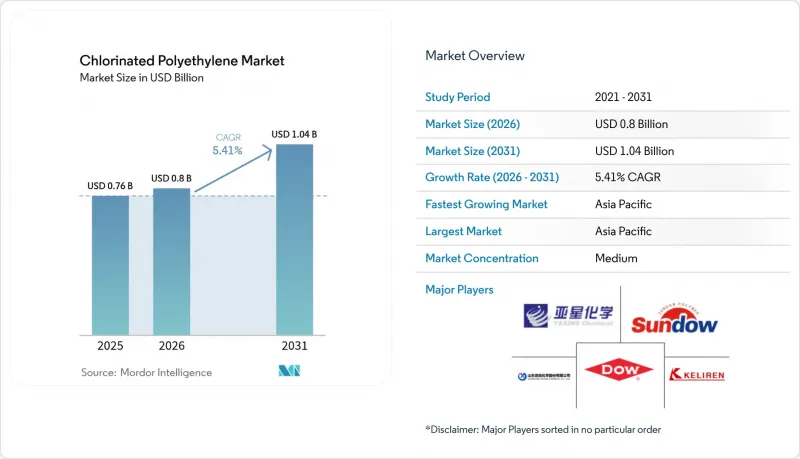
根據 Mordor Intelligence 預測,氯化聚乙烯市場預計將從 2025 年的 7.6 億美元成長到 2026 年的 8 億美元,到 2031 年達到 10.4 億美元,2026 年至 2031 年的複合年成長率預計為 5.41%。
本報告按產品(CPE 135A、CPE 135B、其他)、應用(衝擊改質劑、電線電纜護套、軟管和管材、黏合劑、其他)以及地區(亞太地區、北美地區、歐洲地區、南美地區、中東和非洲地區)進行細分。市場預測以美元計價。
全球氯化聚乙烯市場趨勢及洞察
向無鹵阻燃CPE混合材料過渡
化合物生產商將磷氮基可膨脹阻燃劑摻入氯化聚乙烯(CPE)中,降低了鹵素總含量,從而滿足IEC 60754-2標準並獲得UL-94 V-0認證。一項2025年的研究表明,添加微膠囊化紅磷和三聚氰胺氰尿酸鹽可使臨界氧指數超過34%,菸密度低於80 Ds,從而減少40%的氫氧化物礦物填料用量。北美和歐盟的電纜工廠為資料中心和鐵路運輸提供產品,是這項技術的早期採用者,因為當地法規要求低煙性能,而不是完全禁止使用鹵素。雖然此類「減鹵」化合物延長了氯化聚乙烯產品的生命週期,但由於需要精確的分散過程和防潮包裝,它們增加了化合物的複雜性和成本。
中國供應端的擴張提高了價格競爭力。
山東省一體化的乙烯和氯鹼資產將使該省氯聚氯乙烯(CPE)的平均現金成本在2025年降至每噸1200美元以下,比歐美生產商低20-30%。濰坊亞興公司已將產能擴大至每年8萬噸,但由於出口需求疲軟導致利潤率下降,該公司正轉向生產溫室薄膜和特種軟管用氯聚氯乙烯。價格走軟使印度、越南和印尼的混煉企業受益,這些企業為對成本敏感的聚氯乙烯(PVC)和電纜行業提供原料,但山東省小規模工廠的品質差異卻導致了反傾銷調查,並損害了品牌信譽。
歐盟禁止公共採購含氯塑膠
德國、法國和荷蘭目前優先在公共資助計畫中使用低煙無鹵(LSZH)材料。雖然REACH法規和CPR法規並未完全禁止使用低煙無鹵材料,但根據IEC 60754-1標準,採購指南已將鹵素氣體含量限制在0.5%或以下。電纜和屋頂材料供應商必須保持兩種類型的庫存,而隨著城市地區消防安全法規的日益嚴格,氯化聚乙烯(CPE)正轉向工業市場。因此,歐洲氯化聚乙烯市場正面臨短期銷售下滑和利潤率下降的壓力。
細分市場分析
2025年,氯化聚乙烯(CPE)135A的市佔率佔總銷售額的52.94%。這種半結晶質型CPE的氯含量為35±2%,慕尼粘度約為50,邵氏A硬度為60,延伸率超過600%。這些特性使其在提高硬質PVC的抗衝擊性和用於電線絕緣方面具有顯著優勢。黏度較高的CPE 135B具有更優異的熔體強度,可用於配製吹膜和阻燃填料,預計到2031年其複合年成長率將達到5.51%。特殊型CPE包括用於UL-94 V-0標準電纜化合物的高氯含量(Cl>40%)型、用於橡膠磁鐵的分子量調整型以及用於引擎室軟管的耐熱型。這些特種型CPE共同拓展了其價值,使其超越了通用樹脂的範疇。
隨著生產商向上游製程領域拓展,競爭日益激烈。陶氏化學、瑞森納克以及山東省的龍頭企業正在供應共加工的氯化聚乙烯-磷母粒,使混煉商能夠提供承包式低煙解決方案。這種垂直整合趨勢在通用樹脂價格保持平穩的情況下,透過一體化供應合約留住了長期客戶,從而保障了利潤率,並提高了氯化聚乙烯市場的客戶留存率。
區域分析
預計到2025年,亞太地區將佔全球氯化聚乙烯需求的72.15%,並將在2031年之前以5.78%的複合年成長率成長。中國擁有乙烯(年產量6,200萬噸)和聚乙烯(年產量4,500萬噸)的綜合生產基地,能夠以低成本向氯化聚乙烯反應器供應氯原料。山東省的生產群集出廠價低於每噸1,200美元,這使得印度和越南的混煉企業能夠擴大其市場佔有率,與交聯聚乙烯(XLPE)和熱塑性聚苯乙烯(TPO)競爭。然而,供應過剩正在擠壓生產商的利潤空間,土耳其和巴西也經常對中國企業進行反傾銷調查。
北美市場的成長主要由電動車充電線、資料中心電源線和石油鑽探軟管推動。聯邦標準允許在工業佈線中使用碳聚醚醚酮(CPE),加州政府的採購也日益要求在高載客量交通工具中採用低煙無鹵(LSZH)材料。 Southwire 的 2025 年電動車充電站規範(SPEC 45005)要求使用熱固性 CPE 護套,以確保其持續耐溫 90°C 並符合 FT4 阻燃標準。這些文件凸顯了 CPE 的持久價值,即使鹵素含量受到嚴格監控。
歐洲市場正面臨雙重挑戰。一方面,由於各國採購禁令導致建築用電線數量下降;另一方面,碳邊境調節機制(CBAM)可能會增加高碳排放進口產品的接收成本。以荷蘭Nobian公司為首的本土製造商正在對其膜電解槽維修,使其與可再生能源結合使用,以減少碳排放,同時保持國產碳聚醚(CPE)的競爭力。
在南美洲、中東和非洲,對氯化聚乙烯(CPE)的需求正在增加。在巴西和墨西哥,熱帶工業區正在使用CPE層級構造屋頂材料;在沙烏地阿拉伯和阿拉伯聯合大公國,海上鑽井電纜的護套被指定使用CPE材質,這些電纜通常浸泡在90°C的油中。對鹵素的監管壓力放鬆以及強烈的陽光照射正在推動CPE的應用,從而促進整個氯化聚乙烯市場的多元化成長。
其他好處
- Excel格式的市場預測(ME)表
- 3個月的分析師支持
目錄
第1章:引言
- 研究假設和市場定義
- 調查範圍
第2章:調查方法
第3章執行摘要
第4章 市場狀況
- 市場概覽
- 市場促進因素
- 向無鹵阻燃CPE混合材料過渡
- 中國供應端的擴張提高了價格競爭力。
- 用於氫氣加註基礎設施的耐油軟管
- 熱帶地區三層智慧屋膜的發展
- 歐洲的現場氯處理技術減少了範圍 3 的排放。
- 市場限制因素
- 歐盟禁止公共採購含氯塑膠
- TPV和SEBS彈性體的性能改進
- 對鹵代聚合物徵收新的碳邊境調節關稅
- 價值鏈分析
- 波特五力模型
第5章 市場規模與成長預測
- 依產品
- CPE 135A
- CPE 135B
- 其他
- 透過使用
- 衝擊改質劑
- 電線電纜絕緣
- 軟管和管子
- 黏合劑
- 其他
- 按地區
- 亞太地區
- 中國
- 印度
- 日本
- 韓國
- ASEAN
- 其他亞太國家
- 北美洲
- 美國
- 加拿大
- 墨西哥
- 歐洲
- 德國
- 英國
- 法國
- 義大利
- 俄羅斯
- 其他歐洲國家
- 南美洲
- 巴西
- 阿根廷
- 其他南美國家
- 中東和非洲
- 沙烏地阿拉伯
- 南非
- 其他中東和非洲國家
- 亞太地區
第6章 競爭情勢
- 市場集中度
- 策略趨勢
- 市佔率和排名分析
- 公司簡介
- Aurora Material Solutions
- Bontecn Group China Co. Ltd
- Dow
- Dycon Chemicals
- Epigral Limited
- Hangzhou Keli Chemical Co. Ltd
- Jiangsu Tianteng Chemical Industry Co. Ltd
- Resonac Holdings Corporation
- Shandong Gaoxin Chemical Co. Ltd
- Shandong Ketian Chemical Co. Ltd
- Shandong Novista Chemical Ltd(Novista Group)
- Shandong Rike Chemical Co.,Ltd
- Shandong Xiangsheng New Materials Technology Co. Ltd
- Shandong Xuye New Materials Co. Ltd
- Sundow Polymers Co. Ltd
- Weifang Yaxing Chemical Co. Ltd
第7章 市場機會與未來展望
According to Mordor Intelligence, the chlorinated polyethylene market size is expected to increase from USD 0.76 billion in 2025 to USD 0.8 billion in 2026 and reach USD 1.04 billion by 2031, growing at a CAGR of 5.41% over 2026-2031.
This report is Segmented by Product (CPE 135A, CPE 135B, and Other Products), Application (Impact Modifiers, Wire and Cable Jacketing, Hose and Tubing, Adhesives, and Other Applications), and Geography (Asia-Pacific, North America, Europe, South America, and Middle East and Africa). The Market Forecasts are Provided in Terms of Value (USD).
Global Chlorinated Polyethylene Market Trends and Insights
Shift Toward Halogen-Free Flame-Retardant CPE Hybrids
Formulators are lowering total halogen content by blending CPE with phosphorus-nitrogen intumescent systems, reaching UL-94 V-0 ratings while meeting IEC 60754-2 thresholds. A 2025 study showed that adding micro-encapsulated red phosphorus and melamine cyanurate delivers limiting oxygen index values above 34% and smoke density below 80 Ds, allowing 40% less mineral hydroxide filler. North American and EU cable plants serving data centers and rail transit are early adopters because local codes mandate low-smoke performance without banning all halogens. Such "reduced-halogen" compounds lengthen the product life cycle for the chlorinated polyethylene market, though precise dispersion and moisture-resistant packaging raise formulation complexity and cost.
Chinese Supply-Side Expansion Enhancing Price Competitiveness
Integrated ethylene and chlor-alkali assets in Shandong province drove average CPE cash costs below USD 1,200 per tonne in 2025, undercutting Western producers by 20-30%. Weifang Yaxing alone lifted capacity to 80,000 tpa yet saw margins narrow when export demand cooled, prompting a pivot toward greenhouse-film and specialty hose grades. Price softness benefits compounders across India, Vietnam, and Indonesia that feed cost-sensitive PVC and cable segments, although quality variability among smaller Shandong facilities stokes anti-dumping inquiries and undermines brand confidence.
EU Public-Procurement Bans on Chlorinated Plastics
Germany, France, and the Netherlands now prioritize LSZH materials in publicly funded projects. Although REACH and CPR stop short of an outright ban, procurement guidelines cap halogen acid gas at <= 0.5% under IEC 60754-1. Cable and roofing suppliers must keep dual inventories, diverting CPE toward industrial markets while downtown fire codes tighten. The chlorinated polyethylene market therefore faces near-term European volume erosion and margin compression.
Other drivers and restraints analyzed in the detailed report include:
- Oil-Resistant Hoses for Hydrogen Refueling Infrastructure
- Growth of 3-Layer Smart Roofing Membranes
- TPV and SEBS Elastomer Performance Advances
For complete list of drivers and restraints, kindly check the Table Of Contents.
Segment Analysis
The chlorinated polyethylene market size for CPE 135A accounted for 52.94% of revenue share in 2025. This semi-crystalline grade balances 35+-2% chlorine with Mooney viscosity around 50, generating Shore A 60 hardness and elongation above 600%, metrics prized for rigid PVC impact modification and wire jackets. Higher-viscosity CPE 135B offers extra melt strength, unlocking blown-film and flame-retardant filler loading that underpins a forecast 5.51% CAGR through 2031. Specialty variants. high-chlorine (>40% Cl) for UL-94 V-0 cable compounds, modified molecular-weight grades for rubber magnets, and heat-stable versions for under-hood hoses, collectively broaden value pools beyond commodity resin.
Competition intensifies as producers migrate upstream: Dow, Resonac, and leading Shandong firms supply co-processed CPE-phosphorus masterbatches, enabling compounders to offer turnkey low-smoke solutions. This vertical move shields margin amid flat commodity pricing and embeds long-term customers within integrated supply contracts, reinforcing stickiness across the chlorinated polyethylene market.
Complete Report Scope:
- By Product
- CPE 135A
- CPE 135B
- Other Products
- By Application
- Impact Modifiers
- Wire and Cable Jacketing
- Hose and Tubing
- Adhesives
- Other Applications
- By Geography
- Asia-Pacific
- China
- India
- Japan
- South Korea
- ASEAN
- Rest of Asia-Pacific
- North America
- United States
- Canada
- Mexico
- Europe
- Germany
- United Kingdom
- France
- Italy
- Russia
- Rest of Europe
- South America
- Brazil
- Argentina
- Rest of South America
- Middle-East and Africa
- Saudi Arabia
- South Africa
- Rest of Middle-East and Africa
- Asia-Pacific
Geography Analysis
Asia-Pacific anchored 72.15% of 2025 global demand for the chlorinated polyethylene market and is projected to grow at a 5.78% CAGR through 2031. China harbors integrated ethylene (62 Mt y) and polyethylene (45 Mt y) assets that flow chlorine feedstock cheaply into CPE reactors. Shandong clusters deliver ex-works prices under USD 1,200 t, spurring compounders in India and Vietnam to capture share versus XLPE and TPO. Overcapacity, however, trims producer margins and invites periodic anti-dumping probes from Turkey and Brazil.
North American market growth is buoyed by EV charging cables, data-center power cords, and oil-patch hoses. Federal codes allow CPE in industrial wiring; state procurements in California increasingly request LSZH for high-occupancy transit. Southwire's 2025 EV charge-station spec (SPEC 45005) calls for thermoset CPE jackets to assure 90 °C continuous rating and FT4 flame compliance. Such documents validate CPE's staying power despite halogen scrutiny.
European market faces dual headwinds: national procurement bans shrink building-wire tonnage, and CBAM may raise landed costs for high-carbon imports. Local producers, led by Nobian in the Netherlands, retrofit membrane electrolysers paired with renewable electricity to cut embedded carbon and sustain domestic CPE competitiveness.
South America, the Middle East, and Africa are witnessing rising demand for chlorinated polyethylene. Brazil and Mexico deploy CPE-based three-layer roofing in tropical industrial zones; Saudi Arabia and the UAE specify CPE jackets in offshore drilling cables where 90°C oil immersion is routine. Lower regulatory pressure on halogens and heavy sunlight drive incremental uptake, supporting diversified growth across the chlorinated polyethylene market.
- Aurora Material Solutions
- Bontecn Group China Co. Ltd
- Dow
- Dycon Chemicals
- Epigral Limited
- Hangzhou Keli Chemical Co. Ltd
- Jiangsu Tianteng Chemical Industry Co. Ltd
- Resonac Holdings Corporation
- Shandong Gaoxin Chemical Co. Ltd
- Shandong Ketian Chemical Co. Ltd
- Shandong Novista Chemical Ltd (Novista Group)
- Shandong Rike Chemical Co.,Ltd
- Shandong Xiangsheng New Materials Technology Co. Ltd
- Shandong Xuye New Materials Co. Ltd
- Sundow Polymers Co. Ltd
- Weifang Yaxing Chemical Co. Ltd
Additional Benefits:
- The market estimate (ME) sheet in Excel format
- 3 months of analyst support
TABLE OF CONTENTS
1 Introduction
- 1.1 Study Assumptions and Market Definition
- 1.2 Scope of the Study
2 Research Methodology
3 Executive Summary
4 Market Landscape
- 4.1 Market Overview
- 4.2 Market Drivers
- 4.2.1 Shift Toward Halogen-Free Flame-Retardant CPE Hybrids
- 4.2.2 Chinese Supply-Side Expansion Enhancing Price Competitiveness
- 4.2.3 Oil-Resistant Hoses for Hydrogen Refuelling Infrastructure
- 4.2.4 Growth of 3-Layer Smart Roofing Membranes in Tropical Regions
- 4.2.5 On-site Chlorination Tech Cutting Scope-3 Emissions in Europe
- 4.3 Market Restraints
- 4.3.1 EU Public-Procurement Bans on Chlorinated Plastics
- 4.3.2 TPV and SEBS Elastomer Performance Advances
- 4.3.3 Emerging Carbon-Border Tariffs on Halogenated Polymers
- 4.4 Value Chain Analysis
- 4.5 Porter's Five Forces
- 4.5.1 Bargaining Power of Suppliers
- 4.5.2 Bargaining Power of Buyers
- 4.5.3 Threat of New Entrants
- 4.5.4 Threat of Substitutes
- 4.5.5 Competitive Rivalry
5 Market Size and Growth Forecasts (Value)
- 5.1 By Product
- 5.1.1 CPE 135A
- 5.1.2 CPE 135B
- 5.1.3 Other Products
- 5.2 By Application
- 5.2.1 Impact Modifiers
- 5.2.2 Wire and Cable Jacketing
- 5.2.3 Hose and Tubing
- 5.2.4 Adhesives
- 5.2.5 Other Applications
- 5.3 By Geography
- 5.3.1 Asia-Pacific
- 5.3.1.1 China
- 5.3.1.2 India
- 5.3.1.3 Japan
- 5.3.1.4 South Korea
- 5.3.1.5 ASEAN
- 5.3.1.6 Rest of Asia-Pacific
- 5.3.2 North America
- 5.3.2.1 United States
- 5.3.2.2 Canada
- 5.3.2.3 Mexico
- 5.3.3 Europe
- 5.3.3.1 Germany
- 5.3.3.2 United Kingdom
- 5.3.3.3 France
- 5.3.3.4 Italy
- 5.3.3.5 Russia
- 5.3.3.6 Rest of Europe
- 5.3.4 South America
- 5.3.4.1 Brazil
- 5.3.4.2 Argentina
- 5.3.4.3 Rest of South America
- 5.3.5 Middle-East and Africa
- 5.3.5.1 Saudi Arabia
- 5.3.5.2 South Africa
- 5.3.5.3 Rest of Middle-East and Africa
- 5.3.1 Asia-Pacific
6 Competitive Landscape
- 6.1 Market Concentration
- 6.2 Strategic Moves
- 6.3 Market Share(%)/Ranking Analysis
- 6.4 Company Profiles (includes Global Overview, Market Overview, Core Segments, Financials, Strategic Information, Products and Services, Recent Developments)
- 6.4.1 Aurora Material Solutions
- 6.4.2 Bontecn Group China Co. Ltd
- 6.4.3 Dow
- 6.4.4 Dycon Chemicals
- 6.4.5 Epigral Limited
- 6.4.6 Hangzhou Keli Chemical Co. Ltd
- 6.4.7 Jiangsu Tianteng Chemical Industry Co. Ltd
- 6.4.8 Resonac Holdings Corporation
- 6.4.9 Shandong Gaoxin Chemical Co. Ltd
- 6.4.10 Shandong Ketian Chemical Co. Ltd
- 6.4.11 Shandong Novista Chemical Ltd (Novista Group)
- 6.4.12 Shandong Rike Chemical Co.,Ltd
- 6.4.13 Shandong Xiangsheng New Materials Technology Co. Ltd
- 6.4.14 Shandong Xuye New Materials Co. Ltd
- 6.4.15 Sundow Polymers Co. Ltd
- 6.4.16 Weifang Yaxing Chemical Co. Ltd
7 Market Opportunities and Future Outlook
- 7.1 White-space and Unmet-Need Assessment

 全球氯化聚乙烯(CPE)市場研究報告,2026版
 氯化聚乙烯市場報告:按等級、應用、終端用戶產業和地區分類(2026-2034 年)
 全球氯化聚乙烯市場規模、佔有率、趨勢和成長分析報告(2026-2034年)
 氯化聚乙烯市場:依形態、性能等級、應用、終端用戶產業及通路分類-2026-2032年全球預測
 氯化聚乙烯 (CPE) 市場、全球需求分析、地區、應用及預測(~2034年)
 氯化聚乙烯市場規模、佔有率和成長分析(按產品、氯含量、應用、最終用途行業和地區)- 2025-2032 年行業預測
 2030 年氯化聚乙烯市場預測:按等級、應用和地區進行的全球分析氯化聚乙烯市場、規模、佔有率、趨勢、行業分析報告:依產品、應用和地區 - 市場預測(2025-2034)氯化聚乙烯的全球市場(2018年~2034年)2024 年至 2031 年氯化聚乙烯市場(按等級、應用和地區劃分)