


 |
市場調查報告書
商品編碼
2124196
聚合物塗層織物:市場佔有率分析、行業趨勢和統計數據、成長預測(2026-2031)Polymer Coated Fabric - Market Share Analysis, Industry Trends & Statistics, Growth Forecasts (2026 - 2031) |
||||||

※ 本網頁內容可能與最新版本有所差異。詳細情況請與我們聯繫。
根據 Mordor Intelligence 預測,聚合物塗層紡織品市場將從 2025 年的 199 億美元成長到 2026 年的 208.7 億美元,到 2031 年將達到 270.3 億美元。
預計從 2026 年到 2031 年,其複合年成長率將達到 5.31%。
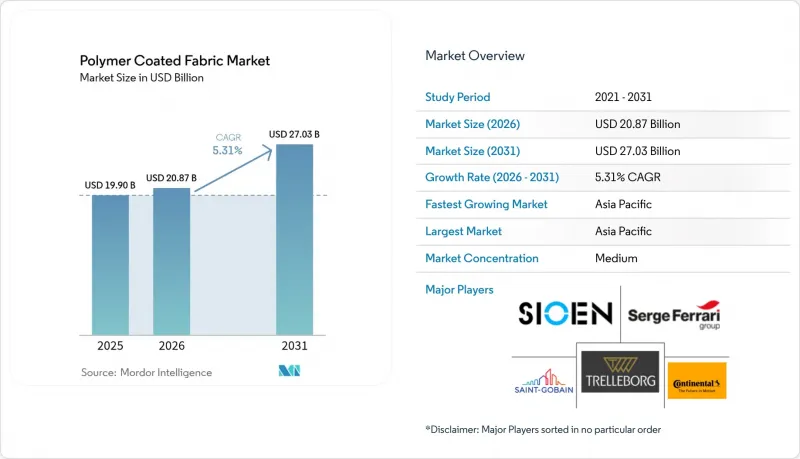
本報告按產品類型(聚氯乙烯、聚氨酯、聚乙烯、矽膠及其他)、應用領域(交通運輸、工業設備罩、屋頂和遮陽篷、防護衣、家具、運動休閒及其他)以及地區(北美、南美、歐洲、亞太地區以及中東和非洲)進行細分。市場預測以美元計價。
全球聚合物塗層織物市場趨勢及洞察
對輕質永續內部裝潢建材的需求
汽車製造商正從傳統的乙烯基和皮革轉向聚氨酯塗層紡織品,這種材料可將車門面板和座椅套的重量減輕高達 15%。此舉符合美國 CAFE 目標,即到 2026 年實現每加侖汽油行駛 49 英里。水性聚氨酯系統不含N-甲基吡咯烷酮,揮發性有機化合物 (VOC) 排放量減少 95%,符合 ISO 12219-1 車廂空氣品質標準。歐洲汽車製造商正在擴大使用源自廢棄食用油和蓖麻油的生物基多元醇,將可再生碳含量提高到 20-30%,同時保持超過 25 兆帕的拉伸強度。家具製造商也正在採用類似的化學技術,以滿足加州 65 號提案的資訊揭露要求以及歐盟對家具和室內裝飾產品的阻燃法規。閉合迴路生產線已經出現,它可以從廢棄座椅套中回收聚酯纖維,從而減少高達 40% 的原生纖維使用量,並支持循環經濟目標。
能夠抵抗氣候變遷的張拉結構正在蓬勃發展。
聚四氟乙烯(PTFE)塗層玻璃和聚氯乙烯(PVC)塗層聚酯薄膜能夠承受超過200公里/小時的風速且不易撕裂,因此成為體育場館屋頂、機場大廳以及易受颶風侵襲地區戶外座艙罩的主流設計方案。歐盟聯合研究中心(JRC)的實地研究證實,在卡達沿海地區安裝的PTFE薄膜在15年後仍能維持其初始抗張強度的98%,優於不到8年就腐蝕的金屬覆層。具有自清潔性能的二氧化鈦基面塗層可透過光催化作用分解有機污垢,進而降低30%的維護成本。沙烏地阿拉伯已累計21億美元,計劃在2028年前在利雅德和吉達建造遮陽走廊,並將膜結構納入其國家適應計畫。類似的解決方案在撒哈拉以南非洲的基礎設施項目中也越來越受到關注,在這些地區,移動式膜結構比固定式混凝土遮蔽設施具有50%的成本優勢。
原油衍生聚合物的價格波動
2025年全年,布蘭特原油價格平均維持在每桶70至90美元,推高了乙烯和丙烯的成本,而乙烯和丙烯佔PVC價格的60%至70%。 2025年第二季現貨價格飆漲12%,導致歐洲中型加工商的利潤率承壓,被迫停產三週,直到市場恢復正常。由於苯的價格落後原油價格三個月,聚氨酯原料(如MDI)也呈現類似趨勢。一些亞洲加工商正在收購多元醇工廠的少數股權以確保供應和價格,而小規模的公司則被迫依賴代工塗裝模式,利潤僅為成品價值的8%至10%。因此,垂直整合正成為應對原物料價格波動的重要避險手段。
細分市場分析
到2025年,聚氯乙烯(PVC)將佔據聚合物塗層織物市場42.15%的銷售額,這主要得益於其樹脂價格比聚氨酯低30%至40%,且其固有的阻燃性能無需添加其他阻燃劑即可滿足NFPA 701標準。水性聚氨酯的市佔率成長速度最快,預計到2031年將以6.12%的複合年成長率成長。這是因為汽車和家具原始設備製造商(OEM)需要觸感柔軟且符合南海岸空氣品質管理區(AQMD)第1168號規則中規定的揮發性有機化合物(VOC)限值的產品。這些化學技術也使加工商無需投資蒸氣回收設備通常會佔據其工廠資本支出的15%。
聚乙烯塗料滿足了對化學惰性有要求的細分市場,例如農業青貯覆蓋物。同時,矽酮體系在250 度C以上仍保持穩定性,因此在高溫應用領域佔據主導地位,例如排氣隔熱毯。氟聚合物分散體和生物基聚酯屬於「其他」類別,它們各自滿足特定的要求,例如極高的耐化學性或「從搖籃到墳墓」的認證。歷史數據顯示,2020年至2025年間,此類產品市場年均成長率約為4.8%,但隨著汽車生產的復甦和公共工程支出的恢復,這一成長動能正在加速。歐洲嚴格的公共採購法規(其中ISO 14001認證權重高達30%)持續推動客戶轉向具有明確回收途徑的聚氨酯解決方案。
區域分析
預計到2025年,亞太地區將以46.42%的市佔率主導聚合物塗層紡織品市場,並在2031年之前維持5.98%的複合年成長率。光是中國一地,到2025年就將生產2,700萬輛汽車,其塗層織物年產能超過80萬噸,主要集中在江蘇和浙江兩省。由於原料產地接近性,這些地區的物流成本最多可降低15%。印度的國家基礎設施計劃到2030年將投入1.4兆美元,將刺激國內需求,並促進對中東和非洲的出口成長。
到2025年,北美將佔據顯著的市場佔有率。汽車座椅將使用18萬噸聚氨酯塗層織物,而到2026年,美國聯邦政府1,100億美元的基礎設施支出將推動其在地工織物和臨時住所領域的應用。歐洲市場的成長則受到歐洲綠色交易中交通運輸部門減排55%目標所帶來的輕量化要求的驅動,這迫使原始設備製造商(OEM)採用碳足跡認證的聚氨酯解決方案。
在南美、中東和非洲,對聚合物塗層織物的需求正顯著成長。成長要素包括巴西農業部門對青貯覆蓋物的需求,以及波灣合作理事會(GCC)的建設項目,特別是體育場館頂棚和交通樞紐的建設。儘管受疫情影響,地域擴張一度停滯,但隨著供應鏈的正常化和基礎設施項目的恢復,預計到2031年,全球聚合物塗層織物市場將保持5.31%的年均成長率。
其他好處:
- Excel格式的市場預測(ME)表
- 3個月的分析師支持
目錄
第1章:引言
- 研究假設和市場定義
- 調查範圍
第2章:調查方法
第3章執行摘要
第4章 市場狀況
- 市場概覽
- 市場促進因素
- 對輕質永續內部裝潢建材的需求
- 能夠抵抗氣候變遷的張拉結構正在蓬勃發展。
- 抗菌醫用家具的引進
- 整合感測器的智慧布料
- 對軟性光伏背板用織物的投資
- 市場限制因素
- 原油衍生聚合物的價格波動
- 聚氯乙烯和鄰苯二甲酸酯的環境檢驗
- 我們將加強對微塑膠排放的監管。
- 價值鏈分析
- 波特五力模型
第5章 市場規模與成長預測
- 依產品類型
- 聚氯乙烯(PVC)
- 聚氨酯(PU)
- 聚乙烯
- 矽酮
- 其他
- 透過使用
- 運輸
- 工業設備罩
- 屋頂和遮陽棚
- 防護衣
- 家具
- 運動休閒
- 其他
- 按地區
- 亞太地區
- 中國
- 印度
- 日本
- 韓國
- 其他亞太國家
- 北美洲
- 美國
- 加拿大
- 墨西哥
- 歐洲
- 德國
- 英國
- 法國
- 義大利
- 其他歐洲國家
- 南美洲
- 巴西
- 阿根廷
- 其他南美國家
- 中東和非洲
- 沙烏地阿拉伯
- 南非
- 其他中東和非洲國家
- 亞太地區
第6章 競爭情勢
- 市場集中度
- 策略趨勢
- 市佔率和排名分析
- 公司簡介
- Continental AG
- Freudenberg Performance Materials Holding GmbH
- Heytex Gruppe
- OMNOVA North America Inc.
- MICHELIN
- Saint-Gobain
- Seaman Corporation
- Serge Ferrari Group
- Sioen Industries NV
- SPRADLING INTERNATIONAL GmbH
- SRF Limited
- Trelleborg AB
第7章 市場機會與未來展望
According to Mordor Intelligence, the polymer coated fabric market size is projected to grow from USD 19.90 billion in 2025 to USD 20.87 billion in 2026, and reach USD 27.03 billion by 2031, growing at a CAGR of 5.31% from 2026 to 2031.
This report is Segmented by Product Type (Polyvinyl Chloride, Polyurethane, Polyethylene, Silicone, and Others), Application (Transportation, Industrial Equipment Covers, Roofing and Awning, Protective Clothing, Furniture, Sports and Leisure, and Others), and Geography (North America, South America, Europe, Asia-Pacific, and Middle East and Africa). Market Forecasts are Provided in Terms of Value (USD).
Global Polymer Coated Fabric Market Trends and Insights
Lightweight and Sustainable Interior Materials Demand
Automotive OEMs are replacing traditional vinyl and leather with polyurethane-coated textiles that lower door-panel and seat-cover weight by up to 15%, a shift aligned with U.S. CAFE targets of 49 miles per gallon by 2026. Water-based polyurethane systems remove N-methyl-2-pyrrolidone, cutting volatile-organic-compound emissions by 95% and enabling compliance with ISO 12219-1 cabin-air standards. European automakers increasingly specify bio-attributed polyols sourced from waste cooking oil or castor beans, achieving 20-30% renewable-carbon content while maintaining tensile strengths above 25 MPa. Furniture manufacturers are adopting analogous chemistries to satisfy California Proposition 65 disclosure rules and the European Union Furniture and Furnishings regulations on flame retardancy. Closed-loop recycling lines that reclaim polyester scrim from end-of-life seat covers are emerging, lowering virgin-fiber use by up to 40% and reinforcing circular-economy goals.
Climate-Resilient Tensile Structures Boom
PTFE-coated glass and PVC-coated polyester membranes now headline designs for stadium roofs, airport halls, and outdoor canopies in cyclone-prone regions because they resist wind loads above 200 km/h without tearing. A Joint Research Centre field study confirmed that PTFE membranes in coastal Qatar retained 98% of initial tensile strength after 15 years, outperforming metallic cladding that corroded in fewer than eight. Self-cleaning titanium-dioxide topcoats slash maintenance costs by 30% through photocatalytic degradation of organic dirt. Saudi Arabia has earmarked USD 2.1 billion for shaded walkways in Riyadh and Jeddah by 2028, embedding fabric structures in national adaptation plans. Similar solutions are gaining traction in sub-Saharan infrastructure projects where relocatable membranes deliver a 50% cost advantage over fixed concrete shelters.
Crude-Derived Polymer Price Volatility
Brent crude averaged USD 70-90 per barrel through 2025, lifting ethylene and propylene feedstock costs that make up 60-70% of PVC pricing. Mid-sized European converters locked into quarterly supply contracts saw margin squeeze when Q2 2025 spot prices jumped 12%, forcing three-week production stoppages until markets normalized. Polyurethane raw-material inputs such as MDI follow similar trends because benzene prices track oil with a three-month lag. Some Asian converters have acquired minority stakes in polyol plants to secure volumes and pricing, while smaller firms resort to toll-coating models that cap profit potential at 8-10% of finished-fabric value. Vertical integration is therefore becoming a critical hedge against raw-material swings.
Other drivers and restraints analyzed in the detailed report include:
- Antimicrobial Healthcare Furnishings Adoption
- Sensor-Embedded Smart Fabrics Integration
- Environmental Scrutiny of PVC and Phthalates
For complete list of drivers and restraints, kindly check the Table Of Contents.
Segment Analysis
PVC accounted for 42.15% of polymer polymer-coated fabrics market revenue in 2025, owing to resin prices that run 30-40% below polyurethane and built-in flame retardancy that satisfies NFPA 701 without extra additives. Water-based polyurethane is capturing share fastest at a 6.12% CAGR to 2031 because automotive and furniture OEMs demand soft-touch surfaces that meet South Coast AQMD Rule 1168 limits on volatile organic compounds. These chemistries also help converters sidestep vapor-recovery investments equal to 15% of plant capital.
Polyethylene coatings cater to chemical-inertness niches such as agricultural silage covers, while silicone systems dominate high-temperature uses like exhaust-insulation blankets because they remain stable above 250 °C. Fluoropolymer dispersions and bio-based polyesters populate the "Others" category, each serving specialty demand for extreme chemical resistance or cradle-to-grave certification. Historical data show the product-type hierarchy grew at roughly 4.8% per year from 2020-2025, but momentum is accelerating as auto production rebounds and public-works spending returns. Stricter European public-procurement rules that grant 30% weighting to ISO 14001 certification continue to nudge customers toward polyurethane solutions with documented recycling pathways.
Complete Report Scope:
- By Product Type
- Polyvinyl Chloride (PVC)
- Polyurethane (PU)
- Polyethylene
- Silicone
- Others
- By Application
- Transportation
- Industrial Equipment Covers
- Roofing and Awning
- Protective Clothing
- Furniture
- Sports and Leisure
- Others
- By Geography
- Asia-Pacific
- China
- India
- Japan
- South Korea
- Rest of Asia-Pacific
- North America
- United States
- Canada
- Mexico
- Europe
- Germany
- United Kingdom
- France
- Italy
- Rest of Europe
- South America
- Brazil
- Argentina
- Rest of South America
- Middle East and Africa
- Saudi Arabia
- South Africa
- Rest of Middle East and Africa
- Asia-Pacific
Geography Analysis
Asia-Pacific dominated the polymer coated fabrics market with a 46.42% share in 2025 and is projected to maintain a 5.98% CAGR through 2031. China alone produced 27 million motor vehicles in 2025 and hosts more than 800,000 tons/year of coated-fabric capacity concentrated in Jiangsu and Zhejiang, where feedstock proximity lowers logistics overhead by up to 15% . India's National Infrastructure Pipeline earmarks USD 1.4 trillion through 2030, stimulating domestic demand and export growth to the Middle East and Africa.
North America accounted for a significant market share in 2025. Automotive seating absorbed 180,000 tons of polyurethane coated fabric, and federal infrastructure spending of USD 110 billion through 2026 is spurring uptake in geotextiles and temporary shelters. Europe's market growth is driven by lightweight requirements under the 55% transport-emission-reduction goal in the European Green Deal, pushing OEMs toward polyurethane solutions with certified carbon footprints.
South America plus the Middle East and Africa are witnessing a considerable rise in demand for polymer coated fabrics. Brazil's farm-sector demand for silage covers and the Gulf Cooperation Council's construction pipeline-particularly stadium roofs and transit hubs-are the main growth drivers. Historically, geographic expansion lagged during pandemic disruptions, but normalization of supply chains and resumption of infrastructure projects underpin the 5.31% global forecast growth rate to 2031.
- Continental AG
- Freudenberg Performance Materials Holding GmbH
- Heytex Gruppe
- OMNOVA North America Inc.
- MICHELIN
- Saint-Gobain
- Seaman Corporation
- Serge Ferrari Group
- Sioen Industries NV
- SPRADLING INTERNATIONAL GmbH
- SRF Limited
- Trelleborg AB
Additional Benefits:
- The market estimate (ME) sheet in Excel format
- 3 months of analyst support
TABLE OF CONTENTS
1 Introduction
- 1.1 Study Assumptions and Market Definition
- 1.2 Scope of the Study
2 Research Methodology
3 Executive Summary
4 Market Landscape
- 4.1 Market Overview
- 4.2 Market Drivers
- 4.2.1 Lightweight and Sustainable Interior Materials Demand
- 4.2.2 Climate-Resilient Tensile Structures Boom
- 4.2.3 Antimicrobial Healthcare Furnishings Adoption
- 4.2.4 Sensor-Embedded Smart Fabrics Integration
- 4.2.5 Flexible PV Back-Sheet Fabrics Investments
- 4.3 Market Restraints
- 4.3.1 Crude-Derived Polymer Price Volatility
- 4.3.2 Environmental Scrutiny of PVC and Phthalates
- 4.3.3 Micro-plastic Release Regulations Tighten
- 4.4 Value Chain Analysis
- 4.5 Porter's Five Forces
- 4.5.1 Threat of New Entrants
- 4.5.2 Bargaining Power of Buyers
- 4.5.3 Bargaining Power of Suppliers
- 4.5.4 Threat of Substitutes
- 4.5.5 Degree of Competition
5 Market Size and Growth Forecasts (Value)
- 5.1 By Product Type
- 5.1.1 Polyvinyl Chloride (PVC)
- 5.1.2 Polyurethane (PU)
- 5.1.3 Polyethylene
- 5.1.4 Silicone
- 5.1.5 Others
- 5.2 By Application
- 5.2.1 Transportation
- 5.2.2 Industrial Equipment Covers
- 5.2.3 Roofing and Awning
- 5.2.4 Protective Clothing
- 5.2.5 Furniture
- 5.2.6 Sports and Leisure
- 5.2.7 Others
- 5.3 By Geography
- 5.3.1 Asia-Pacific
- 5.3.1.1 China
- 5.3.1.2 India
- 5.3.1.3 Japan
- 5.3.1.4 South Korea
- 5.3.1.5 Rest of Asia-Pacific
- 5.3.2 North America
- 5.3.2.1 United States
- 5.3.2.2 Canada
- 5.3.2.3 Mexico
- 5.3.3 Europe
- 5.3.3.1 Germany
- 5.3.3.2 United Kingdom
- 5.3.3.3 France
- 5.3.3.4 Italy
- 5.3.3.5 Rest of Europe
- 5.3.4 South America
- 5.3.4.1 Brazil
- 5.3.4.2 Argentina
- 5.3.4.3 Rest of South America
- 5.3.5 Middle East and Africa
- 5.3.5.1 Saudi Arabia
- 5.3.5.2 South Africa
- 5.3.5.3 Rest of Middle East and Africa
- 5.3.1 Asia-Pacific
6 Competitive Landscape
- 6.1 Market Concentration
- 6.2 Strategic Moves
- 6.3 Market Share (%)/Ranking Analysis
- 6.4 Company Profiles (includes Global level Overview, Market level overview, Core Segments, Financials as available, Strategic Information, Products and Services, Recent Developments)
- 6.4.1 Continental AG
- 6.4.2 Freudenberg Performance Materials Holding GmbH
- 6.4.3 Heytex Gruppe
- 6.4.4 OMNOVA North America Inc.
- 6.4.5 MICHELIN
- 6.4.6 Saint-Gobain
- 6.4.7 Seaman Corporation
- 6.4.8 Serge Ferrari Group
- 6.4.9 Sioen Industries NV
- 6.4.10 SPRADLING INTERNATIONAL GmbH
- 6.4.11 SRF Limited
- 6.4.12 Trelleborg AB
7 Market Opportunities and Future Outlook
- 7.1 White-Space and Unmet-Need Assessment


