


 |
市場調查報告書
商品編碼
2124173
窄頻聯網:市場佔有率分析、產業趨勢與統計、成長預測(2026-2031 年)Narrowband IoT - Market Share Analysis, Industry Trends & Statistics, Growth Forecasts (2026 - 2031) |
||||||

※ 本網頁內容可能與最新版本有所差異。詳細情況請與我們聯繫。
據 Mordor Intelligence 稱,窄頻聯網市場預計到 2026 年價值 136.2 億美元,高於 2025 年的 104.3 億美元,預計到 2031 年將達到 518.2 億美元。
預計2026年至2031年複合年成長率將達30.62%。
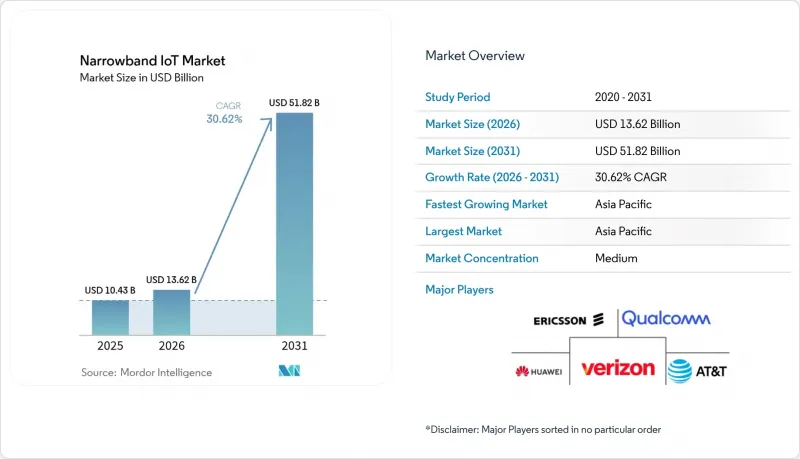
本報告按組件(網路、模組)、部署模式(獨立、帶內、保護帶)、設備類型(穿戴式裝置、追蹤器、智慧電錶、智慧照明、警報器/探測器、其他)、應用(智慧城市、交通/物流、能源/公共產業、零售、其他)和地區進行分類。
全球窄頻聯網市場趨勢及洞察
超低功耗延長電池壽命。
透過利用 eDRX、PSM 和早期資料傳輸技術,能耗和延遲全面降低,使設備能夠在單一電池上運作長達 10 年。現場測試表明,預先配置的上行鏈路資源即使在高流量條件下也能將能耗降低 2.5 倍,並將電池壽命延長 1.6 倍。這種電源特性對公用事業企業而言具有變革性意義,因為電池更換成本通常高於硬體成本。每個單元支援 50,000 個設備,可在不影響耐用性的前提下擴展,從而促進 NB-IoT 在遙測領域的市場成長。
NB-IoT 模組的平均售價 (ASP) 已降至 3 美元以下,加速了其普及。
製造規模的擴大和整合晶片組的應用使模組平均價格降至 3 美元以下,從而得以進入環境感測和資產追蹤等對成本要求較高的領域。每月使用費也降至 0.5 美元,使 NB-IoT 在與免許可 LPWAN 替代方案的競爭中佔據優勢。全球模式提案現在支援全球頻段,使 OEM 廠商能夠透過單一認證在全球範圍內出貨,從而加速新興地區設備出貨量的成長。
與 LTE-M 和免許可 LPWAN(LoRa、Sigfox)的競爭
AT&T逐步淘汰NB-IoT並過渡到LTE-M,凸顯了營運商在行動資產服務中對更高資料傳輸速度和更佳移動性的重視。 LoRa預計到2030年將擁有13億個連接,這表明對於需要完全控制的企業而言,專用網路的吸引力日益增強。這兩個相互競爭的因素意味著,除非吞吐量得到提升,否則NB-IoT市場的關注點將僅限於需要固定廣域覆蓋的應用場景。
細分市場分析
為了因應設備密度激增,營運商紛紛升級核心網路和無線設備,預計到2025年,網路基礎設施支出將佔總收入的62.35%。這項支出反映了NB-IoT市場的早期階段,其覆蓋範圍和容量的擴張速度超過了設備數量的成長速度。同時,由於平均售價(ASP)降低,價值向下游OEM廠商轉移,預計到2031年,模組市場將以32.55%的年複合成長率(CAGR)。整合SoC透過降低組件成本和簡化認證流程,使價格低於3美元,從而促進了大規模應用。透過雲端夥伴關係計量型5G核心服務將使營運商能夠推遲資本支出(CAPEX),並在預測期內將支出結構轉向模組和後端分析。
隨著供應鏈日趨成熟,晶片組參考設計與承包天線封裝方案現已面世,降低了准入門檻。因此,NB-IoT 產業正將重心從容量擴張轉向應用實用化,這標誌著收入來源正逐步從基礎設施轉向設備和資訊服務。
預計到2025年,獨立部署將佔總收入的46.65%,這主要得益於公共產業和工業用戶對專用頻段可預測性能的偏好。中國全國範圍內的智慧電錶部署宣傳活動進一步推動了這一趨勢,鞏固了獨立營運商NB-IoT市場的初期成長。隨著業者重複利用未使用的LTE緩衝區,保護頻帶策略正以34.10%的複合年成長率加速發展,這與歐洲優先考慮頻譜效率的政策一致。在保護頻帶資源匱乏的地區,帶內部署正作為一種過渡方案,在覆蓋範圍和與傳統業務共存之間取得平衡。
電信業者越來越重視基於預期終端密度的頻段,這推動了中型市場對保護頻帶的採用。同時,在關鍵任務應用中,由於隔離優勢,獨立式設計仍然被保留。這種雙重性將持續存在,並塑造出兼顧性能和資產利用率的區域部署模式。
區域分析
預計到2025年,亞太地區將佔全球收入的51.75%。這主要得益於中國移動擁有8.9億連接,以及5G普及率在2023年達到90%。產業政策和大規模公共部門競標正在建立可預測的需求管道,從而促進供應商規模化發展。印度和日本目前正在試點全國智慧計量項目,這些項目正逐漸成為該地區的第二大成長引擎。隨著獨立組網部署的成熟,營運商正將工作重心轉向最佳化保護頻段,以在不進行新的頻率競標的情況下滿足激增的終端需求。
在北美,隨著AT&T退出NB-IoT市場,戰略重組正在進行中,但T-Mobile和Verizon仍在繼續支持全國範圍內的部署,從而形成了競爭格局複雜的局面。政府對水錶和燃氣表更換的基礎設施津貼在一定程度上抵消了產業重組帶來的風險。新興的RedCap試點計畫提供了一個前瞻性的方案,預計在中期內穩定營運商的部署。
在歐洲,基於能源效率和環境監測方面的監管要求,NB-IoT技術得以持續穩定成長。儘管頻段分散,電信業者仍將NB-IoT技術整合到跨境漫遊協定中,並透過引入保護頻段最大限度地利用稀缺的1GHz以下頻段。在環境保護領域,例如沃達豐的瀕危物種追蹤項目,公私合營合作的案例展現了具有社會影響力的應用,從而推動了NB-IoT技術的持續普及。
其他好處:
- Excel格式的市場預測(ME)表
- 3個月的分析師支持
目錄
第1章:引言
- 研究假設和市場定義
- 調查範圍
第2章:調查方法
第3章執行摘要
第4章 市場狀況
- 市場概覽
- 市場促進因素
- 超低功耗延長電池壽命。
- NB-IoT模組的平均售價已降至3美元以下,加速了其普及應用。
- 政府主導的低功耗廣域網路部署用於智慧電錶引入
- 政府對智慧農業和農村數位化發展的激勵措施
- 衛星增強型NB-IoT用於連接遠端資產
- 5G NR-RedCap藍圖,確保長期技術連續性
- 市場限制因素
- 與 LTE-M 和免許可 LPWAN(LoRa、Sigfox)的競爭
- 下行鏈路吞吐量的限制阻礙了空中(OTA)韌體更新。
- 碎片化的頻率分配使全球漫遊變得複雜。
- 未經證實的收益分成模式正在減緩生態系的貨幣化進程。
- 價值供應鏈分析
- 監理情勢
- 技術展望
- 波特五力分析
- 評估新冠肺炎疫情的影響
第5章 市場規模與成長預測
- 按組件
- 網路
- 核心網路
- 無線接取網路(RAN)
- 模組
- 基頻晶片組
- 整合SoC
- 網路
- 不同的發展
- 獨立型
- 入境
- 護腕
- 依設備類型
- 穿戴式裝置
- 醫療保健穿戴式裝置
- 消費級穿戴裝置
- 追蹤器
- 物流追蹤器
- 智慧電錶
- 電錶
- 瓦斯表和水錶
- 智慧照明
- 警報器和探測器
- 煙霧偵測器
- 入侵警報裝置
- 穿戴式裝置
- 透過使用
- 智慧城市
- 運輸/物流
- 能源公用事業
- 零售和自動販賣機
- 農業和畜牧業
- 工業自動化
- 按地區
- 北美洲
- 美國
- 加拿大
- 墨西哥
- 南美洲
- 巴西
- 阿根廷
- 其他南美國家
- 歐洲
- 德國
- 英國
- 法國
- 義大利
- 西班牙
- 其他歐洲國家
- 亞太地區
- 中國
- 印度
- 日本
- 韓國
- 其他亞太國家
- 中東和非洲
- 中東
- 阿拉伯聯合大公國
- 沙烏地阿拉伯
- 土耳其
- 其他中東國家
- 非洲
- 南非
- 奈及利亞
- 肯亞
- 其他非洲國家
- 中東
- 北美洲
第6章 競爭情勢
- 市場集中度
- 策略趨勢
- 市佔率分析
- 公司簡介
- Huawei Technologies Co., Ltd
- Ericsson
- Nokia Corporation
- Qualcomm Technologies
- MediaTek Inc.
- Intel Corporation
- Sony Semiconductor(Altair Chipset)
- Sierra Wireless
- Telit IoT Platforms
- Quectel Wireless Solutions
- u-blox AG
- Fibocom Wireless
- China Mobile
- China Telecom
- Vodafone Group Plc
- Deutsche Telekom AG
- ATandT Inc.
- Verizon Communications Inc.
- Telefonica SA
- Orange SA
- T-Mobile US, Inc.
- Twilio Inc.
第7章 市場機會與未來展望
According to Mordor Intelligence, narrowband IoT market size in 2026 is estimated at USD 13.62 billion, growing from 2025 value of USD 10.43 billion with 2031 projections showing USD 51.82 billion, growing at 30.62% CAGR over 2026-2031.
This report is Segmented by Component (Network, Module), Deployment (Standalone, In-Band, Guard-Band), Device Type (Wearables, Tracker, Smart Meter, Smart Lighting, Alarm and Detector, Others), Application (Smart Cities, Transportation & Logistics, Energy and Utilities, Retail, and More), and Geography.
Global Narrowband IoT Market Trends and Insights
Ultra-low power consumption extends battery life
Devices can operate for up to 10 years on a single battery by leveraging eDRX, PSM, and Early Data Transmission that collectively cut energy draw and latency. Field tests show Pre-Configured Uplink Resources lower energy use 2.5 times and lengthen battery life 1.6 times under dense traffic. This power profile reshapes utility economics because battery replacement often exceeds hardware cost. Support for 50,000 devices per cell adds scale without compromising endurance, validating NB-IoT market adoption across remote metering.
Falling NB-IoT module ASPs below USD 3, enabling mass adoption
Manufacturing scale and integrated chipsets pulled average module prices beneath USD 3.00, unlocking cost-sensitive sectors such as environmental sensing and asset tracking. Subscription fees have also fallen to USD 0.50 per month, giving NB-IoT market propositions parity with unlicensed LPWAN alternatives. World-mode modems now deliver global band support, letting OEMs certify once and ship worldwide, accelerating device volumes in emerging regions.
Competition from LTE-M and unlicensed LPWAN (LoRa, Sigfox)
AT&T's sunset of NB-IoT and migration to LTE-M highlights operator preference for higher data rates and better mobility when serving moving assets. LoRa's forecast of 1.3 billion connections by 2030 underscores the private-network attraction for enterprises that need full control. This dual competitive front narrows the NB-IoT market focus to stationary, deep-coverage use cases unless throughput improvements materialise.
Other drivers and restraints analyzed in the detailed report include:
- Government-mandated LPWAN roll-outs for smart metering
- Government incentives for smart agriculture and rural digitisation
- Limited downlink throughput is hindering OTA firmware updates
For complete list of drivers and restraints, kindly check the Table Of Contents.
Segment Analysis
Network infrastructure generated 62.35% of 2025 revenue as operators upgraded cores and radios to support massive device density. This spending reflects the early phase of the NB-IoT market when coverage and capacity build outweigh device volumes. Modules, however, are projected to compound at 32.55% annually through 2031 as falling ASPs shift value downstream to OEMs. Integrated SoCs reduce bill-of-materials and simplify certification, enabling sub-USD 3.00 price points that catalyse high-volume roll-outs. Consumption-based 5G core services from cloud partnerships let carriers defer capex, altering the spending mix toward modules and backend analytics during the forecast window.
A maturing supply chain now offers chipset reference designs and turnkey antenna packages, lowering barriers for new entrants. The NB-IoT industry thus pivots from capacity expansion to application enablement, underscoring a gradual revenue transition from infrastructure to devices and data services.
Stand-alone deployments held 46.65% revenue in 2025 because utilities and industrial users favour predictable performance in dedicated spectrum. China's national smart-meter campaign reinforced this preference, anchoring early NB-IoT market growth on independent carriers. Guard-band strategies are accelerating at 34.10% CAGR as operators reclaim unused LTE buffers, aligning with European policy that prioritises spectral efficiency. In-band options act as midway solutions where guard bands are scarce, balancing coverage with legacy traffic coexistence.
Operators increasingly model spectrum value against expected device density, pushing guard-band adoption in markets with moderate scale. Conversely, mission-critical applications retain stand-alone designs due to isolation benefits. This duality will persist, shaping region-specific deployment blends that maximise both performance and asset utilisation.
Complete Report Scope:
- By Component
- Network
- Core Network
- Radio Access Network (RAN)
- Module
- Baseband Chipsets
- Integrated SoCs
- Network
- By Deployment
- Stand-alone
- In-band
- Guard-band
- By Device Type
- Wearables
- Healthcare Wearables
- Consumer Wearables
- Trackers
- Logistics Trackers
- Smart Meters
- Electricity Meters
- Gas and Water Meters
- Smart Lighting
- Alarms and Detectors
- Smoke Detectors
- Intrusion Alarms
- Wearables
- By Application
- Smart Cities
- Transportation and Logistics
- Energy and Utilities
- Retail and Vending
- Agriculture and Livestock
- Industrial Automation
- By Geography
- North America
- United States
- Canada
- Mexico
- South America
- Brazil
- Argentina
- Rest of South America
- Europe
- Germany
- United Kingdom
- France
- Italy
- Spain
- Rest of Europe
- Asia-Pacific
- China
- India
- Japan
- South Korea
- Rest of Asia-Pacific
- Middle East and Africa
- Middle East
- United Arab Emirates
- Saudi Arabia
- Turkey
- Rest of Middle East
- Africa
- South Africa
- Nigeria
- Kenya
- Rest of Africa
- Middle East
- North America
Geography Analysis
Asia Pacific accounted for 51.75% revenue in 2025, owing to China Mobile's 890 million managed connections and a 90% 5G penetration rate achieved by 2023. Industrial policy and massive public-sector tenders create predictable demand pipelines that foster supplier scale. India and Japan now pilot nationwide smart-meter projects, positioning them as secondary growth engines within the region. As stand-alone deployments mature, carriers pivot to guard-band optimisation to accommodate surging device counts without fresh spectrum auctions.
North America faces strategic realignment after AT&T's NB-IoT exit, yet T-Mobile and Verizon continue to support nationwide footprints, resulting in a mixed competitive landscape. Government infrastructure grants for water and gas meter upgrades partially offset consolidation risk. Emerging RedCap trials provide a future-proofing narrative that could stabilise carrier commitments over the medium term.
Europe maintains steady growth anchored in regulatory mandates for energy efficiency and environmental monitoring. Operators integrate NB-IoT into cross-border roaming arrangements despite fragmented spectrum, while guard-band deployments maximise scarce sub-1 GHz assets. Public-private projects in conservation, such as Vodafone's endangered species tracking, demonstrate social-impact use cases that sustain adoption.
- Huawei Technologies Co., Ltd
- Ericsson
- Nokia Corporation
- Qualcomm Technologies
- MediaTek Inc.
- Intel Corporation
- Sony Semiconductor (Altair Chipset)
- Sierra Wireless
- Telit IoT Platforms
- Quectel Wireless Solutions
- u-blox AG
- Fibocom Wireless
- China Mobile
- China Telecom
- Vodafone Group Plc
- Deutsche Telekom AG
- ATandT Inc.
- Verizon Communications Inc.
- Telefonica S.A.
- Orange S.A.
- T-Mobile US, Inc.
- Twilio Inc.
Additional Benefits:
- The market estimate (ME) sheet in Excel format
- 3 months of analyst support
TABLE OF CONTENTS
1 INTRODUCTION
- 1.1 Study Assumptions and Market Definition
- 1.2 Scope of the Study
2 RESEARCH METHODOLOGY
3 EXECUTIVE SUMMARY
4 MARKET LANDSCAPE
- 4.1 Market Overview
- 4.2 Market Drivers
- 4.2.1 Ultra-low power consumption extending battery life
- 4.2.2 Falling NB-IoT module ASPs below USD 3, enabling mass adoption
- 4.2.3 Government-mandated LPWAN roll-outs for smart metering
- 4.2.4 Government incentives for smart agriculture and rural digitisation
- 4.2.5 Satellite-augmented NB-IoT for remote asset connectivity
- 4.2.6 5G NR-RedCap roadmap ensuring long-term technology continuity
- 4.3 Market Restraints
- 4.3.1 Competition from LTE-M and unlicensed LPWAN (LoRa, Sigfox)
- 4.3.2 Limited downlink throughput hindering OTA firmware updates
- 4.3.3 Fragmented spectrum allocations complicating global roaming
- 4.3.4 Unproven revenue-sharing models slowing ecosystem monetisation
- 4.4 Value/Supply-Chain Analysis
- 4.5 Regulatory Landscape
- 4.6 Technological Outlook
- 4.7 Porter's Five Forces Analysis
- 4.7.1 Threat of New Entrants
- 4.7.2 Bargaining Power of Buyers/Consumers
- 4.7.3 Bargaining Power of Suppliers
- 4.7.4 Threat of Substitute Products
- 4.7.5 Intensity of Competitive Rivalry
- 4.8 Assessment of COVID-19 Impact
5 MARKET SIZE AND GROWTH FORECASTS (VALUE)
- 5.1 By Component
- 5.1.1 Network
- 5.1.1.1 Core Network
- 5.1.1.2 Radio Access Network (RAN)
- 5.1.2 Module
- 5.1.2.1 Baseband Chipsets
- 5.1.2.2 Integrated SoCs
- 5.1.1 Network
- 5.2 By Deployment
- 5.2.1 Stand-alone
- 5.2.2 In-band
- 5.2.3 Guard-band
- 5.3 By Device Type
- 5.3.1 Wearables
- 5.3.1.1 Healthcare Wearables
- 5.3.1.2 Consumer Wearables
- 5.3.2 Trackers
- 5.3.2.1 Logistics Trackers
- 5.3.3 Smart Meters
- 5.3.3.1 Electricity Meters
- 5.3.3.2 Gas and Water Meters
- 5.3.4 Smart Lighting
- 5.3.5 Alarms and Detectors
- 5.3.5.1 Smoke Detectors
- 5.3.5.2 Intrusion Alarms
- 5.3.1 Wearables
- 5.4 By Application
- 5.4.1 Smart Cities
- 5.4.2 Transportation and Logistics
- 5.4.3 Energy and Utilities
- 5.4.4 Retail and Vending
- 5.4.5 Agriculture and Livestock
- 5.4.6 Industrial Automation
- 5.5 By Geography
- 5.5.1 North America
- 5.5.1.1 United States
- 5.5.1.2 Canada
- 5.5.1.3 Mexico
- 5.5.2 South America
- 5.5.2.1 Brazil
- 5.5.2.2 Argentina
- 5.5.2.3 Rest of South America
- 5.5.3 Europe
- 5.5.3.1 Germany
- 5.5.3.2 United Kingdom
- 5.5.3.3 France
- 5.5.3.4 Italy
- 5.5.3.5 Spain
- 5.5.3.6 Rest of Europe
- 5.5.4 Asia-Pacific
- 5.5.4.1 China
- 5.5.4.2 India
- 5.5.4.3 Japan
- 5.5.4.4 South Korea
- 5.5.4.5 Rest of Asia-Pacific
- 5.5.5 Middle East and Africa
- 5.5.5.1 Middle East
- 5.5.5.1.1 United Arab Emirates
- 5.5.5.1.2 Saudi Arabia
- 5.5.5.1.3 Turkey
- 5.5.5.1.4 Rest of Middle East
- 5.5.5.2 Africa
- 5.5.5.2.1 South Africa
- 5.5.5.2.2 Nigeria
- 5.5.5.2.3 Kenya
- 5.5.5.2.4 Rest of Africa
- 5.5.5.1 Middle East
- 5.5.1 North America
6 COMPETITIVE LANDSCAPE
- 6.1 Market Concentration
- 6.2 Strategic Moves
- 6.3 Market Share Analysis
- 6.4 Company Profiles (includes Global level Overview, Market level overview, Core Segments, Financials as available, Strategic Information, Market Rank/Share, Products and Services, Recent Developments)
- 6.4.1 Huawei Technologies Co., Ltd
- 6.4.2 Ericsson
- 6.4.3 Nokia Corporation
- 6.4.4 Qualcomm Technologies
- 6.4.5 MediaTek Inc.
- 6.4.6 Intel Corporation
- 6.4.7 Sony Semiconductor (Altair Chipset)
- 6.4.8 Sierra Wireless
- 6.4.9 Telit IoT Platforms
- 6.4.10 Quectel Wireless Solutions
- 6.4.11 u-blox AG
- 6.4.12 Fibocom Wireless
- 6.4.13 China Mobile
- 6.4.14 China Telecom
- 6.4.15 Vodafone Group Plc
- 6.4.16 Deutsche Telekom AG
- 6.4.17 ATandT Inc.
- 6.4.18 Verizon Communications Inc.
- 6.4.19 Telefonica S.A.
- 6.4.20 Orange S.A.
- 6.4.21 T-Mobile US, Inc.
- 6.4.22 Twilio Inc.
7 MARKET OPPORTUNITIES AND FUTURE OUTLOOK
- 7.1 White-space and Unmet-Need Assessment

 窄頻聯網晶片組市場-2026-2032年全球市場預測
 2026年全球窄頻上網服務市場報告
 物聯網市場追蹤調查:NB-IoT
 窄頻物聯網晶片組市場:依部署類型、產業、應用和地區劃分 - 全球預測至2036年
 窄頻聯網晶片組市場 - 全球產業規模、佔有率、趨勢、機會、預測:按設備類型、部署方式、產業、地區和競爭對手分類,2021-2031年
 窄頻聯網 (NB-IoT) 市場規模、佔有率和成長分析(按組件、設備類型、部署類型、垂直行業和地區分類)—2026-2033 年行業預測
 2025-2029年全球窄頻物聯網(NB-IoT)市場
 2026 年至 2032 年窄頻物聯網 (NB-IoT) 晶片組市場(按部署類型、最終用戶、應用和地區分類)窄頻物聯網市場按組件、部署模式、網路類型、應用和最終用途分類 - 全球預測 2025-2030
 窄頻物聯網 (NB-IoT) 晶片組市場規模、佔有率、成長分析,按部署類型、設備、產業、地區 - 產業預測,2025-2032 年