


 |
市場調查報告書
商品編碼
2124172
下一代3D顯示器:市場佔有率分析、行業趨勢和統計數據以及成長預測(2026-2031年)Next Generation 3D Display - Market Share Analysis, Industry Trends & Statistics, Growth Forecasts (2026 - 2031) |
||||||

※ 本網頁內容可能與最新版本有所差異。詳細情況請與我們聯繫。
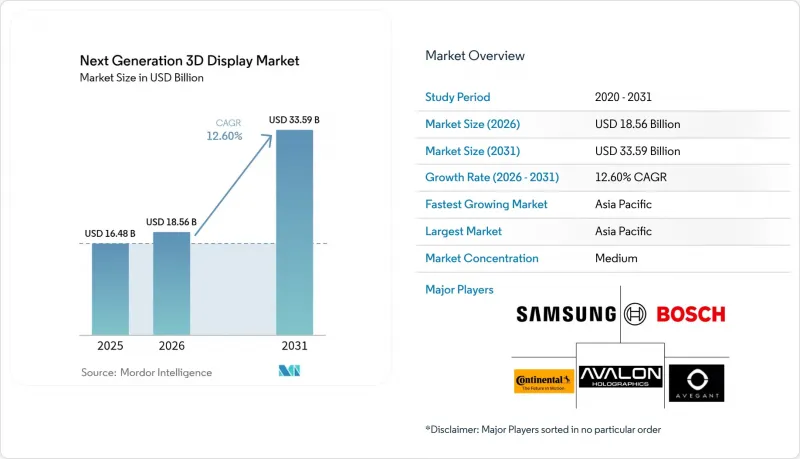
據 Mordor Intelligence 稱,下一代 3D 顯示器市場在 2025 年的價值為 164.8 億美元,預計到 2031 年將達到 335.9 億美元,而 2026 年為 185.6 億美元,預測期(2026-2031 年)的複合年成長率為 12.60%。
本報告依產品(例如,3D全像顯示器、頭戴式顯示器 (HMD))、技術(例如,數位光處理背投影電視(DLP RPTV)、LED)、顯示方式(例如,微型顯示器、傳統/螢幕顯示器)、終端用戶產業(例如,家用電子電器)和地區進行細分。市場預測以美元 (USD) 為單位。
全球下一代3D顯示器市場趨勢及洞察
家用電子電器的快速普及
目前,旗艦智慧型手機和平板電腦均配備了裸眼立體螢幕,無需任何配件即可在遊戲、電商和視訊聊天中實現深度感知,從而提升了在競爭激烈的高階市場中的感知價值。三星在2024年上半年售出了超過200萬台裸眼3D平板電腦,展現了下一代3D顯示市場作為大眾市場的潛力。中國品牌正在將光場模組整合到折疊式設備中,預計售價超過1000美元的設備將獲得15-20%的溢價,以抵消面板成本。隨著矽基OLED的量產不斷推進,2D和3D顯示器之間的成本差距正在縮小,這使得第一線廠商能夠將3D功能定位為高階硬體的標配。零售商報告稱,3D產品視圖的轉換率更高,這刺激了內容生態系統的發展,並最終導致硬體需求的成長。
汽車抬頭顯示器整合浪潮
抬頭顯示器(HUD) 已從平面疊加發展到立體投影,能夠顯示指向前方 10 公尺的導航箭頭,從而消除駕駛員眼部重新調整的延遲,並減少高級駕駛輔助系統 (ADAS) 警報的誤報。大陸集團於 2024 年 3 月進行的全像HUD 演示符合 ISO 26262 安全要求,並被一家德國豪華汽車品牌選中採用。博世及其合作夥伴 OEM 計劃在 2027 年車型年推出微型 LED HUD,使其顯示技術藍圖與 L2+ 級自動駕駛的部署保持一致。眼動追蹤模組可在 10 毫秒內動態調整全像圖的深度,這需要神經加速控制器,並推動了晶片級創新。這些進步鞏固了下一代 3D 顯示器市場作為實現安全至上的駕駛座體驗核心要素的地位。
缺乏3D內容標準
由於 ISO/IEC MPEG-I Part 12 仍處於草案階段,製造商各自維護涵蓋多視圖影片、網格流和光場編碼的專有流程。這種碎片化導致生產成本上升 40% 至 60%,並延緩了產品發布週期,儘管硬體創新強勁,但設備普及速度仍然緩慢。 SMPTE 的 2024 年互通性報告仍然含糊不清,使得各大工作室不得不依賴特定廠商的母帶製作流程。由於深度圖元元資料缺乏一致性,串流媒體平台難以自動將內容與顯示功能相匹配,只能手動選擇。在通用轉碼器建立之前,下一代 3D 顯示市場將面臨供應瓶頸,這將阻礙短期內消費者的接受度。
細分市場分析
預計到2031年,體感顯示器將以每年14.25%的速度成長,成為下一代3D顯示器市場中成長最快的細分市場。實驗室的突破性成果,例如Light Field Lab的280億像素「SolidLight」先導計畫,已證實了商業性可行性。由於體感顯示器允許多個觀眾無需佩戴眼鏡即可同時觀看,因此可以減輕疲勞,並開闢新的應用場景,例如協作設計、醫學成像和娛樂。雖然預計到2025年立體顯示器仍將佔41.72%的銷售額,但關於調節疲勞的研究結果正在限制使用時間,這可能會促使採購趨勢轉向體感顯示器。靜態體感顯示器可以幫助放射科醫生在自由空間中旋轉和查看CT資料集,與2D顯示器相比,提高了異常檢測的準確性。同時,頭戴式立體顯示器在遊戲和培訓領域仍然非常重要,成本限制使得面板價格保持在50美元以下。
儘管全像電腦目前仍需要較高的運算能力,但預計到2027年,邊緣人工智慧加速器將實現更有效率的電池續航力。汽車製造商正在進行自由空間立體儀錶板的試點測試,以取代傳統的儀錶板,旨在提高高速行駛時的空間感知能力。零售商正在推廣體驗式商務,推出落地式立體資訊亭,無需庫存即可展示逼真的產品。這些應用案例正推動立體顯示技術進入下一代3D顯示市場的主流領域。
隨著AR頭顯、飛行員頭盔和手術內視鏡等設備對近眼顯示器的需求加速成長,預計到2031年,基板OLED的出貨量將以每年13.38%的速度成長。像素級調光功能可實現無限對比度,這對於航空和建築行業疊加明亮的戶外場景至關重要。雖然LED面板在體育場級牆面顯示市場佔據主導地位,預計到2025年將佔33.74%的市場佔有率,但其像素密度存在局限性,而基板OLED在這方面表現出色。目前,MicroLED原型機已能實現與OLED相媲美的影像質量,同時也具備抗老化性能;如果良率能夠提高,這項技術將成為OLED的長期替代產品。在注重成本的數位電子看板領域,LCD仍在使用,但其視角狹窄限制了3D協作會話,並且對下一代3D顯示市場的影響有限。
折疊式平板電腦利用軟性OLED基板實現大螢幕與3D立體感,將便攜性與沉浸式體驗完美融合。亮度高達10000尼特的串聯OLED使汽車抬頭顯示器(HUD)即使在陽光下也清晰可見,無需輔助反射器,從而簡化了光學系統配置並降低了車內熱負荷。曾經是低成本大螢幕遊戲顯示器標配的數位光處理(DLP)背投影電視,隨著平板技術的進步,其在尺寸和成本方面的優勢逐漸喪失,正被市場淘汰。這些變化共同鞏固了矽基基板OLED的統治地位,而MicroLED則繼續保持其在藍圖中的戰略地位。
區域分析
預計到2025年,亞太地區將佔全球銷售額的46.31%,並持續維持12.74%的複合年成長率。這得歸功於韓國和中國提供的補貼,以降低微型顯示器領域的資本投資風險並維持供應鏈規模。韓國提供的5000億韓元津貼正在加速基板OLED和MicroLED試點生產線的建設,使韓國本土企業在全球籌資策略中佔據核心地位。中國製造商京東方和天馬正在成都和武漢擴大產能,降低對進口的依賴,並透過積極的定價策略獲得全球設計引進機會。日本正將重心轉向工業和醫療微型顯示器,利用其在精密相機和半導體領域的專業知識,在下一代3D顯示器市場保持獲利能力。
北米では、自動車用HUDの導入拡大、軍事用ARの調達、医療技術の革新が市場を牽引しており、米国の国防予算が堅牢なヘッドセットへの需要を支えています。カナダの視覚効果叢集は、急成長する3Dコンテンツエコシステムを牽引し、現地のハードウェア販売を促進しています。欧州では、全像HUDを統合するドイツおよびイタリアの自動車メーカー、ならびに職場全体で疲労の少ないディスプレイを優先する厳格な安全衛生規制が引き続き主要な支えとなっています。「ホライズン,欧州」や「欧州チップ法」に基づく政策支援により、パイロットファブの投資が進められていますが、そのペースはアジア太平洋地域に比べて緩やかです。
在南美洲,零售和酒店業正在逐步推廣全像資訊亭,以提升品牌體驗,尤其是在巴西的高檔購物中心。在中東,主權財富基金的資金支持下,熱門購物中心和智慧城市計畫正在積極部署3D螢幕。雖然非洲的3D技術應用受到成本和基礎設施的限制,但南非和奈及利亞的企業已經開始採用,整個非洲大陸正準備分階段進入下一代3D顯示市場。
其他好處:
- Excel格式的市場預測(ME)表
- 3個月的分析師支持
目錄
第1章:引言
- 研究假設和市場定義
- 調查範圍
第2章:調查方法
第3章執行摘要
第4章 市場狀況
- 市場概覽
- 市場促進因素
- 家用電子電器的快速普及
- 汽車抬頭顯示器整合浪潮
- OLED和MicroLED技術的進步
- 人工智慧生成全像內容的生態系統的興起
- 政府對國內微顯示器製造廠給予優惠待遇
- 它在遠端醫療醫療手術計劃中的應用正在不斷擴大。
- 市場限制因素
- 缺乏3D內容標準
- 生產線的高昂資本成本
- 退伍軍人事務部相關職業健康問題
- 對稀土元素磷光體供應鏈的依賴
- 產業價值鏈分析
- 宏觀經濟因素的影響
- 監理情勢
- 技術展望
- 波特五力分析
第5章 市場規模與成長預測
- 依產品
- 3D全像顯示器
- 頭戴式顯示器
- 靜態音量顯示
- 光場顯示
- 體積顯示
- 3D顯示設備
- 透過技術
- 數位光處理(DLP )背投影電視(RPTV)
- 發光二極體(LED)
- 有機發光二極體(OLED)
- 電漿顯示器(PDP)
- 液晶顯示器(LCD)
- MicroLED
- 矽基OLED(OLEDoS)
- 訪問方法
- 微型顯示器
- 傳統/螢幕式顯示器
- 按最終用戶行業分類
- 家用電子產品
- 汽車和運輸業
- 醫學領域
- 航太/國防
- 產業
- 教育和培訓
- 零售和廣告
- 按地區
- 北美洲
- 美國
- 加拿大
- 墨西哥
- 南美洲
- 巴西
- 阿根廷
- 其他南美國家
- 歐洲
- 德國
- 英國
- 法國
- 義大利
- 俄羅斯
- 其他歐洲國家
- 亞太地區
- 中國
- 日本
- 韓國
- 印度
- 澳洲和紐西蘭
- 其他亞太國家
- 中東
- 沙烏地阿拉伯
- 阿拉伯聯合大公國
- 土耳其
- 其他中東國家
- 非洲
- 南非
- 奈及利亞
- 埃及
- 其他非洲國家
- 北美洲
第6章 競爭情勢
- 市場集中度
- 策略趨勢
- 市佔率分析
- 公司簡介
- Avalon Holographics Inc.
- Avegant Corporation
- Robert Bosch GmbH
- Continental Aktiengesellschaft
- Fovi3D Inc.
- Samsung Electronics Co., Ltd.
- NVIDIA Corporation
- Google LLC
- Coretronic Corporation
- Creal 3D SA
- Sharp Corporation
- LG Electronics Inc.
- AU Optronics Corp.
- Panasonic Holdings Corporation
- Sony Group Corporation
- Light Field Lab Inc.
- Looking Glass Factory Inc.
- Voxon Photonics Pty Ltd
- RealView Imaging Ltd.
- HYPERVSN Limited
- Holoxica Limited
- Leia Inc.
- Microsoft Corporation
第7章 市場機會與未來展望
According to Mordor Intelligence, the next generation 3D display market size was valued at USD 16.48 billion in 2025 and estimated to grow from USD 18.56 billion in 2026 to reach USD 33.59 billion by 2031, at a CAGR of 12.60% during the forecast period (2026-2031).
This report is Segmented by Product (3D Holographic Display, Head Mounted Displays (HMD), and More), by Technology (Digital Light Processing Rear-Projection Television (DLP RPTV), LED, and More), by Access Method (Micro Display, Conventional/Screen Based Display), by End User Industry (Consumer Electronics, and More), and by Geography. The Market Forecasts are Provided in Terms of Value (USD).
Global Next Generation 3D Display Market Trends and Insights
Rapid Adoption in Consumer Electronics
Flagship smartphones and tablets now ship with autostereoscopic screens that deliver gaming, e-commerce, and video-chat depth cues without the need for accessories, thereby boosting perceived value in saturated premium segments. Samsung moved more than 2 million glasses-free 3D tablets during H1 2024, validating the mass-market potential of the next generation 3D display market. Chinese brands are integrating light-field modules into foldables, counting on 15-20% price premiums above USD 1,000 devices to offset panel costs. The cost gap between 2D and 3D displays is narrowing as OLED-on-silicon volume scales, enabling tier-1 vendors to treat 3D capability as a default spec for high-end hardware. Retailers report higher conversion rates for 3D product views, incentivizing content ecosystems that, in turn, expand hardware demand.
Automotive HUD Integration Wave
Head-up displays are graduating from planar overlays to volumetric projections that place navigation arrows 10 meters ahead, eliminating driver refocus lag and cutting false-dismiss rates for ADAS alerts. Continental's March 2024 holographic HUD demonstration met ISO 26262 safety requirements and secured program adoption by a German luxury marque. Bosch and its partner OEMs plan to launch micro-LED HUDs by model year 2027, aligning display roadmaps with the rollouts of Level-2+ autonomy. Eye-tracking modules dynamically adjust hologram depth within 10 ms, which demands neural-accelerated controllers and propels silicon-level innovation. These advances reinforce the next-generation 3D display market as a core enabler of safety-critical cockpit experiences.
Lack of 3D Content Standards
With ISO/IEC MPEG-I Part 12 still in draft, manufacturers maintain proprietary pipelines spanning multi-view video, mesh streaming, or light-field encoding. This fragmentation raises production costs 40-60% and slows release cadences, damping device uptake despite robust hardware innovation. SMPTE's 2024 interoperability report remains voluntary, leaving major studios tied to vendor-specific mastering approaches. Streaming platforms struggle to auto-match content with display capabilities because depth-map metadata remains inconsistent, forcing manual curation. Until a consensus codec emerges, the next generation 3D display market faces an availability bottleneck that tempers near-term household penetration.
Other drivers and restraints analyzed in the detailed report include:
- Advancements in OLED and MicroLED Technologies
- Emergence of AI-Generated Holographic Ecosystems
- High Capital Costs of Manufacturing Lines
For complete list of drivers and restraints, kindly check the Table Of Contents.
Segment Analysis
Volumetric displays are forecast to expand at 14.25% annually through 2031, making them the fastest-growing slice of the next-generation 3D display market. Laboratory breakthroughs, such as Light Field Lab's 28-billion-pixel SolidLight pilot, have confirmed commercial viability in retail showcases. Multiple-viewer visibility without glasses reduces fatigue and opens collaborative design, medical imaging, and entertainment scenarios. Stereoscopic formats, despite retaining 41.72% revenue in 2025, face usage-time limits due to accommodative stress studies, which may tilt procurement toward volumetric options. Static volumetric units support radiologists who rotate CT datasets in free space, enhancing anomaly detection compared to 2D monitors. Meanwhile, head-mounted stereoscopic displays stay relevant in gaming and training, where cost ceilings dictate sub-USD 50 panel premiums.
Although holographic tablets remain compute-intensive, edge AI accelerators promise battery-friendly operation by 2027. Automotive OEMs are experimenting with free-space volumetric dashboards to replace conventional clusters, seeking to enhance spatial awareness at highway speeds. Retailers deploy floor-standing volumetric kiosks to display lifelike products without inventory, advancing experiential commerce. Collectively, these deployments propel volumetric formats into mainstream segments of the next generation 3D display market.
OLED-on-silicon shipments are projected to grow at a 13.38% rate through 2031, as near-eye demand in AR headsets, pilot helmets, and surgical scopes accelerates. Pixel-level dimming delivers infinite contrast, crucial for overlaying bright outdoor scenes in aviation and construction. LED panels kept 33.74% of 2025 revenue by dominating stadium-scale walls, yet face pixel-density ceilings that OLED-on-silicon surpasses. MicroLED prototypes now match OLED fidelity while offering burn-in resistance, positioning the technology as a long-term successor once yield climbs. Liquid-crystal variants linger in cost-sensitive digital signage, though narrow viewing angles limit collaborative 3D sessions and cap their influence on the next generation 3D display market.
Foldable tablets utilize flexible OLED substrates to provide 3D depth on large canvases, seamlessly merging portability with spatial immersion. Tandem OLEDs that reach 10,000 nits enable sunlight-readable automotive HUDs without auxiliary reflectors, simplifying optics stacks and reducing cabin heat load. Digital Light Processing rear-projection televisions, once a staple of budget big-screen gaming, are exiting the market as flat-panel advances nullify their size-to-cost edge. Collectively, these shifts consolidate OLED-on-silicon's lead while keeping MicroLED on the strategic roadmap.
Complete Report Scope:
- By Product
- 3D Holographic Display
- Head Mounted Displays
- Static Volume Displays
- Light Field Displays
- Volumetric Displays
- Stereoscopic Displays
- By Technology
- Digital Light Processing Rear-Projection Television (DLP RPTV)
- Light Emitting Diode (LED)
- Organic Light Emitting Diode (OLED)
- Plasma Display Panel (PDP)
- Liquid Crystal Display (LCD)
- MicroLED
- OLED-on-Silicon (OLEDoS)
- By Access Method
- Micro Display
- Conventional/Screen Based Display
- By End User Industry
- Consumer Electronics
- Automotive and Transportation
- Medical
- Aerospace and Defense
- Industrial
- Education and Training
- Retail and Advertising
- By Geography
- North America
- United States
- Canada
- Mexico
- South America
- Brazil
- Argentina
- Rest of South America
- Europe
- Germany
- United Kingdom
- France
- Italy
- Russia
- Rest of Europe
- Asia Pacific
- China
- Japan
- South Korea
- India
- Australia AND New Zealand
- Rest of Asia Pacific
- Middle East
- Saudi Arabia
- United Arab Emirates
- Turkey
- Rest of Middle East
- Africa
- South Africa
- Nigeria
- Egypt
- Rest of Africa
- North America
Geography Analysis
Asia Pacific retained 46.31% of 2025 revenue and advances at a 12.74% CAGR, underpinned by South Korean and Chinese subsidies that derisk micro-display capex and sustain supply-chain scale. South Korea's KRW 500 billion grant pool accelerates OLED-on-silicon and MicroLED pilot lines, placing domestic players at the center of global sourcing strategies. Chinese manufacturers BOE and Tianma scale capacity in Chengdu and Wuhan, reducing import dependence and pricing aggressively to gain global design-ins. Japan pivots toward industrial and medical micro-displays, leveraging precision camera and semiconductor expertise to protect margins in the next generation 3D display market.
North America is driven by the growth of automotive HUD rollouts, military AR procurement, and med-tech innovation, with U.S. defense budgets underpinning the demand for ruggedized headsets. Canada's visual-effects cluster fuels a burgeoning 3D content ecosystem, driving local hardware sales. Europe remains anchored by German and Italian carmakers integrating holographic HUDs and by rigorous health-and-safety regulations that prioritize low-fatigue displays across workplaces. Policy support under Horizon Europe and the European Chips Act drives pilot fab investments, albeit at slower cadence than Asia Pacific.
South America sees early retail and hospitality deployments, notably in Brazil's luxury malls where holographic kiosks elevate brand experiences. The Middle East embraces 3D screens in destination shopping centers and smart-city initiatives, backed by sovereign wealth capital. African adoption stays limited by cost and infrastructure, though South Africa and Nigeria begin corporate rollouts, positioning the continent for gradual inclusion in the next generation 3D display market.
- Avalon Holographics Inc.
- Avegant Corporation
- Robert Bosch GmbH
- Continental Aktiengesellschaft
- Fovi3D Inc.
- Samsung Electronics Co., Ltd.
- NVIDIA Corporation
- Google LLC
- Coretronic Corporation
- Creal 3D SA
- Sharp Corporation
- LG Electronics Inc.
- AU Optronics Corp.
- Panasonic Holdings Corporation
- Sony Group Corporation
- Light Field Lab Inc.
- Looking Glass Factory Inc.
- Voxon Photonics Pty Ltd
- RealView Imaging Ltd.
- HYPERVSN Limited
- Holoxica Limited
- Leia Inc.
- Microsoft Corporation
Additional Benefits:
- The market estimate (ME) sheet in Excel format
- 3 months of analyst support
TABLE OF CONTENTS
1 INTRODUCTION
- 1.1 Study Assumptions and Market Definition
- 1.2 Scope of the Study
2 RESEARCH METHODOLOGY
3 EXECUTIVE SUMMARY
4 MARKET LANDSCAPE
- 4.1 Market Overview
- 4.2 Market Drivers
- 4.2.1 Rapid adoption in consumer electronics
- 4.2.2 Automotive HUD integration wave
- 4.2.3 Advancements in OLED and MicroLED technologies
- 4.2.4 Emergence of AI-generated holographic content ecosystems
- 4.2.5 Government incentives for domestic micro-display fabs
- 4.2.6 Growing use in tele-medicine surgical planning
- 4.3 Market Restraints
- 4.3.1 Lack of 3D content standards
- 4.3.2 High capital costs of manufacturing lines
- 4.3.3 Occupational-health concerns on VAC conflict
- 4.3.4 Supply-chain dependency on rare-earth phosphors
- 4.4 Industry Value Chain Analysis
- 4.5 Impact of Macroeconomic Factors
- 4.6 Regulatory Landscape
- 4.7 Technological Outlook
- 4.8 Porter's Five Forces Analysis
- 4.8.1 Bargaining Power of Suppliers
- 4.8.2 Bargaining Power of Consumers
- 4.8.3 Threat of New Entrants
- 4.8.4 Threat of Substitutes
- 4.8.5 Intensity of Competitive Rivalry
5 MARKET SIZE AND GROWTH FORECASTS (VALUE)
- 5.1 By Product
- 5.1.1 3D Holographic Display
- 5.1.2 Head Mounted Displays
- 5.1.3 Static Volume Displays
- 5.1.4 Light Field Displays
- 5.1.5 Volumetric Displays
- 5.1.6 Stereoscopic Displays
- 5.2 By Technology
- 5.2.1 Digital Light Processing Rear-Projection Television (DLP RPTV)
- 5.2.2 Light Emitting Diode (LED)
- 5.2.3 Organic Light Emitting Diode (OLED)
- 5.2.4 Plasma Display Panel (PDP)
- 5.2.5 Liquid Crystal Display (LCD)
- 5.2.6 MicroLED
- 5.2.7 OLED-on-Silicon (OLEDoS)
- 5.3 By Access Method
- 5.3.1 Micro Display
- 5.3.2 Conventional/Screen Based Display
- 5.4 By End User Industry
- 5.4.1 Consumer Electronics
- 5.4.2 Automotive and Transportation
- 5.4.3 Medical
- 5.4.4 Aerospace and Defense
- 5.4.5 Industrial
- 5.4.6 Education and Training
- 5.4.7 Retail and Advertising
- 5.5 By Geography
- 5.5.1 North America
- 5.5.1.1 United States
- 5.5.1.2 Canada
- 5.5.1.3 Mexico
- 5.5.2 South America
- 5.5.2.1 Brazil
- 5.5.2.2 Argentina
- 5.5.2.3 Rest of South America
- 5.5.3 Europe
- 5.5.3.1 Germany
- 5.5.3.2 United Kingdom
- 5.5.3.3 France
- 5.5.3.4 Italy
- 5.5.3.5 Russia
- 5.5.3.6 Rest of Europe
- 5.5.4 Asia Pacific
- 5.5.4.1 China
- 5.5.4.2 Japan
- 5.5.4.3 South Korea
- 5.5.4.4 India
- 5.5.4.5 Australia AND New Zealand
- 5.5.4.6 Rest of Asia Pacific
- 5.5.5 Middle East
- 5.5.5.1 Saudi Arabia
- 5.5.5.2 United Arab Emirates
- 5.5.5.3 Turkey
- 5.5.5.4 Rest of Middle East
- 5.5.6 Africa
- 5.5.6.1 South Africa
- 5.5.6.2 Nigeria
- 5.5.6.3 Egypt
- 5.5.6.4 Rest of Africa
- 5.5.1 North America
6 COMPETITIVE LANDSCAPE
- 6.1 Market Concentration
- 6.2 Strategic Moves
- 6.3 Market Share Analysis
- 6.4 Company Profiles (includes Global level Overview, Market level overview, Core Segments, Financials as available, Strategic Information, Market Rank/Share for key companies, Products AND Services, and Recent Developments)
- 6.4.1 Avalon Holographics Inc.
- 6.4.2 Avegant Corporation
- 6.4.3 Robert Bosch GmbH
- 6.4.4 Continental Aktiengesellschaft
- 6.4.5 Fovi3D Inc.
- 6.4.6 Samsung Electronics Co., Ltd.
- 6.4.7 NVIDIA Corporation
- 6.4.8 Google LLC
- 6.4.9 Coretronic Corporation
- 6.4.10 Creal 3D SA
- 6.4.11 Sharp Corporation
- 6.4.12 LG Electronics Inc.
- 6.4.13 AU Optronics Corp.
- 6.4.14 Panasonic Holdings Corporation
- 6.4.15 Sony Group Corporation
- 6.4.16 Light Field Lab Inc.
- 6.4.17 Looking Glass Factory Inc.
- 6.4.18 Voxon Photonics Pty Ltd
- 6.4.19 RealView Imaging Ltd.
- 6.4.20 HYPERVSN Limited
- 6.4.21 Holoxica Limited
- 6.4.22 Leia Inc.
- 6.4.23 Microsoft Corporation
7 MARKET OPPORTUNITIES AND FUTURE OUTLOOK
- 7.1 White-space and unmet-need assessment

 自動立體3D顯示器市場規模、佔有率和成長分析:按顯示技術、顯示器尺寸、應用、最終用戶、設備類型和地區分類-2026-2033年產業預測
 3D顯示器市場-2026-2032年全球市場預測3D顯示器市場-2026-2032年全球市場預測
 2026年全球刀具展示櫃市場報告
 3D顯示器市場報告:按類型、技術、存取方式、應用和地區分類(2026-2034年)
 裸眼3D顯示市場:依技術、應用、產業及地區分類
 全球3D顯示器市場規模、佔有率、趨勢和成長分析報告(2026-2034年)
 3D顯示器市場分析及預測(至2035年):類型、產品、技術、組件、應用、最終用戶、功能、安裝方式、解決方案3D全像光場顯示市場:依產品類型、光源、解析度、終端用戶產業和應用分類-2026-2032年全球預測3D顯示器市場規模、佔有率、成長率及全球產業分析:按類型、應用和地區分類的洞察,2026-2034年預測