


 |
市場調查報告書
商品編碼
2124170
晶片天線:市場佔有率分析、產業趨勢與統計、成長預測(2026-2031)Chip Antenna - Market Share Analysis, Industry Trends & Statistics, Growth Forecasts (2026 - 2031) |
||||||

※ 本網頁內容可能與最新版本有所差異。詳細情況請與我們聯繫。
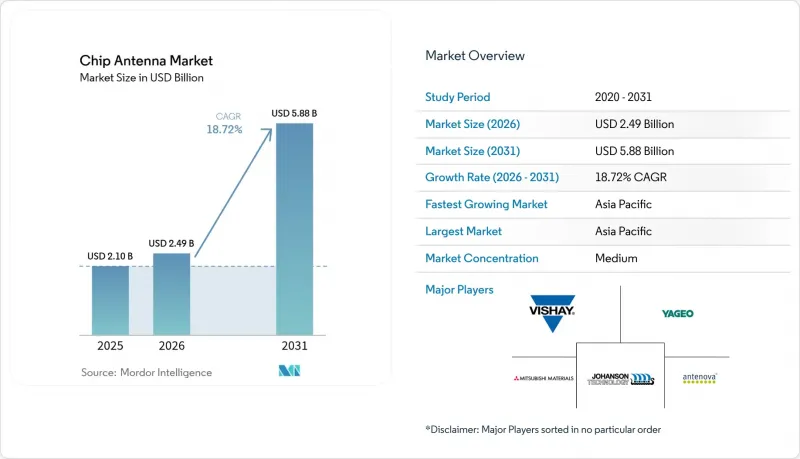
據 Mordor Intelligence 稱,2025 年晶片天線市值為 21 億美元,預計到 2031 年將從 2026 年的 24.9 億美元成長至 58.8 億美元,預測期(2026-2031 年)的複合年成長率為 18.72%。
本報告按類型(低溫共燒陶瓷晶片天線、介質晶片天線和印刷電路基板嵌入式晶片天線)、應用(WLAN/Wi-Fi、藍牙/BLE、雙頻/多頻、GPS/GNSS 和 LPWAN [NB-IoT、LoRa、Sigfox])、終端用戶行業(汽車、家用電子電器、醫療保健和醫療設備、IT 和電信
全球晶片天線市場趨勢及洞察
OEM廠商叢集中穿戴式裝置採用藍牙低功耗技術的案例研究
低功耗藍牙 (Bluetooth LE) 已成為智慧型手錶、健身感測器和新興醫療穿戴裝置的實際標準協定。一級 OEM 廠商正開始在多個產品系列中實現天線佈局的標準化,從而在採購方面實現規模經濟並縮短平台更新周期。 Nordic Semiconductor 的 nRF54L 系列憑藉其高效的無線電部分和針對晶片天線最佳化的參考佈局,順應了這一趨勢。預計到 2024 年,支援低功耗藍牙的設備的年出貨量將超過 18 億台,這將推動天線供應商產能的持續成長。設計標準化也正在擴展到工業和醫療領域,這些領域對可靠性、生物相容性和 FOTA(空中韌體更新)等性能提出了更高的要求。因此,供應商正在投資可調諧電阻網路和高介電常數陶瓷,以平衡尺寸和效率。
車載ADAS雷達模組中使用的LTCC天線
汽車製造商正擴大將雷達單元整合到車頂內襯和儀表板後方,以監控車內人員。這些位置需要能夠承受熱循環並在 76–81 GHz 頻段提供穩定增益的天線。低溫共燒陶瓷 (LTCC)基板由於其低損耗角正切和尺寸穩定性,能夠滿足這兩個要求。 Johanson Technology 的定向右旋圓極化 (RHCP) 天線符合 AEC-Q200 標準,並採用超薄設計,可有效防止因塑膠飾件造成的階躍損耗。同時,Indie Semiconductor 和 GlobalFoundries 等公司也正在進行研發合作,致力於開發 77 GHz 和 120 GHz 雷達 SoC,而這些晶片也需要高精度的天線陣列。這些進展正將晶片天線從簡單的可選組件提升為符合汽車行業 PPAP 和 ISO 26262 工作流程的安全關鍵組件。
客製化PCB/FPC天線與毫米波AR眼鏡的效率差異
擴增實境(AR) 眼鏡以超過 24 GHz 的頻寬傳輸數千兆Gigabit的資料。蝕刻在曲面 FPC 上的客製化銅線天線在總輻射功率方面仍然比分立晶片天線高出 2 dB,這一差異直接影響電池續航時間和圖形延遲。雖然蝕刻在金屬網膜上的透明縫隙環形天線的研究前景廣闊,但由於元件成本高且基板易碎,其應用仍有限。因此,高階 AR/VR 品牌仍然堅持採用客製化電源結構,使得現成的晶片天線不太可能在這個細分市場中得到應用。
細分市場分析
低溫共燒陶瓷(LTCC)天線能夠在毫米波頻段工作,並在寬溫度範圍內最大限度地減少性能波動,預計到2025年將佔據晶片天線市場57.35%的佔有率。隨著汽車雷達模組中LTCC天線應用的日益廣泛,其市場主導地位進一步鞏固。這些模組必須能夠承受車廂頂棚高達+105 度C的溫度。雖然印刷介質天線的產量落後於LTCC天線,但材料科學的創新使得在更薄的基板上實現更高的品質因數(Q值)成為可能,從而實現了19.86%的複合年成長率(CAGR),成為成長最快的天線類型。
此外,智慧型手機OEM廠商對LTCC共燒多層結構特性的需求也推動了市場成長。這種結構使得濾波和匹配網路能夠整合在同一陶瓷塊中。同時,對於對成本敏感、效能容差範圍廣且產量可達數百萬片的物聯網閘道而言,PCB嵌入式天線仍然是極具吸引力的選擇。持續的微型化趨勢正促使研發投入集中於超短波長單極子結構,從而推動其應用於長度小於10毫米、需要2.4 GHz遙測功能的醫療膠囊。
區域分析
亞太地區佔晶片天線市場銷售額的45.60%,預計到2031年將以19.48%的複合年成長率成長。中國已部署超過230萬個5G基地台,為CPE路由器和UE模組中使用的小型天線提供了充足的供應管道。日本憑藉其精密製造的傳統優勢,本土供應商在LTCC高階市場中佔據強勢地位,並鞏固了對汽車行業一級客戶的供應鏈。韓國企業集團正利用其內部技術能力,將客製化的多頻段天線整合到智慧型手機和消費性電子產品中,從而加強其國內垂直整合。
北美排名第二,這主要得益於電信業者重新分配中波頻率以及電動車製造商推動資料密集型平台的發展,後者需要強大的6GHz以下通訊連結。 「晶片與科學法案」正在刺激國內基板和封裝產能,間接支持亞利桑那州和德克薩斯州的天線生產。國防和航太領域主要公司的需求也推動了進一步成長,因為衛星通訊終端和低地球軌道(LEO)用戶設備依賴採用陶瓷饋電網路的相位陣列。
歐洲在德國汽車工業和歐盟嚴格的電磁相容性(EMC)法規的支持下,對高品質的介質解決方案給予了大力發展,目前僅略微落後於亞洲。 《歐洲晶片法案》旨在複製亞洲供應鏈的部分模式,並將在未來五年內提供資金以促進區域天線製造。 LL波段全球導航衛星系統(GNSS)和6GHz Wi-Fi法規的協調統一也影響面向歐洲市場的產品的天線調諧優先順序。
其他好處:
- Excel格式的市場預測(ME)表
- 3個月的分析師支持
目錄
第1章:引言
- 研究假設和市場定義
- 調查範圍
第2章:調查方法
第3章執行摘要
第4章 市場狀況
- 市場概覽
- 市場促進因素
- OEM廠商叢集中穿戴式裝置採用藍牙低功耗技術的案例研究
- 車載ADAS雷達模組中使用的LTCC天線
- Wi-Fi 6E 參考設計要求智慧家庭設備使用晶片天線。
- 專用 5G 工業網路正在推動對 6 GHz 以下頻寬感測器的需求。
- 市場限制因素
- 毫米波AR眼鏡中效率差距與客製化PCB/FPC天線的比較
- 美國有關分形幾何的智慧財產權訴訟阻礙了供應鏈的多元化。
- 超緊湊型穿戴裝置中多無線共存的頻率調整
- 價值供應鏈分析
- 監理展望
- 技術展望
- 波特五力分析
第5章 市場規模與成長預測
- 按類型
- 低溫共燒陶瓷(LTCC)晶片天線
- 介質晶片天線
- 印刷基板-積體電路天線
- 透過使用
- WLAN/Wi-Fi
- Bluetooth/BLE
- 雙頻/多頻
- GPS/GNSS
- LPWAN(NB-IoT、LoRa、Sigfox)
- 按最終用戶行業分類
- 車
- 家用電子產品
- 醫療保健和醫療設備
- 資訊科技和通訊基礎設施
- 工業和零售物聯網
- 智慧電網和智慧家居
- 按地區
- 北美洲
- 美國
- 加拿大
- 墨西哥
- 南美洲
- 巴西
- 阿根廷
- 其他南美國家
- 歐洲
- 德國
- 法國
- 英國
- 義大利
- 西班牙
- 北歐的
- 其他歐洲國家
- 中東
- GCC
- 以色列
- 土耳其
- 其他中東國家
- 非洲
- 南非
- 奈及利亞
- 其他非洲國家
- 亞太地區
- 中國
- 日本
- 韓國
- 印度
- ASEAN
- 其他亞太國家
- 北美洲
第6章 競爭情勢
- 市場集中度
- 策略趨勢
- 市佔率分析
- 公司簡介
- Vishay Intertechnology Inc.
- Yageo Corporation
- Johanson Technology Inc.
- Fractus SA
- Antenova Ltd.
- Partron Co., Ltd.
- Inpaq Technology Co., Ltd.
- Mitsubishi Materials Corporation
- Taoglas Limited
- Fractus Antennas SL
- Murata Manufacturing Co., Ltd.
- KYOCERA AVX Components Corporation
- Molex LLC
- Linx Technologies Inc.
- Pulse Electronics Corp.
- TE Connectivity Ltd.
- Laird Connectivity
- Abracon LLC
- Amphenol Antcom
- Alps Alpine Co., Ltd.
第7章 市場機會與未來展望
According to Mordor Intelligence, the chip antenna market size was valued at USD 2.10 billion in 2025 and estimated to grow from USD 2.49 billion in 2026 to reach USD 5.88 billion by 2031, at a CAGR of 18.72% during the forecast period (2026-2031).
This report is Segmented by Type ( LTCC [Low-Temperature Co-Fired Ceramic] Chip Antenna, Dielectric Chip Antenna, and Printed PCB-Embedded Chip Antenna), Application (WLAN/Wi-Fi, Bluetooth/BLE, Dual-Band/Multi-Band, GPS/GNSS, and LPWAN [NB-IoT, Lora, Sigfox]), End-User Industry (Automotive, Consumer Electronics, Healthcare and Medical Devices, IT and Telecommunications Infrastructure, and More), and Geography.
Global Chip Antenna Market Trends and Insights
Bluetooth-LE design wins for wearables in OEM clusters
Bluetooth Low Energy has become the de facto protocol for smart watches, fitness sensors, and emerging medical wearables. Tier-one OEMs have started standardizing antenna layouts across multiple product families, enabling economy-of-scale procurement and faster platform refresh cycles. Nordic Semiconductor's nRF54L series underscores the trend with a higher-efficiency radio and reference layout optimized for chip antennas. Annual Bluetooth LE device shipments exceeded 1.8 billion in 2024, a figure that keeps antenna suppliers on an upward capacity trajectory. The design convergence is spreading into industrial and medical categories where reliability, biocompatibility, and firmware-over-air updates add further performance requirements. Consequently, vendors are investing in tunable impedance networks and high-dielectric ceramics to balance size with efficiency.
LTCC antennas adopted in-cabin ADAS radar modules
Automakers increasingly embed radar units behind headliners and dashboards to monitor occupants. These locations demand antennas that withstand heat cycles and deliver stable gain at 76-81 GHz. LTCC substrates meet both needs through low loss tangent and dimensional stability. Johanson Technology's directional RHCP antenna combines AEC-Q200 qualification with a slim profile that resists detuning from plastic trim. Parallel R&D alliances, such as Indie Semiconductor with GlobalFoundries, target 77 GHz and 120 GHz radar SoCs that call for equally precise antenna arrays. These moves elevate chip antennas from discretionary items to safety-critical components governed by automotive PPAP and ISO 26262 workflows.
Efficiency gap vs. custom PCB/FPC antennas in mmWave AR glasses
Augmented-reality eyewear streams multi-gigabit data over 24 GHz and higher bands. Custom copper traces etched into curved FPCs still outperform discrete chip antennas by up to 2 dB in total radiated power, a gap that directly impacts battery life and graphics latency. Research into transparent slot-loop antennas etched on metal-mesh films shows promise, but mass adoption remains limited due to higher bill-of-materials costs and fragile substrates. Consequently, premium AR/VR brands continue to specify tailored feed structures, sidelining off-the-shelf chip antennas in this niche.
Other drivers and restraints analyzed in the detailed report include:
- Wi-Fi 6E reference designs mandate chip antennas in smart appliances
- Private 5G industrial networks driving sub-6 GHz sensor demand
- U.S. fractal-geometry IP litigation disrupting supply-chain diversification
For complete list of drivers and restraints, kindly check the Table Of Contents.
Segment Analysis
LTCC antennas held 57.35% of the chip antenna market share in 2025 due to their ability to operate at millimeter-wave frequencies with minimal performance drift under wide temperature swings. This dominance is reinforced by rising adoption in automotive radar modules that must endure up to +105 °C profiles on cabin roofs. Printed dielectric antennas trail in volume but post the fastest growth, riding a 19.86% CAGR as materials science innovations squeeze higher Q-factors into thinner substrates.
Demand is further bolstered by smartphone OEMs that value LTCC's co-fired multilayer capability, allowing integration of filtering and matching networks inside the same ceramic block. Conversely, PCB-embedded antennas remain an attractive choice for cost-sensitive IoT gateways where performance tolerances are broad and unit counts run into millions. Continuous miniaturization funnels R&D dollars into ultra-short monopole geometries, aiding penetration in medical capsules that require 2.4 GHz telemetry yet measure under 10 mm.
Complete Report Scope:
- By Type
- LTCC (Low-Temperature Co-fired Ceramic) Chip Antenna
- Dielectric Chip Antenna
- Printed PCB-Embedded Chip Antenna
- By Application
- WLAN/Wi-Fi
- Bluetooth/BLE
- Dual-Band/Multi-Band
- GPS/GNSS
- LPWAN (NB-IoT, LoRa, Sigfox)
- By End-User Industry
- Automotive
- Consumer Electronics
- Healthcare and Medical Devices
- IT and Telecommunications Infrastructure
- Industrial and Retail IoT
- Smart Grid and Smart Home
- By Geography
- North America
- United States
- Canada
- Mexico
- South America
- Brazil
- Argentina
- Rest of South America
- Europe
- Germany
- France
- United Kingdom
- Italy
- Spain
- Nordics
- Rest of Europe
- Middle East
- GCC
- Israel
- Turkey
- Rest of Middle East
- Africa
- South Africa
- Nigeria
- Rest of Africa
- Asia-Pacific
- China
- Japan
- South Korea
- India
- ASEAN
- Rest of Asia-Pacific
- North America
Geography Analysis
Asia Pacific controls 45.60% of the chip antenna market revenue and is expanding at a forecast 19.48% CAGR through 2031. China deploys more than 2.3 million 5G base stations, sustaining a high-volume procurement pipeline for small-form antennas used in CPE routers and UE modules. Japan's precision-manufacturing heritage positions local suppliers at the premium end of LTCC, cementing supply lines to tier-one automotive clients. South Korean conglomerates leverage in-house capabilities to embed custom multi-band antennas into smartphones and home appliances, reinforcing domestic vertical integration.
North America ranks second as telecom carriers refarm mid-band spectrum and EV makers push data-rich platforms that require robust sub-6 GHz links. The CHIPS and Science Act stimulates domestic substrate and packaging capacity, indirectly supporting antenna production in Arizona and Texas. Demand from defense and aerospace primes further incremental gains because SATCOM terminals and low-earth-orbit user equipment rely on phased arrays with ceramic feed networks.
Europe trails closely, anchored by Germany's automotive sector and the EU's strict EMC regulations that favor higher-quality dielectric solutions. The European Chips Act seeks to replicate parts of Asia's supply chain, providing funding that could catalyze regional antenna fabrication over the next five years. Regulatory harmonization across L-band GNSS and 6-GHz Wi-Fi also influences antenna tuning priorities for products intended for continental markets.
- Vishay Intertechnology Inc.
- Yageo Corporation
- Johanson Technology Inc.
- Fractus S.A.
- Antenova Ltd.
- Partron Co., Ltd.
- Inpaq Technology Co., Ltd.
- Mitsubishi Materials Corporation
- Taoglas Limited
- Fractus Antennas S.L.
- Murata Manufacturing Co., Ltd.
- KYOCERA AVX Components Corporation
- Molex LLC
- Linx Technologies Inc.
- Pulse Electronics Corp.
- TE Connectivity Ltd.
- Laird Connectivity
- Abracon LLC
- Amphenol Antcom
- Alps Alpine Co., Ltd.
Additional Benefits:
- The market estimate (ME) sheet in Excel format
- 3 months of analyst support
TABLE OF CONTENTS
1 INTRODUCTION
- 1.1 Study Assumptions and Market Definition
- 1.2 Scope of the Study
2 RESEARCH METHODOLOGY
3 EXECUTIVE SUMMARY
4 MARKET LANDSCAPE
- 4.1 Market Overview
- 4.2 Market Drivers
- 4.2.1 Bluetooth-LE design wins for wearables in OEM clusters
- 4.2.2 LTCC antennas adopted in-cabin ADAS radar modules
- 4.2.3 Wi-Fi 6E reference designs mandate chip antennas in smart appliances
- 4.2.4 Private-5G industrial networks driving sub-6 GHz sensor demand
- 4.3 Market Restraints
- 4.3.1 Efficiency gap vs. custom PCB/FPC antennas in mmWave AR glasses
- 4.3.2 U.S. fractal-geometry IP litigation disrupting supply-chain diversification
- 4.3.3 Multi-radio coexistence detuning in ultra-compact wearables
- 4.4 Value/Supply-Chain Analysis
- 4.5 Regulatory Outlook
- 4.6 Technological Outlook
- 4.7 Porter's Five Forces Analysis
- 4.7.1 Threat of New Entrants
- 4.7.2 Bargaining Power of Buyers
- 4.7.3 Bargaining Power of Suppliers
- 4.7.4 Threat of Substitute Products
- 4.7.5 Intensity of Competitive Rivalry
5 MARKET SIZE AND GROWTH FORECASTS (VALUE)
- 5.1 By Type
- 5.1.1 LTCC (Low-Temperature Co-fired Ceramic) Chip Antenna
- 5.1.2 Dielectric Chip Antenna
- 5.1.3 Printed PCB-Embedded Chip Antenna
- 5.2 By Application
- 5.2.1 WLAN/Wi-Fi
- 5.2.2 Bluetooth/BLE
- 5.2.3 Dual-Band/Multi-Band
- 5.2.4 GPS/GNSS
- 5.2.5 LPWAN (NB-IoT, LoRa, Sigfox)
- 5.3 By End-User Industry
- 5.3.1 Automotive
- 5.3.2 Consumer Electronics
- 5.3.3 Healthcare and Medical Devices
- 5.3.4 IT and Telecommunications Infrastructure
- 5.3.5 Industrial and Retail IoT
- 5.3.6 Smart Grid and Smart Home
- 5.4 By Geography
- 5.4.1 North America
- 5.4.1.1 United States
- 5.4.1.2 Canada
- 5.4.1.3 Mexico
- 5.4.2 South America
- 5.4.2.1 Brazil
- 5.4.2.2 Argentina
- 5.4.2.3 Rest of South America
- 5.4.3 Europe
- 5.4.3.1 Germany
- 5.4.3.2 France
- 5.4.3.3 United Kingdom
- 5.4.3.4 Italy
- 5.4.3.5 Spain
- 5.4.3.6 Nordics
- 5.4.3.7 Rest of Europe
- 5.4.4 Middle East
- 5.4.4.1 GCC
- 5.4.4.2 Israel
- 5.4.4.3 Turkey
- 5.4.4.4 Rest of Middle East
- 5.4.5 Africa
- 5.4.5.1 South Africa
- 5.4.5.2 Nigeria
- 5.4.5.3 Rest of Africa
- 5.4.6 Asia-Pacific
- 5.4.6.1 China
- 5.4.6.2 Japan
- 5.4.6.3 South Korea
- 5.4.6.4 India
- 5.4.6.5 ASEAN
- 5.4.6.6 Rest of Asia-Pacific
- 5.4.1 North America
6 COMPETITIVE LANDSCAPE
- 6.1 Market Concentration
- 6.2 Strategic Moves
- 6.3 Market Share Analysis
- 6.4 Company Profiles (includes Global level Overview, Market level overview, Core Segments, Financials as available, Strategic Information, Market Rank/Share for key companies, Products and Services, and Recent Developments)
- 6.4.1 Vishay Intertechnology Inc.
- 6.4.2 Yageo Corporation
- 6.4.3 Johanson Technology Inc.
- 6.4.4 Fractus S.A.
- 6.4.5 Antenova Ltd.
- 6.4.6 Partron Co., Ltd.
- 6.4.7 Inpaq Technology Co., Ltd.
- 6.4.8 Mitsubishi Materials Corporation
- 6.4.9 Taoglas Limited
- 6.4.10 Fractus Antennas S.L.
- 6.4.11 Murata Manufacturing Co., Ltd.
- 6.4.12 KYOCERA AVX Components Corporation
- 6.4.13 Molex LLC
- 6.4.14 Linx Technologies Inc.
- 6.4.15 Pulse Electronics Corp.
- 6.4.16 TE Connectivity Ltd.
- 6.4.17 Laird Connectivity
- 6.4.18 Abracon LLC
- 6.4.19 Amphenol Antcom
- 6.4.20 Alps Alpine Co., Ltd.
7 MARKET OPPORTUNITIES AND FUTURE OUTLOOK
- 7.1 White-space and Unmet-Need Assessment


